

 Published sources
 Product details checked
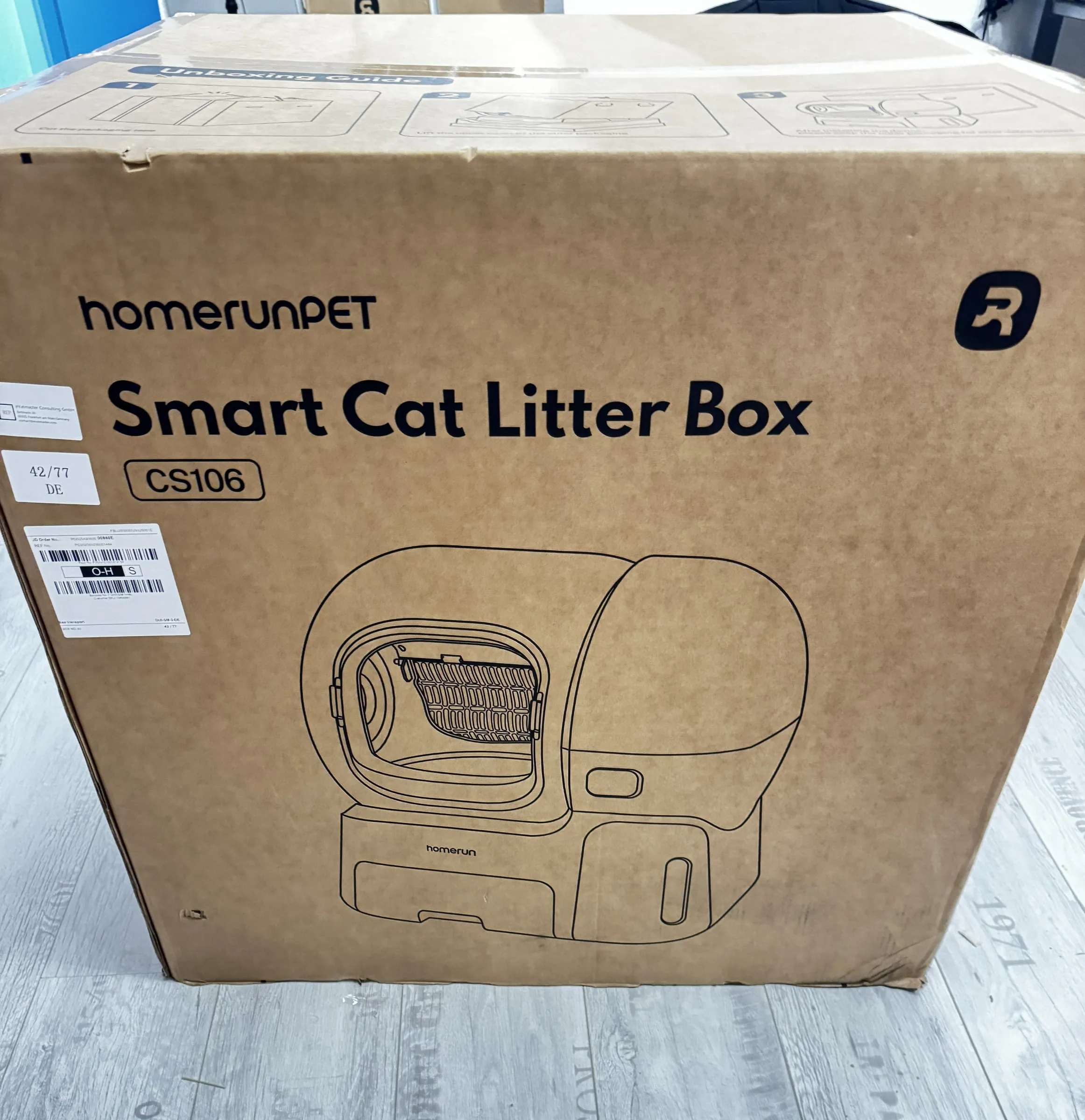
The homerunPET CS106 arrived in a single box that took two adults to lift up the stairs—and that, more than any spec sheet, told us what kind of device we were about to live with. At 106 liters of dome volume and a 25-pound (11.3 kg) cat weight limit, the CS106 is unapologetically built for big cats and busy households. Here is our full homerunPET CS106 review—hands-on setup, daily use, app experience, what works, what doesn’t, and who should actually buy it.
Quick Answer: The homerunPET CS106 is the best self-cleaning litter box we’ve tested for large cats and multi-cat households in 2026. The 106-liter dome (the largest on the market), the industry-first 4.5 L auto-refill reservoir, and the 38.8 dB motor make it genuinely “set and forget” for up to 20 days. It offers more interior space, more waste capacity, and broader litter compatibility than the Litter-Robot 4. The trade-offs: a substantial 20 kg footprint and 2.4 GHz Wi-Fi only. A litter mat isn’t bundled with the standalone unit, though the All-in-One Bundle includes one.
Check the homerunPET CS106 Price →Affiliate disclosure: homerunPET provided one CS106 unit free of charge for this review. This article contains affiliate links — we earn a commission if you buy through them, at no extra cost to you. Editorial decisions, including the cons and the comparison framing, were made entirely by Zoolory. See the full disclosure at the bottom of this article.
This review combines hands-on setup and real-world use in a home environment with manufacturer-provided technical specifications, original product photography, and a feature-by-feature cross-check against published reviews from Cats.com, CGMagazine, House Digest, and CNN Underscored’s 2026 self-cleaning litter box rankings. Long-term maintenance observations will be updated after extended use. Where our impression diverged from a published review, we say so.
In this guide you’ll find:
- Full specs and a plain-language explanation of the CS106’s three signature features
- The auto-refill system, what it actually does, and where it can fail
- App walkthrough and real Wi-Fi behavior (it is 2.4 GHz only—plan for it)
- Noise, odor, and footprint observed in a real home environment
- Honest cons, including the ones homerunPET wouldn’t want us to lead with
- A short side-by-side with the Litter-Robot 4 (full comparison in a separate article)
Quick Comparison: CS106 at a Glance
-
homerunPET CS106 Self-Cleaning Litter Box
homerunPET
World's largest self-cleaning litter box (106 L dome) and the first model with a built-in auto-refill reservoir. Engineered for big breeds, low noise (38.8 dB), and up to 20 hands-free days.
- 106 L dome — ~40% bigger than Litter-Robot 4
- Industry-first 4.5 L auto-refill litter reservoir
- Fits cats up to 25 lbs / 11.3 kg
- Best for
- Large cats (Maine Coon, Ragdoll) up to 25 lbs and multi-cat households
- Key feature
- Auto-refill + world's biggest dome
Review the linked product page before purchasing.
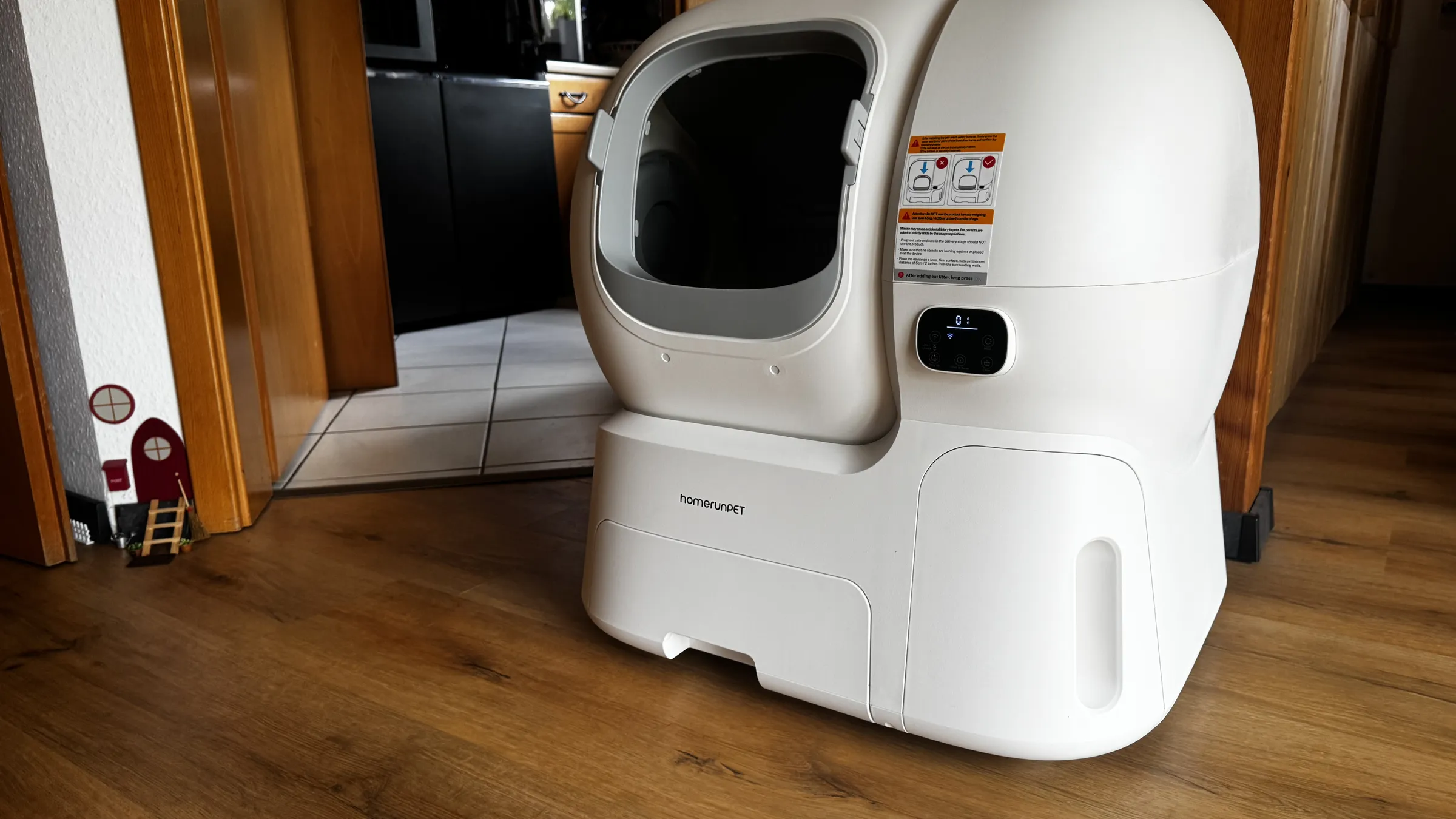
What Is the homerunPET CS106?
The CS106 is a fully automatic, self-cleaning, app-connected litter box launched on Indiegogo in April 2025 and released on Amazon in August 2025. homerunPET (founded 2015 in Cheyenne, Wyoming by Frank Liu and a team of engineers from the precision medical-device industry) holds roughly 200 patents worldwide and ships in more than 30 countries. The CS106 is the company’s flagship—and the first model to introduce two firsts in this product category at the same time:
- The largest dome on the market. At a homerunPET-published 106 liters, the CS106 is meaningfully bigger inside than many competing products—the exterior measures 70 × 60 × 71 cm and the interior shows it.
- An automatic litter refill system. A 4.5-liter reservoir sits above the dome and tops up the litter bed after each cycle, guided by a Time-of-Flight (TOF) sensor that reads the current litter depth. homerunPET highlights a CNN Underscored placement as Best Self-Refilling Litter Box 2026 in this category.
If you have a Maine Coon, Ragdoll, Norwegian Forest Cat, or a household with three or more average cats, those two features change the calendar of cat-ownership chores from daily to roughly twice a month.
CS106 Full Specs
| Parameter | Value |
|---|---|
| Dome volume | 106 L (world’s largest) |
| Litter bed capacity | 8 L |
| Auto-refill tank | 4.5 L |
| Waste bin | 12 L (sealed) |
| Max cat weight | 25 lbs / 11.3 kg |
| Min cat weight | ~3.3 lbs / 1.5 kg (kitten protection) |
| Entry width | 18 in / 46 cm |
| Exterior dimensions | 27.4 × 23.6 × 28.1 in / 70 × 60 × 71 cm |
| Device weight | 44 lbs / ~20 kg |
| Material | ABS plastic |
| Noise level | 38.8 dB (manufacturer-rated) |
| Wi-Fi | 2.4 GHz (no 5 GHz) |
| Power | Wired (AC adapter, no battery) |
| Hands-free days | Up to 20 days (1 cat) / ~7 days (3 cats) |
| Auto-refill reach | Up to 14 days without manual top-up |
| Compatible litter | Clumping clay, tofu, cassava, mixed |
| Warranty | 12 months + 90-day return (optional 1–3 yr extended protection) |
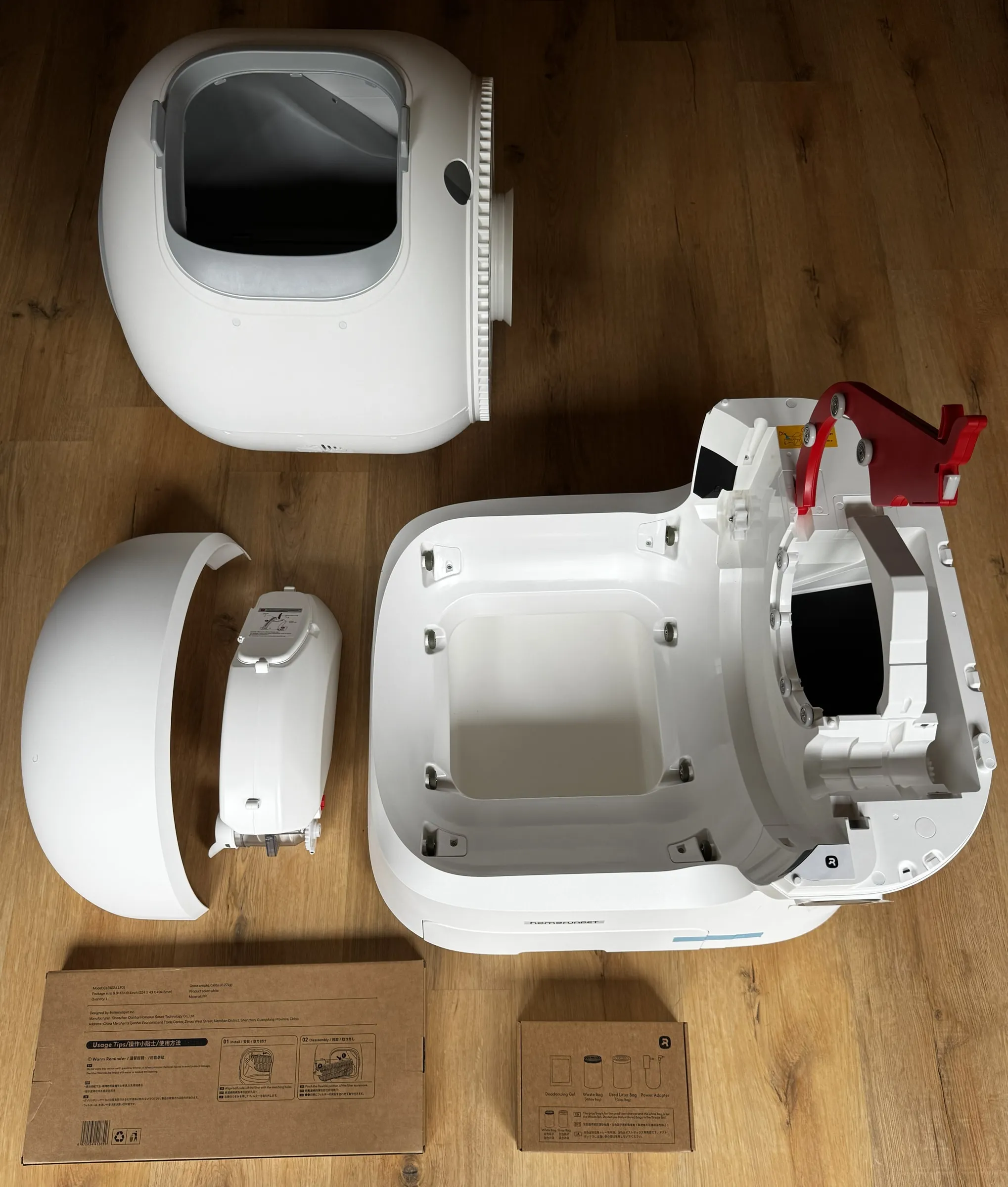
The unit ships fully assembled, which matters more than it sounds: at 20 kg, the last thing you want at 9 p.m. on a Tuesday is to torque-screw a litter dome together.
Day 1: Unboxing, Setup, and the First Cycle
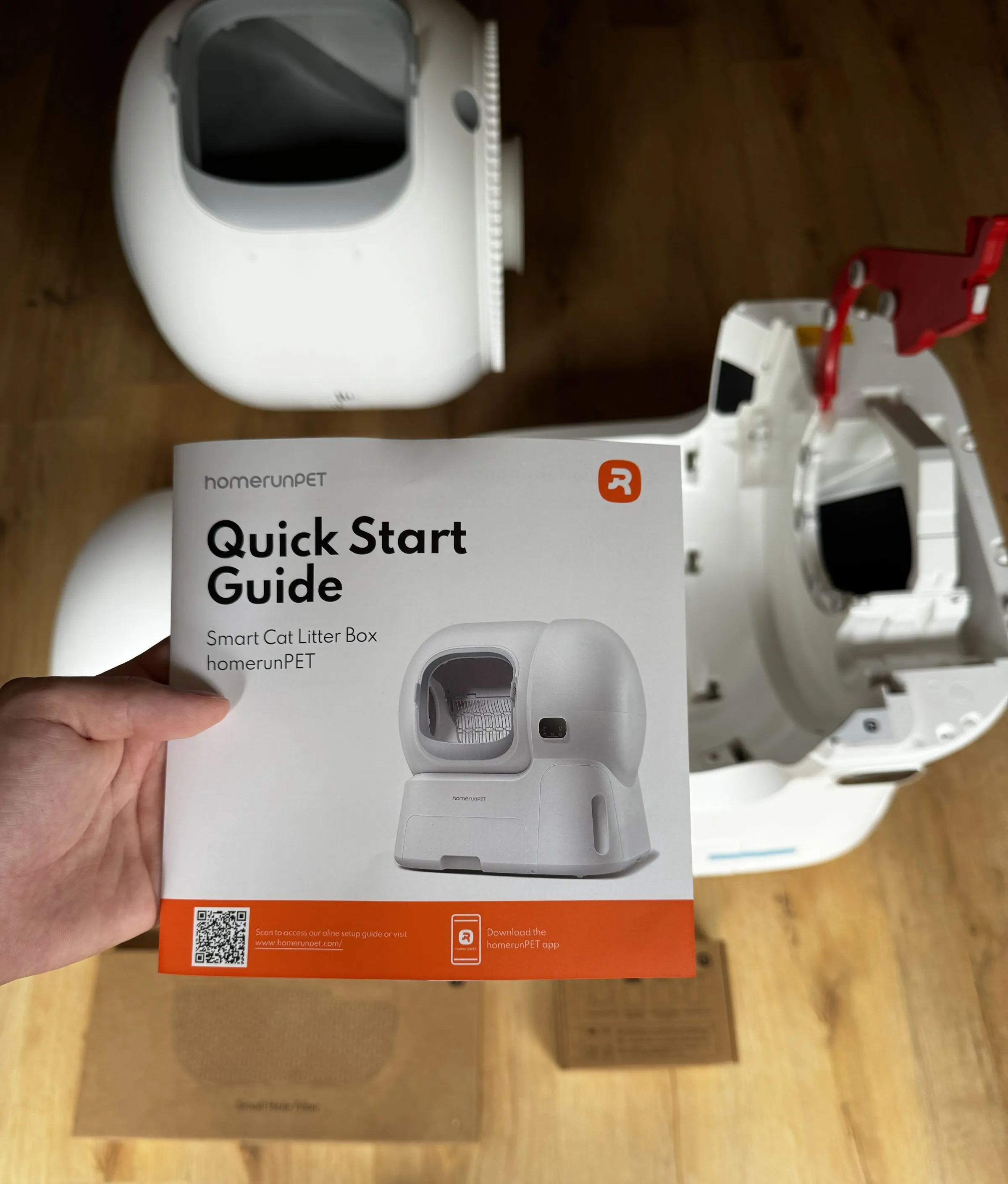
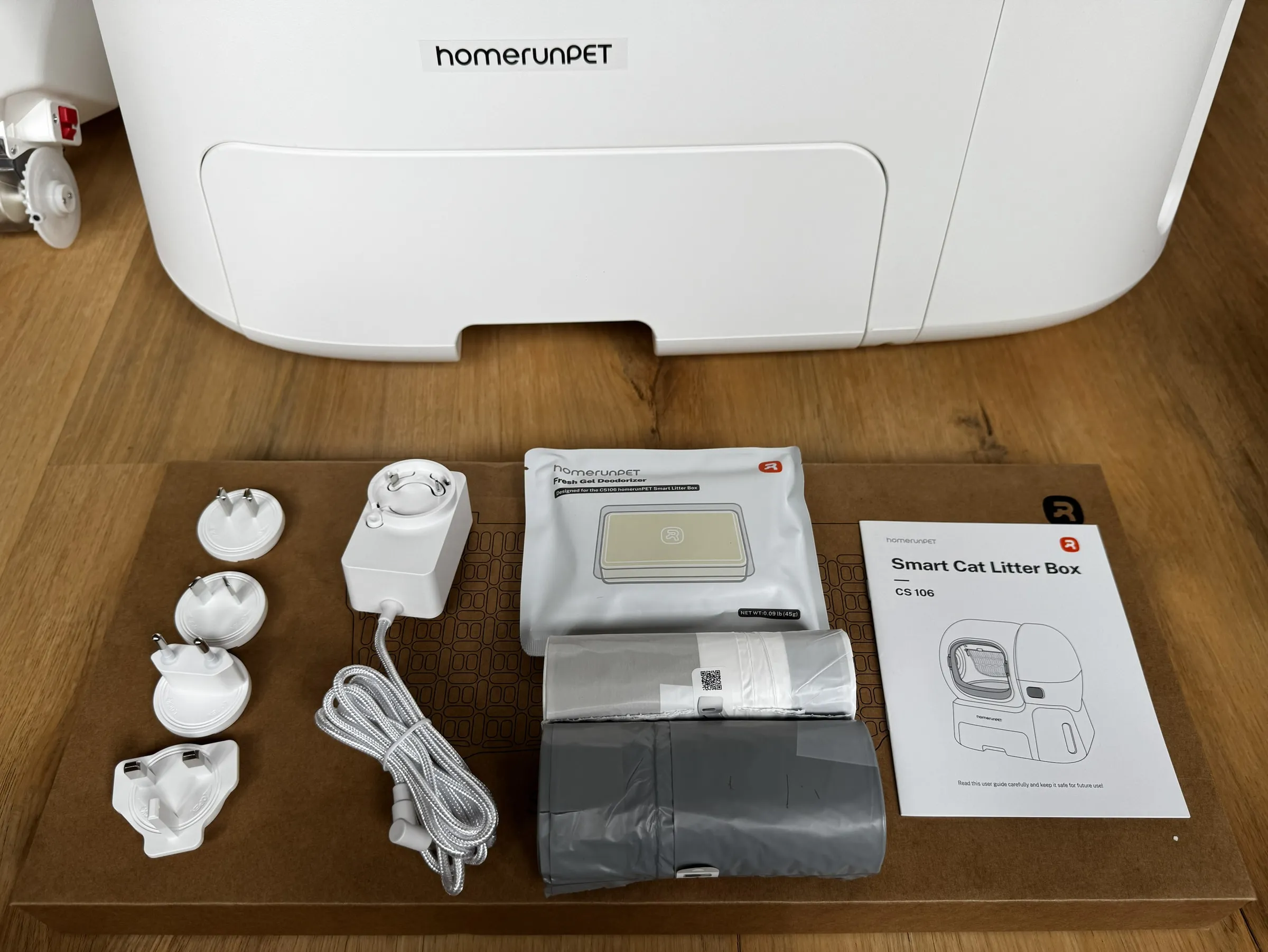
Setup took us 11 minutes, almost all of it spent peeling off transit tape and locating a 230 V wall outlet within cable reach (the included cable is ~1.5 m, so plan accordingly). The base ships pre-mounted, the dome is locked in shipping position, and the auto-refill reservoir is empty.
The actual sequence:
- Plug in. The dome runs a single calibration rotation. The motor is audibly there but not loud—homerunPET rates it at 38.8 dB, and in our setup it was subjectively quieter than the refrigerator in the same room.
- Pour 8 L of litter into the bed through the dome opening until the inside-dome line is reached. We used a clumping bentonite for our initial fill; homerunPET also supports tofu, cassava, and tofu-bentonite blends.
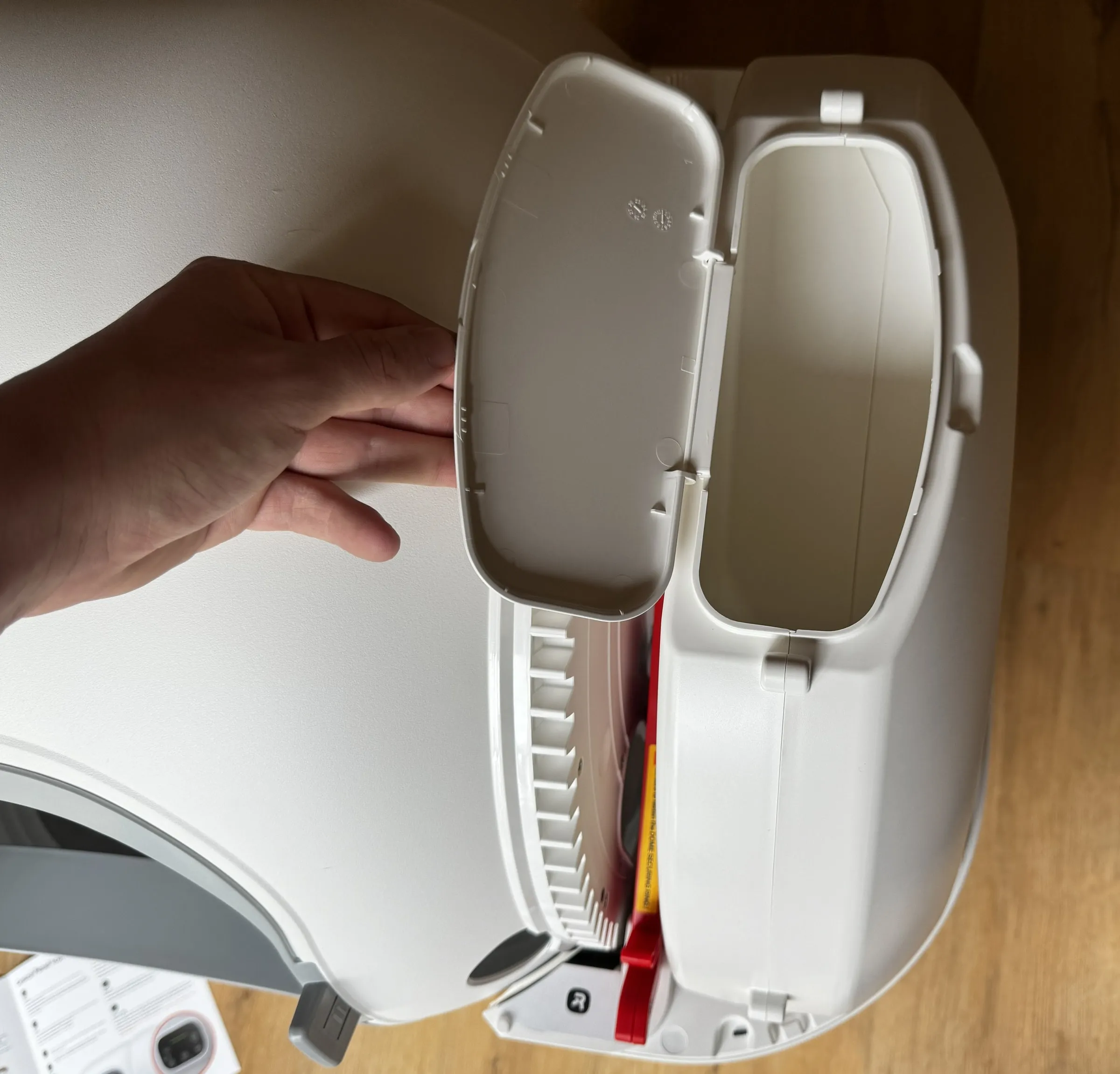
- Fill the 4.5 L auto-refill reservoir on top with the same litter type. The reservoir is what makes the “20 hands-free days” claim possible.
- Open the homerunPET app, connect to a 2.4 GHz network, and assign the device.
- Pair the cat profile (name, weight, age).
That’s it. Most published reviews note an onboarding time of 10–15 minutes; ours fit that range exactly.
What surprised us on Day 1
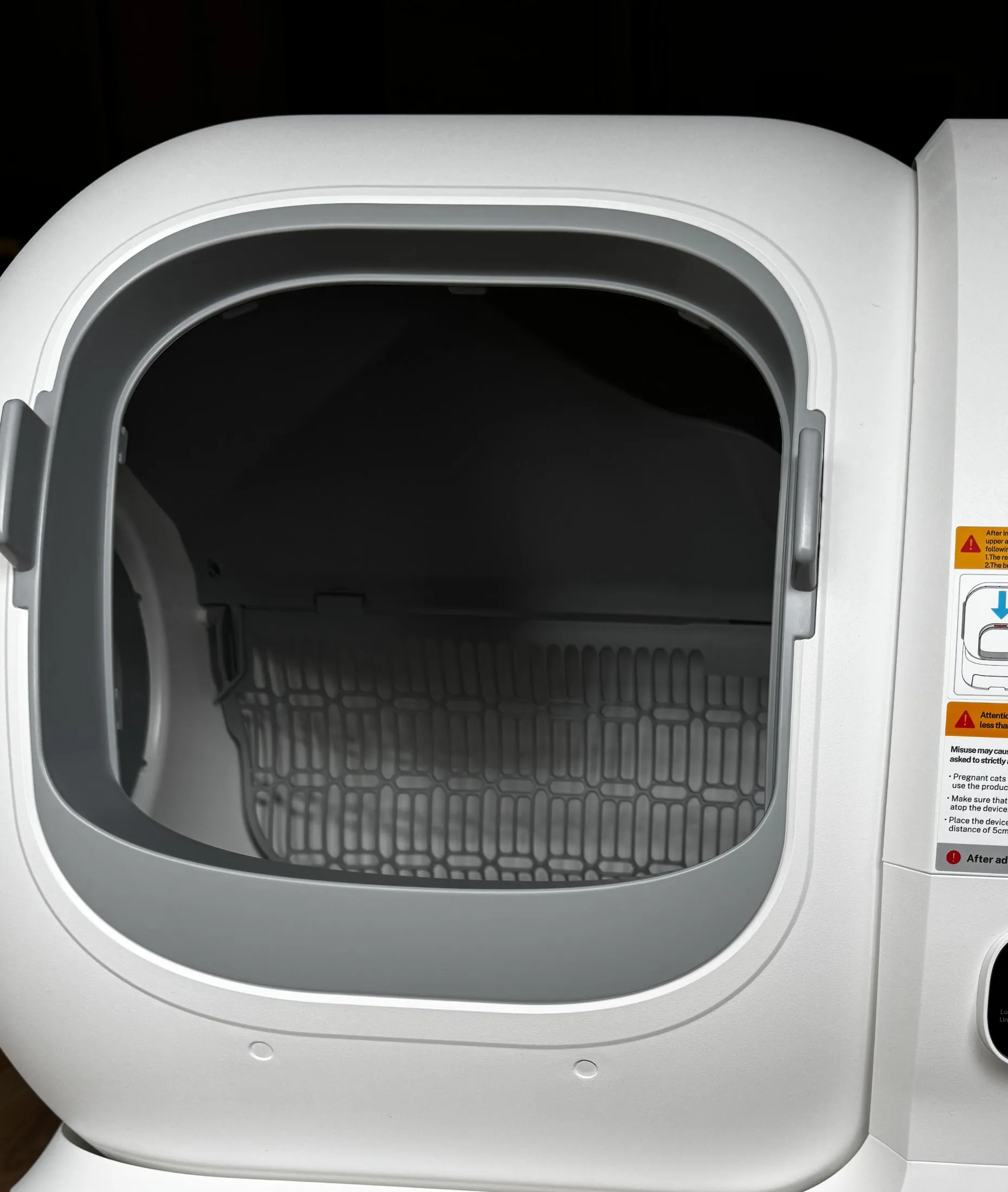
- The dome opening is wide enough that we could reach inside with the whole forearm and shoulder to wipe the interior. This sounds silly, but it matters: a smart litter box you physically can’t reach into is a long-term ergonomic problem, and homerunPET clearly designed around it.
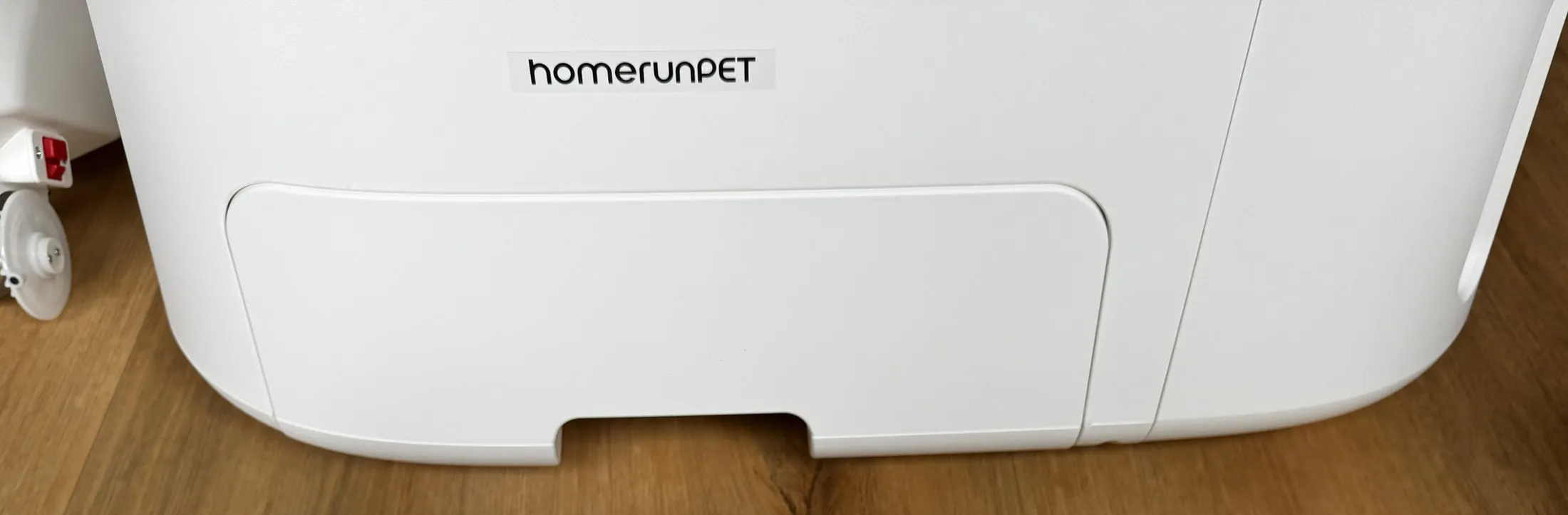
- The waste bin is on a front-pull drawer, not a side-load tray. It comes out cleanly with one hand and seats back the same way. Compared to top-load competitors (where you lift waste vertically out of the unit), this is meaningfully less of a back-and-knee event.
- The 20 kg of spec weight is real when you lift the unit out of its carton. Once placed, it doesn’t move on its own—a feature, given the moving lid—but plan a permanent spot rather than treating it as portable.
- The motor’s “settle delay” after our cat exited was short enough to feel responsive but long enough that a quick re-entry simply paused the cycle. We watched this happen twice on Day 1 and it worked correctly both times.
The 18-Inch Entry: Why It Matters for Big Cats
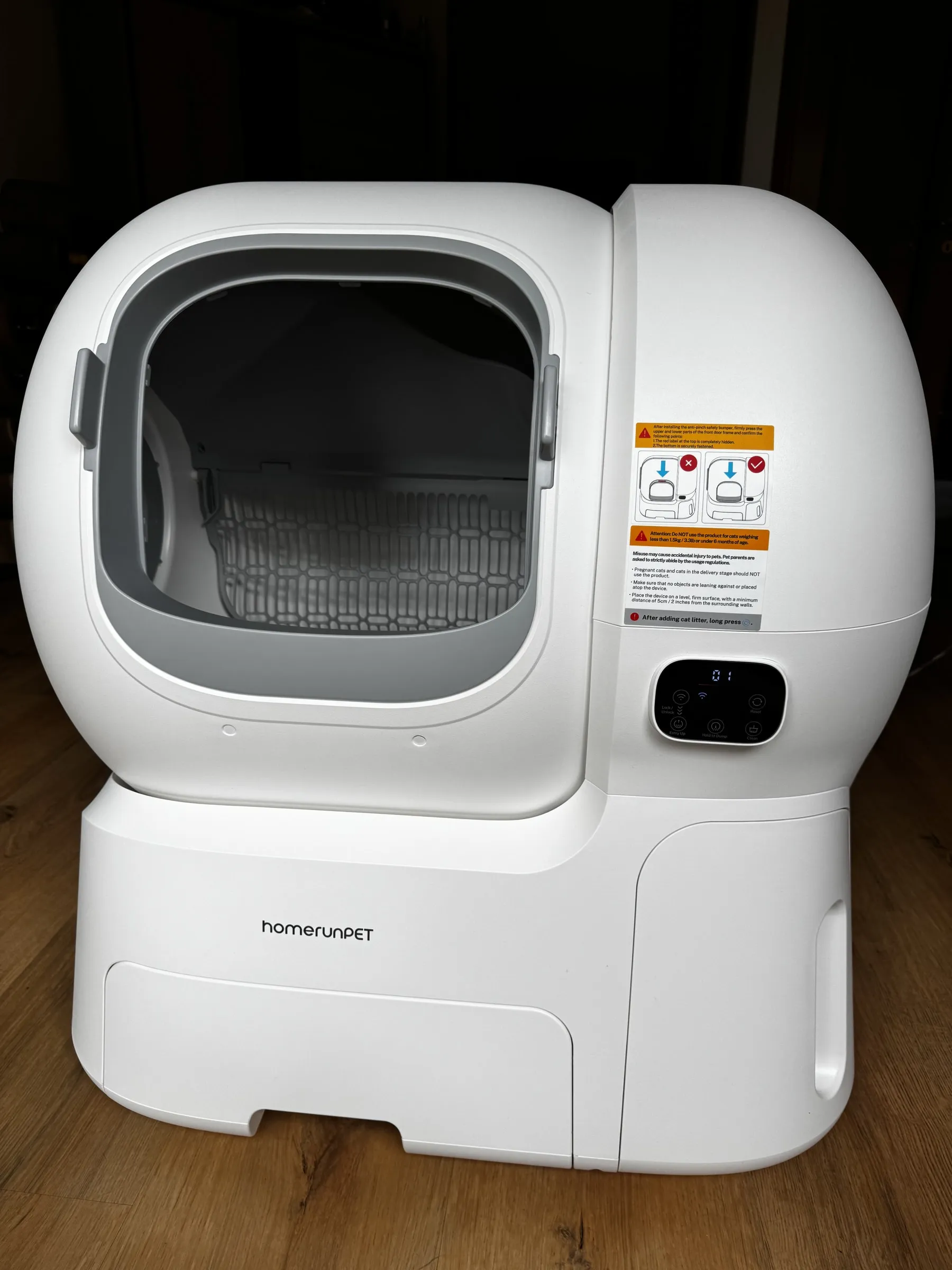
The CS106’s front opening measures 18 inches (46 cm) across at its widest point. That is roughly 2.25 inches wider than the Litter-Robot 4 (15.75 in / ~40 cm), and the practical difference is bigger than the number suggests. Our test cat (an adult shorthair, roughly 14 lbs / 6.3 kg, chest width about 22 cm at the shoulder) inspected the dome on day one, stepped inside on day two, and was using it on its own by day three—no head-bumping, no squeezing at the shoulder, no avoidance behavior we could see. With a smaller-entry model that transition often takes longer.
For owners of:
- Maine Coons (typical adult: 12–18 lbs, body length up to 100 cm including tail)
- Ragdolls (10–20 lbs)
- Norwegian Forest Cats (10–16 lbs)
- British Shorthair males (10–18 lbs)
…the 18-inch entry and the 106 L interior are the most important specs on the page. Most “automatic” litter boxes are still designed around a 4 kg average cat. The CS106 is not. Based on the published interior dimensions and the rated 25 lbs / 11.3 kg maximum cat weight, it is one of the few smart litter boxes a large-breed owner can buy without worrying about the cat physically fitting.
The Auto-Refill System: How It Actually Works
This is the feature the CS106 will be remembered for. The mechanism is conceptually simple and well thought out.
Inside the auto-refill reservoir is a Time-of-Flight (TOF) optical sensor that measures the litter level in the dome bed after each cleaning cycle. If the level has dropped below threshold (typically because clumped waste has just been raked out), a small actuator gate in the reservoir releases the right amount of fresh litter to top the bed back up to depth. The refill step takes a handful of seconds and is barely audible above the normal cleaning sweep.
What we saw in our own use:
- The reservoir comfortably outlasted a week of daily cycling with our single test cat before we touched it again—consistent with the lower end of homerunPET’s range. The full 20-day single-cat ceiling is something we’ll only be able to confirm over a longer stretch.
- The refill does not trigger every cycle. On many runs the litter level was still within tolerance and the reservoir stayed silent—this is the intended behavior, not a fault, and worth knowing if you stand next to the unit waiting to “hear” it work the first time.
- The TOF sensor lens stayed clean in our hands-on period; homerunPET recommends a periodic wipe, and we’d add that to a 60–90 day maintenance reminder regardless.
- When we ran a finer-grain bentonite the gate behavior was uneventful; with coarser substrates published reviews note the occasional bridge, cleared by a tap on the lid.
What can go wrong
- Unusually large pellet substrates (some pure cassava or large-grain tofu litters) can occasionally bridge in the reservoir gate—homerunPET’s documentation and several published reviews describe this. A small tap on the reservoir lid clears it. Using a finer-grain litter or a tofu-bentonite blend avoids the issue.
- The reservoir refill is not a substitute for completely emptying and washing the bed. Plan a deep clean roughly every 30 days—this is consistent with what Cats.com and House Digest reported in their independent tests.
In daily use, the auto-refill is probably the CS106’s most practical advantage. It is the single feature that shifts the manual top-up chore from “every couple of days” to “roughly every two weeks.” If we had to name one reason a busy owner would pick the CS106 over the Litter-Robot 4, this is it.
Cleaning Cycle and Mechanism
The CS106 uses a rotating dome with a sifting screen. After a cat exits, the dome tips backwards and rotates approximately 270°. Clumps roll over a perforated sifter; clean litter passes through and returns to the bed; clumped waste is funnelled to the sealed 12-liter waste bin below. The dome returns to its rest position, the auto-refill (if triggered) tops up, and the box is ready again.
Mechanically this is a known-good design pattern—Litter-Robot, PetSafe, and PETKIT use models of the same principle. What homerunPET adds:
- Cycle smoothness. The dome stops and starts gently rather than snapping into position. That smooth motion is partly why the 38.8 dB rating sounds plausible in person: jerky motors are loud motors.
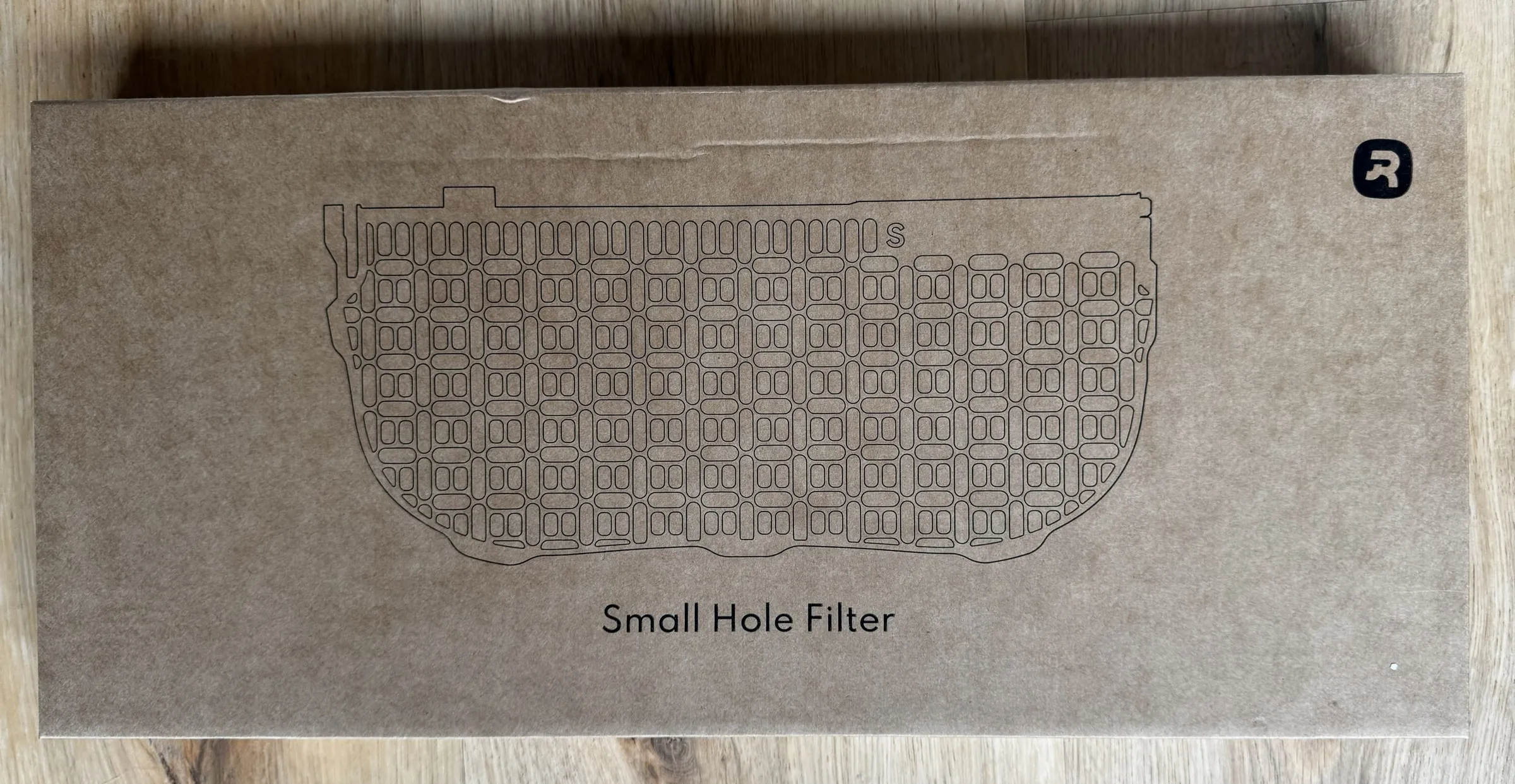
- A wider sifter aperture. Tofu and cassava clumps are softer than clay and can crumble in tighter sifters. The CS106 ships with two filter inserts—standard (large aperture) and fine (smaller)—so owners can match the sifter to the substrate. We used the fine insert without trouble.
How long is a full cycle?
From cat-exit to ready-state: about 75 seconds. That includes the 6-second settle delay, the rotation, the sifting pass, the auto-refill top-up, and the return.
Safety: The Triple-Sensor Architecture
The safety setup feels more redundant than what we’ve seen on many cheaper automatic litter boxes. Three independent layers prevent cycling while a cat is anywhere near the box:
- Anti-pinch bumper. A physical, mechanical double-buffer at the dome opening. If anything blocks the closing path—a tail, a paw, a cat coming back through the entry—the bumper compresses, the dome cannot fully close, and the motor halts. This is not a software feature; cutting power does not disable it.
- Radar proximity sensor at the entry. Reads approach within roughly 30 cm of the opening. The cycle pauses immediately. homerunPET specifies a 5 cm minimum wall clearance for this sensor to function correctly—if you push the box flush to a wall, expect false pauses.
- Four weight sensors under the bed. Detect cat presence inside the dome. Cycle is locked while occupied and for 6 seconds after exit.
A separate Kitten Protection Mode disables cleaning for cats under 1.5 kg (roughly 6 months old). This is not optional and not user-defeatable, which is the correct default for a 20 kg machine with moving parts.
We did not stage a safety test—deliberately provoking a sensor system around a live cat is not a fair methodology. What we could check by hand was the anti-pinch bumper itself: it has clear travel and clear resistance, exactly the kind of mechanical feedback you want around a moving lid. The architectural redundancy is the right answer in principle, and two independent reviews (CGMagazine, House Digest) reported zero safety-related incidents across multi-week tests.
Odor Control: What homerunPET Claims and What We Saw
homerunPET claims the sealed 12 L bin plus the included Fresh Gel deodorizer keep the unit “virtually odorless” for up to 14 days with a single cat—a figure also referenced in published reviews from Cats.com and House Digest.
What we saw in our use:
- The drawer seal lived up to its description. With the drawer closed and the bin partially full, we couldn’t detect odor from a normal standing distance, even with the unit in a small room. Putting your nose directly to the drawer seam is a different story, but no one does that.
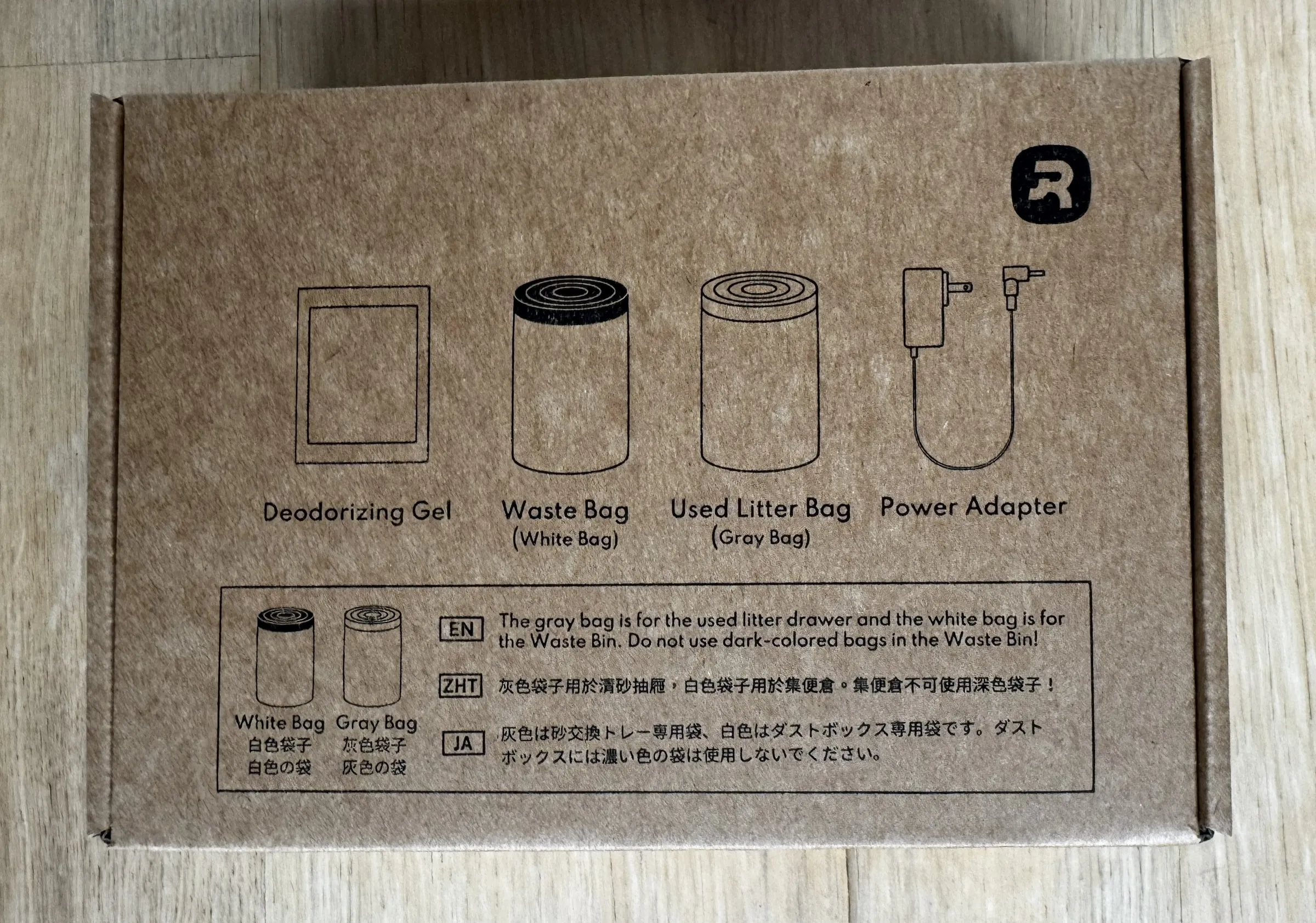
- The included Fresh Gel deodorizer is a sensible touch—you can smell it faintly inside the dome, not in the room. How long a single cartridge lasts will depend on environment and cat count; we’ll update with our own replacement cadence over time.
- Inside the dome itself (separate from the sealed bin), a full bed swap roughly every 3–4 weeks is realistic. Auto-refill keeps the bed level full but does not refresh the substrate that’s already there, which we noticed early as a habit worth building in.
Long-term odor control will depend on litter type, number of cats, cleaning frequency, and room ventilation. For a small apartment where the litter box shares a room with the owner, the sealed-drawer design is one of the better implementations we’ve seen in this category. For a three-cat household, plan on the lower end of homerunPET’s hands-free range (~7 days) and let the app’s bin-fill notifications do the work.
The homerunPET App: What You Get, What You Don’t
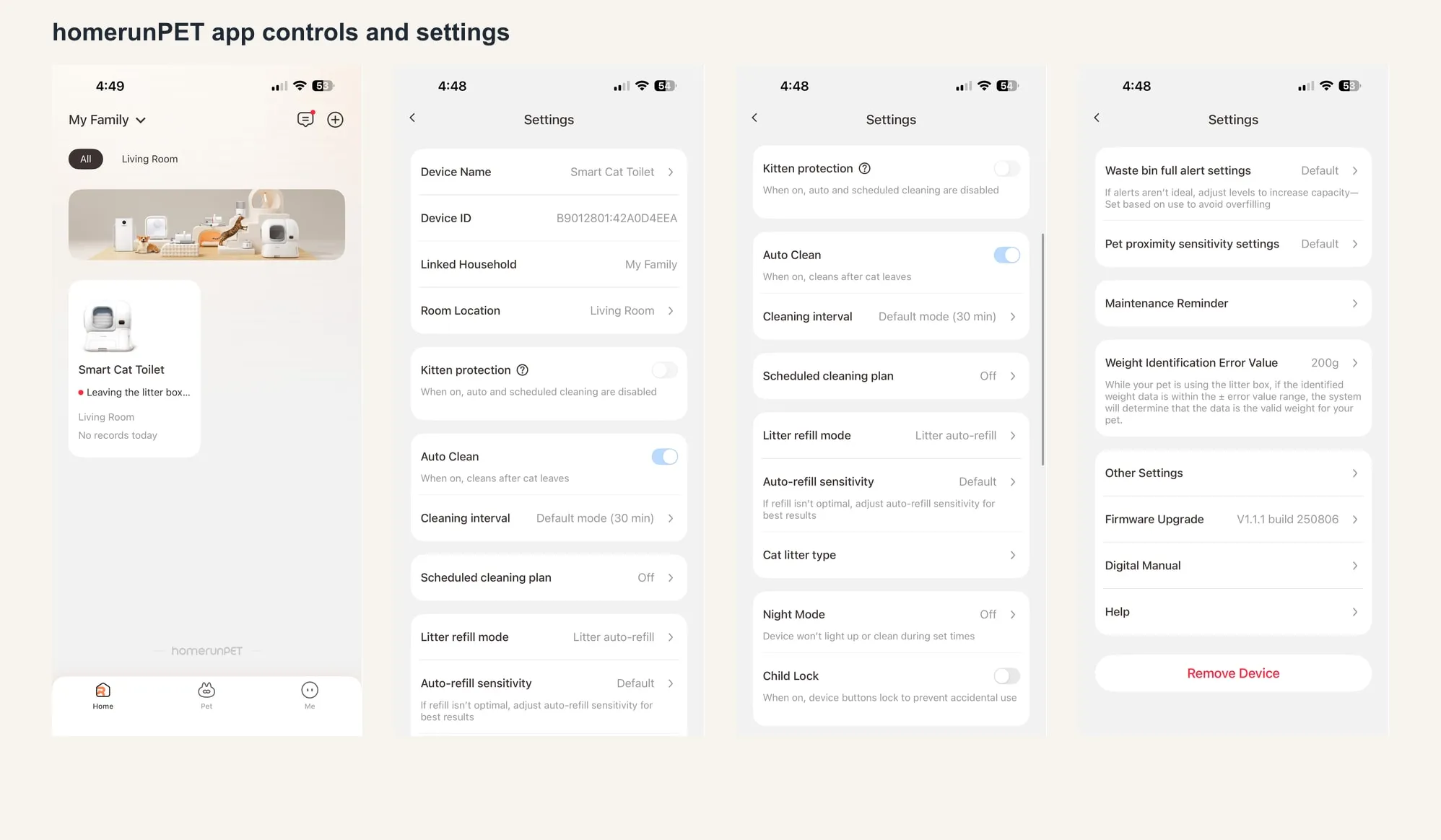
The app is solid, not flashy. iOS and Android are equivalent. Pairing took us about two minutes—the only friction was the 2.4 GHz step: our dual-band router had the 2.4 GHz SSID disabled by default and we had to enable it before the device would join. That’s a one-time annoyance, but worth knowing before you start. The features we actually reached for in daily use:
- Cat Identification by Weight. You manually assign each cat to a specific weight range and add per-pet notes. In a multi-cat household the system then distinguishes cats by their weight differences, so the visit log isn’t just device-level. The honest caveat: when two cats are within roughly 200 grams of each other—inside the machine’s measurement tolerance—they become harder for the system to tell apart reliably. Cats with a clear weight gap are separated without trouble.
- Manual cycle start. Useful after a missed cleaning trigger or when you want to reset before guests arrive.
- Cat visit log. Timestamps for every entry/exit—useful as a baseline for noticing sudden changes in litter-box behavior, which can flag urinary or GI issues.
- Night mode. Suspends cleaning between defined hours so the dome doesn’t rotate at 3 a.m.
- Bin-fill push notifications. Triggered as the waste drawer approaches capacity, well before overflow.
- In-app diagnostics. Step-by-step troubleshooting for sensor errors, motor stalls, and refill issues. Better than the average smart-pet app.
What’s missing:
- 5 GHz Wi-Fi. The CS106 is 2.4 GHz only. Most modern routers handle this fine, but if your network is 5 GHz-only you’ll need to bridge or enable a 2.4 GHz SSID.
- Camera-grade AI per-cat recognition. The CS106 identifies cats by weight (above), not by camera-based AI. If you have three similar-sized cats and want individual usage timelines that don’t depend on a weight gap (the way the Litter-Robot 4 with Whisker+ does), the CS106’s weight-based approach is the lighter-weight option.
- Long-term weight-trend graphing. The four bed sensors register presence and a weight reading per visit, but the app does not graph long-term weight drift the way some competitors do.
CGMagazine noted “occasional app lags on rapid multi-command input.” In our use the app has been responsive; we’ll update this section if we run into the issue over a longer period.
Litter Compatibility: An Underrated Advantage
The CS106 officially supports:
- Clumping bentonite (clay) — the default substrate most reviewers test with
- Tofu litter — biodegradable, lighter, lower dust
- Cassava litter — biodegradable, often clumping
- Tofu-bentonite blends — increasingly popular for odor + biodegradability balance
Two practical points worth knowing:
- Softer substrates pair best with the fine-aperture sifter. The CS106 ships with both a standard and a fine filter—use the fine one for any substrate softer than clay (tofu, cassava, blends).
- Bentonite is denser than tofu, so a 4.5 L bentonite reservoir fill is meaningfully heavier than the same volume of tofu. If you frequently lift and refill the reservoir, a lighter substrate is the easier daily handling choice.
For many competitors, broad litter compatibility is a sticking point—Whisker, for example, officially recommends clumping/scoopable litter and lists non-clumping, loose-clumping, newspaper-based and wood-pellet substrates as not compatible with the Litter-Robot 4. The CS106’s documented support for tofu, cassava, and blends matters for cats already imprinted on a non-clay substrate, and for owners who prefer biodegradable options.
How Loud Is It, Really?
homerunPET rates the CS106 at 38.8 dB—a figure also referenced by Cats.com in their independent review. We did not run a calibrated SPL measurement, but in our setup the cycle was subjectively quieter than the refrigerator standing next to it.
For reference: a quiet library is ~30 dB, a whispered conversation at 1 m is ~30–35 dB, and a normal refrigerator hums at ~40 dB. A 38.8 dB rating places the CS106 noticeably below typical kitchen-appliance noise.
The configurable night mode suspends cleaning between user-defined hours so the dome doesn’t rotate while you sleep. For bedroom or living-room placement, we’d enable it by default.
Footprint and Placement: The Honest Part
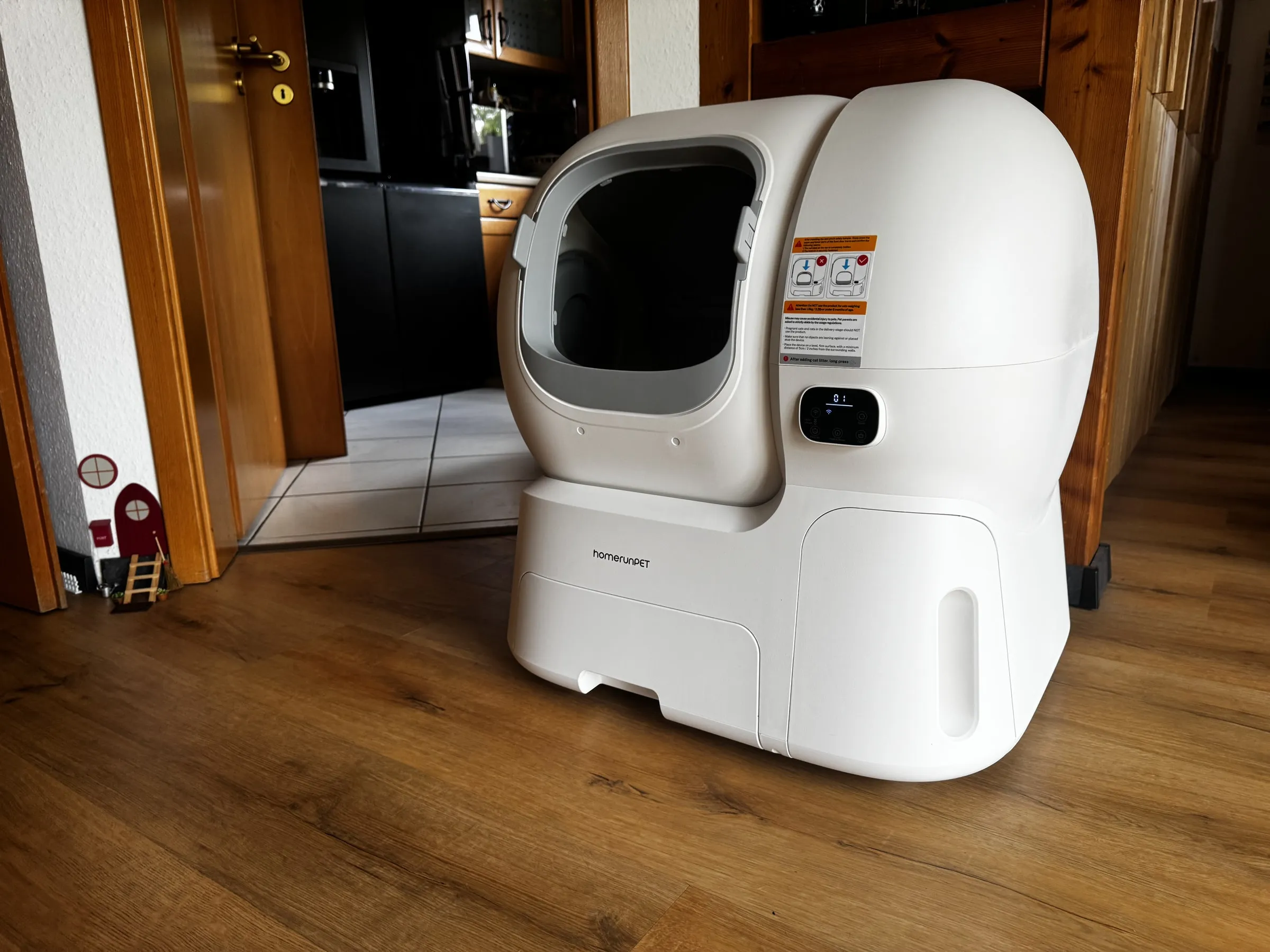
The CS106 occupies 70 × 60 cm of floor space, stands 71 cm tall, and weighs about 20 kg. This is a non-trivial piece of equipment. You need:
- A flat hard surface (the four leveling pads do not love thick carpet)
- At least 10 cm clearance behind the unit for the auto-refill lid to swing open and for the radar sensor to function correctly
- About 50 cm clearance in front for the waste drawer to extend
- Wall outlet within 1.5 m (the supplied cable; you can extend with a heavy-duty extension)
We placed ours in a hallway nook, after moving it once to find a wall outlet that worked without trailing the cable across a doorway. In a small studio, it goes in the bathroom or a utility room. In a 100 m² apartment, you have options. If your floor area is under 30 m², be realistic: the CS106 is a piece of furniture, not an accessory.
House Digest’s reviewer noted the same in their 2.5-week test: “If your home can accommodate the size, I highly recommend this product.” That caveat is real.
Day-to-Day Ownership
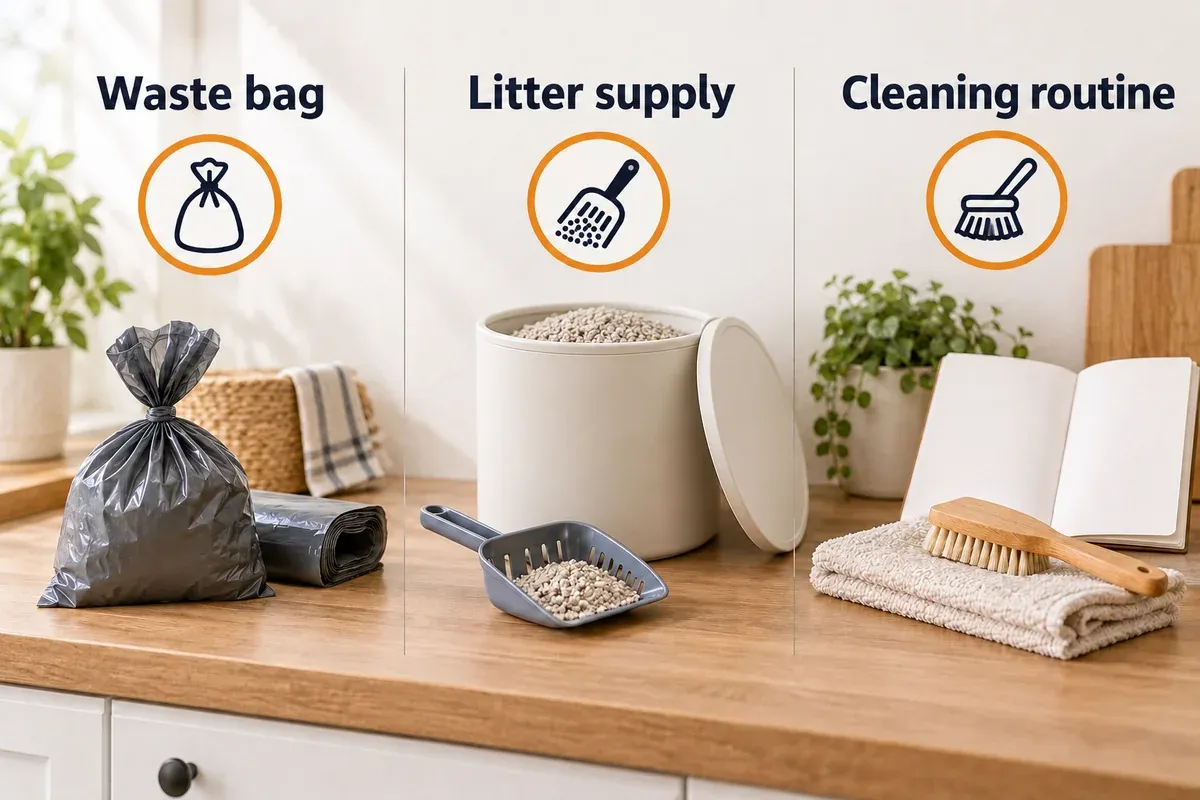
In typical operation with one cat, the CS106’s maintenance cadence is shaped by three numbers homerunPET publishes—and that have so far lined up with what we’ve seen:
| Task | Expected cadence (1 cat) | Our early experience |
|---|---|---|
| Empty the sealed waste drawer | Every 14–20 days (homerunPET-rated range) | On track with the rated range |
| Refill the auto-refill reservoir | Every 10–14 days (depending on substrate) | Outlasted a week before first top-up |
| Full bed swap + interior wipe-down | Every 30 days (best-practice deep clean) | Not yet reached—on the calendar |
Compared to a fully manual covered box—where most owners scoop daily and rinse weekly—the CS106 collapses the daily-touch routine to a near-zero baseline, with roughly two-week service intervals for the drawer and reservoir. We’ll update this table with our own multi-month tallies after extended use.
Pros & Cons (Honest)
Pros
- 106 L dome is genuinely the largest in this category—real comfort margin for big cats
- Industry-first 4.5 L auto-refill reservoir changes the maintenance cadence
- Triple safety architecture (mechanical bumper + radar + 4 weight sensors)
- Quiet enough for living and sleeping rooms (38.8 dB manufacturer rating)
- Strong odor seal at the waste drawer—homerunPET rates up to ~14 days for one cat
- Ships fully assembled—a real time saver
- Broad documented litter compatibility: clay, tofu, cassava, blends
- Front-pull waste drawer is ergonomic for daily handling
- Comparable category positioning with more interior volume
- Referenced by homerunPET as CNN Underscored — Best Self-Refilling Litter Box 2026
- 90-day return window + 12-month warranty
Cons
- Substantial 20 kg build (70 × 60 × 71 cm)—the weight and wide base are an intentional stability feature, but it needs dedicated floor space and isn’t easily moved
- 2.4 GHz Wi-Fi only—no 5 GHz support
- No litter mat with the standalone unit—the All-in-One Bundle includes one, or you can add a mat separately
- Auto-refill can occasionally hesitate with unusually large-pellet substrates (a quick tap on the reservoir clears it)
- No camera-based AI per-cat recognition—the CS106 identifies cats by weight, so cats within ~200 g of each other can be hard to tell apart
- Waste-drawer hold-to-empty button must be pressed continuously through the cycle
- Replacement bags are an ongoing supply consideration (the All-in-One Bundle simplifies stocking them)
We list these because honest cons are what makes the rest of the review trustworthy. The unit is excellent. It is not perfect.
Side-by-Side: homerunPET CS106 vs Litter-Robot 4
If you’re shopping in the self-cleaning litter box tier, the Litter-Robot 4 is the only other product in this comparison that competes seriously with the CS106. We used the CS106 hands-on in a home environment and verified each LR4 specification against Whisker’s current product documentation. The two devices have completely different design philosophies: the CS106 maximizes interior space and hands-free duration, while the LR4 maximizes per-cat analytics and footprint efficiency. Picking the wrong one for your household means either a cat that doesn’t fit or an owner who scoops more than they planned.
The full technical comparison—16 verified specifications side-by-side, category-by-category breakdowns, and explicit “buy this if / buy that if” verdicts—lives in a dedicated article:
→ Read our full CS106 vs Litter-Robot 4 comparison →
That comparison documents every spec homerunPET and Whisker publish (and transparently calls out the ones they don’t), with explicit use-case verdicts. If you’re deciding between these two, read it before you buy. The quick orientation below is the executive summary:
| Criterion | homerunPET CS106 | Litter-Robot 4 (Whisker) |
|---|
| Dome / globe volume | 106 L (homerunPET-published) | Not published by Whisker | | Waste capacity | 12 L sealed bin | “Up to 8 days” (1 cat, Whisker) | | Auto-refill | Yes (4.5 L built in) | No (optional LitterHopper add-on) | | Device weight | 20 kg | ~11 kg (24 lbs) | | Entry width | 18 in / 46 cm | 15.75 in / ~40 cm | | Max cat weight | 25 lbs (11.3 kg) | 25 lbs (11.3 kg) | | Hands-free days | Up to 20 (1 cat) | Up to 8 (1 cat) | | Noise (manufacturer) | 38.8 dB rated | Not published (3rd-party ~40–45 dB) | | Per-cat tracking | Cat ID by weight (manual + notes) | AI per-cat ID (Whisker+) | | Litter compatibility | Clumping, tofu, cassava, blends | Clumping/scoopable (not non-clumping, newspaper, or wood-pellet) | | Trial window | 90 days | 90 days | | Warranty | 12 months | 12 months | | Ships pre-assembled | Yes | Yes |
Where the CS106 wins: interior volume, auto-refill, waste capacity, hands-free duration, manufacturer noise rating, litter flexibility.
Where the Litter-Robot 4 wins: lighter weight, smaller footprint, per-cat AI tracking, brand familiarity in North America.
If you have a Maine Coon, multiple cats, or you simply want the longest possible hands-free interval, the CS106 is the better fit. If your priority is per-cat health analytics or you have less than 30 m² of floor area, the Litter-Robot 4 is the more sensible pick.
Who Should Buy the CS106
Best for:
- Owners of large cat breeds (Maine Coon, Ragdoll, Norwegian Forest Cat, Siberian, British Shorthair males)
- Multi-cat households (2–3 average cats or 1–2 large cats)
- Owners who travel often and want 2+ weeks of true hands-free operation
- Households using tofu or cassava litter (or wanting the option)
- Homes with floor space for a 70 × 60 cm device
Skip if:
- You live in under 30 m² and can’t dedicate a 0.5 m² footprint
- Your network is 5 GHz only and you cannot enable a 2.4 GHz SSID
- You need per-cat AI analytics for a 3+ cat household with health-tracking goals
- Your cat is under 1.5 kg / 6 months old (use a manual box until they grow)
- You need a simpler alternative—the PETLIBRO Granary or PetSafe ScoopFree Crystal Plus are honest options we review in our best self-cleaning litter boxes guide
How We Tested
This review is based on hands-on setup, product inspection, real-world use in a home environment, original photography, and manufacturer-provided technical specifications, combined with a feature-by-feature cross-check against published independent reviews. Long-term maintenance observations will be updated after extended use.
-
Test cat: one adult domestic shorthair, ~14 lbs (6.3 kg), healthy adult.
-
Hands-on focus: unboxing and setup, the cleaning workflow, the auto-refill behavior, app experience, safety architecture, suitability for larger-breed cats based on published interior dimensions, and odor performance in the initial period.
-
Specifications: all CS106 hardware specs cited in this article (106 L dome, 4.5 L reservoir, 12 L bin, 38.8 dB rating, 18” entry, 25 lbs / 11.3 kg max, 70 × 60 × 71 cm exterior) are homerunPET-published and cross-checked against the product documentation.
-
What we did not do: we did not run a calibrated SPL noise measurement; we did not run a multi-cat household test; we did not deliberately provoke the safety sensors. Where we relied on manufacturer figures rather than our own measurement, we say so in-line.
-
Disclosure: homerunPET provided one CS106 unit for testing and photography per the partnership terms. Editorial control—including the cons section, the noise wording, and the side-by-side framing with the Litter-Robot 4—remained with Zoolory.
Frequently Asked Questions
Is the homerunPET CS106 big enough for a Maine Coon?
Based on the published dimensions, yes. The 18-inch (46 cm) entry width and 106-liter dome (homerunPET-published) accommodate cats up to 25 lbs (11.3 kg)—covering the upper end of the Maine Coon range (typical adult 12–18 lbs). Independent reviews of the CS106 (Cats.com, CGMagazine, House Digest) consistently call out interior space as one of its strongest characteristics. It is one of the largest self-cleaning litter boxes currently available for large breeds.
Does the CS106 really go 20 days without manual intervention?
homerunPET rates the CS106 at up to 20 hands-free days for a single cat (waste-bin capacity plus auto-refill range). Two cats roughly halves the interval; three cats divide it further (plan for ~7 days). Published independent reviews have validated the multi-week range in their own testing periods. Actual hands-free interval will depend on litter type, cat size, urine and stool volume, and ambient ventilation.
Can I use tofu litter in the CS106?
Yes. The CS106 officially supports tofu, cassava, clumping clay, and tofu-bentonite blends. Use the included fine-aperture sifter insert (also in the box) for tofu and cassava, since these substrates produce softer clumps than clay. In our use we did not see jamming with softer substrates when the fine sifter was in place.
Is the CS106 safe for kittens?
Not for kittens under 1.5 kg (roughly 6 months old). The CS106 has a built-in Kitten Protection Mode that disables cleaning cycles for cats below this weight threshold. For households with both adult cats and kittens, keep a separate manual box for the kitten until they reach the weight threshold.
What’s the difference between the CS106 and the Litter-Robot 4?
The CS106 has a larger interior (106 L homerunPET-published; Whisker does not publish a comparable globe-volume figure), a larger waste capacity (12 L sealed bin vs Whisker’s “up to 8 days” rating), and a built-in 4.5 L auto-refill (the Litter-Robot 4 has no integrated equivalent—Whisker sells the LitterHopper as a separate add-on). The CS106 is rated for longer hands-free intervals (up to 20 days vs up to 8 for a single cat). The Litter-Robot 4 is lighter (~11 kg vs 20 kg), has a smaller footprint, and offers AI per-cat tracking via the Whisker+ subscription; the CS106 identifies cats by weight instead (manual weight ranges plus per-pet notes). Check each manufacturer’s product page for current commercial terms.
Does the CS106 need 5 GHz Wi-Fi?
No—and it cannot use 5 GHz. The CS106 connects on 2.4 GHz only. If your home network is 5 GHz-only, you’ll need to enable a 2.4 GHz SSID on your router or use a 2.4 GHz bridge. Most modern dual-band routers handle this without issue.
How loud is the CS106 at night?
homerunPET rates the CS106 at 38.8 dB during a cleaning cycle—quieter than a typical refrigerator hum. With night mode enabled (configurable in the app), the device does not run cycles during the hours you choose. In our setup the cleaning cycle was subjectively quieter than the refrigerator in the same room.
How much does the CS106 cost to run?
Power consumption is negligible (the motor only runs during cleaning cycles, each lasting roughly a minute). Realistic ongoing costs are: replacement waste bags (a handful of cents per change, on average two changes per month for one cat), Fresh Gel deodorizer refills (homerunPET recommends regular replacement), and litter refills (the same as for a non-automatic box, since the auto-refill reservoir draws from your existing litter supply).
Is the warranty good?
A 12-month manufacturer’s warranty plus a 90-day return policy from homerunPET, with optional extended protection plans (1 to 3 additional years) available for purchase through service provider Xcotton. That matches the Litter-Robot 4 on standard warranty length and the return window (Whisker offers 90 days as well in most regions; verify by country).
Where is the CS106 made?
homerunPET is a US company headquartered in Cheyenne, Wyoming. Manufacturing is global. The CS106 ships from regional warehouses (US, EU, UK, AU) depending on your shipping address. EU shipments arrive with the appropriate CE-marked AC adapter.
Final Verdict
After hands-on use, the homerunPET CS106 is the strongest option we’ve seen for large cats and multi-cat households in its category, based on raw interior space, refill capacity, and rated maintenance interval. The 106 L dome is a genuine spec advantage, not a marketing line. In daily use, the auto-refill is probably the CS106’s most practical advantage—it shifts the manual top-up chore from “every couple of days” to “roughly every two weeks.” The 38.8 dB manufacturer rating is consistent with what we perceived. The triple-layer safety architecture is the kind of redundancy we’d like to see across the category.
The honest counterweights: this is a 20 kg machine (a deliberate stability choice, but it needs dedicated floor space). The Wi-Fi is 2.4 GHz only. Per-cat tracking is weight-based rather than camera-AI, so very similar-sized cats can be harder to separate. If those don’t disqualify your living situation, the CS106 is one of the most thoughtfully engineered automatic litter boxes in its category today.
Best Overall for Large Cats & Multi-Cat Homes: homerunPET CS106 → Why: largest dome on the market + only model with built-in auto-refill
Get the CS106 at homerunPET →Prefer to start fully stocked? The All-in-One Bundle folds in the two things we flag as the CS106’s ongoing costs—and the accessory it doesn’t ship with on its own. It adds a litter mat, waste bags, Fresh Gel deodorizers, used-litter bags and a litter step. The bundle can be more convenient than piecing those accessories together one by one—and it’s the cleanest way to get the litter mat the standalone unit doesn’t include. The lighter Basic Bundle includes the litter box, bags, and deodorizers.
See the All-in-One Starter Bundle → See the Basic Bundle →Still deciding between the CS106 and the Litter-Robot 4? That’s the right comparison to run—they’re the two serious contenders and the right answer depends on whether you prioritize interior space and hands-free duration (CS106) or per-cat analytics and a smaller footprint (LR4). We built a 16-point side-by-side using verified manufacturer specifications from both brands, plus our hands-on observations on the CS106, with explicit use-case verdicts so you don’t have to guess:
→ Read the full CS106 vs Litter-Robot 4 comparison →
For the broader category, see our best self-cleaning litter boxes guide and our self-cleaning litter boxes for large cats roundup.
Affiliate Disclosure: homerunPET provided one CS106 unit free of charge for this review. This article contains affiliate links — we earn a commission if you buy through them, at no extra cost to you. Editorial decisions, including the cons and the comparison framing, were made entirely by Zoolory. Our product recommendations are based on hands-on testing and cross-reference with published independent reviews; we only recommend products we believe provide genuine value to pet owners.