

 Published sources
 Product details checked
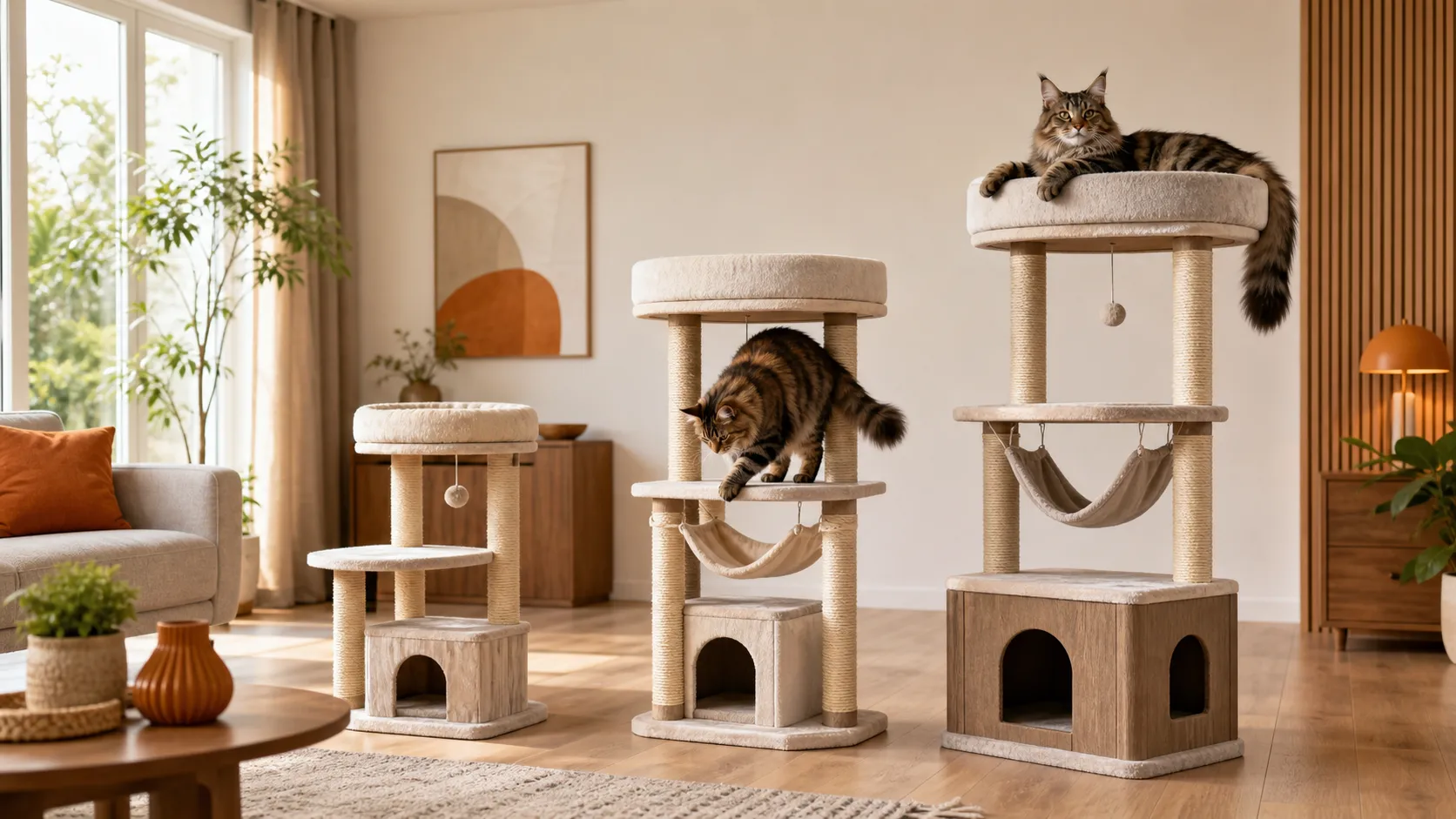
A cat tree does not need to reach the ceiling to be useful. It needs to give your cat enough room to stretch, scratch, climb, hide, and rest without wobbling or forcing every jump through one narrow bottleneck.
Quick answer: For one average adult cat, start with a tree around 55–65 inches tall, a stable base of roughly 20 × 20 inches or larger, and at least one perch that is wide enough for your cat to turn around and stretch. For a large cat over about 15 pounds, prioritize 18–22-inch resting surfaces, a wider base, thick scratching posts, and secure anchoring over height alone. These are practical buying targets, not universal rules—your cat’s body, age, mobility, and favorite sleeping position matter more than a number on the box.
The best way to choose is to measure your cat and the space first, then compare the usable perch, condo, hammock, and base dimensions. A 73-inch tower with tiny platforms can be a worse fit than a 60-inch tree with one genuinely roomy top perch.
This guide uses feline-environment guidance, practical measurements, and published product specifications to explain what size makes sense. It is about choosing well, not collecting the tallest tower in the room.
In this guide, you’ll learn:
- How tall a cat tree should be for kittens, average adults, large breeds, and seniors
- How to size perches, hammocks, condos, scratching posts, and the base
- Why height, footprint, and stability have to be evaluated together
- How to measure your cat and your room before ordering
- What three currently described Amazon.com options illustrate about size and trade-offs
- When a shorter, wider, or wall-secured setup is the safer choice
Quick size guide: match the tree to the cat
Use the table below as a starting point. The ranges are practical buying targets designed to help you compare product options; they are not a substitute for checking the exact product measurements.
| Cat or household | Practical height target | Resting-surface target | Base and layout priority |
|---|---|---|---|
| Kitten or small adult | 40–55 in | 14–16 in usable perch width | Low, easy routes; avoid a single high leap |
| Average adult cat, about 8–12 lb | 55–65 in | 16–18 in on at least one main perch | Stable base around 20 × 20 in or larger |
| Large adult cat, about 13–18 lb | 60–75 in | 18–22 in on the main perch or hammock | Wider base, thick posts, and anti-tip support |
| Maine Coon or another very large cat | 60–80 in if stable | 20 in or more is a useful starting target | Favor wide resting areas over extra height |
| Two or more cats | 60–80+ in, depending on the room | At least two genuinely usable resting places | Separate routes and safe places; do not rely on one top perch |
| Senior or less mobile cat | 30–55 in, with lower options | A low, broad bed plus reachable platforms | Steps, ramps, and short transitions matter more than height |
If product information only advertises the tower’s total height, treat that as incomplete information. Look for the individual platform, hammock, condo opening, post diameter, and base measurements. Those are the dimensions your cat actually experiences.
What makes a cat tree the right size?
1. Height creates options, not automatic value
Cats often use elevated areas to observe their surroundings and feel secure. The AAFP and ISFM feline environmental-needs guidelines describe elevated areas as a way to increase a cat’s vertical space, while the International Cat Association’s cat-friendly home guidance also recommends vertical space, scratching surfaces, and hideaways.
That does not mean every cat needs an 80-inch tower. A tall tree only adds value when your cat can reach its levels comfortably and the structure stays stable during a launch or landing. For a normal adult cat, 55–65 inches often provides a useful high lookout without making the whole piece overly top-heavy. A large, athletic cat may enjoy more height, but the base and resting surfaces need to grow with it.
2. Size the resting surfaces for the cat’s body, not the product title
The most important platform is the one your cat will use for sleeping or surveying the room. It should allow the cat to turn around, settle without hanging over the edge, and stretch at least part of the body. A deep hammock can be comfortable even when its outer frame looks compact; a flat platform with only a narrow usable center may be much less useful than its advertised dimensions suggest.
As a practical starting point:
- Small cats and kittens: look for one perch around 14–16 inches wide.
- Average adult cats: aim for at least one 16–18-inch usable perch or hammock.
- Large cats: 18–22 inches is a more realistic starting range for the main resting area.
- Very large or long-bodied cats: prioritize a long, broad bed or hammock and verify the interior opening of every condo.
These numbers help you screen products. Your cat’s preferred sleeping posture is the final test. If your cat regularly sleeps stretched out on a sofa cushion, a small circular perch will probably be disappointing even if the cat technically fits on it.
3. The base has to match the height
Tall structures create more leverage when a cat jumps, scratches, or changes direction near the top. A narrow base can make a tower wobble even when the product page says it is “heavy duty.” A wider base, lower center of gravity, level flooring, and an anti-tip strap or wall connection can all improve stability.
For one average cat, a base around 20 × 20 inches is a reasonable starting screen. Large cats and multi-cat homes usually deserve more floor contact—often 24 × 20 inches or more—or a design that is explicitly secured to a wall. Do not place a tall tree on a thick rug that lets one corner sink, and do not assume a wall strap can compensate for a base that is too small or an assembly that is loose.
4. Scratching posts need usable height and enough thickness
Many cats scratch upward while standing on their hind legs. The post should be tall enough for a near-full-body stretch, firmly attached to the base, and covered with a material your cat actually uses. Sisal is common, but the exact texture preference varies.
For a large cat, a single thin post may flex or wear quickly. Multiple posts are useful because they spread scratching and climbing across the tree, but they do not replace one sturdy, full-height scratching surface. Check how the post joins the platform and whether the tree can be tightened after assembly.
5. A good route is safer than a dramatic jump
The advertised number of levels is less important than how those levels connect. Kittens need shorter transitions and protected lower platforms. Older cats may need steps, ramps, or a low bed that does not require a leap. Active adults can handle larger gaps, but a narrow landing still makes a tree harder to use.
Look at the route from the floor to the highest perch. Can the cat climb up and come down without having to reverse a difficult jump? Are there two ways around a condo, or does one occupied hammock block the whole tree? A good cat tree gives the cat choices rather than forcing all traffic through one tiny shelf.
6. Multi-cat homes need more than one “best” spot
In a multi-cat home, one tall tree is not automatically enough. The AAFP/ISFM guidelines recommend safe places sized for individual cats and separated from one another. In practice, that means more than one useful resting place, some visual separation, and enough room for one cat to pass another without a standoff.
For two cats, look for at least two broad resting areas plus lower hideaways or a second nearby perch. For three or more cats, consider two smaller trees in different locations instead of one oversized tower. This can reduce competition and gives a timid cat an alternative route.
Measure your cat before you buy
Five minutes with a tape measure can prevent the most common sizing mistake: buying by height alone.
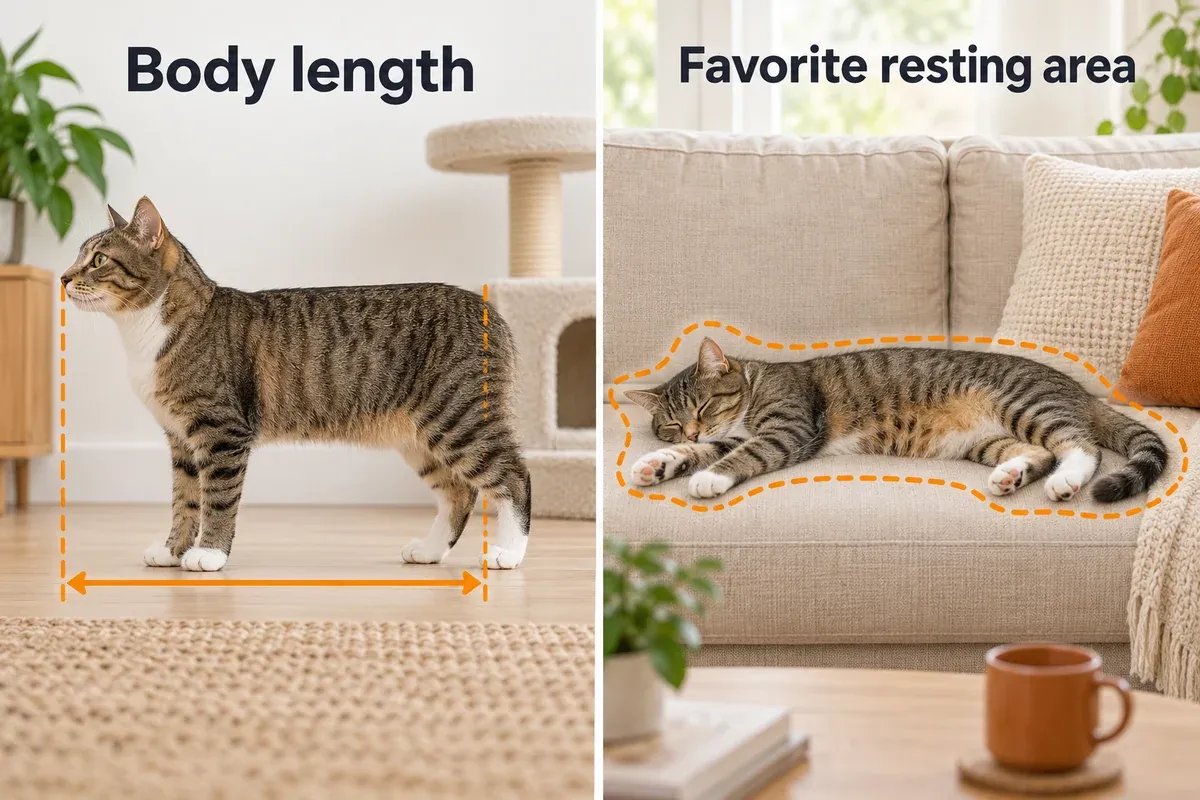
- Measure body length: measure from the nose to the base of the tail while your cat is standing naturally. Do not include the tail.
- Measure shoulder width: note the widest part of the chest and shoulders. This helps you judge condo doors and narrow tunnels.
- Record weight and age: weight is useful, but it is not a substitute for body dimensions. A long, lean cat can need more surface area than a heavier, compact cat.
- Measure a favorite bed: measure the cushion or sofa area your cat already chooses. This is often a better predictor of perch preference than breed labels.
- Measure the room: record ceiling height, available width and depth, door clearance, nearby furniture, and the distance from the tree to a window or radiator.
Then compare those measurements with the product’s usable dimensions. If a product lists only “large cat” or “XXL,” keep looking until you can find the actual platform and condo measurements.
Four linked examples that show the trade-offs
The products below are included as size examples, not as a ranked “best” list.
Size examples from linked products
-
FEANDREA UPCT087G01 Cat Tree, 64.6 Inches
FEANDREA
A 64.6-inch activity center with a hammock, basket, condo, and removable toy elements—useful for comparing a mid-size tower with your cat's actual measurements.
- 64.6-inch overall height
- Hammock and basket resting spots
- Enclosed cat condo
- Height
- 64.6 inches
- Best for
- A practical baseline for average-size adult cats and tighter rooms
-
Globlazer F70 Pro Heavy Duty Cat Tree, 70 Inch
Globlazer
Product selected for the stated use case; confirm fit with the manufacturer's specifications.
- 70-inch vertical height
- Scratching posts plus hammock and condo
- Mid-range price point for a full-size tower
- Height
- 70 inches
- Best for
- Large cats that need a full-height tower without jumping straight to premium pricing
-
Taoqimiao F30W Heavy Duty Cat Tree, 73 Inch
Taoqimiao
A 73-inch tower marketed for cats 25 lbs and up, with two widened condos, an enlarged sleeping platform, nine scratching posts, and two baskets.
- 73-inch vertical height
- Two widened condos and an enlarged sleeping platform
- Nine scratching posts and two baskets
- Height
- 73 inches
- Best for
- Large cats that need wider resting areas and several scratching stations
-
Omlet Freestyle Indoor Cat Tree
Omlet
An adjustable floor-to-ceiling cat-tree system with aluminum poles, bamboo components, replaceable scratch surfaces, and configurable steps, hammocks, and dens.
- Adjustable poles for ceiling heights up to 14 ft 5 in
- Configurable steps, bridges, ramps, hammocks, and dens
- Replaceable scratch surfaces and machine-washable fabrics
- Height
- Adjustable for ceilings up to 14 ft 5 in
- Best for
- A customizable vertical route when floor space is limited
Review the linked product page before purchasing.
FEANDREA UPCT087G01, 64.6 inches: a useful mid-size baseline
Check current price on Amazon →product information features: Hammock, basket, condo, and removable toy elements
The FEANDREA is a good illustration of why height is only one part of the decision. At 64.6 inches, it sits in the useful range for many adult cats and offers several activity zones without becoming a floor-to-ceiling installation.
Use it as a baseline if you have one average-size adult cat, limited floor space, or a budget ceiling around the mid- range. If you have a 17–22-pound Maine Coon or another long-bodied cat, do not stop at the product title. Confirm that the top perch, hammock, and condo opening are large enough for the way your cat actually rests.
Good fit if: you want a conventional multi-level tree and a lower-cost reference point for sizing.
Think twice if: your cat needs an oversized bed, has difficulty with narrow openings, or regularly overwhelms smaller furniture.
Globlazer F70 Pro, 70 inches: more vertical room without a premium price
Check current price on Amazon →The F70 Pro shows the middle ground many owners are looking for: a full-height 70-inch tower, more vertical territory than a compact tree, and a price that is still below many premium furniture-style designs.
This type of tower makes sense when your cat likes to climb and you have enough floor area for the base to sit flat. Before ordering, check the base dimensions, the top platform’s usable area, and whether the manufacturer provides an anti-tip strap. A 70-inch structure is tall enough that small assembly errors or an uneven floor can become noticeable.
Good fit if: your cat enjoys climbing and you want a conventional full-height tower around the mark.
Think twice if: you cannot secure a tall structure, your room has limited ceiling clearance, or the described resting surfaces are still too narrow for your cat.
Taoqimiao F30W, 73 inches: a large-cat-oriented layout
Check current price on Amazon →product information features: Two widened condos, enlarged sleeping platform, nine scratching posts, and two baskets
The Taoqimiao product information is positioned for larger cats and advertises a 73-inch height, widened condos, and an enlarged sleeping platform. Those features align with the right decision criteria for a big cat: more than one place to rest, a route with several levels, and enough scratching surfaces to distribute daily use.
Weight claims do not tell you whether a 20-pound cat can turn around inside a condo or fully stretch on the top perch. Check the final dimensions, inspect the base after assembly, and use the included anti-tip solution or an appropriate wall connection when the room and wall construction allow it.
Good fit if: your large cat needs several resting and scratching zones and the described platform dimensions match your measurements.
Think twice if: you need a narrow footprint, cannot secure a tall tower, or the product page does not show enough detail for the surfaces your cat will use most.
Omlet Freestyle: a configurable floor-to-ceiling route
The Omlet Freestyle shows a different way to use height: adjustable aluminum poles support a route that can be configured with steps, bridges, ramps, hammocks, and dens. Omlet states that pole options cover ceiling heights up to 14 feet 5 inches, but the maximum range is not a buying target. Measure the actual ceiling, allow for installation, and space the route for your cat’s reach and mobility.
Configure the Omlet Freestyle →Good fit if: floor space is tight and you want to change or replace individual climbing and scratching parts over time.
Think twice if: the ceiling or floor cannot support the prescribed tension setup, you cannot verify the installation, or your cat needs a freestanding low route.
A simple pre-checklist before checkout
Save the product page and confirm each item below. If any answer is missing, treat that as a reason to pause rather than a detail to guess.
- Height: Does the top perch fit below the ceiling with enough room for assembly and cleaning?
- Main perch: Is the usable resting surface at least as large as your cat’s favorite bed?
- Condo opening: Can your cat enter, turn, and leave without squeezing through a narrow door?
- Base: Is the footprint wide enough for the tower’s height and your cat’s jumping style?
- Posts: Is there at least one sturdy scratching post tall enough for a full-body stretch?
- Route: Can your cat reach the top through manageable steps, and can it come back down?
- Multi-cat use: Are there multiple separate resting spots rather than one top platform?
- Safety: Does the package include an anti-tip strap, and can the tree sit level on your floor?
- Maintenance: Can you tighten the structure and clean or replace the parts your cat will use most?
Common sizing mistakes to avoid
Buying the tallest tree you can find
Height is visible in a product title, so it is easy to compare. But a taller tree with a small base and cramped perches can be less useful—and less stable—than a shorter, wider design. Start with the cat’s resting surface and the room’s safe footprint, then add height if the structure still meets those requirements.
Counting every platform as a sleeping platform
A narrow step, a scratch ramp, and a covered bridge may all be useful, but they are not interchangeable with a broad resting bed. Count only surfaces where your cat can comfortably lie down. This matters even more in a multi-cat home, where several cats may want to rest at the same time.
Trusting “XXL” without checking measurements
“Large cat” and “XXL” are marketing labels. The exact numbers tell you whether the product is a fit. Pay special attention to the interior condo dimensions, because an oversized outer frame can hide a surprisingly small sleeping compartment.
Ignoring the way your cat jumps
Some cats climb carefully from level to level. Others launch from the floor and land hard on the highest perch. If your cat is an enthusiastic jumper, choose a wider base, tighten every joint after assembly, and use the anti-tip hardware recommended by the manufacturer.
Putting a tall tree in the wrong place
A tree beside a window may be used more than one in an empty corner. But it should not block a doorway, heater, curtain, or escape path. Leave enough room to clean behind it and to remove the tree if a joint needs repair.
What if your cat does not use the tree?
A correct size does not guarantee an instant introduction. Place the tree near a familiar resting area, add a blanket that smells like home, and reward calm investigation. Keep dangling toys secure and avoid forcing your cat onto the top perch.
If the tree feels wobbly, stop using the upper levels until you fix the assembly or replace the structure. If an older cat suddenly stops jumping, appears painful, or struggles with ordinary movement, a cat tree is not the right place to troubleshoot the change—ask your veterinarian about it.
For a tree that is slightly too small, a separate full-height scratching post or a stable low bed can add useful functions. Do not improvise extra platforms on a structure that was not designed to carry them. If the main perch is too narrow for your cat to relax, replacing the tree is usually safer than trying to enlarge it with loose attachments.
Frequently Asked Questions
What is a good height for a cat tree?
For one average adult cat, 55–65 inches is a practical starting range. Large, active cats may enjoy 60–80 inches, but the tree should become wider and more stable as it gets taller. A shorter tree with a broad, usable perch is often better than a very tall, narrow tower.
Do Maine Coons need a special cat tree?
They do not need a particular brand, but they often need more usable surface area and stronger stability than a small standard tree provides. Measure the individual cat, look for a broad perch or hammock, and check condo openings instead of relying on the breed label alone.
How wide should a cat-tree perch be?
Measure the area where your cat normally sleeps. As a rough buying screen, 16–18 inches works for many average adult cats, while 18–22 inches is a more useful starting range for large cats. The perch should allow the cat to turn around and rest without hanging over a hard edge.
Is a taller cat tree always better?
No. Height is useful for climbing and observation, but only when the route is accessible and the structure is stable. For kittens, seniors, or cats that dislike exposed heights, lower beds and short steps may matter more than a high top perch.
How many cat trees do two cats need?
There is no universal number, but one shared top perch can create competition. Aim for at least two comfortable resting places and some separation between them. Two smaller trees in different areas can be more useful than one giant tree with one attractive bed.
Should I anchor a cat tree to the wall?
If the manufacturer provides an anti-tip strap, use it according to the instructions—especially for tall towers, heavy cats, and active multi-cat homes. Use hardware suitable for your wall construction, and do not rely on a strap to compensate for a loose joint or an undersized base.
Can a senior cat use a tall cat tree?
Yes, if lower levels are easy to reach and the route does not require risky jumps. Add a low resting bed, steps, or a ramp, and keep the favorite sleeping spot at a height your cat can access comfortably. If mobility changes suddenly, speak with a veterinarian.
Final answer: buy for usable space, then add height
For one average adult cat, a 55–65-inch tree with a stable 20 × 20-inch-or-larger base and a 16–18-inch main perch is a sensible starting point. For a large cat, move toward a 60–75-inch structure with an 18–22-inch resting surface, a wider base, thick scratching posts, and anti-tip support. For multiple cats, add separate resting zones rather than simply buying the tallest tower.
The winning measurement is not the number printed in the product title. It is whether your cat can climb, stretch, turn, rest, scratch, and leave the structure without crowding or wobbling. Measure that first, and the right cat tree size becomes much easier to spot.
For a product-focused follow-up, see Best Cat Trees for Large Cats 2026. For more ways to build a cat-friendly vertical environment, browse the Zoolory Cats guides.