

 Published sources
 Product details checked
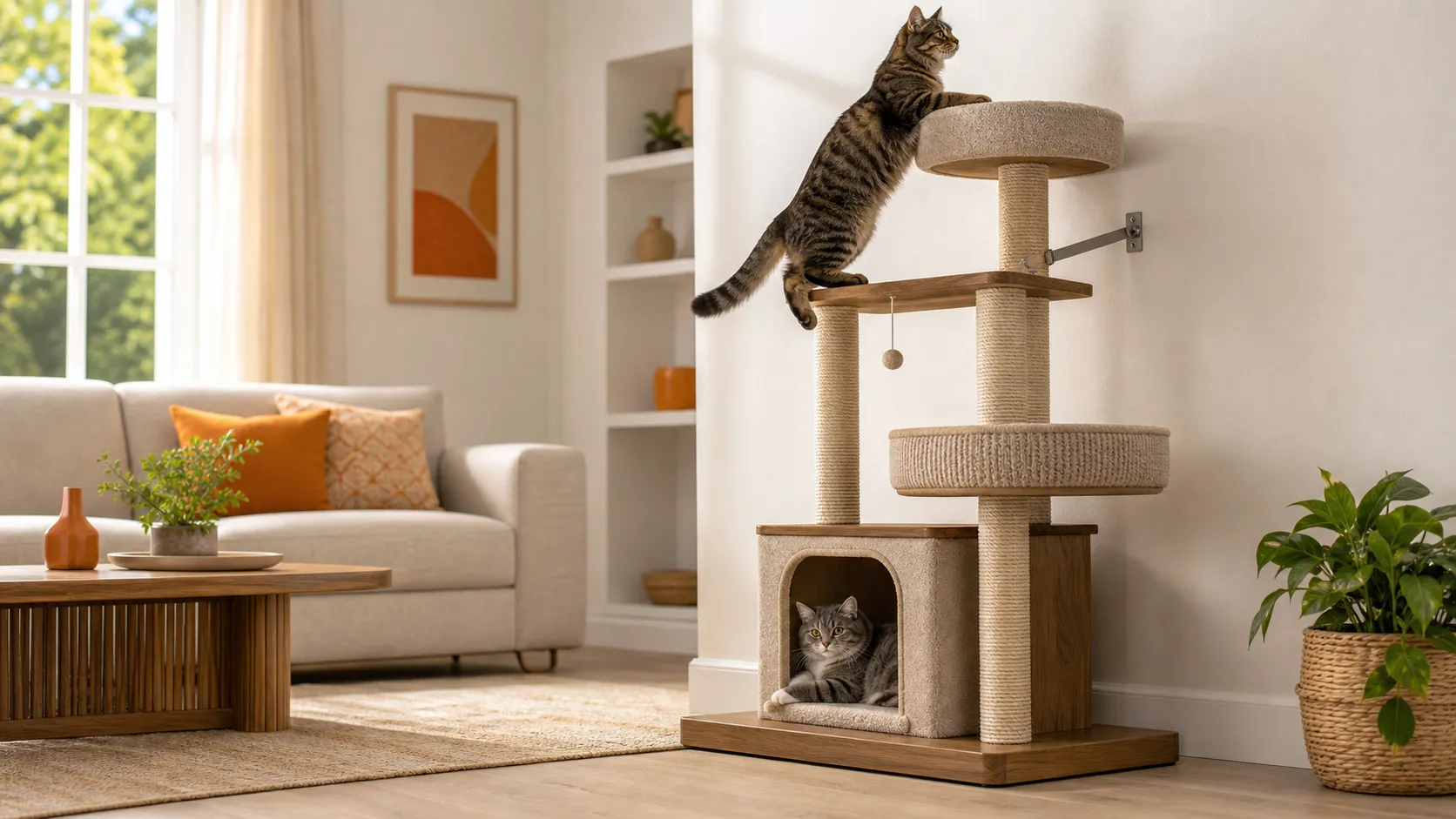
A cat tree that sways, rocks, or leans is not just annoying furniture. It is a small structure that takes repeated dynamic loads when a cat launches, lands, scratches, or changes direction near the top. Stop using the upper levels until you know why it moves.
Quick answer: Move your cat away from the tree, check every threaded joint and platform, put the base on a level and compatible floor, and secure a tall or active tree to a suitable structural point in the wall. A thin floor-grip pad can reduce sliding on a compatible hard floor, but it cannot fix a rocking base or replace an anti-tip connection. If the particleboard, post, fastener threads, or base are cracked or stripped, replacement is usually safer than adding more hardware.
This guide focuses on the tree you already own. It helps you distinguish loose assembly, floor movement, wall anchoring, and a fundamentally undersized base before you spend money on a strap, anchor, mat, or replacement.
The first safe response
- Take the cat off the tree calmly. Do not catch or pull a cat that is already climbing. Clear the area and offer another resting place.
- Do not let the cat test the fix. A wobble that feels small to a person can become a full tip when a cat jumps from the floor to the highest platform.
- Photograph the setup before disassembly. Capture the joint positions, hardware, wall gap, and base footprint so you can spot a missing part or assembly error.
- Stop immediately if you see damage. Cracked boards, pulled-out screws, bent brackets, split posts, exposed sharp metal, or a leaning base are replacement-or-repair conditions, not tightening conditions.
The U.S. Consumer Product Safety Commission’s Anchor It campaign recommends following the manufacturer’s instructions and anchoring tip-prone furniture with an appropriate anti-tip device. A cat tree is not the same as a dresser, but the same basic safety principle applies: a restraint does not make damaged or badly assembled furniture sound.
What the movement is telling you
Use the pattern of movement to choose the first test. Change one variable at a time so you know what actually helped.
| What you see | Likely bottleneck | First safe test | Correct direction |
|---|---|---|---|
| One post or platform rotates when you push it | Loose threaded joint, missing washer, or stripped insert | Remove the cat and check the joint with the correct tool | Reassemble with the original hardware; replace damaged parts |
| The whole base rocks on a hard floor | Uneven feet, warped board, or a base that is too small | Press each base corner and look for a gap | Level the structure only if the base is sound; otherwise replace it |
| The tree stays upright but slides across the floor | Low friction or a smooth floor finish | Mark the base position, then apply light sideways hand pressure | Use a thin, floor-compatible grip layer as a supplement |
| The top moves far more than the bottom | Tall lever arm, top-heavy layout, or no wall restraint | Hold the base still and test the upper platform by hand | Improve the base or add a properly matched wall connection |
| It tips only when the cat jumps or two cats use it | Dynamic load exceeds the practical stability margin | Keep the cats off and inspect the full load path | Anchor it, reduce the height, or replace it with a wider design |
| It wobbles only on a thick rug | Uneven compression or a sinking corner | Move it briefly to a level hard floor | Correct the base; do not hide a rocking base under thicker padding |
| A screw spins without tightening | Stripped particleboard or damaged insert | Stop turning the screw | Replace the part or the tree; do not rely on a larger random screw |
| Your cat suddenly avoids the tree after a slip | Loss of confidence, fear, or pain | Remove the physical risk and watch normal movement | Fix the structure; contact a veterinarian if pain signs remain |
Products matched to the failure mode
These are examples, not a universal shopping list. The right product depends on the wall construction, the tree’s attachment point, and whether the problem is sliding or structural movement.
Stability products by job
-
Booda Brand Metal Furniture Anchors, 10 Pack
Booda Brand
A 10-pack of metal furniture straps and brackets with screws and wall anchors. The product documentation claims up to 400 lb per set, but that is a manufacturer claim rather than a cat-tree test rating.
- Metal strap-and-bracket design with included screws and wall anchors
- Adjustable connection and quick-release feature for moving furniture
- product documentation recommends two sets per piece of furniture
- Best for
- A metal anti-tip restraint when the tree and wall have a suitable structural attachment point
-
TOGGLER SNAPTOGGLE Drywall Anchors, 1/4-20 Bolts, 20 Pack
TOGGLER
A zinc-plated steel mechanical toggle system with 1/4-20 bolts. the product documentation specifies hollow materials from 3/8 to 3 5/8 inches, but a toggle anchor is not a universal substitute for a stud or masonry connection.
- Mechanical toggle spreads the connection behind hollow wall material
- Includes 20 anchors and 1/4-20 round-head bolts
- product documentation specifies 3/8- to 3 5/8-inch hollow materials
- Best for
- A no-stud hollow-drywall option only when the wall, bracket, and load are compatible
-
Gorilla Grip Strong Rug Pad Gripper, 2 x 6 ft
GORILLA GRIP
A trim-to-fit, dual-sided non-adhesive rug pad intended to improve grip between a rug and its floor. Under a cat tree it can reduce sliding, but it cannot correct a rocking base or replace a wall restraint.
- 2 x 6-foot roll can be cut to the footprint of a level base
- Non-adhesive grip on both sides according to the manufacturer
- Useful only as a supplemental floor-contact measure
- Best for
- Reducing minor base slide on a compatible smooth, hard floor
-
SHA CERLIN 65-Inch Large Cat Tree Tower
SHA CERLIN
A broad 65.7-inch tower with a widened top platform, enlarged condo, multiple plush perches and baskets, sisal posts, and scratching ladders.
- 44.5 x 28.3-inch footprint spreads the load across a wide base
- product documentation states the strengthened structure supports up to 33 lbs
- Multiple levels, padded perches, baskets, hammock, and scratching ladders
- Best for
- Budget buyers who have room for a wide base
Review the linked product page before purchasing.
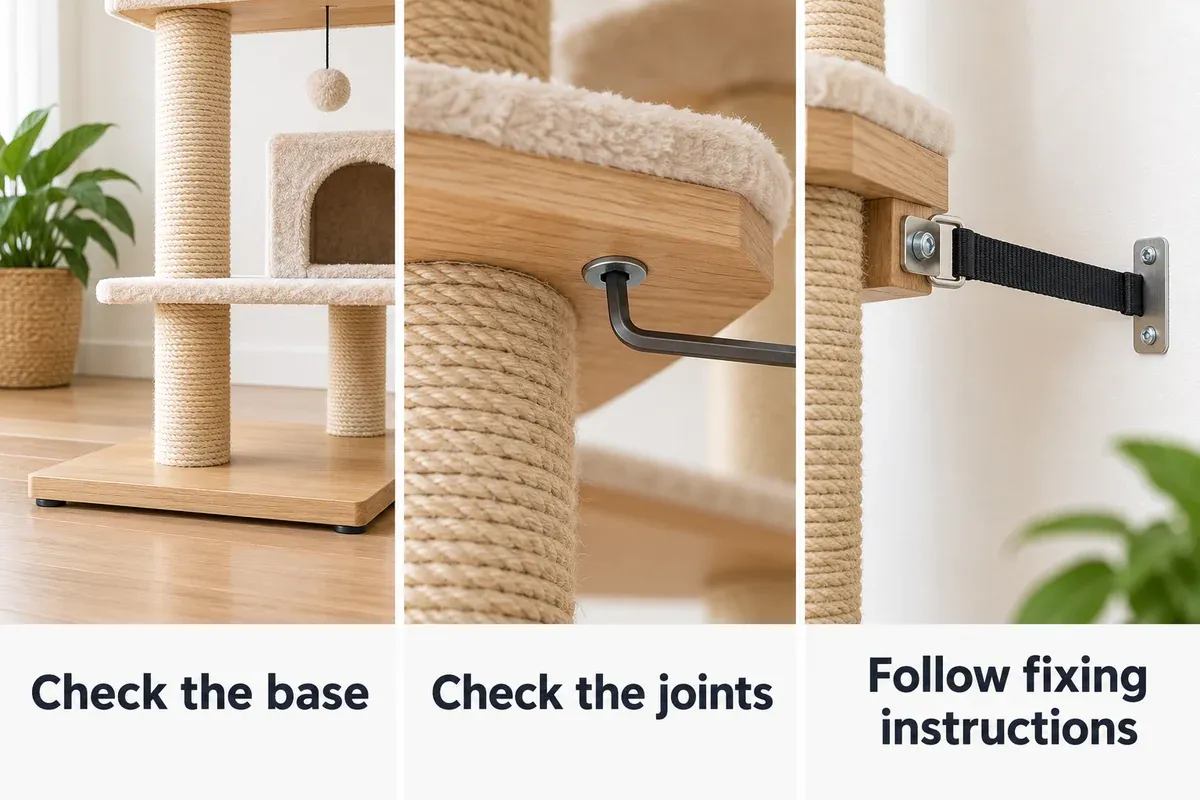
1. Recheck assembly before adding hardware
Many wobbly cat trees are loose at a connection that looked tight during assembly. A tall tower can amplify a small amount of play at every joint.
Work from the bottom up
- Remove the loose top platforms, beds, and toys so the frame is easier to handle.
- Check that every post is attached to the intended platform and that no washer, barrel nut, bolt, or threaded rod is missing.
- Start every fastener by hand. If it cross-threads or binds immediately, stop and check alignment rather than forcing it.
- Tighten the frame in stages from the base upward. Keep the platform square while you tighten, then make one final pass with the correct tool.
- Check again after the first day of use and after the first week. Soft particleboard can settle slightly under load.
Do not substitute a random longer screw, drill through a thin platform without knowing what is behind it, or use glue to compensate for stripped threads. Those changes can create a sharp point, split the board, or put the fastener into a weak edge. Ask the manufacturer for model-specific replacement hardware when the parts are available.
Inspect the load path, not just the loudest joint
Look at the complete route from the top bed to the floor: platform, post, connector, baseboard, feet, floor, and any wall restraint. A tight top bolt cannot compensate for a cracked baseboard. Likewise, a strong wall strap cannot safely hold a unit whose post is pulling out of the platform.
2. Put the base on a stable floor
The base should sit flat with all intended contact points supported. Hair, a folded rug edge, a floor transition, or one missing foot can create a rocking point.
The Mau product-safety guide specifically warns that a level, stable surface matters because jumping, multi-cat use, uneven floors, and other dynamic forces can still tip a product. Its guidance also treats stabilizing pads as support for the feet, not as a replacement for an anti-tip device.
Use this order:
- Sweep hair and debris from beneath the base.
- Set the assembled tree on a hard, level floor temporarily.
- Press each corner and note whether the gap follows the base or the floor.
- Check that the baseboard is straight and that every factory foot is present.
- Place the tree near a wall or in a corner only after the base itself is sound.
When a grip pad helps
A thin, non-compressible, floor-compatible grip layer can reduce minor sideways sliding. The Gorilla Grip rug-pad guidance says its pad is non-adhesive and should be used on compatible surfaces, with the material laid flat and free of wrinkles. Its warnings exclude surfaces such as carpet, vinyl, lacquered or acrylic finishes, natural stone, porous surfaces, and refinished floors.
If you use the Gorilla Grip 2 x 6 ft pad, cut it close to the supported footprint. Do not leave loose material where a cat can pull it out, and do not use a thick soft pad to hide a corner that does not touch the floor. If the base rocks without the pad, solve the base problem first.
3. Decide whether the tree needs a wall connection
A tall tree beside a wall is easier to keep within a safe movement range when the upper frame is restrained. The restraint should limit forward travel; it should not be the only thing keeping a poorly assembled or narrow-based tower upright.
Wall anchoring is especially sensible when:
- the tree is tall relative to its footprint;
- your cat launches hard, scratches vigorously, or weighs enough to move the tower;
- more than one cat uses it at once;
- the manufacturer supplies an anti-tip strap or says to secure the unit;
- children or dogs may bump the tree; or
- the tree sits where a tip could block a doorway or land on a person.
Feandrea’s official FAQ recommends using the included anti-tip kit for maximum safety and gives extra emphasis to taller models and active or multi-cat homes. Treat that as model-specific manufacturer guidance, then match the hardware to your actual wall.
Anchor the strong part of the tree
Attach the strap or bracket to a substantial upper post or platform support close to the main frame. Avoid a thin decorative shelf, a fabric hammock, a removable cushion, or a point that can tear out of particleboard. Keep the tree plumb, leave the strap snug without pulling the structure sideways, and remove any loop or screw point that could catch fur or paws.
For a broad or heavily used tower, two properly placed restraint points may control twisting better than one. Do not interpret that as a universal number: use the manufacturer’s instructions and have the attachment reviewed if the tree is unusually tall, heavy, or placed in a high-consequence location.
Match the hardware to the wall
Drywall over a wood stud: A strap or steel bracket fastened into the stud is the preferred path when the stud location and bracket allow it. Use the fastener type, length, washer, and pilot hole specified by the hardware manufacturer. A plastic plug in the drywall face is not equivalent to a stud connection.
Hollow drywall with no stud at the attachment point: A mechanical toggle can be appropriate only when the wall thickness, bracket hole, bolt, and expected load are compatible. The TOGGLER SNAPTOGGLE product information is the right place to confirm the system’s installation and working-load guidance. Drill the specified hole, install the exact anchor, and do not substitute a different bolt or use a damaged toggle.
Masonry or concrete: Use a masonry-rated anchor system and bit that match the wall and the bracket. Do not assume a drywall anchor, wood screw, or included generic plug will work in masonry.
Plaster and lath, hollow block, crumbly drywall, or an unknown wall: Pause. The visible surface does not tell you the strength of the underlying attachment. Ask a qualified installer or the hardware manufacturer before drilling.
The TOGGLER 1/4-20, 20-pack is a practical example of a mechanical hollow-wall anchor, not a permission slip to anchor every cat tree into drywall. Match the anchor to the wall thickness and the manufacturer’s instructions. If a stud or suitable masonry connection is available, use that path instead.
4. Choose straps, screws, anchors, and pads by their actual job
| Part | What it does | What it cannot do |
|---|---|---|
| Anti-tip strap | Limits how far the upper structure can move away from the wall | Repair a cracked platform, stripped insert, or undersized base |
| Wall bracket or metal plate | Transfers the strap load into the wall and tree | Make an incompatible wall anchor safe |
| Screw, bolt, and washer | Hold the bracket to a suitable structural point | Create strength in weak particleboard or a damaged stud |
| Mechanical drywall toggle | Spreads a load behind suitable hollow wall material | Replace a stud or work in every plaster, lath, or crumbly wall |
| Floor-grip pad | Reduces small amounts of sliding on a compatible surface | Stop a tree from tipping or correct a rocking base |
| Matching replacement part | Restores the model’s intended joint or base | Justify mixing parts from another tree or improvising a new frame |
The Booda metal furniture-anchor set is useful when its included bracket and fastener path can be matched to the tree and wall. The manufacturer describes support for up to 400 lb per set and recommends two sets per furniture item. That is a general furniture-restraint specification, not a tested safety rating for a particular cat tree, cat weight, wall, or installation. Use the manufacturer’s instructions and inspect the completed connection.
Do not reuse an unknown plastic restraint kit
Check the CPSC recall notice for Cranach Hardware tip-restraint kits before reusing an old kit from a drawer or a previous piece of furniture. The recall involved plastic brackets and cable ties that could break or degrade; the CPSC directed consumers to stop using the recalled kits and replace them with compliant restraints.
5. When a replacement tree is safer than another fix
Repair is sensible when the model is sound and the problem is a missing or loose part. Replacement is the safer direction when:
- the baseboard is cracked, bowed, or too narrow for the height;
- a post pulls out because the particleboard threads are stripped;
- the top platform or connector is bent or split;
- a required manufacturer part is unavailable;
- the tree still shifts after correct assembly on a level floor and a suitable wall restraint; or
- there is no safe wall attachment and the base is not stable enough on its own.
In that situation, look for a lower center of gravity, a wide footprint, substantial baseboard, and a clear anti-tip provision. A taller replacement is not automatically an upgrade.
It still needs a level setup and a suitable anti-tip connection when the room and wall allow it.
If your existing tree is already wider and structurally sound, replacing it just to buy a popular model may not solve the cause. Measure the base, inspect the joints, and compare the replacement’s real footprint with the space where it will stand.
6. Test the fix without putting your cat at risk
After the tree is reassembled and any wall connection is installed:
- Push lightly at the base in several directions. It should not rock or walk across the floor.
- Apply gradual hand pressure to each main platform. Look for movement at the joint, not just movement of the whole tower.
- Check that the wall strap is snug, the bracket is not bending, and the wall surface is not cracking or pulling away.
- Put the cat tree back in its intended place and repeat the checks after any move.
- Let your cat investigate the lower level first. Keep the first few sessions supervised and stop if the structure moves or the cat slips.
Inspect the structure after the first week, after a relocation, after a hard impact, and at least monthly in a busy multi-cat home. The Mau safety guidance also recommends checking fixings regularly and discontinuing use if the product becomes unstable, loose, or damaged.
What not to do
- Do not keep using the upper platforms because the wobble is “only a little.”
- Do not rely on adhesive-only strips, hook-and-loop pads, or cable ties as the primary anti-tip connection.
- Do not put books, folded cardboard, loose wood shims, or a thick soft rug under one corner.
- Do not drill arbitrary holes through a post or platform without knowing the internal structure.
- Do not force a drywall anchor into a stud hole, or a wood screw into a hollow wall, just because it is the hardware you have.
- Do not over-tighten a fastener until particleboard crushes around the washer.
- Do not combine a replacement part from another model unless the manufacturer confirms compatibility.
- Do not let a child climb the tree to test it.
Frequently Asked Questions
Does every cat tree need to be attached to a wall?
No single rule fits every model, but a tall, narrow, heavily used, or manufacturer-supplied-strap tree deserves a wall connection when a suitable attachment is available. The wall restraint is an extra control against tipping; it does not replace a level floor, sound base, or correct assembly.
Can a rug pad fix a wobbly cat tree?
Only if the actual problem is minor sliding on a compatible floor. A pad cannot correct a rocking base, warped board, loose joint, or top-heavy frame. Remove the pad and test the tree on a level hard floor before deciding.
What if I cannot find a stud?
Use a suitable mechanical hollow-wall anchor only after confirming the wall material, thickness, bracket, bolt, and expected load. If the wall is plaster, lath, crumbly, or unknown, get qualified advice. If no safe wall connection is possible, choose a lower or wider tree instead of guessing.
How many anti-tip straps should I use?
Follow the tree and hardware instructions. One point may limit forward movement but allow twisting; two properly placed points can control rotation better when the structure and wall support them. More straps cannot compensate for a damaged base or a weak wall.
What if the tree still wobbles after I tighten everything?
Take it out of service and check the base, floor contact, stripped threads, missing parts, and wall connection. If the structure still moves after those checks, replace it or ask the manufacturer for a model-specific repair path. Do not keep adding random screws.
My cat now avoids the tree. Is that a training problem?
It may be loss of confidence after a slip or sudden movement. First remove the physical risk. If your cat shows limping, stiffness, reluctance to jump elsewhere, hiding, or other pain signs, stop the experiment and contact your veterinarian.
Sources and further reading
- CPSC Anchor It: furniture tip-over prevention
- CPSC recall: Cranach Hardware tip-restraint kits
- Mau product safety guidance
- Feandrea FAQ and anti-tip guidance
- TOGGLER SNAPTOGGLE manufacturer information
- Gorilla Grip rug-pad instructions and surface warnings
- AAFP and ISFM feline environmental-needs guidelines
Last updated: August 2, 2026