

 Published sources
 Product details checked
An aquarium starter kit can simplify the equipment list, but it does not make a new tank ready for fish on day one. The filter still needs a working biological community, the water must be tested, and the livestock must fit the tank’s actual volume and shape.
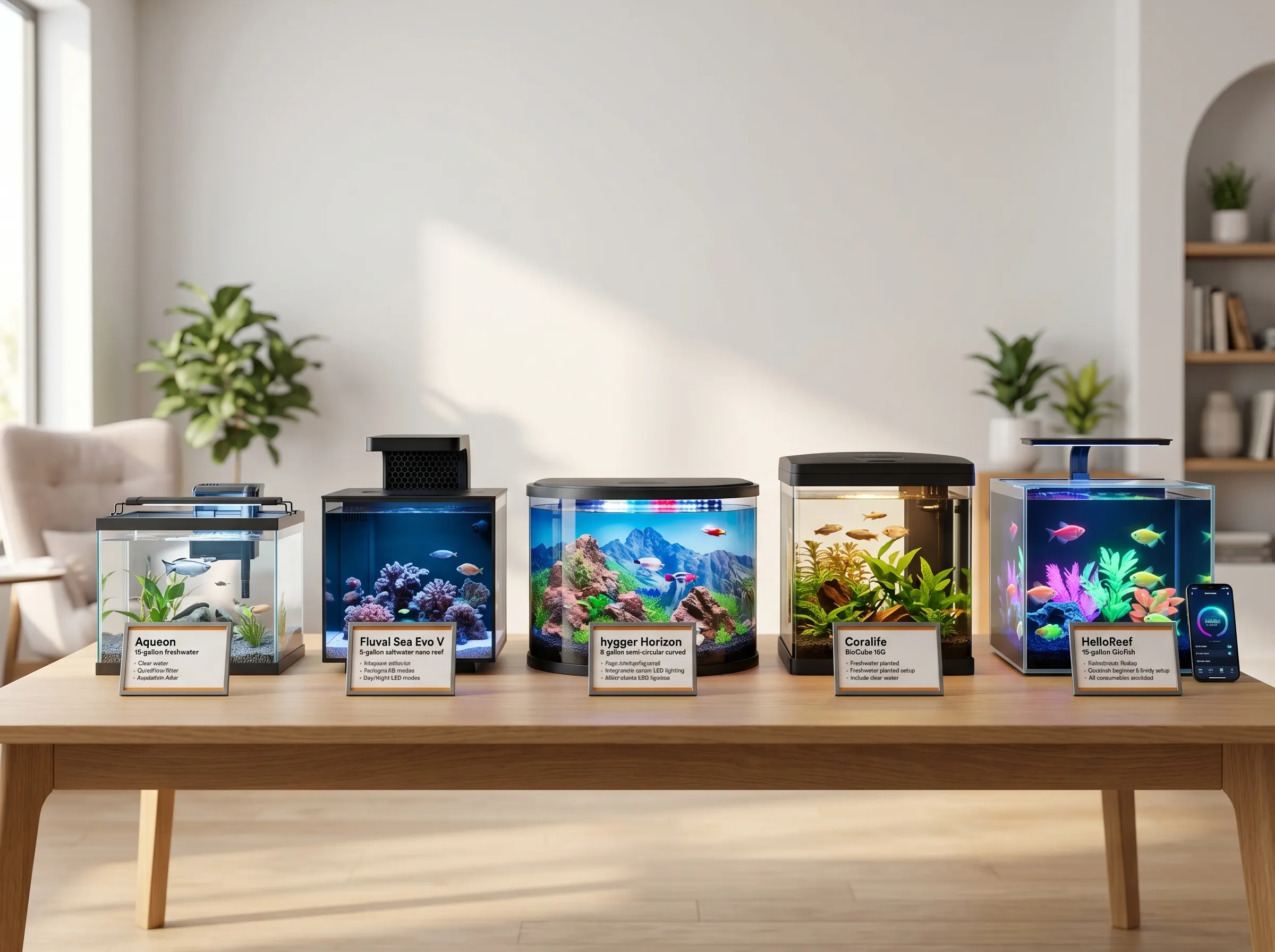
Quick answer: For a straightforward freshwater starting point, the Aqueon 10 Gallon LED Starter Kit is the clearest equipment bundle in this comparison. The Fluval Sea Evo V 5 Gallon is a compact saltwater platform, while the Coralife BioCube 16 offers an integrated filtration chamber and marine-capable lighting. Choose the kit for its equipment and footprint, then cycle it before adding animals.
The nitrogen cycle is not optional. UF/IFAS explains how ammonia is converted to nitrite and then nitrate in an aquatic biofilter, and New Mexico State University describes fishless cycling and the water tests used to confirm it.
Advertisement / Affiliate disclosure: This article contains paid affiliate links. As an Amazon Associate, we earn from qualifying purchases at no extra cost to you.
Quick comparison
-
Aqueon 10 Gallon LED Starter Kit
Aqueon
A 10-gallon-class freshwater kit with a glass tank, LED hood, power filter, preset heater, and basic accessories listed by the manufacturer; verify the current model.
- Glass tank and LED hood listed
- Power filter and preset heater listed
- Thermometer, net, and setup materials listed
- Tank size
- 10 gallons
- Best for
- A straightforward freshwater equipment base for a small, deliberately stocked tank
- Lighting
- LED hood
-
Fluval Sea Evo V 5 Gallon Saltwater Kit
Fluval
A 5-gallon Fluval Sea Evo all-in-one with integrated filtration and LED lighting; heater and marine setup supplies require separate planning.
- 5 US gallon model
- Integrated 3-stage filtration
- LED lighting listed
- Tank size
- 5 gallons
- Best for
- A compact saltwater platform for a carefully planned nano setup
- Lighting
- LED day/night with touch start
-
hygger Horizon 8 Gallon LED Aquarium Kit
hygger
An 8-gallon curved freshwater kit with multi-mode LED lighting, internal filtration, and a fixed 3D background; verify the current model details before choosing livestock.
- Curved display layout
- Multi-mode LED with timer settings listed
- Internal power filter listed
- Tank size
- 8 gallons
- Best for
- A compact freshwater display when the fixed curved layout suits the plan
- Lighting
- 18W multi-mode LED with timer
-
Coralife BioCube 16 Gallon Complete Kit
Coralife
A 16-gallon BioCube-style aquarium with built-in rear filtration and LED lighting; the current manufacturer page lists fish, corals, substrate, and décor separately.
- 16-gallon class display
- Built-in rear filtration chamber
- LED with timer and day/night functions listed
- Tank size
- 16 gallons
- Best for
- A compact all-in-one display with rear filtration and timed LED
- Lighting
- LED with sunrise/sunset modes
-
HelloReef 15 Gallon Glofish Complete Freshwater Kit
HelloReef
A 15-gallon freshwater HelloReef bundle with tank, filtration, light, heater, décor, water-care items, food, and lessons listed on the current product page; verify the package.
- 15-gallon-class system
- AI Blade smart LED listed
- GloFish substrate and décor listed
- Tank size
- 15 gallons
- Best for
- A bundled freshwater setup with learning materials
- Lighting
- AI Blade smart LED with app control
Package contents and model variants can change. Confirm the current product details and plan for the separate cycling and maintenance supplies.
What a starter kit does—and does not—include
Most kits combine a tank with some mixture of a lid, light, filter, heater, pump, or basic accessories. That is useful because the parts are designed to fit together. It does not mean that the box contains a cycled aquarium, suitable substrate, every water treatment, a safe stand, or livestock that matches the tank.
The Aqueon LED 10 Aquarium Kit page, for example, lists a glass aquarium, LED hood, QuietFlow filter, preset heater, thermometer, net, samples, and a setup guide. It also states that fish, gravel, and décor are separate. Treat the manufacturer’s published documentation as the final check for a specific bundle.
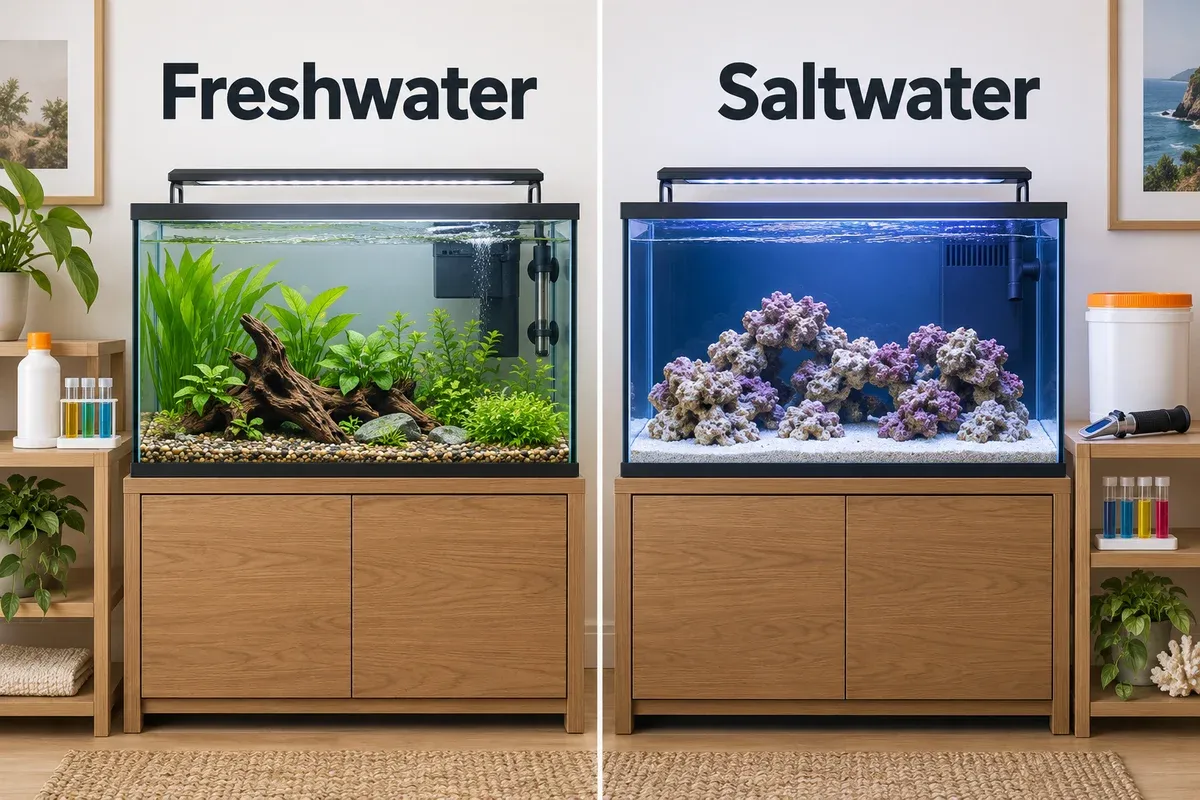
Freshwater and saltwater are different projects
Freshwater usually needs dechlorinated water, a suitable heater when the species requires it, a filter, a thermometer, a test kit, and a stocking plan. Saltwater adds marine salt mix, a salinity meter or refractometer, a source of purified water, and often additional flow or filtration. A kit that works for freshwater should not be assumed to be marine-safe.
For either type, tank volume is only one part of the decision. Footprint, water depth, swimming behavior, adult size, social needs, temperature, and waste production can rule out a species even when the nominal gallon number looks adequate.
The two examples below show why the water-care supplies must match the habitat, even when the tank comes as a kit.
The five kits in this comparison
1. Aqueon 10 Gallon LED Starter Kit — a simple freshwater equipment base
The Aqueon is a sensible choice when you want a conventional rectangular freshwater layout and a matched hood, filter, and heater. Its shape is easy to place and decorate, and the official product page makes the included equipment relatively clear.
Why it fits
- A rectangular footprint is easier to plan around than a highly curved display.
- The preset heater and filter reduce compatibility decisions for a first setup.
- A lid and light are useful for evaporation control and a consistent day/night routine.
Important limits
- Ten gallons leaves little room for stocking mistakes. Fish must be selected by adult size and behavior, not by a generic “inches of fish” rule.
- Fish, gravel, décor, water treatment, and testing still need to be planned.
- The kit is equipment, not a biological filter that has already cycled.
2. Fluval Sea Evo V 5 Gallon — compact saltwater platform
The official Fluval Evo page describes the 5-gallon model as an all-in-one saltwater aquarium with integrated three-stage filtration and LED lighting. That makes the hardware tidy, but five gallons is a very small marine system: salinity and temperature can change quickly, and livestock options are narrow.
Why it fits
- Rear filtration keeps equipment out of the display.
- The integrated light and pump reduce the number of separate components.
- It can suit a carefully planned, lightly stocked nano setup.
Important limits
- The heater, salt mix, purified water, salinity testing, and cycling plan still matter.
- “Reef-capable” lighting does not mean that every coral species will receive enough usable light.
- A small water volume gives you less margin for evaporation, overfeeding, or delayed maintenance.
3. hygger Horizon 8 Gallon — display-first freshwater option
This curved 8-gallon kit is aimed at a decorative freshwater setup with integrated lighting and filtration. It can work when the fixed background and curved viewing shape are part of the appeal, but those same features make the usable layout less flexible than a plain rectangular tank.
Check before choosing it
- Measure the actual footprint and confirm where the filter intake and return sit.
- Confirm that the flow can be adjusted for the species you intend to keep.
- Treat the listed volume as a starting point, not proof that any particular fish community will fit.
Its strongest use case is a small, deliberately stocked display. It is not a reason to add more fish than the tank and filter can support.
Check current price on Amazon →4. Coralife BioCube 16 — integrated marine or freshwater display
The Coralife BioCube product page lists a built-in rear filtration chamber, a pump, adjustable return, and LED lighting. It also clearly states that fish, corals, substrate, and décor are sold separately.
Why it fits
- The rear chamber keeps the display visually clean.
- A 16-gallon footprint gives more planning room than a five-gallon nano tank.
- The built-in light and timer are convenient for a controlled day/night schedule.
Important limits
- In saltwater use, you still need salt mix, purified water, salinity checks, and a mature biological filter.
- Coral-capable lighting is not a universal promise for every coral placement or species.
- The stand must support the filled system on a level surface.
5. HelloReef 15 Gallon GloFish Freshwater Kit — bundled learning support
The current HelloReef GloFish kit page lists a 15-gallon aquarium, filtration, light, heater, décor, water-care items, food, and step-by-step lessons. That is a more complete equipment bundle than many basic kits, but “complete” must not be read as “ready for fish immediately.”
Why it fits
- The bundle can reduce the number of separate compatibility decisions.
- The learning material may help a first-time keeper follow setup steps in order.
- The themed décor gives the tank a clear visual direction.
Important limits
- Verify the exact package and current included items before ordering.
- Cycle the aquarium and test the water even if beneficial bacteria or water conditioner is supplied.
- A themed kit still needs a species-appropriate stocking plan and sensible feeding.
A practical first-week checklist
Before livestock arrives, make the setup easy to test and maintain:
- Check the physical setup. Confirm that the stand is level and rated for a filled aquarium, the tank has no leak, cables form drip loops, and the filter intake cannot be blocked by décor.
- Prepare the water tools. Keep a dedicated bucket and siphon, a water conditioner suitable for the source water, a thermometer, and tests for ammonia, nitrite, and nitrate. A conditioner does not prove that the biological cycle is complete.
- Run the system consistently. Install the filter and heater according to their manuals, set a repeatable light schedule, and avoid switching several variables at once while the cycle is developing.
- Keep a simple log. Write down the date, temperature, test results, water changes, products added, and any change in fish behavior once livestock is present. UF/IFAS fish-health guidance recommends recording water-quality parameters and observing feeding and behavior because changes can signal a water-quality problem.
- Plan the first stocking. Choose adult sizes, social needs, and swimming space before buying an animal. Add a modest first group only after the cycle is demonstrated, then retest rather than immediately filling the remaining space.
Do not rinse biological media under untreated tap water or replace every filter material at the same time as routine maintenance. Those actions can remove or disturb the bacteria that process waste. If a filter needs cleaning, use removed aquarium water when the manufacturer’s instructions allow it and keep the biological media wet.
How to cycle a new aquarium safely
Use the following sequence for a new freshwater or marine system:
- Set up the hardware. Place the tank on a suitable, level support. Install the filter, heater, light, and thermometer according to the manuals. For saltwater, mix the marine salt with purified water before livestock is considered.
- Add the biological media and test kit. A filter’s pump can move water on the first day; its bacterial population still needs time to establish.
- Add an ammonia source for a fishless cycle. Use a controlled source intended for aquarium cycling and follow the test-kit instructions. Do not use fish as the ammonia source.
- Test ammonia, nitrite, and nitrate. Ammonia and nitrite are toxic to fish and invertebrates. A rising nitrate reading can be part of a progressing cycle, but the actual readiness check depends on the test results and the cycling method.
- Add livestock only after the cycle is demonstrated. A practical check is that the tank processes the planned ammonia input and shows zero detectable ammonia and nitrite under the test-kit method. Do not rely on elapsed days alone.
- Stock slowly. Add a modest first group, feed sparingly, and retest after the biological load changes.
The time required varies with temperature, pH, surface area, bacterial media, and the ammonia source. UF/IFAS notes that establishing a biofilter can take several weeks; a “run the filter for one week” promise is not a safe substitute for testing.
Stocking without the one-inch rule
The old “one inch of fish per gallon” formula ignores adult size, body shape, activity, social behavior, filtration, and oxygen demand. It is especially misleading in small tanks. Instead:
- identify the adult size and social needs of each species;
- check the tank’s length and swimming space, not just its volume;
- account for plants, décor, substrate, and the water displaced by equipment;
- introduce compatible animals gradually; and
- check ammonia and nitrite after each meaningful increase in bioload.
Aqueon’s beginner-fish guide also warns that small aquariums are where overstocking and undersized species choices cause particular problems.
Ongoing maintenance
Once the tank is stocked, test water regularly and record the results. Replace evaporated freshwater with freshwater; adding saltwater to replace evaporation raises salinity. Perform partial water changes when the maintenance plan and test results call for them, and avoid replacing all biological media at once unless the manufacturer and water-quality situation require it.
Keep the filter intake clear, remove uneaten food, clean algae safely, and inspect heaters, cords, lids, and stands. A starter kit reduces setup friction, but it does not remove the need for observation.
Frequently Asked Questions
Can I add fish on the same day as the kit?
No. The kit can be assembled on day one, but the biological filter is not established simply because the pump is running. Cycle the tank and confirm the water parameters first.
Is a larger kit always better?
More water volume can give you more stability and planning room, but it does not compensate for an unsuitable species, poor maintenance, or overfeeding. Choose the largest footprint you can safely support and maintain.
Do I need a water test kit if the package includes water conditioner?
Yes. Water conditioner can address specific tap-water chemicals; it does not show whether ammonia or nitrite is safe. Testing answers a different question.
Can I convert a freshwater kit to saltwater?
Only when the tank, filtration, light, heater, seals, and other components are suitable for the marine setup. The product manual and manufacturer should decide compatibility. A freshwater kit is not automatically a reef system.
Bottom line
Choose the kit that matches the habitat you can maintain, the adult needs of the livestock, and the available footprint. The Aqueon is the most straightforward freshwater equipment base in this group; the Fluval Evo and Coralife BioCube are compact marine platforms with tighter stocking margins; the HelloReef bundle adds equipment and learning material. Every one of them still needs a measured biological cycle before animals are added.
Affiliate Disclosure: We earn from qualifying purchases through Amazon Associates at no extra cost to you.