
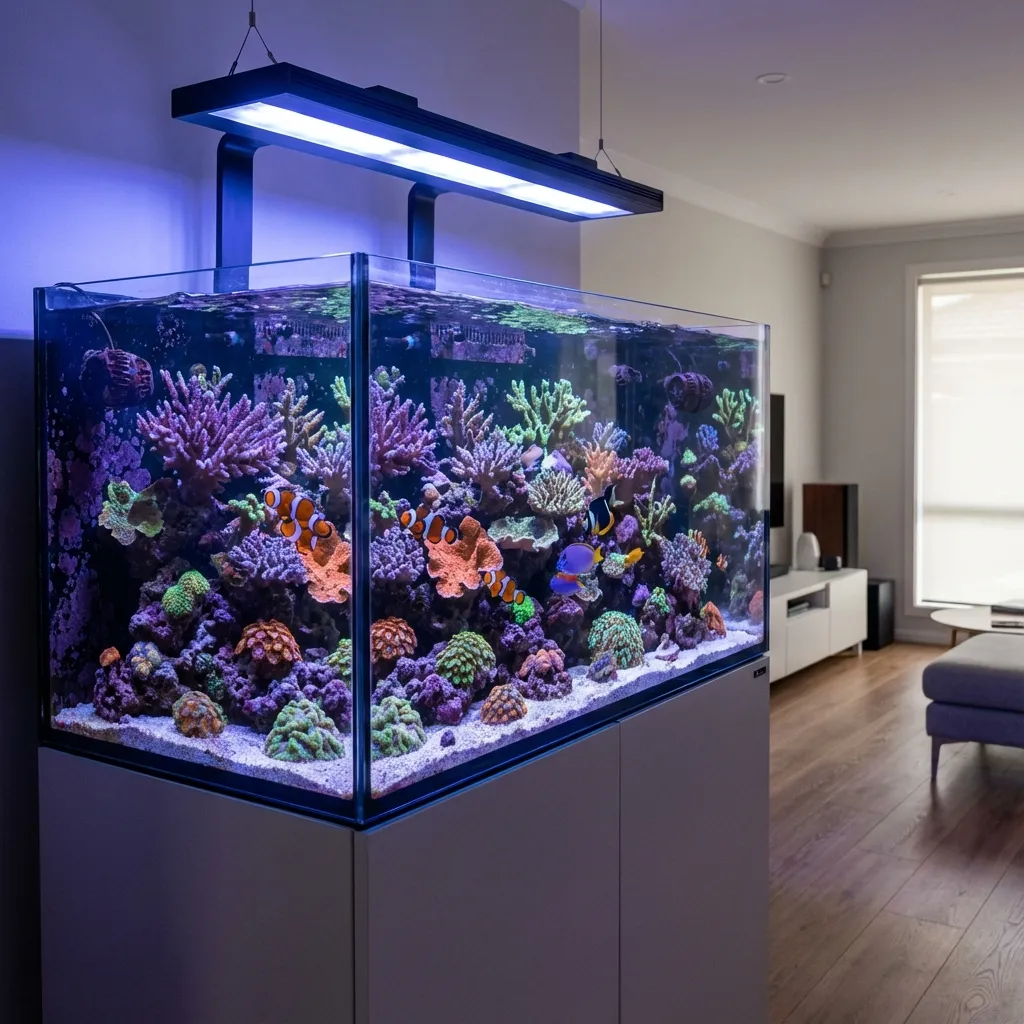

 Published sources
 Product details checked
A saltwater aquarium kit can package a tank, pump, filtration, and lighting neatly, but no kit can skip water chemistry or biological cycling. Salt mix, purified water, salinity testing, ammonia and nitrite testing, temperature control, and a species-appropriate stocking plan remain part of the setup.
Quick answer: The HelloReef 15 Gallon Complete Kit is the most bundled option in this comparison. The Coralife BioCube 16 is a compact all-in-one system with an integrated rear chamber, while the Coralife BioCube 32 gives more water volume and display space. The Ultum Nature Systems 17 Gallon AIO is better for an owner who wants to select more of the lighting and support equipment independently. None of these systems is ready for fish or coral simply because water and salt have been added.
UF/IFAS explains that a marine aquarium needs its nitrogen cycle established before fish or other animals are added. UF/IFAS also describes ammonia, nitrite, and nitrate as core water-quality checks. Those steps are more important than whether a box uses the word “complete.”
Advertisement / Affiliate disclosure: This article contains paid affiliate links. As an Amazon Associate, we earn from qualifying purchases at no extra cost to you.
Quick comparison
-
HelloReef 15 Gallon Complete Kit
HelloReef
A 15-gallon-class saltwater bundle with equipment and guided setup support; confirm which salt, rock, sand, and livestock materials are included in the current package.
- 15-gallon-class system
- Equipment bundle varies by package
- Guided setup support
- Tank size
- 15 gal
- Best for
- A bundled saltwater setup with guided lessons
- Lighting context
- Verify lamp and coral target
-
Coralife BioCube 16 Gallon
Coralife
A 16-gallon BioCube aquarium with a built-in rear filtration chamber, pump, return nozzle, and LED lighting; fish, corals, substrate, and décor remain separate considerations.
- 16-gallon class AIO
- Built-in rear filtration chamber
- LED timer and day/night functions listed
- Tank size
- 16 gal
- Best for
- A compact marine display with integrated rear filtration
- Lighting context
- Lighting must be matched to coral needs
-
Coralife BioCube 32 Gallon
Coralife
A 32-gallon BioCube aquarium with integrated filtration and LED lighting; the larger footprint adds display space but does not replace testing or maintenance.
- 32-gallon class AIO
- Integrated rear filtration
- LED lighting and timer listed
- Tank size
- 32 gal
- Best for
- A larger integrated marine display with more planning room
- Lighting context
- Lighting and livestock compatibility must be verified
-
Ultum Nature Systems 17 Gallon AIO
Ultum Nature Systems
A 17-gallon rimless all-in-one aquarium platform for an owner who wants to select lighting, heating, and other marine equipment deliberately.
- 17-gallon class cube
- Rimless display
- Low-iron glass listed
- Tank size
- 17 gal
- Best for
- A more custom marine build with an all-in-one filtration base
- Lighting context
- Depends on the selected lighting
A kit’s listed equipment is not a stocking guarantee. Verify the current package and plan for salt, testing, cycling, maintenance, and livestock-specific needs.
What “complete” means in a saltwater kit
In product language, “complete” may mean that the tank, light, pump, filter media, heater, salt, rock, sand, food, or lessons are bundled. The exact contents vary by model and package. It does not mean that the biological filter is mature, that the salinity is correct, or that a fish and coral combination is safe.
You should be able to answer these questions before ordering:
- Is the aquarium glass or acrylic, and what support does the manual require?
- Which pump, filter media, light, heater, lid, and accessories are actually included?
- Are salt mix, purified water, substrate, rock, and water tests separate?
- Is the light intended for viewing and fish, or does the manufacturer document a coral-use case?
- Can replacement media and lamps be obtained for the exact model?
The four kits in this comparison
1. HelloReef 15 Gallon Complete Kit — the most bundled route
HelloReef’s current setup overview emphasizes a packaged aquarium experience with guided lessons and a defined first setup. That can be useful for a beginner who wants a sequence to follow instead of assembling every component independently.
Why it fits
- A bundled system reduces the number of initial compatibility decisions.
- Guided setup material can make it easier to understand the order of water preparation, cycling, and stocking.
- The 15-gallon footprint is compact enough for many homes while offering more buffer than a five-gallon marine tank.
Important limits
- The included gear still needs to be assembled, checked, and operated according to the current instructions.
- The tank must complete a fishless cycle; a starter animal is not a substitute for a biofilter.
- A clownfish, anemone, or coral is not automatically appropriate for a small system. Adult size, territory, flow, light, and maturity all matter.
2. Coralife BioCube 16 — integrated chamber and compact display
The Coralife BioCube aquarium page lists a built-in filtration chamber, quiet submersible pump, adjustable return nozzle, and LED lighting. It also states that fish, corals, substrate, and décor are sold separately.
Why it fits
- The rear chamber hides filtration and leaves a clean display.
- The light and timer simplify a consistent day/night schedule.
- The 16-gallon format is easier to place than a large custom reef while offering more water volume than the smallest nano systems.
Important limits
- “Coral-capable” lighting is not proof that every coral species or placement will receive the required intensity.
- Salt mix, purified water, salinity measurement, rock, substrate, and testing must be planned.
- The rear chamber and pump still need cleaning, observation, and compatible replacement parts.
3. Coralife BioCube 32 — more water volume and display room
The 32-gallon BioCube uses the same general all-in-one concept as the smaller model, but the larger water volume and footprint can make livestock planning less restrictive. More volume is helpful; it is not a substitute for cycling or maintenance.
Why it fits
- There is more room to create a rock structure with open swimming space.
- Parameter changes can be less abrupt than in a very small system when evaporation and dosing are controlled.
- The integrated filtration and lighting keep the initial hardware list manageable.
Important limits
- The filled aquarium is heavy and needs a suitable, level stand.
- A larger tank increases the amount of salt, water, electricity, and maintenance work.
- Corals still require species-specific light, flow, stability, and acclimation.
4. Ultum Nature Systems 17 Gallon AIO — a cleaner custom starting point
This rimless all-in-one format suits an aquarist who wants a minimal display and is prepared to select the missing equipment carefully. It is a platform rather than a promise that the final system will meet the needs of a particular fish or reef.
Why it fits
- The open design leaves room to choose a light, heater, media, and circulation plan.
- A 17-gallon footprint can support a deliberately selected nano community.
- It is a good fit for someone who wants to understand each component instead of relying on a single bundle.
Important limits
- Lighting and heating must be matched to the enclosure and livestock.
- Rimless tanks need careful attention to evaporation, salt creep, and stable water level.
- The owner carries more responsibility for compatibility, safety, and replacement parts.
Equipment checklist before livestock
At minimum, plan for:
- a suitable aquarium, level stand, lid or splash control, and safe power routing;
- marine salt mix and purified water appropriate for the intended livestock;
- a calibrated salinity meter or refractometer;
- a heater and a separate thermometer;
- mechanical and biological filter media;
- tests for ammonia, nitrite, nitrate, pH, and salinity;
- a safe source of ammonia for a fishless cycle;
- appropriate flow for the chosen fish, invertebrates, or corals; and
- a maintenance plan for evaporation, water changes, filter cleaning, and lamp care.
Do not buy animals first and then choose the water parameters around them. Decide what the tank can support, then confirm the species’ adult size, compatibility, diet, flow, lighting, and temperature requirements.
Decide between fish-only and reef before setup
The same aquarium can be marketed as marine-capable while requiring very different planning for fish-only and reef use.
- Fish-only: prioritize swimming space, filtration, oxygen exchange, temperature stability, and compatibility between adult fish. Lighting can be simpler when there are no photosynthetic corals, but it still needs a reliable day/night schedule.
- Fish with invertebrates: check whether every fish is safe with the intended snails, shrimp, or other animals. “Cleaner crew” is not interchangeable between systems.
- Reef: plan for coral-specific light and flow, stable salinity, suitable rock or biological media, and a mature system. A label such as “reef-ready” describes a starting platform; it does not confirm the light level at every coral position.
Make the livestock decision before choosing the lamp, flow pattern, and upgrade path. Changing from a lightly stocked fish-only system to a demanding reef can require new equipment and a different maintenance routine, not just a different bulb.
If water tests show that your corals need regular alkalinity or calcium supplements, choose the dose from the additive instructions and measured demand. Before automating it, calibrate the aquarium dosing pump and check the volume at the outlet. Repeat the check after changing the supplement, pump tube or dosing-line position.
Return pump flow: rear chamber or separate sump?
An all-in-one kit returns water from a rear filtration chamber through a short outlet. Start with the included pump and the aquarium manufacturer’s flow and compatibility instructions. Keep its intake clear, maintain the intended chamber water level, and plan additional display circulation for the animals you choose.
For a drilled aquarium with a separate sump, measure the lift from the sump’s operating water level and the full return-pipe route before choosing a pump. Use the reef return pump size calculator to find the flow and head to check on the exact pump’s performance curve. The largest GPH number on the box does not tell you what reaches the display through that plumbing. Before adding livestock, follow the reef overflow checks for Durso, Herbie and BeanAnimal to confirm the drain arrangement, preserve emergency capacity, and test power-off drainback and restart.
How to cycle a saltwater aquarium
1. Prepare the water and hardware
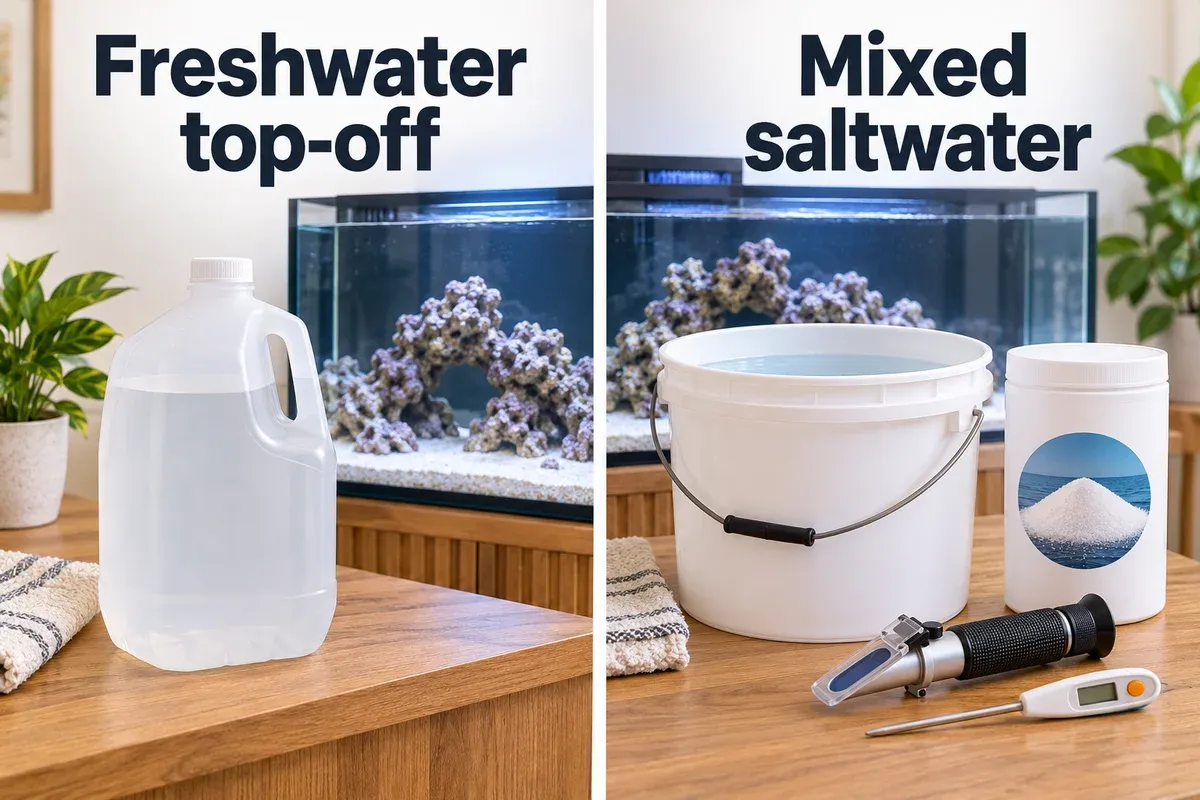
Follow the salt manufacturer’s mixing instructions and use a salinity meter that has been calibrated for the range you need. Run the heater and pump, check the temperature, and confirm that there are no leaks or unsafe cable loops. For a marine system, replacing evaporated water later means adding fresh water, not extra saltwater.
Check purified source water before adding salt or filling the freshwater top-off reservoir. If your RO/DI output shows unexpectedly high TDS, use the three-point RO/DI measurement sheet to compare feed water, RO-only water and final DI output. Those readings help separate a membrane or pressure problem from an exhausted or bypassed DI cartridge before you buy parts.
2. Add an ammonia source without animals
Start a fishless cycle with a controlled ammonia source and the biological media in place. Do not use a fish, clownfish, anemone, or “starter animal” to create ammonia. A product’s included bacteria may help, but it does not remove the need to measure the result.
3. Test the nitrogen compounds
Record ammonia, nitrite, nitrate, pH, salinity, and temperature. Ammonia is converted to nitrite and then nitrate by different bacterial populations. During the process, ammonia and nitrite can reach levels that are dangerous to aquatic life.
4. Confirm the cycle by testing, not by the calendar
The cycle is complete only when the aquarium can process the planned ammonia source and the test results show no detectable ammonia and nitrite under the method you are using. The time varies with temperature, pH, surface area, media, and the starting material. UF/IFAS describes marine cycling as a process that can take several weeks; “add water and fish” is not a setup protocol.
5. Stock slowly and observe
After the cycle is demonstrated, add one modest livestock group at a time. Give the biological filter time to respond, feed lightly, and retest after each meaningful change. Quarantine is a separate risk-control step and may be appropriate for fish, especially when the system would be difficult to medicate safely with corals or invertebrates present.
Saltwater stocking without a gallon formula
There is no reliable universal rule such as one inch of fish per gallon or one clownfish per ten gallons. Those formulas ignore adult body size, territory, activity, oxygen demand, filtration, aquascape, and the needs of tank mates.
For each candidate animal, check:
- adult length and swimming behavior;
- whether it needs a pair, group, territory, or solitary space;
- compatibility with invertebrates and corals;
- minimum tank length and aquascape requirements;
- temperature, salinity, flow, and feeding needs; and
- whether the tank is mature enough for that animal.
An anemone is not a decorative add-on for a newly cycled nano tank. It may need strong, stable lighting, mature water quality, appropriate flow, and careful species-specific planning. Start with livestock whose requirements match the system you can actually maintain.
Reef lighting: “reef-ready” is not a universal measurement
Manufacturers may describe a fixture as reef-capable, but different corals need different light levels and the usable intensity depends on height, reflector, water depth, surface movement, and other equipment. Begin with the light manufacturer’s coverage information, use shade and lower-light zones, and acclimate photosynthetic animals gradually.
Do not infer that a kit will supply the same light at every point in the aquarium. If you keep demanding corals, measure or otherwise verify the light at the animals’ planned positions rather than relying on a marketing label.
Plan for warm-room temperatures
Record the water temperature with the room at its warmest and the usual lights and pumps running. A kit’s heater controls warming; the aquarium may also need cooling to hold the temperature required by its inhabitants. Include the water in rear chambers or a connected sump when assessing the system.
Use the aquarium chiller size calculator to separate the capacity needed to cool warm water from the heat that keeps entering through equipment and the room. Include any extra chiller-loop pump, and plan a ventilated location for the chiller before buying it. Match the chosen model’s cooling output and water-flow requirements to the complete system.
The two supplies below have different roles in a marine routine, so label and store them separately.
Maintenance after cycling
Check salinity and temperature regularly, top off evaporation with fresh water, and test ammonia and nitrite whenever an animal is added or something looks wrong. Keep pumps and intakes clear, remove detritus, inspect cables and heaters, and clean salt creep before it interferes with equipment.
With an automatic top-off (ATO), check that each fill stops at the normal operating waterline and that the hose stops flowing when the pump stops. If the level keeps rising, follow the ATO overfill checks for sensors, pumps and siphons before leaving it running unattended.
Water changes should be part of a measured maintenance plan, not a fixed promise that suits every bioload. Use a clean, temperature-matched, correctly mixed replacement saltwater and avoid large sudden chemistry changes.
Keep a marine maintenance log
Record salinity, temperature, ammonia, nitrite, nitrate, water changes, top-offs, filter cleaning, and every livestock addition. The log helps separate evaporation from a true salinity problem and shows whether a change followed a new animal, a missed maintenance task, or an equipment failure. It also gives a veterinarian or experienced aquarist something concrete to review if fish stop eating, hide, breathe rapidly, or develop visible lesions.
Test more often after adding animals, changing filtration, treating a problem, or seeing unusual behavior. UF/IFAS emphasizes regular water-quality testing and records in marine aquarium management. A fixed calendar can be a useful reminder, but the bioload and observed results should determine when additional checks are needed.
Frequently Asked Questions
Can I add fish as soon as the salt mix dissolves?
No. Mixing salt creates marine water; it does not create a mature biofilter. Cycle the system fishlessly and confirm ammonia and nitrite results before adding animals.
Is a bigger saltwater tank easier?
More water volume can provide more buffer and more stocking options, but it also costs more to fill, light, heat, and maintain. A larger tank with poor testing is still unsafe.
Does an all-in-one kit need a protein skimmer?
Not every small system needs the same equipment. A skimmer can be useful in some marine setups, but its value depends on bioload, filtration, water changes, and the livestock plan. Follow the tank and skimmer manufacturer’s compatibility guidance.
Can I use tap water?
Tap water quality varies and may contain substances that complicate a marine system. Use water appropriate to the salt mix and livestock, and test or treat it according to a reliable local-water plan.
Bottom line
The best saltwater kit is the one whose volume, filtration, light, and upgrade path match the animals you can responsibly keep. HelloReef offers the most bundled learning route; the BioCube 16 and 32 provide integrated displays at different volumes; and the Ultum AIO suits a more custom setup. None of them bypasses salinity control, water testing, fishless cycling, or species-specific stocking.
Affiliate Disclosure: We earn from qualifying purchases through Amazon Associates at no extra cost to you.