

 Published sources
 Product details checked
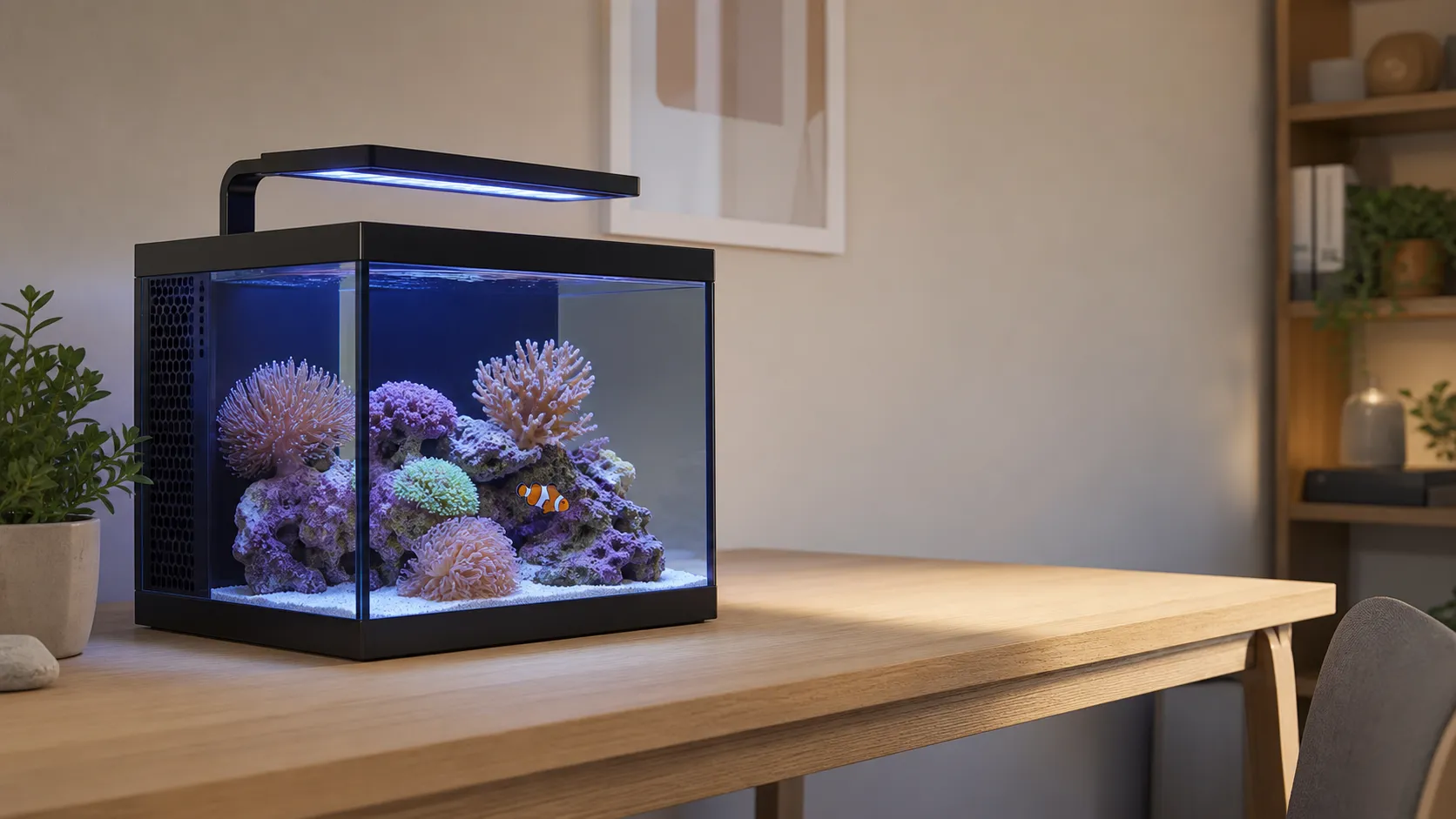
The Fluval Evo 13.5 is one of the most recognizable desktop saltwater aquariums because it solves a real problem: it gives you a clean all-in-one display without a separate sump, cabinet full of plumbing, or oversized light fixture. The compact footprint is appealing, but 13.5 gallons is still a small marine system. The tank is attractive and capable; it is not a maintenance-free reef in a box.
Quick answer: The Fluval Evo 13.5 is worth buying if you want a compact nano reef for one very light fish plan, invertebrates, or lower-light corals and you are willing to test water and top off frequently. The included 14,000 K LED and three-stage rear filtration are a strong starting point.
The comparison below uses published specifications and owner reports. Subjective observations are identified as owner-reported rather than presented as our own measurements.
Fluval Evo 13.5 and the Smart Add-Ons
The tank and the upgrades that actually matter
-
Fluval Evo XII Saltwater Aquarium Kit, 13.5 Gallon
Fluval
13.5-gallon all-in-one saltwater aquarium with a 14,000 K LED, three-stage rear filtration, and integrated pump; heater and livestock supplies are separate.
- 13.5 US gal / 52 L display
- 14,000 K reef-capable LED
- 500 LPH integrated pump
- Best for
- Compact nano reefs for patient beginners and experienced keepers
- Key feature
- Compact all-in-one nano reef platform
-
Fluval M50 Submersible Aquarium Heater, 50W
Fluval
Adjustable 50W submersible heater with a computer-calibrated thermostat, reflective finish, and three-year warranty for fresh or saltwater use.
- 50W rating for aquariums up to 15 US gal
- Adjustable temperature dial
- Reflective finish blends into the tank
- Best for
- Temperature control in the Fluval Evo 13.5 and other tanks up to 15 gallons
- Key feature
- Adjustable heater sized for the Evo 13.5
-
AUTOUTLET Saltwater Aquarium Refractometer with ATC
AUTOUTLET
Manual dual-scale saltwater refractometer with automatic temperature compensation, 0–100 ppt and 1.000–1.070 specific-gravity scales, and setup accessories.
- 0–100 ppt salinity scale
- 1.000–1.070 specific-gravity scale
- Automatic temperature compensation
- Best for
- Affordable salinity checks during setup and weekly maintenance
- Key feature
- Budget dual-scale salinity measurement
-
Fluval Sea CP1 Circulation Pump
Fluval
Compact 1,000 LPH / 265 GPH circulation pump with 270-degree directional adjustment, designed for aquariums up to 15 gallons.
- 265 US GPH / 1,000 LPH maximum flow
- Broad, gentle stream for reef circulation
- 270-degree adjustable direction
- Best for
- Adding broad, adjustable flow after the stock pump leaves dead spots
- Key feature
- Broad supplemental flow for nano reefs
Review the linked product page before purchasing.
What You Get for the Money
Fluval’s product documentation calls the model the Evo Aquarium Kit, Black, 13.5 US Gal / 52 L. The product is also commonly labeled Evo XII or model 10531A1 by retailers. Its strongest selling point is integration: the rear filtration, pump, canopy, and LED are designed as one compact unit, so the front of the aquarium stays visually calm.
The headline specifications are useful, but they need context:
| Specification | Fluval’s published figure | What it means in practice |
|---|---|---|
| Display volume | 13.5 US gal / 52 L | Enough for a small, conservative marine plan; not a community tank |
| Dimensions | 22 in L × 15 in W × 11.5 in H | A desktop footprint, but the filled system still needs a strong, level surface |
| Lighting | 31 LEDs, 1,383 lumens, 14,000 K | Suitable starting light for fish and lower-to-moderate light corals |
| Pump and filter flow | 132 US GPH / 500 LPH | Fine for a light bioload; rockwork can create dead spots |
| Filtration | Foam, carbon, and BioMax media | Mechanical, chemical, and biological stages in the rear compartment |
| Power draw | 16W | Modest consumption for a small all-in-one kit |
These figures come from Fluval’s current Evo product page. The North American instruction manual is worth downloading before setup because it covers the media arrangement, cleaning intervals, and electrical safety.
Included vs. Not Included
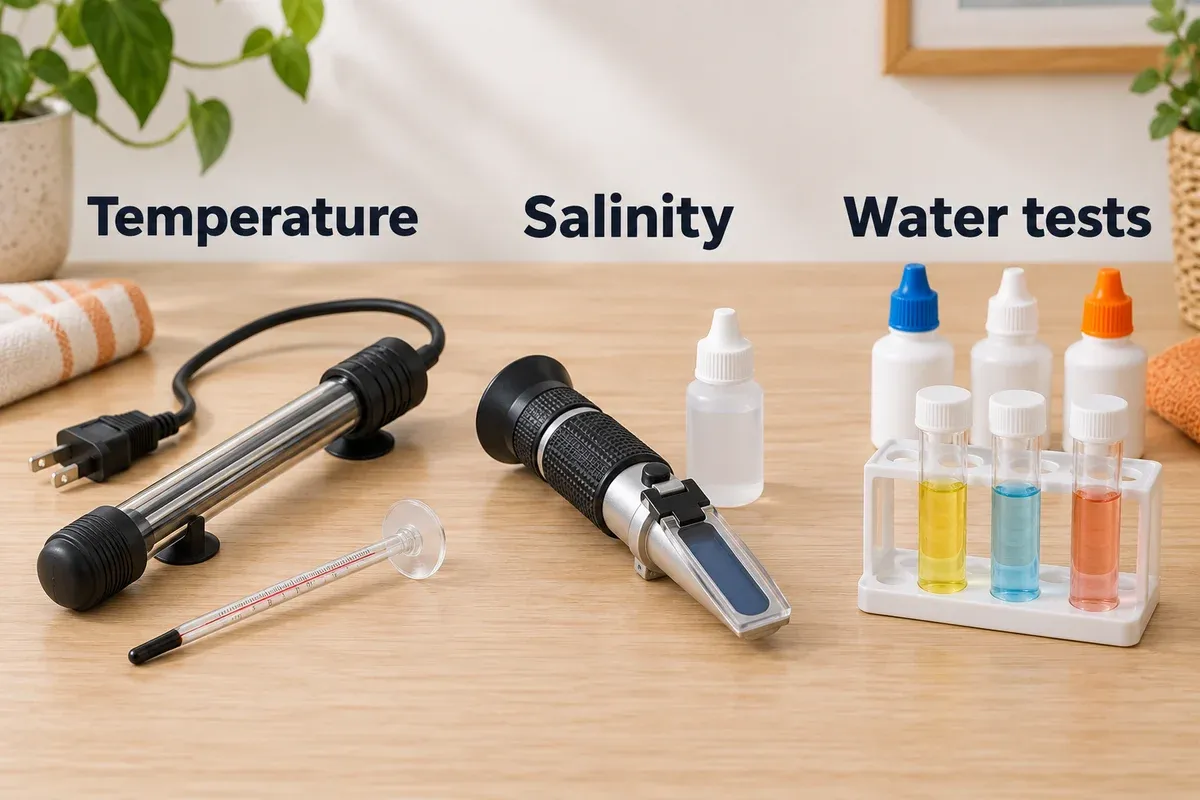
The Evo is an aquarium platform, not a complete saltwater starter bundle. The box gives you the tank hardware and filtration media. You still need to plan the biological and temperature side of the system.
| Included | Buy separately |
|---|---|
| Glass aquarium, canopy, and integrated rear chamber | 50W heater and separate thermometer |
| 14,000 K LED light with touch control | Marine salt and purified or RO/DI water |
| Pump with dual output nozzles | Aragonite sand, live rock or dry rock, and a test kit |
| Foam, carbon, and BioMax media | Salinity refractometer and calibration solution |
| Easy-feed opening | Livestock, cleanup crew, and optional auto top-off |
The distinction matters because the aquarium looks finished on the shelf. It is not ready for fish the moment you add saltwater. You still need to establish the nitrogen cycle, confirm temperature and salinity, and give the tank time to mature.
Check current price on Amazon →These supplies belong in the setup budget alongside the tank and its included hardware.
Design and Day-to-Day Usability
The black frame, canopy, and honeycomb-style rear panel are the reason the Evo still looks current years after its launch. Cables and most filter hardware stay out of sight. The front feed opening is genuinely useful, and the removable cover gives you access to the rear chamber without dismantling the display.
There is one practical warning: a filled 13.5-gallon marine aquarium is heavy. Water alone weighs roughly 112 pounds, before adding glass, rock, sand, and equipment. Put it on a rigid, level surface that can carry the complete load. A narrow desk that flexes under weight is a poor aquarium stand, even if the empty tank fits perfectly.
The compact footprint is also a double-edged sword. It works well in an office or apartment, but the rear chamber leaves limited room for bulky equipment. Small heaters fit the intended layout better than long, high-wattage models. Measure the chamber and route cables before filling the tank; making hardware changes after the rockwork and livestock are in place is unnecessarily stressful.
Filtration: Good Starting Point, Not a Shortcut
The Evo’s three-stage filtration is more useful than a basic internal filter. Foam catches particles, carbon helps with dissolved organics and discoloration, and BioMax provides surface area for beneficial bacteria. The rear compartment keeps that equipment hidden and makes the display look cleaner than a hang-on-back filter would.
The limitation is not the number of stages. It is the small water volume and the amount of biological media available after you add rock, sand, and livestock. A 13.5-gallon reef can look clear while ammonia, nitrite, nitrate, or salinity are moving in the wrong direction. Clear water is not proof that the system is cycled or stable.
For maintenance, rinse the foam in removed aquarium water rather than chlorinated tap water, and do not replace every piece of biological media at once. Replace carbon when it is exhausted or when you need to remove medication and odors; it is a consumable, not a substitute for water changes.
Does It Need a Protein Skimmer?
Usually not on day one. With a low bioload, regular water changes, sensible feeding, and clean mechanical media, many nano reefs can run successfully without a skimmer. The optional Fluval PS2 Mini is more relevant when the tank is heavily fed, carries a higher bioload, or develops persistent surface film and nutrient issues.
Buying a skimmer before the aquarium is cycled often adds noise and tuning work without solving the actual problem. Start with stable basics, then add export equipment only when your testing shows a reason.
Lighting: Reef-Capable with Important Limits
The Evo’s 14,000 K LED is a meaningful advantage over a generic freshwater kit. It produces the blue-white appearance marine keepers expect and can support fish, live rock, and lower-to-moderate light corals when the tank is mature and the animals are placed appropriately.
“Reef-capable” should not be read as “suitable for every coral.” The stock fixture is a sensible entry point for soft corals and other undemanding choices. It is not the reason to buy the Evo if your goal is an SPS-dominated reef, a demanding anemone, or a densely packed coral garden. Those goals may require a different light and better water movement, which can cost more than the original kit.
The touch control is simple, but it is not the same as a programmable sunrise-and-sunset controller. Use a reliable external timer only if it is compatible with your exact setup and electrical safety plan. A consistent light schedule is more useful than running the fixture at maximum intensity all day.
Temperature and Flow Upgrades
The Heater Is the First Necessary Add-On
Fluval specifically lists the M50 50W as the heater for tanks up to 15 US gallons / 50 L. It has an adjustable dial, a reflective finish, and a three-year warranty. In a 13.5-gallon saltwater tank, 50W is a sensible starting size for a normal indoor room, but the correct wattage still depends on the room temperature and how much the tank is covered.
Use a separate thermometer. If the aquarium is in a cold room or the room temperature changes sharply, consider a controller or a second layer of temperature protection rather than simply installing a much larger heater. Any heater can fail in the on position, and a small tank heats up quickly.
Check current price on Amazon →The integrated 500 LPH pump and twin outlets are enough for a lightly stocked tank with open rockwork. Do not add a wave maker just because a reef checklist says every nano needs one. First observe the surface, detritus, and coral movement. If the rockwork creates a dead spot, redirect the returns before adding hardware.
The Fluval Sea CP1 is a reasonable optional upgrade. Fluval rates it for aquariums up to 15 gallons, with a broad 265 GPH / 1,000 LPH stream and 270-degree adjustment. In a 13.5-gallon display, that is a lot of extra flow. Mount it low enough to move water behind the rockwork, aim it across glass rather than directly at animals, and start at the gentlest useful position.
Check current price on Amazon →Salinity and Maintenance Are the Real Review
The Evo’s best feature is its size; its biggest drawback is also its size. Evaporation removes freshwater, not salt. When water evaporates from a nano reef, salinity rises unless you replace that lost volume with fresh purified water. Small daily changes are noticeable in a 13.5-gallon system.
For a reef-oriented setup, aim for a stable specific gravity around 1.025–1.026 at the calibration temperature, or approximately 35 ppt. The exact target should follow the salt mix and livestock plan, but stability matters more than chasing a perfect number. Never use saltwater for evaporation top-off; that compounds the salinity problem.
An inexpensive dual-scale refractometer is more useful than guessing from a hydrometer. The AUTOUTLET model in the table reads specific gravity and parts per thousand and includes automatic temperature compensation. Calibrate it with a proper 35 ppt solution, keep the prism clean, and take readings from a mixed sample rather than from a splash at the waterline.
Check current price on Amazon →A Realistic Maintenance Rhythm
- Daily: Check temperature, water level, fish behavior, and whether the pump is running normally.
- Every few days: Top off evaporation with purified freshwater; in warm, dry rooms this may be daily.
- Weekly: Test salinity and the parameters relevant to your livestock, wipe salt creep, and perform roughly a 10–15% water change if that matches your maintenance plan.
- Monthly: Clean the pump and impeller, inspect the heater, and rinse mechanical media as needed.
- After every change: Recheck temperature and salinity before adding the new water to the display.
If that list already feels like too much work, a larger aquarium may be a better choice. More water volume does not eliminate maintenance, but it gives you a wider buffer when a top-off or water change is delayed.
Stocking: What the Evo 13.5 Can Reasonably Handle
Treat the Evo as a small marine display, not a miniature version of a 100-gallon reef. Add livestock slowly after the cycle is complete, and keep the final bioload conservative. One small fish plan with invertebrates is easier to manage than several fish competing for the same oxygen and filtration capacity.
Avoid tangs, large wrasses, active swimmers, and a collection of fish that would need more horizontal space. Even a fish that fits physically may produce more waste than a 13.5-gallon system can process comfortably. The tank is better suited to a restrained fish-and-invertebrate plan or a coral-focused nano display than to a busy fish community.
For corals, start with hardy, lower-to-moderate light choices after the tank is stable. Place them according to actual light and flow, leave room for growth, and resist the temptation to fill every rock immediately. A new nano reef is easier to correct when the aquascape is open and the bioload is low.
Fluval Evo 13.5 Pros and Cons
Pros:
-
Attractive all-in-one design hides the rear filtration and keeps the front display uncluttered
-
13.5 gallons gives noticeably more stability and stocking room than the 5-gallon Evo V
-
14,000 K LED, foam, carbon, BioMax, canopy, and pump are included
-
Compact enough for an office, apartment, or carefully selected desk
-
Optional upgrades can be added gradually instead of bought all at once
Cons:
- Heater, saltwater supplies, rock, sand, and testing equipment are not included
- Small volume makes evaporation, temperature, and overfeeding mistakes more consequential
- Stock LED is not a universal solution for demanding SPS corals or anemones
- Touch-control lighting lacks the scheduling depth of newer app-controlled fixtures
- Rear chamber space is tight once you add a heater, skimmer, or media basket
- A filled aquarium is heavy even though the empty footprint looks desk-friendly
Who Should Buy It?
Buy the Fluval Evo 13.5 If You Want
- A clean, compact all-in-one saltwater display rather than a custom sump system
- A first nano reef and you are comfortable learning the nitrogen cycle and salinity control
- A small fish-and-invertebrate plan or a lower-light coral focus
- A tank that can start simply and receive upgrades only when testing shows a need
- A proven platform with lots of owner experience and replacement parts
Choose Something Else If You Need
- A low-maintenance aquarium that can be ignored for several days
- Multiple active fish or species that need long swimming lanes
- Strong stock lighting for demanding corals without an upgrade
- A complete box containing heater, salt, rock, sand, and livestock supplies
- Maximum stability from day one; a larger 20–30 gallon system is more forgiving
If you are comparing the Evo with other all-in-one saltwater options, our best saltwater aquarium kits guide explains what a complete kit includes. For a broader freshwater and saltwater starter comparison, see best aquarium starter kits. If you decide to customize the lighting later, our aquarium lighting guide covers the trade-offs.
Fluval Evo 13.5 Setup Plan for the First Month
- Build the dry system first. Level the stand, check the rear chamber, install the pump, and plan cable loops before adding water.
- Mix saltwater separately. Bring the water to temperature and confirm salinity with a calibrated refractometer before filling the display.
- Add rock and sand with room for flow. Do not pack the rear intake or build a wall that blocks the return nozzles.
- Cycle without livestock. Test ammonia and nitrite and follow a complete cycling method. Do not add fish simply because the water looks clear.
- Add a heater and thermometer. Keep temperature stable and check that the heater remains fully submerged as the water level changes.
- Start with a light schedule. Shorter lighting is easier to manage during the early algae phase; increase gradually once the system is stable.
- Add livestock one step at a time. Give the biofilter time to adjust after each addition and continue testing.
- Add the CP1 or an auto top-off only when the problem is clear. Extra equipment should solve a measured issue, not create more points of failure.
Frequently Asked Questions
Is the Fluval Evo 13.5 good for beginners?
It can be a good first saltwater aquarium for a patient beginner, but it is not the easiest possible marine system. The all-in-one hardware removes equipment-matching work; it does not remove cycling, testing, salinity control, or water changes. If you want more buffer against mistakes, choose a larger tank.
Does the Fluval Evo 13.5 include a heater?
No. Fluval’s Evo product page identifies the M Series 50W heater as the compatible add-on for the 13.5-gallon model. You will also want a separate thermometer and a safe way to protect the heater from running dry.
Can the stock light grow coral?
It can support fish and lower-to-moderate light corals when the tank is stable and the coral is placed appropriately. Do not assume that “reef-capable” means it will provide enough light for demanding SPS corals or anemones. Verify the needs of each coral and upgrade the light if your livestock plan requires it.
Does the Evo 13.5 need a protein skimmer?
Not automatically. A low-bioload tank with regular water changes can run without a skimmer. Consider one later if your bioload, feeding, or nutrient measurements justify the added tuning and maintenance.
How many fish can go in a Fluval Evo 13.5?
Use a conservative stocking plan rather than a fixed fish count. One small fish plan with invertebrates is easier to keep stable than several active fish. Avoid tangs, large wrasses, and fish that need substantial swimming space.
How often should I change water in the Evo 13.5?
Many owners use a weekly 10–15% change as a practical starting point, then adjust based on testing and livestock. The important part is consistency: match temperature and salinity before adding replacement water, and do not let evaporation turn into a salinity swing.
Is the Fluval Evo 13.5 better than the 5-gallon Evo V?
For saltwater, usually yes. The 13.5-gallon model gives you more water volume, more display space, and a larger margin for small mistakes. It still needs careful maintenance, but the 5-gallon Evo V is even less forgiving and offers much less stocking flexibility.
Final Verdict: A Good Nano-Reef Platform with a Learning Curve
The Fluval Evo 13.5 remains a sensible buy because its strengths are practical: a tidy all-in-one design, capable starting filtration, an attractive marine LED, and enough volume to be more manageable than ultra-small desktop tanks.
Our recommendation is yes, with conditions. Buy it if you like the compact format, will budget for a heater and testing gear, and want to keep the final stocking plan light. Skip it if you want to add several fish, grow demanding corals under the stock light, or leave the aquarium unattended for days at a time. In those cases, spend the extra money on a larger system before you spend it on upgrades.
Check current price on Amazon →Sources and Research Notes
- Fluval’s official Evo Aquarium Kit specifications were used for capacity, dimensions, lighting, pump output, filtration, and included media.
- Fluval’s North American Evo instruction manual was used for setup and maintenance context.
Those reports are not treated as controlled testing.