

 Published sources
 Product details checked
With two or more cats, a litter box can go from clean to overloaded before you have finished your morning coffee. An automatic model can reduce the scooping, but the right choice for a multi-cat home is not simply the one with the biggest waste drawer. Cat size, entrance design, safety sensing, cleaning speed, litter compatibility, and the way your cats share space all matter.
Quick answer: The Litter-Robot 4 Supply Bundle is the strongest all-around choice for a busy home with up to four average-size cats. The PETLIBRO Luma is the most interesting option for individual cat recognition and activity tracking. The Neakasa M1 Plus is the better fit for large cats or cats that dislike enclosed boxes, while the PETKIT PuraMax 2 offers the best value for average-size cats. The UPFAS Automatic is best treated as a low-cost second station, not as the only box for a large or very busy household.
The comparison uses published specifications and owner reports; it does not represent hands-on testing of every model.
In this guide, you will learn:
- Which automatic litter boxes are genuinely practical for two, three, or four cats
- How to interpret one-cat capacity claims in a multi-cat home
- Which models fit large cats, kittens, older cats, or cats that prefer open space
- Why an automatic unit does not replace the usual multi-box setup
- How to transition cats safely and keep a robot from becoming the only point of failure
Quick Comparison Table
-
Litter-Robot 4 Supply Bundle
Whisker
Premium self-cleaning litter box with app control, weight tracking, and comprehensive supply bundle included.
- Automatic sifting separates waste from clean litter
- WiFi app tracks visits and weight trends
- Sealed, carbon-filtered waste drawer
- Best for
- Multi-cat households, large cats, convenience-focused owners
- Waste capacity
- Up to 8 days for one cat; less in multi-cat homes
-
PETLIBRO Luma AI Automatic Litter Box
PETLIBRO
Next-generation AI-powered litter box with health monitoring, multi-cat recognition, and advanced odor control.
- AI camera recognizes individual cats and records litter-box activity
- Waste drawer holds about 2.9 gallons / 11 liters
- Multi-cat recognition (up to 10 cats with personalized tracking)
- Best for
- Tech-savvy owners, multi-cat households, health monitoring focus
- Waste capacity
- About 11 L; up to 7 days for two cats per manufacturer guidance
-
Neakasa M1 Plus Open-Top Self-Cleaning Cat Litter Box
Neakasa
Open-top automatic litter box with a generous entry and large published weight range for multi-cat homes.
- Open-top design is easier for large or hesitant cats
- 11.23 L waste bin and 7.17 L litter capacity
- Published cat weight range of 2.2-33 lbs
- Best for
- Large cats and homes that prefer an open entrance
- Waste capacity
- 11.23 L waste bin; up to 14 days for one cat
-
PETKIT PuraMax 2 Automatic Self-Cleaning Cat Litter Box
PETKIT
Compact automatic litter box with a lower entry, app control, safety sensors, and a strong mid-range price.
- 7 L waste bin with a manufacturer claim of up to 15 days for one cat
- Low entrance helps kittens and older cats
- Triple odor-control approach and anti-leakage design
- Best for
- Value-focused homes with average-size cats
- Waste capacity
- 7 L waste bin; up to 15 days for one cat
-
UPFAS Automatic Self-Cleaning Cat Litter Box
UPFAS
Low-cost automatic litter box with app monitoring for owners who need an entry-level second station.
- Lowest upfront price in this roundup
- App monitoring and automatic cleaning
- Safety sensors and washable components
- Best for
- Budget buyers with two average-size cats
- Waste capacity
- Medium-cat product information; verify current bin details
Review the linked product page before purchasing.
Our Picks at a Glance
Best Overall: Litter-Robot 4 Supply Bundle
Check current price on Amazon →The Litter-Robot 4 is the most balanced choice when several cats share one primary automatic station. Its enclosed sifting cycle separates clumps from clean litter, the sealed waste drawer keeps the mess contained, and the app can track visits and weight trends. The supply bundle also includes useful consumables, which makes the setup easier to evaluate.
Best for: Homes with up to four average-size cats, owners who want a mature app ecosystem, and households that value a contained waste drawer over an open-top design.
Why it stands out for multiple cats
Whisker publishes support for up to four cats weighing 3–25 pounds. The entry measures about 15.75 by 15.75 inches, and the unit is designed around clumping litter. The app’s visit and weight history is useful when you want to notice that one cat has stopped using the box or is making unusually frequent visits. It is a monitoring aid, not a diagnosis, but that distinction still makes the data valuable in a multi-cat home where it can be difficult to tell which cat used the box.
The bundle includes three OdorTrap refills, ten liners, 30 wipes, and carbon filters. Those supplies do not make the unit maintenance-free, but they reduce the number of separate items to order during setup. Whisker’s official product page also lists a 90-day in-home trial and a one-year warranty for the base product; verify the exact terms for the product you choose before buying.
Limitations to plan for
The Litter-Robot 4 is large and needs a firm, level surface. It is not a good candidate for a soft, uneven carpet unless you add an appropriate stable platform. Its advertised capacity is up to eight days for one cat, so a home with two to four cats should expect a shorter emptying interval. Do not plan a vacation around the one-cat maximum.
The unit also counts as one litter-box location. If you have two cats, it should usually be one part of a larger setup rather than the only toilet in the home. A cat that is startled by a rotating mechanism may also need a traditional box during the transition.
Bottom line: Choose the Litter-Robot 4 if you want the strongest combination of multi-cat capacity, activity tracking, containment, and established support—and you are comfortable paying a premium for it.
Best for Individual Cat Tracking: PETLIBRO Luma AI Automatic Litter Box
Check current price on Amazon →The PETLIBRO Luma takes a different approach from a basic automatic sifter. Its camera and app are designed to recognize individual cats and organize litter-box activity by profile. That makes it particularly interesting for homes where one cat needs closer observation, such as a senior cat or a cat with a known urinary or digestive history.
Best for: Multi-cat households that want cat-by-cat activity data and an open-top entrance, especially when the cats are within the published 2.2–22-pound range.
What the Luma adds
PETLIBRO publishes a 2.9-gallon, roughly 11-liter sealed waste drawer, recognition for up to ten cats, and an entry measuring about 17.4 inches. The company says the drawer can cover up to seven days for two cats under its guidance.
The open-top layout provides a wide visual field and avoids the tunnel-like feeling some cats dislike. It also makes it easier for you to see whether the drum needs topping up or cleaning. PETLIBRO lists 2.4 GHz and 5 GHz WiFi support, while the published noise range is approximately 35–47 dB.
What to watch
This is a technology-forward product, so it makes the most sense if you will actually use the app and review the logs. A camera-based identification system can misread cats, especially when they are similar in size or move together. Treat the profile data as a helpful signal rather than a medical record.
The “up to ten cats” figure describes recognition capacity, not a recommendation to place ten cats on one machine. Keep additional boxes in separate locations, and empty the drawer before it reaches the limit.
Bottom line: The Luma is the best match when knowing which cat used the box matters almost as much as reducing scooping.
Best Open-Top Choice for Large Cats: Neakasa M1 Plus
Check current price on Amazon →The Neakasa M1 Plus is the easiest recommendation here for a large cat that feels cramped in a covered robot. Its open-top format gives a broad approach, a lower visual barrier, and more room to turn. The published weight range extends up to 33 pounds, which gives it more headroom than many enclosed alternatives on paper.
Best for: Maine Coons, Ragdolls, and other large cats; cats that prefer an open view; homes that can tolerate some additional litter scatter.
Capacity and fit
Neakasa publishes an 11.23-liter waste bin and 7.17-liter litter capacity, with a maximum claim of up to 14 days for one cat. The unit is about 23.3 by 20.7 by 20.2 inches, weighs approximately 22.81 pounds, and has a published entry height of 13.86 inches. Those dimensions are more relevant to a large cat than the marketing day count: a wide opening and enough turning room can determine whether a cat uses the machine consistently.
For two or three cats, treat the 14-day number as an upper bound for a single low-use cat. A busy household will fill the drawer much sooner. Check the waste level daily during the first week, then set your own emptying rhythm based on what you see rather than on the headline number.
Trade-offs of the open design
Open-top machines can be easier to accept, but they do not contain litter and odors as completely as a sealed enclosure. A tracking mat placed in front of the unit is worthwhile, and the surrounding floor should be easy to vacuum.
Bottom line: Pick the Neakasa M1 Plus when physical access and large-cat comfort are more important than a fully enclosed design or the lowest ongoing footprint.
Best Value for Average-Size Cats: PETKIT PuraMax 2
Check current price on Amazon →The PuraMax 2 offers the most convincing middle ground in this comparison. It has app control, safety sensors, a low entrance, and odor-control features without the full feature load of the two premium choices. It is a practical starting point for two average-size cats when your home has enough room for additional traditional boxes.
Best for: Average-size cats, budget-conscious owners, and homes that want an automatic primary station without paying for camera-based tracking.
Where the value comes from
PETKIT lists a 7-liter waste bin and up to 15 days for one cat. It also publishes a low-entry design, triple odor control, and anti-leakage protection.
The PuraMax 2 is relatively compact at about 24.41 by 21.18 by 21.73 inches. It uses 2.4 GHz WiFi for connected features, so it is important to confirm that your router has a compatible network during setup. The app can help with cleaning status and activity trends, but it does not provide the same individual-cat recognition focus as the Luma.
Where it falls short
The 15-day figure is a one-cat maximum, not a realistic two- or three-cat promise. The low entrance helps smaller or older cats but does not automatically mean the internal turning space will suit a very large breed. If you have three or more cats, or if one cat is especially large, the Litter-Robot 4 or Neakasa M1 Plus is a safer first comparison.
Bottom line: The PuraMax 2 is the sensible value pick when you want useful automation and safety features for average-size cats, while keeping enough conventional boxes elsewhere in the home.
Best Budget Second Station: UPFAS Automatic Self-Cleaning Litter Box
Check current price on Amazon →The UPFAS is included for a narrower use case: a low-cost second automatic station for two average-size cats. It is also the product in this roundup that needs the clearest boundaries.
Best for: A budget-conscious home with medium-size cats that wants to add automation without replacing every existing box.
Product documentation describes the model for medium cats and kittens, and it may require assembly. That is not enough information to recommend it for a Maine Coon, a high-volume three-plus-cat household, or a home where a single jammed machine would leave no alternative.
The useful role for this model is as an additional station: keep a dependable regular box available, place the UPFAS in a separate quiet location, and watch whether every cat can enter, turn, and leave comfortably. If your cats are large, skip this option and spend more on a model with clearly published large-cat dimensions.
Bottom line: The UPFAS can make sense as a low-risk budget experiment or supplemental station, but it is not the strongest choice as the only automatic box in a multi-cat home.
How Many Litter Boxes Do Multiple Cats Need?
An automatic litter box is a cleaning appliance, not a waiver from basic feline behavior needs. The ASPCA and Cornell Feline Health Center both point owners toward the familiar rule of one box per cat plus one extra, placed in quiet and accessible locations. The American Association of Feline Practitioners’ behavior guidelines also emphasize multiple locations, escape routes, and boxes large enough for the cat to turn comfortably.
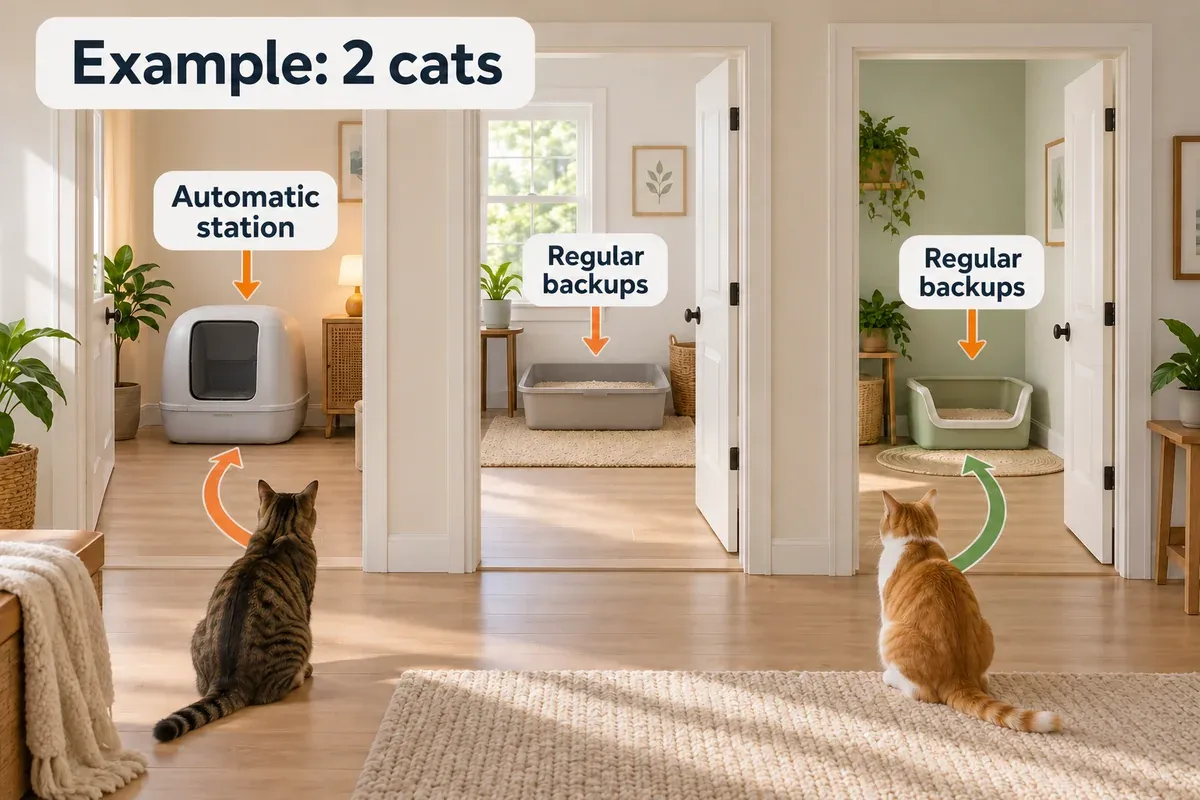
That means a two-cat home should usually begin with three total boxes, even if one is automatic. A three-cat home should usually plan for four. They do not all need to be expensive robots. One automatic box plus two large, easy-to-clean traditional boxes can be a more stable setup than two robots clustered together in one room.
| Household | Sensible starting setup | Why it works |
|---|---|---|
| Two average-size cats | One automatic box plus two regular boxes | Gives cats choice and provides a backup during cleaning or a power outage |
| Two large or selective cats | One large/open automatic box plus two oversized regular boxes | Protects access if one cat dislikes the mechanism or the entrance |
| Three cats | One automatic box plus three regular boxes, or two automatic plus two regular boxes | Spreads traffic across locations instead of concentrating every visit in one machine |
| Senior cat or cat with health concerns | Low-entry box near the cat’s main living area plus other boxes | Reduces stairs and makes behavior changes easier to notice |
Some homes can use fewer boxes successfully, but that is a behavior result to observe, not a promise to buy around. If one cat blocks access, guards the hallway, or refuses the automatic cycle, add a box in another location before changing litter or blaming the machine.
How to Choose an Automatic Litter Box for a Multi-Cat Home
Start with the largest cat, not the smallest one
The usable interior matters more than the outside dimensions. A cat should be able to enter, turn around, squat, and leave without pressing against the walls or the rotating mechanism. The FelineVMA guide recommends a box about one and a half times the cat’s body length, measured from nose to the base of the tail. Many automatic boxes are smaller inside than their product photos suggest.
For a large breed, compare the entrance height, opening width, drum or tray shape, and the space above the litter—not only the published weight limit. The Neakasa M1 Plus is the most forgiving pick in this list for a cat that wants an open view. The Litter-Robot 4 has a generous published entrance, while the PuraMax 2 and UPFAS need more careful fit checks for large cats.
Convert capacity claims into a multi-cat schedule
Manufacturers usually publish a best-case one-cat number. The safe way to use it is as an upper bound, then shorten it for the number and size of cats using the machine. A drawer advertised for 14 days for one cat will not reliably last 14 days for three cats. Large clumps, high urine output, and a cat that visits frequently shorten the interval further.
For the first week, check the waste drawer every day and record how quickly it fills. Empty it before it becomes hard to move or before the machine starts leaving clean litter behind. Keep spare liners, filters, and the correct litter nearby so a full drawer does not turn into a missed cleaning cycle.
Check litter compatibility before you commit
Most rotating or sifting machines work best with a clumping litter that forms firm clumps. Loose, weak clumps can break apart during a cycle and leave residue on the grate or inside the drum. Crystal, pine, paper, tofu, and mixed litters are not interchangeable across models, so follow the manual rather than assuming that a litter marketed for another robot will work.
Unscented, fine-grained litter is also the safer starting point for a cat that is hesitant about a new box. Scented litter and abrupt texture changes can create avoidance even when the machine itself is working correctly.
Treat safety sensors as a requirement, not a bonus
Look for weight sensing, infrared or optical sensors, anti-pinch protection, and a cleaning delay after a visit. Do not run an automatic cycle with a kitten or very small cat until the manufacturer says the model can identify that weight safely. A cat that is still learning to use the device should have the automatic cycle paused or manually controlled during acclimation.
No safety system removes the need to inspect the unit. Check for stuck clumps, a blocked chute, litter around the sensor area, and a waste drawer that is not seated correctly. In a multi-cat home, the machine gets more use and small problems appear sooner.
Compare the real maintenance burden
The upfront cost is only the first number. Also consider liners, odor filters, odor-control cartridges, replacement mats, app subscriptions if applicable, electricity, and the time needed to disassemble and wash the waste path. A simpler robot that needs frequent troubleshooting may cost more of your time than a premium machine that runs predictably.
The Litter-Robot 4 supply bundle is helpful because it includes several consumables. The PuraMax 2 may cost less to enter but still needs regular bags and cleaning. The open-top Neakasa M1 Plus can reduce enclosure anxiety while increasing the need for floor cleanup. Those are different trade-offs, not a universal ranking.
Plan for power and internet interruptions
Choose a location where a short WiFi outage will not trap your cats without another option. The mechanical cleaning cycle and app connection are separate concerns on some models, but a router issue can still remove your monitoring view. Keep at least one regular box available, especially during travel, storms, or firmware updates.
How to Introduce an Automatic Litter Box to Multiple Cats
- Set it up beside a familiar box. Do not remove the old box on day one. Let the cats investigate the new shape while their normal bathroom remains available.
- Use the same unscented litter at first. A familiar texture makes it easier to tell whether a cat dislikes the machine or the litter change.
- Leave the automatic cycle off initially. Allow each cat to enter and leave without the unit moving. Follow the product manual for the recommended acclimation period.
- Turn on cleaning after successful visits. Start with a longer delay and observe from a distance. A sudden motor or rotation can frighten a cautious cat.
- Keep the old box for longer than you think. Remove it only after every cat uses the new unit reliably and you still have the recommended number of boxes elsewhere.
- Watch the individual cats, not the average household behavior. One confident cat using the robot does not prove that a timid cat accepts it.
If a cat stops using the box, urinates outside it, strains, or visits repeatedly with little output, pause the transition and contact a veterinarian. House-soiling can have medical causes; the ASPCA litter-box guidance and Cornell’s house-soiling guide are good starting points, not substitutes for an exam.
Frequently Asked Questions
Can one automatic litter box serve multiple cats?
It can handle traffic from multiple cats, but it should not automatically become the only litter box. Start with one box per cat plus one extra across the home. If the automatic unit becomes a favorite, you can observe traffic and adjust gradually, but keep a backup available for a power failure, cleaning, or a cat that dislikes the cycle.
How many automatic litter boxes do I need for two cats?
One automatic unit can be a useful primary station for two cats, but a stable starting setup is one automatic box plus two regular boxes in separate locations. Add a second automatic unit only if traffic is high, one cat is avoiding the shared station, or your home layout makes the other boxes hard to reach.
How often should I empty an automatic litter box with two or more cats?
Use the manufacturer’s one-cat capacity as a maximum, then shorten the interval for the number and size of cats using the unit. Inspect the drawer every day during the first week. Your cats’ actual clump volume is more reliable than a headline claim, and a full drawer can cause rejected cycles, odor, or litter left behind.
What is the best automatic litter box for large cats?
The Neakasa M1 Plus is the easiest fit in this roundup for a large cat because of its open-top design and published 2.2–33-pound range. The Litter-Robot 4 is another strong option with a wide published entry and up-to-four-cat support. Always compare usable interior space with your cat’s body length and turning posture.
Are automatic litter boxes safe for kittens?
Only when the specific model’s weight and age guidance says they are. Many automatic units need a minimum weight for their sensors to detect a cat reliably. Keep the cycle paused for a kitten below that threshold and provide a normal box until the kitten is large enough for the manufacturer’s safety instructions.
Do automatic litter boxes stop litter-box odor in a multi-cat home?
They can reduce the time waste sits in the open, but they cannot remove odor from an overfilled drawer, dirty waste path, damp litter, or an undersized setup. Empty the drawer on a schedule, wash the parts the manual allows, use the correct litter, and keep additional boxes clean. Our guide to reducing litter-box smell covers the room-level fixes that a robot cannot solve.
Is health tracking on a litter box a diagnosis?
No. Weight and visit changes can help you notice a pattern, especially when several cats share a home, but they do not identify the cause. A sudden change in urination, straining, repeated visits, blood, or house-soiling warrants veterinary advice.
Final Verdict
For most multi-cat homes, the Litter-Robot 4 Supply Bundle is the best overall investment because it combines a mature cleaning system, useful activity data, a sealed waste drawer, and published support for up to four cats. Choose the PETLIBRO Luma if identifying individual cats is your priority. Choose the Neakasa M1 Plus for large cats or an open-top preference, and the PETKIT PuraMax 2 when you want a more affordable automatic primary station for average-size cats. The UPFAS is best reserved for a budget second station and medium-size cats.
Whichever model you choose, make the purchase part of a multi-box plan. The most reliable multi-cat setup is the one that still works when the drawer is full, the app is offline, a cat rejects the motor, or the machine needs a deep clean.