

 Published sources
 Product details checked
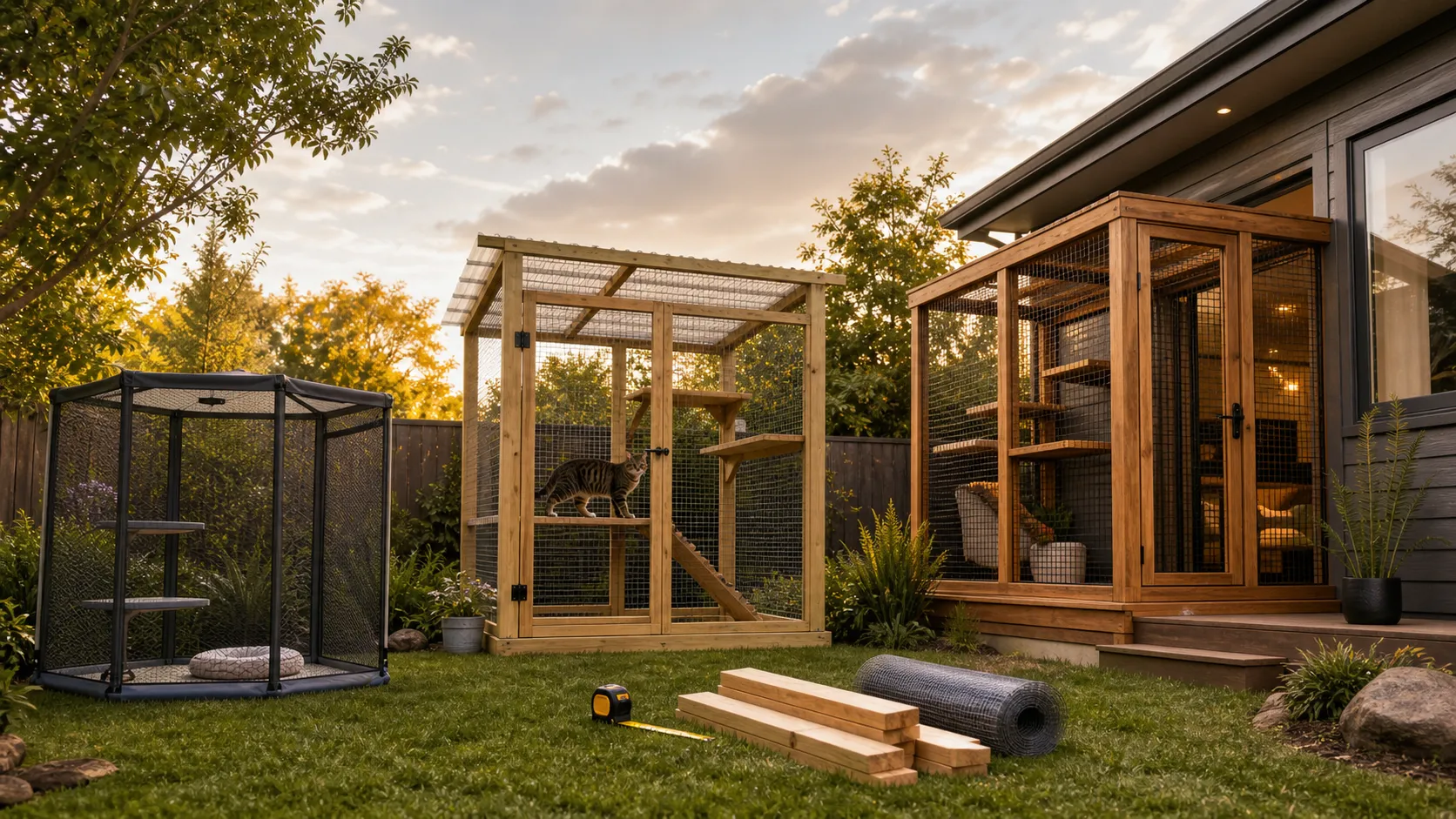
A catio can be a soft-sided mesh kit, a carefully anchored wood frame, or a small addition built onto your house. Those options can all give a cat safer outdoor access, but they do not belong in the same budget bucket. The frame is only part of the bill: mesh, roof protection, access, anchors, shelves, tools, shipping, and labor often decide the final number.
Quick answer: Plan on roughly $100–$180 for a portable starter kit, $175–$500 for a ready-made mobile or walk-in unit before site work, $400–$1,200 in DIY materials for a small permanent catio, and $1,200–$4,000+ for a professionally built attached or custom enclosure. These are planning ranges, not quotes.
Humane World for Animals notes that catios can cost anywhere from under $100 to thousands of dollars. Its advice is useful for the first budget decision: kits are convenient when you do not have carpentry tools, while a custom build makes more sense when the space, access point, or weather requirements are unusual. This guide turns that broad range into a line-by-line budget and shows how kit and custom-build choices affect the total.
Catio Cost at a Glance
The table below separates the enclosure itself from the costs that are easy to forget. A “kit” can look inexpensive until you add a tunnel, a roof panel, ground anchors, or a safer connection to a window.
| Catio path | Planning range | Usually includes | Common additions |
|---|---|---|---|
| Portable mesh kit | $100–$180 | Mesh walls, fabric frame, basic platforms or cubes | Ground stakes, shade, weather cover, tunnel, replacement mesh |
| Mobile or prebuilt wood kit | $175–$500 | Frame, roof, doors, platforms, hardware | Anchoring, shipping, window connection, weather sealing, extra shelves |
| DIY small permanent build | $400–$1,200 in materials | Lumber, rigid mesh, roof, door, fasteners, basic enrichment | New tools, foundation work, permits, paid help, premium roof |
| Custom attached or walk-in build | $1,200–$4,000+ | Site-specific design, structure, roof, access, finish | Contractor labor, electrical work, masonry, complex flashing, permit fees |
The last line is deliberately wide. A simple freestanding structure assembled by a handy homeowner is not comparable with a weather-tight room attached to a wall. Get a local quote for any work that changes a door, window, siding, roof, foundation, or electrical connection.
Ready-Made Options as Budget Anchors
These products are included as budget anchors, not as a ranking. The existing outdoor cat enclosure and catio comparison covers the larger product-by-product differences. Here, the question is what kind of expense each format creates after you account for setup, weather, and enrichment.
Catio kits and add-ons
-
Kitty City Outdoor Catio Mega Kit
Kitty City
Portable outdoor catio kit with enclosed nylon mesh and rearrangeable cubby cubes. It removes lumber cutting from the first setup, but it is not the same as a rigid, permanently anchored enclosure.
- Enclosed nylon mesh construction
- Rearrangeable cubby cubes
- Modular portable layout
- Best for
- Lowest-cost modular mesh starter kit for supervised outdoor use
-
Rywell Extra Large Foldable Catio Outdoor Cat Tent
Rywell
Lightweight 3-tier foldable tent-style catio with 300D Oxford fabric mesh, reinforced steel frame, 5 windows, UV-resistant waterproof roof cover, and included carry bag for easy transport.
- Fully enclosed 3-tier tent design
- 5 interactive windows/openings
- Large zip door on side for easy access
- Best for
- Travel, camping, apartment balconies, portable indoor-outdoor use, multi-cat households
-
Aivituvin Mobile Cat Catio on Wheels (62.8" Single)
Aivituvin
Mobile wooden catio on 4 wheels for easy indoor-to-outdoor movement. Features waterproof asphalt roof, 3-tier design with platforms and hammock, window attachment capability, and ability to combine multiple units.
- Mobile 4-wheel design - moves freely on grass
- Waterproof asphalt roof
- 3-tier construction with 3 platforms
- Best for
- Mobile indoor-to-outdoor cat access, single cats, renters needing flexible setups
-
FunXplore 71.1" Large Cat Catio Outdoor Enclosure
FunXplore
Large walk-in catio with flip-friendly weatherproof roof, 6 access doors, elevated shelf design, 4 multi-tiered observation decks, sisal scratching post, dual hideaways, and aerial crossing bridge. Capacity for up to 8 cats.
- Walk-in full-height 67" front door (no bending)
- Weatherproof flip-friendly asphalt roof
- 6 access doors including window connections
- Best for
- Large multi-cat households, walk-in access, weatherproof outdoor protection
-
Aivituvin Large 4-Tier Cat Catio with Weatherproof Roof
Aivituvin
Premium 4-tier wooden catio with 3 resting rooms, 5 windows (4 acrylic + 1 sliding), 3 platforms, spacious layout, and upgraded tall entry door at 65.8" for easy access and cleaning. Features safer latches and strengthened platforms.
- 4-tier loft design with maximum space
- 3 resting rooms for privacy
- 5 windows (4 acrylic + 1 sliding window)
- Best for
- Large multi-cat families, indoor-outdoor access, maximum climbing space
-
Omlet Catio Outdoor Cat Enclosure
Omlet
A modular, flat-packed steel-mesh catio that starts at 6 by 6 feet and can be expanded with covers, tunnels, and climbing accessories.
- Starts at 6 by 6 feet with a 6-foot-8-inch center height
- Heavy-duty welded steel mesh and modular sizing
- Optional tunnel, weather covers, and outdoor cat-tree accessories
- Best for
- A customizable walk-in steel-mesh catio for a long-term yard setup
-
Kitty City Outdoor Catio 10-Foot Cat Tunnel
Kitty City
Ten-foot, cat-sized play tunnel with an 11-inch diameter, designed as a modular connector for the Kitty City outdoor system. It adds route length and enrichment; it is not a complete enclosure or a structural barrier by itself.
- 10-foot tunnel length
- 11-inch cat-sized diameter
- Modular catio connector
- Best for
- Low-cost access and enrichment add-on for a compatible Kitty City setup
Review the linked product page before purchasing.
The low-entry option: Kitty City Outdoor Catio Mega Kit
That low price buys convenience and modularity, not a permanent backyard room. The enclosed nylon mesh and rearrangeable cubby cubes make it useful for a balcony, patio, or supervised trial. They do not provide the same rigid frame, roof load capacity, latch security, or anchoring options as a timber catio. Inspect seams and zippers, keep the enclosure stable, and bring it in when the weather or local predator risk makes the setup unsuitable.
Check current price on Amazon →The portable fabric comparison: Rywell Extra Large Foldable Catio
The Rywell format sits in the same broad price neighborhood but uses a taller, three-tier foldable tent design with a steel frame, 300D Oxford fabric mesh, five openings, and a weather-resistant roof cover.
This is a practical choice when storage, travel, camping, or a rental apartment matters more than a permanent connection to the house. Budget for anchoring and acclimation time: a cat can move a lightweight enclosure, and a new outdoor route should not be treated as secure until you have checked every opening and watched the cat use it.
Check current price on Amazon →The mobile wood middle ground: Aivituvin on wheels
The Aivituvin mobile unit is a useful example of why “kit” does not always mean fabric. It has a fir-wood frame, an asphalt roof, four swivel wheels, three tiers, a resting house, and platforms.
The wheels make repositioning easier, but they do not automatically make the unit safe in wind or on a slope. Treat wheels as a setup convenience, not as anchoring. If the unit sits outside, check the wheel locks, level the base, and use an appropriate anchor method for the surface.
The prebuilt walk-in baseline: FunXplore and larger wood catios
A walk-in wood unit changes the labor calculation. The Aivituvin four-tier and PetsCosset 71-inch options sit in the same broader “large prebuilt” comparison group.
These products can be cheaper than a custom build when the dimensions work and you can assemble the structure yourself. They still need a level location, a plan for wind and snow, and a safe connection if the catio touches a window or door. A prebuilt roof is not proof that the entire structure is suitable for your climate.
The configurable steel baseline: Omlet Catio
Omlet’s modular steel-mesh system is useful when a fixed wooden kit does not match the planned footprint. The current product page says the system starts at 6 × 6 feet, has a 6-foot-8-inch center height, and can add tunnels, covers, and climbing accessories. Build the budget from the exact configuration in the cart rather than treating the starter footprint as the final cost.
Configure the Omlet Catio →The inexpensive add-on: Kitty City 10-foot tunnel
Check current price on Amazon →What a DIY Catio Actually Costs
The most useful DIY estimate is not “lumber plus wire.” It is a short bill of materials with a separate line for access and weather.
| DIY component | Small-build planning range | What changes the cost |
|---|---|---|
| Frame lumber or rigid panels | Footprint, cedar versus treated lumber, height, double framing | |
| Cat-safe mesh and attachment | Surface area, rigid welded mesh, corrosion resistance, staples, trim | |
| Roof and rain protection | Solid roof area, snow load, flashing, gutters, shade panels | |
| Door, window link, or tunnel | Human-size door, cat flap, wall penetration, tunnel length | |
| Shelves and enrichment | Number of levels, outdoor-rated surfaces, ramps, beds, scratchers | |
| Anchors, fasteners, finish, and drainage | Soil or concrete, wind exposure, pet-safe finish, ground clearance | |
| Tools | Existing saw and drill versus buying or renting everything |
For a small 4-by-6-foot attached or freestanding project, a realistic materials worksheet might look like this:
| Line item | Example allowance |
|---|---|
| Frame and bracing | |
| Rigid mesh, staples, and trim | |
| Roof panel and weather detailing | |
| Door or house connection | |
| Shelves, ramp, and washable perch | |
| Anchors, screws, finish, and drainage details | |
| Contingency for waste and replacements | |
| Materials total with tools already owned | About $720 |
That is a planning example, not a shopping cart or a contractor quote. If you already have a saw, drill, level, clamps, and staple gun, the project may stay near the materials total. If you must buy or rent tools, add that cost separately. A kit can be financially sensible even when its sticker price is higher because it replaces cutting, measuring, and some of the first-round mistakes.
The BC SPCA stand-alone catio plan shows why a permanent build needs more than a few rolls of netting. Its example shopping list includes cedar framing, roof plywood, screws, stainless or galvanized wire mesh, staples, and the tools to cut and attach everything.
Mesh, Roof, and Access: Where the Budget Becomes Safety
Mesh is a barrier, not a decoration
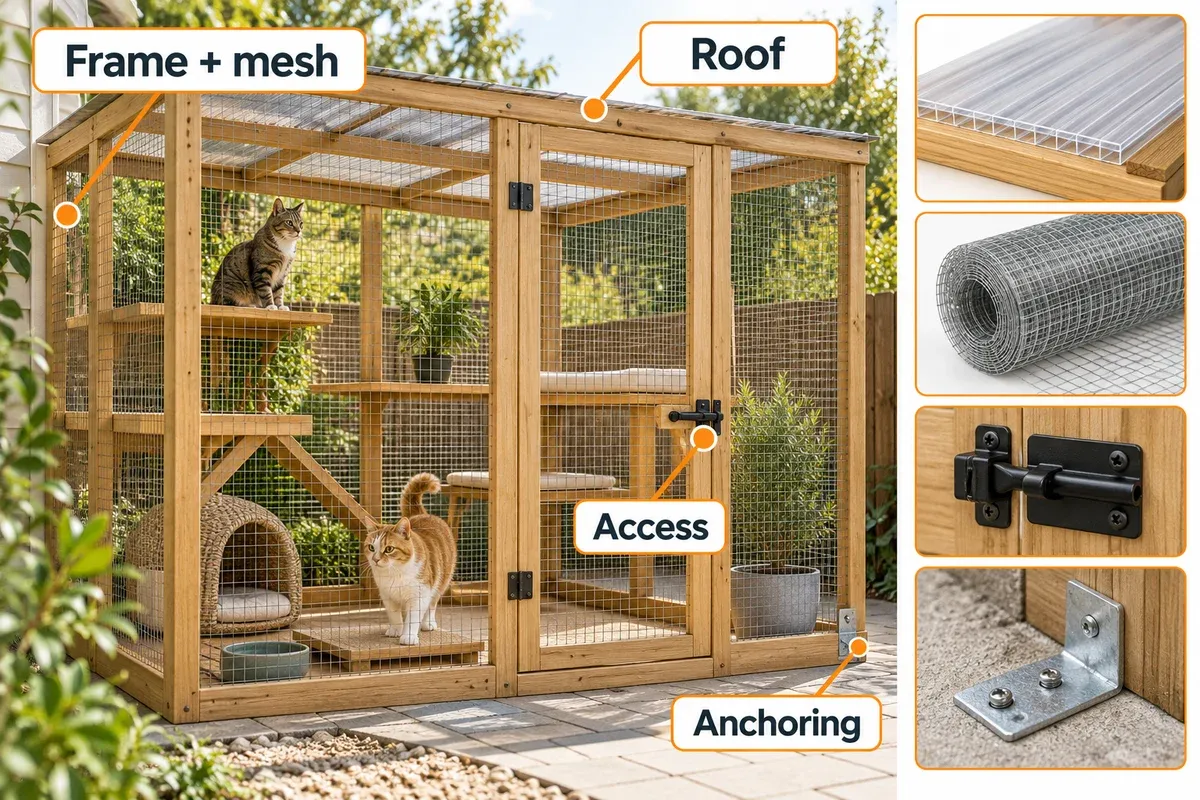
The mesh has to close the walls and roof, stay attached under pressure, and resist the corrosion your climate brings. The BC SPCA example lists 1-by-1-inch stainless or galvanized wire mesh. Use that as a reference point for the plan, not as a universal answer: the right opening, wire gauge, coating, and attachment method depend on the cat, the enclosure, local predators, and the structure.
Do a physical inspection before the first outdoor session. Push on every panel, check the bottom edge, look for a gap under the door, and run a hand over cut ends and staples. Trim or cover anything sharp. A soft window screen is not a substitute for a rigid enclosure mesh when a cat can push against it.
A roof changes the project
A roof keeps cats shaded and dry, but it also adds wind load and weight. A full solid roof can be worthwhile in snow or heavy rain; a partial roof and shade panel may be enough in a mild climate. Humane World specifically recommends considering whether the roof can handle local snow and whether the catio provides ventilation and protection from heat.
Do not attach a roof to an unbraced frame and assume the mesh will stabilize it. Add diagonal bracing, secure the structure to an appropriate base, and plan drainage so water does not collect beside the house or under the enclosure.
Access is usually the hidden line item
The cheapest enclosure is not useful if you cannot get the cat into it safely. If the catio connects to the house, measure the sill and wall thickness before ordering a product. For a cat flap comparison, see our guide to the best microchip cat flaps.
Humane World recommends designing for the way people and cats will actually use the space: an accessible door, clear ventilation, water, and a simple way to clean or retrieve a cat. Leave enough room for a person to reach a frightened cat without climbing over unstable furniture.
Shelves and Outdoor Accessories: Spend on Usable Enrichment
Shelves are a cost-effective way to add usable area without expanding the footprint. Install platforms at different heights, leave a clear route between levels, and provide at least one low resting spot for a cat that does not want to climb. The BC SPCA cat-enrichment guide recommends varied heights and secure shelf attachment; use studs or suitable anchors wherever the wall or frame requires them.
Budget for surfaces that can be wiped, dried, or replaced. Outdoor carpet can stay damp, exposed wood can splinter, and a hammock that works indoors may not dry quickly after rain. A washable bed, scratcher, water bowl, and a shaded platform are usually more valuable than a large collection of toys.
The BC SPCA catio extras guide is a useful source for low-cost enrichment ideas. Its plans are more valuable as a reminder to build for climbing, scratching, hiding, and resting than as a reason to copy every accessory. Start with two or three strong, cleanable features and observe what your cat uses.
If the catio is away from the house, include water and a cleanable litter solution only when you can maintain them reliably. The Humane World catio guide also recommends placing the enclosure where you can see it, with ventilation and protection from heat, weather, and escape routes.
DIY Kit vs Custom Build: Which Costs Less for Your Situation?
Choose a ready-made kit when:
- You rent, have limited tools, or need to store the enclosure seasonally.
- You want to test whether your cat enjoys outdoor time before committing to a permanent structure.
- A standard footprint fits a level balcony, patio, or small yard.
- You can supervise use and add anchors, shade, or a roof solution appropriate for your location.
- The main value is quick setup rather than a walk-in room attached to the house.
The main risk is false economy. A soft kit is not a substitute for a framed outdoor room. Add the cost of anchors, replacement parts, weather protection, and the time required to inspect it after every move.
Choose DIY when:
- You have a safe location and can build a rigid frame accurately.
- The standard products waste space around a window, deck, or fence.
- You want a particular roof, door, tunnel route, or shelf arrangement.
- You can buy materials locally and already own the tools.
- You are comfortable checking the structure after wind, rain, and temperature changes.
DIY gives you control, but the “free labor” is not free if the project takes several weekends or must be rebuilt. Include your time in the comparison, especially if a prebuilt walk-in unit already matches the footprint.
Choose a custom build when:
- The catio must attach to a wall, window, deck, or existing door.
- You need a human-size walk-in door, a covered tunnel, or a large multi-cat route.
- Snow, wind, shade, drainage, or neighborhood rules require site-specific decisions.
- You need the enclosure to match the house and remain in place for years.
- A professional should handle flashing, structural attachment, masonry, or electrical work.
Custom is not automatically safer. It is only better when the design and execution solve a real site constraint. Ask for a written scope that separates materials, labor, site preparation, permits, delivery, and maintenance.
A Simple Catio Budget Formula
Use this formula before you shop:
Total catio budget = enclosure + mesh or walls + roof/weather protection + access + anchors/site work + shelves/enrichment + delivery + 15% contingency + tools or labor.
That formula covers the one-time enclosure project. For the separate recurring costs of food, litter, routine care, and insurance, use our cat cost calculator.
Then make three versions:
- Minimum safe setup: the smallest enclosure that closes completely, stays stable, provides shade, and lets you supervise.
- Comfortable daily setup: add a weather-protected rest area, two or more platforms, a clear route, and easier cleaning.
- Long-term setup: add a durable roof, human access, corrosion-resistant hardware, a house connection, and professional help where the building envelope is involved.
This keeps a large product from winning on size alone. A smaller rigid catio with a secure door and cleanable shelves can be a better long-term purchase than a larger fabric enclosure that must be moved or replaced.
The highlighted parts below belong in the budget alongside the enclosure itself, even when you buy a ready-made kit.
How to Avoid False Savings
Do not remove the roof from the calculation
Rain, sun, snow, and heat determine whether the space is usable. If the cat cannot find shade or dry footing, the advertised square footage has little value.
Do not assume a dog kennel is cat-ready
Humane World mentions dog kennel panels as one way to reduce the cost of a catio frame. That can work as a starting structure, but you still need to evaluate opening size, sharp edges, roof coverage, latch security, bottom gaps, and the panel’s ability to handle the local weather. A dog kennel door is not automatically an escape-proof cat door.
Do not forget the house connection
A cat flap, tunnel, or window insert can be the most expensive part of a small attached project. Measure before purchasing, and do not cut siding, glass, a door, or a wall without knowing how the opening will be sealed and supported. If you are unsure, use a professional.
Do not treat a rating as a safety test
Ratings help compare buyer experience, but they do not confirm that a product is suitable for your yard, predator exposure, snow load, or unsupervised use. Read the dimensions, inspect the hardware, and plan an initial supervised session.
A Practical Decision Guide
Choose the portable kit if your priority is a low-risk trial and you can supervise the cat every time.
Choose a mobile or walk-in prebuilt unit if you want faster setup, more structure, or human access but still have a standard footprint.
Choose DIY if the shape of the yard or the window connection matters more than assembly speed and you already have the tools or skills.
Choose custom if the catio becomes part of the house, needs a large weatherproof roof, or must solve a structural or site-specific problem.
For the product-level comparison after you settle the budget, continue to the best outdoor cat enclosures and catios. For platforms that need to work for larger cats, see the best cat trees for large cats and the best cat trees for Maine Coon cats.
Frequently Asked Questions
Is a small catio realistic?
Yes, for a portable mesh kit or a small accessory-based setup. It is not a realistic plan for a permanent, anchored, weatherproof walk-in catio unless you already have most of the structure and tools. Plan for anchors, shade, inspection, and replacement parts before calling the setup complete.
Is a DIY catio cheaper than a kit?
DIY can be cheaper when you already own tools, can buy materials efficiently, and do not need difficult house connections. A kit can be cheaper in total when it prevents tool purchases, wasted cuts, shipping from multiple suppliers, or a rebuild. Compare the finished safe setup, not only the frame price.
What mesh should a DIY catio use?
Use a rigid, corrosion-appropriate mesh that fully closes the enclosure and can be fastened without sharp exposed edges. Never rely on a loose, easily torn screen as the only barrier.
Can I use a dog kennel as the catio frame?
Sometimes, but it still needs a cat-specific safety review. Add or replace panels where openings are too large, cover sharp edges, secure the roof, verify the door latch, close the bottom gap, and anchor the structure. The conversion is only a budget shortcut if the finished enclosure remains safe and weather-appropriate.
How many shelves does a catio need?
There is no universal number. Start with a low rest, a high observation point, and a clear route between them. Add levels only when they improve movement or give cats space to avoid one another. Use stable, cleanable surfaces and anchor every shelf for the cat’s full jumping force.
Can I leave a portable catio outside all season?
Only if the manufacturer, weather, anchoring, and inspection routine support that use. Fabric, zippers, connectors, and lightweight frames can deteriorate or move in wind and rain. A portable enclosure should be treated as a supervised, condition-dependent setup unless it has been properly secured and weather-tested.
Do I need a permit for a custom catio?
It depends on your city, property rules, landlord, and whether the structure changes a wall, window, deck, roof, or foundation. Check locally before construction. A professional should confirm any structural or weather-sealing work that affects the house.