

 Published sources
 Product details checked
The best large-breed puppy food is not the one with the most dramatic joint claim or the highest crude-protein number. It is a complete growth diet that is appropriate for the puppy’s expected adult size, fed in a measured amount that supports steady growth and a lean body condition.
Large-breed puppies have a longer growth period and less tolerance for careless overfeeding than many small breeds. The Merck Veterinary Manual explains that large and giant breeds may not complete growth and skeletal maturity until roughly 10–16 months. It also warns that overfeeding increases growth rate and that extra calcium, phosphorus, or vitamin D beyond a complete growth diet may be unnecessary or contraindicated.
Canine hip dysplasia is not a single-food disease. Merck describes it as developmental and multifactorial, so no food in this comparison can promise to prevent, cure, or reverse it.
Advertisement / Affiliate disclosure: This article contains paid affiliate links. As an Amazon Associate, we earn from qualifying purchases at no extra cost to you.
Quick answer
- Most direct US label fit: Purina Pro Plan Puppy Large Breed Chicken & Rice, whose official label states complete and balanced nutrition for all life stages, including growth of large-size dogs weighing 70 lb or more as adults.
- Grain-inclusive dedicated puppy option: Wellness Complete Health Large Breed Puppy, whose official product page publishes a large-breed puppy formula and detailed nutrient guarantees.
- Another large-breed puppy formula: Blue Buffalo Life Protection Large Breed Puppy Chicken & Brown Rice, with a published AAFCO growth statement on the linked North American product information.
- Regional formulation to check carefully: Eukanuba Puppy Large Breed. The official Canadian page identifies growth including large-size dogs, but the package sold in another market may have different values.
- Not a puppy recommendation: The current official Taste of the Wild High Prairie Canine Recipe page states that it is formulated for adult maintenance. It should not be presented as a complete large-breed puppy growth diet.
Comparison table
-
Purina Pro Plan Large Breed Puppy Dry Dog Food, Chicken and Rice Formula, 34 lb Bag
Purina Pro Plan
A chicken-and-rice large-breed puppy formula whose US label states growth of large-size dogs and lists DHA, calcium, and phosphorus guarantees.
- Large-breed puppy target life stage
- Chicken and rice formula
- US label lists DHA, calcium, and phosphorus guarantees
- Best for
- A US large-breed puppy formula with a directly stated large-size growth claim
- Life-stage data
- All life stages including growth of large-size dogs
- Crude protein
- 28% crude protein
- Crude fat
- 13% crude fat
-
Wellness Complete Health Large Breed Puppy, Chicken & Brown Rice, 30 lb Bag
Wellness Core
A grain-inclusive large-breed puppy recipe with chicken, brown rice, salmon meal, DHA/EPA information, and a published nutrient panel.
- Deboned chicken listed as a leading ingredient
- EPA and DHA are listed in the product information
- Probiotic microorganisms are listed
- Best for
- Puppies whose owners prefer a grain-inclusive large-breed growth formula
- Life-stage data
- Large-breed puppy
- Crude protein
- 29% crude protein
- Crude fat
- 12% crude fat
-
Blue Buffalo Life Protection Formula Large Breed Puppy Dry Dog Food, Chicken & Brown Rice, 34 lb Bag
Blue Buffalo
A chicken-and-brown-rice large-breed puppy recipe with DHA, ARA, and an official North American growth nutrient panel.
- Deboned chicken listed as a leading ingredient
- DHA and ARA are listed in the product information
- LifeSource Bits are described by the manufacturer
- Best for
- Owners comparing a large-breed puppy formula with a published growth statement
- Life-stage data
- Large-breed puppy growth
- Crude protein
- 26% crude protein
- Crude fat
- 15% crude fat
-
Eukanuba Puppy Large Breed Dry Dog Food, 30 lb Bag
Eukanuba
A large-breed puppy formula with chicken, fish oil, and a regional AAFCO growth statement; verify the current market-specific label before purchase.
- Chicken and poultry ingredients listed
- DHA from fish oil is listed
- 26% crude protein and 14% crude fat on the linked regional label
- Best for
- A dedicated large-breed puppy formula whose local growth statement should be checked
- Life-stage data
- Large-breed puppy growth; verify local label
- Crude protein
- 26% crude protein
- Crude fat
- 14% crude fat
Guaranteed-analysis values and life-stage statements can change by formula and market. Read the current package, especially the nutritional adequacy statement and calorie content, before choosing a food.
How to read the label before comparing brands
1. Start with the nutritional adequacy statement
In the United States, the AAFCO guide to selecting pet food says the nutritional adequacy statement is the key label information for matching a food to a pet’s life stage. Look for a statement that covers growth and, for a dog expected to weigh at least 70 lb as an adult, explicitly includes growth of large-size dogs.
AAFCO does not approve or certify individual pet foods. It establishes model nutrient profiles and feeding protocols; the manufacturer and relevant state authorities are responsible for compliance. The AAFCO labeling guidance explains why the adequacy statement, feeding directions, guaranteed analysis, ingredients, and calorie statement all matter.
In Europe, use the formulation and label information for the market where the food is sold and compare it with the current FEDIAF Nutritional Guidelines. FEDIAF’s 2025 guideline is the relevant current version linked from its official page. AAFCO and FEDIAF statements are not interchangeable wording; do not copy a US label conclusion onto a European bag without checking the local formulation.
2. Confirm the food is a complete growth diet, not a topper
Some cans, toppers, treats, supplements, and foods for intermittent or complementary feeding are not designed to be the puppy’s sole diet. AAFCO explains that foods carrying a complete-and-balanced statement should also provide feeding directions for the life stage. If the label says “intermittent,” “supplemental,” or “complementary,” it should not replace a complete puppy diet unless a veterinarian has designed the overall plan.
3. Check calories as well as percentages
AAFCO requires calorie information to be expressed as kilocalories per kilogram and a familiar unit such as a cup or can. The AAFCO calorie guide explains why calories per cup are useful when comparing similar dry foods, while the calorie-per-kilogram value makes the comparison more consistent across different serving sizes.
Crude protein and crude fat percentages are minimum guarantees, not a complete description of the food. A puppy can gain too much body condition on a diet that looks excellent on the front of the bag if the portion is too large or treats are not counted.
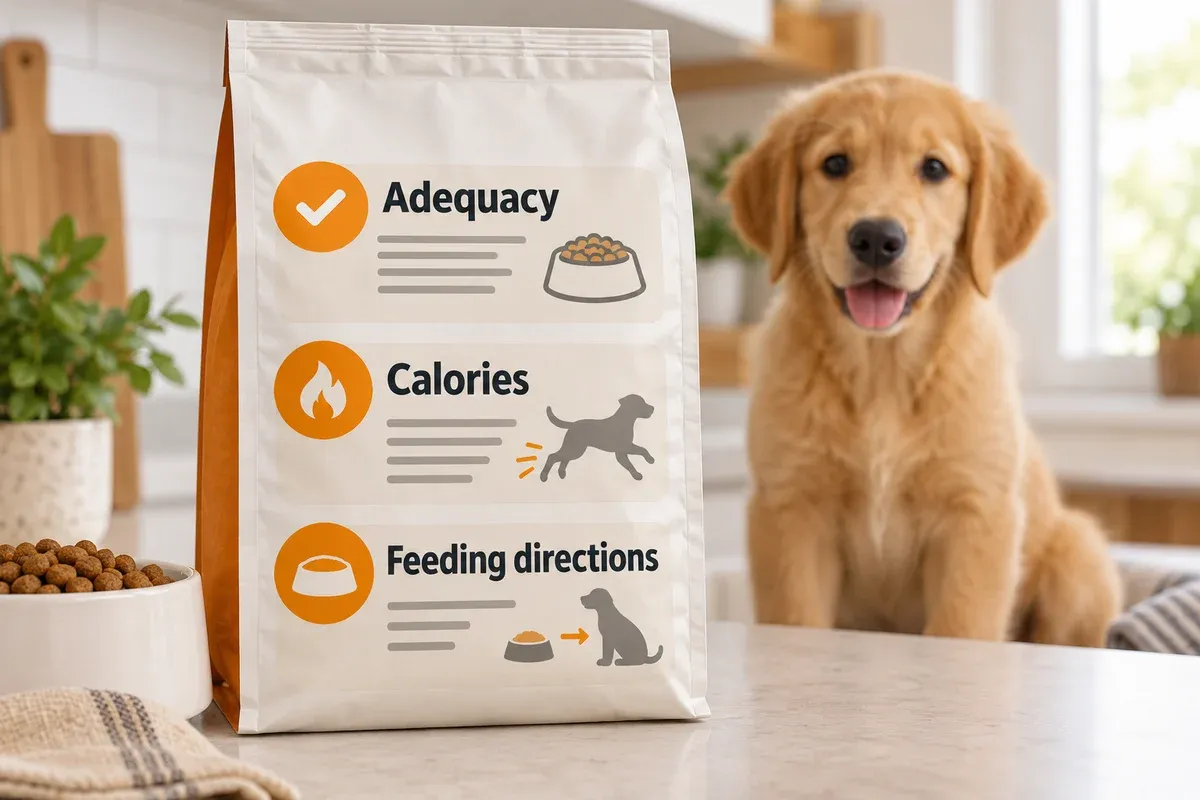
Use the three label sections below as a checklist, then read the corresponding information on your own bag.
The four suitable starting points, with their limits
1. Purina Pro Plan Puppy Large Breed Chicken & Rice — clearest US label starting point
Purina’s official product page and current label PDF state that the formula provides complete and balanced nutrition for all life stages, including growth of large-sized dogs weighing 70 lb or more as adults. The label lists 28% minimum crude protein, 13% minimum crude fat, 1.1% minimum calcium, 0.9% minimum phosphorus, and 0.1% minimum DHA in the linked US formulation.
Check current price on Amazon →Why it is a sensible starting point
The important advantage is not a promise about hips; it is the clarity of the US growth statement and the fact that the label supplies calorie and feeding information for different maturity-weight bands. That makes it easier to discuss a measured feeding plan with a veterinarian.
What not to infer
The label’s DHA, glucosamine, calcium, and phosphorus values do not make the food a treatment or guarantee against orthopedic disease. The protein and fat numbers also should not be treated as targets for every puppy. Use the current calorie statement and the puppy’s body condition to decide whether the feeding amount is appropriate.
Verdict
Choose it when you want a US formula with a directly stated large-size growth claim and a detailed label. Recheck the package because Purina formulas, package sizes, and regional labels can change.
2. Wellness Complete Health Large Breed Puppy — grain-inclusive comparison choice
The official Wellness product page identifies this as a large-breed puppy recipe and lists 29% minimum crude protein, 12% minimum crude fat, 1.2% minimum calcium, 1.0% minimum phosphorus, and a combined EPA/DHA guarantee in the current product information.
Check current price on Amazon →Why it is useful to compare
The product page gives a dedicated large-breed puppy context and publishes more than a front-of-bag ingredient story. Owners who prefer a grain-inclusive chicken, rice, and salmon-meal formula can compare the adequacy statement, calories, feeding guide, and body-condition response against other complete growth foods.
What not to infer
The presence of DHA, probiotics, or a named grain does not establish that a food prevents hip dysplasia. Nutrient guarantees are tied to the current formulation, and the label should be checked in the market where the bag is purchased.
Verdict
Choose it when the current package has the required growth statement for the puppy’s expected adult size and the calorie density works with a measured feeding plan. It is a formulation to compare—not a medical diet.
3. Blue Buffalo Life Protection Large Breed Puppy — label-focused growth option
Blue Buffalo’s US product page describes the Life Protection Formula Large Breed Puppy Chicken & Brown Rice Recipe. The linked North American product information states that it is formulated for growth and lists 26% minimum crude protein, 15% minimum crude fat, 1.2% minimum calcium, 1.0% minimum phosphorus, and 0.1% minimum DHA for that regional label.
Check current price on Amazon →Why it is useful to compare
The recipe is explicitly presented as a large-breed puppy product, and the manufacturer provides a nutrient panel that can be compared with other dedicated growth foods. The ingredient list, however, is only one part of the decision; AAFCO explains that the adequacy statement and feeding directions are essential label information.
What not to infer
DHA, ARA, antioxidants, and the LifeSource Bits description are product features, not proof of orthopedic prevention. The US and Canadian pages are not a substitute for the exact package in your market, so confirm the local label before calculating portions.
Verdict
Choose it when the current local package confirms growth for the expected adult size, supplies a clear calorie statement, and suits the puppy’s tolerance and body condition. Compare the complete label rather than selecting on the ingredient list alone.
4. Eukanuba Puppy Large Breed — regional-label option
Eukanuba’s Canadian product page identifies Puppy Large Breed as a growth diet and publishes 26% minimum crude protein and 14% minimum crude fat. The page’s AAFCO statement includes growth in large-size dogs, while another official regional Eukanuba page describes large and giant breed age ranges. Those details are useful for comparison, but the exact US package and feeding guide should be checked before purchase.
Check current price on Amazon →Why it is useful to compare
It is clearly positioned as a dedicated large-breed puppy formula rather than an adult maintenance diet. The label also provides a concrete maturity-age context, which can be helpful when planning the transition to adult food, although the correct timing depends on the individual dog’s expected size and body condition.
What not to infer
“Optimal calcium and phosphorus” or “DHA” wording on a manufacturer page is not the same as a clinical claim about dysplasia. Regional formulas can differ in nutrient guarantees, calorie density, ingredients, and feeding instructions.
Verdict
Choose it only after confirming that the local package’s adequacy statement covers the puppy’s expected adult size. Use the local calorie and feeding directions rather than copying values from the Canadian or another regional page.
Why the Taste of the Wild High Prairie product is not in the puppy shortlist
The current official Taste of the Wild High Prairie Canine Recipe page states that the dry recipe is formulated for adult maintenance, and its current guaranteed analysis lists 32% crude protein and 18% crude fat. It is not the same as a puppy-specific High Prairie recipe or a formula whose adequacy statement includes growth of large-size dogs.
That distinction matters more than the product name’s references to bison, venison, or grain-free ingredients. The page should not be used as a recommendation for a growing large-breed puppy unless the exact package in question carries an appropriate growth statement. This guide therefore does not place that adult-maintenance product in the puppy comparison table.
Taste of the Wild’s own FAQ also distinguishes puppy-specific recipes from adult or all-life-stages recipes and recommends a gradual transition when changing foods. Product names and formulas can change, so read the exact current label rather than assuming that every High Prairie product has the same life-stage statement.
Calcium, phosphorus, and the danger of simple ratios
Calcium and phosphorus are essential for growth, but a ratio copied from a label is not a complete nutritional assessment. Guaranteed-analysis values may be minimums, may be expressed on an as-fed basis, and do not by themselves show the full nutrient profile or the energy density of the food.
The 2025 FEDIAF guidelines discuss both minimum and maximum calcium considerations for growing dogs and explain why high calcium intake can adversely affect skeletal development in large-breed dogs, particularly early in growth. That is why a responsible comparison asks whether the diet is formulated for large-breed growth instead of inventing a homemade “ideal ratio.”
Merck likewise states that additional calcium, phosphorus, and vitamin D beyond the amounts in a complete and balanced growth diet are rarely necessary and may be contraindicated. Do not add bone meal, calcium powder, vitamin D, or a joint supplement to a complete puppy food without veterinary advice.
Feeding for steady growth rather than maximum growth
Measure the food
Use a kitchen scale when possible. Cups vary, kibble density differs by recipe, and a small daily overage becomes meaningful over weeks. Start with the current package’s feeding guide, then adjust based on weight trend, body condition, activity, treats, and veterinary advice.
Track the trend
Merck recommends close monitoring of weight and says a slow growth rate is preferable to a fast one for large- and giant-breed puppies. A weekly record of body weight, food grams, treats, stool quality, and appetite is more useful than reacting to a single weigh-in.
Keep the puppy lean, not hungry or underfed
“Controlled growth” does not mean restricting a puppy arbitrarily. It means feeding enough of a complete growth diet while avoiding excess body fat and unnecessarily rapid gain. A veterinarian can assess body condition, muscle, growth curve, and expected adult size together.
Count treats and toppers
Treats, chews, table food, wet toppers, and training rewards add calories and can dilute the balance of a complete diet. If they are a regular part of the routine, include them in the feeding discussion rather than adjusting the main food by guesswork.
Food and treats are only one part of the first-year plan. Use our puppy cost calculator to estimate adoption, starter supplies, vaccinations, training, food, and insurance together.
Protein, fat, ingredients, and marketing claims
Protein percentage is not a quality score
Crude protein does not describe digestibility, amino-acid balance, calorie density, or the complete mineral profile. A higher number is not automatically better for skeletal development. Compare foods within the same verified growth standard and monitor the puppy rather than ranking formulas by one percentage.
Fat and calories work together
Fat is energy-dense, so the fat percentage and calorie statement both matter. A puppy may need a different volume of two foods with similar protein guarantees because their metabolizable energy differs. AAFCO’s calorie guidance explains why kcal/kg and kcal/cup should be read together.
Ingredient lists are useful but limited
AAFCO requires ingredients to be listed in descending order by weight, but the ingredient list does not replace the adequacy statement or guaranteed analysis. Words such as “natural,” “premium,” “holistic,” “ancestral,” or “meat-first” are not a substitute for a complete growth formulation.
Grain-inclusive versus grain-free
Grain-free is not automatically better for a large-breed puppy. The FDA’s current information on non-hereditary canine DCM says the issue is complex, that reports have involved both grain-free and grain-containing diets, and that no simple causal conclusion should be drawn from the reports. If a puppy has a medical reason to avoid an ingredient, use a veterinarian-guided plan instead of choosing by a marketing category.
Diagnosed disease, prevention, and ordinary development
Diagnosed hip dysplasia or another orthopedic condition
A diagnosis requires a veterinary examination and, when indicated, imaging. Food may be part of weight management or a broader treatment plan, but none of the products here is a veterinary therapeutic diet for hip dysplasia and none should be described as a treatment.
Prevention
There is no honest basis for promising that one food prevents hip dysplasia. Genetics, development, body condition, growth rate, activity, and other factors contribute. The nutrition goal is a complete diet formulated for large-breed growth, measured portions, and a healthy body condition—not a miracle calcium ratio.
Normal comfort and development
For a healthy puppy, focus on the adequacy statement, calories, measured portions, body condition, regular growth checks, and veterinary care. This approach is less dramatic than a disease-prevention claim, but it is more useful and easier to verify.
When to involve a veterinarian or veterinary nutritionist
Ask for individual advice if the puppy has abnormal growth, persistent diarrhea or vomiting, poor appetite, weight loss, lameness, pain, an orthopedic diagnosis, a suspected food allergy, a therapeutic-diet requirement, or a home-prepared diet. A board-certified veterinary nutritionist is appropriate when the diet itself needs to be formulated or medically managed.
Do not change a puppy’s diet abruptly in response to an online claim. Keep the old and new food, amounts, treats, symptoms, and dates in a short log so the veterinary team can evaluate the pattern.
This article was not reviewed by a veterinarian, and it does not present any product as veterinary-approved, disease-preventive, or suitable for every puppy.
Frequently Asked Questions
What does “large breed” mean on a US puppy-food label?
AAFCO wording commonly refers to growth of large-size dogs expected to weigh 70 lb or more as adults. Use the exact statement on the package and the expected adult size of the individual dog; do not rely only on a breed name or a photograph.
Is an all-life-stages food automatically suitable for a large-breed puppy?
No. In the US, check whether the statement explicitly includes growth of large-size dogs. A product can be all-life-stages in one market or recipe and maintenance-only in another. The current Taste of the Wild High Prairie dry recipe reviewed here is a concrete example: its official page states adult maintenance.
Should I add calcium to a large-breed puppy food?
Not by default. Merck says extra calcium, phosphorus, and vitamin D beyond a complete balanced growth diet are rarely necessary and may be contraindicated. Ask the veterinarian before adding any mineral or vitamin supplement.
Does higher protein make a puppy grow too quickly?
Protein percentage alone does not answer that question. Total calories, feeding amount, mineral balance, body condition, and the complete formulation matter. Do not choose or reject a food on crude protein alone.
How much should my puppy eat?
Use the current package’s feeding guide as a starting point, weigh the food, include treats, and monitor the puppy’s weight and body condition. Adjustments should be based on the puppy’s trend and, when there is uncertainty, veterinary advice—not on a generic online cup amount.
Can a puppy eat wet and dry food together?
It can be possible when both products are appropriate for the life stage and the combined calories are controlled. Check whether the wet product is complete or complementary, and reduce the dry portion according to the calorie information rather than adding a topper without adjustment.
When should a large-breed puppy switch to adult food?
There is no single age for every breed. Merck notes that large and giant breeds may mature later than small breeds. Use the food’s life-stage directions, expected adult size, growth trend, and veterinary assessment.
Is grain-free food dangerous?
The FDA describes the diet-associated DCM issue as complex and does not say that every grain-free food is inherently unsafe. Grain-free is also not necessary for normal large-breed growth unless there is a specific dietary reason. Discuss a change with a veterinarian when the puppy has a medical history or symptoms.
Final recommendation
Start with the adequacy statement, not the front-of-bag promise. For a US large-breed puppy, Purina Pro Plan Large Breed has the clearest directly stated large-size growth wording among the products reviewed. Wellness, Blue Buffalo, and Eukanuba are additional dedicated growth formulas to compare, provided the current local package fits the puppy’s expected adult size.
Do not use the current adult-maintenance Taste of the Wild High Prairie dry recipe as a large-breed puppy recommendation. For every food, verify the local label, calorie density, feeding guide, and formulation date; feed measured portions; monitor the growth trend; and involve a veterinarian when the puppy’s health or diet is medically complicated.
Sources and verification
- Merck Veterinary Manual: feeding practices and large-breed puppy growth
- Merck Veterinary Manual: hip dysplasia in dogs
- AAFCO: selecting the right pet food
- AAFCO: labeling requirements and nutritional adequacy
- AAFCO: calorie content
- FEDIAF: current nutritional guidelines
- FEDIAF 2025 nutritional guidelines PDF
- FDA: questions and answers on possible non-hereditary DCM causes
- Purina Pro Plan Puppy Large Breed official US product page
- Purina official US label PDF
- Wellness Complete Health Large Breed Puppy official product page
- Blue Buffalo US Large Breed Puppy product page
- Blue Buffalo North American nutrient information
- Eukanuba Puppy Large Breed official regional product page
- Taste of the Wild High Prairie Canine Recipe official product page
Nutrition guidance, product pages, and source links were checked in August 2026. Product formulas, package sizes, ingredient lists, calorie values, and adequacy statements can change; verify the current package and local formulation before purchase.
Affiliate Disclosure: We earn from qualifying purchases through Amazon Associates at no extra cost to you.