


 Published sources
 Product details checked
If your dog can unzip a bed, pull out the stuffing, and swallow pieces before you get across the room, replacing another soft mat is not the real solution. You need to control access to the parts your dog can grab, choose materials that match the behavior, and still give the dog a safe place to rest.
The important catch is that “indestructible” is a marketing shortcut, not a literal promise. A determined dog can damage almost anything. The strongest designs reduce the opportunity to get a tooth around an edge in the first place. That is why an enclosed aluminum frame and a taut sleeping surface usually outperform a thick bed with a tough-sounding fabric cover.
Quick answer: The Kuranda Chewproof Elevated Dog Bed is the best overall choice for a dog that repeatedly destroys fabric beds. The K9 Ballistics Chew Proof Armored Padded Crate Bed is the better compromise when a crate setup needs real cushioning. The Bedsure Chew Proof Dog Bed is a budget crate pad for scratching and occasional mouthing, not for a dog that eats bedding.
Quick Comparison: Indestructible Dog Beds at a Glance
-
Kuranda Chewproof Elevated Dog Bed (50 x 36)
Kuranda
A raised bed built around an aluminum frame and a heavy-duty vinyl sleeping surface. The enclosed rail design keeps the fabric edge away from the dog's mouth, which is the key difference from a standard soft bed.
- 50 x 36 inch models
- Aluminum frame, corners, and legs
- Heavy-duty vinyl sleeping surface
- Best for
- Dogs that repeatedly destroy fabric beds
- Size
- 50 x 36 inches
-
K9 Ballistics Chew Proof Armored Padded Dog Crate Bed (Medium)
K9 Ballistics
A padded crate bed that combines an aluminum frame with ballistic fabric and removable legs.
- 100% aluminum frame and corners (manufacturer claim)
- 1.5 inch padded center
- Ballistic ripstop fabric
- Best for
- Aggressive crate chewers who still need padding
- Size
- 35 x 22 x 4.5 inches (selected medium models)
-
Veehoo Chew Proof Padded Elevated Dog Bed (41 Inch)
Veehoo
A lower-cost raised cot with a padded, waterproof surface for indoor, outdoor, or crate use.
- 41-inch gray models
- Padded mat included
- Waterproof surface
- Best for
- Budget shoppers who want an elevated, padded bed
- Size
- 41-inch models
-
Bedsure Chew Proof Dog Bed for Large Dogs (35 x 22)
Bedsure
A budget-friendly padded crate bed with reinforced corners, a soft velvet surface, and a machine-washable cover. It is useful when the problem is scratching, nesting, or occasional mouthing, but the soft surface remains accessible to a relentless chewer.
- 35 x 22 inch models
- Reinforced corners
- Machine-washable cover
- Best for
- Mild chewers who need a washable crate pad
- Size
- 35 x 22 inches
Review the linked product page before purchasing.
What Makes a Dog Bed Genuinely Chew-Resistant?
Most failed beds do not fail because the center fabric is too thin. They fail because the dog can find a seam, zipper, corner, loop, or loose edge and work on it with the front teeth. Once there is a hole, stuffing and foam become both a reward and a hazard.
For this guide, I treated a bed as meaningfully chew-resistant when it does at least three things:
- It limits access. Rails, recessed fabric, and a taut sleeping surface are more useful than a thick but loose cover that a dog can pinch between the teeth.
- It has a stable structure. Aluminum or reinforced frames should not twist when a large dog launches onto the bed or drags it across the floor.
- It has a sensible failure plan. Replaceable fabric, available hardware, easy inspection, and a clear warranty matter because no product should be considered immortal.
That definition separates four very different products that are often placed under the same label:
- True chew-resistant cots: The fabric is captured by the frame, so there is little for a dog to grab. These are usually the safest starting point for serious fabric destroyers.
- Armored padded beds: A framed design adds a cushion or fiberfill center. They are more comfortable in crates, but they introduce padding that still needs inspection.
- Padded elevated beds: These can be a good value for dogs who scratch or mouth bedding, but the cover and corners remain accessible.
- Tough soft beds: Ballistic fabric can resist digging and ordinary wear while still being unsuitable for a dog that chews constantly. Tough fabric is not automatically chew-proof.
If the destruction happens only when your dog is alone, a stronger bed is only one part of the answer. The ASPCA notes that separation anxiety can include destructive chewing, pacing, barking, and attempts to escape. Start with its guidance on destructive chewing, and use a bed as management rather than as a cure.
How I Chose These Beds
The construction, access points, washability, and fit for the dog’s behavior matter more than a generic popularity signal.
The comparison also had to answer a practical question: what happens when the dog tries to start the usual attack? A dog that digs at the edge needs a different solution from a dog that bites through a crate pad, and both are different from a senior dog that needs deep orthopedic cushioning. The recommendations below make those trade-offs explicit instead of calling every durable-looking bed indestructible.
The 4 Best Indestructible Dog Beds Reviewed
1. Kuranda Chewproof Elevated Dog Bed - Best Overall for Severe Chewers
Best for: Dogs that repeatedly destroy soft beds
The Kuranda is the clearest example of an anti-access design. Its aluminum rails hold the sleeping surface inside the frame rather than leaving a soft perimeter for the dog to grab. The heavy-duty vinyl option is firm, wipeable, and suitable for indoor or outdoor use; Kuranda also lists replacement parts and a weight rating of up to 250 pounds on its official product page.
Check current price on Amazon →Why It Stands Out
The frame is the product, not a decorative detail. A dog can lie on the surface, but there is no loose cushion edge to pull away from the frame. That makes it a strong match for dogs that immediately target seams, corners, and stuffing.
The trade-off is comfort. This is a firm elevated cot, not a plush orthopedic mattress. Many dogs settle on it quickly, especially in warm rooms, but dogs with arthritis or pressure-point problems may need a thin, securely fitted pad or a different bed altogether. Read our guide to the best orthopedic dog beds if joint comfort is the primary need.
The 50 x 36 inch version is appropriate only if the dog can lie fully extended without hanging over the frame. Use the external dimensions when checking floor space, and remember that a very large bed can be difficult to move through a doorway after assembly.
Key Features
- Aluminum frame, corners, and legs
- Heavy-duty vinyl sleeping surface
- Enclosed rail design keeps the fabric edge out of easy reach
- Rated for dogs up to 250 pounds by the manufacturer
- Indoor and outdoor use
- Replaceable fabric and hardware
Pros and Cons
Pros
- Best protection against edge-grabbing and fabric pulling
- No foam or loose stuffing in the main sleeping surface
- Easy to wipe clean and useful in warm weather
- Replacement parts make long-term ownership more realistic
Cons
- Firm rather than plush
- Assembly is more involved than placing a soft mat
- Premium price, especially in the largest size
- Outdoor mesh models do not have the same chew-proof warranty coverage as the heavy-duty vinyl option
Bottom line: Choose the Kuranda when your main problem is a dog that destroys fabric beds by grabbing and ripping. It is the best first step for severe chewers, provided the dog does not need deep foam support and the size is measured correctly.
Check current price on Amazon →2. K9 Ballistics Chew Proof Armored Padded Crate Bed - Best for a Crate
Best for: Heavy crate chewers who still need padding
The K9 Ballistics Armored Padded Crate Bed is the comfort-oriented pick for a dog that cannot use an ordinary crate mat. It pairs an aluminum frame with ballistic fabric and a 1.5-inch padded center, so the dog gets more cushioning than on a bare cot. K9 Ballistics explains the frame, padding, crate compatibility, and cleaning limitations on its official product page.
Check current price on Amazon →Why It Stands Out
This is a useful middle ground between a hard crate tray and a soft bed with a zipper. The framed construction limits access to the outer edge, while the padded center makes it more inviting for dogs that dislike a firm raised surface.
Fit also matters more than it does with a floor mat. K9 Ballistics specifically warns that this bed may not fit plastic carriers, custom crates, or heavy-duty crates. Measure the inside floor and the diagonal of the crate door before ordering. A bed that has to be forced through the opening is the wrong size even if the internal dimensions appear close.
Key Features
- Aluminum frame and corners according to the manufacturer
- 1.5-inch padded center
- Ballistic ripstop fabric
- Removable legs for a lower or elevated setup
- Designed for many standard wire crates
- Manufacturer-described 120-day Chew Proof Warranty
Pros and Cons
Pros
- More comfortable than an unpadded raised cot
- Framed edge gives a chewer fewer places to start
- Useful for dogs that need a crate-safe sleeping surface
- Optional legs make the setup more flexible
Cons
- Padding still needs frequent inspection
- May not fit plastic, custom, or heavy-duty crates
- Not a replacement for a crate sized and trained correctly
Bottom line: Choose this bed when your dog needs real padding inside a standard wire crate, but you still want to remove the easy zipper-and-stuffing failure point. If the dog is already swallowing damaged foam or fabric, remove the bed and involve your veterinarian before trying another padded option.
Check current price on Amazon →3. Veehoo Chew Proof Padded Elevated Dog Bed - Best Budget Raised Option
Best for: Budget-conscious owners who want padding and airflow
The Veehoo is the value pick when a bare mesh cot feels too stark but a premium aluminum bed is outside the budget. Veehoo’s own chewproof elevated-bed product information describes the raised frame and size options.
Check current price on Amazon →Why It Stands Out
It adds a little more comfort without giving up the airflow and easy-clean advantages of an elevated bed. That can work well for a dog who scratches, nests, mouths the cover occasionally, or gets hot on a floor-level bed.
The frame may remain perfectly usable while a determined dog damages the pad or cover. Think of it as a durable-value bed with a padded component, not a guaranteed answer for a dog that has already eaten multiple beds.
Check all seams during the first week. If the dog repeatedly targets one corner, remove the padded mat rather than waiting for a small tear to become an ingestion risk. You can sometimes use the raised frame on its own while deciding whether a more enclosed sleeping surface is necessary.
Key Features
- Waterproof surface
- Elevated design with airflow underneath
- Indoor, outdoor, or crate use described
- Six described size options
- Lower price than the aluminum-frame premium picks
Pros and Cons
Pros
- Lower-cost way to try an elevated design
- Softer than a bare cot
- Waterproof surface is easier to clean after accidents
- Useful for warm rooms, porches, and travel setups
Cons
- The padded cover and seams remain reachable
- No absolute chew-proof guarantee
- A strong dog may damage fabric even if the frame survives
Bottom line: This is the sensible budget experiment for a dog who scratches or mouths bedding but has not shown a pattern of swallowing fabric. For an established fabric eater, start with the Kuranda or a framed crate bed instead.
Check current price on Amazon →4. Bedsure Chew Proof Dog Bed - Best Budget Crate Pad for Mild Chewers
Best for: Scratching, nesting, and occasional mouthing
The Bedsure is the most ordinary-looking bed on this list, and that is exactly why its use case needs to be narrow. It is a padded crate mat with reinforced corners, a soft velvet surface, and a machine-washable cover. Those features are practical for a calm dog that makes a nest or occasionally mouths a corner, but they do not remove the basic weakness of a soft bed: the dog can still reach and pull the fabric.
Check current price on Amazon →Why It Stands Out
The value is in the washable, familiar format. Some dogs do not need a metal-framed cot; they need a clean, padded surface that fits a crate and can survive normal use. Reinforced corners are helpful for light wear, but they should not be confused with an enclosed chew-proof rail.
If your dog has already opened a soft bed and pulled out foam, skip this category. The soft surface is still something to grab, and a machine-washable cover does not make swallowed material safe. Use the Bedsure only when the behavior pattern is mild and you are prepared to check it often.
Key Features
- 35 x 22 inch models
- Reinforced corners
- Soft velvet sleeping surface
- Machine-washable cover
Pros and Cons
Pros
- Affordable padded crate option
- Comfortable for dogs that prefer a soft surface
- Washable cover is practical for everyday messes
- Easier to fit than a raised frame
Cons
- Not suitable for dogs that swallow fabric or foam
- Soft edges remain accessible to a determined chewer
- Does not provide the anti-access protection of a framed cot
- Reinforced corners are not the same as a chew-proof warranty
Bottom line: Buy this only for a mild chewer or scratcher whose bed history supports a soft mat. It is a budget comfort choice, not a heavy-chewer solution.
Check current price on Amazon →Choose by Your Dog’s Destruction Pattern
The right bed depends more on the first five minutes than on the label on the box.
Your dog bites the edge and pulls
Choose a design that keeps the edge out of reach. The Kuranda is the strongest match because the sleeping surface is held inside the frame. A soft pillow bed with a “tough” cover still gives the dog a seam to work on.
Your dog digs, scratches, and circles before lying down
Start with a raised bed or a tightly fitted surface that cannot bunch up. The Veehoo may be enough for moderate behavior; move to the Kuranda if the dog starts opening the pad or pulling the fabric from the corners.
Your dog destroys crate mats
Measure the crate before shopping. The K9 Ballistics Armored Padded Crate Bed is the most targeted option here, but only when the bed can pass through the door and sit flat inside. For a dog with separation anxiety, a heavy-duty dog crate may improve safety, but confinement should be introduced as part of a behavior plan rather than used as punishment.
Your dog is a puppy or an occasional mouther
Do not pay for a fortress if the behavior is normal exploration and you can supervise. Provide legal chew outlets, interrupt calmly, and reinforce the choice to chew the right item. The ASPCA recommends management, supervision, and appropriate chew options for destructive chewing; it also warns against punishing a dog after the damage has happened.
Your dog destroys the bed only when alone
Look for the larger pattern: barking, pacing, scratching at exits, drooling, house-soiling, or frantic greetings. Those signs point toward separation-related distress rather than a simple preference for shredded fabric. Our guide to why dogs destroy beds helps separate chewing, discomfort, boredom, and distress; our guide to why a dog may not stop barking covers trigger management, while a veterinarian or qualified behavior professional should guide serious anxiety cases.
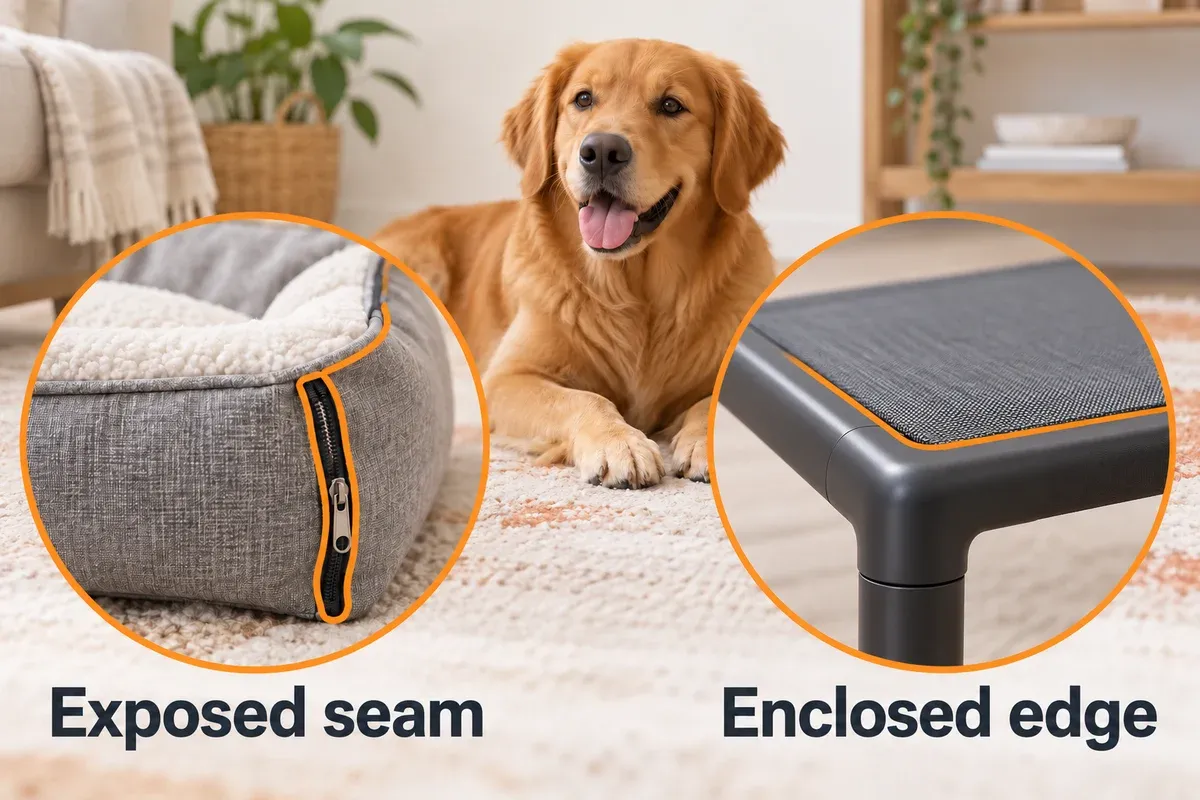
The close-ups show why a reachable seam gives a chewer a starting point, while a frame-held edge limits access.
How to Size an Indestructible Dog Bed
Measure the dog, the sleeping area, and the route into the room. A bed that is hard to destroy but too small is not a successful purchase.
- Measure from the nose to the base of the tail while the dog is standing.
- Add enough length for the dog to lie fully extended without the shoulders or hips hanging over the edge.
- Compare that target with the finished bed dimensions, not just the advertised sleeping surface.
- For a crate bed, measure the inside floor and the diagonal of the door opening. The bed must fit through the opening without bending or scraping against the frame.
- For a giant breed, leave room for turning around and check the manufacturer’s weight guidance, but do not treat a weight rating as a comfort rating.
For raised cots, also check height. A young, mobile dog may enjoy a higher platform, while a senior dog or a dog with joint pain may need a lower entry or a padded floor-level option. Our guide to dog ramps for large dogs can help if access to elevated rest areas is already difficult.
Durability Versus Comfort: The Trade-Off Most Buyers Miss
The most chew-resistant bed is not automatically the most comfortable bed. A taut vinyl cot is easy to clean, cool, and difficult to attack, but it does not distribute pressure like a deep orthopedic mattress. A padded crate bed is more inviting, but the padding creates another component to inspect. A plush bed is comfortable for many dogs, but its bolsters, seams, and zipper are often exactly what a determined chewer wants.
A simple decision rule works well:
- Safety and destruction are the immediate problem: start with the least accessible design, usually an enclosed-frame cot.
- The dog needs padding but can be supervised: consider a framed padded crate bed and inspect the center frequently.
- Joint pain, stiffness, or difficulty rising is the main problem: prioritize orthopedic support and a controlled environment; begin with our orthopedic dog-bed guide rather than assuming a firm chew-proof cot will solve it.
- The dog is young and only occasionally mouths fabric: a washable pad may be enough while training and enrichment improve.
If a senior dog suddenly starts destroying or avoiding a bed, do not assume it is only a behavior issue. Pain, heat, digestive problems, or anxiety can change how a dog rests. A veterinarian can help rule out medical causes.
A Durable Bed Does Not Replace a Behavior Plan
Use the bed to reduce damage while you work on the reason for the chewing:
- Remove access to damaged material. If you see torn fabric, exposed foam, loose threads, or broken hardware, take the bed away immediately.
- Offer an appropriate outlet. Food puzzles, safe chew toys, sniffing, training, and exercise can reduce boredom and frustration, but every chew item still needs supervision and size-appropriate selection.
- Practice short, successful absences. If destruction happens only when you leave, increase alone time gradually and use a camera or another safe way to observe the pattern.
- Do not punish after the fact. A damaged bed is evidence that the setup failed; it is not a teachable moment after the dog has finished the behavior.
- Get help when there is risk. Contact a veterinarian if your dog has swallowed fabric, foam, stuffing, or hardware, or if chewing is paired with panic, self-injury, guarding, or sudden behavior change.
For dogs that need more structure, our basic dog-training guide covers reward-based skills such as a mat cue, leave it, and calm settling. Those skills make it easier to supervise a new bed and to redirect the dog before the first corner becomes a project.
Care and Inspection Checklist
Even a strong bed lasts longer when the first weak point is found early.
- Check the underside: Look for bent rails, loose bolts, cracked plastic feet, or fabric pulled out of its channel.
- Run a hand around the edge: Any exposed snag, sharp point, or loose thread is a reason to stop using the bed until it is repaired.
- Clean according to the material: Wipe vinyl and frames rather than soaking components that can trap moisture. Follow the manufacturer’s directions for padded centers.
- Introduce it while supervised: Let the dog sniff and settle, then reward calm use. Do not leave the dog alone with a new padded bed on the first day.
- Keep the warranty information: Save the order and product details, especially for a bed with replaceable fabric or a chew-proof warranty.
- Replace after meaningful damage: A bed is no longer safe because it used to be durable. Once the dog can access stuffing, foam, or hardware, retire or repair it.
What I Would Not Call Indestructible
I would not use the word for a conventional pillow bed with a zipper, loose bolsters, exposed piping, or a removable foam insert. A ballistic cover may slow down scratching and digging, but it does not stop a dog from finding the zipper or a corner. The same goes for any bed whose marketing focuses on fabric denier while leaving the edge easy to grab.
A promising design deserves consideration, not an absolute guarantee. Watch the actual dog, the actual seam, and the actual first week of use.
Final Verdict: The Best Indestructible Dog Beds 2026
- Best overall for a serious fabric destroyer: Kuranda Chewproof Elevated Dog Bed. The enclosed aluminum-frame design addresses the main failure point: access to the edge.
- Best padded crate option: K9 Ballistics Chew Proof Armored Padded Crate Bed. It gives a crate-trained dog more cushioning while limiting easy access to the perimeter, but fit and inspection are essential.
- Best lower-cost raised option: Veehoo Chew Proof Padded Elevated Dog Bed.
- Best budget soft pad: Bedsure Chew Proof Dog Bed. Use it for mild chewing, scratching, and nesting, not for a dog that eats bedding.
If you want the shortest answer, start with the Kuranda when safety and fabric destruction are the priority. Choose the K9 Ballistics bed when the bed must live inside a standard wire crate and padding matters. Whichever design you buy, inspect it under supervision first and treat “indestructible” as a goal of safer construction, not permission to ignore damage.
Frequently Asked Questions
Are indestructible dog beds truly indestructible?
No. The phrase describes a design goal, not a guarantee. Enclosed frames and taut surfaces can make a bed much harder to attack than a pillow bed, but a determined dog can still bend hardware, damage fabric, or create a new weak point. Inspect the bed and remove it when damaged.
What is the best dog bed for a dog that eats stuffing?
Start with a bed that has no loose stuffing or accessible zipper, such as an enclosed-frame elevated cot. If the dog needs padding, use a framed padded crate bed only with close supervision and frequent inspection. If any material has already been swallowed, contact a veterinarian rather than trying another bed first.
Are elevated dog beds good for large or senior dogs?
They can be, especially for airflow, easy cleaning, and stable support. A firm cot is not the same as an orthopedic foam bed, though. Senior dogs with arthritis or pressure-point pain may need deeper cushioning, a lower entry, or a combination of a secure cot and a carefully fitted pad.
How do I know which size to buy?
Measure the dog while standing, add enough room for a fully extended sleeping position, and compare that measurement with the bed’s finished dimensions. For crate beds, also measure the door opening diagonally. If the dog cannot turn around and stretch out comfortably, choose the next size up when the room and frame allow it.
Can I leave a chew-proof bed in the crate when I am away?
Only after the bed has passed a supervised trial and your dog has shown that the material is not being damaged or swallowed. A “chew-proof” label does not remove the need to check the frame, corners, fabric, and padding. A dog with separation anxiety may still injure itself while trying to escape even if the bed survives.
What should I do if my dog keeps destroying every bed?
Remove unsafe beds, provide supervised alternatives, and identify the pattern: boredom, teething, digging, discomfort, guarding, or distress when alone. Increase management while you work on the cause. Ingestion, self-injury, panic, or a sudden change in behavior warrants veterinary guidance and, when needed, a qualified behavior professional.