

 Published sources
 Product details checked
The best canister filter is the one whose real circulation, media capacity, maintenance access, and electrical specification fit your aquarium. A large pump number alone does not tell you how much water will return to the tank after media, tubing, fittings, and height are taken into account.
This guide gives a practical shortlist for freshwater and marine aquariums and explains the numbers instead of treating every GPH figure as if it came from the same test. The technical values below come from the linked manufacturer pages or manuals. We did not perform an independent flow, noise, or durability test, so manufacturer claims are identified as such.
Advertisement / Affiliate disclosure: This article contains paid affiliate links. As an Amazon Associate, we earn from qualifying purchases at no extra cost to you.
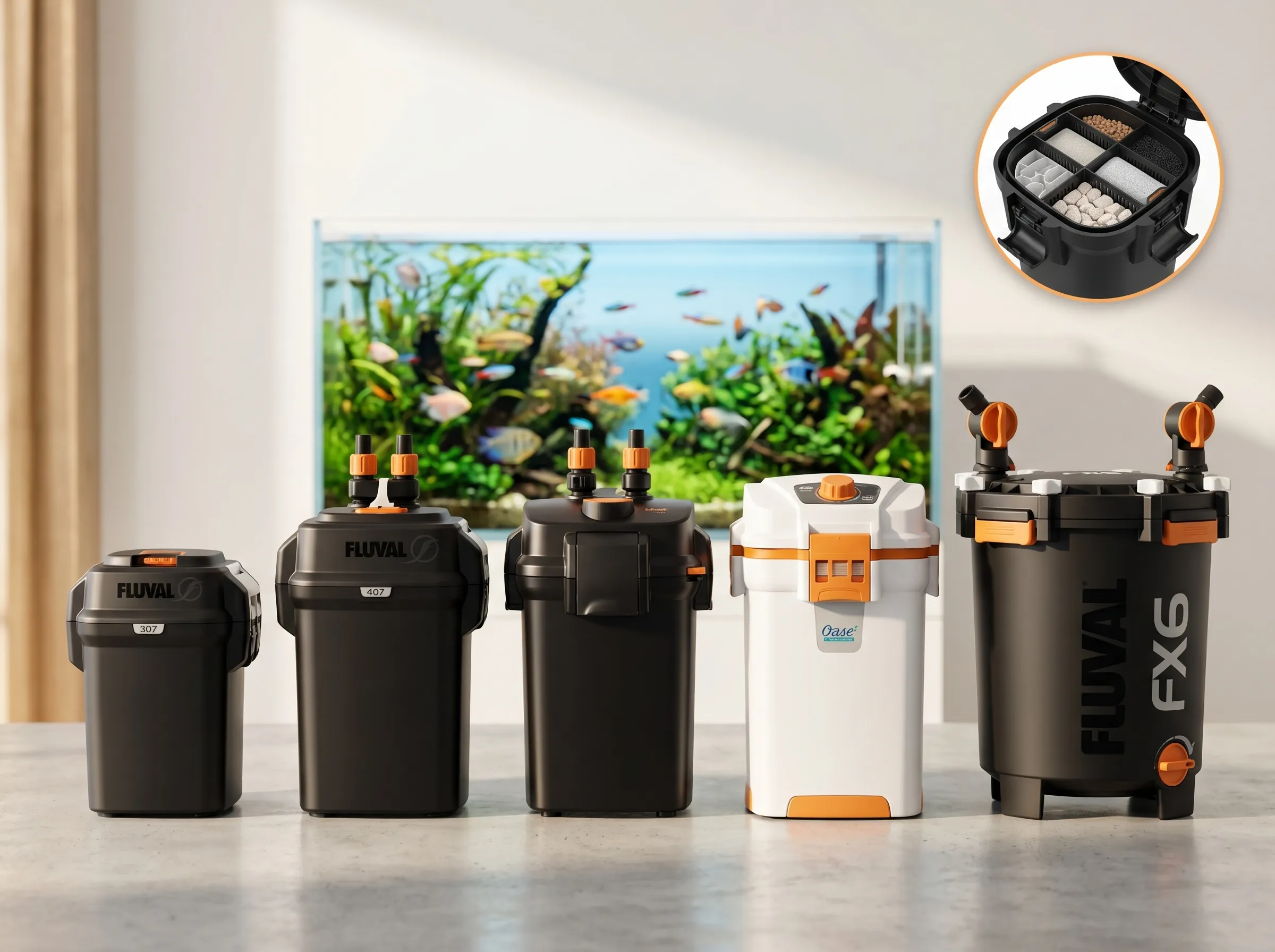
Quick comparison
-
Fluval 307 Performance Canister Filter
Fluval
Mid-range canister filter with Fluval's eTEC technology, a vertical pre-filter, and easy media-basket access. Fluval lists 303 US GPH pump output and 206 US GPH filter circulation for the US 307 model.
- 303 US GPH / 1150 L/h pump output
- 206 US GPH / 780 L/h filter circulation
- Vertical pre-filter and EZ-Lift media baskets
- Best for
- Aquariums up to 70 gallons (freshwater and lightly planted)
- Manufacturer flow
- 303 US GPH / 1150 L/h pump output
- Filter circulation
- 206 US GPH / 780 L/h filter circulation
- Listed tank range
- 40–70 US gal / 90–330 L
- Key feature
- See product page
-
Fluval 407 Performance Canister Filter
Fluval
High-performance canister filter with manufacturer-listed 1450 L/h pump output, 930 L/h filter circulation, and a 50–100 US gallon rating.
- 383 US GPH / 1450 L/h pump output
- 245 US GPH / 930 L/h filter circulation
- Up to 25% quieter than the previous generation, according to Fluval
- Best for
- Aquariums up to 100 gallons (freshwater, planted, and light bioload)
- Manufacturer flow
- 383 US GPH / 1450 L/h pump output
- Filter circulation
- 245 US GPH / 930 L/h filter circulation
- Listed tank range
- 50–100 US gal / 150–500 L
- Key feature
- High-performance quiet filtration for large tanks
-
Marineland Magniflow Canister Filter (100-Gallon)
MarineLand
The 360 model is rated by Marineland for up to 100-gallon freshwater or marine aquariums and uses three media stages with a quick-release valve block.
- 360 GPH model rated up to 100 gallons
- Mechanical, chemical, and biological media stages
- Water-tight lift-up canister lid
- Best for
- Budget-conscious aquarists with large tanks (up to 100 gallons)
- Manufacturer flow
- 360 GPH pump output (manufacturer rating)
- Filter circulation
- See product page
- Listed tank range
- up to 100 gallons
- Key feature
- 3-stage affordable filtration with easy maintenance
-
OASE BioMaster 2 Thermo 600 Canister Filter
OASE
Thermo canister filter with a 300 W heater, removable pre-filter, 6.8 L filter volume, and a manufacturer-listed maximum flow of 1250 L/h.
- Maximum flow: 1250 L/h
- Built-in 300 W heater
- 6.8 L filter volume and 0.60 L pre-filter volume
- Best for
- Premium setups up to 160 gallons (freshwater and saltwater) with built-in temperature control
- Manufacturer flow
- 1250 L/h maximum flow (manufacturer specification)
- Filter circulation
- See product page
- Listed tank range
- up to 600 L / approximately 158 US gal
- Key feature
- Premium all-in-one with integrated heater
-
Fluval FX6 High-Performance Canister Filter
Fluval
Large-capacity canister filter with Smart Pump monitoring, automatic air evacuation, a 400 US gallon rating, and separately published pump-output and filter-circulation figures.
- 925 US GPH / 3500 L/h pump output
- 563 US GPH / 2130 L/h filter circulation
- Smart Pump auto-evacuates trapped air every 12 hours
- Best for
- Large tanks up to 400 gallons (heavy bioload, marine, and planted setups)
- Manufacturer flow
- 925 US GPH / 3500 L/h pump output
- Filter circulation
- 563 US GPH / 2130 L/h filter circulation
- Listed tank range
- up to 400 US gal / 1500 L
- Key feature
- Professional-grade for large, demanding setups
Pump output and filter circulation are different measurements. Confirm the exact regional model, voltage, manual, and current product specification before installation.
What the comparison actually measures
Canister-filter specifications are useful only when their labels are understood. The terms below are related, but they are not interchangeable.
Pump output
Pump output is the volume the pump can move under the manufacturer’s stated test conditions. Fluval publishes this as US GPH and litres per hour for the 07 Series and FX6. It is the number most often printed in product names and retailer listings, but it is not necessarily the flow you will measure at the aquarium return.
Filter circulation
Filter circulation is a lower, more installation-oriented figure that Fluval publishes for its 07 Series and FX6. It includes the effect of the canister and media path in the manufacturer’s test setup. It is the more useful number when comparing Fluval models with one another, but it is still not a guarantee of the flow in your own cabinet.
Aquarium capacity
The stated tank range is a manufacturer recommendation, not a stocking limit. A 100-gallon label does not say how many fish, how much feeding, or what species the filter can safely support. A lightly stocked planted aquarium and a heavily fed aquarium with large fish place very different demands on mechanical and biological filtration.
Media and canister volume
More volume can provide more room for mechanical, biological, or chemical media, but only if the media is arranged correctly and kept clean enough for water to pass through it. A larger canister can also require more cabinet clearance, heavier hoses, and more time during a waterlogged maintenance job. Capacity is therefore a useful selection criterion, not a performance guarantee.
The best canister filters, explained in detail
1. Fluval 407 — best all-rounder for 50–100 US gallons
The Fluval 07 Series specification page lists the 407 for 50–100 US gallons. Its detailed model table gives 383 US GPH / 1,450 L/h pump output and 245 US GPH / 930 L/h filter circulation at 120 V / 60 Hz. The same page lists a 23 W draw for the US model.
Fluval describes the 07 Series as up to 25% quieter than the previous generation and lists a vertical pre-filter and EZ-Lift media baskets. “Up to 25% quieter” is a manufacturer comparison, not a standardized dB rating. Cabinet resonance, trapped air, impeller wear, and hose routing can change the sound of any canister in a home.
Check current price on Amazon →Why it fits
The 407 is a sensible middle ground when a 307 is too close to its rated range but an FX6 would add more capacity and physical size than the aquarium needs. The vertical pre-filter can catch larger debris before it reaches the main media path, while the lift handle makes the baskets easier to remove during service.
Important limits
Fluval’s overview row currently displays 407 US GPH while the detailed specification lists 383 US GPH. Both rows show 1,450 L/h; this guide uses the detailed figure because it is paired with the 930 L/h filter-circulation value. Always compare like with like and do not combine the overview pump figure with the detailed circulation figure.
The 50–100-gallon range also does not determine whether the return will be comfortable for delicate fish or plants. Use the outlet, spray bar, or lily pipe to distribute flow rather than assuming the largest setting is best.
Verdict
Choose the 407 when you want a widely supported canister with a clear manufacturer specification set, enough media room for a medium-to-large aquarium, and a maintenance design that does not require an integrated heater. Check cabinet height and the US electrical specification before ordering.
2. Fluval 307 — best smaller 07 Series option
Fluval lists the 307 for 40–70 US gallons, with 303 US GPH / 1,150 L/h pump output and 206 US GPH / 780 L/h filter circulation. The US model is listed at 16 W and 120 V / 60 Hz. These values appear in the official 07 Series product specification and the 07 Series user manual.
Check current price on Amazon →Why it fits
The 307 keeps the same basic 07 Series approach—vertical pre-filter, media baskets, AquaStop valve, and instant priming—in a smaller format. It can be a better match than oversizing a filter for a 40–70-gallon aquarium, particularly when the livestock prefers moderate flow and the cabinet has limited space.
Important limits
The box or pump value is not what an inline chiller, spray bar, or return nozzle necessarily receives. Fluval’s FAQ explains that tubing length and media are important factors affecting output and warns users not to exceed the vertical distance in the instruction manual. The manufacturer FAQ is worth reading if the filter will sit far below the tank or if you plan to add equipment to the hose path.
Verdict
Choose the 307 when the aquarium and bioload fit its 40–70-gallon starting range and you prefer the 07 Series maintenance layout. Move up to the 407 when media capacity, fish load, or planned equipment leaves little operating margin.
3. Fluval FX6 — best for very large or heavily stocked systems
The official Fluval FX6 page lists a 400-US-gallon aquarium capacity, 925 US GPH / 3,500 L/h pump output, and 563 US GPH / 2,130 L/h filter circulation. It also lists 20 L of canister volume and 5.9 L of biological volume.
Check current price on Amazon →Why it fits
The FX6 is the capacity choice in this group. Its larger canister and biological-volume figures make it appropriate to consider for large aquariums, high-bioload systems, or installations where you want more media space than a 07 Series filter provides. Fluval’s Smart Pump also monitors the pump and periodically pauses to help evacuate trapped air, according to the product documentation.
Important limits
“Up to 400 gallons” is not a stocking recommendation and does not remove the need for water testing, partial water changes, and appropriate biological maturation. The FX6 also takes more room in a cabinet and contains more water and media to lift during service. Plan the hose route before filling the aquarium, and make sure the stand can accommodate the canister without bending the tubing or blocking the motor head.
The FX6 manual also makes clear that pump care requires the filter to be unplugged and emptied before the motor unit is serviced. That is a practical safety requirement, not an optional maintenance detail.
Verdict
Choose the FX6 when the aquarium genuinely benefits from high capacity and substantial media volume. It is a poor fit for a small tank simply because the pump number looks impressive; the physical size, outlet flow, and maintenance load all grow with the filter.
4. OASE BioMaster² Thermo 600 — best when an integrated heater matters
The official OASE BioMaster² Thermo 600 specification lists a maximum flow of 1,250 L/h, 6.8 L filter volume, 0.60 L pre-filter volume, and a 300 W integrated heater. OASE lists the model for aquariums up to 600 L and identifies it for fresh and salt water on the linked international page. OASE’s North American page also describes the EasyClean pre-filter and four-stage sealed filtration path: BioMaster 2 Thermo 600.
Check current price on Amazon →Why it fits
The integrated heater is the reason to consider this model over a conventional canister. It can reduce visible equipment inside the aquarium and keeps temperature control in the same external unit. The removable EasyClean pre-filter is also useful when coarse debris needs to be removed without opening the entire main media stack.
Important limits
The old 600 L/h value previously shown for this product was incorrect. The linked manufacturer specification lists a maximum flow of 1,250 L/h. That maximum is still not the same as delivered circulation through media and plumbing, and it should not be compared directly with a Fluval filter-circulation value unless the test method is the same.
The integrated heater also makes regional electrical compatibility especially important. Check voltage, frequency, plug, heater wattage, and the current manual for the exact version sold in your market. A 300 W heater is not a substitute for checking the actual aquarium’s temperature control and monitoring.
Verdict
Choose the BioMaster² Thermo 600 when the integrated heater and separate pre-filter genuinely simplify the installation. Choose a conventional canister instead if you already have a suitable heater or if replacement of one combined unit would be less convenient for your setup.
5. Marineland Magniflow 360 — best for a conventional three-stage layout
The official Marineland Magniflow page lists the 360 model at 360 GPH for aquariums up to 100 gallons. Marineland describes three media stages—mechanical, chemical, and biological—a quick-prime button, a lift-up lid, and a valve block that separates from the motor housing for maintenance. The same page lists a limited three-year warranty.
Check current price on Amazon →Why it fits
The Magniflow is easy to understand if you want a conventional staged layout and a quick-release valve block. Marineland explicitly presents the line for freshwater and marine aquariums, but saltwater compatibility still requires attention to the rest of the installation, including hoses, media choice, and electrical safety.
Important limits
Marineland publishes the 360 GPH model rating but not the same filter-circulation field shown in the Fluval tables. Do not treat 360 GPH and 930 L/h as identical test measurements. The Magniflow quick setup guide also instructs owners to unplug the filter before maintenance, rinse filter media with aquarium water rather than tap water, and avoid soap or household cleaners.
Verdict
Choose the Magniflow when the straightforward three-stage design and quick-release service block match your maintenance habits. Choose a Fluval or OASE model when you specifically need a published circulation figure, integrated temperature control, or a different media-basket design.
How to size a canister filter without the broken formula
For a rough screening calculation, use the tank’s actual water volume rather than the outside dimensions or the manufacturer’s maximum aquarium claim:
target pump output (GPH) = actual tank volume (US gal) × chosen turnover factorFor a 75-gallon aquarium and an illustrative five-times screening factor:
75 × 5 = 375 GPH target pump outputThere is no division by 60 in that calculation. Dividing an hourly flow by 60 converts gallons per hour to gallons per minute; it does not calculate the pump output needed for an hourly turnover.
The turnover factor is not a universal rule for every aquarium. Fish that prefer calmer water, planted aquascapes, sponge pre-filters, spray bars, and inline equipment all change the practical result. Use the calculation to create a shortlist, then compare the manufacturer’s filter circulation, media volume, tank range, and installation limits.
Mechanical, biological, and chemical media: what each stage is for
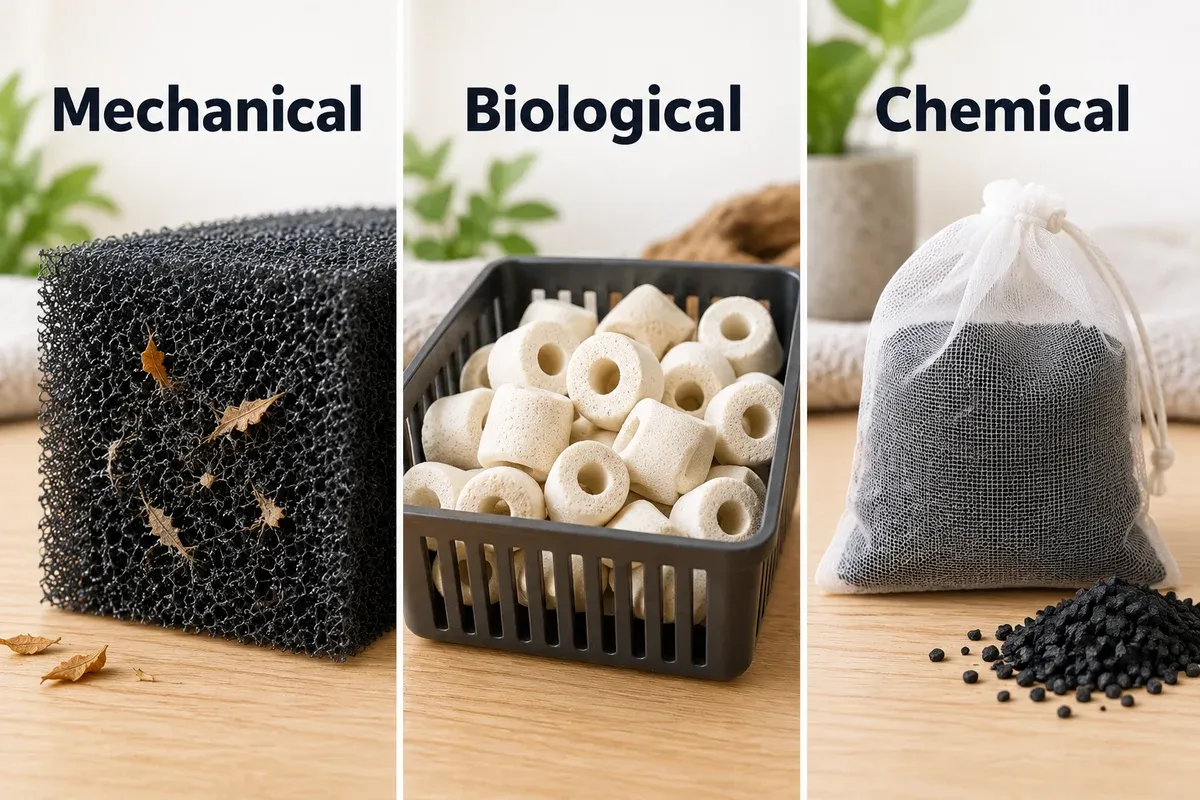
Marineland describes the Magniflow’s three stages as mechanical, chemical, and biological filtration. That is a useful way to plan a media stack:
- Mechanical media catches suspended particles. It is the stage that usually needs the most frequent cleaning because trapped debris restricts water flow.
- Biological media provides protected surface area for the aquarium’s microbial community. Do not replace every biological component at once unless the current manual and your maintenance plan specifically support that change.
- Chemical media is situation-dependent. Carbon and other adsorbents can be useful for particular water-quality or medication tasks, but they are not a replacement for adequate mechanical and biological filtration or regular water testing.
Fluval’s 07 Series manual recommends different maintenance intervals for different components and explicitly says not to replace all media at the same time. The manual’s maintenance table is a better basis for a schedule than a fixed internet-wide rule.
The materials below perform different jobs; their side-by-side arrangement is a comparison rather than a loading order.
What to measure before ordering
1. Actual water volume
Measure the aquarium’s filled volume as realistically as possible. Substrate, rocks, wood, internal equipment, and a lower operating water line reduce the water volume compared with the nominal tank size. Do not use the filter’s “up to” capacity as your calculation input.
2. Vertical distance and hose route
Measure from the water surface to the canister’s intended position and check the manual’s maximum vertical distance. Keep the hoses smooth, avoid unnecessary loops, and leave enough slack to remove the motor head. Fluval’s FAQ specifically warns that the defined vertical distance should not be exceeded.
3. Cabinet clearance
Measure height, width, door opening, and the space needed to lift baskets. A canister that fits when empty may be awkward or unsafe to remove when full of water and media.
4. Electrical and heater compatibility
US 120 V / 60 Hz specifications cannot automatically be transferred to another country. With a Thermo model, check the heater’s voltage, wattage, plug, and safety instructions separately from the pump.
5. Replacement parts and service access
Before buying, check whether the manufacturer provides replacement impellers, gaskets, hoses, baskets, and pre-filter parts for your market. OASE maintains a spare-parts page for the BioMaster 2 Thermo 600, while Fluval and Marineland provide manuals and support pages linked above.
Setup: a careful first start
Read the manual before connecting the hoses. Place the canister upright on a stable surface below the aquarium, secure the intake and return, check every gasket and valve, and prime the unit exactly as directed. Fluval provides a separate 07 Series priming guide, while Marineland’s quick setup guide explains its quick-prime button and valve block.
After the first start, look for leaks at the motor-head gasket, valve block, hose connections, and aquarium rim. Trapped air can produce rattling or a weak return. Do not open a running canister, work on the impeller while it is connected to power, or use soap and household cleaners on aquarium equipment.
Maintenance and weak-flow troubleshooting
When a canister becomes noisy or its return weakens, check the simple causes first: trapped air, a blocked intake strainer, a dirty pre-filter, clogged tubing, a worn impeller, a pinched hose, a poor gasket seal, or a return placed above the manual’s limit. Clean biological media only as the current manual allows; several manufacturers specify aquarium water for media rinsing so that the media is not unnecessarily exposed to treated tap water.
Do not promise a fixed cleaning interval for every aquarium. Stocking, feeding, substrate, plant debris, pre-filter design, and media choice determine how quickly flow declines. Record the normal return pattern after setup and inspect the filter when the pattern changes.
Frequently Asked Questions
Is a higher GPH always better?
No. More flow may improve particle transport and surface movement, but excessive or poorly directed flow can stress fish, uproot plants, or create an uncomfortable current. The useful result is the circulation your livestock tolerates after the filter is installed, not the biggest number printed on a box.
Should I compare pump output or filter circulation?
Use the same measurement type for both models. Fluval publishes both for several models, so compare pump output with pump output and filter circulation with filter circulation. Marineland’s 360 GPH rating is not automatically equivalent to Fluval’s 930 L/h circulation value.
Can I use a canister filter on saltwater?
Only when the manufacturer supports the exact model. Marineland’s official page describes the Magniflow for freshwater and marine aquariums, and OASE lists the BioMaster² Thermo 600 for fresh and salt water on the linked specification page. Follow the current manual for every other model and consider the complete marine installation, not only the filter body.
Do I need a separate heater?
The OASE model reviewed here includes a 300 W heater. The Fluval and Marineland models reviewed here are filtration units without an integrated heater, so temperature control must be planned separately.
Are the manufacturer’s flow numbers what I will see in my tank?
Usually not. Media loading, hose length, fittings, water level, head height, intake condition, and maintenance can reduce real-world flow. Treat the specifications as a starting comparison and inspect the installed return rather than promising a precise aquarium turnover.
How often should I clean the canister?
Follow the manual and the aquarium’s observed flow. Fluval publishes a component-specific maintenance schedule, and Marineland’s quick guide gives maintenance instructions for its media, foam, carbon, and impeller. A heavily stocked aquarium may need service sooner than a lightly stocked one.
Can I replace all the filter media at once?
That is usually a poor default because it removes multiple filtration stages at the same time. Fluval’s manual specifically advises against replacing all media together. Replace or rinse components according to the current manual and avoid changing the whole biological section without a plan.
What should I do if the filter leaks?
Unplug it safely, stop the flow, and inspect the gasket, valve block, hoses, clamps, and motor-head alignment according to the manual. Do not keep running a leaking filter while guessing. If a seal, impeller, or housing is damaged, use the manufacturer’s replacement-part or support process.
Final recommendation
For many 50–100-gallon aquariums, the Fluval 407 is the most balanced starting point because the manufacturer publishes both pump output and filter circulation. The Fluval 307 is the smaller 07 Series choice, the FX6 is the high-capacity option, the OASE BioMaster² Thermo 600 is the integrated-heater choice, and the Marineland Magniflow 360 is the conventional three-stage alternative.
Whichever model you choose, size the filter from actual water volume and livestock needs, compare like-for-like flow figures, measure the cabinet and hose route, and plan maintenance before installation. A correctly maintained filter with a comfortable outlet is more useful than an oversized pump that is difficult to service or unsuitable for the animals.
Sources and verification
- Fluval 07 Series: models, pump output, filter circulation, and tank ranges
- Fluval 07 Series FAQ: flow, head height, hose, and maintenance guidance
- Fluval 07 Series user manual
- Fluval FX6: detailed specifications and filter circulation
- Fluval FX6 user manual
- OASE BioMaster² Thermo 600: official international specifications
- OASE BioMaster 2 Thermo 600 North American product information
- Marineland Magniflow: official model capacities and features
- Marineland Magniflow quick setup and maintenance guide
Specifications and links were checked in August 2026. Retailer availability, regional model numbers, voltage, and pricing can change; verify those details on the linked product page before buying.
Affiliate Disclosure: We earn from qualifying purchases through Amazon Associates at no extra cost to you.