

 Published sources
 Product details checked
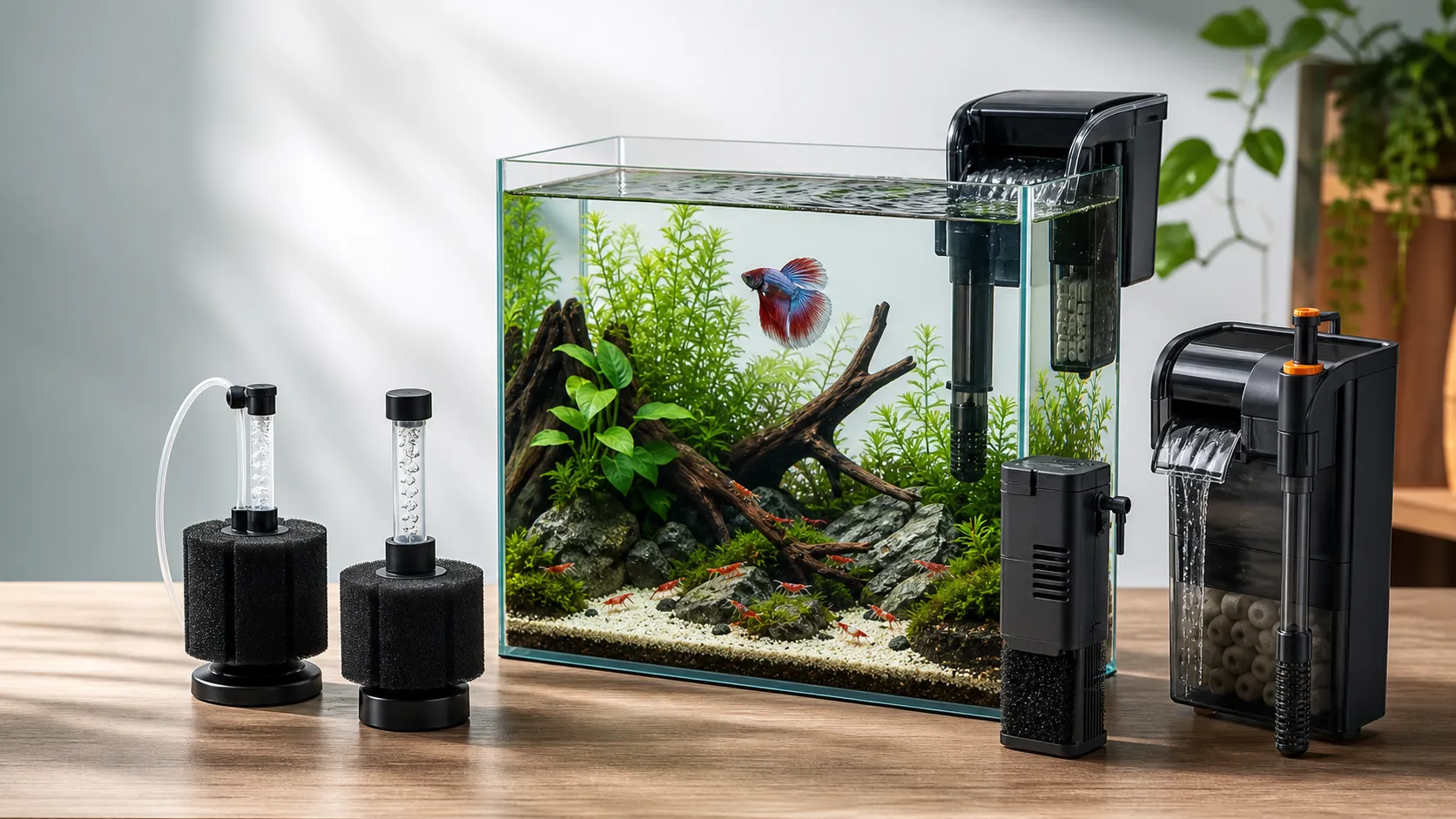
The best low-flow aquarium filter is not the one with the smallest number on the box. It is the filter that keeps ammonia and debris under control while giving your betta or shrimp a calm place to rest, feed, and graze.
Quick answer: Choose an air-driven sponge filter first for shrimp colonies, fry, or a long-finned betta. Choose an adjustable HOB filter when you want a compact all-in-one unit and do not want a separate air pump. Use an internal filter only when its stated tank range matches your aquarium and its intake is protected. For a 10-20 gallon tank, a correctly sized adjustable HOB can work well, but shrimplets still need an intake sponge or guard.
This guide compares linked products with manufacturer information and established aquarium-care guidance.
What makes a filter low-flow?
Low-flow does not mean no filtration and it does not mean a completely still water surface. A good setup still moves water through mechanical and biological media, creates enough surface exchange for oxygen, and leaves at least one calm zone.
The most useful features are:
- A broad, gentle intake: Sponge filters spread suction over a large surface and are much safer for shrimp and fry than an exposed narrow intake.
- Adjustable output: A flow dial lets you start low and increase movement only when the tank needs it.
- A diffuser or distributed return: A sponge, spray bar, or outlet aimed at the glass breaks up a hard jet.
- Enough biological media: A quiet filter that cannot process the tank’s waste is not a safe filter.
- Simple maintenance: You should be able to clean the mechanical part without discarding the entire bacterial colony.
The Aqueon guide to choosing an aquarium filter makes the same basic point: tank size, bioload, maintenance, and flow all matter. A GPH label is a comparison point, not a species-specific comfort rating.
Best low-flow aquarium filters at a glance
Low-flow filter options for bettas and shrimp
-
AQUANEAT 3-Pack Bio Sponge Filter (Small)
AQUANEAT
Three compact air-driven sponge filters with mechanical and biological filtration, minimal current, and no exposed impeller intake.
- Three small sponge filters in one pack
- intended for aquariums up to 10 gallons
- Soft sponge intake and minimal current
- Best fit
- Shrimp, fry, and gentle filtration for a small betta tank
- Useful feature
- Shrimp-safe sponge intake
-
NICREW Slim Aquarium Filter, Adjustable 42 GPH
NICREW
A compact, adjustable HOB filter described at 42 GPH for 1-5 gallon tanks. It is a practical replacement path when an oversized nano filter keeps overpowering the tank, not a universal upgrade for larger or heavily stocked aquariums.
- 42 GPH described flow
- For 1-5 gallon aquariums
- Adjustable flow control
- Best fit
- 1-5 gallon nano tanks when accessories cannot tame the current safely
- Useful feature
- Compact adjustable HOB
-
Tetra Whisper 4i Internal Power Filter (27 GPH)
Tetra
Space-saving submersible filter with a 27 GPH pump and three-stage filtration through a replaceable Bio-Bag cartridge and Bio-Scrubber.
- 27 GPH described pump
- Rated for 1-4 gallon aquariums
- Three-stage filtration
- Best fit
- A compact internal filter for a 1-4 gallon compatible setup
- Useful feature
- Compact submersible internal filter
-
AQQA Aquarium Sponge Filter (Small, 5-20 Gallons)
AQQA
Air-powered sponge filter with two sponges and ceramic bio media that adds gentle filtration and surface agitation without a motor-driven water jet.
- Small version intended for 5-20 gallons
- Two replaceable sponge elements
- Includes ceramic bio media balls
- Best fit
- 5-20 gallon shrimp, betta, fry, or breeding tanks with an air pump
- Useful feature
- Gentle air-powered filtration
-
Aqueon SmartClean Power Filter (Medium, 10-20 Gallons)
Aqueon
Hang-on-back filter with adjustable flow, an EcoRenew cartridge, a Bio-Holster for biological media, and a water-change spout that reduces maintenance mess.
- Medium size rated for 10-20 gallons
- Adjustable flow rate
- EcoRenew cartridge with carbon
- Best fit
- An adjustable HOB for a 10-20 gallon betta or shrimp community tank
- Useful feature
- Quick water-change spout
Review the linked product page before purchasing.
Our picks, with the important trade-offs
AQUANEAT 3-Pack Bio Sponge Filter: best for shrimp, fry, and the gentlest intake
The small AQUANEAT 3-Pack Bio Sponge Filter is the safest default when your first concern is preventing suction injuries. Product documentation describes mechanical and biological filtration, minimal current, and a soft sponge that is unlikely to pull in small fish or shrimp. It is intended for tanks up to 10 gallons and measures about 2 inches in diameter by 4.75 inches high.
The trade-off is that this is not a complete powered filter kit. You need an external air pump and airline tubing, and running three sponges does not automatically make sense in a small aquarium. Use one sponge in a lightly stocked nano tank, or use the pack as a spare and breeding-tank solution. A small adjustable air valve can help you set the bubble rate without turning the filter into a hard current.
Aquarium Co-Op’s explanation of how a sponge filter works is useful here: rising bubbles lift water through the sponge, trapping particles while creating surface agitation. That is why a sponge filter can be gentle without being passive.
Best for: Shrimp colonies, fry, quarantine tanks, or a betta that struggles with every motorized outlet.
Watch out for: You still need to buy and tune the air pump, and the up-to-10-gallon claim is not a substitute for sensible stocking.
NICREW Slim Aquarium Filter: best compact HOB when you want adjustable flow
The NICREW Slim Aquarium Filter is the practical choice when you want a small hang-on-back filter without adding a separate air pump. Its published specifications describe 42 GPH, 3W, and a 1–5 gallon range. The flow is adjustable, and the product documentation says the package includes the intake tube, extension tube, intake sponge, and cartridge.
This is a better betta option than a fixed, high-output filter when the aquarium is genuinely in the 1-5 gallon range. Start at the lowest setting, aim the return at the back glass, and confirm that the fish can stop swimming and reach food normally. For shrimp, treat the included intake sponge as a starting point rather than proof that every shrimplet is protected. Inspect the sponge for gaps and add a correctly sized prefilter if you see livestock near the intake.
It is also not an appropriate sole filter for a 10-gallon-or-larger tank or a heavy bioload.
Best for: A small betta or shrimp nano tank where you want a quiet HOB and no external air pump.
Watch out for: The 1-5 gallon rating is a real limit. Do not solve a larger tank’s filtration needs by simply running this filter at full power.
Tetra Whisper 4i: best compact internal filter for a compatible 1-4 gallon setup
Tetra lists the 4i at 27 GPH for 1-4 gallon aquariums, with three-stage filtration through a Bio-Bag cartridge and Bio-Scrubber. The unit clips to the tank wall and remains submerged, which can be useful when there is no room behind a nano aquarium. The official Tetra product page confirms the 4i’s 27 GPH size.
There is an important boundary: the described range tops out at four gallons. That makes the 4i a reasonable compact filter for a compatible setup, but it is not my first pick for a standard 5-gallon betta aquarium or a shrimp colony. It also relies on replaceable cartridges and has a less shrimp-proof intake than a full sponge filter. If you use it with tiny shrimp or fry, add a safe intake barrier and monitor whether the barrier clogs and reduces flow.
Best for: A space-limited 1-4 gallon aquarium, temporary quarantine, or a keeper who specifically wants an internal three-stage cartridge filter.
Watch out for: Do not stretch its tank rating, and budget for replacement cartridges.
AQQA Aquarium Sponge Filter: best larger sponge setup with ceramic bio media
The small AQQA Aquarium Sponge Filter is intended for 5-20 gallons and adds ceramic bio media to two sponge elements. It is air-powered, so there is no motor-driven water jet; the rising bubbles provide aeration and circulation. Product documentation specifies that an air pump and airline are required and not included.
This is a good fit for a 5-10 gallon shrimp or betta setup that needs more sponge area than a tiny nano filter. The ceramic balls provide additional biological-media space, but they do not make the filter maintenance-free. Rinse the sponge in removed aquarium water when it becomes dirty, keep the airlift unobstructed, and do not assume the broad 5-20 gallon label means it can handle any stocking level.
Best for: A 5-20 gallon breeding, shrimp, fry, or betta tank that already has an adjustable air pump.
Watch out for: The pump and tubing are separate purchases, and the medium or large models is not automatically better for a small aquarium.
Aqueon SmartClean Power Filter: best adjustable HOB for 10-20 gallons
The Aqueon SmartClean Power Filter in the medium 10-20 gallon size is the most useful HOB pick in this group for a larger betta or shrimp community tank. It has an adjustable flow rate, an EcoRenew cartridge, a Bio-Holster for biological filtration, and a spout designed to make partial water changes less messy. Aqueon’s SmartClean product page confirms the adjustable-flow design and Bio-Holster.
For adult shrimp and a betta community setup, adjustable flow and a cleanable biological section are more important than the cartridge’s marketing language. For a breeding colony, add an intake sponge or guard before introducing shrimplets. A HOB can be gentle at its lowest setting and still create a concentrated return at the surface, so aim the outlet along the back wall and keep a quiet resting area.
Best for: A 10-20 gallon freshwater tank where you want adjustable HOB flow and easy partial water changes.
Watch out for: It is still a powered HOB. Protect the intake, keep the biological holster established, and do not confuse low output with zero maintenance.
Choose by livestock, not by the biggest tank rating
For one betta
Start with a properly heated and cycled aquarium of at least 5 gallons when possible. Aqueon’s betta care guide notes that bettas prefer calm water and that a filter helps maintain water quality. The filter should leave a small surface ripple without forcing the fish to swim constantly.
For a 5-gallon tank, the NICREW Slim is the most direct no-air-pump option in this list. A sponge filter is the gentlest option if you already own an air pump. The Tetra 4i is better reserved for a compatible 1-4 gallon setup rather than used as a shortcut for a larger betta aquarium.
Watch the fish for more than a few minutes after installation. A betta should be able to pause behind a plant or piece of hardscape, approach food, and move between the surface and lower water without being swept into one path. A small amount of surface movement is useful; a tank-wide treadmill is not.
For shrimp and shrimplets
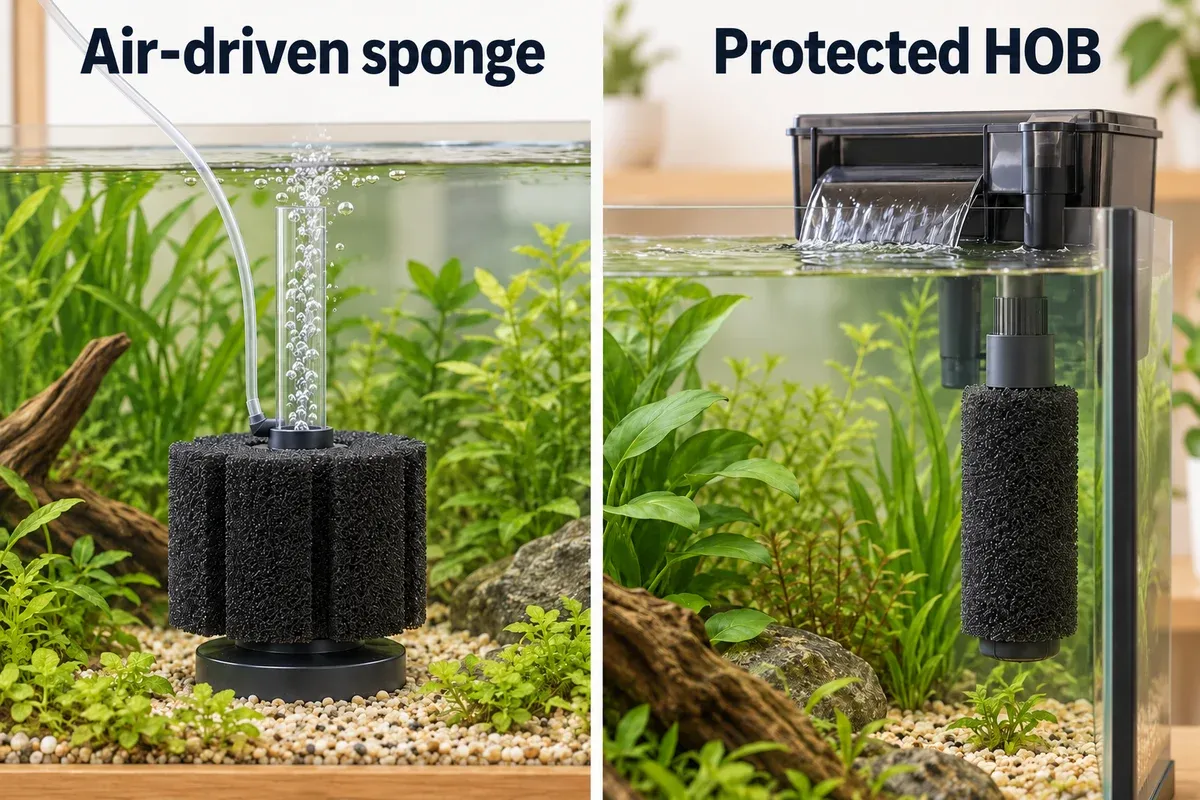
Protect the intake before you add livestock. A full sponge filter is the simplest route because the sponge is both the intake and the mechanical media. If you use a HOB or internal filter, a correctly sized prefilter sponge spreads suction and gives biofilm a place to grow. The Aquarium Co-Op guide to slowing aquarium flow recommends sponge filters, outlet redirection, and spray bars as practical ways to reduce current without abandoning filtration.
If your existing filter is otherwise appropriate, you do not need to replace it just because the return is forceful. A correctly measured Check current price on Amazon → can soften intake suction, but clean it before debris makes the pump work against a restriction. It does not fix a hard outlet jet.
Also remember that a betta may eat juvenile shrimp. Filter choice can protect shrimplets from the intake, but it cannot remove the stocking and behavior risk of keeping the two species together. Give shrimp dense cover and have a backup plan if the betta hunts them.
The two layouts below show different ways to protect the intake while maintaining circulation.
How to set up a low-flow filter safely
- Match the filter to the actual tank volume. Use the manufacturer’s stated range as a boundary, not a promise. A filter rated up to 20 gallons is not automatically gentle in a 5-gallon tank.
- Install the intake before turning on the filter. Keep it fully submerged, stable, and covered when shrimp or fry are present.
- Start at the lowest safe setting. For an air-driven sponge, reduce air gradually. For a HOB, use the flow control and aim the return at the glass. Never block a powered outlet with a loose object.
- Check the surface and the calm zone. Look for a light ripple and at least one area where the fish can rest. A flat surface with no exchange is not the goal.
- Use a simple tracer test. Follow a food flake or other clean floating tracer for 20-30 seconds at the surface and middle of the tank. If it is pinned to one corner, diffuse or redirect the return.
- Test water quality after the change. Check ammonia and nitrite during the transition, especially if you replace a cartridge filter or move biological media. Filters support the nitrogen cycle; they do not instantly cycle a new aquarium.
When cleaning, rinse reusable biological media in removed aquarium water rather than chlorinated tap water. Aqueon’s aquarium cleaning checklist recommends keeping biological media in aquarium water while the filter is serviced. Do not replace every piece of established media at the same time unless there is a specific contamination or medication reason.
When the filter is not the real problem
Strong swimming, hiding, clamped fins, or rapid breathing can also come from ammonia, nitrite, temperature, disease, aggression, or an uncycled tank. If several animals change behavior at once, test water before buying a smaller filter. A calm-looking aquarium with bad water is still unsafe.
If your current unit has the right capacity but the return is too forceful, start with the Aquarium Filter Too Strong guide. It covers outlet redirection, HOB baffles, spray bars, intake sponges, and the difference between reducing visible turbulence and starving a pump.
Common mistakes to avoid
- Choosing by GPH alone: A high number can be comfortable when dispersed and stressful when delivered through a narrow jet.
- Using an airline valve on a water return: Airline valves are for air tubing and air-driven filters. They are not a safe universal valve for a powered HOB or canister return.
- Packing the intake with fine foam: A clogged barrier can reduce flow, trap waste, and make the motor work harder. Use a coarse, correctly sized sponge and clean it regularly.
- Removing all biological media during a filter swap: Move established media into the new filter or run the old and new filters together during the transition when practical.
- Assuming quiet equals gentle: Motor noise and water velocity are different measurements. A filter can be quiet and still push a betta around.
- Trying to fix an undersized filter by turning it down: Low flow does not compensate for inadequate biological capacity. Correct the tank-size mismatch instead.
Frequently Asked Questions
What is the best type of filter for shrimp?
An air-driven sponge filter is the best default for most shrimp and breeding tanks because it combines broad, gentle intake protection with mechanical and biological filtration. A HOB can also work when its intake is covered and the return is diffused.
What is the best filter for a betta in a 5-gallon tank?
Choose a sponge filter with a controllable air pump or a compact adjustable HOB such as the NICREW Slim. Start with gentle output, keep a small surface ripple, and provide plants or hardscape that create a resting zone. Do not use a filter’s maximum tank number as proof that the current will be comfortable.
Can a sponge filter keep an aquarium clean?
Yes, when it is correctly sized, maintained, and paired with an air pump that moves enough water through the sponge. It provides mechanical and biological filtration, but it does not remove the need for water changes, sensible feeding, and water testing.
Do shrimp need a filter in a small aquarium?
A stocked aquarium needs reliable water movement and biological filtration. A sponge filter is usually safer than an exposed internal or HOB intake, especially when shrimplets are present. If the tank is very lightly stocked, the filter still needs to be matched to the waste load and maintained.
Is 27 GPH too much for a betta?
Not automatically. The Tetra Whisper 4i’s 27 GPH is intended for 1-4 gallon aquariums, but the outlet design, water depth, media condition, and tank layout determine the current the fish experiences. Test whether the betta can rest and feed instead of judging the number alone.
Can I keep a betta and shrimp with the same low-flow filter?
Yes, the filter can support both, but the betta’s individual behavior is the larger risk. Protect the shrimp intake, provide dense cover, and watch for hunting. A low-flow filter will not prevent predation.
Should I turn off the filter at night?
Usually no. A properly adjusted filter can run continuously and maintain circulation and biological filtration. If the current is too strong, fix the outlet or use a smaller or adjustable filter rather than relying on daily shutdowns.
Bottom line
For the gentlest and most shrimp-safe setup, choose the AQUANEAT sponge filter and add a controllable air pump. For a small betta tank without an air pump, the NICREW Slim is the most convenient adjustable HOB option. The Tetra Whisper 4i is a compact choice only within its 1-4 gallon range. For larger sponge setups, choose the AQQA; for an adjustable 10-20 gallon HOB, choose the Aqueon SmartClean and protect its intake for shrimp.
Whatever you buy, start with the lowest practical flow, keep a gentle surface ripple, and verify that your livestock has a calm zone. The right low-flow filter is a balance between water quality, oxygen exchange, intake safety, and animal behavior.
Sources and further reading
- Aqueon Betta Care Guide - calm-water preferences, housing, filtration, and routine care.
- Aqueon: How to Choose the Best Filter for You and Your Tank - tank size, bioload, media, maintenance, and flow considerations.
- Aqueon: SmartClean Power Filter - official adjustable-flow and Bio-Holster product information.
- Aqueon Aquarium Cleaning Checklist - safe filter cleaning and handling biological media.
- Tetra: Whisper Internal Power Filter - official 4i size, 27 GPH, and three-stage filtration information.
- Aquarium Co-Op: How to Improve Water Circulation on Aquarium Sponge Filters - how sponge filters move water and why they suit bettas, shrimp, and fry.
- Aquarium Co-Op: How to Slow the Flow in Your Aquarium - practical outlet redirection, sponge, and spray-bar approaches.