
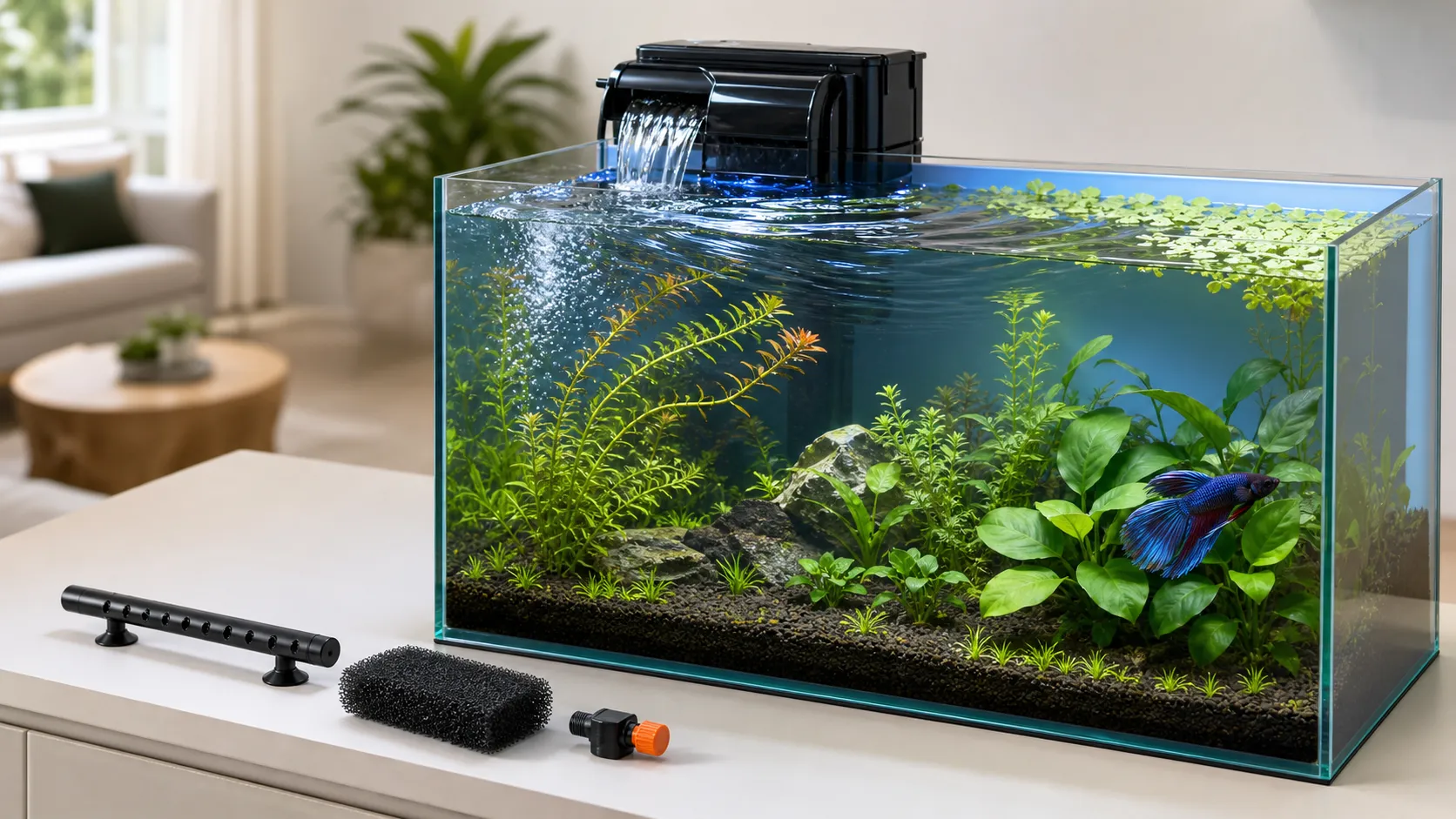

 Published sources
 Product details checked
An aquarium filter can be working perfectly and still create the wrong current for the fish, shrimp, or plants in your tank. The clue is not the filter’s tank-size label alone. It is what the animals and the water surface are doing all day.
Quick answer: Your aquarium filter is probably too strong when fish must constantly swim against one direction, long fins or fry are repeatedly pushed around, shrimp cannot graze normally, or floating plants are pinned to the opposite side. First redirect or diffuse the outlet while keeping a small surface ripple. Use a filter baffle for a hang-on-back filter, a spray bar for a compatible canister, a prefilter sponge for strong intake suction, an air valve only for air-driven filters, and a smaller filter only when the pump is fundamentally oversized.
In this guide, you’ll learn:
- Which symptoms point to excessive current for bettas, gouramis, shrimp, fry, bottom fish, and floating plants
- How to test flow without relying on the number printed on the box
- Which fixes are safe for HOB, canister, internal, and sponge filters
- Why a dirty prefilter can make flow problems worse
- When a baffle or spray bar is enough—and when replacing the filter is the better answer
Is your aquarium filter actually too strong?
The correct flow is the flow your livestock can live with while the filter still moves oxygenated water through the tank and collects waste. A danio or hillstream loach may enjoy more movement than a long-finned betta. A shrimp tank may need gentle intake suction even when the visible outlet looks calm. One universal GPH number cannot answer both questions.
Filter labels are also only a starting point. A pump’s advertised flow can change with water depth, tubing, elbows, filter media, head height, and how dirty the intake is. Use the label to compare models, then judge the installed filter by the behavior it creates in your aquarium.
Symptoms in fish and invertebrates
| What you see | What it may mean | First check |
|---|---|---|
| A betta, honey gourami, or long-finned fish is always swimming, hiding behind décor, or struggling to pause | The current may be leaving no calm resting zone | Aim the outlet at the back wall and watch whether the fish can rest without being pushed |
| Shrimp, fry, or tiny snails are pulled toward the intake | The intake suction is too exposed or too strong for the livestock | Add a correctly sized prefilter sponge and inspect it often |
| Fish can cross the tank only with effort, or food is swept away before they can feed | The main current is too directional or turbulent | Trace the return path and diffuse the outlet instead of blocking the intake |
| Corydoras or other bottom fish cannot forage in one area | The flow reaches the substrate with no sheltered feeding zone | Create a low-flow pocket behind plants or hardscape |
| Active swimmers such as danios choose the flow and leave it normally | The movement may be appropriate rather than excessive | Check that they can also rest, feed, and move away from the strongest stream |
| Duckweed, salvinia, or frogbit is pressed into one corner and roots whip constantly | Surface flow is too concentrated for floating plants | Lower the return below the surface or use a baffle/spray bar |
| Every stem plant leans in one direction | Directional flow is reaching the whole aquascape | Move the outlet or break the stream with hardscape; leaning alone is not proof of harm |
Clamped fins, hiding, lethargy, rapid breathing, and loss of appetite are not flow diagnoses by themselves. Check temperature, ammonia, nitrite, oxygenation, disease, and stocking as well. If fish are gasping at the surface or several animals deteriorate at once, test ammonia and nitrite immediately and treat it as a water-quality problem—not merely a filter-adjustment project.
A 10-minute flow test before you buy anything
Do these checks with the filter running normally. Do not turn off a working filter for hours, remove all biological media, or pinch a hose just to make the aquarium look calmer.
1. Check the water level and outlet position
For a hang-on-back filter, a low water level can turn a normal return into a loud, forceful waterfall. Bring the aquarium to the manufacturer’s safe operating level and make sure the intake remains fully submerged. Do not overfill past the rim or lid instructions.
Then move the outlet one variable at a time. Aim a return at the back glass, slightly below the surface, and watch for a gentle ripple. A tank needs gas exchange, so “quiet” should not mean a sealed, mirror-flat surface with no movement at all.
2. Watch a single floating tracer
Use one clean, aquarium-safe floating object or a single food flake and follow its path for 20–30 seconds. You are looking for a concentrated jet that crosses the entire tank, not a specific speed target.
Repeat the test near the surface, in the middle, and near the bottom. If the tracer always gets pushed into one corner, the outlet is too directional. If it circulates gently and there are still calm areas, the flow may be suitable even if the filter looks powerful at the outlet.
3. Run the fish-and-plant test
Watch feeding time and the next quiet period. Can the fish approach food, pause, and leave the current? Can shrimp graze on a surface without being swept away? Do floating plants have room to spread? A filter is not “too strong” because one area moves; it is too strong when the tank offers no usable refuge.
4. Measure approximate output when you need a number
For a short comparison between settings, hold a clean measuring container under the normal outlet for 15 seconds, while keeping the intake submerged and returning the same water to the tank immediately. Do not let a canister or internal pump run dry. The result is approximate because catching the outlet changes the back pressure slightly.
Use this calculation:
GPH ≈ gallons collected in 15 seconds × 240
For example, 0.35 gallons in 15 seconds is about 84 GPH. Divide that estimate by the actual tank volume to get a rough turnover comparison. Aqueon describes 4–6 times tank volume per hour as a useful starting range, but species, plants, media, stocking, and outlet design still matter. Aquarium Co-Op likewise emphasizes that ideal flow depends on the animals and plants rather than one universal number.
Treat turnover as a comparison tool, not a pass/fail rule. A 5-gallon tank with a 42 GPH filter may be comfortable for one setup and too turbulent in another if the outlet is a narrow jet.
Match the fix to the filter type
| Filter type | Best first fix | Product category that fits | Do not do this |
|---|---|---|---|
| Hang-on-back (HOB) waterfall | Raise water level, aim at glass, then baffle the outlet | HOB baffle | Stuff dense material into the intake or create an overflow path |
| Compatible canister | Spread the return over more holes and aim it at the back wall | Model-specific spray bar | Force a random hose valve onto the return without checking the manufacturer’s design |
| Internal motor filter | Aim the nozzle at glass or surface; add a coarse diffuser if secure | Prefilter sponge or outlet diffuser | Seal the output or let a loose sponge block the impeller intake |
| Sponge filter / air stone | Reduce air volume gradually | Airline flow valve | Treat an airline valve as a water-flow valve |
| Oversized nano or small-tank filter | Replace it with a correctly sized adjustable filter | Low-flow filter | Keep reducing flow until the filter barely circulates or loses biological capacity |
The five products below are tools for these specific situations. They are not a shopping list you need to buy in full.
Tools for calming aquarium filter flow
-
HOZOE Aquarium Filter Baffle (6 CM)
HOZOE
A clip-on, sloped baffle that spreads a hang-on-back filter's waterfall over a calmer path. the product documentation offers several sizes, so measuring the outlet matters more than the low price.
- Sloped, multi-stage flow-diversion design
- Reduces splash, surface impact, and waterfall noise
- Best for
- HOB waterfall filters with a short outlet
- Key feature
- Sloped waterfall baffle
-
Fluval Spray Bar Kit for 06 & 07 Canister Filters
Fluval
A model-specific return accessory that divides a canister filter's output across a row of holes. It is a better fit solution than forcing a generic valve onto a pressurized return hose.
- Designed for compatible Fluval 06 and 07 series canister filters
- Extends from 15 to 30 inches (38-76 cm)
- Distributes return flow across the aquarium
- Best for
- Fluval 106/206/306/406 and 107/207/307/407 canister filters
- Key feature
- Distributed return flow
-
AQUANEAT 6-Pack Pre-Filter Sponge (0.8 Inch Intake)
AQUANEAT
Six reusable foam sleeves that cover a filter intake, catch larger debris before it reaches the impeller, and soften suction around small livestock. The selected sleeve is sized around a 0.8-inch intake, not every filter tube.
- Six sponge sleeves in the selected pack
- product information states a fit range around 0.8-1 inch for the elastic opening
- Helps keep shrimp, fry, and snails away from the intake
- Best for
- Shrimp, fry, snails, and tanks with strong intake suction
- Key feature
- Gentler intake suction
-
Pawfly 6-Pack 1-Way Aquarium Air Flow Control Valves
Pawfly
Six small lever valves for adjusting air volume in standard aquarium airline tubing. They are useful for air-driven sponge filters, but they are not water-flow valves for a powered HOB or canister return.
- Six 1-way straight air distributors
- Fits standard 3/16-inch (4 mm) airline tubing
- Individual levers adjust or shut off each air line
- Best for
- Sponge filters and air stones powered by an external air pump
- Key feature
- Adjustable airline volume
-
NICREW Slim Aquarium Filter, Adjustable 42 GPH
NICREW
A compact, adjustable HOB filter described at 42 GPH for 1-5 gallon tanks. It is a practical replacement path when an oversized nano filter keeps overpowering the tank, not a universal upgrade for larger or heavily stocked aquariums.
- 42 GPH described flow
- For 1-5 gallon aquariums
- Adjustable flow control
- Best for
- 1-5 gallon nano tanks when accessories cannot tame the current safely
- Key feature
- Compact adjustable HOB
Review the linked product page before purchasing.
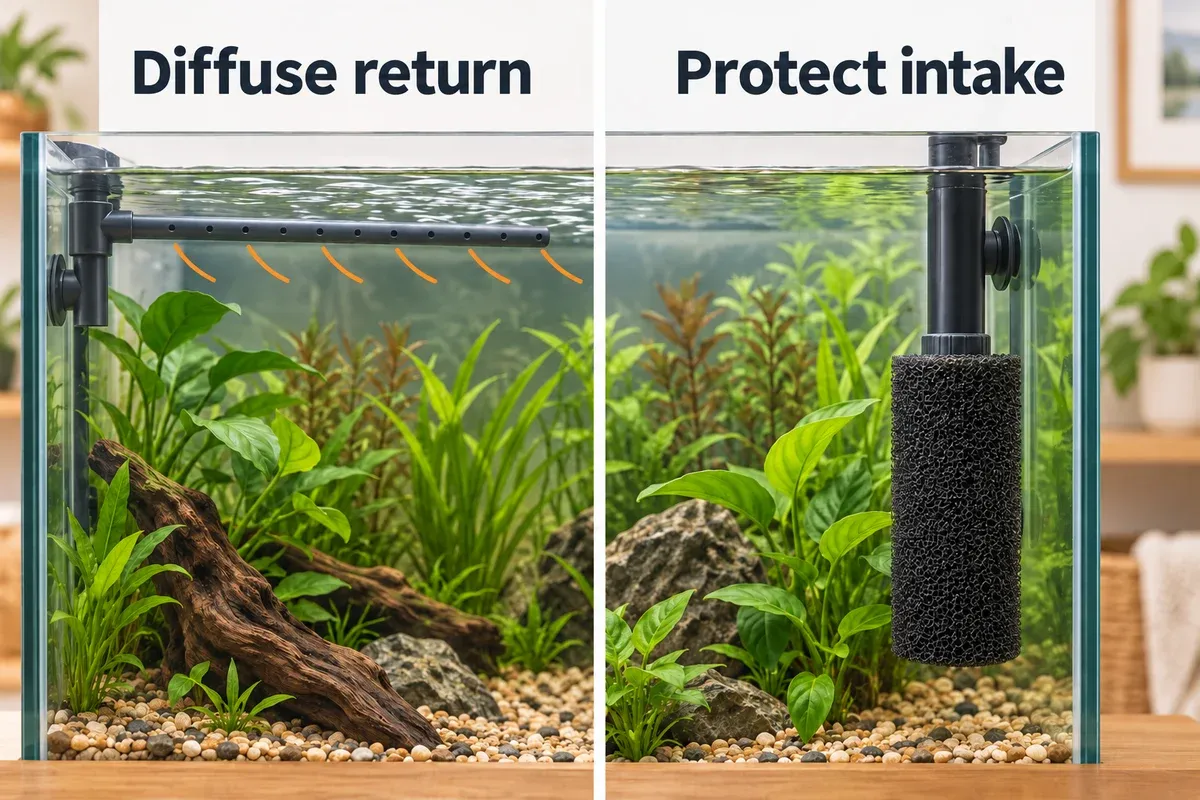
The two close-ups below address different parts of the water path: outgoing current and incoming suction.
Safe fixes, from simplest to strongest
1. Redirect the outlet before you reduce the filter
This is the lowest-risk fix because filtration continues at the same pump setting. Point a HOB waterfall toward the back glass, raise the water level to the safe operating mark, or place a canister return just below the surface with the holes aimed along the back wall. You want distributed movement and a small ripple, not a high-energy jet across the whole aquarium.
Add plants, wood, or a stable ornament in the return path if it creates a genuine calm zone. Secure everything so it cannot fall against the glass or trap a fish. Recheck the tank after feeding because food movement often reveals a problem that is not obvious when the aquarium is empty.
2. Add a HOB baffle when the waterfall is the problem
The HOZOE Aquarium Filter Baffle (6 CM) is a targeted option for a hang-on-back outlet that hits the water too hard. Its sloped trough spreads the falling water over a longer path, which can reduce splash and turbulence while keeping a visible return. Match the baffle to the outlet dimensions in the manufacturer instructions before ordering. Check current price on Amazon →
Install the baffle with the aquarium at its normal water level, then watch the sides and back of the filter for bypass water. A baffle that is too narrow, loose, or clogged can redirect water over the rim.
Clean the baffle or its sponge in removed aquarium water whenever debris builds up. Never let a small diffuser become the only place where mechanical waste is trapped and then leave it unattended for weeks.
3. Use a spray bar on a compatible canister filter
The Fluval Spray Bar Kit A234 is made for Fluval 06 and 07 series canister filters, including the 106/206/306/406 and 107/207/307/407 families. The bar extends from 15 to 30 inches and distributes the return through multiple holes. Fluval says it can be positioned to direct water and improve surface agitation. Check current price on Amazon →
For a betta, shrimp, or floating-plant setup, start with the bar just below the surface and aim the holes toward the back wall. If oxygenation is a concern, rotate it slightly upward until there is a gentle ripple. A spray bar changes how the flow enters the tank; it does not reduce the pump’s rated capacity, so a very oversized canister may still need a smaller or adjustable return solution.
Do not describe this part as a universal fit. If you use another canister brand, check its official accessories first. A loose hose connection can leak or send the return in one concentrated stream.
4. Protect the intake with a prefilter sponge
The AQUANEAT 6-Pack Pre-Filter Sponge is most useful when the problem is suction rather than the visible outlet. The 0.8-inch version is intended for intakes around 0.8–1 inch. It can keep shrimp, fry, and snails away from the intake while catching larger particles before they reach the impeller. Check current price on Amazon →
Measure the intake tube first. A loose sleeve can fall off; an undersized sleeve can choke the intake. Rinse the sponge in water removed during a water change, never under untreated tap water, and clean it sooner if the flow drops. A prefilter is especially useful in a shrimp or fry tank, but it is not a substitute for an outlet baffle when the waterfall is the part creating the current.
5. Use an airline valve only with an air-driven filter
The Pawfly 6-Pack 1-Way Air Flow Control Valve is for 3/16-inch airline tubing. It makes sense with a sponge filter or air stone connected to an external air pump: turn the lever down gradually until bubbles and circulation are gentle, while keeping enough movement for oxygen exchange. the product documentation recommends a check valve after the control valve, which is a sensible protection against back-siphoning. Check current price on Amazon →
This small accessory is often mislabeled as a general filter-flow valve. It does not belong on a powered HOB or canister water return. Do not completely close every air outlet on a pump just to silence the tank. If the pump has no safe adjustment range, use a bleed setup or replace it with an adjustable air pump.
6. Replace an oversized nano filter
If a baffle, a safer outlet position, and a clean intake still leave no calm water in a 1–5 gallon aquarium, the filter itself may simply be too large for the setup. The NICREW Slim Aquarium Filter is described at 42 GPH with adjustable flow for 1–5 gallon tanks. It is a realistic replacement option for a small betta, shrimp, or planted nano tank when the existing filter is a constant jet. Check current price on Amazon →
Keep the limitation clear: a 1–5 gallon filter is not a replacement for adequate filtration in a 10-gallon-or-larger aquarium or a heavily stocked tank. When changing filters, move established biological media into the new filter if it fits, or run the old and new filters together for a transition period while monitoring ammonia and nitrite.
What to avoid when reducing aquarium flow
Do not pinch a canister hose as a default fix
A hose clamp or improvised valve can create back pressure, make a pump noisier, reduce circulation through the media, and leave you with a hidden maintenance problem. If a filter brand supplies a purpose-built control valve, follow that manual. Otherwise, diffuse the return with a compatible spray bar or redirect it toward a wall.
Do not pack the intake with fine foam
Fine foam can look like an easy way to slow a filter, but it loads quickly with debris and can starve the pump. Use a coarse, correctly sized prefilter and clean it on a schedule based on the tank’s bioload. If the filter loses output suddenly, inspect the intake, sponge, impeller, and media before changing livestock or adding chemicals.
Do not turn off the filter as the permanent solution
Short shutdowns for feeding or maintenance may be appropriate for some equipment, but an off filter stops water movement through the biological media. It also removes the regular surface exchange that helps maintain oxygen. Fix the flow path while keeping the filter running safely whenever possible.
Do not confuse calm water with stagnant water
Bettas prefer gentle flow, but they still need stable, conditioned water and reliable filtration. Shrimp and fry need protection from suction, not a completely still tank. The goal is a tank with a strong filtration process and usable low-flow zones—not a decorative container with no circulation.
Flow by livestock and plant type
Bettas, gouramis, and long-finned fish
Start with the gentlest configuration: a return along the back wall, a baffle or spray bar, and floating cover or plants that create resting places. Aqueon notes that bettas come from sluggish habitats and do better with calm water and gentle filtration. The fish should be able to reach the surface, feed, and pause without being carried away.
Shrimp, fry, and tiny snails
The intake is often the bigger risk. Cover it with a correctly sized coarse sponge, check the sponge for clogging, and keep a fine-leaved or hardscape refuge near—not inside—the main return. Observe young livestock after every filter clean because a changed sponge or loose fitting can alter suction quickly.
Corydoras, loaches, and other bottom fish
Some bottom fish enjoy oxygen-rich movement, but they still need a place to rest and forage. Do not judge the tank from the surface alone. Watch the substrate: if food is swept away and the fish cannot hold position near the bottom, redirect the stream or add a sheltered zone.
Danios and other active swimmers
Active species may use a stronger current as enrichment. That does not mean the entire tank should be a treadmill. Provide calmer water behind plants or décor, and watch whether the fish choose the flow or are trapped in it.
Floating and delicate plants
Floating plants make current visible. If all of them are pressed into one corner, lower the return below the surface, aim it at the glass, or distribute it through a spray bar. Stem plants leaning slightly can be normal; torn leaves, uprooted plants, and no calm planting area suggest the flow path needs attention.
When strong flow is not the real problem
If the animals look stressed even after the return is diffused, widen the diagnosis. Test ammonia and nitrite, check temperature with a separate thermometer, inspect the filter for trapped air or a damaged impeller, and review recent maintenance. Cloudy water, surface gasping, or a sudden change after replacing all filter media can point to water-quality instability rather than a simple flow mismatch. Our guide to cloudy aquarium water causes covers that separate diagnosis.
A new setup may also have the wrong equipment for its size or livestock. The beginner aquarium checklist explains why a filter must be sized for both bioload and current tolerance. If you are building a larger system, compare the media capacity and return design in our canister filter guide instead of choosing only by the highest GPH number.
Frequently Asked Questions
Can I reduce filter flow without damaging the pump?
Usually, redirecting or diffusing the outlet is the safer first move. Use a built-in flow control only as the manufacturer describes it. Avoid pinching hoses or completely blocking a powered return because the pump may run against excessive back pressure or lose the circulation the biological media needs.
Is a higher turnover rate always better?
No. Turnover is a rough comparison, not a welfare target. More flow can help distribute oxygen and collect waste, but the correct setup must also give the resident fish, shrimp, and plants areas where they can rest, feed, and grow. Aqueon’s 4–6 times-per-hour starting range is useful context, not a universal pass/fail line.
How do I know if a betta’s filter is too strong?
Look for persistent struggle against the current, hiding behind objects, difficulty reaching food, or an inability to pause in place. A betta should have a calm route to the surface and a resting zone. Check water quality too, because lethargy and clamped fins can have causes unrelated to flow.
Will a prefilter sponge make my filter weaker?
It can soften intake suction and add mechanical filtration, but it can also restrict flow when it becomes dirty. Choose the correct diameter and rinse the sponge in removed aquarium water when debris builds up. It is especially useful for shrimp and fry, but it usually will not solve a forceful HOB waterfall.
Are aquarium flow valves safe on a canister filter?
An airline valve is not a canister-water valve. Use airline valves with air tubing and sponge filters. For a canister, prefer the brand’s compatible spray bar, an approved control, or a return aimed at the back wall. If you are unsure whether a valve is designed for flow control, do not install it on the return hose.
Should I turn off the filter when fish are being pushed around?
Turn it off only long enough for safe maintenance if the manual allows it, or if there is an immediate overflow or electrical hazard. As a permanent fix, shutting it down removes filtration and circulation. Redirect or diffuse the flow, create a calm zone, and solve the underlying sizing or outlet problem.
Bottom line
An aquarium filter is too strong when its current removes the fish’s ability to rest, feed, or choose where to swim—not simply because its box lists a high GPH number. Start with water level and outlet direction, then use the tool that matches the filter: HOB baffle, compatible spray bar, correctly sized intake sponge, airline valve for air-driven equipment, or a smaller filter when the system is oversized.
Keep a small surface ripple, clean any sponge or baffle before it becomes a blockage, and recheck ammonia and nitrite after changing filters. A calm aquarium is not an unfiltered aquarium; it is a system where filtration and animal comfort work together.
Sources and Further Reading
- Aquarium Co-Op: How to Slow the Flow in Your Aquarium for practical baffle, spray bar, plant, and sponge-filter flow adjustments.
- Aquarium Co-Op: How to Improve Water Circulation on Aquarium Sponge Filters for gentle sponge-filter flow and airline valve use.
- Aqueon: How to Choose the Best Filter for You and Your Tank for species-sensitive flow guidance and turnover as a starting point.
- Aqueon: Betta Fish Tank Setup for low-flow filter guidance for bettas.
- Fluval: Spray Bar Kit for 06, 07 Canister Filter for compatibility and spray-bar positioning.