

 Published sources
 Product details checked
Your cat water fountain can stop moving water for a surprisingly ordinary reason: the reservoir is a little low, hair is wrapped around the impeller, or an air pocket is trapped inside the pump. A dead motor is only one possibility.
Quick answer: Unplug the fountain, fill the reservoir above the pump, then work through the pump, impeller, filter, tubing, and power connection in that order. Most weak-flow and humming problems clear after a proper pump cleaning and a careful reassembly. If the pump still does not run after a known-good power check, replace the exact model-compatible pump before replacing the entire fountain.
This guide uses manufacturer manuals and failure patterns that apply across PetSafe Drinkwell, Catit Flower, PETLIBRO, and compatible ceramic fountains. It is a troubleshooting guide, not a hands-on product review.
Before You Start: Keep Your Cat Hydrated
Put down a clean backup bowl before you unplug the fountain. Do not wait for the repair if your cat is already drinking less than usual. A fountain is a convenience, not the only water source your cat should have.
Work on a dry counter and unplug the adapter before touching the pump. Never submerge the power adapter, splice a damaged cable, or run a pump dry while testing it. If the adapter or cable is cracked, hot, wet inside, or smells burned, stop using it and replace the manufacturer-approved power part.
If your cat is lethargic, vomiting, has dry or sticky gums, is not eating, or is straining to urinate, contact a veterinarian instead of treating the fountain as the whole problem. VCA Animal Hospitals’ hydration guide lists lethargy, poor appetite, dry gums, reduced skin elasticity, and sunken eyes among dehydration signs.
Quick Troubleshooting Path
Start with the symptom you see. This short path prevents you from buying a pump when the real problem is a blocked filter or an air lock.
| What you notice | First check | Most likely causes |
|---|---|---|
| No sound and no flow | Outlet, adapter, cable, and connector | Power path, failed adapter, failed pump |
| A hum but no water | Water level and pump intake | Low water, air lock, clogged impeller, blocked intake |
| Gurgling or intermittent flow | Prime the pump under water | Trapped air, low reservoir, loose tubing |
| Very weak stream | Remove the filter for a brief diagnostic test | Dirty filter, limescale, hair, blocked nozzle |
| Flow stops after a few minutes | Check whether the pump is overheating or running dry | Low water, impeller friction, failing motor |
| Water leaks after cleaning | Recheck seals, lid, tube, and filter position | Misassembly, pinched gasket, misplaced cover or tube |
The order matters. Do not open the motor housing or start with an expensive replacement. First eliminate the causes that take five minutes to fix.
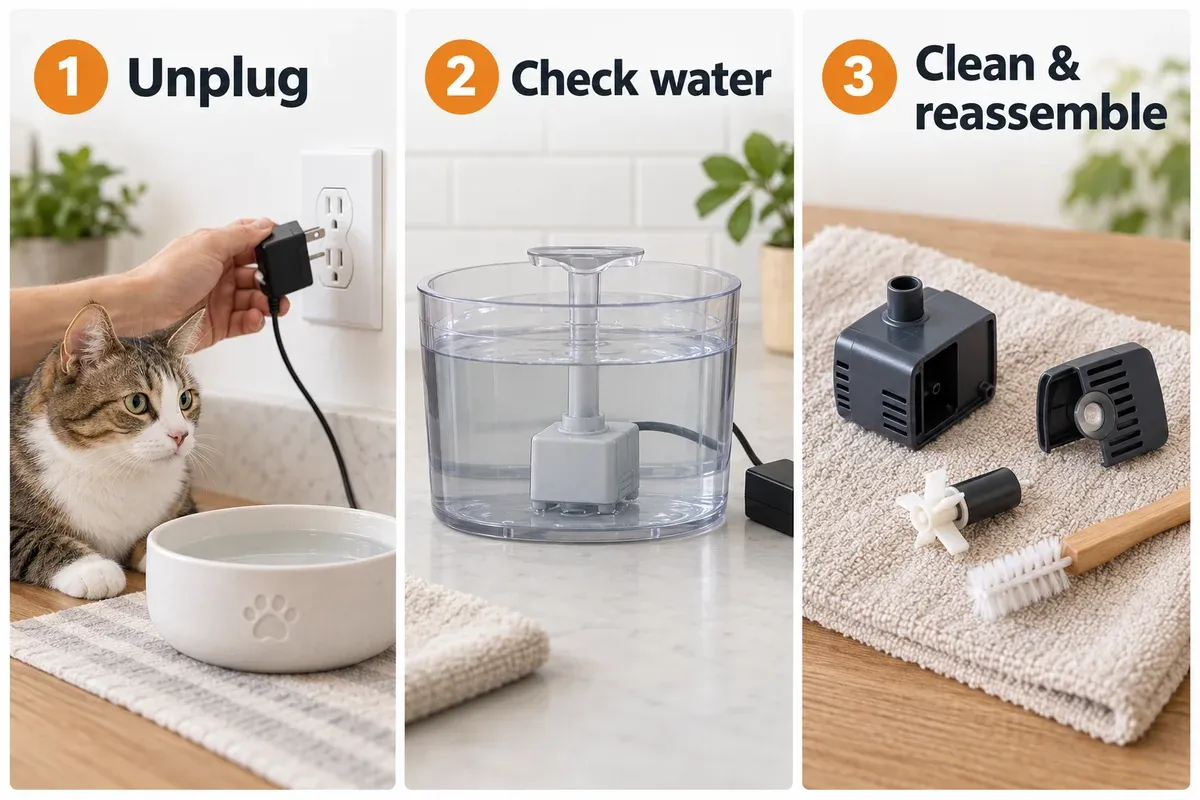
Step-by-Step: Get the Pump Running Again
1. Check the water level and reservoir position
Unplug the fountain and fill it with fresh water until the pump is completely covered. A submersible pump can hum, rattle, or fail to prime when the water level drops just below its intake. Refill the reservoir after inserting a filter because the filter, tray, and pump chamber displace water.
Check that the reservoir is seated flat on its base. A tilted bowl can leave the pump partly exposed even when the water level looks adequate from the front. Do not overfill past the model’s maximum line, especially if the fountain has a shallow tray or a small filter compartment.
2. Verify the entire power path
With the fountain still unplugged, inspect the cable from the pump to the adapter. Look for a loose inline connector, a bent USB plug, moisture, chew marks, or a cable that has been pulled tight behind furniture. Plug the adapter into a known-good wall outlet rather than assuming a power strip is working.
If your model uses USB power, test the adapter specified for that fountain. A USB cable that fits physically is not automatically the correct voltage or current. Keep the adapter away from splash zones and create a small drip loop so water cannot run along the cable into the outlet.
The sound is a useful clue: no sound after a verified power check points toward the adapter, connector, or motor; a steady hum points more often toward water, air, debris, or the impeller.
3. Re-seat the filter, cover, tube, and nozzle
A fountain can look assembled while one small part blocks the water path. Remove the lid and check each connection:
- Is the filter facing the direction shown in the manual?
- Is the filter too swollen, packed with hair, or overdue for replacement?
- Is the pump cover fully clipped into place?
- Is the silicone tube connected at both ends and free of kinks?
- Is the spout or nozzle seated in the lid rather than pressed against the filter?
- Is a foam pre-filter wrapped around the pump intake where the model expects it?
If you have a PetSafe Drinkwell Platinum, compare the parts with the Drinkwell manual before forcing anything. Other brands use similar-looking pumps with different covers and tubing, so a part that fits loosely can still leak or starve the impeller.
4. Remove an air lock
An air lock is trapped air that stops a small pump from lifting water. It often appears after a fountain has been emptied, cleaned, or moved. The pump may buzz while the outlet stays dry.
- Unplug the fountain.
- Fill the pump chamber and reservoir with clean water.
- Lift the pump under the water, tilt it gently from side to side, and let trapped bubbles escape.
- Re-seat the pump while it remains submerged.
- Reconnect the tube and lid, then test it for a few seconds.
Do not shake the pump while it is connected to power. If the fountain starts and then gurgles, turn it off, top up the water, and repeat the prime rather than leaving it to run dry.
5. Clean the impeller and intake
The impeller is the small magnetic rotor inside the pump. Hair, food dust, biofilm, and mineral flakes can slow it until the fountain only hums. This is the most important cleaning step because wiping the visible pump shell does not clear the impeller chamber.
Unplug the pump and remove its front cover according to the model’s instructions. Pull out the impeller only if the manual allows it; some pumps use a small cap or shaft that can be damaged by a screwdriver. Rinse the cover and intake, then use a soft brush or cotton swab to remove debris from the rotor cavity. The rotor should turn freely without scraping.
PetSafe’s manual recommends cleaning the pump about every two weeks and explains that the impeller can be removed for cleaning. It also warns against placing the pump or adapter in a dishwasher. Reassemble the cover before testing so loose parts cannot enter the rotor.
6. Remove limescale without damaging the electrical parts
White flakes or a rough, chalky impeller are signs of mineral buildup. Hard water can narrow the intake and make a healthy pump sound weak. With the pump unplugged, remove the pump cover and other parts the manual identifies as washable. Soak those removable parts in a diluted white-vinegar solution only as directed by the manufacturer, then rinse until there is no vinegar smell.
Never soak the power adapter or any sealed electrical section. Do not mix vinegar with bleach or another cleaner. If the impeller shaft is pitted, the housing is cracked, or the rotor still binds after cleaning, a replacement pump is safer than trying to lubricate it with household oil.
7. Test the filter and outlet separately
An old carbon filter can swell, shed debris, or become so restricted that the pump cannot maintain flow. For a short diagnostic test, run the cleaned fountain with the filter removed while you watch it closely. If the stream returns, replace the filter with the correct model rather than using the fountain permanently without filtration.
The filter test also catches incorrect reassembly. If the pump works without the filter but stops when the filter is inserted, the filter may be backward, overpacked, the wrong size, or not fully wetted. Pre-soak a new carbon filter if the instructions call for it, and rinse loose carbon dust before installing it.
8. Reassemble and watch the first cycle
Fill with fresh water, secure the pump, connect the tube, install the filter and lid in the correct order, and start on the lowest flow setting if your model has one. Watch the fountain for at least ten minutes:
- The pump should remain covered by water.
- The stream should stay steady rather than pulsing.
- The lid should not lift or leak around the edges.
- The adapter and cable should remain cool and dry.
- The pump should not become noticeably louder as it runs.
Mark the water level with a removable piece of tape. If the fountain stops when the level falls only a little, the pump may be worn or the intake may sit too high for the way your cat uses the fountain.
When the Pump Is Actually Worn Out
Replace the pump when all of the following are true: the outlet works, the adapter is correct and dry, the pump is fully submerged, the impeller is clean and free, the filter is not blocking flow, and the fountain still produces no flow or repeatedly stops after warming up.
Replace the pump only if the replacement matches the fountain model, connector, voltage, mounting feet, cable length, and pump cavity. “Universal” often describes the connector, not the hydraulic fit. A pump that sits too high can run dry; one with the wrong outlet can leak or produce a weak stream.
Replace the entire fountain when the reservoir is cracked, the lid no longer seals, the power adapter is proprietary and damaged, the pump housing is swollen or corroded, or several parts have failed together. If the bowl and lid are still cleanable and intact, a pump is usually the more sensible first repair.
Replacement Parts and New-Fountain Options
The table below is deliberately repair-first. The first four entries are replacement pumps for named fountain families. The final entry is a complete fountain for cases where the old basin, lid, or pump housing is no longer worth repairing.
-
PetSafe Drinkwell Platinum Replacement Pump
PetSafe
The model-specific replacement pump for a Drinkwell Platinum fountain. It is the cleanest repair when the reservoir, lid, cord, and filter housing are still sound.
- OEM PAC00-13204 replacement
- Approx. 5.5-foot cord
- Submersible pump design
- Best for
- PetSafe Drinkwell Platinum owners who need the exact OEM pump
- Key fit
- OEM replacement for Drinkwell Platinum
-
PETLIBRO PLWF002 Replacement Pump
PETLIBRO
A replacement pump with power cord for the PETLIBRO PLWF002 fountain. Use it when the bowl, filter cover, and adapter are still healthy but the pump no longer moves water.
- Designed for the PLWF002
- Pump and power cord included
- 5V product information specification
- Best for
- PETLIBRO PLWF002 owners who want a low-cost, model-matched fix
- Key fit
- Model-matched pump for PETLIBRO PLWF002
-
Hagen Catit Flower Fountain Replacement Pump
Catit
A Catit/Hagen replacement pump for the Flower Fountain family. It uses four suction cups and keeps the original fountain housing in service, but the USB adapter is sold separately.
- Catit/Hagen replacement pump
- Four suction cups
- Works with selected Flower and Senses models
- Best for
- Catit Flower Fountain and compatible Senses fountain owners
- Key fit
- Replacement pump for selected Catit fountains
-
Lawfery Replacement Pump for Ceramic Cat Fountain
Lawfery
A third-party 5V pump for compatible 2.1-liter/71-ounce ceramic fountains. Choose it only after matching the connector, pump cavity, cable length, and suction-foot layout.
- 5V USB pump
- Approx. 6-foot cable
- Four suction cups
- Best for
- Compatible 2.1-liter ceramic fountain owners who need an aftermarket pump
- Key fit
- Aftermarket pump for compatible 2.1L ceramic fountains
-
PETLIBRO Dockstream 2 Cat Water Fountain
PETLIBRO
Smart fountain with a stainless steel tray, 5G WiFi, app monitoring, 4-layer filtration, and water intake tracking. The premium tray is useful for owners replacing a fountain with hard-to-reach plastic seams, but the pump and filter still need routine cleaning.
- Stainless steel construction
- WiFi & app hydration tracking
- 4-layer filtration system
- Best for
- Tech-savvy cat owners who want app-based hydration tracking
- Key fit
- Stainless steel tray + app monitoring
Review the linked product page before purchasing.
PetSafe Drinkwell Platinum Replacement Pump: Exact OEM Fit
Check current price on Amazon →This is the first part to consider if your fountain is specifically the Drinkwell Platinum. the product documentation identifies the pump as PAC00-13204 and gives it an approximately 5.5-foot cord. It is a better match than a generic USB pump because the pump cover, outlet, and mounting position are designed for the Platinum housing.
Choose it when the basin, lid, filter compartment, and power adapter are in good condition. Do not use the Platinum pump as a substitute for PetSafe 360, Ceramic, or other Drinkwell models; verify the nameplate and the part number before ordering.
Best for: A silent or weak Platinum pump after cleaning and priming. Skip if: Your fountain is a different Drinkwell model, the adapter is damaged, or the bowl is cracked.
PETLIBRO PLWF002 Replacement Pump: Low-Cost Model-Matched Repair
Check current price on Amazon →The PLWF002 pump is the sensible low-cost repair for owners of that exact PETLIBRO model.
Match the old pump’s connector and cable before ordering. This part should not be treated as a replacement for newer wireless or redesigned PETLIBRO systems. If your PLWF002 adapter is intermittent, replace or verify the adapter at the same time; a new pump cannot correct unstable power.
Best for: A working PLWF002 bowl and adapter with a failed or noisy pump. Skip if: You cannot confirm the model number or the filter housing is already cracked.
Hagen Catit Flower Fountain Replacement Pump: For Selected Catit Models
Check current price on Amazon →The Catit/Hagen replacement pump is aimed at the Flower Fountain family and uses four suction cups to hold the pump in place. The important catch is that the USB adapter is not included.
Catit publishes a replacement-pump compatibility list and identifies compatible fountain families such as Flower, Mini Flower, Senses, and Fresh & Clear models. Use that list and your fountain’s model number together; a similar-looking Catit lid does not guarantee a matching pump outlet.
Best for: A Catit Flower or compatible Senses fountain with a sound USB adapter. Skip if: You need a new adapter too, or your fountain is not on the compatibility list.
Lawfery Ceramic Fountain Pump: Aftermarket Option With a Fit Check
Check current price on Amazon →This Lawfery pump is an aftermarket option for compatible 2.1-liter/71-ounce ceramic fountains. Its product information specifies a 5V USB pump, an approximately 6-foot cable, four suction cups, and 1.5W.
Before ordering, measure the old pump and compare the connector, outlet direction, cable route, suction-foot spacing, and adapter. The brand’s pump page describes this family of specifications, but a third-party pump still needs to fit your particular fountain body.
Best for: A compatible ceramic fountain where the original pump is no longer available. Skip if: You want guaranteed OEM fit or cannot verify the dimensions.
PETLIBRO Dockstream 2: Replace the Whole Fountain When the Housing Is Done
Check current price on Amazon →The PETLIBRO Dockstream 2 is not a replacement pump for the PLWF002. It is a complete fountain to consider when the old basin leaks, the lid is permanently stained or cracked, the pump cavity is damaged, or the cost of several repairs approaches the cost of a new setup.
That extra connectivity is not automatically an upgrade for every household. A simpler fountain may be easier to clean and troubleshoot. Compare the Dockstream 2 with other materials and flow designs in our cat water fountain comparison before replacing a fountain that only needs a filter or pump.
Best for: A structurally worn fountain where you want a new stainless-steel setup and monitoring features. Skip if: Your existing bowl is intact and the fault is only a clogged impeller or filter.
Part or New Fountain? Use This Decision Rule
Repair with a pump or filter when:
- The reservoir and lid are intact and do not leak.
- The adapter and cable are undamaged.
- The pump cavity, tubing, and filter housing are still available.
- The exact replacement part is easy to identify.
- The repair costs much less than a complete fountain.
Replace the whole fountain when:
- A crack, warped lid, or failed seal lets water reach the electronics.
- The fountain needs multiple proprietary parts at once.
- The pump cavity is permanently corroded or the new pump cannot seat correctly.
- Your cat avoids the fountain because the material or flow design is a poor fit.
- You want a different capacity, tray material, or monitoring setup anyway.
Do not choose by price alone. A replacement pump is wasted if the adapter is failing, and a new fountain is unnecessary if a clean OEM pump restores a sound bowl. Photograph the old pump, connector, and model label before shopping. That small record prevents the most common compatibility mistake: ordering a pump that fits the plug but not the fountain.
How to Prevent the Same Failure
Fresh water and a short cleaning routine reduce repeat problems more effectively than a higher-priced pump.
- Daily: Top up before the pump intake is exposed, remove visible hair, and check that the stream is steady.
- Weekly: Empty and rinse the bowl, tray, lid, and filter housing. Wipe slime from corners instead of letting it reach the pump.
- Every one to two weeks: Unplug the pump, remove the cover if the manual allows it, and clean the impeller and intake.
- On the filter schedule: Replace carbon or foam filters according to the model instructions. PetSafe’s Drinkwell manual lists a two-to-four-week carbon-filter interval, while hard water or multiple cats may require closer attention.
- After every deep clean: Prime the pump under water and confirm that the tube, filter, and lid are seated before leaving the fountain unattended.
If your cat prefers still water, keep a separate bowl even when the fountain works. You can also find practical ways to increase total water intake in Cat Not Drinking Enough Water; a working pump should support hydration, not become the only route to it.
Frequently Asked Questions
Why does my cat water fountain hum but not pump water?
The pump is receiving power, but water is not moving through it. Check the water level, remove an air lock, clean the impeller, and inspect the intake and outlet for hair or limescale. If the hum remains after those checks, the impeller or motor may be worn.
Can I run the fountain without the filter?
You can remove the filter briefly as a diagnostic test if the model permits it, but do not treat that as normal operation. If flow returns without the filter, replace the blocked or incorrectly installed filter and rinse the new one as directed.
Can I use a universal replacement pump?
Only when the voltage, connector, outlet, mounting position, cable length, and pump dimensions all match. Most “universal” pumps are not universal hydraulically. A model-specific OEM pump is safer when one is available.
Why is the fountain noisy after I cleaned it?
The pump may still contain air, the water level may be too low, the impeller may be mis-seated, or the pump cover may not be clipped in. Unplug it, prime the pump under water, and check the rotor before assuming the motor is defective.
Is vinegar safe for cleaning a cat water fountain pump?
Use diluted white vinegar only on removable, non-electrical parts and only in a way the manufacturer’s manual allows. Rinse thoroughly. Never soak the adapter, mix vinegar with bleach, or use household oil on the impeller.
How often should I clean the pump?
Every one to two weeks is a practical starting point for most fountains, with more frequent cleaning if you have hard water, multiple cats, visible hair, or a fountain that becomes noisy quickly. Follow the model manual when it gives a different interval.
Should I replace the pump or the entire fountain?
Replace the pump when the bowl, lid, adapter, and pump housing are sound and an exact replacement is available. Replace the fountain when it leaks, is cracked, has a damaged adapter or proprietary housing, or needs several expensive parts at once.
What should I do if my cat stops drinking while the fountain is broken?
Offer fresh water in a clean backup bowl immediately and monitor eating, energy, urination, and other behavior. If your cat is lethargic, vomiting, not eating, appears dehydrated, or has trouble urinating, contact a veterinarian promptly rather than waiting for a replacement pump.
Final Takeaway
A cat water fountain that stops pumping is often recoverable. Check water and power first, then prime the pump, clean the impeller, remove limescale safely, test the filter, and reassemble one part at a time. If the motor is truly failing, buy the pump that matches the fountain model; replace the whole unit only when the housing, adapter, or several parts are also worn.