

 Published sources
 Product details checked
If your cat keeps trying to urinate but passes little or no urine, go to an emergency veterinarian now. A urinary blockage can be life-threatening, particularly in male cats; changing the water bowl will not help. Cornell’s feline urinary tract guide identifies repeated attempts, straining, pain, and little or no urine as signs that require immediate attention.
If your cat is otherwise well, eating wet food, and urinating as usual, an untouched water bowl may be normal. Wet food supplies water, and some cats drink when no one is watching. What matters is a change from your cat’s usual pattern, especially alongside reduced appetite, vomiting, diarrhea, weakness, weight loss, or a change in urination. International Cat Care’s drinking guide makes this distinction between a well cat with steady habits and a cat whose drinking has changed.
Decide whether your cat needs care now
- Emergency care now: Your cat repeatedly visits the litter box, strains or cries, and produces little or no urine. Do not wait to see whether a new bowl, wet food, or a fountain helps. Cornell explains why suspected urethral obstruction is an emergency. If you cannot tell whether your cat has passed urine, call an emergency veterinary service while you check. Collapse, inability to stand, or repeated vomiting with marked weakness also needs emergency assessment; see VCA’s guide to emergencies in cats.
- Contact your veterinarian promptly: Your cat has a confirmed new drop in drinking, even without another obvious sign. Also call if your cat is eating less, vomiting, has diarrhea, seems weak or unusually quiet, has dry or tacky gums, or appears to have sunken eyes. These can accompany dehydration or illness. A cat that stops eating also needs prompt advice; Cornell warns that loss of appetite can become serious quickly. If you suspect dehydration, Cornell advises contacting a veterinarian promptly.
- Observe the usual pattern: Your cat is bright, eating the usual amount of wet food, passing urine normally, and has no new symptoms. Keep fresh water available and note any change. Low visible drinking by itself is not proof of dehydration, as International Cat Care explains.
A cat that starts drinking much more than usual also deserves a veterinary conversation. Increased thirst can occur with kidney disease, diabetes, or hyperthyroidism; it is not a sign that extra water has solved the problem. International Cat Care discusses excessive drinking and its possible causes.
Why the bowl can look untouched
A cat takes in water both by drinking and by eating. Cornell’s hydration guide gives a rough reference of about 4 US fluid ounces per 5 pounds of lean body weight per day from all sources. For a 10-pound cat, that is about 8 US fluid ounces (one cup, or roughly 240 mL). It is a general reference, not a bowl quota or a reliable home test for an individual cat. Diet, activity, temperature, health, and water losses change the picture.
Wet cat food commonly contains about 70–80% water, according to International Cat Care. To see what that means, imagine an 85 g portion that actually contains 75% water: it contributes about 64 g, or roughly 64 mL, of water. Two such portions contribute about 128 mL before the cat takes a sip. This is an illustration, not a prescription. In the US, the moisture percentage in a food’s guaranteed analysis is a maximum, so multiplying the label figure by the portion size does not measure the water your cat actually consumed; AAFCO explains how that label is defined.
A dry-food eater usually needs to get more water from drinking. If your cat’s food has changed, compare both the food and the bowl before deciding that the drinking itself changed. If you have several cats, an outdoor cat, or a fountain plus bowls, a single bowl’s level tells you even less about one cat’s intake.
When a change may signal illness
Low intake is not always a preference. Cornell lists poor appetite, weakness, dental pain, limited access to water, and conflict between cats as reasons a cat may drink less. Vomiting, diarrhea, kidney disease, diabetes, and hyperthyroidism can increase water loss. A cat with a urinary problem may visit the litter box often while producing only small amounts of urine. The signs overlap, so the bowl alone cannot tell you which cause applies.
Watch what happens when your cat approaches water. Does the cat avoid a particular station but use another? Has a fountain stopped running or become noisy? Is there visible film on the drinking surface? Those observations can help you improve access. They do not explain away illness when appetite, energy, weight, or urination also changes.
Check the litter box for urine actually passed, not just visits. Painful urination, blood in the urine, and urinating outside the box also warrant veterinary advice because lower urinary tract signs have several possible causes. A cat repeatedly straining with little or no urine needs emergency care. Cornell describes the signs and the need for a veterinary examination and urinalysis. If your cat is avoiding the box, the litter-box troubleshooting guide can help you record the behavior, but veterinary assessment comes first when urinary signs appear.
Make water easier to find and use
These are choices for a cat that is otherwise well, or supportive steps while you follow your veterinarian’s advice. Try one change at a time and leave a familiar water source in place. A preference for one bowl or fountain is individual; no single setup is guaranteed to make every cat drink more.
Offer several clean stations
Put fresh water where your cat spends time, in quiet places away from litter trays, doors, and noisy appliances. International Cat Care recommends at least one water source per cat plus one extra, and at least one on every floor. Spread stations out so another cat cannot control access to all of them. For a cat with reduced mobility, place an easy-to-reach bowl near a usual resting area instead of relying on a high counter or a route with stairs; the same guide calls for special access arrangements for cats with mobility problems.
Replace the water daily. Wash and rinse bowls regularly, ideally every day, so old water and residue do not affect taste or hygiene. International Cat Care gives the cleaning guidance, and VCA advises daily washing and thorough rinsing. If you use a cleaner, rinse until none remains.
Let your cat choose a bowl
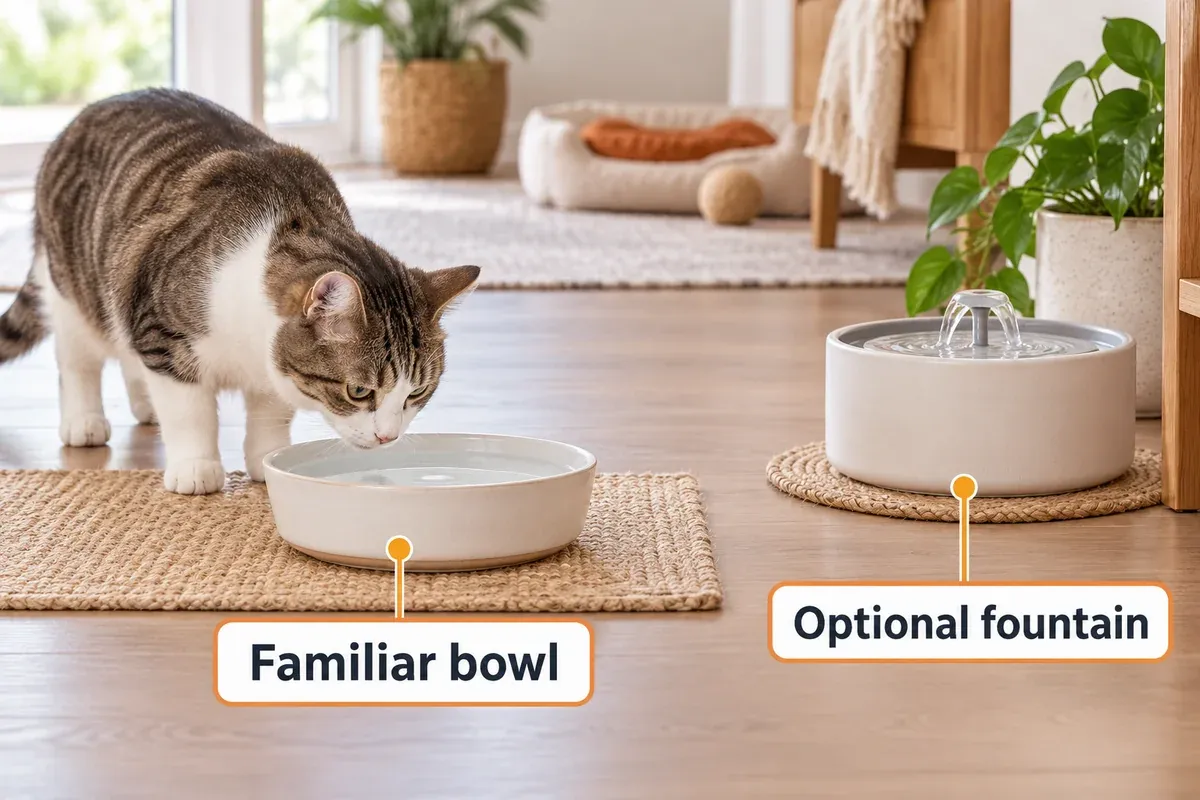
Try a stable, wide, shallow glass or ceramic bowl, filled high enough for easy access, alongside the familiar one. Some cats avoid a deep bowl when their whiskers touch its sides or their head must reach far into it. Others have no problem with the old bowl. International Cat Care describes these preferences; a bowl change is an experiment, not a treatment.
You can also try room-temperature water and a different quiet location. Keep at least one station away from the litter box. If food and water are next to each other, try a separate water spot rather than moving the only bowl your cat already uses. VCA covers location, temperature, and bowl options.
Try a fountain without taking away the bowl
Some cats like moving water; others dislike the sound or prefer a still bowl. Cornell notes that fountain preference varies. Introduce a fountain gradually and keep the familiar bowl available. Refill it, dismantle and clean the wet parts, and change the filter according to the manufacturer’s instructions; International Cat Care explains this routine.
If the fountain has stopped moving water, put down a clean bowl and use the fountain pump troubleshooting guide to check the equipment. If you see a pink or slippery film, provide a clean bowl and follow the fountain cleaning guide. The equipment guides address the water source. A cat that still drinks less or seems unwell needs veterinary advice even after the fountain works again.
Use food moisture carefully
Wet food can contribute substantially to total water intake. If your cat eats normally and your veterinarian agrees with a diet change, introduce suitable wet food gradually and check that your cat continues to eat enough. International Cat Care recommends discussing diet changes with the veterinarian, especially when a cat has a medical condition. VCA also suggests small amounts of water added to food, provided the cat accepts it; offer the usual food if the moistened version is refused. Do not make your cat go without food to encourage a switch.
Keep a prescribed kidney, urinary, or other therapeutic diet in place until your veterinarian advises a change. Water access supports those cats, but their food and treatment plan depend on the diagnosed condition. Cornell’s chronic kidney disease guide stresses hydration and careful transitions with a veterinary team.
Consider flavor only with a safe recipe
For a cat that is otherwise well, Cornell suggests that a little water from tuna packed in water or a small amount of low-sodium chicken broth may encourage drinking. International Cat Care also suggests plain water used to poach chicken or fish, without stock or added salt. Offer plain fresh water as well, and replace flavored water rather than letting it stand.
Read every ingredient before offering prepared broth. Onion, garlic, and chives can harm cats, according to the ASPCA’s food safety list. Do not add salt or essential oils to water: the ASPCA warns about salt toxicity, and Cornell lists several essential oils as hazardous to cats. Use electrolyte products or supplements only if your veterinary team recommends them. Skip flavoring if your cat has a prescribed diet or a medical condition unless your veterinary team approves it. If a cat still avoids water or seems ill, flavor is no substitute for an examination.
Signs of dehydration and the limits of home checks
Cornell lists lethargy, weakness, poor appetite, dry or tacky gums, and, in more severe cases, sunken eyes as possible dehydration signs. Vomiting and diarrhea can increase water loss. These signs call for veterinary advice; they do not tell you how dehydrated a cat is or why.
You may have heard of the skin-tent test, in which lifted skin is expected to spring back. Cornell cautions that older cats may have less elastic skin even when hydrated. A normal-looking result also cannot rule out a developing problem. Use changes in behavior, food intake, urination, and overall condition to decide when to call, rather than relying on one home test.
Do not syringe water into a reluctant cat. International Cat Care warns that forcing water this way is stressful and can cause illness if liquid enters the lungs. If you think your cat is dehydrated, a veterinarian can assess the cat, choose appropriate fluids, and investigate the cause.
Keep a useful record without waiting for seven days
A seven-day log can show a baseline for a cat that is currently well. It is not a seven-day trial for a cat with new low drinking, poor appetite, vomiting, diarrhea, weakness, or urinary signs. Call your veterinarian when those changes appear; seek emergency care for straining with little or no urine. You can keep notes while arranging care, but do not postpone the call until the log is complete.
For a well cat, record one line each day at about the same time:
| What to note | A practical way to record it | What it can tell you |
|---|---|---|
| Food | Wet or dry food, approximate portion eaten, and any water mixed in | A new food pattern may change how much water comes from the bowl. |
| Water offered | Which bowls or fountains were available, whether you refilled them, and any spill or cleaning | A falling water level is only a rough clue, especially with several cats. |
| Urination | Usual or changed litter-box visits and whether urine was actually passed | Straining or repeated trips with little or no urine changes the decision immediately. |
| General condition | Appetite, activity, vomiting, diarrhea, and any weight change you know | Illness signs matter more than one day’s bowl level. |
This record is an observation tool, not a way to diagnose dehydration. In a multi-cat home, one empty bowl cannot show which cat drank from it. For an outdoor cat, drinking away from home may be invisible. If you are concerned about a drop in intake, tell the veterinary team what has changed now; do not wait to obtain a precise number. Cornell recommends prompt veterinary contact when dehydration is suspected.
Bring the food name, medication list, and any notes about appetite, vomiting, stool, and urine to the appointment. The veterinarian may assess hydration and choose tests based on the signs. For urinary symptoms, Cornell describes a physical examination and urinalysis as common first steps, with further testing when needed.
Common questions
My cat eats wet food but never seems to drink. Is that okay?
It can be. International Cat Care says low observed drinking is not concerning by itself in a well cat on wet food when habits have not changed. Keep fresh water available. If appetite, energy, weight, urine output, or drinking behavior changes, contact your veterinarian.
Will a fountain make my cat drink more?
It may help an individual cat that likes moving water, but it is not a reliable cure for low intake. Cornell notes that fountain preferences vary. Keep a clean still-water option and address any signs of illness separately.
Should I switch to wet food if my cat suddenly stops drinking?
Do not rely on a food switch to investigate a sudden change. Call your veterinarian, particularly if your cat is eating less or has other symptoms. For a well cat, a gradual, veterinary-approved diet change may increase water from food; International Cat Care explains how to introduce it.
Is drinking more than usual good news?
A new increase in thirst can be a sign of illness, even if your cat looks comfortable. Note whether urination and weight have changed and contact your veterinarian. International Cat Care lists kidney disease, diabetes, and hyperthyroidism among possible causes. Keep water available; the Merck Veterinary Manual advises against restricting water.