

 Published sources
 Product details checked
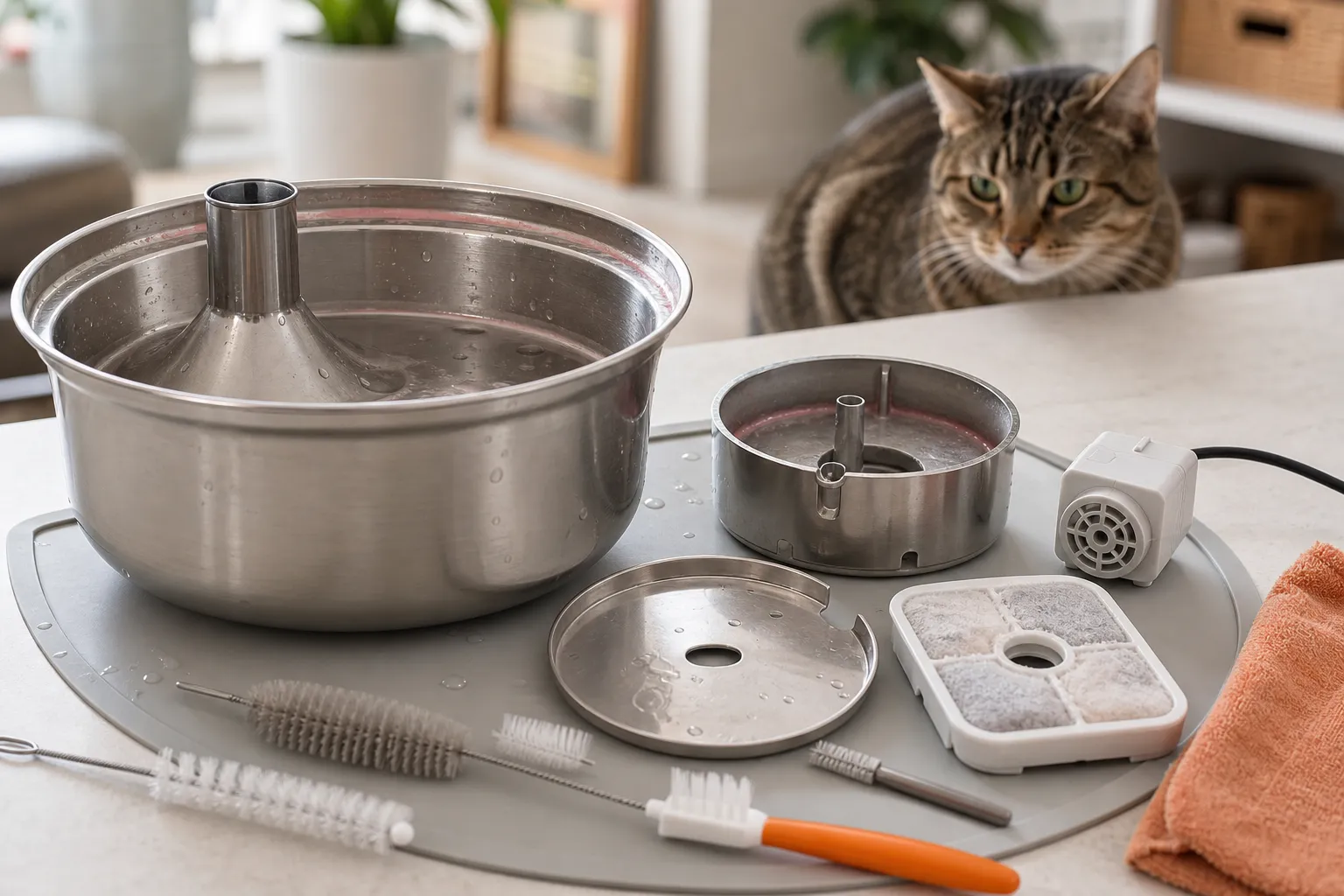
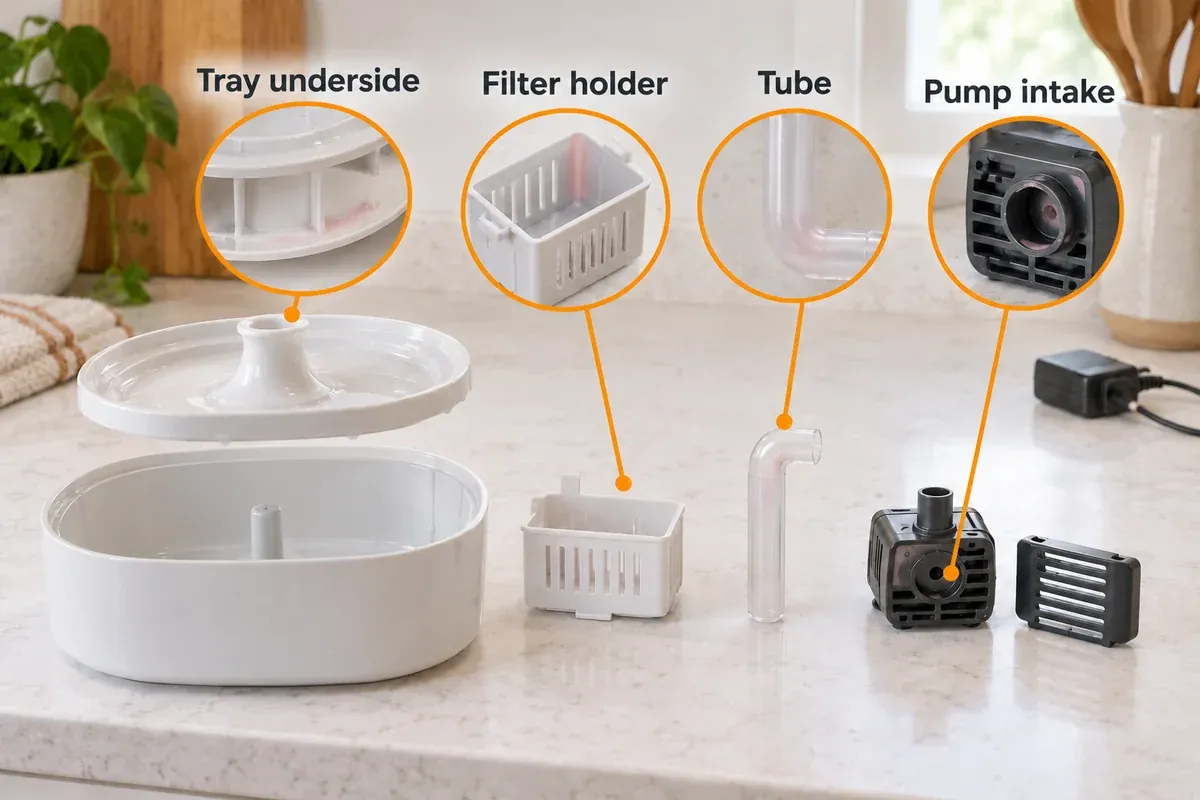
A thin pink or reddish ring around the waterline is a sign that your cat’s fountain needs a proper reset—not just a top-off. The residue often hides in the pump cover, filter holder, spout, or the narrow seam where the reservoir meets the drinking surface.
Quick answer: Pink slime in a cat water fountain is usually a slimy biofilm mixed with trapped organic residue and mineral deposits. The color alone cannot identify the organism. Unplug the fountain, discard the water and visibly dirty filter, take the fountain apart as far as the manual allows, scrub every wet part with warm water and unscented dish soap, rinse until no film or smell remains, and let everything dry before reassembling. If the film returns quickly after a complete clean, inspect the pump and consider a fountain with fewer hidden channels.
This guide focuses on the practical cleaning problem. It uses veterinary cleaning guidance, the CDC’s explanation of pink-red Serratia discoloration in damp areas, and the product information for the linked cleaning tools.
In this guide, you’ll learn:
- What pink slime is—and why the color is not a diagnosis
- How to clean the reservoir, pump, filter housing, and mat without leaving cleaner residue
- When a filter or replacement pump helps, and when it will not
- How to prevent the film from returning between weekly deep cleans
- Which signs mean the fountain is difficult to clean or should be replaced
Helpful Products for a Fountain Reset
These products solve different parts of the problem. A brush reaches seams, a filter handles routine water-path debris, a replacement pump is only useful when the connector and dimensions match, and a mat protects the floor from splash. The fountain in the last row is a replacement option—not a reason to skip cleaning.
Fountain-cleaning and replacement options
-
PetSafe Drinkwell Water Fountain Cleaning Kit (3 Brushes)
PetSafe
A three-brush set with different brush profiles and a flared sponge tip for reaching the narrow parts of compatible Drinkwell fountains.
- Three differently sized brushes
- Flared sponge tip for deeper cleaning
- Plastic-wrapped steel shafts resist rust
- Best for
- Scrubbing pump channels, intake grilles, and fountain seams
- Key feature
- Three-brush set with sponge tip
-
PetSafe Drinkwell Replacement Carbon Filters (12-Pack)
PetSafe
PetSafe-branded carbon filters for select Drinkwell fountains. They can catch some debris and reduce taste or odor, but they do not replace disassembly and scrubbing.
- 12-pack of carbon filters
- Certified-fit product information for select Drinkwell fountains
- Designed for roughly 2–4 weeks of filtration per filter
- Best for
- Compatible Drinkwell owners replacing carbon filters on schedule
- Key feature
- 12-pack carbon filter
-
Cat Water Fountain Filters for 67 oz / 108 oz Fountains (16-Pack)
Generic replacement
A 16-piece replacement pack intended for 67 oz/2L and 108 oz/3.2L fountains, with eight filters and eight sponges. Treat the described capacity as a starting point and match the shape of your original filter.
- 16-piece pack
- Eight filters plus eight pre-filter sponges
- intended for 67 oz/2L and 108 oz/3.2L fountains
- Best for
- Common 2L/3L fountain owners when the filter holder matches
- Key feature
- 16-piece filter and sponge pack
-
OYES DR-DC160 Cat Fountain Replacement Pump
OYES
A small submersible replacement pump with USB connection, blue LED, IP68 waterproofing, 1.5W power draw, and advertised operation under 25dB. It is a match-by-measurement part, not a universal pump.
- DR-DC160-style replacement format
- USB connection
- 1.5W described power draw
- Best for
- Replacing a failed low-voltage DR-DC160-style pump
- Key feature
- DR-DC160-style replacement pump
-
Leash Boss Fountain Mat (20 x 15 Inches)
Leash Boss
A 20 x 15-inch silicone mat made for pet fountains and gravity bowls. It protects the floor from splash and refill drips, but it is not a substitute for cleaning underneath the fountain.
- 20 x 15-inch medium size
- Designed for fountains up to about 12 inches in diameter
- Silicone surface wipes clean
- Best for
- Containing splashes under fountains up to about 12 inches in diameter
- Key feature
- 20 x 15-inch silicone fountain mat
-
PETLIBRO Dockstream 2 Cat Water Fountain
PETLIBRO
Smart fountain with a stainless steel tray, 5G WiFi, app monitoring, 4-layer filtration, and water intake tracking. The premium tray is useful for owners replacing a fountain with hard-to-reach plastic seams, but the pump and filter still need routine cleaning.
- Stainless steel construction
- WiFi & app hydration tracking
- 4-layer filtration system
- Best for
- Tech-savvy cat owners who want app-based hydration tracking
- Key feature
- Stainless steel tray + app monitoring
Review the linked product page before purchasing.
What Is the Pink Slime in a Cat Fountain?
The short answer is biofilm: a slippery layer made by microorganisms that attach to a wet surface and trap other residue. In a pet fountain, that residue can include saliva, hair, food dust, skin oils, and mineral particles. A filter can catch some particles, but it cannot remove a film that has already attached to the pump housing or a seam.
People often call any pink bathroom film “Serratia marcescens.” The CDC’s explanation of Serratia marcescens describes pink-orange-red discoloration in damp bathroom areas, but a fountain’s color is not enough to identify one species. Without a laboratory test, it is more accurate to call the residue a pink biofilm and clean it thoroughly.
The texture gives you more useful information than the color:
| What you see | More likely explanation | What to do |
|---|---|---|
| Slick pink or red film in a seam, pump cover, or waterline | Biofilm with trapped residue | Disassemble, scrub, rinse, dry, and replace a contaminated filter |
| Hard white or chalky crust | Mineral scale from the water | Descale only as the fountain manual allows, then rinse thoroughly |
| Dust, fur, or food particles without a slippery layer | Debris entering the water path | Improve daily rinsing and clean the pump intake and filter holder |
| Film that remains after washing | A hidden channel, impeller cover, or porous/damaged part was missed | Repeat the clean with the pump opened as far as allowed, or replace the part |
Is Pink Slime Dangerous for Cats?
Do not panic, but do not let your cat keep drinking from a visibly slimy fountain. The residue is a clear sign that the water path needs cleaning, and you cannot determine its exact contents from its color. Put down a clean temporary bowl while you work.
Seeing pink film is not proof that your cat has an infection or that the fountain caused an illness. If your cat has suddenly changed how much it drinks, is vomiting, has diarrhea, seems unusually tired, refuses food, or otherwise seems unwell, contact your veterinarian. A dirty fountain should not be used to explain away a change in health.
The safer rule is simple: remove the dirty water, clean the equipment, and monitor the cat separately. The VCA guide to encouraging cats to drink recommends fresh water, daily washing and rinsing of bowls, and cleaning fountain filters weekly or as directed by the manufacturer.
If your cat continues to drink less than usual, our guide to what to do when a cat is not drinking water covers practical next steps and warning signs.
Before You Clean the Fountain
Prepare the area first. This keeps the reset quick and prevents a clean fountain from picking up residue from the same mat or countertop.
- Offer a separate clean bowl. Keep water available while the fountain is unplugged and drying.
- Unplug the fountain. Never clean around a powered pump or pull on the cord to move the unit.
- Take a photo of the assembly. Photograph the filter holder, pump cover, impeller position, and tubing before removing them.
- Read the model instructions. Some pumps open for impeller cleaning; others have sealed sections that should not be forced apart.
- Discard visibly dirty water and filters. Carbon filters are not restored by rinsing once they have a strong smell or visible film. Replace reusable sponges only if the manufacturer says they are washable.
- Wash the mat and nearby surface. A clean fountain on a slimy mat can pick up residue again from underneath.
Use a clean sink, basin, or large towel. You do not need harsh chemicals for the first reset. Warm water, unscented dish soap, a soft cloth, and narrow brushes are usually the most controllable starting point.
How to Remove Pink Slime Step by Step
1. Empty the fountain and remove every accessible part
Pour out the water rather than trying to dilute the film. Remove the lid, drinking surface, filter, filter tray, spout, tubing, pump cover, and impeller if the instructions identify them as removable. The goal is to expose the wet surfaces where the film is hiding.
Do not force a snap-fit cover or pry open a sealed electrical component. If the manual says the pump is a sealed unit, clean the outside and intake as directed. A replacement pump is safer than damaging the housing or cord.
2. Wipe away the visible film before washing
Use a disposable paper towel or a dedicated cloth to lift the thickest residue from the waterline and corners. This prevents you from spreading a concentrated film through the sink. Put the towel in the trash and rinse the part once before applying soap.
This is also the moment to look for a crack, swollen plastic, a warped gasket, or a seam that no longer closes. A damaged reservoir can keep leaking and create a permanently damp area under the fountain.
3. Wash the reservoir and drinking surface
Use warm water and a small amount of unscented dish soap. Work the cloth over the waterline, underside of the lid, silicone feet, gasket grooves, and the area beneath the filter holder. Pink residue often survives a quick pass because the smooth visible bowl is clean while the underside is not.
Use a soft brush rather than steel wool or an abrasive pad. Scratches create more places for residue to collect and can make a plastic surface harder to inspect. The PetSafe Drinkwell cleaning kit is designed around fountain parts and includes several brush shapes, but it is not guaranteed to fit every brand.
4. Open and clean the pump as far as the manual allows
The pump is the part most likely to be skipped and the part most likely to keep a recurrence going. Remove the front cover and impeller only if the fountain instructions allow it. Use a narrow brush to clean the impeller cavity, intake grille, outlet, and any short tube connected to the pump.
Rinse the pump body under clean running water while keeping the plug and adapter out of the sink. Spin the impeller gently with a finger to check that it moves freely; do not scrape it with a knife or force it sideways. Never run the pump dry, even for a quick test.
If the pump is noisy, weak, or still coated after it has been cleaned, compare the original connector, outlet position, dimensions, and suction-cup layout before ordering a replacement. A DR-DC160-style replacement such as the OYES fountain pump can be a practical option, but it is not a universal fit for every fountain.
If the fountain still does not move water after cleaning, use our guide to troubleshooting a cat water fountain that is not pumping before buying a replacement pump.
5. Replace the filter and clean the filter holder
Remove the old carbon filter and inspect the holder behind it. Hair and wet food dust can collect under the filter where they are easy to miss. Wash the empty holder with soap, rinse it, and brush the water inlet and outlet.
For a compatible Drinkwell fountain, the PetSafe replacement carbon filters are the manufacturer-branded option. For many generic 67-oz/2-L or 108-oz/3.2-L fountains, a pack such as these 16-piece replacement filters may fit—but capacity labels are not enough. Match the original filter’s length, width, thickness, and holder shape before ordering.
A filter is a consumable part, not a disinfectant. It can support water quality after the fountain is clean, but it cannot sterilize a pump cavity or remove established slime from a seam.
6. Rinse until the water and smell are neutral
Rinse every soapy part several times. Run a finger over the seams: the surface should feel clean rather than slippery, and there should be no perfume or detergent smell. Rinse the filter holder separately so soap does not soak into a new carbon filter.
Do not pour bleach, bathroom cleaner, essential oils, or a household disinfectant into the fountain as a shortcut. Never mix cleaners. If the manufacturer’s instructions specifically allow a diluted disinfectant, follow that exact label direction and rinse the parts completely before your cat can access them. The ASPCA’s household-product guidance is a useful reminder that “pet-safe” depends on the product, concentration, and exposure route.
7. Dry, reassemble, and test with fresh water
Let the parts air-dry fully on a clean towel. Reassemble the fountain in the order shown in the manual, install a fresh filter, and fill it with fresh water. Place it on a clean, dry mat and confirm that the pump is fully submerged before switching it on.
Watch the first few minutes for leaks, unusual noise, a weak stream, or bubbles caused by a mis-seated filter or pump cover. If the water looks clear and the flow is normal, discard the first small test fill if you are unsure whether all soap was removed. Do not allow the cat back to the fountain until the water is clean and odor-free.
8. Recheck the hidden areas the next day
Look under the lid, around the pump intake, and beneath the filter holder after 24 hours. If a new pink ring is already forming, do not keep replacing only the water. The source is probably a missed pump cavity, a contaminated reusable part, a leaking seam, or a surface that is difficult to clean completely.
A Simple Recurrence Check
Use this short decision table after the first reset:
| What happens next | What it suggests | Best next move |
|---|---|---|
| The fountain stays clear for a week | The main issue was overdue cleaning or a dirty filter | Keep the routine and adjust the filter schedule to the manual |
| Film returns around the pump within a few days | The pump cover, impeller cavity, or tube was missed | Repeat the reset with the pump opened as far as permitted |
| Film returns at the same reservoir seam | A gasket, crack, or hard-to-reach channel may be retaining residue | Inspect the seal and consider replacing the part or fountain |
| Water is clear, but the floor is wet | Splash, overfilling, a loose lid, or a leak | Reduce fill level, check the seal, and use a fountain mat |
| The pump is weak after cleaning | Debris in the impeller, worn pump, or air entering the intake | Recheck water level and impeller; match a replacement pump carefully |
How to Keep Pink Slime From Coming Back
The most effective routine is small and consistent. A fountain should be treated like a water dish with extra parts, not as a self-cleaning appliance.
Rinse and refill instead of topping off
Check the water level daily. Empty cloudy or visibly dirty water, rinse the reservoir, and refill with fresh water rather than repeatedly adding water to the old supply. Daily bowl cleaning is also recommended by the ASPCA’s cat nutrition guidance.
Deep-clean the wet path weekly
At least once a week—or more often for multiple cats, heavy shedding, or a warm room—take apart the parts that the manual identifies as washable. Clean the pump cover, intake, filter holder, lid underside, spout, and any silicone gasket groove. A quick wipe of the top bowl is not a full fountain clean.
Replace filters on the model’s schedule
Use the replacement interval in the manual as the starting point. Shorten it when a filter looks slimy, smells stale, becomes clogged with hair, or changes the water flow. Keep a spare filter on hand so a dirty cartridge does not turn into an extra week of use.
Clean the mat and the space underneath
Splash and refill drips leave an organic film on the mat even when the fountain itself looks fine. Lift the fountain, wash the mat, wipe the floor, and dry both before putting the fountain back. The Leash Boss fountain mat is sized for fountains up to about 12 inches in diameter, but any washable mat that fits the footprint can serve the same purpose.
Keep the fountain easy to inspect
If you cannot reach the pump channel without special tools, or if the fountain has several sealed wet compartments, maintenance will be harder to keep up with. Stainless steel or ceramic contact surfaces can be easier to inspect, but neither material prevents biofilm when water and residue remain in a hidden pump area.
The PETLIBRO Dockstream 2 is a current stainless-tray option with a 3-liter/101-ounce reservoir, app monitoring, and a multi-layer filter system. It is a premium replacement to consider when your current fountain is difficult to take apart; it still needs regular filter and pump cleaning. For a broader comparison of fountain materials, flow styles, and capacity, see our guide to the best cat water fountains.
When Should You Replace the Fountain?
You do not need to discard a sound fountain because you saw one pink ring. Replace or retire it when one of these conditions applies:
- The reservoir, lid, or tubing has a crack, deep scratch, warped seam, or persistent leak.
- The pump cavity cannot be accessed or rinsed, and film repeatedly returns within a few days of a complete clean.
- The pump cord, plug, or adapter is damaged, hot, or intermittently cutting out.
- The fountain keeps a detergent smell after repeated rinsing.
- Your cat avoids the fountain after it has been cleaned and tested with fresh water.
Choose the replacement by the maintenance path first. Look for removable wet parts, a reachable impeller, a filter holder you can see clearly, and replacement parts that are easy to identify. A larger capacity or app is useful only if the fountain remains easy to clean.
What Not to Do
- Do not rely on a fresh fill. Pink film attached to a seam will not disappear because the reservoir is topped up.
- Do not use the filter as a cleaning plan. Filters trap some debris; they do not clean the pump housing.
- Do not mix products. Never combine bleach, vinegar, ammonia, dish soap, or other cleaners.
- Do not use abrasive tools. Scratches can make plastic parts harder to clean.
- Do not boil plastic parts unless the manual explicitly allows it. Heat can warp lids, seals, and filter holders.
- Do not run the pump dry. A dry test can damage the pump and create a second problem.
- Do not punish a cat for avoiding the fountain. Offer a clean bowl and troubleshoot the equipment instead.
Frequently Asked Questions
Is pink slime in a cat water fountain mold?
Not necessarily. A slippery pink or red film is more accurately described as biofilm unless it has been identified by testing. The color can be associated with Serratia in damp household areas, but it cannot tell you which microorganisms are present in your fountain.
Can I clean the pink film with vinegar?
Vinegar may help with some mineral scale, but it should not replace mechanical scrubbing of biofilm. Check the fountain’s manual first, do not mix vinegar with other cleaners, and rinse every part thoroughly before refilling the fountain. If the film is thick or recurring, focus on the pump, filter holder, and hidden channels rather than only treating the visible ring.
How often should I clean a cat water fountain?
Check the water daily and remove hair or food debris as soon as you see it. A practical starting point is a full weekly wash of the reservoir, lid, pump cover, filter holder, and other removable wet parts, with filter replacement on the manufacturer’s schedule. Multiple cats, shedding, warm rooms, or recurring film may call for more frequent cleaning.
Will a new filter stop pink slime?
It may help with routine debris after the fountain has been cleaned, but a new filter will not remove film from a pump cavity or seam. Clean the fountain first, then install a compatible filter and monitor the hidden areas for recurrence.
Is stainless steel better than plastic for preventing pink slime?
Stainless steel can be easier to inspect and may be less prone to visible scratching than some plastic parts. It is not self-cleaning. The pump, filter holder, tubing, lid underside, and gaskets still need regular attention, whatever the reservoir material.
Should I call a veterinarian because I found pink slime?
Not because of the residue alone. Clean the fountain and provide a separate clean water source. Call your veterinarian if your cat develops a sudden change in drinking, vomiting, diarrhea, lethargy, reduced appetite, or another concerning sign; do not assume the fountain explains those symptoms.
Final Fountain-Cleaning Checklist
Before returning the fountain to normal use, confirm that:
- The water has been discarded and the fountain was unplugged.
- The pump, intake, spout, filter holder, lid underside, and seams were cleaned.
- The contaminated filter was replaced or handled according to the manual.
- No slippery film, detergent smell, or cleaner residue remains.
- The fountain and mat are fully dry before reassembly.
- The pump is submerged and the fountain is not leaking or running dry.
- A clean backup bowl is still available if the cat rejects the reset.
If pink slime keeps returning, treat that recurrence as useful information. The next fix may be a reachable pump, a correctly fitted replacement filter, a fresh gasket, or a simpler fountain—not a stronger cleaner.