

 Published sources
 Product details checked
Cat litter tracking is usually treated as a shopping problem: buy a better mat, try a heavier litter, or find a box with taller sides. Those changes can help, but they solve different failure points. A mat cannot stop litter that is stuck between your cat’s toes, and a low-tracking litter cannot contain a box that is too small or positioned beside a narrow escape route.
Quick answer: run a short, controlled test. First observe where the litter appears, then test the box with the familiar litter, the litter with the familiar box, and the mat only after the first two variables are understood. Change one variable at a time, keep the cat’s familiar option available, and measure whether the first few feet outside the box actually get cleaner.
This guide is about reducing loose litter without making the box unpleasant or inaccessible. It is not a promise of a completely granule-free home: some cats naturally carry a small amount out after digging. The goal is to identify the main source and make the setup easier to live with.
Start by finding where the litter leaves the setup
Before buying anything, watch one or two normal exits from the side. A phone video can help if your cat is comfortable with it. Do not interrupt, pick up, or call your cat while it is using the box. Look for the first visible granules, not just the farthest piece you find later.
| First place you see litter | Most likely source | First variable to test |
|---|---|---|
| On the rim, front lip, or wall beside the box | Digging or a box that is too short, shallow, or cramped | Box size, wall shape, and open approach |
| On the first one to three steps | Granules carried on paws or fur | Litter texture and a landing mat |
| In a clean trail beyond the exit | Paw carry, a narrow exit route, or a mat that is too small | Mat length and the first few feet of flooring |
| In one corner or behind a door | The cat is stepping over or around the intended exit | Box orientation and room layout |
Scatter and tracking can happen at the same time. If the box is leaving a pile directly outside the front, start with the box and its orientation. If the box looks tidy but individual paw prints continue across the room, start with litter texture and the exit path.
The evidence behind a sensible setup
The AAHA and AAFP litter-box guidance recommends quiet, accessible locations, an appropriate box for the cat’s size, and an unscented clumping litter as a useful starting point. It also notes that older or mobility-limited cats may need a lower entry. Ohio State University’s Indoor Pet Initiative litter-box guide similarly recommends a large uncovered box, while noting that higher sides can contain scatter and lower sides can help kittens and older cats.
The AAFP/ISFM house-soiling guidelines add two details that matter for a tracking test: many commercial boxes are too small, and a fine, sand-like unscented clumping litter at roughly 1.25 inches (3 cm) is a reasonable starting depth. These are starting points, not rules that override your cat’s comfort. The same guidelines recommend offering choices in separate boxes rather than forcing a cat to accept a sudden change.
Research on litter substrates also finds individual preferences among materials such as clay, silica, and wood pellets. The field assessment of cats’ litter-box substrate preferences is useful context: a litter that is marketed as low tracking is still a poor solution if your cat dislikes its feel.
Options for a controlled tracking test
These are not ranked as a universal “best” list. They are a small set of linked options chosen for different tests: more wall containment, a medium-grain clay formula, two plant-based textures, and two different mat shapes.
Options for a controlled tracking test
-
IRIS USA XX-Large High Sided Cat Litter Box
IRIS USA
An open-top plastic box with a 30 x 20 x 14-inch described footprint, tall walls, and a lower curved entry. It gives a multi-cat home a spacious primary station without a hood.
- 30 x 20 x 14 in described dimensions
- 14 in high walls with a 6.5 in curved entry
- Open top for visibility and easier monitoring
- described size
- 30 x 20 x 14 in
- What it tests
- Box and wall-containment test
-
Dr. Elsey's Clean Tracks Clumping Clay Cat Litter, 40 lb
Dr. Elsey's
Fragrance-free medium-grain bentonite litter with hard clumping and a manufacturer low-tracking claim; the 40-lb bag is a large commitment for a first test.
- Medium-grain 100% bentonite clay
- Fragrance-free and marketed as low dust
- Hard-clumping formula for easier removal
- described size
- 40 lb bag
- What it tests
- Low-tracking formula claim
-
World's Best Cat Litter Multiple Cat Unscented – 15 lb
World's Best Cat Litter
A lightweight, unscented corn-based litter with quick clumping and odor control. It is the most useful texture change in this group when a cat dislikes the feel or handling weight of clay.
- Made from whole-kernel corn with no artificial perfume
- Lightweight and marketed as 99% dust free
- Quick clumping and odor control for multi-cat use
- described size
- 15 lb bag
- What it tests
- Lightweight unscented alternative
-
Tuft & Paw Really Great Cat Litter
Tuft & Paw
A clumping tofu litter sold in 9.25-pound bags and described by the manufacturer as ultra low-tracking and 99% dust-free.
- Pellet-shaped tofu litter for a distinct tracking test
- Manufacturer describes it as ultra low-tracking and 99% dust-free
- One 9.25 lb bag is described as about one month for one cat
- described size
- 9.25 lb bag
- What it tests
- Pellet-shaped tofu-litter tracking trial
-
Pieviev Double-Layer Litter Box Mat, 30 x 24 in
Pieviev
30 x 24-inch EVA honeycomb mat with a double-layer litter trap, water-resistant base, and a design that lets dry litter fall through for collection.
- Double-layer honeycomb litter trap
- Waterproof and slip-resistant bottom layer
- described size
- 30 x 24 in
- What it tests
- Double-layer honeycomb trap
-
GORILLA GRIP Cat Litter Box Mat, 35 x 23 in
GORILLA GRIP
A wide cushioned coil-mesh mat with deep grooves that catches loose litter outside the box. It helps keep a planned station tidy but cannot compensate for a box that is too small or badly placed.
- 35 x 23 in described size
- Cushioned coil mesh with deep catch grooves
- Can be rinsed or vacuumed
- described size
- 35 x 23 in
- What it tests
- Wide exit-path catch area
Review the linked product page before purchasing.
Product descriptions such as “low tracking,” “99% dust free,” or “captures litter” are manufacturer or retailer claims unless a separate source is linked. That distinction is why the test plan below matters more than a badge or a single review.
Take a 24-hour baseline before changing anything
The baseline does not need laboratory precision. It needs to be repeatable enough to tell whether a change helped.
- Record the setup. Note the box’s usable interior length and width, entry height, litter brand and texture, approximate litter depth, mat dimensions, and the direction your cat normally exits.
- Measure the cat if the box may be undersized. Measure from the nose to the base of the tail, not to the tail tip. A box around 1.5 times that length is a useful target from feline-care guidance, but compare usable interior floor rather than the outside of the product package.
- Clear a short observation lane. Sweep the first 3 to 6 feet outside the box, including under the edge of the mat. Keep the flooring the same for the baseline if possible.
- Photograph or collect the evidence. A quick photo after each use, or dry sweepings collected on a white sheet of paper, will show whether you are dealing with large granules, fine dust, or a few pieces carried on paws.
- Make no changes for one day. Keep the scoop and cleaning routine normal. If there are multiple cats, note which cat used the box rather than treating the total floor debris as one measurement.
Do not reduce litter below a comfortable level just to make the floor look cleaner. A cat that cannot dig or cover waste normally may avoid the box, and avoidance is a much larger problem than a few granules.
Test 1: change the box, not the litter
Run this test when litter is on the rim, the box visibly limits turning, the cat kicks over a low front, or the cat has to step out and immediately jump over a cluttered area. Keep the same litter depth, scoop routine, room, and mat. Put a new box beside the familiar one if you can; this lets the cat choose rather than making a tracking experiment a litter-box refusal experiment.
What to look for in a box
- Usable floor first: the cat should be able to turn, dig, and position itself without pressing against the walls. A large outside measurement can hide a smaller interior.
- High sides where the cat needs them: taller walls can catch kicked litter and contain high urine, but only if the cat can comfortably enter.
- A workable entry: a high wall is not automatically better for a kitten, senior, arthritic cat, or cat with a painful paw. Preserve a lower step-in or use a different station for access.
- A clear landing direction: the cat should not have to leap over the mat edge, door threshold, or another box immediately after exiting.
Leave the old box in place during the first test. If the new box gets used and the litter pile beside the exit shrinks, the box or orientation was part of the problem. If your cat ignores it, do not interpret that as proof that high sides are bad; check the entry, location, scent, and interior space.
Test 2: change the litter, not the box
Run this test when the box is large enough and the mess is mostly fine granules on the first steps or a dusty trail. Put the candidate litter in a second, identical or similarly comfortable box if possible. Keep the familiar litter available for at least the first comparison. A separate box tells you more than mixing two textures in one tray, where you cannot tell whether the cat prefers one or is simply tolerating both.
Start around 1.25 inches (3 cm) if that suits your cat, then observe whether the cat can dig and cover normally. Do not use a thin layer as a tracking hack. If a cat dislikes a coarse, sharp, strongly scented, or dusty texture, it may shake its paws, groom more, or leave the box quickly. The ScienceDirect substrate-preference study is a reminder that substrate preference varies by individual.
A medium-grain clay trial
Check current price on Amazon →A lighter plant-based texture trial
Check current price on Amazon →A pellet-shaped tofu-litter trial
Tuft & Paw describes Really Great Cat Litter as ultra low-tracking and 99% dust-free. Treat those as manufacturer claims to test, not a guaranteed result. Its pellet shape creates a more distinct texture change than the clay and corn options, so offer it in a separate box and keep the familiar litter available during the comparison.
View the tofu litter at Tuft & Paw →Give each litter enough time for normal box use, but stop the comparison if use drops, the cat holds urine or stool, or accidents begin. A cleaner floor is not a successful result if the cat is uncomfortable.
Test 3: change the exit path and mat
Run this test when litter is already outside the box in the first few steps, especially when the granules appear to be carried rather than kicked. A mat is a collection zone, not a paw-cleaning device. It cannot remove every particle from between toes, and it cannot fix a box that is too small.
Set the mat up for the actual exit
- Place it directly after the normal exit, not several feet away where the cat can bypass it.
- Extend the mat roughly 24 to 36 inches beyond the exit when the room allows, and choose enough width for the cat’s natural path.
- Keep a flat edge and a stable floor under it. Avoid curling corners, slippery backing, and a mat that forces a senior cat to step over a raised lip.
- With an automatic box, do not put the mat under the machine’s feet, level sensors, drawer, or moving parts unless the manufacturer explicitly allows it. A mat that changes the box’s level can create a different problem; see our guide to why an automatic litter box keeps stopping.
Two useful mat shapes
The Pieviev 30 × 24-inch double-layer mat uses an EVA honeycomb surface and a lower layer described as waterproof and slip resistant. Dry litter can fall through the openings for collection. It is a good fit when you want to lift or open the mat and return clean, dry granules to the box. Fine dust can still pass through, and no mat catches litter that never lands on it.
Check current price on Amazon → Check current price on Amazon →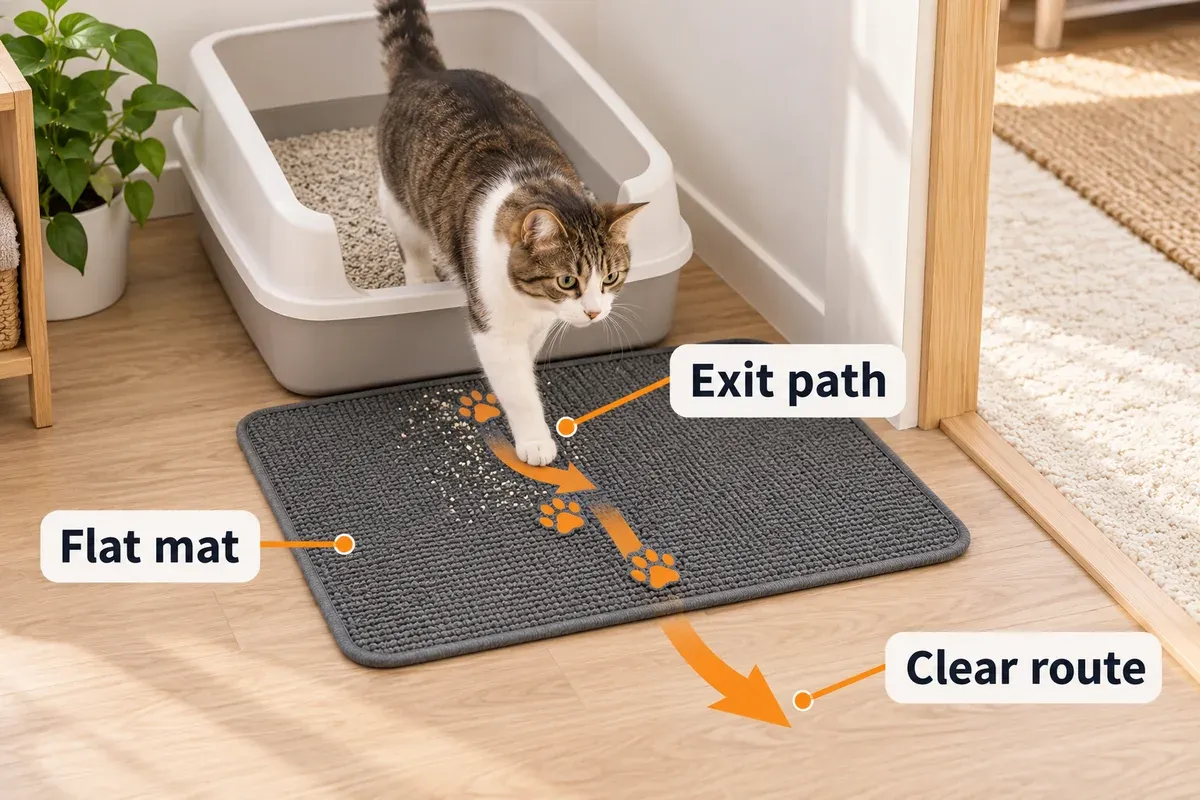
A seven-day test plan
This schedule is for finding the main source of tracking, not for forcing a cat to accept a new product in seven days. If your cat hesitates, goes less often, or has an accident, return to the familiar setup and slow the change down.
| Day | Change | What to record |
|---|---|---|
| 1 | Baseline only | First point of litter, granule size, cat’s exit direction, and amount on the clear lane |
| 2–3 | New box beside the familiar box; same litter and mat | Which box is used, rim scatter, and whether the first landing area is cleaner |
| 4–5 | New litter in a second box; keep box and mat variables stable | Acceptance, paw shaking or grooming, dust versus larger granules, and floor debris |
| 6 | Add or resize the mat after the chosen box exit | Whether the mat collects litter and whether the trail stops within its footprint |
| 7 | Verify the winning setup without adding another variable | Clean the mat, repeat the same observation lane, and check whether the result holds after normal use |
If the new box is ignored, move it only after you have checked the entrance, interior size, room traffic, and scent. If the new litter is rejected, do not keep removing the familiar option to make the experiment “work.” If the mat is full but the floor is clean, it is doing its containment job; if the mat is empty and the trail continues, the cat may be carrying litter outside the mat’s path or the problem is mainly the litter texture.
How to interpret the result
| Result | What it tells you | Next move |
|---|---|---|
| Less litter on the rim after the larger or taller box | Box size, wall height, or orientation was contributing | Keep the box only if entry and usable floor still work for the cat |
| The mat fills, but the floor beyond it stays clean | Loose litter is landing in the exit zone | Keep the mat, but sweep or wash it before debris becomes a new texture problem |
| The mat stays empty and a fine trail continues | Particles may be carried on paws or may be small enough to fall through | Compare litter textures and use a longer, stable landing lane |
| One litter reduces tracking but the cat uses it less | Cleanliness improved at the expense of preference | Revert, offer both in separate boxes, and prioritize normal box use |
| A shallow litter layer looks cleaner but the cat digs less | The test changed comfort rather than solving the source | Restore a comfortable depth and keep testing box or mat placement |
| A larger box is avoided | The issue may be entry height, location, smell, privacy, or interior shape | Keep the familiar box and change only one of those factors |
Common mistakes that keep the floor messy
Changing the box, litter, and mat together
You may get a cleaner floor, but you will not know why. Worse, if the cat rejects the new arrangement, you will not know which change caused it. Test the box first, then litter, then the exit surface.
Using less litter than the cat needs
A thin layer can reduce the number of granules available to kick, but it can also stop normal digging and covering. Use the cat’s behavior and the roughly 3 cm starting point from the AAFP/ISFM guidance, then adjust only if the cat remains comfortable.
Choosing a covered or top-entry box only because it looks tidier
A cover can contain scatter for one cat and make another cat feel trapped or reduce usable floor. Top-entry boxes can also be a poor fit for seniors, kittens, heavy cats, or cats with pain. Access and size come before the appearance of the room.
Putting the mat under the whole machine
An automatic box needs to remain level and free to cycle. Put the mat at the exit, not beneath sensors, feet, a waste drawer, or a moving base. If the machine is already stopping, troubleshoot that problem separately.
Adding perfume or deodorizing powder
The AAFP/ISFM guidelines caution against deodorizing powders and slotted grills in litter-box setups. Strong scents can also make a cat avoid a box. Clean the box and the mat routinely instead of masking the problem with fragrance.
Returning dirty litter from the mat
Only return clean, dry granules that have fallen through or onto the mat. Do not put damp litter, feces, hair, or floor debris back into the box. Wash the mat according to its instructions, use mild soap when appropriate, rinse thoroughly, and let it dry completely before putting it back.
When tracking may be a health or comfort signal
Sudden paw licking, limping, a change in gait, crying while entering or leaving, repeated trips with little urine, straining, blood, vomiting, or little to no urine are not product-testing problems. Contact a veterinarian promptly; little or no urine in a male cat or a cat that is straining can be an emergency. Cornell’s house-soiling overview explains why medical causes should be considered before treating a litter-box change as behavior. Do not punish a cat for tracking, accidents, or avoiding a box.
Frequently Asked Questions
How big should a litter mat be?
Start with the cat’s actual exit path, not the box’s marketing size. A mat extending about 24 to 36 inches beyond the normal exit and wide enough for a straight approach is a practical starting point. Make it longer when the cat jumps out, turns, or walks around the box before reaching the room’s main floor.
Will pellet litter always stop tracking?
No. Pellets may reduce fine dust for some homes, but cats can reject the texture, carry pieces, or kick larger particles out of a shallow box. Offer a separate test box and judge both floor debris and normal box use.
What litter depth should I use?
About 1.25 inches (3 cm) is a reasonable evidence-based starting point for a fine, unscented clumping litter, but the cat’s preference and digging behavior matter. Do not make the layer unusually shallow just to reduce tracking.
Can I put a mat under an automatic litter box?
Only if the machine’s instructions allow it and the mat does not change level, sensor contact, drawer clearance, or movement. In most setups, placing the mat directly after the exit is safer. For a malfunctioning machine, see automatic litter box keeps stopping.
My cat still tracks litter after I change the mat. What now?
Look at the granules between the toes and the first point of contact outside the box. A longer mat will not solve a texture problem, and a new litter will not solve rim scatter. Return to the baseline, change one variable, and keep the familiar box available.
Is a towel as good as a litter mat?
A washable towel can be a useful short-term test because it is cheap and easy to replace, but it tends to fold, hold dampness, and let granules roll off the edge. It can tell you whether a collection zone helps; a stable, flat mat is usually easier to maintain long term.
Final verdict: diagnose the first failure point
If litter is kicked over the rim, test a larger open box with suitable walls and an accessible entry. If the box is clean but the first steps are dusty, compare litter textures in a second box at a comfortable depth. If the litter is carried beyond the exit, add a flat, wide landing zone that matches the cat’s route. Keep the setup quiet, scoop daily, wash the box regularly, and change one variable at a time.
For sizing the box before you buy, use the cat litter box size calculator. If your cat is refusing the box as well as tracking litter, start with the health and preference guidance in best cat litter for cats that refuse their litter box. For the daily cleaning side, see how to reduce litter box smell.