

 Published sources
 Product details checked
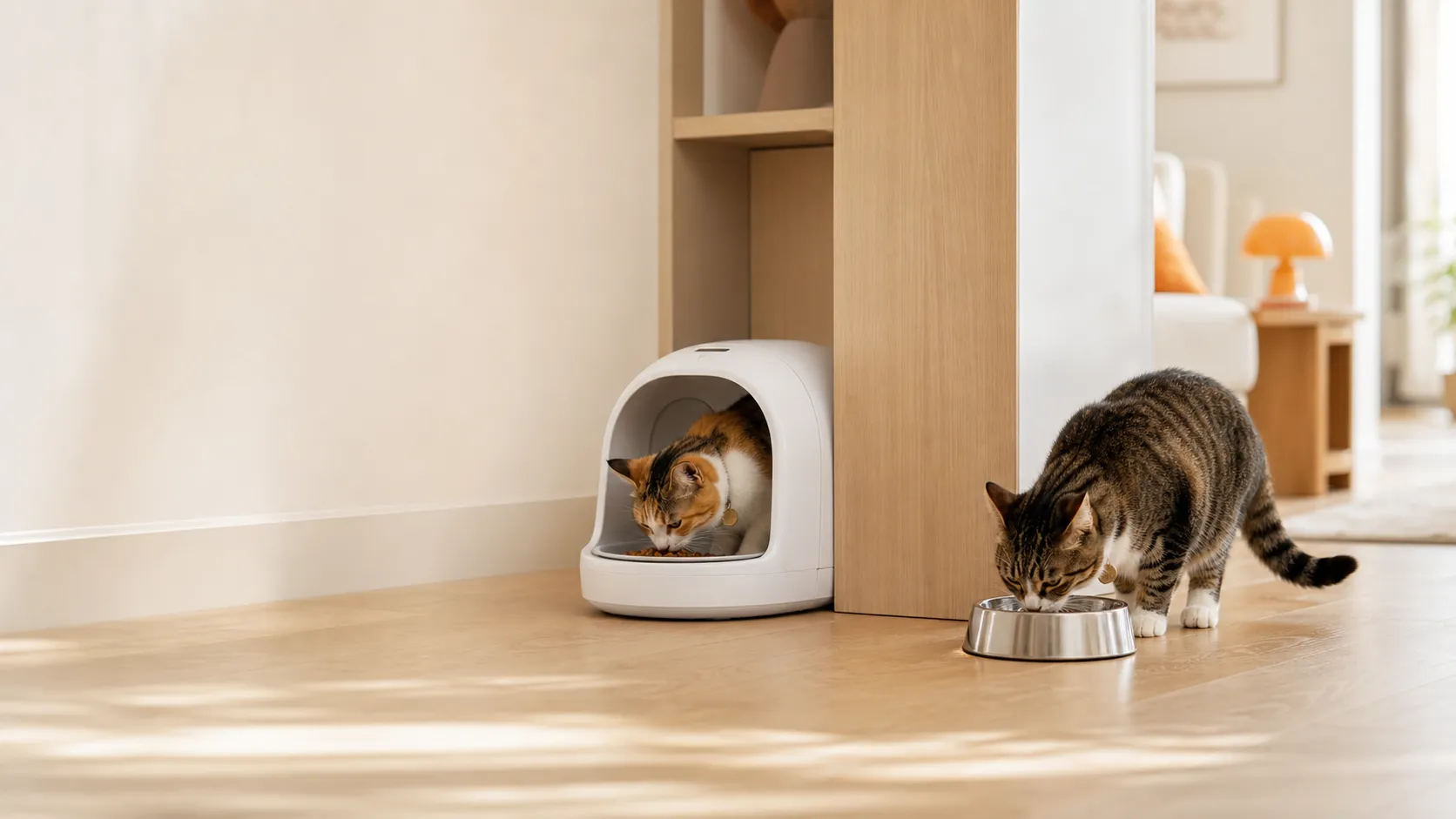
Few multi-cat problems are more frustrating than filling two bowls and watching one cat finish both. The slower cat may stop eating, the food thief may gain weight, and a diet that was meant for one cat can quietly become the other cat’s daily diet. Kitten food, prescription food, wet food, and calorie-controlled meals make the problem even more important to solve.
Quick answer: Match the feeding setup to the reason the food is being stolen. For open-bowl grazing, use a selective feeder that recognizes the correct cat. For two different dry diets, an RFID feeder can control access and portions. For a kitten and an adult cat, separate rooms or cat-specific access are usually more reliable than putting one bowl on a high shelf. If both cats can eat the same food but one eats too fast, use two stable stations and a slow feeder or smaller scheduled meals. A two-bowl feeder can reduce crowding, but it cannot identify which cat is eating from which bowl.
Match the Tool to the Actual Feeding Problem
Products for different multi-cat feeding problems
-
SureFeed Microchip Pet Feeder
Sure Petcare
Selective feeder that opens for a programmed cat's implanted microchip or supplied RFID collar tag instead of relying on a timed hopper.
- Works with compatible 9-, 10-, or 15-digit microchips
- Also supports a Sure Petcare RFID collar tag
- 400 ml / 13.5 fl oz food capacity
- Best for
- Free-feeding cats with different diets or food thieves
- Key feature
- Microchip/RFID access
-
PETLIBRO RFID Automatic Cat Feeder
PETLIBRO
RFID collar-tag feeder that opens for the assigned cat and logs meals in the app.
- RFID collar tag opens the assigned bowl
- Designed for food stealing and different diets
- App logs who ate what and when
- Best for
- Multi-cat homes with different diets
- Key feature
- RFID access + meal tracking
-
oneisall Automatic Cat Feeder for 2 Cats
oneisall
A 5L/20-cup dual-bowl feeder with timed portions, stainless steel bowls, voice recording, and no app dependency.
- 5L / 20-cup hopper
- Separate stainless steel bowls
- Timed portion dispensing
- Best for
- Budget-conscious two-cat households
- Key feature
- Dual-bowl timed dispensing
-
PetSafe Healthy Pet Simply Feed Automatic Feeder
PetSafe
App-free feeder with a 24-cup hopper, up to 12 meals per day, and a 15-minute slow-release setting.
- 24-cup capacity
- Up to 12 meals per day
- 1/8-cup to 4-cup portions
- Best for
- Most dry-food households and fast eaters
- Key feature
- Slow release + app-free scheduling
-
Outward Hound Fun Feeder Slo Bowl – Small
Outward Hound
Small 3/4-cup slow-feeder bowl with a wave pattern and non-slip base. It makes dry-food pieces harder to eat in one fast mouthful without adding electronics or a complicated setup.
- 3/4-cup capacity for small meals
- Wave pattern slows access to kibble
- Non-slip base
- Best for
- Cats that gulp dry food and need an inexpensive slow-feeding trial
- Key feature
- Wave-pattern slow feeding
Review the linked product page before purchasing.
The table is intentionally not a ranking. These products solve different problems:
- SureFeed Microchip Pet Feeder: the strongest fit when a cat must be able to reach its own wet or dry food without another cat getting in.
- PETLIBRO RFID feeder: a premium dry-food option for a cat-specific collar tag, scheduled portions, and app-based meal records.
- oneisall dual-bowl feeder: a lower-cost way to dispense the same dry food on the same schedule into two separate bowls. It is not an access-control device.
- PetSafe Healthy Pet Simply Feed: useful for scheduled dry food, smaller portions, and a 15-minute slow-release setting, but it cannot separate two cats by identity.
- Outward Hound Fun Feeder Slo Bowl: a low-cost trial for a cat that gulps dry food. Its small capacity makes it a focused tool, not a complete multi-cat solution.
First, Identify Which Cat-Feeding Problem You Have
Before buying a feeder, watch one or two normal meals. The same behavior can have very different causes, and the wrong product can add hardware without fixing access.
| What you observe | The real problem | Best first move |
|---|---|---|
| One cat patrols the room and eats leftovers | Uncontrolled access | Feed in separate spaces or protect the slower cat’s food with selective access |
| Both cats need different food | Diet access, not just timing | Give each diet its own protected station and measure portions |
| A kitten eats adult food or the adult raids kitten food | Age-specific nutrition and access | Use separate meal spaces or cat-specific access; ask your veterinarian about the correct food and amount |
| One cat finishes in seconds and then steals | Speed plus opportunity | Slow the fast eater and remove the opportunity to patrol while the other cat eats |
| Both cats eat the same food but crowd each other | Competition or bowl placement | Use separate, stable stations with visual distance and clear escape routes |
| One cat has suddenly become a very slow or reluctant eater | Possible health issue | Arrange veterinary advice rather than treating the change as a feeder problem |
Do not solve food stealing by simply adding more calories to the thief’s bowl. First calculate the total daily amount for each cat with your veterinarian’s guidance, then control who can reach which portion. A feeder can enforce access, but it cannot decide how many calories an individual cat needs.
A Simple Reset Plan That Works With Most Setups
You do not need to change every variable at once. A short, consistent reset makes it easier to see whether the issue is hunger, speed, social pressure, or an open bowl that anyone can reach.
1. Measure the daily food before changing the schedule
Use a kitchen scale or a consistent measuring method and write down each cat’s daily allowance. Keep the total amount appropriate for that cat; the goal is to control access, not to put either cat on an accidental crash diet. Include treats in the daily picture.
2. Give each cat a named station
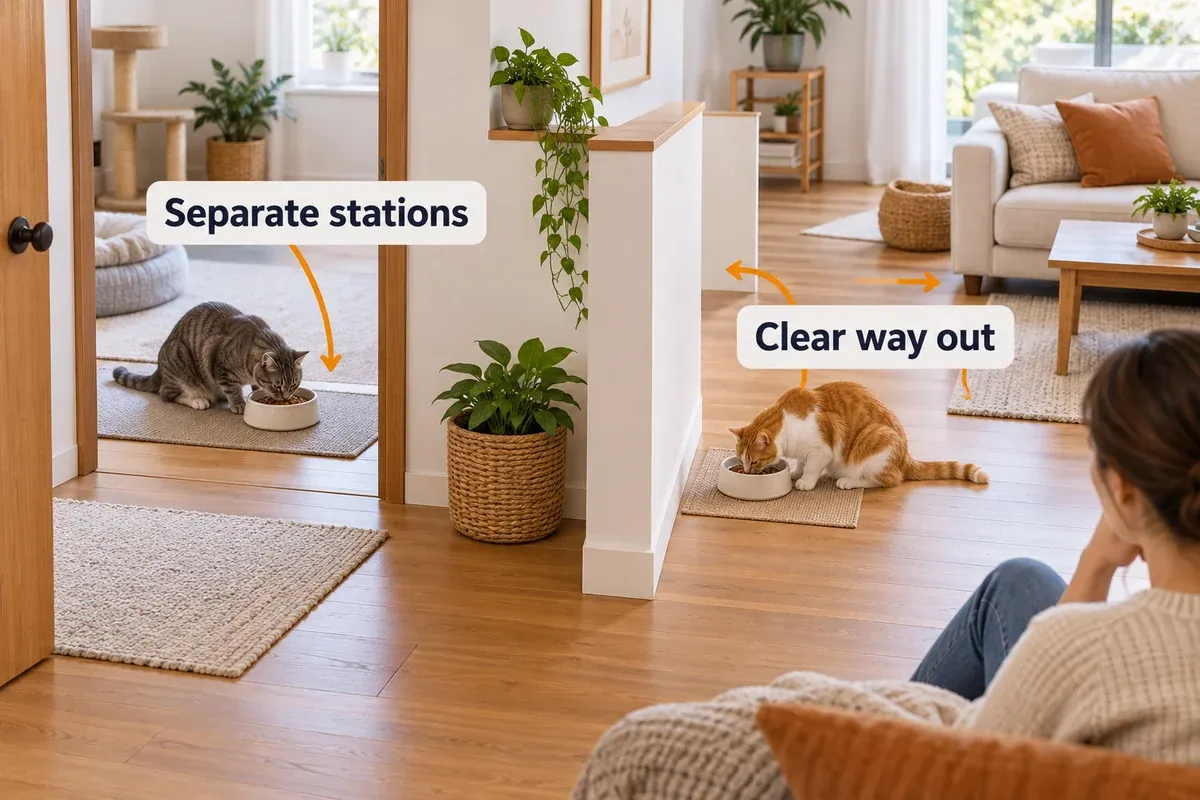
Set up one bowl or feeder per cat. Place them far enough apart that one cat cannot stand at one station while watching or blocking the other. A visual barrier, a different room, or a baby gate with a safe opening can help, but every cat still needs a calm route away from the bowl.
Do not put a nervous cat’s bowl in a dead-end corner or beside a litter box. A cat that feels trapped may eat less, wait until the other cat leaves, or abandon the station entirely.
3. Feed at the same time while you supervise
Start with meals you can watch. If one cat finishes first, redirect that cat away from the other station with a closed door, a short play session, or a calm activity. Do not reward successful food theft with an extra meal.
If you are moving away from free feeding, make the transition gradual for a cat that is used to grazing. A slower eater may need more time than a cat that inhales a meal. The important part is that the slower cat gets uninterrupted access to its own food.
4. Test the setup before trusting a device
Run several supervised meals. Check that the correct cat can enter, that the other cat cannot squeeze in, and that the portions match the setting. For a connected feeder, test it with the home WiFi and with the network unavailable. For a battery device, keep fresh batteries and a manual backup plan.
5. Track results for a week
Record who ate, roughly how much was left, and whether either cat vomited, regurgitated, or avoided the station. A short log often reveals that the food thief is not hungry at every meal; it may simply be taking advantage of an open bowl.
If You Want to Keep Free Feeding
Free feeding is easiest to manage when one cat can reach a shared bowl at any time. That is exactly why it fails in many multi-cat homes: you cannot tell which cat ate the food, and the more confident cat controls the resource.
Best fit: a selective microchip feeder
The SureFeed Microchip Pet Feeder is designed to open for a programmed cat’s compatible implanted microchip or a supplied RFID collar tag. Product documentation describes a 400 ml / 13.5 fl oz capacity, wet- and dry-food compatibility, four C-battery operation, support for up to 32 pet identities, and a three-year warranty. The official product information also makes clear that the device is about selective access, not a large timed hopper.
Check current price on Amazon →This is the most direct solution when a grazing cat needs access throughout the day but another cat must not eat that food. Put the protected cat’s food inside the feeder and introduce the lid while you are home. If the cat is wary, begin with familiar food and a calm, open approach rather than forcing its head into the feeder.
For two cats on two different diets, one protected bowl may not be enough. The cat whose food is left in an ordinary open bowl may still be raided. In that situation, protect both diets, feed the second bowl in a separate room, or use scheduled meals that you can supervise.
Important limits:
- The standard SureFeed is not a timed dispenser. You still load the portion yourself.
- A compatible implanted microchip and a supplied RFID tag are different access methods. If your cat is not comfortable wearing a tag, check the microchip compatibility before ordering.
- The capacity is suited to daily feeding and grazing, not to storing a large supply for an unattended trip.
- A selective feeder works only if the second cat cannot reach around the entrance or access another unprotected bowl.
If the Cats Eat Different Dry Foods
Best fit: an RFID hopper with cat-specific access
The PETLIBRO RFID Automatic Cat Feeder combines a dry-food hopper with a supplied RFID collar tag.
Check current price on Amazon →It makes sense when one cat needs a particular dry diet and you want a record of access as well as scheduled portions. PETLIBRO lists the feeder for dry kibble in the 2-15 mm range, so check the shape and size of your food before ordering. It is not a wet-food solution, and the supplied tag is not an implanted microchip.
The collar tag is the main practical trade-off. Use a breakaway collar that your cat already tolerates, introduce it gradually, and confirm that the assigned cat can open the feeder without hesitation. If a cat refuses the tag, a separate room or a microchip-based model may be less stressful.
For a wider comparison of dry-food, wet-food, two-cat, and RFID designs, see our guide to the best automatic cat feeders. The key question is still access: a connected app does not prevent food stealing if both cats can reach the bowl.
Kitten Plus Adult Cat: Separate the Diet Before You Separate the Bowls
A kitten and an adult cat may have different calorie needs, meal patterns, and food formulations. The kitten may need more frequent meals, while the adult may need carefully measured portions or a weight-management diet. Let your veterinarian determine the appropriate food and amount for each cat, especially if either cat has a medical or prescription diet.
The most reliable home setups are:
- Separate rooms for scheduled meals: close the door, give the slower cat enough time, then remove leftovers or store them safely.
- Cat-specific access: use a microchip or RFID feeder when the kitten needs to graze or the adult must not reach kitten food.
- A supervised transition: teach the kitten and adult cat their own stations before leaving food available without supervision.
Raising one bowl is not a dependable access control system. Many adult cats can reach high surfaces, and a kitten may be able to climb sooner than expected. It can also create a fall risk or make the feeding station uncomfortable. Physical separation or verified cat-specific access is easier to audit.
If you use a collar tag, choose a properly fitted breakaway collar and watch the first meals. Never make a cat go hungry while it is learning a new feeder. Keep the old supervised setup available until the new one has worked consistently.
When One Cat Eats Too Fast and Then Steals
Sometimes the food thief is not trying to take the other cat’s diet; it is simply finished first. In that case, solve speed and access together. A slow feeder can stretch the first cat’s meal, but it does not protect the second cat if both bowls remain open in the same room.
Timed and slow-release option: PetSafe Healthy Pet Simply Feed
The PetSafe Healthy Pet Simply Feed is a practical dry-food option when the cat needs smaller, more controlled portions. PetSafe lists a 24-cup hopper, up to 12 meals per day, portions from 1/8 to 4 cups, and a slow-feed mode that distributes a meal over 15 minutes. It accepts dry or semi-moist food and uses four D-cell batteries; the optional adapter is separate.
Check current price on Amazon →The slow-feed setting is useful for a cat that bolts its own food and immediately looks for more. PetSafe notes that a 1/8-cup portion cannot be divided further, so the smallest setting may not become a true slow meal. This feeder also has no way to identify individual cats. Use it in a separate room or with a second access-control solution if food stealing is still possible.
Low-cost bowl trial: Outward Hound Fun Feeder Slo Bowl
The small Outward Hound Fun Feeder has a 3/4-cup capacity and a wave pattern that makes dry-food pieces harder to swallow in one fast mouthful. The described design includes a non-slip base and top-rack dishwasher-safe construction. It can be a sensible low-cost test before buying an electronic feeder, but it is too small for a large meal in some cats and does not recognize a cat.
Check current price on Amazon →Do not use a slow feeder as an explanation for a sudden change in appetite. Dental pain, nausea, illness, stress, or difficulty swallowing can all look like slow eating. If a cat is reluctant to eat, loses weight, repeatedly vomits, drools, or seems painful, contact a veterinarian.
When a Two-Bowl Feeder Is Enough
The oneisall Automatic Cat Feeder for 2 Cats has a 5L / 20-cup hopper, two stainless-steel bowls, timed portions, a voice recorder, and no WiFi requirement. Confirm the current product terms and included parts before buying.
Check current price on Amazon →It is a reasonable choice when:
- both cats eat the same dry food;
- both cats can follow the same meal schedule;
- the main problem is crowding rather than one cat targeting the other cat’s food; and
- you can still supervise the first meals.
It is not the right first purchase when one cat needs a prescription diet, the kitten and adult need different food, or one cat routinely crosses the room to steal. Both bowls follow the same dispensing system, and the feeder does not confirm which cat ate from which bowl. In those situations, separate stations or cat-specific access matter more than hopper size.
Why Common Fixes Fail
Putting two bowls side by side
Side-by-side bowls look fair to a person but can feel like one shared resource to cats. A confident cat can block both, switch bowls, or finish its own meal and patrol the second bowl. Start with visual distance and separate escape routes.
Leaving extra food out for the slower cat
This protects neither diet nor portion. The extra food becomes a second opportunity for the thief. If the slower cat needs more time, give it a quiet room or a protected feeder instead.
Moving one bowl onto a counter
Height does not equal cat-specific access. It may also be unsafe, hard to clean, or inaccessible to a cat with arthritis. Use a secure, reachable station and control entry.
Buying a gravity feeder
A gravity hopper solves refilling, not ownership. Any cat that can reach the bowl can eat the food. Choose it only when all cats can share the same food and portions safely.
Adding a slow feeder but keeping the bowls together
The fast eater may still finish its slow bowl before the other cat and then steal. Pair speed control with distance, a closed door, or selective access.
Set Up a Fair Feeding Station
The device is only one part of the solution. Use this checklist for either bowls or automatic feeders:
- one named station per cat;
- enough distance or visual separation that one cat cannot monitor both bowls;
- a clear escape route and no dead-end corner;
- a stable, non-slip base and a bowl that the cat can approach comfortably;
- a location away from litter boxes and busy foot traffic;
- a cleaning routine that fits the food type, especially for wet food;
- measured portions and a written record during the first week;
- fresh batteries or a power backup, plus a manual feeding plan.
Introduce an electronic feeder while you are at home. Check that the right cat is recognized every time, that the lid or access door closes as expected, and that the actual portion matches the setting. Kibble size changes the amount dispensed by many hopper feeders, so weigh a few test portions instead of trusting the cup setting alone.
Frequently Asked Questions
Will a microchip feeder stop one cat from eating the other cat’s food?
It can stop access to the food inside the protected feeder when the cat and device are correctly paired. It cannot stop a cat from eating food in a second open bowl, stealing during supervised meal setup, or pushing another cat away from an unprotected station. For two different diets, protect both access points or feed in separate rooms.
Is an RFID collar tag the same as an implanted microchip?
No. An implanted microchip is under the skin and must be compatible with the feeder. An RFID collar tag is a separate tag attached to a collar. The PETLIBRO model in this article uses its supplied collar tag; it is not an implanted-microchip feeder. The SureFeed model supports compatible implanted microchips and a supplied RFID tag.
Can two cats share one automatic feeder?
They can share a feeder when they eat the same food, accept the same schedule, and neither cat needs access protection. A dual-bowl model may reduce crowding. It will not prevent one cat from eating both portions unless the cats are separated or the device provides cat-specific access.
How do I feed a kitten and an adult cat separately?
Use separate rooms for scheduled meals or use cat-specific access for the diet that must be protected. Do not rely on a high shelf or on guessing which cat ate. Ask your veterinarian for the appropriate kitten and adult diets, portions, and meal frequency, then monitor body condition and weight.
Can free feeding work in a two-cat home?
Yes, but it is much easier when each cat has protected access and both cats maintain healthy portions and weight. Shared open bowls make it difficult to know who ate what. A microchip feeder is usually more useful than a larger hopper when the problem is access rather than refilling.
What if my cat refuses the new feeder?
Slow down the transition. Keep the station in a familiar, quiet location, use familiar food, and supervise short practice meals. Do not withhold food to force acceptance. If the cat remains reluctant to eat, or the change is sudden, investigate health and stress with a veterinarian rather than continuing to change equipment.
Will a slow feeder stop vomiting?
Only if eating too quickly is contributing to the episode, and even then it is not a diagnosis or treatment. Repeated vomiting, blood, pain, weakness, inability to keep water down, or possible toxin or foreign-object exposure needs veterinary attention. A slow feeder should never delay care.
The Bottom Line
The reliable fix is to control access before buying more capacity. Use separate rooms or cat-specific access for different diets, including kitten and adult food. Use a timed or slow-release feeder when the issue is portion speed. Use a dual-bowl station only when both cats can safely share the same food and schedule. Once each cat can eat calmly without being interrupted, the rest of the routine becomes much easier to measure and maintain.