

 Published sources
 Product details checked
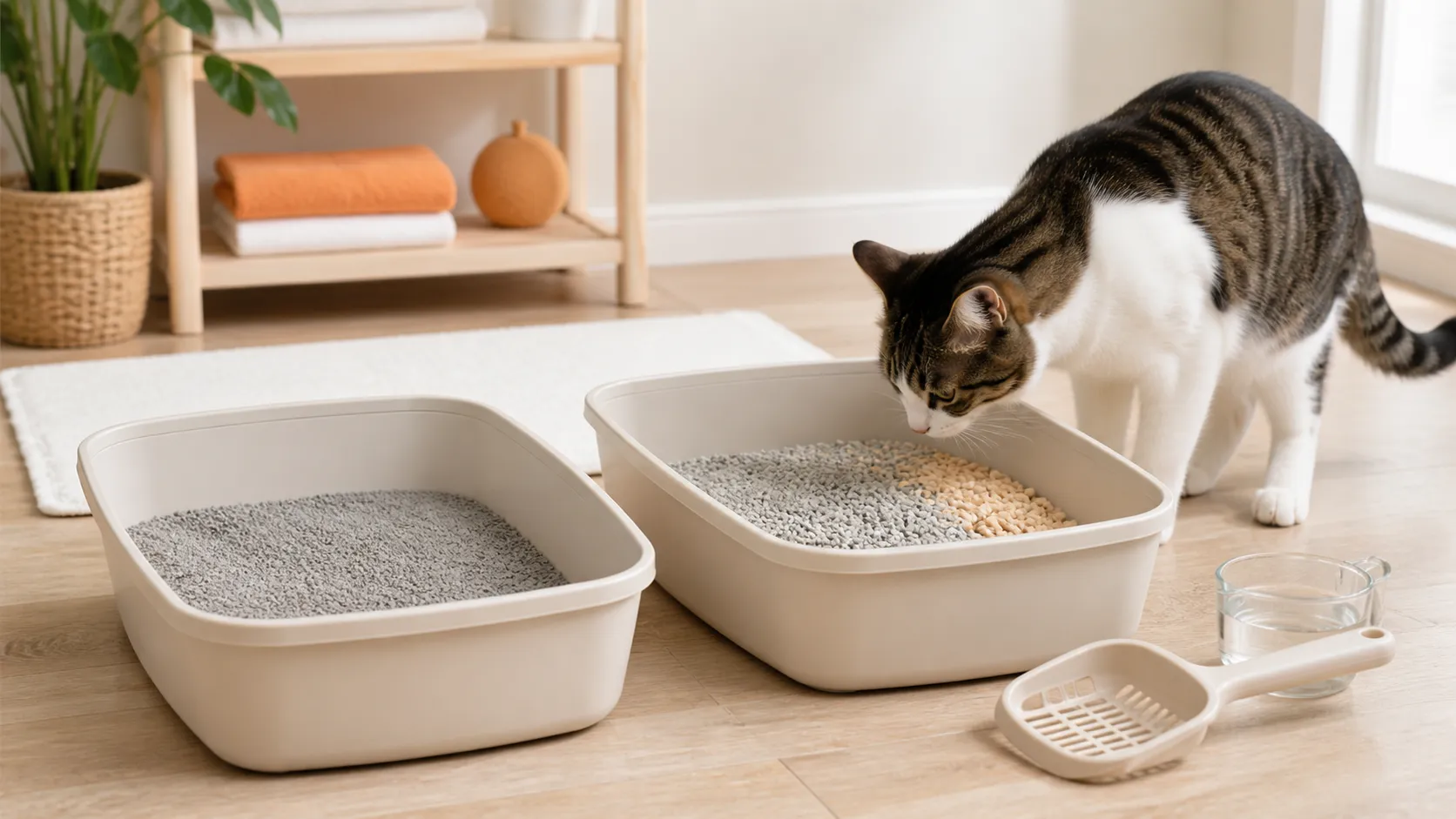
The safest way to switch from clay to tofu cat litter is to make the new texture optional first, then increase it in small, measured steps. Do not empty every box and replace the litter overnight just because the new bag says it clumps the same way.
Quick answer: keep the familiar clay-litter box available, add a second comparable trial box, and change only the trial box over 14 days: 10%, 25%, 40%, 50%, about 65%, 80%, 90%, then 100% tofu litter. Advance only while your cat enters, digs, eliminates, and leaves normally. Stay at the same ratio for mild hesitation; return to the last accepted mix if avoidance appears. Day 14 is not a deadline for removing the familiar box.
This schedule is a conservative practical plan, not a clinically validated universal protocol. Cornell’s house-soiling guidance recommends changing brands gradually by adding small amounts of new litter to the old, while the AAFP/ISFM house-soiling guidelines recommend offering multiple boxes with different litters for a preference evaluation. Your cat’s behavior decides the pace.
Do not start a litter experiment when a cat is already straining, urinating unusually often, producing little urine, constipated, painful, or suddenly eliminating outside the box. Those signs need veterinary assessment, not a different substrate.
Before Day 1: Record a Three-Day Clay-Litter Baseline
For three ordinary days, change nothing. Scoop at your normal times and record what “normal” looks like before tofu litter enters the picture.
Use a simple log for each box:
| Check | What to record | Why it matters |
|---|---|---|
| Visits and output | Approximate urine clumps and stools at the same time each day | Shows whether use drops after the texture changes |
| Entry | Walks straight in, sniffs, circles, or leaves | Hesitation may appear before a complete refusal |
| Foot position | All four paws in the litter or balancing on the rim | Rim-perching can indicate substrate or box aversion |
| Digging and covering | Normal, reduced, frantic, or absent | A marked change suggests the surface feels different |
| Tracking | Litter on the same mat and in a marked floor zone | Creates a fair baseline for the later comparison |
| Cleaning | Scoop time, stuck clumps, crumbs, and refill volume | Separates household convenience from feline acceptance |
If multiple cats share the home, identify use only when you can do so without disturbing them. A door-facing camera outside the toileting area may help distinguish cats, but do not aim it into a place where people expect privacy. If you cannot tell which cat used which box, note that limitation rather than assigning the output by guesswork.
Keep the familiar box’s location, depth, cleaning routine, mat, and enclosure status constant. Changing the litter, box shape, scent, and location together makes the result impossible to interpret.
Set Up a Second Test Box Before You Mix Anything
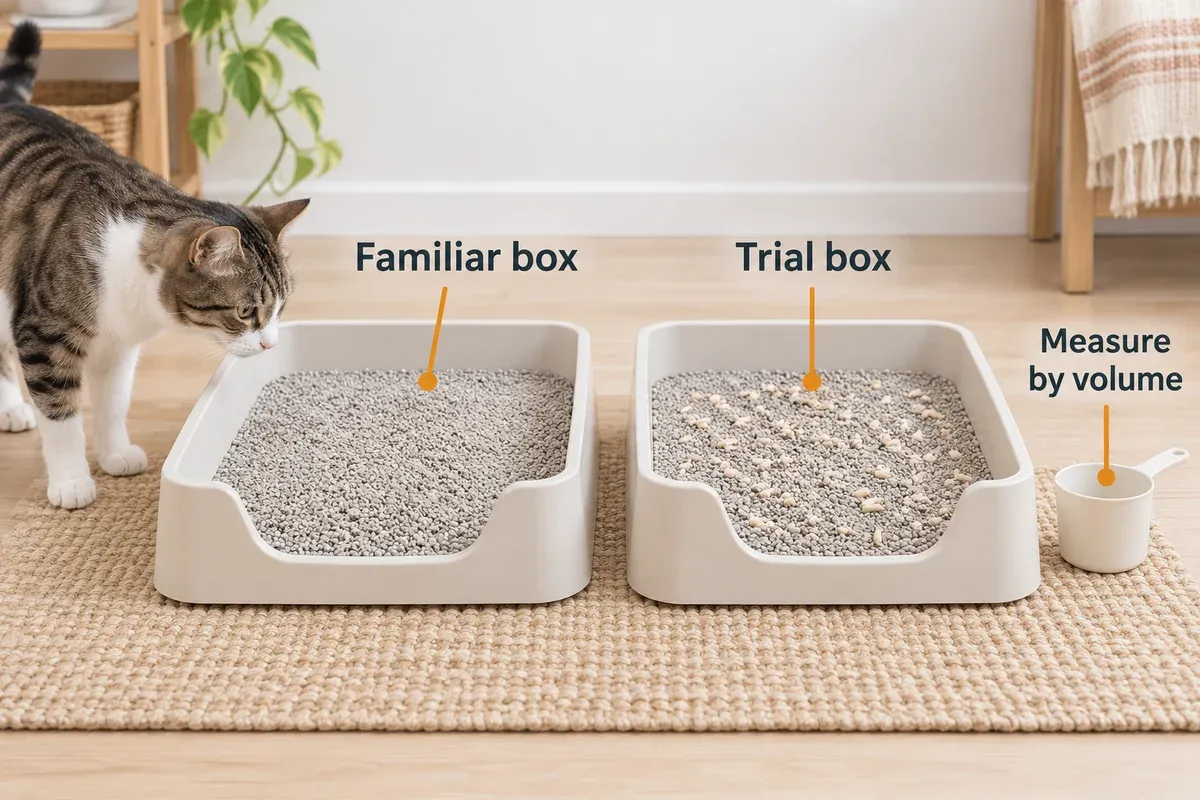
The trial box should isolate the litter variable as closely as your home allows:
- Use a box with a similar usable floor area, entry height, and cover status.
- Put it near the familiar box without narrowing either entrance or escape route.
- Fill both boxes to the same measured depth.
- Keep the familiar box at 100% old clay litter.
- Change only the trial box according to the schedule below.
- Scoop both boxes on the same timetable with separate clean scoops.
The two boxes are a short-term preference pair, not permission to cluster all household boxes permanently. In a multi-cat home, keep the other litter stations distributed through the home; the AAFP/ISFM environmental guidelines emphasize multiple, separated toileting resources and individual choice. Our multi-cat litter-box placement planner covers the room-layout part in more detail.
Advertisement / Affiliate disclosure: This article contains paid affiliate links. We may earn a commission at no extra cost to you.
Tofu litter for a separate texture trial
-
Tuft & Paw Really Great Cat Litter
Tuft & Paw
A clumping tofu litter sold in 9.25-pound bags and described by the manufacturer as ultra low-tracking and 99% dust-free.
- Pellet-shaped tofu litter for a distinct tracking test
- Manufacturer describes it as ultra low-tracking and 99% dust-free
- One 9.25 lb bag is described as about one month for one cat
- Best for
- A separate low-tracking tofu-litter texture trial
- Pack size
- 9.25 lb bag
- Trial format
- Pellet-shaped tofu-litter tracking trial
The low-tracking and 99% dust-free statements are manufacturer claims, not results of an independent Zoolory test. Choose the current formula only after checking its scent and directions.
Product fit: Tuft & Paw Really Great Cat Litter
The current Tuft & Paw product page describes Really Great Cat Litter as a clumping, pellet-shaped tofu litter sold in 9.25-pound bags. The company calls it “ultra low-tracking” and “99% dust-free.” Those figures describe the manufacturer’s product, not every tofu litter and not a guarantee that no particles will leave your cat’s paws.
For the cleanest preference test, choose the unscented option when the familiar clay litter is unscented. Cornell notes that most cats prefer unscented litter. Changing both texture and fragrance at once adds a second variable and can make a refusal harder to interpret.
The long pellet texture is intentionally different from fine clay. That difference may reduce scatter in one home and feel unacceptable under another cat’s paws. The 2022 ISFM/AAFP cat-friendly veterinary environment guidelines note that some cats—particularly cats with degenerative joint disease—may find pelleted substrates painful to stand on. A senior cat, a cat with paw pain, or a cat already balancing on the box rim deserves a veterinarian-guided plan rather than pressure to accept pellets.
The 14-Day Tofu Cat Litter Transition Schedule
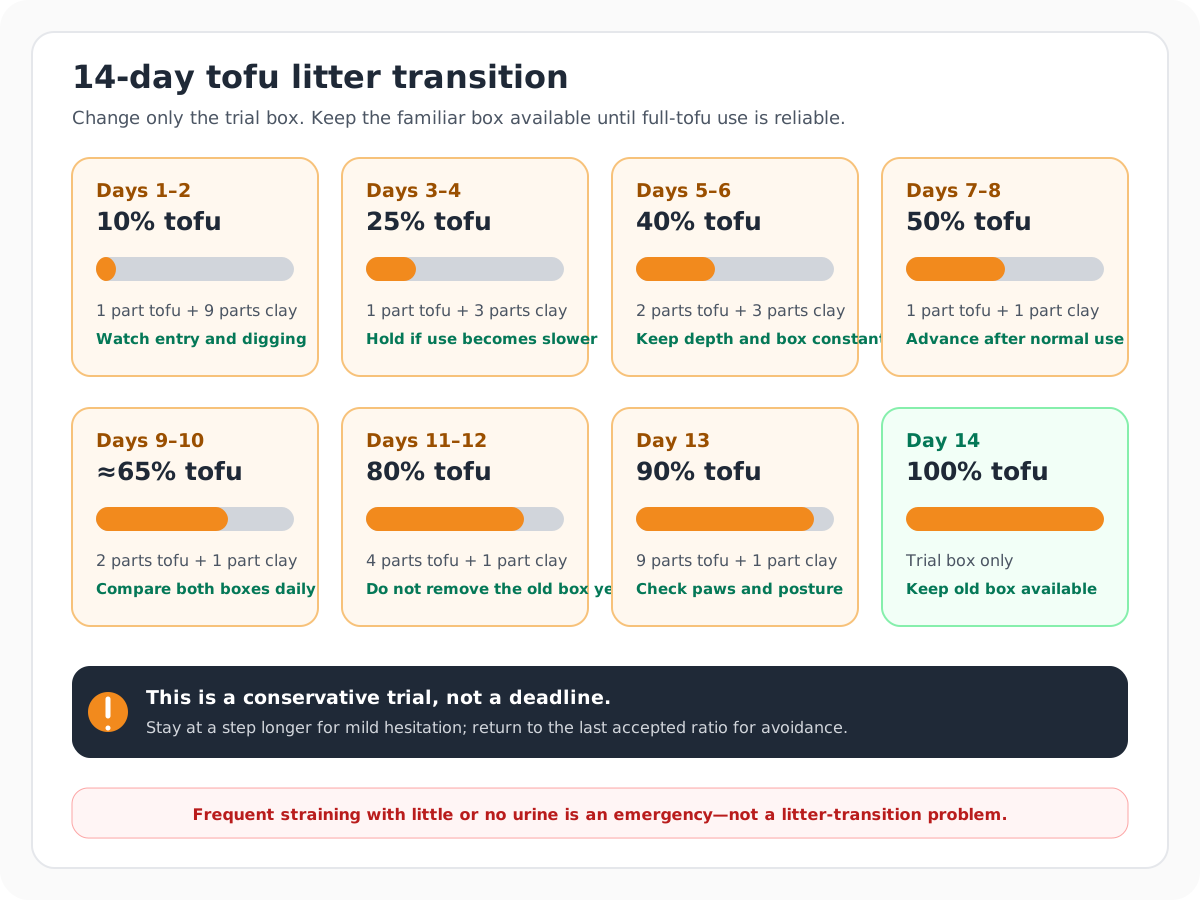
| Days | Trial-box mix by volume | Easy measuring ratio | Advance when… |
|---|---|---|---|
| 1–2 | 10% tofu / 90% clay | 1 part tofu + 9 parts clay | The cat enters and eliminates without a new hesitation pattern |
| 3–4 | 25% tofu / 75% clay | 1 part tofu + 3 parts clay | Digging, posture, output, and exit remain normal |
| 5–6 | 40% tofu / 60% clay | 2 parts tofu + 3 parts clay | The trial box is still used voluntarily |
| 7–8 | 50% tofu / 50% clay | 1 part tofu + 1 part clay | There is no repeated rim-perching or immediate retreat |
| 9–10 | About 65% tofu / 35% clay | 2 parts tofu + 1 part clay | Use remains stable across two days |
| 11–12 | 80% tofu / 20% clay | 4 parts tofu + 1 part clay | Normal use continues; the familiar box stays available |
| 13 | 90% tofu / 10% clay | 9 parts tofu + 1 part clay | Paws, gait, toileting posture, and output look normal |
| 14 | 100% tofu in the trial box | Tofu only | The cat chooses and uses it normally—without being placed inside |
Measure by volume, not bag weight
Clay and tofu pellets have different densities. A half-pound of each is not a 50:50 experience in the box. Use one dedicated dry cup or scoop as a “part,” measure both substrates by volume, and blend the trial-box batch thoroughly before pouring it in.
Keep the total fill depth constant. If the baseline is two inches, do not let the mixture become four inches deep just because you added new litter. Depth preference can be as important as material preference, and the AAFP/ISFM guidelines specifically include variable depth in preference testing.
Do not keep topping a 10% mix with pure tofu and call the next result 25%. Scoop the trial box, estimate how much clean litter remains, and prepare the replacement amount as a measured batch. Exact laboratory precision is unnecessary; a repeatable process is the goal.
What to do at each morning and evening check
- Scoop both boxes and record output before adding litter.
- Confirm that both approaches are open and neither box has shifted.
- Level the surface to the same depth without packing it hard.
- Sweep or vacuum only after recording the tracking zone.
- Note the cat’s behavior without carrying or placing the cat in the trial box.
- Change the ratio only after the full planned interval has passed with normal use.
If the cat investigates but keeps choosing the clay box, that is information—not disobedience. Hold the ratio. A litter that solves a cleaning problem for a person still has to be acceptable to the cat.
Acceptance Signals, Pause Signals, and Stop Signals
Green: continue at the planned pace
Proceed when your cat:
- approaches and enters the trial box without a new long pause;
- places all four paws on the substrate;
- digs, turns, squats, and covers in its usual pattern;
- produces its ordinary urine and stool output;
- leaves calmly rather than springing out immediately; and
- continues using other litter stations normally.
A single sniff is not acceptance. The meaningful signal is normal elimination in the trial box.
Amber: stay at the same ratio or roll back one step
Hold for another two days when your cat sniffs longer, digs less, uses the trial box less often, or chooses the familiar box for every event but otherwise appears well. If the pattern persists, return to the last mix the cat used normally.
Roll back immediately when you see repeated rim-perching, entering and leaving without eliminating, sudden frantic digging, jumping out before finishing, or new elimination beside the box. Restore the last comfortable setup and keep it stable. Do not punish accidents, restrict access to the familiar box, or place the cat into the pellets.
If a return to the familiar setup does not restore normal use, contact your veterinarian. AAHA’s litter-box avoidance guide explains why urinary disease, gastrointestinal problems, pain, mobility changes, stress, and box setup all need consideration.
Red: stop the transition and seek veterinary care
Treat frequent litter-box trips with little or no urine as an emergency. The VCA emergency guide states that a cat repeatedly trying to urinate but producing no urine or only drops needs immediate veterinary attention. Also stop and seek prompt care for:
- crying or obvious pain while urinating or defecating;
- blood in urine or stool;
- vomiting, marked lethargy, weakness, or hiding;
- a tense or painful abdomen;
- sudden inability or reluctance to step into either box; or
- a major, unexplained change in urine or stool output.
Do not wait for day 14 to see whether those signs resolve.
How to Compare Tracking Without Trusting the Bag Claim
“Low tracking” is useful only if it is true in your room with your cat’s coat, paws, digging style, mat, and box. Compare the two substrates under the same conditions.
- Mark a 3-foot zone from the box entrance with removable painter’s tape.
- Use the same clean litter mat for the clay baseline and the full-tofu comparison.
- Sweep at the same time each day before routine floor cleaning.
- Empty the sweepings onto a white sheet of paper and photograph them from the same height.
- Separate intact litter pieces from ordinary hair and household dirt.
- Record particles beyond the marked zone, not only the material caught by the mat.
- Compare at least three clay-baseline days with several stable 100%-tofu days.
| Result | Likely interpretation | Next action |
|---|---|---|
| Fewer intact pellets leave the tofu box | The larger shape may be releasing from your cat’s paws sooner | Keep the mat and cleaning schedule constant to confirm |
| Few intact pellets but many crumbs | Pellets may be breaking during digging or scooping | Check storage, depth, scoop slots, and the current product directions |
| Similar scatter for both litters | Box exit, mat, coat, or digging style may dominate the result | Use our cat litter tracking guide before changing litter again |
| Less tracking but weaker acceptance | The household benefit does not outweigh avoidance | Return to the accepted substrate and test another low-change solution |
Do not use dust clouds, fragrance, or visible cleanliness as a medical proxy. A manufacturer dust claim does not establish that a litter is hypoallergenic, prevents respiratory disease, or is appropriate for a particular diagnosis.
View Really Great Cat Litter at Tuft & Paw →Cleaning and Odor: Keep the Comparison Fair
Scoop both boxes at least daily and more often if that is your established routine. The AAFP/ISFM house-soiling guidelines recommend removing waste at least once a day and avoiding strong or ammonia-based cleaning products. A scented deodorizer introduced halfway through the trial can affect acceptance and invalidates the comparison.
Tofu clumps may feel different on the scoop from bentonite-clay clumps. Follow the current package directions, allow the recommended clump time, and use a scoop whose slots retain the clumps without forcing or crushing them. Do not assume that one broken clump means the litter has failed; record performance across multiple normal events.
Keep the open bag sealed in a cool, dry place. Plant-fiber pellets can be affected by humidity. Do not pour damp, swollen, moldy, or contaminated litter into the box.
Disposal: “Flushable” Does Not Override Local Rules
Tuft & Paw describes its tofu litter as water-dissolving and flushable. That is a manufacturer product claim, not universal permission to put used litter into a toilet.
Wastewater rules, septic-system guidance, plumbing condition, and environmental restrictions take priority. For example, the City of Riverside’s official sewer guidance says even litter marketed as flushable can clog plumbing and should go in the trash. San Luis Obispo County’s toxoplasmosis guidance also says not to flush cat litter and recommends bagging feces for household garbage.
Use this conservative disposal rule:
- Default: seal used clumps and feces according to local household-waste rules and place them in the trash.
- Municipal sewer: flush only if the litter maker, your local wastewater authority, building rules, and your plumber all permit it.
- Septic system: do not assume dissolving pellets are septic-safe; follow the septic professional and local authority.
- Compost: do not put used cat litter or cat feces into a home compost pile intended for food-growing areas.
- Pregnancy or immune suppression: the CDC recommends having someone else change cat litter when possible; otherwise use disposable gloves, wash hands, and follow your clinician’s advice.
Never dispose of used litter outdoors, in a storm drain, sink, or garbage disposal.
Multi-Cat and Senior-Cat Adjustments
Multi-cat home
Do not convert every box together. Keep the normal number and distribution of litter stations, and run the tofu trial in one added or designated box. Record which cat accepts the mixture. One confident cat using 100% tofu does not prove that the other cats have accepted it.
If one cat guards the trial pair, move the experiment to a second safe zone or stop until each cat has unobstructed access. A substrate test cannot be interpreted when social blocking determines which box is reachable.
Senior or mobility-limited cat
Keep entry height low, the approach non-slip, and the box large enough to turn around. Watch for a new reduction in jumping, stiffness, a shortened stride, or reluctance to put paws into the pellets. Those signs may reflect pain rather than stubbornness. Ask your veterinarian before continuing.
Kitten
Do not force a newly adopted kitten through a litter change while it is still learning the home. Stabilize the box location and familiar substrate first. Keep litter out of the mouth, supervise exploration, and ask the veterinarian about age-appropriate product selection if the kitten eats litter.
Frequently Asked Questions
How long does it take a cat to switch to tofu litter?
Some cats accept a new substrate quickly; others need several weeks or reject that texture. Fourteen days is a structured starting plan, not a deadline. Extend any step that produces mild hesitation, and keep the familiar box until the cat has used the 100% tofu trial box normally for several days.
Can I switch from clay to tofu litter immediately?
A cat that has already used tofu litter may tolerate an immediate change, but a cold-turkey switch removes choice and makes refusal harder to reverse. Cornell recommends adding new litter gradually. A second-box trial is the lower-risk approach when the cat’s preference is unknown.
Should I mix litter in every box?
No. Change one trial box and preserve at least one familiar option. In a multi-cat home, maintain the usual distributed resources and track acceptance cat by cat.
What if my cat only uses the clay box?
Hold the current ratio or return to the last accepted one. Confirm that box size, location, depth, cleanliness, and access are comparable. If the cat continues to reject the pellets, accept that preference and choose a different tracking-control strategy.
Is tofu cat litter really dust-free?
The featured product is described by its manufacturer as 99% dust-free. That is not the same as zero dust, an independent laboratory result, or a medical claim. Pellets can also crumble through handling, humidity, and use. Judge the actual bag and stop if you see contamination, unusual dust, or a health concern.
Can tofu cat litter be flushed?
Not by default. Even when a manufacturer says the litter dissolves, some wastewater authorities prohibit all cat litter, and septic or building rules may be stricter. Bagging and trash disposal according to local rules is the conservative default.
When can I remove the old clay-litter box?
Only after the cat has used the 100% tofu trial box normally for several days and still has enough other clean, accessible litter stations. Remove or repurpose one familiar box at a time. Put it back if use drops or accidents begin.
Bottom Line
A successful tofu cat litter transition preserves choice. Establish the clay-litter baseline, add a comparable second box, increase the tofu share from 10% to 100% only while behavior remains normal, and keep the familiar box beyond day 14 if your cat needs it. Measure tracking separately from acceptance, treat manufacturer dust and tracking figures as claims, and default to local waste rules rather than a flushability label.
If your cat refuses both boxes or shows pain, straining, or abnormal output, stop changing litter and involve a veterinarian.
Sources and Review Notes
- AAFP/ISFM Guidelines for Diagnosing and Solving House-Soiling Behavior in Cats
- Cornell Feline Health Center: Feline Behavior Problems—House Soiling
- AAFP/ISFM Feline Environmental Needs Guidelines
- 2022 ISFM/AAFP Cat Friendly Veterinary Environment Guidelines
- AAHA: Why Won’t My Cat Use the Litter Box?
- VCA Animal Hospitals: Emergencies in Cats
- CDC: People at Increased Risk for Toxoplasmosis
- Tuft & Paw: Really Great Cat Litter
- City of Riverside Public Works: Sewer FAQ
Product specifications and performance phrases were reviewed against the linked manufacturer page on August 10, 2026. Packaging and instructions can change; the current product page and delivered label take priority.