

 Published sources
 Product details checked
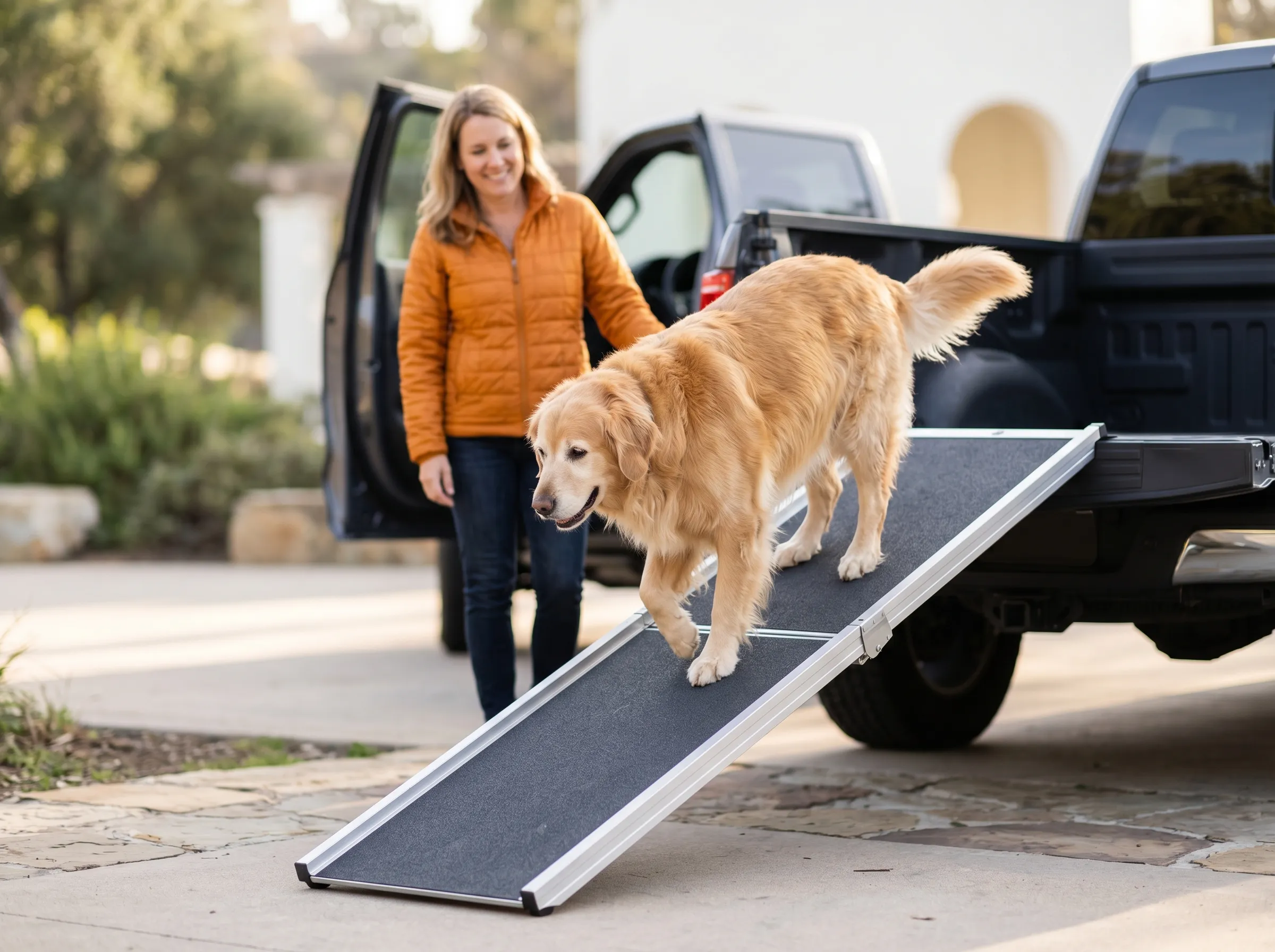
A dog ramp can make access to a vehicle, bed, or couch more manageable, but the right choice depends on the height, available deployment space, surface traction, width, and the dog’s ability to walk under control. A ramp is an access aid—not a treatment for arthritis, hip dysplasia, cruciate disease, a spinal problem, or an injury.
The Merck Veterinary Manual describes canine hip dysplasia as developmental and multifactorial. The American College of Veterinary Surgeons also describes multiple contributors and condition-specific treatment decisions. This guide therefore separates diagnosed disease, possible prevention goals, and ordinary comfort instead of promising that a particular ramp prevents a diagnosis.
Advertisement / Affiliate disclosure: This article contains paid affiliate links. As an Amazon Associate, we earn from qualifying purchases at no extra cost to you.
Quick answer
- Best-documented vehicle ramp: WeatherTech PetRamp. Its official page publishes length, width, folded length, weight, load limit, surface, feet, handles, and warranty details.
- Longest manufacturer-listed vehicle option here: GAOYITK’s 71-inch ramp. Its official storefront lists a non-slip surface and a 250 lb limit; match the exact variant before use.
- Furniture-specific option: PRIORPET’s couch ramp. The manufacturer lists seven height settings from 14–20.5 inches and a 200 lb limit.
- Evidence rule: The shortlist below uses manufacturer-published specifications wherever a product claim is made. Marketplace availability and variants can still change, so confirm the current product page before use.
How this comparison works
We compare the dimensions that determine whether a ramp can be used safely in a particular place:
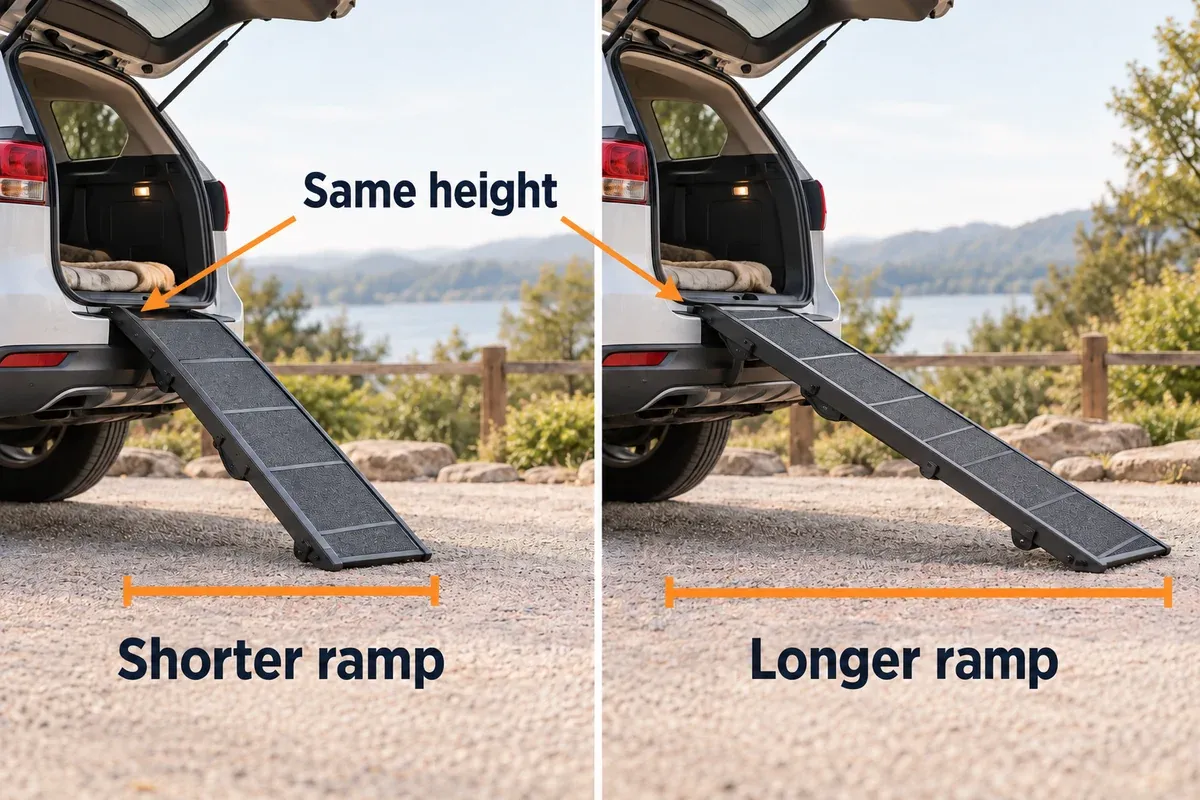
- Ramp length: a longer ramp usually produces a lower angle at the same platform height, but it needs more floor or driveway space.
- Width: a wider walking surface gives a dog more lateral margin, but width alone does not make a ramp stable.
- Platform height: the same ramp can be comfortable beside a low couch and too steep beside a tall SUV.
- Surface: traction must remain usable for the dog’s paws and be cleanable. “Non-slip” is a manufacturer or listing description, not an independent test result.
- Stated load limit: treat it as the manufacturer’s or listing’s published limit, not as proof that the ramp will stay in place on every surface.
- Placement and support: feet, hinges, the upper lip, support ribs, straps, and the surface below determine whether the ramp remains where it was placed.
We did not conduct a laboratory load, slip, flex, noise, or durability test. Product facts are separated from veterinary guidance, and no product is presented as a medical device.
Comparison table
-
GAOYITK 71" Extra-Long Dog Car Ramp
GAOYITK
Folding 71-inch ramp with a 20-inch width, non-slip surface, and a stated load limit of 250 lbs; confirm the exact variant before purchase.
- 71-inch length
- 20-inch width
- Iron-aluminum composite construction
- Best for
- Large dogs and vehicles where a longer ramp fits
- Length
- 71 inches
- Stated limit
- 250 lbs
- Surface
- Non-slip surface (manufacturer listing)
-
PRIORPET Wooden Couch Ramp
PRIORPET
Purpose-built birchwood couch ramp with 7 adjustable heights (14"-20.5"). Non-slip rubber surface. Fully assembled, no tools needed. 200 lbs capacity.
- 35-inch length optimized for furniture
- 7 adjustable heights (14"-20.5")
- Solid birchwood construction
- Best for
- Couch and chair access for small-to-medium dogs
- Length
- 35 inches
- Stated limit
- 200 lbs
- Surface
- High-traction rubber surface (listed spec)
-
WeatherTech PetRamp 67"
WeatherTech
WeatherTech’s official page lists a 67-inch resin ramp with a 300 lb stated limit, ribbed surface, rubber feet, carrying handles, and a lifetime limited warranty.
- 67-inch length
- 300 lb stated capacity
- Proprietary resin construction listed
- Best for
- A vehicle ramp with a detailed manufacturer specification page
- Length
- 67 inches
- Stated limit
- 300 lbs stated limit
- Surface
- Molded ribbed, non-slip rubber surface
Manufacturer specifications and variants can change. Before use, confirm the current length, width, load limit, surface, support method, and vehicle or furniture fit on the linked product page.
The ramps, reviewed by use case
1. WeatherTech PetRamp 67-inch — best-documented vehicle option
WeatherTech’s official PetRamp page lists a 67-inch unfolded length, 15-inch width, 33.5-inch folded length, 16 lb weight, and support for up to 300 lb. The page also describes rubber feet, a ribbed non-slip surface, molded handles, a proprietary resin, and a lifetime limited warranty.
Check current price on Amazon →Why it fits
This is the easiest vehicle option in the comparison to audit before purchase because the manufacturer publishes the measurements in one place. The length is long enough to create a less steep geometry than a short furniture ramp at the same height, while the folded length and 16 lb weight still matter when the ramp must be stored in a vehicle.
The 15-inch width is also a meaningful trade-off. It is not exceptionally wide, so a very large dog that turns sideways or needs a handler beside it may have less margin than on a 20-inch listing. Measure the dog’s shoulder width and the available vehicle opening rather than choosing only by the 300 lb number.
How to use it responsibly
Place the upper end so it cannot slide or lift from the bumper or cargo edge, make sure the rubber feet sit fully on the ground, and test the ramp without the dog first. Inspect the surface when wet or dirty. A published load limit does not guarantee stability if the vehicle edge, ground, or feet are incompatible.
Verdict
Choose the WeatherTech when you want the most complete manufacturer specification set in this comparison and the 15-inch walking width suits your dog. It is a strong starting point for vehicle access, but it still needs correct placement and gradual training.
2. GAOYITK 71-inch — longest listed vehicle ramp
GAOYITK’s official dog-ramp storefront lists a 71-inch folding ramp with a non-slip surface and a stated limit of up to 250 lb. The affiliate product record identifies the selected entry as 20 inches wide and four-fold; because the storefront presents more than one ramp, verify that the length, width, folds, and capacity belong to the exact model you receive.
Check current price on Amazon →Why length matters
At the same vehicle height, a 71-inch ramp has a lower geometric angle than a 63- or 67-inch ramp. That can be useful when the dog is hesitant on inclines or when a handler needs a slower, more controlled walk. The trade-off is deployment space: measure behind the vehicle with the hatch open, not just the cargo area.
What to check
The official storefront identifies a 250 lb limit, but that number is not a stability certification for a particular vehicle. Confirm the hinge locks, support ribs, feet, upper lip, and any safety strap. Check whether the folded package will fit where you intend to store it. A long ramp also creates more leverage at the vehicle edge if the upper contact point is not secure.
Verdict
Choose this model only when its extra length fits the driveway or loading area and the exact variant’s support details are clear. It is a geometry-focused option, not automatically the safest option simply because it is the longest.
3. PRIORPET wooden couch ramp — furniture-specific option
PRIORPET’s official US couch-ramp page lists a birchwood ramp with seven adjustable heights from 14–20.5 inches, a non-slip rubber surface, a 200 lb load capacity, and a folded size of about 39.6 by 14 by 3 inches. The manufacturer describes it for couch and chair use and says it is not intended for beds or cars.
Check current price on Amazon →Why it can fit
The shorter furniture-focused format is easier to place beside a low couch than a full vehicle ramp. The adjustable heights allow the owner to measure the couch rather than guessing from a product name. The rubber surface is also easier to evaluate and clean than a loose blanket placed over a board.
What to verify before use
The manufacturer’s 200 lb figure is a published load limit, not a guarantee that a large dog will be comfortable or that the base will remain fixed during a fast turn. Keep the ramp on a suitable floor, check the feet and hinges, and supervise early use. Because the page says it is intended for couch and chair access, do not repurpose it for a tall bed or vehicle without manufacturer guidance.
Verdict
Choose the PRIORPET when the target is a couch or chair within its height range and the dog’s size and movement fit the 200 lb limit with room to spare. It is not the right tool for loading a large dog into an SUV.
Ramp geometry: compare slope instead of guessing
If the stated length is the sloped walking surface, an approximate angle is:
angle = arcsin(platform height ÷ ramp length)Use the same units for both measurements. At a 30-inch platform height, the approximate geometric angles are:
| Ramp length | Approximate angle at 30 in |
|---|---|
| 63 in | 28.4° |
| 67 in | 26.6° |
| 71 in | 25.0° |
These are geometry examples, not universal comfort or safety thresholds. The calculation is not directly comparable when a manufacturer reports a horizontal base length instead of the sloped surface length. A ramp’s flex, edge transitions, surface, side rails, placement, and the dog’s gait also affect use.
For a 20-inch couch and a 35-inch sloped ramp, the same calculation gives about 34.8°. That is why a short furniture ramp can feel much steeper than a longer vehicle ramp, even when both are marketed for dogs.
The measurements to take before ordering
Vehicle height and deployment distance
Measure from the ground to the cargo floor or sill with the vehicle in the position where the dog will load. Then measure the clear distance behind the vehicle with the hatch or door open. The ramp must fit both dimensions at once. A long ramp that cannot be fully supported is less useful than a shorter one that can be placed securely.
Bed and couch height
Measure to the top surface where the dog will step, not merely to the wooden frame. Include a mattress, cushion, or removable topper. Check whether the ramp will meet the edge flush or leave a gap that requires a jump.
Dog width and walking style
Measure at the shoulders and observe whether the dog walks straight, turns, or backs up when uncertain. Width is only one part of the margin; a nervous dog may need side rails, a handler, or a different access arrangement even on a wide ramp.
Surface and floor condition
A non-slip surface on a ramp cannot compensate for a slippery floor underneath. Check the ramp when paws or the surface are damp, clean away hair and grit, and do not cover hinges with a loose towel that can bunch underfoot.
Load limit and dynamic movement
Compare the dog’s body weight with the stated limit, but do not treat the difference as a tested safety factor. A dog walking, stopping, or turning creates movement that a static label may not describe. Inspect support ribs, locking hinges, feet, straps, and the upper contact point before every vehicle use.
Training a dog to use a ramp
Do not put an unfamiliar dog directly at the top of a vehicle ramp. Start with the ramp flat on the floor, allow the dog to investigate it, and reward calm steps. Raise the height gradually only when the dog can cross without scrambling or freezing. Use a harness or light support during early sessions if appropriate, but do not drag the dog or force it forward.
The VCA guidance on osteoarthritis notes that a vehicle ramp can help reduce stress on the back and leg joints and that many dogs can learn to use ramps. VCA also recommends improving traction around the home and supervising access to stairs when falls are a concern. The VCA home-mobility guidance emphasizes that a ramp must be sturdy, must not slip, and should have good traction.
Stop the session if the dog repeatedly refuses, slips, cries, changes gait, or shows signs of pain. A ramp is not a substitute for assessing why mobility has changed.
Health context: diagnosis, prevention, and normal comfort are different
If a veterinarian has diagnosed arthritis, dysplasia, or an injury
Ask the treating veterinarian how much incline, repetition, and weight-bearing activity is appropriate. The Merck Veterinary Manual’s osteoarthritis guidance lists difficulty with stairs, reduced jumping, and slowness to rise among possible clinical signs. Those signs do not identify the cause by themselves.
After surgery, follow the discharge instructions rather than assuming a ramp makes activity unrestricted. The ACVS postoperative guidance says running, jumping, playing, and stairs should be limited as directed by the veterinary team. A dog can appear willing to move before tissues are ready for normal activity.
If the goal is prevention
Do not claim that a ramp prevents hip dysplasia, osteoarthritis, cruciate disease, or spinal injury. Hip dysplasia has multiple contributing factors, and the ACVS overview describes diagnosis and management as individual decisions. A ramp may reduce a particular jumping task or make access easier; that is different from preventing a disease.
If the goal is everyday comfort
For a healthy dog, choose based on fit, traction, stability, and willingness to use the ramp. A dry surface, good lighting, short nails, and supervision can make the access task easier, but they do not guarantee success. If the dog starts avoiding stairs, jumping, vehicles, or furniture, arrange a veterinary assessment instead of selecting a heavier-duty ramp and assuming the problem is solved.
When a ramp is the wrong solution
A ramp is not enough when the dog cannot walk steadily, repeatedly collapses, drags a limb, shows severe pain, or cannot control the descent. A sling, crate, temporary restriction, lower access point, or a veterinary rehabilitation plan may be more appropriate. After an acute injury or surgery, the ACVS fracture guidance specifically cautions against jumping, running, and unrestricted stairs during healing.
Seek prompt veterinary advice for a sudden inability to bear weight, severe pain, repeated falls, breathing difficulty, collapse, or a rapid change in mobility. This article cannot diagnose the cause.
Frequently Asked Questions
Is a longer dog ramp always safer?
No. At the same platform height, a longer ramp has a lower geometric angle, but it also needs more room and may create more leverage at the vehicle edge. A shorter ramp can be appropriate when it is fully supported and the dog can use its incline comfortably.
What is the safest angle for a large dog?
There is no single universal angle that can be promised for every dog, diagnosis, ramp surface, and placement. Use the angle calculation to compare options, then consider the dog’s gait, the surface, the height, and the veterinary plan if a condition is present.
Can a ramp prevent hip dysplasia?
No reliable claim supports that conclusion. Hip dysplasia is developmental and multifactorial. A ramp can alter access to a vehicle or piece of furniture, but it cannot remove genetic, developmental, body-condition, or other contributors to a diagnosis.
Should I use a ramp after surgery?
Only according to the treating veterinary team’s instructions. Some surgeries require strict restriction of running, jumping, stairs, or even weight-bearing. A ramp may be part of a plan, but it may also be too much activity during an early healing period.
Does a 250 or 300 lb label mean the ramp is safe for every large dog?
No. The number is a stated product limit. Stability also depends on the dog’s movement, the support points, the floor, the vehicle edge, the ramp’s flex, and whether the exact variant matches the published specification.
Are ramps better than stairs?
Not automatically. A ramp can reduce the need for repeated jumping and may be easier for some dogs, while stairs can use less floor space and may suit a dog that prefers distinct steps. The dog’s diagnosis, coordination, surface, and training determine the better option.
How do I stop a ramp from sliding?
Use the manufacturer’s feet, straps, upper lip, and placement instructions. Put the feet on a clean, suitable surface, check that the upper end is fully supported, and do not rely on a blanket or loose mat to hold a vehicle ramp in place.
What if my dog refuses the ramp?
Return to flat-floor training and shorter sessions. Do not pull the dog up by the collar or force it over the incline. Repeated refusal, pain, limping, or a sudden change in willingness should prompt a veterinary conversation.
Final recommendation
For a large dog, begin with measurements rather than marketing language: platform height, available deployment length, clear width, traction, support points, and the exact stated load limit. WeatherTech has the most complete manufacturer documentation in this comparison; GAOYITK offers the longest listed vehicle ramp; PRIORPET is designed for lower furniture.
The correct ramp is the one the dog can use under supervision without slipping, scrambling, pain, or a forced jump. If mobility has changed or surgery is involved, the veterinary plan takes priority over any product recommendation.
Sources and verification
- Merck Veterinary Manual: hip dysplasia in dogs
- Merck Veterinary Manual: osteoarthritis in dogs and cats
- American College of Veterinary Surgeons: canine hip dysplasia
- American College of Veterinary Surgeons: postoperative care
- American College of Veterinary Surgeons: fracture aftercare and activity restriction
- VCA Animal Hospitals: helping a dog with osteoarthritis
- VCA Animal Hospitals: creating a comfortable home for a mobility-compromised dog
- WeatherTech PetRamp specifications
- GAOYITK dog-ramp storefront
- PRIORPET official couch-ramp specifications
Technical specifications and source links were checked in August 2026. Marketplace specifications, variants, and load limits can change; verify them on the linked product page before use.
Affiliate Disclosure: We earn from qualifying purchases through Amazon Associates at no extra cost to you.