

 Published sources
 Product details checked
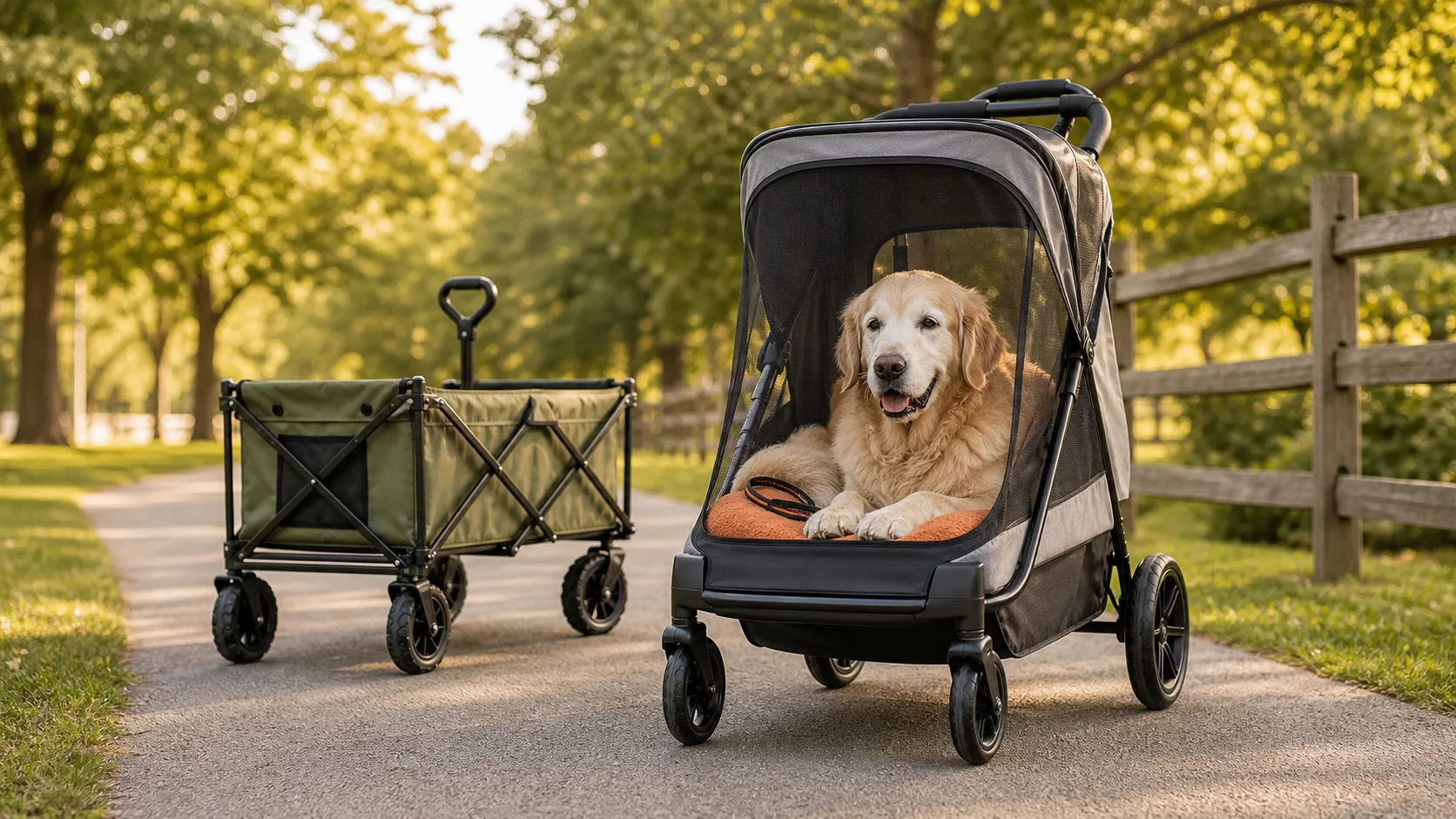
Choose an enclosed dog stroller for regular outings when your large senior dog fits the cabin and can use the entrance comfortably. Choose a pet wagon with a compatible ramp when stepping over the entrance or being lifted is the main obstacle. Either choice must provide enough usable space for your dog to rest and change position, secure containment, and handling you can manage with your dog aboard.
Start with the movement that causes difficulty. A dog that walks happily for a short distance but tires on the way home needs a place to rest. A dog that cannot negotiate the entrance needs a different loading arrangement. A high weight rating solves neither a cramped cabin nor a painful step.
If slower walking, limping, trouble rising, or reluctance to be handled is new, arrange a veterinary assessment before extending outings. These can be signs of pain, as explained in Cornell’s guide to recognizing pain in dogs. A stroller transports your dog; it does not establish why movement has become difficult.
In this guide:
- What changes between a stroller and a wagon
- How to measure your dog and the usable cabin
- Product dimensions and their limits
- Fit examples that rule out a purchase
- Entry, ramps, and unloading
- Handling a heavy dog on your usual route
- Preparing the floor and introducing the ride
- Planning outings and keeping the vehicle usable
- Before-you-buy checklist
- Frequently asked questions
What changes between a stroller and a wagon
An enclosed stroller usually has a push handle, mesh cabin, canopy, and a defined doorway. A pet wagon often has an open tub, a pull handle or separate push handle, and a side or end that lowers for access. Some designs combine both formats, so the name alone tells you little about accessibility.
| Everyday question | Enclosed dog stroller | Pet wagon or stroller wagon |
|---|---|---|
| How does the dog enter? | Through a front or rear door; the floor and threshold may still be too high | Through a lowered end or ramp on some models; ordinary cargo wagons may require a lift |
| Can the dog leave without turning? | Front and rear doors can provide a straight exit if the layout allows it | Depends on the ramp position, opening, and space to change direction |
| Where does the dog rest? | Inside a shaped cabin, sometimes narrowed by wheel housings or a sloping front | On a tub floor that may be broad but can also be narrow, flexible, or obstructed |
| How is the dog contained? | Closed mesh and doors provide a physical boundary; a tether is a backup | Low sides alone may not contain a dog that stands, leans, or tries to climb out |
| What provides shade? | A canopy, with mesh panels left open to airflow | A suitable canopy or separate shade arrangement; an open top still exposes the dog to sun |
| How do you steer? | Usually from behind, with the dog visible in front | Pushing can keep the dog visible; pulling requires you to check behind you and manage the turning arc |
| What takes space at home? | The folded frame, wheels, and sometimes a rigid cabin | The folded tub, handles, canopy, and ramp; accessories can make storage bulkier |
Choose for the actual design. A ramp-equipped enclosed stroller can be more accessible than a wagon with high sides. An open wagon can give a tall dog more headroom, but it still needs a way to prevent an attempted exit. Neither category guarantees a wider floor, better brakes, or a smoother ride.
For a dog that needs rest breaks during neighborhood walks, start with cabin fit and a straightforward entrance. For a dog that cannot turn comfortably in a confined space, prioritize a usable front-to-rear exit. For a dog that cannot step up, examine the complete ramp arrangement before considering the canopy or folding mechanism.
How to measure your dog and the usable cabin
You need a tape measure, your dog’s current weight, and a level floor where your dog normally rests. Use inches throughout or centimeters throughout. Mixing the two is an easy way to order the wrong size.
Measure a comfortable resting position
Let your dog settle naturally. Do not fold their legs underneath them or encourage a tighter curl to make a smaller cabin work.
Record:
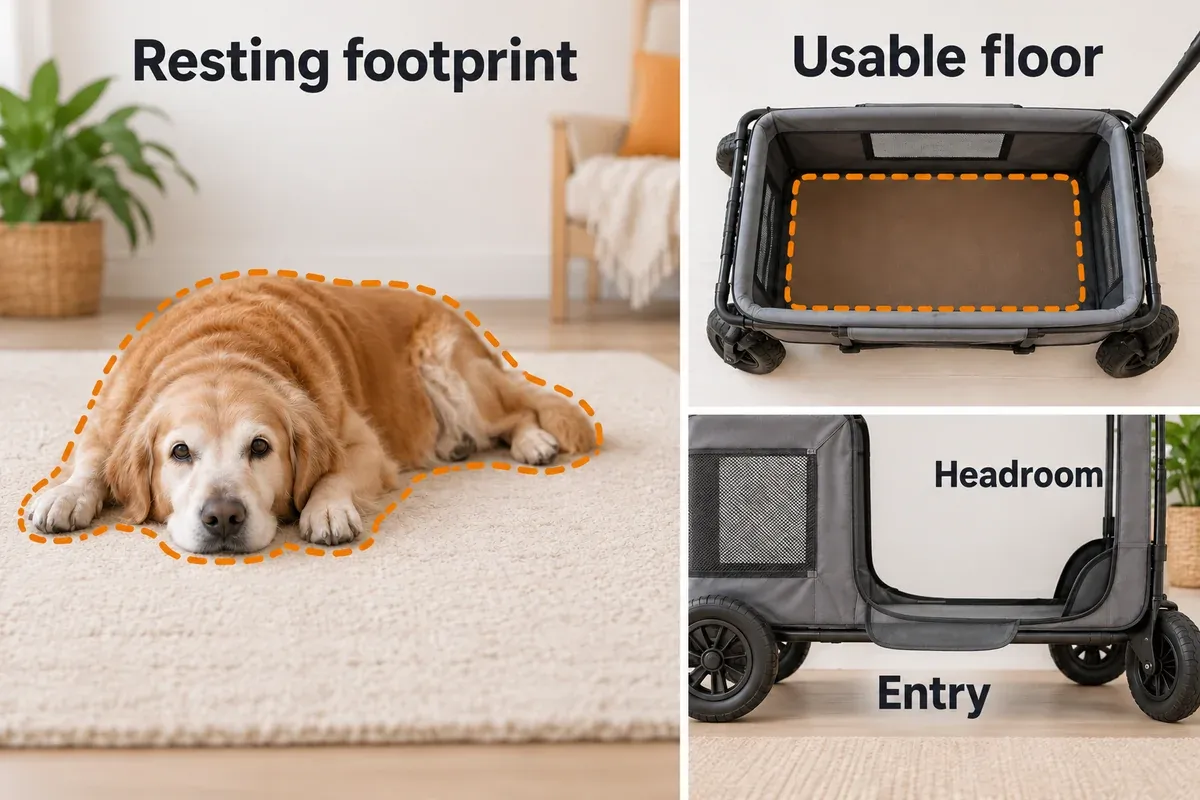
- Resting length: the space occupied from the furthest forward point of the head or paws to the furthest rear point. Include paws that extend beyond the body.
- Resting width: the widest span in the position your dog uses on longer rests, including legs that project to the side.
- Sitting height: floor to the highest point of the head or ears in a natural seated position, if your dog can sit comfortably.
- Standing height and shoulder width: useful for the entrance and the movements needed to settle inside. Do not make a painful dog stand for a measurement.
- Current weight: needed for the relevant pet-weight limit and overall load limit.
A nose-to-rump measurement can help describe body size, but it does not replace the complete resting footprint. A long dog lying on its side may occupy much more width than its chest measurement suggests.
Measure more than one normal resting position if your dog changes between curling and stretching. Choose for the larger position they need, especially on an outing long enough for them to lie down. Photographing the position beside a tape measure can also help a manufacturer understand your fit question.
Ask for five separate product measurements
“Large,” “XL,” and an overall length are not useful substitutes for the following measurements:
| Measurement | What to measure | Why it can rule out a model |
|---|---|---|
| Usable floor length | Supported interior floor, front to rear, between obstructions | Your dog’s head, rump, or extended paws would press against an end |
| Usable floor width | Narrowest floor width where the dog must lie or change position | A broad body or side-lying legs cannot fit comfortably |
| Usable enclosed height | Top of the installed mat to the lowest roof, canopy, or frame obstruction over the dog’s position | Your dog must crouch, tilt its head, or push against mesh |
| Entry height | Ground to the floor and ground to the highest threshold the dog must cross | A supposedly low floor still requires a difficult step over a lip |
| Permitted weight | Pet limit and any separate total-load limit for that exact model | The dog, bedding, and carried items exceed the applicable limit |
Also ask for the clear doorway width and height, plus the ramp’s usable width and deployed dimensions when a ramp is part of the plan. A spacious cabin is of little use if your dog’s shoulders cannot pass through its door.
For a curved or tapered cabin, use the narrowest relevant measurement. A length measured above the floor or a width measured at the top of the sides can overstate the space your dog actually occupies. Keep package dimensions, unfolded exterior dimensions, and handle height out of the fit calculation.
Allow room for movement, without inventing a sizing rule
The floor must be larger than your dog’s resting footprint. An exact edge-to-edge match leaves no allowance for a change in posture, a rounded corner, or the mat you add. There is no universal extra-inch allowance that makes every dog comfortable.
Before ordering, mark the proposed interior rectangle on your floor with removable tape, away from the dog’s walking path. Let your dog rest beside or within it voluntarily. This helps you spot an obvious shortage of floor area; it cannot reproduce the doorway, walls, tether, floor support, or a moving ride.
Use a demonstration unit or a returnable home trial to confirm that your dog can enter, settle, reposition, and leave. Recheck enclosed height with the actual bedding installed. If a mat raises the dog’s resting surface by 2 inches, it also removes about 2 inches of headroom.
Separate pet capacity from total load
A maximum pet weight applies to the dog. A maximum load may include the dog, mat, water, bags, and other carried items. Follow the exact model’s instructions when both limits exist, and do not treat unused pet capacity as permission to overload a storage basket or hang bags from the handle.
Weight is a hard filter, but a lighter dog can still fail every space check. Extra load capacity also does not prove that you can stop the vehicle on your route or lift it into your car.
Product dimensions and their limits
The examples below show an enclosed dual-entry stroller, a ramp-equipped stroller wagon, and a narrower stroller that can be ruled out by body width. They are compared using the same measurement types. Published cabin dimensions are starting figures; confirm the usable floor and clearance with the supplied mat in place.
This is a comparison of published specifications and instructions, not a hands-on ride test. “Not specified” means the measurement is unresolved. It is not permission to assume the dog will fit.
| Model | Cabin length × width | Published interior height | Entry from ground | Weight limit |
|---|---|---|---|---|
| Petbobi 80-lb dual-entry stroller | 32.7 × 19.7 in / 83.1 × 50.0 cm | 23.6 in / 59.9 cm; minimum clearance above installed bedding needs checking | 10.5 in / 26.7 cm step-in; clear doorway size needs checking | 80 lb / 36.3 kg pet weight |
| Snagle Paw StrideMate MAX | 34.25 × 22.83 in / 87.0 × 58.0 cm | 19.29 in / 49.0 cm described as interior height; minimum closed-canopy clearance needs confirmation | Built-in ramp; numerical floor height, threshold, and ramp rise/run not specified | 220 lb / 99.8 kg maximum load |
| Pet Gear AT3 No-Zip, PG8350NZ | 29 × 13 in / 73.7 × 33.0 cm in this manual | 22 in / 55.9 cm nominal interior height | Step-in height not specified in the manual; check the exact unit | 75 lb / 34.0 kg pet weight; width excludes broad dogs |
Rounded conversions use 2.54 centimeters per inch and 0.453592 kilograms per pound. Height above the ground, tub depth, overall stroller height, and clear height above the mat are different measurements.
Petbobi: a conditional choice for a dog that fits the narrower cabin
The 80-lb dual-entry Petbobi has front and rear zippered doors, mesh windows, an adjustable canopy, two safety leashes, and a one-foot rear brake. Its main advantage is the possibility of a straight entrance and exit without an in-cabin turn.
Consider it when your dog is within the pet-weight limit, has a resting footprint comfortably smaller than the cabin, and can negotiate the step-in. Check both door openings with the mat installed.
Rule it out if your dog weighs more than 80 pounds, needs more than the available width, or cannot clear the entrance without jumping, slipping, or painful assistance. A thick extra cushion can make the entrance harder and the roof clearance smaller. The dual doors do not resolve an unsuitable floor height.
Check current price on Amazon →StrideMate MAX: a ramp-equipped wagon with measurements still to resolve
The StrideMate MAX specifications give larger cabin length and width figures than Petbobi’s and a much higher load rating. Confirm how much of that space remains usable with the supplied liner in place. They also give an empty weight of 44.1 pounds, about 20 kilograms. That weight matters if you need to load it into a car or carry it between floors.
Its ramp setup has closed, horizontal, and entry positions. The horizontal extension is not automatically additional riding space. Keep the access panel secured in the configuration required for movement.
Consider the design when a ramp and extra width address your dog’s main obstacle. Before ordering, obtain the deployed ramp measurements, threshold, clear doorway, and minimum canopy clearance. The published 19.29-inch interior height does not establish all of those values. Until those fit checks pass, treat this as an option to investigate, not a confirmed fit for a large painful dog.
Pet Gear AT3: exclude it when the dog’s body needs more width
The PG8350NZ manual gives a 13-inch interior width and a 75-pound maximum pet weight. That width alone excludes a dog whose required resting width reaches or exceeds 13 inches; they would have no room to settle without pressing against the sides. A dog over 75 pounds also fails the weight limit.
An older PG8350NZ manual gives a slightly different interior length of 30 inches, with the same 13-inch width. Use the instructions for the exact version in front of you. Neither length makes this a broad cabin for a large dog.
The AT3’s 28.5-inch exterior width and 12-inch tires describe the vehicle, not the dog’s lying area. Zipperless access and large tires cannot make up for a width failure. It is not a general recommendation for the large senior dogs discussed here.
Zoosky, Saudism, and Libbipaw: do not choose from an incomplete size claim
Zoosky’s brand catalog includes a 110-lb stroller, but that capacity does not establish the usable floor or closed-canopy headroom. A figure such as 33 × 20 × 12 inches needs a labeled diagram explaining what each dimension measures. Do not turn the last number into a verified roof height, tub depth, or entry height by guesswork.
The same rule applies to the Saudism 130-lb stroller and Libbipaw ramp wagon: obtain model-specific supported floor dimensions, minimum usable height, entry and doorway measurements, and written weight limits before selecting one. Without those details, their suitability for a large senior dog is unresolved. They are not included as purchase recommendations here.
If the manufacturer cannot answer a measurement that determines whether your dog can board or rest, choose a demonstrable fit elsewhere. Ordering from a capacity headline transfers that uncertainty to you and your dog.
Fit examples that rule out a purchase
These are hypothetical dogs and measurements, not product tests or breed-size rules. They show how to reject an obvious mismatch before paying for a home trial.
| Hypothetical dog | Weight check | Space check | Decision |
|---|---|---|---|
| 70 lb / 31.8 kg; resting footprint 36 × 21 in / 91.4 × 53.3 cm | Below Petbobi’s 80-lb limit and StrideMate MAX’s load rating before other items | Resting length exceeds both published cabin lengths; width also exceeds Petbobi’s | Reject both for this resting position, despite the weight headroom |
| 90 lb / 40.8 kg; resting footprint 33 × 21 in / 83.8 × 53.3 cm | Exceeds Petbobi’s pet limit; below StrideMate MAX’s load rating before other items | Footprint is smaller than the MAX’s published length and width | Reject Petbobi; MAX still needs usable-space, entry, headroom, and handling checks |
| 66 lb / 29.9 kg; needs 27 in / 68.6 cm seated height inside a closed cabin | Below Petbobi’s pet limit | Seated height exceeds Petbobi’s published 23.6-in cabin height even before any extra bedding | Reject that closed-cabin setup; do not solve it by forcing a crouched posture |
For a length or width failure, turning the dog diagonally is not a dependable remedy. Their widest resting position, ability to change posture, and access path still have to fit. If your dog already struggles to turn, a diagonal arrangement can create exactly the movement you are trying to avoid.
A paper fit is also only a first pass. In the second example, a floor measurement taken inside the wheels, a narrowing doorway, or a short steep ramp could still rule out the wagon. The correct result at that stage is “needs checking,” not “safe because it holds 220 pounds.”
Entry, ramps, and unloading
Check the complete movement into the cabin
Board on firm, level ground with the parking brake engaged. Set the opening and ramp as instructed before your dog approaches. Keep control of the frame without standing where you block the dog or create a trip hazard.
Watch whether your dog can approach straight on, pass through the opening, transfer onto the supported floor, and settle without a tight turn. A low floor can still have a raised sill. A wide door can still lead into a narrow cabin.
Then check the exit. If there is a second door, determine whether it genuinely gives a straight route out. If there is one ramp, your dog may need to turn or back out to use it. Neither movement should be assumed comfortable for a dog with weakness or pain.
Do not test whether your dog can tolerate a high step by asking for repeated attempts. Stop if the entrance produces slipping, scrambling, yelping, or a new limp. AAHA’s senior-care guidance includes appropriate ramps, better footing, and fitted padded support harnesses for lifting larger pets. Ask your veterinary team which assistance fits your dog’s condition and your own lifting ability.
A ramp’s length matters only in relation to its rise
A ramp replaces an abrupt step with an incline. To compare two entrances, measure the vertical rise from the ground to the ramp’s top and the horizontal distance occupied by the deployed ramp. A longer horizontal run for the same rise creates a shallower incline.
For illustration, a 12-inch rise over a 24-inch horizontal run gives an angle of about 26.6°. The same rise over a 48-inch run gives about 14.0°. The calculation is arctangent of rise divided by horizontal run. Both measurements must use the same unit; horizontal run is not the sloping length printed on the ramp.
These angles describe geometry. They are not veterinary limits or evidence that either arrangement suits your dog. The shallower arrangement also needs more clear ground behind the vehicle, which may be unavailable beside a parked car or on a narrow sidewalk.
Check that the ramp:
- is designed to attach to that vehicle and stays attached during entry and exit;
- has enough clear width for your dog’s normal paw placement;
- meets the relevant weight limit, including any separate ramp limit;
- rests on firm ground and has no loose lower edge or large gap at the top;
- provides traction in the dry and wet conditions you expect;
- leaves an accessible landing inside, rather than ending at a raised mat or obstruction.
Use side edges as guides, not proof that a fall is impossible. Do not balance a separate ramp on a fabric wall, wheel, or unstable lip. A car ramp is not automatically compatible with a pet wagon.
If your dog refuses a ramp they otherwise have permission to use, our guide to ramp grip, slope, wobble, and fear helps you check the physical setup. A wagon with a ramp still asks your dog to use a ramp; it is not a shortcut around pain or fear.
Decide whether lifting is workable before buying
Some dogs cannot use any practical ramp independently. In that situation, the buying decision includes an agreed method of assisted loading and unloading. An open canopy may give you room to help, but it does not make a large dog light or prevent a painful lift.
Discuss support with your veterinary team, including whether a fitted lifting harness, a second capable person, or different transport equipment is appropriate. Never lift a dog by the collar or assume a stroller handle can support their body. Include the return journey: the dog may be more tired when you unload than when you started.
Handling a heavy dog on your usual route
Test steering and parking on level ground
Assemble and inspect the empty vehicle according to its manual. Confirm the wheel attachments, frame locks, brake operation, and access-panel latches before adding your dog.
If the instructions permit it, use securely distributed test weight below the relevant limits to assess handling on a flat, private surface. Keep weight supported on the floor and positioned where the dog will rest. Loose bottles or bags that roll into one corner give a poor representation of the load and can destabilize the vehicle.
Walk slowly, turn both ways, stop, engage the parking brake, and release it again. Check whether the wheels rub, the frame twists, the floor sags, or the handle forces you into an uncomfortable posture. This can reveal faults and handling problems; it is not a stability certification or a substitute for the manufacturer’s use restrictions.
Treat a parking brake as a device for holding the parked vehicle unless the manual specifically gives it another role. A locked front swivel wheel is a steering setting, not a brake. Do not rely on either to control speed downhill.
Rule out a vehicle you cannot keep stationary during boarding or steer and stop at walking pace. A higher-capacity model may increase your available floor space while also becoming harder to move, store, and lift.
Match wheels to the surface, without trusting “all-terrain” alone
Larger wheels can help with small surface interruptions, but wheel diameter does not tell you how much vibration reaches your dog. Tire material, suspension, the loaded frame, speed, and the shape of the ground all affect the ride. Start with smooth pavement before trying a different surface.
On compact gravel or short firm grass, check for increased pushing effort and visible rocking. Deep gravel, loose sand, mud, tree roots, and side slopes create different problems. A wagon described as all-terrain may still sink, tip, or become difficult to control there.
Use curb cuts. Avoid taking an occupied vehicle down stairs or dropping it off a curb. If your usual route has a barrier that requires tipping or lifting the loaded vehicle, choose another route or a different transport plan before leaving home.
Measure the route and storage space too
Compare the vehicle’s widest exterior point with your narrowest doorway, gate, elevator opening, and car loading opening. Include protruding wheels and handles. A floor that fits the dog is only part of the decision if the vehicle cannot reach your front door.
Check folded dimensions in the configuration you will store: wheels on or off, canopy attached or removed, and ramp packed alongside. Test the required lifting motion when possible. An easy fold can still leave an awkward, heavy object that one person cannot put in a trunk.
For a pull wagon, consider how you will observe the dog without repeatedly twisting around. Check both push and pull configurations if provided; changing the handle does not guarantee equally manageable braking or turning. Avoid routes that leave you controlling a heavy vehicle with one hand while managing other dogs with the other.
Preparing the floor and introducing the ride
Use a stable mat that fits inside the supported floor
Start with the supplied liner or a mat the manufacturer permits. It should lie flat, resist sliding, and allow your dog to get up without the surface bunching under their paws. Keep its edges clear of door latches and the ramp landing.
The mat needs enough cushioning for the dog’s resting comfort without becoming a deep, unstable pile. A bulky bed or several folded blankets can reduce floor width, block the entrance, raise the dog’s center of mass, and remove headroom. A bolster can also obstruct a straight exit.
Our orthopedic dog bed guide explains useful checks for resting space, support, entry, and cleanability. Those principles can help you assess a transport mat, but a household bed is not automatically the right size or an approved accessory for a stroller.
For a dog prone to accidents, choose a permitted liner you can remove and clean. If using an absorbent pad, secure it beneath the resting surface so it cannot slide under the paws. Dry the floor and bedding after an accident; a waterproof layer does not keep the upper surface dry.
Fit the restraint around a comfortable resting position
Use the vehicle’s specified attachment points and restraint instructions. A properly fitted body harness avoids making a collar the point that catches an attempted exit. Set the restraint so your dog can lie down and reposition without reaching a dangerous opening or getting a leg tangled.
Check the arrangement with the doors and canopy in their riding positions. A tether must not hold the dog’s head up, cross under a limb, pull them sideways, or allow them to climb over a low wall. If the required restraint cannot provide both comfort and containment, reject that setup.
Never leave your dog unattended inside. A calm dog can stand suddenly when another animal approaches. Keep hands and paws away from folding joints, and use the closure required for movement even if your dog was relaxed while parked.
Introduce the vehicle in small steps
The AKC’s dog-stroller guidance recommends a gradual introduction with positive reinforcement. Let your dog investigate an empty, stationary vehicle in a familiar place first, with the entrance open and the brakes on.
Once approaching is comfortable, invite voluntary entry using the access method your dog can manage. Reward a brief settled position, then allow an easy exit. Add a small amount of movement only after entering and resting are relaxed. The first moving trial can be just a few feet on a flat surface.
Introduce the tether and closed canopy gradually too. Do not combine a difficult entrance, unfamiliar restraint, and a moving enclosed cabin in the first attempt. Stop if your dog freezes, trembles, scrambles to escape, or cannot settle. Return to the last comfortable step and reassess fit before adding more practice.
A dog that willingly enters but becomes distressed when the vehicle moves may be responding to movement, vibration, or confinement. Repeatedly taking longer rides does not resolve an unsuitable setup. If distress persists or you suspect pain, ask your veterinarian for help.
Planning outings and keeping the vehicle usable
Give walking and riding separate jobs
Use the ride for the part of the outing your dog cannot comfortably walk, within their veterinary plan. You may be able to combine a short sniffing walk with a rest ride, or use the vehicle to reach a quiet place for a brief walk.
VCA’s osteoarthritis exercise guidance emphasizes controlled, regular activity and reassessment if symptoms worsen. It does not justify one universal walking duration for every senior dog. Recovery from surgery, weakness, and heart or breathing conditions can change what an appropriate outing involves.
Start close to home, with somewhere to stop and unload safely. Observe how your dog settles, breathes, and moves afterward. A dog that is stiffer after a ride may need a different surface, less time in one position, a better entry arrangement, or a veterinary review. Do not simply add a softer cushion and extend the next outing.
Plan for shade and airflow
A canopy provides shade only where it covers the dog, and shade does not make a warm enclosed space cool. Keep ventilation openings clear. Avoid draping blankets across the mesh or leaving a rain cover in place when conditions do not require it.
Older dogs and dogs with airway, lung, or heart problems can be more vulnerable to overheating. The Royal Veterinary College’s heatstroke guidance identifies panting that progresses to distressed breathing, restlessness, drooling, vomiting, weakness, and collapse among warning signs.
If you suspect overheating, end the outing and move to a cool, ventilated place. Begin cooling with water cooler than the dog and airflow, and contact a veterinarian promptly for transport advice. Do not force water into the mouth. Apparent improvement does not rule out a serious heat-related problem.
Choose cooler conditions, carry drinking water, and keep an easy return route. A portable fan is an accessory, not permission to keep a dog in a hot cabin or leave them unattended. In cold or wet weather, use suitable protection without blocking breathing or trapping damp bedding against the body.
Keep car travel separate from stroller use
A stroller or wagon is not a crash-tested vehicle restraint just because it folds or has internal tethers. Transport the dog using an appropriate car-travel arrangement. Secure the empty folded stroller separately so it cannot move around the passenger area.
Do not leave your dog inside a folded, detached, or unsecured cabin while driving. If a product has a distinct car-carrier function, follow the instructions for that exact configuration rather than assuming the outdoor setup transfers to a vehicle.
Clean, inspect, and budget for the parts you will use
After wet or muddy outings, remove debris from the wheels, brake mechanisms, ramp hinges, and access latches. Clean liners and fabric according to their care instructions and allow everything to dry before folding. Avoid lubricant on braking surfaces; follow the manual for any permitted lubrication.
Before each ride, check for loose wheel attachments, damaged clips, frayed tethers, torn mesh, a sagging floor, and a brake or latch that no longer engages fully. Stop using the vehicle if a load-bearing part or containment closure is damaged. An improvised strap is not a replacement for a broken frame lock or ramp latch.
Before buying, find out whether replacement wheels, liners, brake parts, door hardware, and compatible ramps are available for the exact model. Include any required ramp, permitted mat, rain cover, replacement restraint, and storage arrangement in your buying decision. A low purchase price is less useful if an essential damaged part cannot be replaced.
Check return conditions before a home trial, including whether an assembled or dog-used item can be returned and who pays for shipping. Large folded frames can be inconvenient to pack and ship. If the access or fit remains uncertain, a local demonstration can answer more than a product photograph.
Before-you-buy checklist
Keep the measurements and answers together so a high capacity rating does not distract you from a failed entry or cabin check.
| Check | What you need before committing |
|---|---|
| Resting footprint | Your dog’s actual resting length and width, with paws included |
| Supported floor | Interior length and narrowest width larger than that footprint, with room to reposition |
| Enclosed height | Clearance above the installed mat that suits the positions your dog needs |
| Weight | Dog within the pet limit and complete load within any separate total-load limit |
| Entrance | Clear doorway and threshold your dog can use without a jump or painful assistance |
| Ramp, if needed | Compatible attachment, adequate width and traction, suitable rise/run, and an accessible landing |
| Exit | A workable straight exit, turn, or assisted unloading method for your dog |
| Containment | Comfortable restraint and closures that prevent an unsafe exit during movement |
| Handling | Frame, floor, steering, and parking that you can manage under permitted load |
| Route and storage | Doorways, surfaces, car opening, folded dimensions, and lifting demands you can accommodate |
| Ongoing use | Washable resting surface, inspection routine, replacement parts, and acceptable return conditions |
Reject a candidate if any essential check fails. Keep it off the shortlist if a missing measurement prevents you from completing that check. For a large senior dog, the next useful step is a measured fit and entry trial, not choosing the largest weight number.
Frequently asked questions
Is a stroller or wagon better for a 90-pound senior dog?
Start by excluding anything with a pet limit below 90 pounds. Then compare the dog’s complete resting footprint, required headroom, entrance, and exit movement. An enclosed stroller may suit regular walks if those checks pass. A ramp wagon may suit a dog that cannot step into a cabin, but the ramp and doorway still need to fit. A load rating above 90 pounds does not settle the decision.
Can a dog be too large even when it is below the weight limit?
Yes. A long, lean dog can exceed the floor length; a broad dog can exceed the width; a tall dog can run out of closed-canopy clearance. The dog must also be able to pass through the opening and settle comfortably. Use the resting footprint and movement checks as separate filters from weight.
Does a wagon ramp make transport suitable for a dog with arthritis?
A compatible ramp may change how the dog boards, but it does not establish whether that incline, surface, or outing suits the dog’s condition. Check the physical setup and follow your veterinarian’s movement advice. Stop if your dog slips, shows pain, or cannot use the entry comfortably.
Can I leave the canopy open to make a short cabin fit a tall dog?
Only use an open configuration when the manufacturer permits it and containment remains secure. Opening the canopy changes headroom; it does not increase floor length or width. A dog that can climb out, lean over a side, or become caught by the tether still needs a different setup.
Should my dog turn around inside before getting out?
Only if they have enough usable space and can do so comfortably. Front and rear doors can remove the need for a turn, but check the actual route through both openings. A single-ramp wagon may require turning or backing out, which can be difficult for some dogs with weakness or pain.
Can I use an ordinary folding utility wagon?
Do not assume that a cargo rating approves pet transport. You still need a supported floor, safe access, ventilation, appropriate containment, restraint points, and workable brakes. High fabric sides can create a lifting problem. A purpose-designed pet wagon with clear instructions gives you a more useful starting point, but it must pass the same fit checks.
Can my dog stand while the wagon is moving?
Do not plan the outing around standing or walking in a moving cabin. A sudden shift in weight, turn, or stop can change balance and restraint tension. Set up a comfortable resting position and follow the model’s transport instructions. Stop on level ground before helping the dog change position or get out.
How long can a senior dog ride?
There is no single duration that covers every dog’s mobility, breathing, temperature tolerance, and ability to change position. Begin with a short trial close to home and follow any limits from your veterinary team. Extend only while your dog remains comfortable during and after the outing; the vehicle’s capacity is not a duration guideline.
Is a dog stroller a substitute for a wheelchair or a recovery plan?
No. A stroller or wagon carries a resting dog. A fitted wheelchair has a different movement role, and a postoperative plan sets limits that a transport product does not override. Ask the veterinary team which equipment and outings are appropriate when your dog needs ongoing assistance or is recovering from a procedure.
Sources and further reading
- Petbobi: 80-lb dual-entry dog stroller — cabin figures, step-in, doors, and transport features.
- Snagle Paw: StrideMate MAX specifications and ramp setup — model dimensions, load limit, and access configurations.
- Pet Gear: PG8350NZ manual and older PG8350NZ manual — interior dimensions and model instructions.
- AAHA: Senior-care pain management — ramps, footing, and support for larger pets.
- Cornell: Recognizing pain in dogs — changes in movement and behavior that warrant veterinary assessment.
- VCA: Exercising dogs with osteoarthritis — controlled activity and reassessment when symptoms worsen.
- AKC: Deciding if dog strollers are good options for you — gradual introduction, ventilation, and the role of walking.
- Royal Veterinary College: Heatstroke in dogs and cats — risk factors, warning signs, and immediate action.