

 Published sources
 Product details checked
Choose a high-velocity dog dryer by the airflow you can control, the coat you need to dry, and the setup you can use comfortably. CFM describes air volume; horsepower describes power. Neither number, on its own, predicts how quickly your dog will be dry. A useful airflow comparison also needs the measurement point, hose, nozzle, and speed setting.
For home bathing, start with adjustable airflow, an option to dry without added heat, enough hose reach, and accessible filters. For a dense undercoat or several dogs, investigate performance through the working hose and nozzle before buying a larger machine. A higher advertised HP figure does not establish a better result.
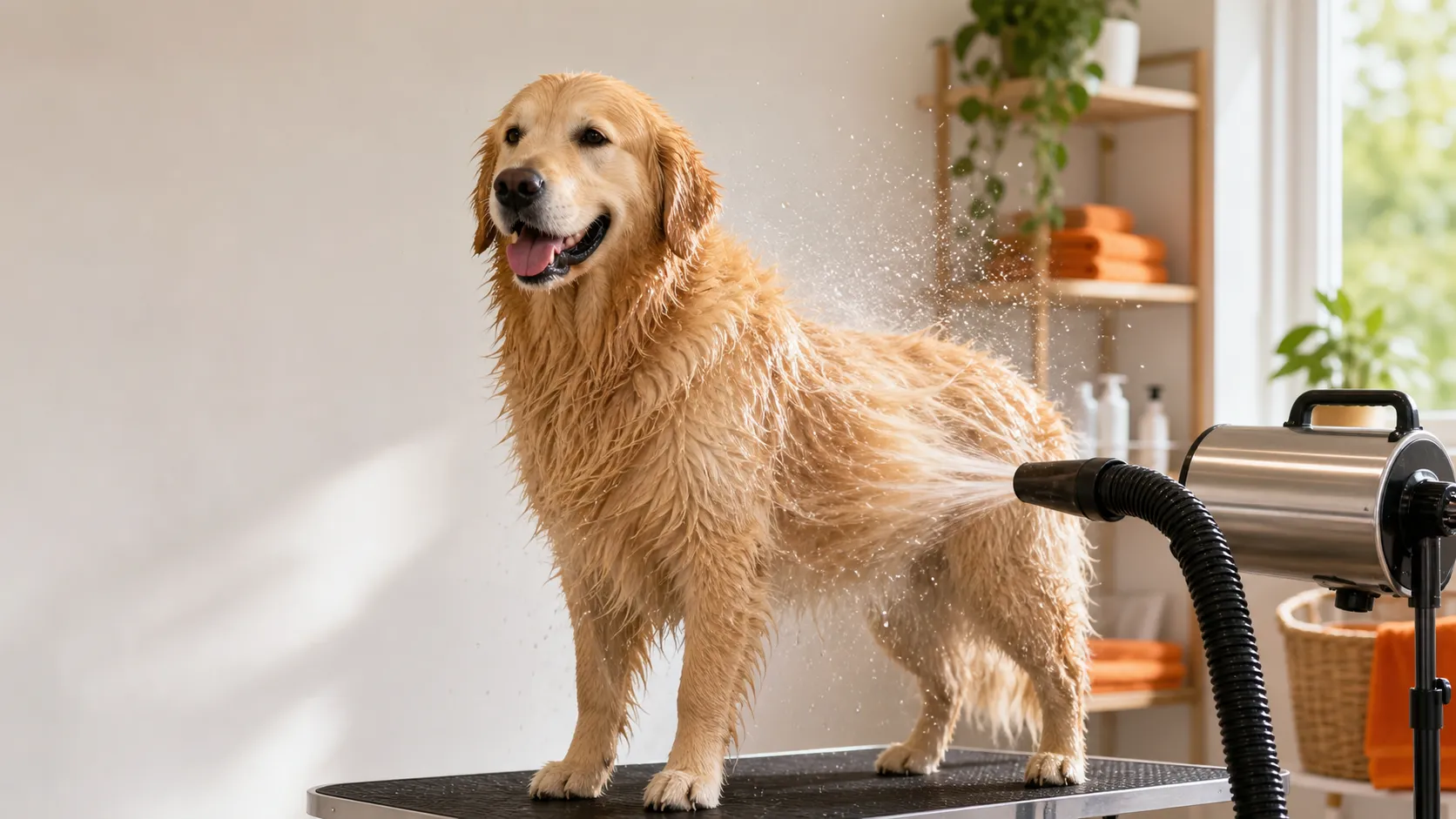
A force dryer moves water out of the coat. The American Kennel Club explains this drying action and advises avoiding heat that could burn the skin. That makes airflow control and your dog’s comfort the starting point for the purchase.
In this guide
- What CFM, airspeed, horsepower, and watts mean
- How to compare measurements fairly
- Choose by coat and bathing routine
- Four US-market dryers and their controls
- Prepare your grooming space
- A drying routine you can follow
- Troubleshoot slow drying or a hot dryer
- Frequently asked questions
What the numbers actually measure
CFM measures air volume
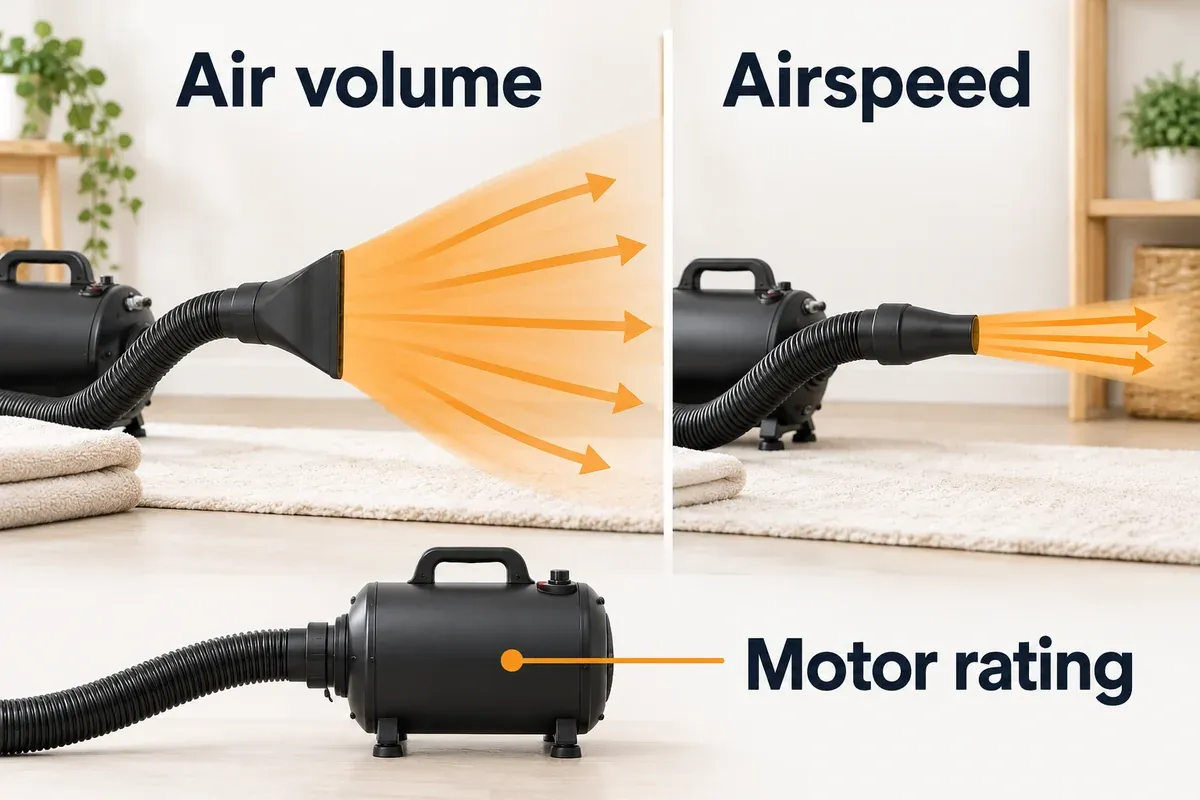
CFM means cubic feet per minute: the volume of air passing a measurement point in one minute. It can describe output at the machine opening, the hose end, or an attached nozzle. Those configurations place different restrictions on the airflow.
MetroVac explicitly measures its Master Blaster technical figures at the full opening and warns that attachments change the result. This is a useful distinction when reading any dryer specification. A full-opening rating does not describe the air delivered through every accessory.
If one manufacturer uses metric units, convert volume before comparing:
- 1 CFM ≈ 0.02832 m³/min, or 1.699 m³/h.
- 1 m³/min ≈ 35.31 CFM.
The calculation follows the cubic-foot conversion in NIST’s conversion tables. Confirm whether a figure is per minute or per hour; m³/min and m³/h differ by a factor of 60. Converting the units does not resolve differences in test conditions.
FPM and MPH measure airspeed
FPM means feet per minute. MPH means miles per hour. Both describe speed, while CFM describes volume. A narrow outlet can produce a fast, concentrated stream; a wider outlet spreads air over a larger area.
To relate airspeed units, divide FPM by 88 to obtain MPH. This converts the speed only. You cannot convert FPM to CFM without knowing the outlet area and the average velocity across it.
The basic relationship is air volume per minute = average airspeed × outlet area, with matching units. A single fast reading at the center of a nozzle is not an average across the opening. For that reason, multiplying a headline airspeed by a guessed nozzle diameter is not a reliable way to fill in a missing CFM rating.
For grooming, choose the attachment that lets you direct the air without blasting one small patch of skin. A high airspeed figure says little about how comfortable the dryer will be at its lowest setting.
Pressure explains why the working setup matters
Airflow meets resistance as it passes through the hose and nozzle. The fan’s operating point depends on that resistance. AMCA’s explanation of fan curves describes the relationship between air volume, pressure, and system resistance.
Applied to a dog dryer, this means the useful question is how it moves air through the accessories you will actually use. A free-opening CFM rating alone cannot answer that. Nor does a pressure rating alone establish how much air reaches the coat.
You do not need to become a fan engineer to choose a dryer. If the manufacturer supplies only one airflow figure, keep its limitations in mind and give weight to speed control, nozzle choice, hose handling, and service support.
Horsepower needs a definition
Horsepower is a unit of power, but the label on a dryer may describe a peak rating or another manufacturer-defined motor rating. Read the wording around the number. Peak HP is not a statement of continuous mechanical output during a grooming session.
MetroVac, for instance, describes the Master Blaster’s motors as two 4.0 peak-HP motors. The word “peak” changes the meaning of the claim. Adding the labels together does not tell you how much air will leave a particular nozzle.
For scale, one mechanical horsepower is about 745.7 watts, using NIST’s power conversion. Five continuous mechanical horsepower would therefore be about 3,729 watts of mechanical output. That conversion cannot turn an advertised “5 HP” label into a measured output, electricity-use figure, or CFM rating.
Treat HP as supporting information once you know what the manufacturer means by it. Do not use it to rank drying speed across brands.
Watts and amps describe the electrical side
The electrical input rating helps you plan the outlet and circuit. It does not measure drying performance. Power may be used by a motor, a heater, or both, and a maximum rating does not tell you the consumption at every speed setting.
Check the voltage, frequency, and rated current for the exact regional version. A model sold for a 230-volt supply may have different specifications from a similarly named US version. A plug adapter changes the plug shape; it does not make the electrical ratings interchangeable.
For energy budgeting, use energy in kWh = average input in kW × operating hours. The average input needs a suitable measurement or manufacturer data for the setting you use. A nameplate maximum can provide an upper planning figure, but it should not be presented as the machine’s measured consumption throughout a bath.
Heat settings describe an option, not a drying score
“No heat” usually means no added heater. Air can still warm as it passes through a running motor. The Flying One describes its heater-off setting as warm air, and XPOWER describes the B-24’s base airflow as motor-warmed.
Start with added heat off where the dryer permits it. Check the air on your hand before directing it at the body, keep the nozzle moving, and reassess during the session. A hand check is a comfort check, not a calibrated temperature measurement or a guarantee against a burn.
Virginia Tech’s Veterinary Teaching Hospital recommends cool or low dryer settings and constant movement. A high maximum temperature is not a benefit you need to use.
How to compare dryer specifications fairly
A specification helps only when you know what was measured. Before treating two numbers as comparable, look for the following information.
| Specification | Conditions needed for a useful comparison | What an incomplete figure cannot establish |
|---|---|---|
| Air volume in CFM | Same measurement point, hose length, attachment, speed or motor setting, and comparable test conditions | Airflow at your dog’s coat or a drying-time advantage |
| Airspeed in FPM or MPH | Same nozzle opening, measurement position, and speed setting; average versus peak velocity identified | Total air volume or suitability for a particular breed |
| Air temperature | Heater setting, inlet or room temperature, measurement point, warm-up time, and whether the value is absolute temperature or temperature rise | Skin temperature or a safe exposure time |
| Noise in dB | Sound pressure versus sound power identified, weighting such as dBA, distance, operating setting, attachments, and room conditions | Which machine your dog will tolerate or which is quieter in your room |
| Electrical input | Exact model and region, supply voltage and frequency, rated current, and whether a heater is included | Mechanical motor output, air volume, or actual energy use at all settings |
CFM needs to match the working setup
The four dryers below have manufacturer-published airflow figures, but their cited pages do not provide a common test protocol. Use those figures as references for the individual models. Compare controls and hose reach directly; relative drying speed needs a matched test.
Do not infer that a dryer with twice the published CFM will dry a dog in half the time. Water left after toweling, coat condition, humidity, nozzle choice, usable speed, and breaks all affect the session. The more useful question is whether your setup removes water from the areas that are currently difficult to dry.
If airflow data is missing, ask the manufacturer for output through the supplied hose and nozzle at a specified setting. A clear answer is more informative than a bigger motor label.
Temperature and temperature rise must stay separate
An outlet temperature describes how hot the air is at a stated point. A temperature rise describes how much warmer it becomes relative to the inlet air. They are different quantities.
For conversions, absolute °F = °C × 1.8 + 32, while a temperature increase in °F = an increase in °C × 1.8. The extra 32 belongs only in the absolute-temperature conversion. Mixing these formulas can turn a specification into a misleading heat claim.
Even a correctly converted temperature range needs its operating conditions. Do not line up an outlet maximum from one dryer and a motor-related rise from another as if they measure the same thing. Neither should become a target temperature for your dog’s skin.
A “quiet” label needs more than a decibel number
Noise measurements change with position and operation. NIOSH recommends keeping the microphone distance and recording duration consistent when comparing equipment. That principle matters when one dryer advertises a low-speed reading and another gives a maximum-output figure.
An unqualified dB figure cannot support a precise comparison with an A-weighted sound-pressure measurement at a stated distance. The weighting and distance matter, as do the hose, nozzle, room, and operating speed. None of the four cited dryer pages supplies a shared noise test suitable for ranking them here.
For the person doing frequent grooming, NIOSH explains how sound level and exposure duration contribute to hearing risk. Human workplace guidance is not a dog-hearing safety limit. A fabric grooming wrap is not evidence of a tested level of hearing protection either. Reduce noise at the source where practical, take breaks, and judge your dog’s comfort separately.
Choose by coat and bathing routine
There is no universal CFM requirement for a breed or weight class. The following is a practical selection guide, not a measured assignment of airflow to coat types. Start with the job the dryer must do and the control your dog needs.
| Your drying task | Prioritize | Reconsider the purchase if |
|---|---|---|
| Occasional baths for a short, smooth coat | Thorough toweling; a controllable dryer only if damp areas remain | Towels already dry the dog comfortably and completely |
| Long or silky hair | Low-speed control, manageable hose, section-by-section drying | You cannot control the stream without tangling or distress |
| Curly or hair-like coat | A coat-specific brushing and finishing plan, gentle handling, controllable air | You expect a force dryer to remove mats or replace brushing |
| Dense double coat | Access to the undercoat, steady airflow through the working accessories, clean filters | The outer hair looks dry but you have no way to check underneath |
| Several dogs or frequent grooming | Workable breaks, cleaning time, service parts, hose reach, and the manufacturer’s operating limits | The circuit, space, or maintenance routine cannot support the equipment |
| A dog frightened by sound or handling | Very low starting airflow, gradual introduction, and a calm grooming plan | Buying more power is your only plan for finishing the bath |
Short, smooth coats
Try absorbent towels before assuming you need a force dryer. The AKC’s coat-specific drying guidance notes that short-coated dogs may be dried with a towel, while longer, thicker coats may need a dryer to finish.
Your purchase decision should follow the result. If the dog is comfortably dry after toweling, there may be little reason to add storage, noise, and filter maintenance. If damp areas remain, choose a dryer that starts gently and is easy to aim; body size alone does not justify a dual-motor model.
Long, silky, or curly coats
A dryer belongs within the coat-care routine. It does not remove mats. Work in manageable sections, using the attachment and speed that let you keep control of the hair. If the stream whips the hair into knots, reduce the force and ask a groomer to demonstrate an appropriate technique.
Curly coats and styling work may need brushing while drying, a finishing dryer, or another coat-specific approach. Ask how to separate water removal from finishing before buying equipment. A force dryer that removes bulk water well may still be awkward for the final brush-and-dry stage.
Do not blast a tight mat in the hope that it will open. The skin underneath can be difficult to inspect, and extra force does not solve the underlying coat problem.
Dense double coats
Check the undercoat instead of judging the surface alone. Part the hair in several places and assess whether moisture remains near the skin. Cornell explains that a thick coat that stays damp, particularly where mats hold moisture, can contribute to hot spots.
For this task, ask how the dryer performs through its normal hose and nozzle, whether its speed can be reduced, and how easily you can work around the dog. A larger machine is worth considering if your present dryer remains inadequate after proper toweling, filter cleaning, and a sound technique. A CFM band cannot make that assessment for you.
Several dogs, mobile work, or a salon routine
Write down the complete job: preparation, drying, breaks, filter cleaning, packing, and storage. A longer hose may make movement easier, while a lighter body may matter more when you carry equipment between appointments. For a fixed grooming station, replacement parts and service access become particularly useful.
Check the manufacturer’s operating instructions for continuous use and cooling requirements. Two motors do not automatically mean continuous-duty approval, less noise, or lower total running time. Include the time needed to clean and cool the equipment when planning back-to-back sessions.
Four US-market dryers to consider
These options suit different handling and space requirements. The recommendations below follow documented controls, accessories, and construction; they do not claim hands-on tests or measured superiority. The purchase links are for US-market products. Choose a version rated for your local electrical supply if you live elsewhere.
Compare controls, hose reach, and your grooming setup
-
SHELANDY Model 1902 Groomer Partner Pet Dryer
SHELANDY
Adjustable airflow, warm/cool options, and four nozzle types for a home grooming setup.
- Stepless airflow control
- Warm/cool temperature options
- Hose extends to 65 inches
- Air and heat control
- Stepless airflow; warm/cool options
- Hose reach
- Extendable to 65 in (about 5.4 ft)
- Consider for
- Home bathing where the dryer can stay close to the working area
-
XPOWER B-24 Thermal Ace Force Pet Dryer
XPOWER
An 8.8 lb body with electronic variable speed, selectable added heat, and an eight-foot hose.
- Electronic variable speed control
- Motor-warmed air with low/high added heat
- Three nozzles and washable filters
- Air and heat control
- Variable speed; heater-off/low/high
- Hose reach
- 8-foot flexible hose
- Consider for
- Mobile grooming or storing the dryer between baths
-
Flying Pig Flying One High-Velocity Grooming Dryer
Flying Pig Grooming
Steel housing, a ten-foot hose, and separate airflow and heat controls for working around the dog.
- Variable speed with heater-off/low/high
- Steel housing and ten-foot hose
- Round and flat nozzles
- Air and heat control
- Variable speed; heater-off/low/high
- Hose reach
- 10-foot flexible hose
- Consider for
- A grooming area where long hose reach and selectable added heat matter
-
Flying Pig Double Motor High-Performance Grooming Dryer
Flying Pig Grooming
A dual-motor steel dryer with adjustable airflow, a ten-foot hose, three nozzles, and spare filters.
- Two motors with adjustable airflow
- Steel housing and ten-foot hose
- Three nozzles and spare filters
- Air and heat control
- Adjustable airflow; added heat unspecified
- Hose reach
- 10-foot flexible hose
- Consider for
- A fixed grooming station where dual motors and long hose reach are wanted
Hose lengths describe supplied reach, not airflow measurement conditions. Manufacturer CFM ratings below use no shared test protocol, so they do not establish relative drying speed.
SHELANDY Model 1902: adjustable airflow for a home setup
The SHELANDY 1902 has stepless airflow adjustment, warm/cool options, four nozzle types, and a hose extendable to 65 inches. Its published airflow is 84.7 CFM, with an approximate 65–135 MPH speed range; the measurement configuration is unspecified.
The controls and compact hose setup make it an option for bathing at home where you can keep the machine close to the working area. Measure the route around your tub or drying space; full extension leaves little spare reach for movement.
Choose it for manageable controls and a suitable layout. Its CFM figure does not establish a breed limit, a quietest-dryer claim, or slower drying than another brand. If you need to work well away from the dryer body, prioritize a longer hose instead of stretching this one to its limit.
Check current price on Amazon →XPOWER B-24 Thermal Ace: a portable body with an eight-foot hose
The XPOWER B-24 combines electronic variable speed, motor-warmed airflow, low/high added heat, three nozzles, and an eight-foot hose. The body weighs 8.8 lb. Its US specifications give 115V/60Hz, 12A, and 150 CFM rated airflow, without a hose/nozzle test configuration.
It is worth considering when you carry the dryer between grooming locations or store it after each bath. The hose offers room to move while the body stays in place. A stand and wall mount are separate accessories.
Choose it for portability and access to the controls. The low/high heater switch is an optional tool, not proof of a quicker or safer session. Confirm that your routine can use the heater-off setting, and keep the washable filters maintained as instructed.
Check current price on Amazon →Flying Pig Flying One: steel housing and selectable added heat
The Flying One FP1PR has a steel body, variable speed, a 10-foot hose, round and flat nozzles, and heater-off/low/high settings. Its US specifications give 110V, 12.72A, 240 CFM, and 28,000 FPM. The measurement point and attachment configuration are not defined.
The longer hose is useful where you need to move around a dog without repeatedly relocating the base. The manufacturer describes heater-off operation as warm air, so turning off added heat does not mean the outlet stays at room temperature.
The published 85–165°F temperature range has no stated test conditions and is not a target for the skin. Choose this model for its hose, housing, and adjustable controls; its larger headline airflow number does not prove faster drying than the other models here.
Check current price on Amazon →Flying Pig Flying Double: dual motors for a fixed grooming station
The Flying Double FP2TB has two motors, adjustable airflow, a steel shell, a 10-foot hose, three nozzles, and spare filters. Its US product specifications give 1600W/120V and 385 CFM, without an airflow measurement configuration.
Consider it when you want dual-motor equipment in a grooming area with enough room for the body, hose, and cleaning routine. Establish the available low-speed control and the manufacturer’s operating limits before planning several dogs in succession.
The cited specifications do not define an added-heater control or temperature range. If independently selectable heat is essential to your finishing routine, obtain that detail before choosing this model. Two motors and a high CFM claim do not establish a quieter session, a breed-specific drying time, or continuous-duty suitability.
Check current price on Amazon →Prepare your grooming space
Place the equipment before the bath
Choose a stable, dry place for the dryer with a clear air intake. Keep the machine and electrical connections away from bath water and splashes. Position the hose so you can reach the dog without pulling the dryer toward the tub or across a walkway.
Practice that movement with the dryer off. Check whether the hose reaches the far side of the dog, bends freely, and leaves room for you to hold it comfortably. A long advertised hose is of little use if furniture forces it into a tight bend.
Use a secure, non-slip working surface and arrange towels within reach. A dog that cannot stand comfortably needs a grooming plan that accommodates sitting, lying down, and breaks. Discuss painful handling or limited mobility with your veterinarian or groomer before the bath.
Match the electrical supply to the unit
Use the unit’s regional manual and rating label to confirm the outlet requirements, including grounding and any required GFCI protection. Add up other appliances on the same circuit. A dryer, room heater, and other grooming equipment may share a supply even when their outlets are in different parts of the room.
Use extension leads only if the manufacturer’s instructions allow them and specify the required rating. Stop using a damaged cord, loose connection, unusually hot plug, or appliance that repeatedly trips protection. Ask an electrician to assess an unsuitable supply instead of repeatedly resetting it or improvising adapters.
Budget for upkeep and a workable return policy
Check access to replacement filters, hoses, nozzles, and any service parts the manufacturer identifies. For a mobile setup, include a safe way to transport and store the hose without crushing it. For a fixed station, account for optional mounts and enough space to clean the intake.
Read the return conditions before purchase, particularly whether they permit a used grooming appliance to be returned. Your dog’s response and the hose layout are difficult to judge from a photograph. A manufacturer warranty covers defined faults; it is different from a trial period for unsuitable equipment.
A drying routine you can follow
1. Prepare the coat and check the skin
Before wetting the dog, identify mats, debris, and areas that are sore to touch. Virginia Tech recommends gentle brushing before bathing and thorough shampoo rinsing. A force dryer cannot correct shampoo left against the skin or safely solve a tightly matted coat.
Follow any prescribed bathing instructions. If you find painful skin, open sores, or marked inflammation, ask your veterinarian about the appropriate bathing and drying method before proceeding.
2. Press out water with towels
After the bath, press an absorbent towel into the coat rather than rubbing long hair vigorously. Change to a dry section or another towel as it becomes saturated. Virginia Tech’s drying advice specifically recommends pressing towels against the coat.
Toweling first gives you a calmer starting point and less water to remove with the dryer. Keep the face separate from the force-drying task.
3. Introduce sound and airflow gradually
Begin the introduction on a separate occasion when the dog is dry and you are not trying to finish a bath. Let the dog investigate the switched-off machine, then introduce its sound at a distance. Reward comfortable behavior and keep sessions brief.
PetMD’s grooming guidance recommends a low setting with no added heat, the nozzle initially pointed down, and allowing the dog to move away. Move toward brief contact with gentle airflow only while the dog stays comfortable. Reduce the distance or increase the intensity gradually, without changing both at once.
Watch for repeated escape attempts, freezing, trembling, or refusal of a reward the dog usually accepts. Stop and return to an easier step if they occur. These observations guide the session; they do not diagnose a behavioral or medical problem. A dog that cannot tolerate the dryer needs a groomer’s or veterinarian’s help with an alternative plan.
4. Dry small sections with the heat off
Check the airflow on your hand, then begin on a body area the dog accepts being handled. Hold the attachment securely, use low speed, and keep it moving. Follow the manufacturer’s nozzle and distance instructions; a universal close-contact distance would ignore differences in attachments and airflow.
Part the coat enough to see where you are working. As you move through each section, reassess the warmth and the dog’s response. If the air feels uncomfortable, stop and check the settings and equipment. Increasing heat should not be the default response to a slow section.
5. Protect the face and sensitive areas
Keep the air away from the eyes, nose, mouth, ear canals, and other sensitive openings. The AKC’s dryer-introduction guidance warns against directing the dryer at the face and ears. Use towels for these areas unless a groomer has shown you a suitable alternative for your dog.
Reduce force when moving toward thin-haired or sensitive body areas. Removing a concentrator does not make all airflow safe, and a head wrap does not give permission to blast the head. Stay with the dog throughout drying.
6. Check underneath before deciding you are done
Turn the dryer off and part the coat in several places. Check the undercoat, behind the ears, under the legs, skin folds, and between the toes. A smooth-looking surface can hide dampness underneath.
If moisture remains, continue with short, comfortable sections and breaks. Cornell’s hot-spot guidance supports thorough drying after swimming or wet weather, especially for longer or double coats. Drying reduces one source of trapped moisture; it does not prevent every skin problem.
7. Finish with equipment care
Switch off, unplug, and let the unit cool before maintenance. Clean filters as instructed, and let washable filters dry completely before reinstalling them. Inspect the hose, attachments, cable, and connections before the next session.
Keep the intake clear during use. Do not wrap the dryer in towels, put it inside a box to suppress sound, or operate it without a required filter. If you need a quieter arrangement, use an approved mount or location that keeps airflow and electrical connections safe.
Stop for pain, overheating, or distress. Switch off the dryer if your dog becomes unusually hot, breathes heavily, repeatedly tries to escape, or reacts as though a body area hurts. Persistent redness, weeping skin, sores, or unusual odor need veterinary advice. If you suspect overheating, move the dog away from the heat, begin cooling with water cooler than the dog, and contact a veterinarian immediately. Weakness, collapse, or abnormal gum color are emergency warning signs. Follow PDSA’s heatstroke first-aid guidance; do not try to finish drying first.
Troubleshoot before buying more power
Use this order when drying seems slow or the machine behaves differently. Stop immediately for damaged electrical parts, a burning smell, or severe distress. Routine airflow checks begin with the unit switched off and unplugged.
| What you notice | First useful check | Next step |
|---|---|---|
| The coat is still dripping before drying | Whether towels are saturated or only the surface has been dried | Press with a fresh towel before evaluating the machine |
| Less airflow than before | Intake filter, hose bends, nozzle blockage, and loose connections | Clean or reconnect only as the manual permits; replace damaged parts |
| A dry surface with damp undercoat | Whether you are working through sections down to the undercoat | Change the technique; ask a groomer to demonstrate if needed |
| Air becomes uncomfortably warm | Added-heat setting, intake obstruction, and the manufacturer’s operating limits | Stop, cool the unit, and correct the cause before continuing |
| The dog repeatedly pulls away | Sound, airflow intensity, position, handling, or a sore area | Lower the difficulty or stop; arrange professional help if the problem persists |
| The dryer cuts out or trips the supply | Manual troubleshooting, blocked intake, and electrical rating | Stop repeated restarts; seek manufacturer service or an electrician as appropriate |
| Drying remains impractical after the checks | Whether your dog can tolerate enough airflow and whether the setup suits the coat | Trial a suitable alternative with a groomer or self-service wash before buying |
Keep a useful record of your own sessions
If you already own a dryer, note the coat condition, towel preparation, attachment, speed, heat setting, room conditions, drying time, and breaks. Use the same definition of finished drying each time, including the undercoat check.
That record can help identify an equipment fault or a technique problem. A session made slower by extra breaks is a different problem from one with weak airflow through a clean hose. The solution to the first may be a calmer routine; the second may need maintenance or replacement.
Treat your record as a comparison within your own setup. It cannot validate another manufacturer’s CFM claim or establish how quickly the same equipment will dry a different dog.
When a purchase is worth reconsidering
A dryer upgrade is reasonable when the present machine is maintained correctly, you have appropriate guidance on technique, and the drying task still cannot be completed comfortably. Specify what needs to improve: low-speed control, hose reach, portability, service access, or airflow through the working attachment.
If your dog tolerates neither the sound nor gentle airflow, buying a more powerful model does not resolve that limitation. A professional demonstration or a self-service wash with suitable equipment may help you judge the task before committing to another appliance.
For other equipment and everyday care, browse our dog care guides.
Frequently asked questions
How much CFM does a double-coated dog need?
There is no universal CFM minimum that determines a suitable dryer for every double-coated dog. Check whether it removes water through your chosen hose and nozzle, can be turned down, and lets you inspect the undercoat comfortably. Breed labels and published CFM bands cannot determine the answer for an individual coat and setup.
Is a 5 HP dryer better than a 3 HP dryer?
The numbers alone cannot answer that. Find out whether each rating describes peak or continuous power, then examine airflow under comparable conditions, controls, accessories, and electrical requirements. A prominent HP label is not a measured drying-time advantage.
Can I compare a 150 CFM dryer with a 240 CFM dryer?
You can record each manufacturer’s rating, but you need matching measurement conditions to draw a performance comparison. The cited XPOWER and Flying Pig pages do not establish a shared hose/nozzle protocol. Their ratings should not be used to calculate a percentage improvement in drying speed.
Is a no-heat dryer always cool?
No. A switched-off heater or an absent heating element does not prevent motor-warmed air. Check comfort throughout use, keep the nozzle moving, and maintain the intake. Stop if the air becomes uncomfortable and follow the manufacturer’s troubleshooting guidance.
Why not compare the advertised temperatures and dB figures in the product table?
Without equivalent measurement points, operating settings, and test conditions, a neat numerical ranking would be misleading. Heat control and airflow adjustment are useful features to compare directly; a hotter outlet or an isolated low noise number does not establish a better purchase.
Can I use a human hair dryer instead?
The AKC recommends a dog-specific dryer and cautions against the heat used by human hair dryers. For a short coat that dries completely with towels, a dryer may be unnecessary. For a thick or difficult coat, ask a groomer about suitable equipment and technique instead of using concentrated heat to hurry the job.
Does a force dryer replace brushing or remove mats?
No. It can help you remove water and separate hair while drying, but brushing, detangling, and finishing remain coat-care tasks. Tight mats, painful skin, or a coat you cannot inspect need appropriate grooming or veterinary help before bathing and drying.
Will a dual-motor dryer always be faster?
No reliable universal claim follows from the motor count. Delivered airflow, usable controls, coat preparation, dog tolerance, and required breaks determine the session. Also check the operating limits; dual motors alone do not establish approval for uninterrupted use.
How long should drying take?
Use the coat’s condition as the endpoint. Part the hair and check that damp areas are resolved while the dog remains comfortable. A fixed minute count cannot account for coat density, water left after toweling, room conditions, equipment, and breaks.
What should I choose for a dog afraid of the dryer?
Prioritize very low starting airflow and gradual introduction. Assess whether the dog accepts gentle sound and air before planning a full bath. If fear persists, arrange a groomer’s or veterinarian’s drying plan; a “quiet” label is not a promise that your dog will accept the machine.
Sources and further reading
- SHELANDY Model 1902 specifications
- XPOWER B-24 specifications and accessories
- Flying Pig Flying One FP1PR specifications
- Flying Pig Flying Double FP2TB specifications
- MetroVac Master Blaster measurement conditions and peak-HP wording
- AMCA: airflow, pressure, and fan curves
- NIST conversion tables
- NIOSH: comparing equipment noise
- NIOSH: understanding human noise exposure
- American Kennel Club: drying dogs and introducing the dryer
- Virginia Tech Veterinary Teaching Hospital: bathing and drying safely
- Cornell University: damp coats and hot spots
- PetMD: helping a dog become comfortable with a dryer
- PDSA: heatstroke warning signs and first aid