

 Published sources
 Product details checked
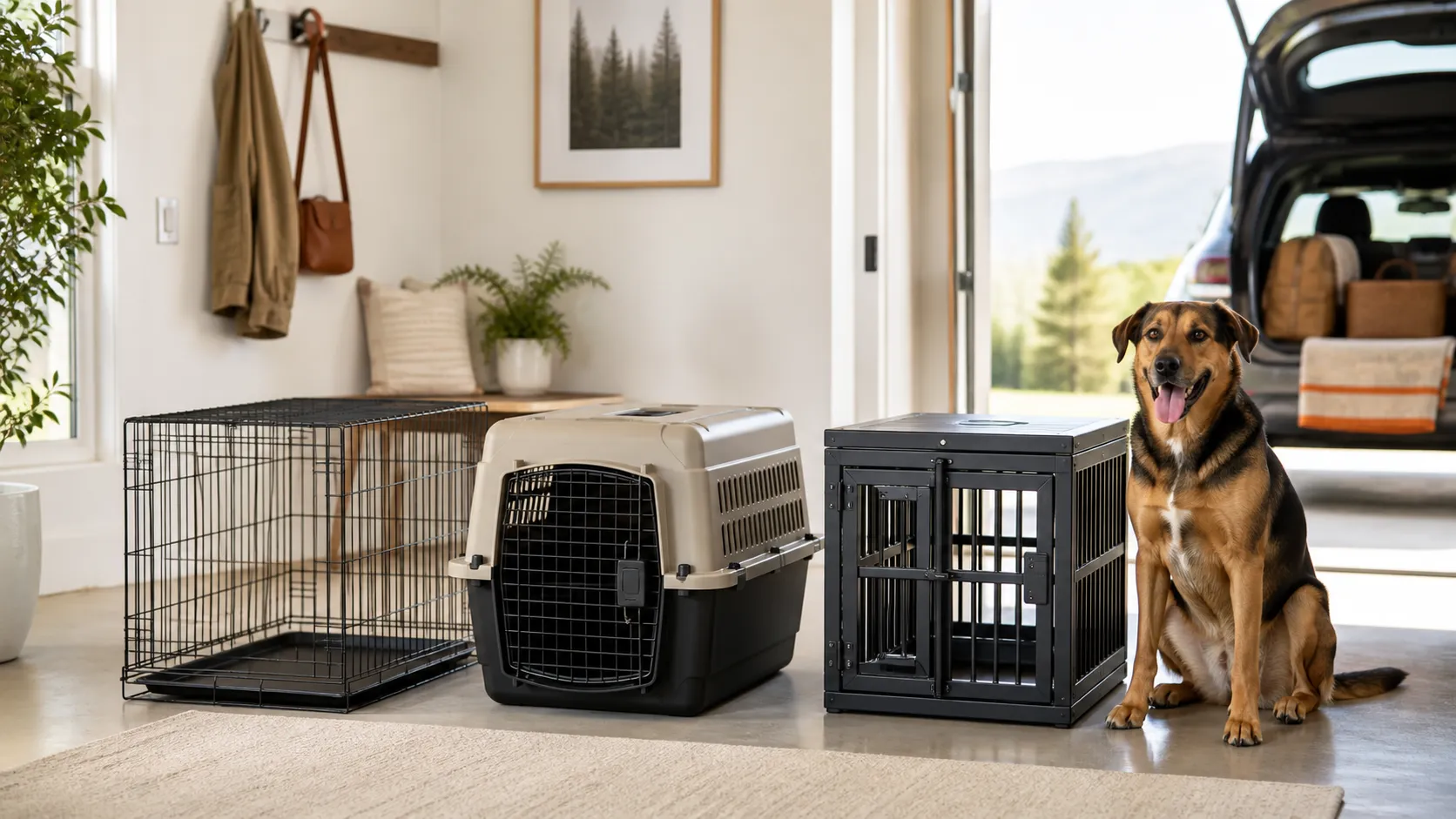
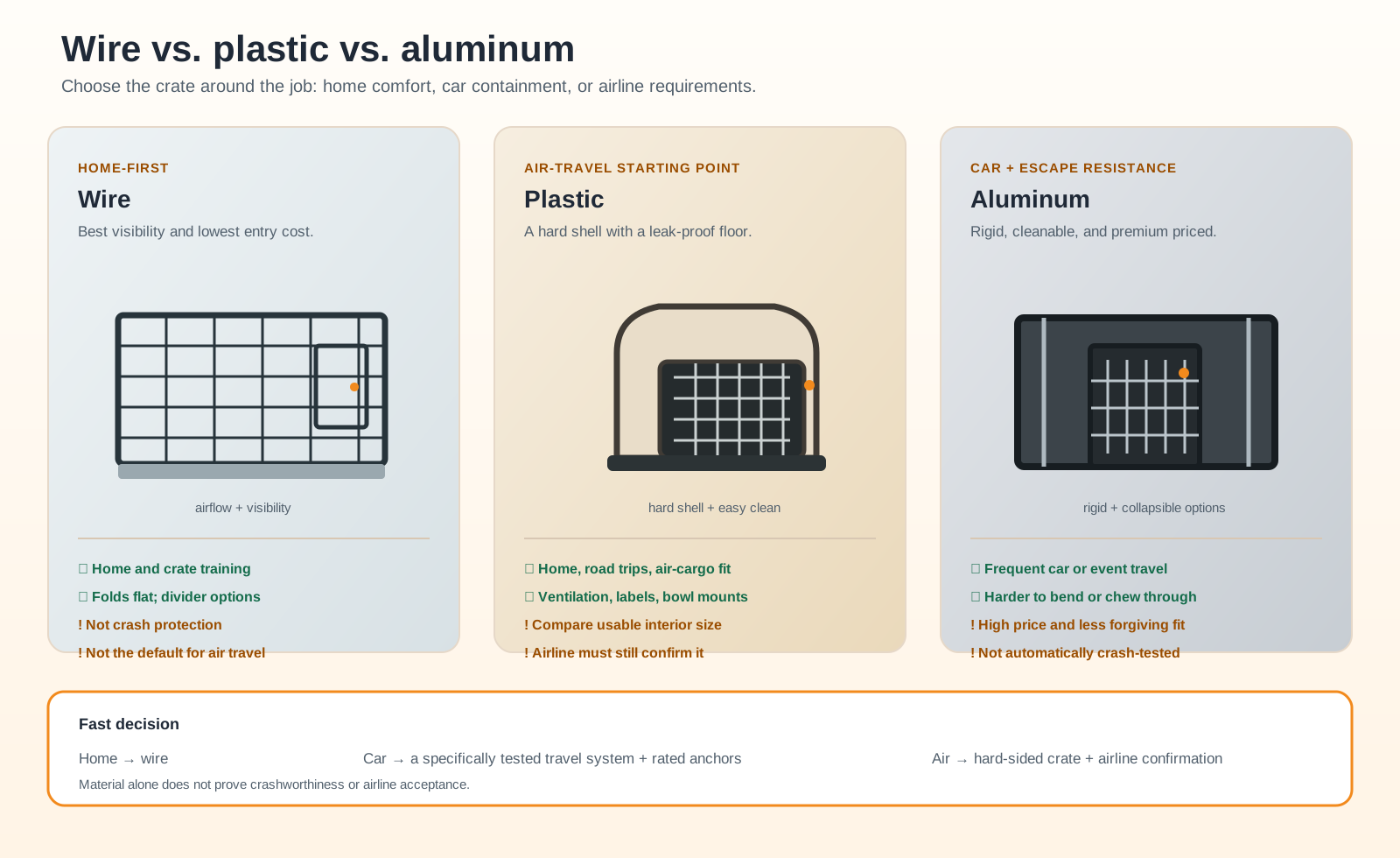
Wire, plastic, and aluminum crates are not three versions of the same product. They solve different problems. Wire is usually the easiest home crate to see through and store. Plastic is often the simplest starting point for air travel because it provides a hard shell, a leak-resistant floor, and a door that can be secured. Aluminum is a premium choice when you need a rigid, cleanable crate that can collapse or move between vehicles and events.
The important catch is that a crate can be excellent at home and wrong for a car or an airplane. Material alone does not prove crashworthiness, and a product page that says “airline-friendly” is not an airline booking approval.
Quick answer: choose a wire crate for ordinary home training and daily containment, a rigid plastic crate when one hard-sided box needs to cover home, road trips, and a possible air-cargo journey, and an aluminum crate when durability, cleanability, and frequent transport justify the price. For car safety, look for a tested travel system with the manufacturer-specified anchor hardware. For air travel, measure the usable interior, follow the current IATA dog-and-cat container guidance, and obtain approval from the airline operating your exact route.
Crate examples by material
Starting options by material
-
Amazon Basics 36 Inch Double-Door Wire Dog Crate
Amazon Basics
Fold-flat metal wire crate with two doors, a divider panel, a removable tray, and a top handle for simple home use.
- 36 x 23 x 25 in exterior
- Two doors and divider panel
- Fold-flat storage
- Material
- Powder-coated metal wire
- Best fit
- Lower-cost home crate and occasional transport
-
MidWest Homes for Pets 42 Inch iCrate
MidWest Homes for Pets
Large fold-flat wire crate with a divider, leak-proof tray, rubber feet, carry handle, and a slide-bolt latch with Paw Block.
- 42.5 x 28.5 x 30.5 in exterior
- product information guidance for 71-90 lb dogs
- Divider panel and leak-proof tray
- Material
- Powder-coated metal wire
- Best fit
- Owners who want the stated features and a clear fit for their setup
-
Petmate Vari 36 Inch Plastic Travel Kennel
Petmate
Rigid plastic kennel with a metal door, four-sided ventilation, a stay-dry moat, tamper-resistant tie points, and a 32.5-inch internal length.
- 32.5 x 22.25 x 26 in internal dimensions
- 36 x 25 x 27 in exterior
- Metal door and four-sided ventilation
- Material
- Rigid recycled-plastic shell
- Best fit
- One hard-sided crate that can cover home, road trips, and an airline check
-
K9 Kennel Boss Medium Collapsible Aluminum Dog Crate
K9 Kennel Boss
Powder-coated aluminum crate with built-in handles, molded stackable corners, and optional knurled bolts that collapses without tools.
- 33.8 x 22.4 x 28.0 in internal dimensions
- 34.6 x 23.2 x 28.9 in assembled exterior
- Collapses to suitcase configuration in under a minute
- Material
- Powder-coated aluminum
- Best fit
- Frequent car travel, events, and owners who need a collapsible rigid crate
-
Impact Collapsible 30 Inch Aluminum Dog Crate
Impact Dog Crates
Collapsible aluminum kennel with one-handed operation, stackable sizes, military-grade handles, ventilation openings, and included side rails.
- 30.5 x 20.5 x 26 in exterior
- 28.5 lb medium size from manufacturer dimensions
- Opens or collapses in about one minute
- Material
- 5052 aluminum
- Best fit
- Premium collapsible car crate for dogs that are already comfortable crating
Review the linked product page before purchasing.
What the material changes
| Material | What it does well | Main compromise | Strongest use case |
|---|
| Plastic | Hard shell, a more enclosed resting space, leak-resistant floor, easy wipe-down | Bulkier to store, less open airflow, and the exterior can hide how small the interior really is | Home plus road trips, with air travel as a possible second use after approval | | Aluminum | Rigid panels, cleanable surfaces, premium handles, and collapsible options | High price, more weight than a basic wire crate, and fit is less forgiving | Frequent car or event transport and dogs that defeat ordinary crates |
No row in that table means “safe in every situation.” A calm dog in a wire crate may be perfectly well contained at home. The same wire crate can still be a poor choice in a collision or at an airline acceptance desk. Conversely, an expensive aluminum crate may be strong and portable without having been independently crash-tested or approved for air transport.
Wire dog crates: the practical home default
Wire crates remain useful because they make everyday management simple. A dog can see the room, air moves freely, many models fold flat, and a divider lets a puppy use an adult-size crate without turning one end into a bathroom. The tray is also easy to remove after an accident.
They are a good fit when the dog is calm in the crate, the crate will live mainly in the home, and you want a lower-cost option that is easy to replace or store. Put the crate on a stable surface, use the supplied floor-protection feet, and check every latch and bar after the first unsupervised sessions.
Wire becomes the wrong tool when the dog is bending bars, catching teeth or paws in the mesh, throwing its body against the door, or showing panic when left alone. A heavier wire gauge can slow a failure, but it does not address the cause of escape behavior. If the dog is injuring itself, destroying multiple crates, or swallowing metal or plastic, involve your veterinarian and a qualified behavior professional rather than escalating only the crate weight.
Wire crate options
Amazon Basics 36 Inch Double-Door Wire Crate — lower-cost starting point
Check current price on Amazon →This is the sensible budget choice when the main job is home containment and the dog is not a determined escape artist. The 36-inch label is not a measurement of the dog’s available sleeping space, so compare the actual crate with your dog’s standing height, length, and turning space before ordering.
Check current price on Amazon →Think of the 42-inch iCrate as a home-first product. For a car, the crate still needs a real anchoring plan; for air travel, use a hard-sided airline container unless the airline explicitly tells you otherwise.
MidWest’s official iCrate page is useful for checking the available sizes and the manufacturer’s intended features. It is a better reference for the model family than copying a size range from a third-party product information.
Plastic dog crates: the easiest mixed-use starting point
Plastic is often the most practical compromise when one crate must work in several places. The shell blocks some visual stimulation, the floor is easier to keep clean, and the door can be secured with the kind of hardware airlines expect. Large models are less convenient in a small room, but they are usually easier to use for road trips than a large open wire cage.
For air travel, the details matter. USDA APHIS says an air-travel kennel should be hard-sided, have strong fasteners, provide ventilation on three sides and the door, use a leak-proof floor with absorbent material, and allow handlers to reach food and water containers without opening the door. The kennel also needs the required live-animal and upright-arrow labels. Read the USDA APHIS air-travel kennel checklist before assuming a product includes everything you need.
Petmate Vari 36 — the best starting point when air may be involved
Check current price on Amazon →The Vari has a metal door, four-sided ventilation, a stay-dry moat, and tamper-resistant holes that can accept securing ties. Petmate’s official Vari Kennel page says the larger sizes have tie-down strap holes, that wing nuts and bolts are required for airline travel, and that owners should verify the exact airline. Petmate also notes that 36- and 40-inch kennels may ship by freight, so plan transport around the crate dimensions and your airline’s requirements.
This is the plastic option I would start with when air travel is a real possibility, not because the brand is automatically “IATA approved,” but because the design gives you a realistic path to the hard-sided, secure, ventilated, leak-resistant setup that an airline can inspect. IATA explicitly says it does not certify or endorse particular brands or models.
Aluminum dog crates: premium durability for home and car
Aluminum makes sense when a basic wire crate has already failed, when the crate is moved often, or when cleanable rigid panels matter more than price. It can be less visually open than wire, easier to wipe down than fabric, and more resistant to bending. The tradeoff is that premium construction does not remove the need for correct sizing, ventilation, anchoring, supervision, or behavior work.
The two aluminum offers below are travel-oriented, collapsible models. That is an important part of the decision, not a footnote.
K9 Kennel Boss Medium — collapsible aluminum for frequent transport
Check current price on Amazon →The manufacturer’s Medium product page says optional knurled bolts can increase rigidity and warns that collapsible crates may not suit dogs with crate anxiety or destructive behavior. That warning should guide the purchase: a collapsible aluminum crate is a durable travel tool for a dog that already settles, not a guaranteed solution for a dog trying to break out in panic.
Use it as a home or car crate only after you have checked the interior dimensions and built an anchor plan. Do not turn “aluminum” into “crash-tested” in your mind, and do not assume the openings, fasteners, or labels meet an airline’s cargo requirements.
Impact Collapsible 30 Inch — premium one-minute setup
Check current price on Amazon →The Impact product information makes the collapsible design’s strengths clear. It is a good fit for a dog that already knows how to settle and for an owner who moves the crate between the house, vehicle, training space, or event setup. The side rails must be secured whenever the crate is in use.
For flying, Impact’s own guidance points customers toward its separate Airline Dog Crate line. Treat the Collapsible model as a home-and-car product unless the airline has reviewed the exact model and configuration in writing.
Home, car, or air: choose for the actual job
If the crate will live mostly at home
Start with wire if your dog is calm, you value visibility, and a divider or fold-flat storage helps. Choose plastic if your dog settles better in a more enclosed den or if cleanup and reduced visual stimulation matter. Choose aluminum when the dog has a proven history of escaping ordinary crates and you are prepared for the price, weight, and behavior-management work.
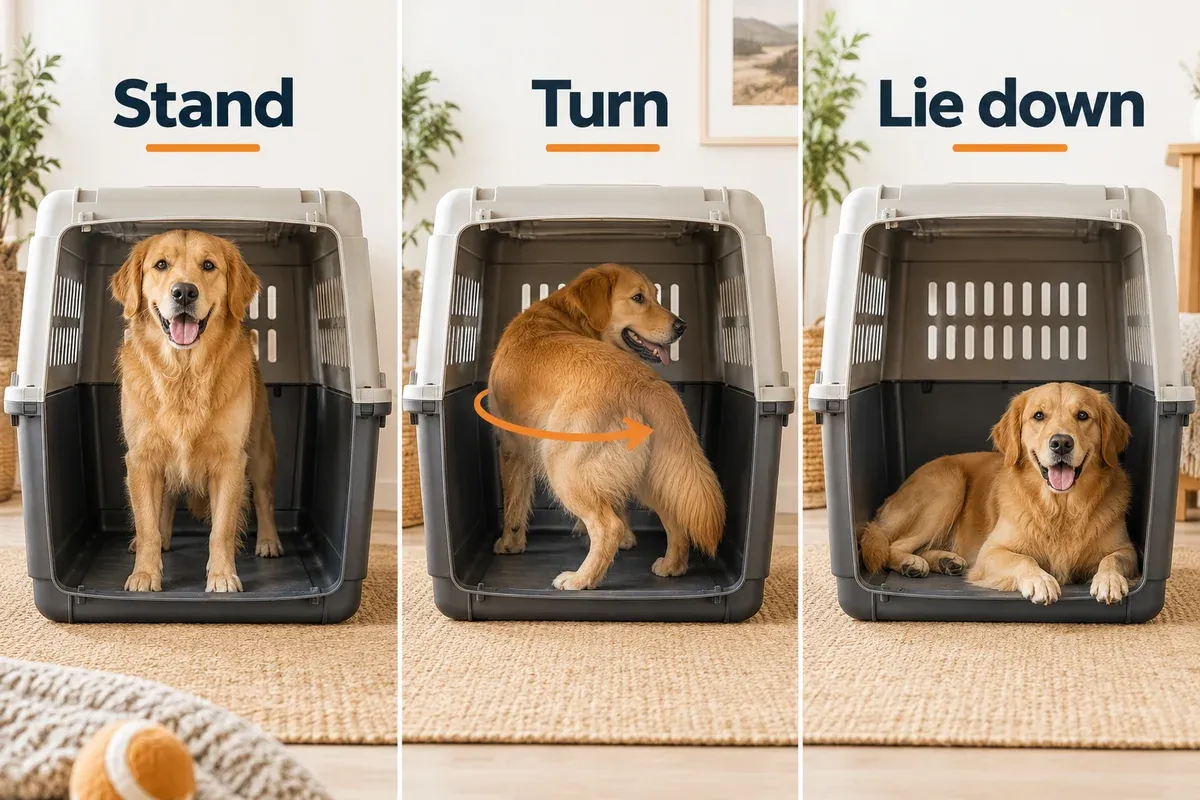
The crate should be large enough for the dog to stand naturally, turn around without folding its body, sit erect, and lie down in a natural position. A divider can reduce unused space for a puppy, but it is not a substitute for checking the adult-size interior.
If the crate will travel in a car
Separate containment from crash protection. A secured crate can stop a dog from roaming around the cabin and becoming a distraction. That is useful. It does not automatically protect the dog or human passengers in a collision.
The Center for Pet Safety’s 2015 crate study found serious failure modes in common travel setups. In one test, a MidWest wire kennel with rubber straps slid into the seatback fixture and deformed severely. In a reinforced setup, the crate stayed in the cargo area, but the test dog hit the back of the crate and the crate still failed. CPS summarizes the lesson plainly: many ordinary wire crates should be considered distraction-prevention tools rather than significant crash protection.
For a car setup:
- Use the cargo area or seat position specified by the crate and vehicle instructions.
- Use only the manufacturer-specified, strength-rated anchor system; do not improvise with elastic cords.
- Keep the crate away from loose luggage that can become a second impact hazard.
- Do not attach a collar or walking harness to the crate as a crash restraint.
- Check the door, fasteners, anchor points, and floor after every long trip.
- Never leave a dog unattended in a parked vehicle, regardless of crate material or ventilation.
If collision protection is the deciding factor, use the Center for Pet Safety certified-products list as a separate research step. CPS lists specific products and anchor systems, including a Rock Creek aluminum crate with strength-rated anchor straps; it does not certify aluminum as a category.
If the crate may be used for air travel
Air travel is the most rules-driven use case. Start with the IATA Container Requirements 1 PDF, which is the technical reference for dogs and cats and is marked Edition 52, January 2026. Then check the airline, aircraft, route, season, and whether the dog will travel in the cabin, as checked baggage, or as cargo.
For one dog, IATA’s approximate minimum internal dimensions are:
Minimum internal length = A + (0.5 × B)
Minimum internal width = 2 × C
Minimum internal height = D + bedding
Where:
- A is nose to the root of the tail.
- B is floor to elbow.
- C is shoulder width or the widest point, whichever is greater.
- D is natural standing height to the top of the head or highest ear tip.
- Bedding is the thickness of the actual travel pad or absorbent material.
Snub-nosed breeds need a container about 10% larger under the IATA guidance. The measurements are internal, not the exterior dimensions printed in a product title. Our airline dog crate size calculator walks through the same A-D measurements and keeps the airline-approval warning visible.
This is why the Petmate Vari 36 is the most straightforward starting point in this comparison for an airline conversation. It has a hard shell, metal door, ventilation, a leak-resistant floor design, and published internal dimensions. It is still not a universal approval: the airline must accept the exact crate, dog, route, and configuration.
Wire crates and collapsible aluminum crates are not the default air-travel answer. Their openings, door hardware, ventilation pattern, floor, handles, bowls, labels, and fasteners must all meet the airline’s requirements. If an airline says no, a material comparison cannot turn that answer into yes.
Can one crate do everything?
Sometimes, but forcing one crate to cover all three jobs is often where owners make the most expensive mistake. A large wire crate can be ideal at home but awkward and weakly protected in a vehicle. A plastic kennel can travel well but be less pleasant as a permanent home den. A collapsible aluminum crate can be excellent for car and event transport but too expensive, too heavy, or unsuitable for the airline.
These combinations are usually more practical:
- Home + air: wire at home, hard-sided plastic for air travel.
- Home + car: wire at home, a dedicated travel crate or certified carrier for the vehicle.
- Home + frequent car travel: plastic or aluminum if the dog is calm and the anchor system is correct.
- Escape history + air travel: solve the home or car escape problem first, then choose a separate airline-compliant container; do not assume a heavy aluminum crate is accepted.
Two correctly fitted crates often cost less—and create less risk—than making one compromise crate serve a job it was never designed for.
A buying checklist that prevents the common mistakes
- Measure the dog standing. Record nose to tail root, floor to elbow, shoulder width, and natural head or ear height.
- Compare internal dimensions. Product length and usable length are not interchangeable.
- Name the primary job. Home, car, air, or a genuine combination should be decided before you compare colors and discounts.
- Inspect the failure points. Check the latch, door frame, seams, tray, ventilation, handles, and anchor points.
- Match the behavior. A crate for a calm dog has different requirements from one for a dog that panics, bites bars, or throws its body at a door.
- Verify travel rules separately. Read the airline’s current policy and get approval for the exact model and dimensions. IATA guidance is a standard reference, not a booking confirmation.
Final decision
- Choose wire when the crate is primarily for home training, visibility, and affordable everyday containment.
- Choose plastic when you need the most realistic path to one hard-sided crate for home, road trips, and possible air travel.
- Choose aluminum when frequent transport, cleanability, and resistance to ordinary crate damage justify a premium price.
- Choose a crash-tested travel system when vehicle safety is the priority; ordinary wire, plastic, or aluminum construction is not enough by itself.
- Choose a separate airline crate when an airline, aircraft, route, or dog-specific requirement makes the home or car crate a poor fit.
If you want one practical starting point for mixed use, begin by measuring your dog against a hard-sided plastic kennel such as the Petmate Vari 36. If the crate will stay at home, a well-fitted wire crate is usually the simpler answer. If your dog already defeats wire or you move the crate constantly, examine aluminum—but keep the separate car-safety and air-travel checks in place.
Frequently Asked Questions
Are wire crates safe in a car?
They can provide useful containment when correctly secured, but a normal wire crate is not automatically crash protection. Center for Pet Safety testing found serious deformation and dog-impact concerns in common wire-crate setups. Use a tested travel system and rated anchors when collision protection matters.
Is plastic better than wire for air travel?
Plastic is often the easier starting point because a rigid shell, secure metal door, leak-resistant floor, ventilation, labels, and attached bowls align more naturally with air-transport checks. It is not automatically compliant. The airline must approve the exact crate, dog, route, and configuration.
Are aluminum dog crates airline-approved?
Not by material alone. A collapsible aluminum crate can be a strong home or car product and still have the wrong openings, fasteners, floor, handles, or labels for air transport. Follow the IATA and USDA requirements and ask the airline before buying for a flight.
Can I leave bedding in any crate?
Use bedding that fits without blocking ventilation, interfering with the door, or creating a chewing hazard. For air travel, measure the thickness of the actual pad because IATA’s minimum internal height adds the bedding allowance. For a dog that destroys fabric, use a supervised trial before leaving any soft material unattended.
How much bigger should the crate be than the dog?
Do not add a generic number to a breed chart. The dog should stand naturally, turn around, sit erect, and lie down comfortably. For air travel, use the IATA A-D formula and compare the result with the manufacturer’s internal dimensions.
Is it better to own two crates?
Often, yes. A wire crate can stay set up in the house while a hard-sided or crash-tested travel system stays ready for the car or flight. Two correctly fitted tools are safer than forcing an open home crate to do airline work or treating a premium aluminum crate as proof of crash testing.
Sources and standards
- IATA Traveler’s Pet Corner and container-sizing guidance
- IATA Container Requirements 1, Edition 52, January 2026 (PDF)
- USDA APHIS: preparing pets for air travel
- Center for Pet Safety: 2015 crate study results
- Center for Pet Safety certified products
- MidWest iCrate product information
- Petmate Vari Kennel product information
- K9 Kennel Boss Medium product information
- Impact Collapsible crate product information