

 Published sources
 Product details checked
The best horse supplement is not automatically the one with the longest ingredient list. Start with forage, the complete ration, workload, body condition, and the problem you are trying to solve. A supplement may help fill a documented gap, but it should not replace diagnosis, dental care, farriery, balanced feeding, or treatment.
The AAEP trace-mineral guide recommends discussing supplementation with a veterinarian and considering the whole diet. The Merck Veterinary Manual also cautions that many animal supplements have not been tested as rigorously as medicines. That does not make every supplement useless; it means the claim, ingredient, dose, and horse must be kept separate.
Advertisement / Affiliate disclosure: This article contains paid affiliate links. As an Amazon Associate, we earn from qualifying purchases at no extra cost to you.
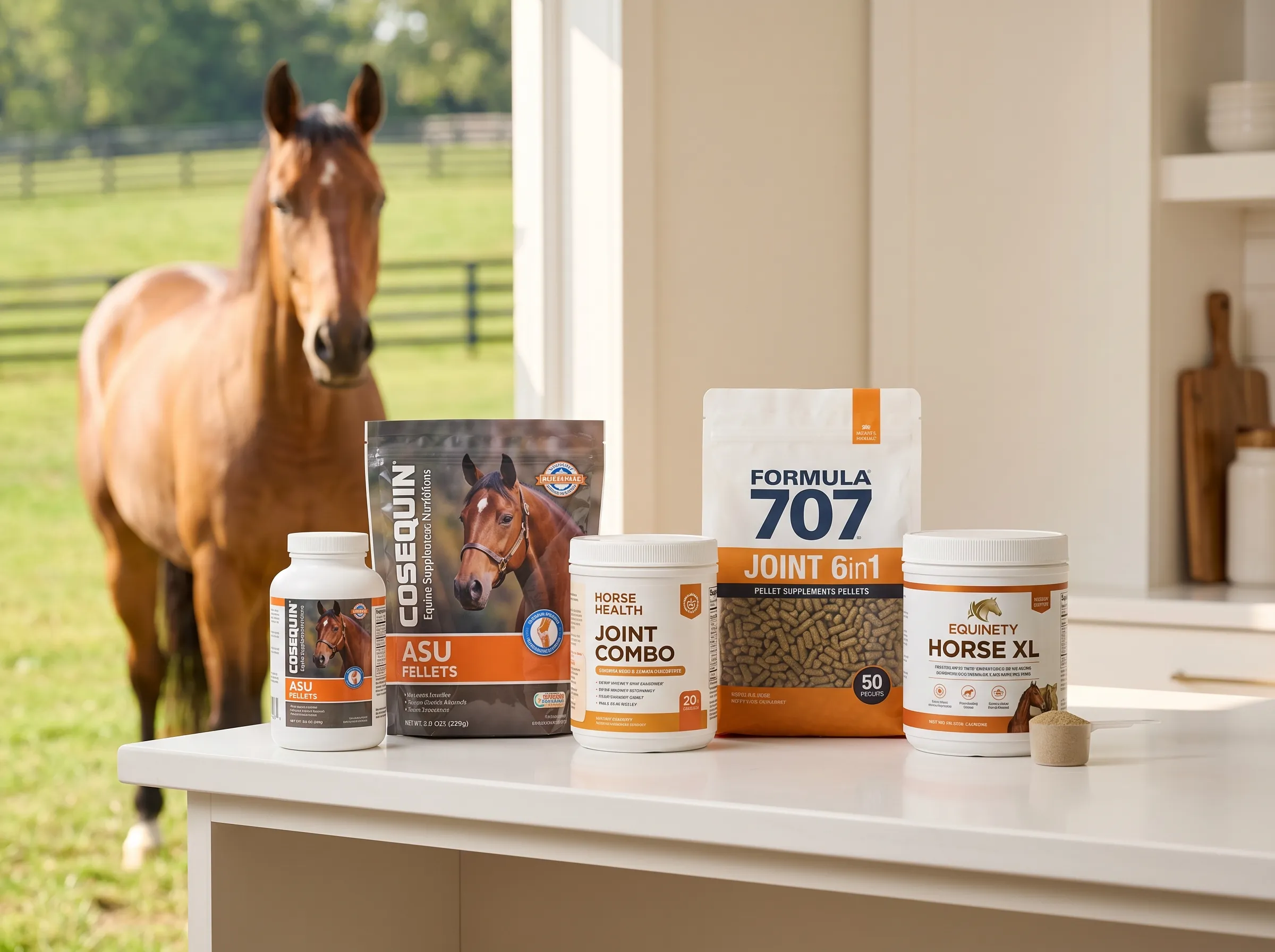
Quick comparison
-
Nutramax Cosequin ASU Pellets Joint Health Supplement for Horses
Nutramax Laboratories
A joint-support product listing with glucosamine, chondroitin, MSM, and ASU; compare the current label with the horse’s complete ration.
- Joint-focused formula
- Pellet format
- Declared ingredients should be checked against the current label
- Best for
- Owners comparing a joint-focused pellet format
-
Horse Health Joint Combo Hoof & Coat Supplement
Horse Health
A combination formula listing joint, hoof, coat, and mineral ingredients; compare the full label with the horse’s ration before use.
- Joint, hoof, and coat categories in one formula
- Ingredient overlap with other feeds needs checking
- Pellet format
- Best for
- Owners comparing a broad joint, hoof, and coat blend
-
Formula 707 Joint 6in1 Equine Supplement
Formula 707
A multi-ingredient joint-support pellet listing with several declared compounds; review the complete label and ration before choosing a broad blend.
- Multi-ingredient joint category
- Pellet format
- Exact ingredient amounts should be verified on the current label
- Best for
- Owners comparing a multi-ingredient joint blend
-
Equinety Horse XL Supplement – Amino Acids
Equinety
An amino-acid-focused supplement listing for horses; assess total protein, calories, and the complete ration before use.
- Amino-acid category rather than a joint treatment
- Powder format
- Total protein and forage quality still matter
- Best for
- Owners evaluating an amino-acid-focused product
-
Nutramax Cosequin ASU Joint Health Supplement for Horses - Powder
Nutramax Laboratories
A double-strength joint-support powder listing with ASU and other declared ingredients; the serving and overlap with other products must be checked on the current label.
- Powder format
- Joint-focused ingredient list
- Serving size must be measured accurately
- Best for
- Owners comparing a joint-focused powder format
Ingredient lists, serving directions, and package sizes can change. Read the current label and check the complete ration before adding a product.
Before buying any supplement
Ask these questions in order:
- What is the actual problem? A new limp, weight loss, poor topline, dull coat, diarrhea, or behavior change deserves an examination rather than a guess.
- What does the horse already receive? Include forage, concentrate, ration balancer, salt, electrolytes, treats, and every supplement.
- Is there a documented gap? A forage analysis and ration calculation are more useful than choosing by an ingredient buzzword.
- Can the product’s ingredients and serving be verified? Avoid a proprietary blend when you cannot tell how much of the relevant ingredient is supplied.
- How will you measure the result? Decide what will change, how long you will monitor it, and when you will stop.
Do not stack several joint, hoof, mineral, or performance products on the assumption that more support is always better. Overlapping copper, zinc, selenium, vitamins, calories, or active ingredients can make the final ration unsuitable.
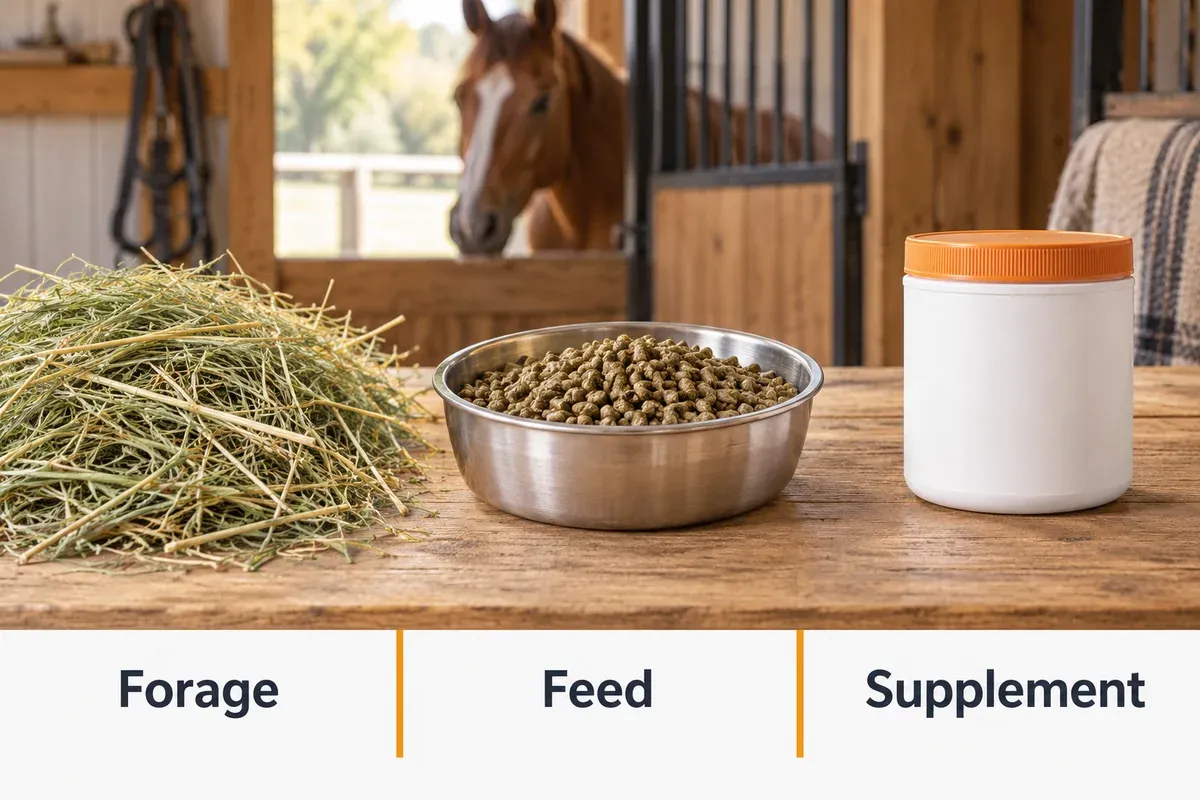
Use the three-part ration view below to make your ingredient list. Include the products your horse already receives before comparing another supplement label.
How to read a supplement label
Compare products using the daily serving, not the size of the scoop or the number of ingredients on the front of the tub. Write down:
- the amount of each relevant ingredient per daily serving;
- whether the serving changes with body weight, workload, or a loading phase;
- calories, sugar, starch, salt, and every added vitamin or mineral;
- the amount already supplied by forage, concentrate, ration balancer, and other supplements; and
- storage instructions, lot information, and any competition-specific cautions.
“More concentrated” is only useful if the amount and purpose are clear. A product can be convenient but still be a poor fit when it adds a mineral that is already adequate or hides the active ingredient inside a proprietary blend. Keep a photo or copy of the label with the ration record because formulas and serving directions can change.
For competition horses, check the rules of the actual governing body before use. The AAEP position on therapeutic medication in competition horses stresses evidence-based decisions and notes that supplement marketing does not determine competition compliance. A “natural” or over-the-counter label is not a clearance for every event.
The five products in this comparison
These are product categories and examples, not proof that every horse needs a supplement. A product description or affiliate listing is not an independent clinical trial.
1. Nutramax Cosequin ASU Pellets — a joint-focused format
Cosequin ASU pellets are aimed at owners looking for a joint-support formula in a daily pellet format. The ingredient combination is the reason to compare it with other joint products, not evidence that it prevents, reverses, or treats arthritis.
Why it may fit
- A joint-focused formula is easier to evaluate than an everything-in-one product when joint support is the specific goal.
- Pellets can be practical for horses that refuse powders, subject to the horse’s diet and the current label.
- The product can be compared by declared ingredients and serving size rather than by the word “proven.”
Limits
- The evidence for oral joint supplements is variable, and a horse with lameness needs a veterinary work-up.
- Do not combine it with another glucosamine, chondroitin, MSM, or mineral product without calculating overlap.
- Follow the current label; do not transfer a serving from another Cosequin format.
2. Horse Health Joint Combo Hoof & Coat — a broad combination formula
This product combines joint, hoof, and coat ingredients. That may be convenient when the horse’s ration and goals genuinely call for more than one category, but a broad formula is harder to tailor and can duplicate nutrients from a ration balancer.
Check before choosing it
- Identify every mineral and vitamin in the full serving, not just the headline joint ingredients.
- Compare the biotin, zinc, copper, and manganese contribution with the current ration.
- Decide whether the horse actually has a hoof or coat nutrition gap rather than treating appearance as proof of deficiency.
Its main advantage is convenience. Its main limitation is that a single blend may not provide the right amount for each individual goal.
Check current price on Amazon →3. Formula 707 Joint 6in1 — a multi-ingredient joint blend
A multi-ingredient product can reduce the number of tubs in the feed room, but “six in one” does not mean six times the benefit. The important comparison is whether the label gives enough detail to judge the ingredients, serving, palatability, and compatibility with the rest of the ration.
When it may be reasonable
- You want one joint-oriented product and can verify the complete label.
- The horse’s veterinarian or equine nutritionist agrees that the ingredients match the goal.
- You are prepared to introduce it alone and record the response.
When another approach is better
- You need to correct a specific mineral shortfall and the blend adds unrelated ingredients.
- The horse has a diagnosed condition requiring a controlled diet.
- You cannot calculate the total amount of an overlapping ingredient.
4. Equinety Horse XL — amino-acid-focused support
An amino-acid product is a different category from a joint supplement. It may be worth discussing when the complete ration, forage quality, workload, and muscle condition suggest that protein quality or amino-acid supply needs attention.
Important context
- Amino acids are building blocks of protein; they are not a guaranteed treatment for muscle loss, poor topline, joint disease, or recovery.
- Evaluate total protein and calories first, including forage and concentrate.
- A horse losing weight, muscle, or performance needs a veterinary and nutrition assessment rather than a promise of cellular repair.
Use the current manufacturer serving directions and ask whether the product adds calories, starch, sugar, or ingredients that conflict with the horse’s diet.
Check current price on Amazon →5. Cosequin ASU Powder Double Strength — a powder alternative
The powder format is useful to compare when a horse accepts a top-dressed supplement more readily than pellets or when the owner needs a different serving format. “Double strength” is a label description, not a direction to double another product’s dose.
Check before switching
- Compare the declared active ingredients per serving, not just the scoop size.
- Confirm whether the new product is replacing or adding to the previous joint supplement.
- Measure the supplied scoop accurately and keep the product dry.
Choose the category by the problem
Ration balance and trace minerals
If the forage and base feed do not meet the horse’s mineral needs, a ration balancer or targeted mineral plan may be more useful than a joint blend. Use a forage analysis where possible and have the entire ration reviewed. Selenium is a particular reason to avoid casual stacking because the safe range is narrow.
Electrolytes and sweating
Electrolyte use depends on sweat loss, heat, exercise, access to water, and the rest of the ration. It is not a universal performance booster. Provide clean water and ask the veterinarian how to handle a horse that will not drink, has repeated exercise intolerance, or shows signs of dehydration.
Hoof and coat support
Hoof growth is slow, and a supplement cannot correct every cause of cracking, pain, infection, poor trimming, or conformation. Coordinate nutrition with a qualified farrier and veterinarian. If a product contains biotin, zinc, copper, or other minerals, count them in the full ration.
Joint and mobility support
A joint supplement should never delay investigation of lameness, heat, swelling, reduced range of motion, or a change in gait. Merck’s chronic-pain guidance emphasizes that the underlying cause and a complete pain plan matter; a supplement is not a substitute for that plan.
Amino acids and muscle condition
Muscle loss can reflect insufficient calories, poor-quality protein, dental problems, pain, endocrine disease, gastrointestinal disease, or training changes. Correct the reason first. An amino-acid product can be considered only after the base ration has been checked.
How to introduce and monitor a product
- Change one product at a time whenever possible.
- Follow the current label and use a scale or consistent measure.
- Keep the horse’s forage, feed, training, and management notes with the product start date.
- Monitor appetite, manure, body weight, body condition, hoof growth, coat, gait, and performance according to the intended goal.
- Stop and call the veterinarian for colic signs, diarrhea, allergic reactions, acute lameness, severe lethargy, or refusal to eat.
- Check current competition rules if the horse competes; a product label is not a guarantee of sport compliance.
Do not promise a fixed result timeline. Some nutrition changes require weeks or months because tissue growth and body condition change slowly; other symptoms need attention immediately.
Frequently Asked Questions
Does every performance horse need supplements?
No. A balanced ration, suitable forage, water, salt access, dental care, farriery, and appropriate training may be all that is needed. Supplement only for a clear nutritional or management reason.
Can I combine two joint supplements?
Do so only after comparing the full ingredient lists and getting professional advice. Two products can duplicate active ingredients, minerals, calories, or additives without providing a predictable extra benefit.
Are natural ingredients automatically safer?
No. Natural substances can have pharmacologic effects, contamination risks, interactions, or unsuitable doses. Safety depends on the ingredient, dose, horse, product quality, and complete ration.
How long should I try a supplement?
There is no universal trial period. Define the goal with your veterinarian or equine nutritionist, record a baseline, and agree on when the product will be reviewed or stopped. Do not keep adding products because a vague improvement is hard to judge.
Bottom line
Choose a horse supplement by a verified need, a transparent label, and compatibility with the complete ration. The products above represent joint, combination, and amino-acid formats, but none is automatically “proven,” veterinarian-approved for every horse, or a treatment for lameness. Start with forage and health assessment, add one carefully selected product if justified, and monitor the result.
Affiliate Disclosure: We earn from qualifying purchases through Amazon Associates at no extra cost to you.