

 Published sources
 Product details checked
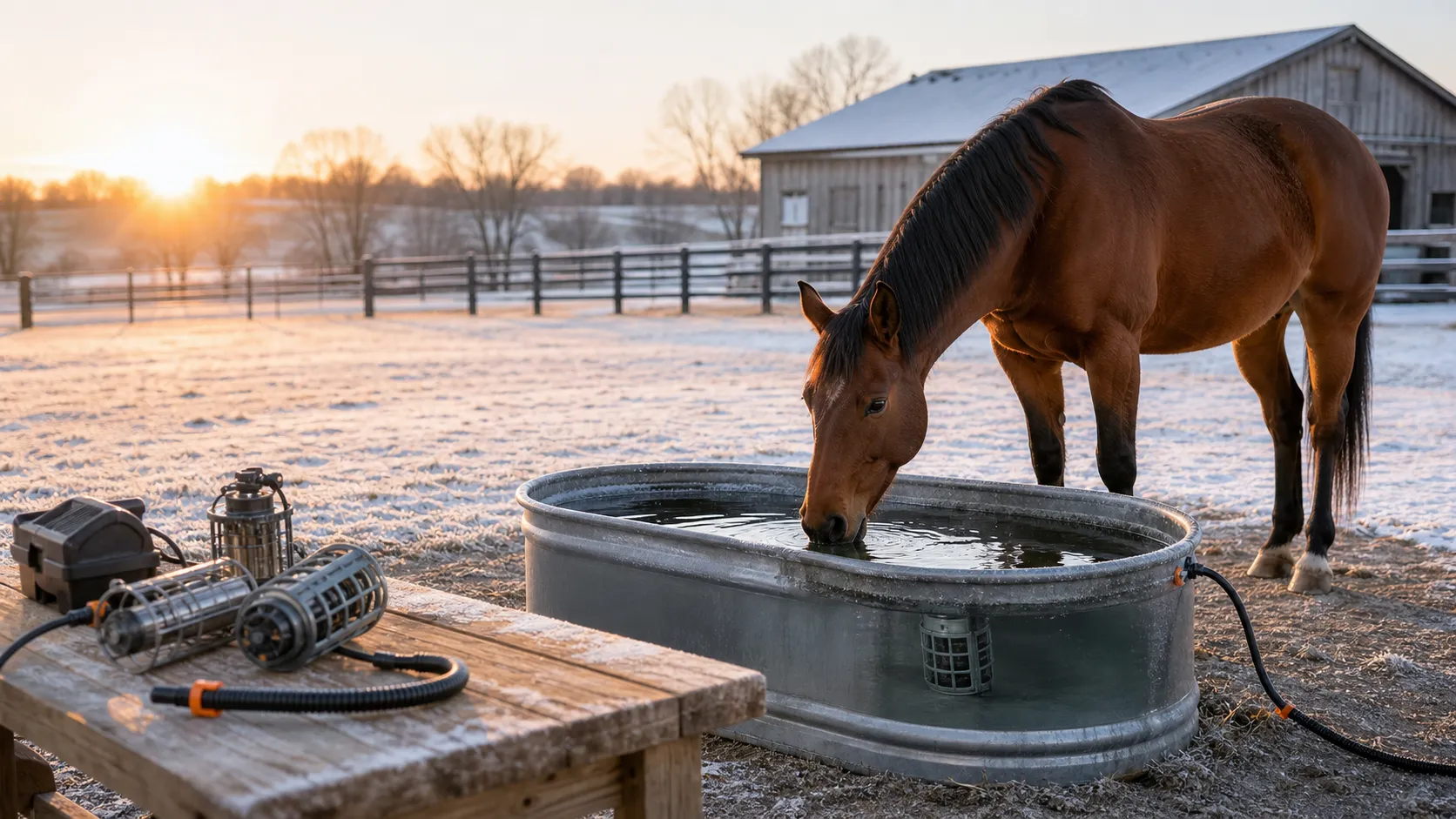
A trough that is full of water is not useful if a sheet of ice keeps your horse from reaching it. In winter, reduced drinking can contribute to dehydration and impaction colic, while a heater that is too small, poorly placed, or connected to an unsuitable circuit can create a different kind of risk.
Quick answer: The Farm Innovators H-429 1500W is the strongest all-around choice for a correctly sized 100-300 gallon stock tank in a genuinely cold climate. The H-418C 1250W is the better flexible pick when you want to switch between floating and submersible use. For smaller tanks, the Farm Innovators C-500 500W is easier to match than a large de-icer. The K&H 250W is a lower-power option for small tanks and moderate freezes, while the API 2002DP is the cleanest fit for a permanent 100-300 gallon tank with a compatible drain plug.
This comparison uses published specifications, manufacturer guidance, and owner reports rather than hands-on winter testing.
In this guide, you will learn:
- Which heater style fits a small automatic waterer, a 50-gallon tub, or a large stock tank
- How to match wattage to tank volume and climate without blindly buying the biggest unit
- Which products are marked safe for plastic, rubber, or metal tanks
- What a 250W, 500W, 1250W, or 1500W heater draws from a 120V circuit
- How to install, inspect, and maintain an electric trough heater around horses
- When a drain-plug model is worth the extra installation work
Quick comparison: horse trough heaters at a glance
Horse water trough heater comparison
-
Farm Innovators H-429 1500W Submergible Stock Tank De-Icer
Farm Innovators
High-output cast-aluminum submersible de-icer with thermostatic control, a protective cage, and an anti-chew cord protector. Match the heater to the tank size, climate, and available circuit.
- 1500W submersible heating element
- Thermostatic operation near freezing
- Protective cage and anti-chew cord protector
- Best for
- Large 100-300 gallon stock tanks in consistently freezing weather
- Key feature
- High-output heater for large stock tanks
-
Farm Innovators H-418C 1250W Convertible Stock Tank De-Icer
Farm Innovators
A 1250W cast-aluminum unit that converts between floating and submersible use. The manufacturer describes it as safe in plastic, thermostatically controlled, and covered by a three-year guarantee.
- 1250W convertible floating or submersible design
- Cast-aluminum construction
- Safe in plastic according to the manufacturer
- Best for
- Owners who need one heater that can float or sit below the water
- Key feature
- Flexible placement without buying two heater styles
-
Farm Innovators C-500 500W Cast Aluminum Utility De-Icer
Farm Innovators
Compact 500W cast-aluminum utility de-icer for smaller containers. the product documentation and manufacturer materials describe thermostatic operation and plastic-safe use up to 50 gallons.
- 500W submersible format
- Rated for containers up to 50 gallons
- Safe in plastic according to manufacturer materials
- Best for
- Plastic or metal tanks, tubs, and automatic waterers up to 50 gallons
- Key feature
- Compact plastic-safe heater for smaller containers
-
K&H Ultimate Stock Tank Deicer 250W
K&H Pet Products
A 250W floating-or-submersible de-icer with a protective cage, cord clip, and thermostatic control. Match the wattage to the tank size and local winter conditions.
- 250W low-power option
- Floating or submersible in one unit
- Full cage and included cord clip
- Best for
- Small tanks and mild-to-moderate freezing conditions with a lower power draw
- Key feature
- Low-power flexible de-icer for smaller tanks
-
API 2002DP 1500W Universal Drain Plug De-Icer
API / Miller Manufacturing
A 1500W drain-plug de-icer that routes through a 3/4-inch-or-larger drain hole instead of sitting inside the drinking area. Miller Manufacturing lists thermostatic operation, cULus product information, and a 100-300 gallon range.
- 1500W drain-plug installation
- Fits a 3/4-inch-or-larger drain hole according to the product documentation
- Recommended for 100-300 gallon tanks
- Best for
- Permanent 100-300 gallon tanks with a compatible drain plug
- Key feature
- Permanent installation with the element outside the drinking area
Review the linked product page before purchasing.
Why winter water access matters
The University of Minnesota Extension recommends keeping horse water around 45° to 65°F and notes that ponies increased their daily intake by approximately 40% when water was above freezing during cold weather. Its winter guidance also puts a typical 1,000-pound adult horse at roughly 10 to 12 gallons of water per day, with dry hay providing far less moisture than summer pasture. Read the full winter-care guidance from UMN Extension.
That does not mean every horse needs a warm-water system or that a heater must make the trough hot. A good de-icer keeps an accessible opening and reduces the chance of the entire source freezing. You still need to confirm that each horse can drink, that the water stays clean, and that the electrical equipment is intact.
For the cleaning side of that routine, see our guide to cleaning algae from a horse water trough. A heater can protect access to water, but it cannot replace regular scrubbing and fresh-water checks.
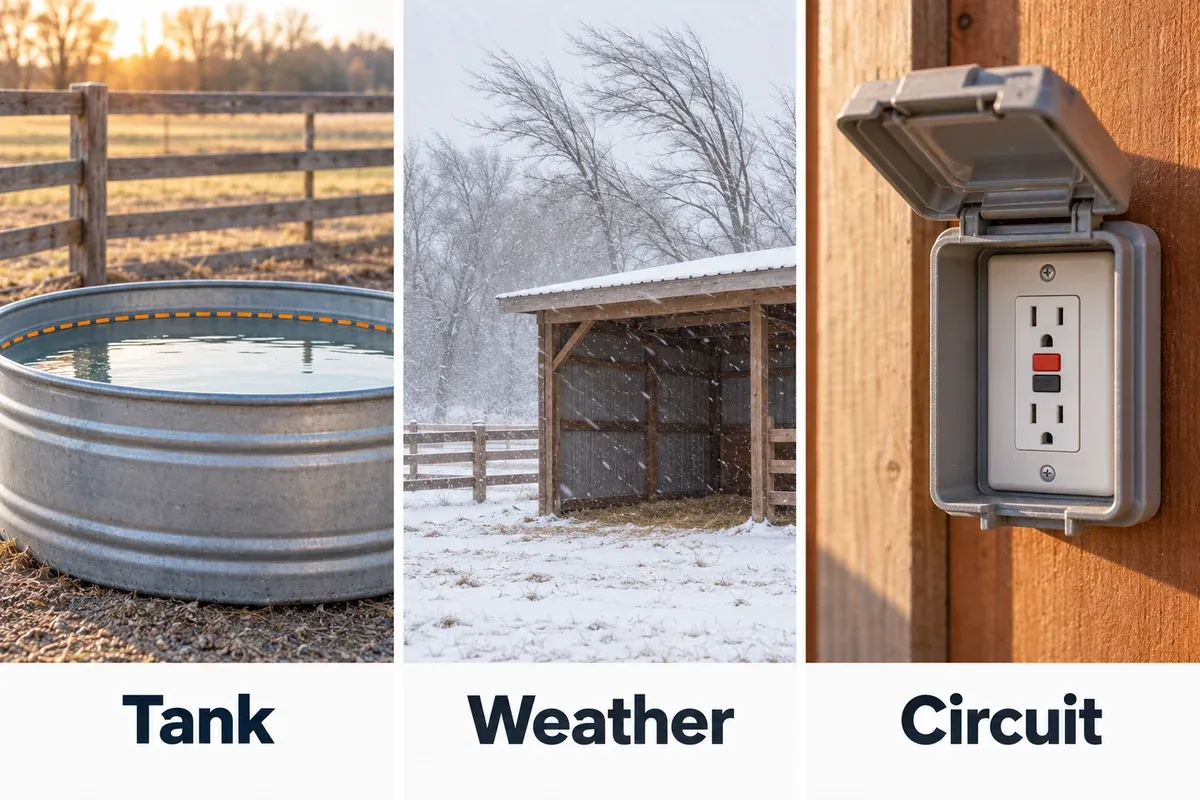
The right product depends on four measurements: the tank’s actual water volume, the coldest expected temperature, the tank material, and the available circuit. Wind, shade, insulation, water turnover, and whether the tank is exposed on all sides can change the result just as much as the number printed on the heater.
The five best horse water trough heaters for freezing weather
1. Farm Innovators H-429 1500W — Best overall for large stock tanks
Best for: 100-300 gallon stock tanks in cold climates Type: Submersible Material: Cast aluminum with protective cage
Why we recommend it
Farm Innovators’ product information and buying chart place the H-429 in the large-tank category, not the small-bucket category. That distinction matters: a 1500W heater is powerful enough to be useful in a 100- or 300-gallon tank, but it is an unnecessarily large electrical load for a small automatic bowl. The manufacturer also describes the model as suitable for plastic and metal stock tanks when the application is matched correctly. See Farm Innovators’ agricultural de-icer range and its stock-tank wattage guide.
Check current price on Amazon →Key features
- 1500W output: Gives a large exposed tank more reserve than a 250W or 500W utility unit.
- Submersible placement: The heater rests at the bottom rather than floating where a horse can nudge it.
- Thermostatic control: It is intended to activate near freezing instead of running continuously.
- Protective cage: Helps separate the heating element from the tank and livestock.
- Anti-chew cord protector: Adds a layer of protection, but the cord still needs a route that horses cannot reach or pull.
- 14 x 14 x 6 inch product dimensions: Leave enough clearance for the tank floor and any drain or liner.
Pros and cons
Pros:
- High output fits large stock tanks better than small utility de-icers
- Cast aluminum conducts heat efficiently and resists ordinary farm wear
- Thermostat and cage are built into a familiar, simple design
Cons:
- A 1500W load is approximately 12.5 amps at 120V
- Too large for a bucket, small automatic bowl, or lightly freezing setup
- Needs careful circuit, cord, and GFCI planning around water
- It cannot compensate for an uninsulated tank in extreme wind or a failed electrical supply
Bottom line: Choose the H-429 when the tank is large enough to justify 1500W and the circuit is ready for it. It is the best overall starting point for a normal 100-300 gallon stock-tank installation, but it is not a universal answer for every trough.
Best for: Large pasture tanks, exposed stock tanks, owners who need high output with a practical feature set Skip if: You have a small container, no properly protected 120V supply, or a tank that is not approved for the heater’s use
2. Farm Innovators H-418C 1250W — Best convertible design
Best for: Owners who want floating and submersible modes Type: Convertible floating or submersible Warranty: Three-year manufacturer guarantee
Why we recommend it
The 1250W output sits just below the 1500W class while keeping a large-tank use case. That makes it a useful compromise for owners who want more reserve than a 500W utility de-icer but do not need the highest output available. The conversion is a feature only if you follow the instructions exactly; it is not a reason to improvise the float, legs, cord, or placement.
Farm Innovators lists the H-418C as a 1250W convertible stock-tank de-icer, thermostatically controlled, safe in plastic, and covered by a three-year guarantee. See the manufacturer’s H-418C specifications.
Check current price on Amazon →Key features
- Two installation modes: Float or submerge it depending on the tank and cord-management plan.
- 1250W output: A strong middle ground for larger tanks when the manual’s capacity chart supports it.
- Plastic-safe construction: Useful when the trough is structural foam, rubber, or plastic, provided the model is used as directed.
- Thermostat: Helps reduce unnecessary runtime.
- Anti-chew cord protector: Helpful around livestock, but not a substitute for inaccessible routing.
- Three-year guarantee: Longer stated coverage than the H-429 or C-500.
Pros and cons
Pros:
-
Most flexible placement of the five picks
-
Safe-in-plastic claim is clearly stated by the manufacturer
-
Three-year guarantee adds confidence for seasonal equipment
-
Lower nominal draw than a 1500W heater while still serving larger tanks
Cons:
- Floating mode creates more cord-management responsibility
- The 1250W rating still draws about 10.4 amps at 120V
- Conversion takes a little more setup discipline than a fixed-style unit
- It is not automatically the best choice for a small tank or a severe microclimate
Bottom line: The H-418C is the best fit when flexibility matters as much as raw output. It is especially appealing for seasonal pasture layouts and plastic stock tanks, as long as the final mode and electrical setup follow the manual.
Best for: Changing tank layouts, plastic stock tanks, owners who want one convertible heater Skip if: You want the simplest fixed installation or only need a small low-wattage unit
3. Farm Innovators C-500 500W — Best for tanks up to 50 gallons
Best for: Small stock tanks, tubs, and automatic waterers up to 50 gallons Type: Submersible utility de-icer Warranty: One-year manufacturer guarantee
Why we recommend it
The model is useful for a single horse’s smaller water source, a pony setup, a tub, or an automatic waterer with a larger basin. It is not a shortcut for heating a full-size exposed stock tank. Farm Innovators’ specification sheet places the C-500 in the 50-gallon class and describes it as a thermostatic utility de-icer for plastic or metal containers. The same guide supports the broader principle that wattage must be matched to both volume and climate, not selected by price alone.
Check current price on Amazon →Key features
- 500W output: Appropriate starting point for containers up to 50 gallons in the manufacturer’s application range.
- Compact form: the product documentation gives dimensions of approximately 8 x 7.5 x 2 inches.
- Plastic-safe claim: Reduces the risk of choosing a metal-only element for a plastic or rubber tank.
- Cast aluminum body: Designed for efficient heat transfer and ordinary farm use.
- Thermostatic operation: Runs when needed rather than continuously.
Pros and cons
Pros:
-
Clear use case for smaller containers
-
Lower electrical draw of about 4.2 amps at 120V
-
Compact shape is easier to position in a tub or small tank
-
Plastic-safe guidance is available from the manufacturer
Cons:
- Not designed as the default solution for 100-300 gallon tanks
- Less reserve in high wind, deep cold, or an uninsulated container
- One-year guarantee is shorter than the H-418C or K&H coverage
- Still requires a protected outdoor electrical setup and daily inspection
Bottom line: Buy the C-500 because your container is small, not because the low wattage sounds safer. For up to 50 gallons, it is a more proportionate choice than a large tank de-icer; for a full-size trough, step up according to the manufacturer’s chart.
Best for: Pony water tubs, small stock tanks, 25-50 gallon containers, larger automatic bowls Skip if: Your tank is 100 gallons or larger, fully exposed, or in a severe cold zone
4. K&H Ultimate Stock Tank Deicer 250W — Best low-power option
Best for: Small tanks and moderate freezes Type: Floating or submersible Safety: MET safety described
Why we recommend it
The manufacturer describes the family as thermostatically controlled, safe for plastic, rubber, and metal stock tanks, MET safety described, and backed by a two-year warranty. It also includes a full cage and cord clip. See K&H’s Ultimate Stock Tank Deicer range.
The trade-off is simple: 250W leaves less heating reserve. The manufacturer instructions also warn that mineral buildup can cause the unit to stop or trip a GFCI. That makes cleaning and inspection part of the product’s real cost, especially with hard water.
Check current price on Amazon →Key features
- 250W output: About 2.1 amps at 120V.
- Floating or submersible design: One product can adapt to different small-tank layouts.
- Full protective cage: Helps keep the element separated from animals and tank surfaces.
- Cord clip: Supports safer cord routing at the rim.
- MET safety certification and two-year warranty: Useful signals for a wet outdoor electrical product.
- Wattage range: The family is available in higher outputs, but each selected version must be matched separately.
Pros and cons
Pros:
-
Lowest price and lowest power draw in this comparison
-
Flexible floating/submersible format
-
Full cage and cord clip are included
-
Two-year manufacturer warranty
Cons:
- 250W is easy to outgrow in a large or exposed trough
- Published specifications are less detailed than those of the two Farm Innovators premium picks
- Mineral scale can affect operation and cause nuisance GFCI trips
- The shared product family makes wattage selection easy to overlook
Bottom line: The K&H 250W is a good small-tank choice when your climate and volume support a low-power heater. Do not buy it for a 100-gallon tank simply because it is inexpensive; choose the correct K&H wattage or a different model.
Best for: Small tanks, mild-to-moderate freezing, lower electrical demand Skip if: You have a large exposed trough, frequent sub-zero weather, or no way to check the unit for scale and damage
5. API 2002DP 1500W — Best permanent drain-plug installation
Best for: Permanent 100-300 gallon tanks with a compatible drain hole Type: Universal drain-plug de-icer Installation: 3/4-inch-or-larger drain opening
Why we recommend it
The API 2002DP is a different solution from the other four. Instead of placing a caged heater inside the drinking area, it uses a drain-plug adapter so the heating element is associated with the tank’s drain installation. That can create a cleaner, more permanent setup for a large tank that already has the right opening.
Miller Manufacturing’s API comparison identifies the 2002DP as a 1500W universal drain-plug de-icer for 100-300 gallons, with cULus certification and thermostat thresholds that differ from other API models. It also distinguishes this model from the LOCKNDRY-compatible versions, so do not substitute a similar-looking API part without checking the exact model. Read Miller Manufacturing’s API de-icer comparison.
Check current price on Amazon →Key features
- Drain-plug design: Keeps the heater out of the open drinking space when installed correctly.
- 1500W output: Intended for large tanks rather than buckets.
- 3/4-inch-or-larger fit: The drain hole must match before you order.
- Over-temperature protection: Adds a layer of control beyond simple on/off heating.
- Stainless-steel element and cULus certification: Useful construction and safety signals from the manufacturer.
- 100-300 gallon range: A better fit for a permanent stock tank than a small portable tub.
Pros and cons
Pros:
-
Cleanest option for a compatible permanent installation
-
Heater element is not floating around the horse’s drinking area
-
Clear 100-300 gallon use case
-
Stainless-steel heating element and over-temperature protection
Cons:
-
Higher price and more installation work than a submersible unit
-
It is not a universal fit for every tank drain
-
A 1500W load still needs an appropriately protected circuit
-
Less useful if you move troughs between pastures
Bottom line: Choose the API 2002DP when you are building or upgrading a permanent large-tank installation and the drain opening is compatible. For a temporary tank, the H-429 or H-418C is easier to deploy.
Best for: Permanent 100-300 gallon tanks, clean installations, compatible drain holes Skip if: You need portability, have a small tank, or are not prepared to verify the drain and electrical installation
The three site checks below help narrow the choice. Use the exact heater manual for its approved tank materials, water level and electrical installation.
How to choose the right wattage
Wattage is not a competition. A large heater can still be the wrong product if the tank is small, the circuit is undersized, or the tank material and model instructions do not match. Start with the tank’s actual gallons, then account for the coldest expected zone and exposure.
Farm Innovators’ published chart is a useful starting point for its own de-icers. It suggests the following pattern, but it is not a universal promise for every brand or climate:
| Tank size | Warmer winter zones or protected setup | Colder zones or exposed setup |
|---|---|---|
| Up to 25 gallons | 250W | 500W may be needed |
| About 50 gallons | 500W | 1000W may be needed |
| About 100 gallons | 1000W | 1500W may be needed |
| 200-300 gallons | 1500W in many zones | Use the manufacturer’s large-tank model guidance; do not guess |
The same chart lists 250W for some 5- and 25-gallon applications, 500W for 50 gallons in milder zones, and model-specific higher-output units for the coldest zones. Check the complete manufacturer chart before ordering.
Compare the electrical load before you buy
At 120V, the approximate running current is watts divided by volts:
| Heater output | Approximate current at 120V | Practical implication |
|---|---|---|
| 250W | 2.1A | Lower draw, but limited reserve for large or exposed tanks |
| 500W | 4.2A | Proportionate for smaller tubs and tanks up to about 50 gallons |
| 1250W | 10.4A | Strong middle class; circuit and weatherproof installation matter |
| 1500W | 12.5A | High-output class; verify the circuit and other barn loads first |
These are approximate load calculations, not permission to install a heater on an unknown circuit. Farm Innovators uses the same watts-divided-by-volts approach in its product guidance. If you do not know whether a barn outlet, GFCI, breaker, cord, and weather protection are suitable, ask a qualified electrician before connecting a heater.
Submersible, floating, or drain-plug: which style fits?
Submersible de-icers
Submersible models sit below the surface, often inside a protective cage. The H-429 and C-500 are examples. The main risks are forgetting to unplug before removal, allowing the water level to drop below the element, or routing the cord where horses can chew it.
Floating de-icers
Floating heaters are easy to move and can keep a hole open near the surface. They also make cord management more obvious. The H-418C and K&H can be used in floating mode. Use the included cord clip or the manufacturer’s mounting method, and make sure a horse cannot catch the cord with a muzzle, halter, hoof, or fence.
Drain-plug de-icers
Drain-plug heaters can be cleaner for a permanent stock-tank installation because the heating element is not placed in the open bowl. The API 2002DP only makes sense if the tank has a compatible drain opening and you are comfortable with the installation requirements. A drain-plug model is not a drop-in replacement for a caged submersible heater.
If your setup is an automatic bowl rather than a stock tank, compare the heater choice with our guide to the best automatic horse waterers. The bowl’s fill valve, exposed plumbing, and actual water volume can change the right freeze-protection approach.
Safe installation and daily maintenance checklist
- Measure the water volume. Use the actual fill level, not the tank’s marketing name. A 100-gallon tank that is only half full may still have different heat loss than a small full tub.
- Check the tank material. Buy a model explicitly marked safe for plastic or rubber when that is your container. Never assume that all metal heating elements are plastic-safe.
- Prepare the electrical side first. Use a properly grounded, weather-protected circuit with appropriate ground-fault protection where required by the product instructions and local code. Do not improvise extension cords or adapters.
- Keep the cord inaccessible. An anti-chew sheath reduces risk but does not make a reachable cord safe. Route it outside the horse’s reach and inspect it after storms, turnout changes, and any chewing incident.
- Submerge before energizing. If the model is submersible, place it in the water and confirm the water covers the element before plugging it in. Unplug at the receptacle before moving or cleaning it.
- Check the water every day. Confirm that the heater is not exposed, the water is flowing or accessible, the trough has not iced over, and there is no damaged cord, unusual odor, or electrical sensation in the water.
- Remove mineral scale. Scale can reduce heat transfer and, according to K&H’s instructions, may contribute to a heater stopping or tripping a GFCI. Follow the product’s cleaning instructions; do not scrape or coat the element with an unapproved chemical.
- Keep a backup water plan. Have a second clean source or a safe manual watering routine for power outages, heater failure, or a tripped GFCI. Never leave horses dependent on one unverified electrical device.
The University of Minnesota specifically recommends checking tank heaters for worn or damaged wires and checking the water for electrical sensations or shocks. If anything seems abnormal, prevent access, disconnect the supply from a dry and safe location if possible, and contact a qualified electrician. See UMN’s full winter-care safety notes.
For a structured troubleshooting sequence when a waterer stops working, use our horse waterer troubleshooting guide alongside the heater manual.
Common mistakes to avoid
-
Buying by wattage alone: A 1500W heater does not automatically make a 25-gallon bucket safer or more effective.
-
Ignoring the tank material: Plastic-safe, rubber-safe, and metal-only claims are not interchangeable.
-
Leaving the heater on when the tank is empty: A submersible element needs water coverage before it is energized.
-
Treating a cord protector as a complete safety system: A horse can still pull or damage a cord at the edge of a tank.
-
Skipping cleaning: Mineral scale, algae, hay, and manure can reduce water quality and heater performance. UMN’s tank-cleaning guidance recommends regular cleaning even in winter.
-
Relying on snow or ice: UMN and Penn State both emphasize that snow is not a dependable replacement for clean, accessible drinking water.
-
Using a heater without checking the circuit: A 1500W unit can draw roughly 12.5 amps at 120V before other barn loads are considered.
Frequently Asked Questions
What size heater do I need for a 100-gallon horse trough?
Use the manufacturer’s chart as a starting point. In the Farm Innovators chart, a 100-gallon tank is paired with 1000W in milder zones and 1500W in colder zones. Wind, shade, insulation, tank shape, and water turnover can change the result, so confirm the exact model manual rather than treating the wattage as a guarantee.
Is a 250W horse trough heater enough?
It can be enough for a small tank or automatic waterer in a moderate freeze, especially when the tank is protected from wind. It is not a sensible default for a large exposed stock tank. The K&H 250W is the low-power pick here; move up in wattage when the tank volume and climate require it.
Can I use a trough heater in a plastic stock tank?
Only when the product and its instructions explicitly allow plastic or rubber use. The H-418C, C-500, K&H range, and the H-429 instructions include plastic-safe guidance. Still follow placement, water-level, and cord rules for the exact model.
Does a de-icer make the water warm?
Usually no. A thermostatic de-icer is intended to keep water from freezing or to maintain an open drinking area, not to heat the trough to a hot-water temperature. Horses still need clean, accessible water, and some may drink more readily when water is above freezing or moderately warm.
Is a floating or submersible heater safer for horses?
Neither style is automatically safe without correct installation. A submersible unit is less exposed in the bowl but must stay covered by water. A floating unit can be easy to reposition but needs especially careful cord clipping and routing. Follow the model’s instructions and inspect the setup daily.
Can I use a drain-plug heater in any trough?
No. The API 2002DP is designed for a compatible 3/4-inch-or-larger drain opening and a 100-300 gallon application. Measure the drain, confirm the tank material and seal, and follow the installation manual before choosing this style.
Should I leave horses with only one heated trough?
It is better to have a backup plan. A power outage, tripped GFCI, damaged cord, or failed thermostat can remove access even when the trough looks full. Check the heated source daily and keep an alternative clean water source ready during severe weather or maintenance.
Final verdict
The best horse water trough heater is the one that matches the tank, climate, material, and electrical installation:
- Best overall for a large tank: Farm Innovators H-429 1500W for correctly sized 100-300 gallon stock tanks.
- Best flexible design: Farm Innovators H-418C 1250W when floating and submersible modes are both useful.
- Best for up to 50 gallons: Farm Innovators C-500 500W for smaller tubs, tanks, and automatic waterers.
- Best low-power option: K&H 250W for small containers and moderate freezing.
- Best permanent drain installation: API 2002DP 1500W when a 3/4-inch-or-larger drain opening and a permanent setup are already in place.
Whichever model you choose, treat it as part of a winter watering system rather than a set-and-forget appliance. Provide clean water, check the tank and heater every day, keep cords away from horses, and have a backup plan for the first outage or frozen morning.
Sources and further reading
- University of Minnesota Extension: Caring for your horse in the winter
- University of Minnesota Extension: Cleaning water and tanks
- Penn State Extension: Equine winter wellness tips
- American Association of Equine Practitioners: Principles of Equine Welfare
- Farm Innovators: Agricultural de-icers
- Farm Innovators: Convertible Stock Tank De-Icer H-418C
- Farm Innovators: Stock-tank wattage and climate guide (PDF)
- K&H Pet Products: Ultimate Stock Tank Deicer
- Miller Manufacturing: API de-icer comparison