

 Published sources
 Product details checked
Quick Answer: Choose a horse blanket by the protection your horse needs. The BARN & STABLE 600D 200g and Gallopoff 1200D 200g provide midweight insulation; the Gallopoff adds a ripstop shell. The Tough1 600D Turnout Sheet offers rain protection without insulating fill. The WeatherBeeta ComFiTec Essential Turnout Combo 360g is the heavyweight option, with an integrated neck cover for horses that need more coverage and warmth.
Start with your horse’s coat, body condition, shelter, and turnout conditions. A clipped horse standing in cold rain has different needs from an unclipped horse with a dry winter coat. Buying the warmest blanket can be just as unhelpful as buying one that leaves a horse cold.
This guide compares the four models’ construction, fill, fastenings, and fit. It also explains where turnout blankets differ from stable blankets and fly sheets, so you can choose the right type before choosing a brand.
In this guide, you’ll discover:
- Which of these four blankets suits rain protection, midweight warmth, or heavyweight turnout
- What 600D, 1200D, and ripstop tell you about the outer fabric
- How to choose between 0g, lightweight, 200g, and 360g fill
- How to interpret waterproof and breathability figures without mistaking them for guarantees
- How to measure your horse and check shoulder, chest, and wither fit
- How to adjust front closures, belly straps, and leg straps safely
- How to wash, inspect, store, and repair a turnout blanket
Quick Comparison Table
-
BARN & STABLE 600D 200g Turnout Blanket
BARN & STABLE
A 600D polyester turnout blanket with 200g fill, a waterproof and breathable shell, fleece wither protection, and shoulder gussets.
- 600D polyester outer shell
- 200g midweight poly-fill
- Double-buckle front with hook-and-loop assist
- Best for
- Midweight turnout with adjustable front buckles
- Fill weight
- 200g poly-fill
- Outer shell
- 600D
-
Gallopoff 1200D Ripstop 200g Fill Horse Blanket
Gallopoff
A 1200D ripstop turnout blanket with 200g fill, smooth nylon lining, fleece wither protection, and adjustable front and belly fastenings.
- 1200D ripstop outer shell
- 200g midweight insulating fill
- Smooth nylon lining and fleece wither pad
- Best for
- Midweight turnout with a ripstop outer
- Fill weight
- 200g poly-fill
- Outer shell
- 1200D
-
Tough1 600D Waterproof Turnout Sheet
Tough1
A no-fill turnout sheet with a 600D waterproof outer, shoulder gussets, fleece wither protection, and adjustable fastenings.
- 600D waterproof outer shell with no insulating fill
- Shoulder gussets and fleece wither protection
- Cross surcingles with elastic ends
- Best for
- Rain protection without added insulating fill
- Fill weight
- 0g - no insulating fill
- Outer shell
- 600D
-
WeatherBeeta ComFiTec Essential Turnout Combo 360g
WeatherBeeta
A heavyweight combo turnout with a 1200D ripstop outer, 360g fill, integrated neck cover, smooth lining, and adjustable quick-clip front.
- 1200D ripstop outer shell with PFC-free Guard-Tec coating
- Waterproof to 2,000mm+ hydrostatic pressure tested
- Breathable to 3,000g/m2+ moisture vapor transmission
- Best for
- Heavyweight turnout with integrated neck coverage
- Fill weight
- 360g poly-fill
- Outer shell
- 1200D ripstop
Review the linked product page before purchasing.
Top 4 Horse Blankets Compared
1. BARN & STABLE 600D with 200g Fill – Adjustable Midweight Turnout
Check current price on Amazon →Best For: Horses that need a filled turnout blanket with adjustable buckle closures
Material: 600D polyester outer with 200g poly-fill
Waterproof and Breathability Figures: 3000mm / 3000mvp, as specified by BARN & STABLE
Why We Recommend It
The BARN & STABLE combines a 200g fill with a waterproof, breathable shell, double front buckles, and crossed belly straps. It is a practical option when your horse needs insulation as well as weather protection and you prefer buckles you can adjust individually at the chest.
The fleece at the withers adds a soft contact surface, while shoulder gussets leave room for movement. These details are useful, but they cannot compensate for a neckline that pulls backward or a chest that is too narrow. A horse with recurring rubs needs a fit check before another blanket is chosen.
BARN & STABLE gives the shell’s figures as 3000mm/3000mvp. The waterproof and moisture-vapor figures describe different properties; neither establishes a safe temperature range or promises a sweat-free horse. The fill and your horse’s response matter just as much.
Key Features
- 600D Polyester Outer: The weather-facing fabric; denier describes the yarn rather than the blanket’s warmth.
- 200g Poly-Fill: Midweight insulation for a horse that needs more than a rain sheet.
- Waterproof, Breathable Shell: Combines rain protection with moisture-vapor transfer.
- Fleece Wither Protection: Adds a softer contact surface over the withers.
- Double-Buckle Front Closure: Separate adjustment points help you set the chest opening.
- Hook-and-Loop Assist: Holds the front overlap together alongside the buckles.
- Low Cross Surcingles: Help keep the blanket centered when adjusted for the horse.
- Adjustable, Removable Leg Straps: Allow adjustment at the hind legs and removal for care or replacement.
- Shoulder Gussets and Tail Flap: Provide room at the shoulders and extra rear coverage.
Pros & Cons
Pros:
- Combines weather protection and midweight insulation in one blanket
- Adjustable front buckles give you control over chest fit
- Fleece wither protection provides a soft contact surface
- Shoulder gussets allow more room than a straight-sided cut
- Removable leg straps can be adjusted or replaced separately
Cons:
- The fixed 200g fill cannot be removed for warmer days
- Fleece and gussets do not resolve a poor neckline or shoulder fit
- Its 600D label alone cannot tell you how it will withstand your horse’s turnout habits
Bottom Line
Choose the BARN & STABLE for its combination of 200g insulation and adjustable fastenings. Before committing to the fit, check that the front lies flat, the withers are free from concentrated pressure, and the shoulders move comfortably when the horse grazes. Those checks tell you more about suitability than a waterproof number alone.
Best for: A horse that needs a midweight turnout blanket and fits this buckle-front cut.
Skip if: You need removable insulation, a no-fill rain sheet, or a different chest and neckline shape.
Check current price on Amazon →2. Gallopoff 1200D Ripstop with 200g Fill – Midweight with a Ripstop Shell
Check current price on Amazon →Best For: Horses needing 200g insulation in a 1200D ripstop turnout
Outer Shell: 1200D ripstop, waterproof and breathable
Lining: Smooth nylon with fleece protection at the withers
Why We Recommend It
The Gallopoff’s main distinction from the BARN & STABLE is its 1200D ripstop outer. Ripstop uses reinforcing threads to help limit the spread of a tear. That makes it worth considering when fabric damage is a concern, although it does not make a blanket resistant to every bite, snag, or pull.
Its smooth nylon lining and fleece wither pad address contact with the coat. A smooth lining can reduce friction, but a blanket that slides, pulls across the shoulders, or presses on the withers can still cause rubs. High shoulder gussets provide extra room during grazing and walking; check that room on the horse rather than judging the cut from a photograph.
The model compared here has 200g fill. Gallopoff also offers other fill weights, but choosing one of those means choosing a different insulated version. You cannot remove the fill from this blanket to turn it into a 0g sheet.
Key Features
- 1200D Ripstop Outer: Reinforcing threads help resist the spread of small tears.
- Waterproof, Breathable Shell: Intended for outdoor weather protection while allowing moisture vapor to pass through.
- 200g Fill: Midweight insulation, separate from the shell’s denier rating.
- Smooth Nylon Interior: Presents a smooth surface against the coat.
- Fleece Wither Pad: Adds softness at a common contact point.
- Double Front Buckles with Hook-and-Loop Assist: Adjustable fastening at the chest.
- Cross Surcingles and Adjustable Leg Straps: Help stabilize the blanket when fitted correctly.
- High Shoulder Gussets and Large Tail Flap: Add room for movement and rear weather coverage.
Pros & Cons
Pros:
- Ripstop reinforcement is useful when limiting tear spread matters
- Combines a smooth body lining with a fleece wither pad
- Shoulder gussets make movement an explicit part of the cut
- Front buckles and straps give several points of adjustment
- Provides the same fill category as the BARN & STABLE in a different shell construction
Cons:
- Ripstop cannot guarantee that a tear stops at a particular size
- A 1200D shell does not establish a longer service life or a warmer blanket
- The 200g fill remains in place when temperatures rise
Bottom Line
Choose the Gallopoff if you want a midweight blanket with a ripstop outer and smooth lining. If your horse repeatedly damages blankets, also look for sharp edges, snagging points, poor fit, or biting from field companions. Stronger fabric cannot make an unsafe turnout area suitable.
Best for: Midweight turnout where ripstop construction is an important selection criterion.
Skip if: Your horse needs no added insulation or the blanket’s shoulder and neckline shape does not suit them.
Check current price on Amazon →3. Tough1 600D Waterproof Turnout Sheet – No-Fill Rain Protection
Check current price on Amazon →Best For: Horses needing weather protection without added insulating fill
Outer Shell: 600D waterproof fabric
Fill: 0g; this is a turnout sheet
Why We Recommend It
The Tough1 serves a different purpose from the three filled blankets. Its no-fill construction makes it the option to consider when keeping rain off is the priority and your horse does not need the insulation of a 200g or 360g blanket.
It still has useful fitting features. Tough1’s 600D sheet specifications include shoulder gussets, fleece wither protection, crossed surcingles, and replaceable elastic leg straps. A double-buckle front with a quick-grip tab secures the chest. It is more than a plain sheet draped over the horse.
A no-fill sheet can have a place in winter management, depending on the horse and weather. It is not a substitute for insulation when that insulation is needed. Equally, adding fill simply because the calendar says winter can leave a thick-coated horse too warm.
Key Features
- 600D Waterproof Outer: Weather protection without an insulating fill layer.
- 0g Fill: Keeps this sheet distinct from the midweight and heavyweight choices.
- Shoulder Gussets: Provide additional room at the front of the blanket.
- Fleece Wither Protection: Adds a soft contact area over the withers.
- Double-Buckle Front and Quick-Grip Tab: Adjustable chest fastening with an overlap tab.
- Cross Surcingles: Belly straps with elastic ends help hold the sheet in position.
- Adjustable, Replaceable Elastic Leg Straps: Allow adjustment and replacement of a worn strap.
- Tail Flap: Adds coverage at the rear.
Pros & Cons
Pros:
- Offers a no-fill alternative when a filled blanket would be excessive
- Includes shoulder gussets and fleece wither protection
- Uses adjustable front buckles and crossed belly straps
- Replaceable leg straps make strap wear easier to address
- Can complement a filled blanket when a horse needs different protection as conditions change
Cons:
- No fill means it supplies no added fill insulation
- It cannot replace a warm blanket for a horse that needs one
- A waterproof description alone does not let you rank its fabric against numbered laboratory ratings
Bottom Line
Choose the Tough1 for a rain-sheet job. A backup only helps if it meets the horse’s needs: replacing a 200g winter blanket with a 0g sheet changes the insulation, even if both outer shells are waterproof. Keep that difference in mind when choosing something to use while another blanket dries.
Best for: Rain protection for a horse that does not need added fill, or a lighter option alongside a suitable winter blanket.
Skip if: Your immediate need is midweight or heavyweight insulation.
Check current price on Amazon →4. WeatherBeeta ComFiTec Essential Turnout Combo 360g – Heavyweight with Neck Coverage
Check current price on Amazon →Best For: Horses needing heavyweight turnout insulation and an integrated neck cover
Material: 1200D ripstop with 360g poly-fill
Waterproof Figure: 2000mm+ hydrostatic pressure tested
Breathability Figure: 3000g/m²+ moisture-vapor tested
Why We Recommend It
The ComFiTec Essential Turnout Combo 360g is the heaviest-filled blanket in this comparison. Its combo cut includes neck coverage, so it is a different choice from an open-neck turnout as well as a warmer choice than the two 200g models.
WeatherBeeta combines a 1200D ripstop shell, PFC-free Guard-Tec coating, and a smooth 210T lining. Its waterproof and breathability figures describe the fabric’s resistance to water pressure and ability to transfer moisture vapor. The shell, seams, and fastenings still need regular inspection throughout winter.
The quick-clip front is convenient for frequent changes, and the fill indicator helps distinguish this weight from other blankets. Liner compatibility gives you a way to add insulation when needed. The important limit is that the existing 360g fill stays in place: this is a heavyweight turnout, even without a liner.
Key Features
- 1200D Ripstop Shell: Reinforcement helps limit tear spread in the outer fabric.
- 360g Poly-Fill: The heavyweight insulation option among these four models.
- Integrated Neck Cover: Extends coverage beyond the body; check neck fit as well as chest fit.
- PFC-Free Guard-Tec Coating: The waterproof coating specified for this model.
- 2000mm+ Waterproof and 3000g/m²+ Breathability Figures: Fabric-test values, rather than a temperature or comfort guarantee.
- Smooth 210T Lining: A smooth contact surface against the coat.
- Side Gussets and Twin Cross Surcingles: Room for movement with belly-strap stabilization.
- Adjustable Quick Clips and Touch Tape: Front fastenings that can be set for the horse.
- Tail Flap and Removable Leg Straps: Rear coverage and adjustable stabilization.
- Reflective Details and Fill Indicator: Help with visibility and identifying the blanket’s fill.
- WeatherBeeta Liner Compatibility: Accepts compatible liners to add warmth; it does not remove the base fill.
Pros & Cons
Pros:
- Offers heavier insulation than the two 200g models
- Integrated neck coverage suits horses that need this style
- Quick clips simplify regular blanket changes after adjustment
- Smooth lining and gussets address contact and movement
- Compatible liners provide an option for adding insulation
- Reflective details help you see the blanket when light catches them
Cons:
- Fixed 360g fill limits its usefulness in warmer weather
- The integrated neck cover adds coverage you may not need
- Adding a liner makes it warmer; it cannot create a 0g or 200g version
- A high denier and branded coating do not establish a particular lifespan
Bottom Line
Choose the WeatherBeeta when your horse needs heavyweight insulation and the combo-neck style. Include neck comfort in the fitting check, especially with the head lowered to graze. A heavier blanket is useful only when the horse needs that warmth; buying it as a single solution for every season would miss its purpose.
Best for: Heavyweight turnout needs with a suitable combo-neck fit.
Skip if: Your horse needs a lighter blanket, no fill, or a style without integrated neck coverage.
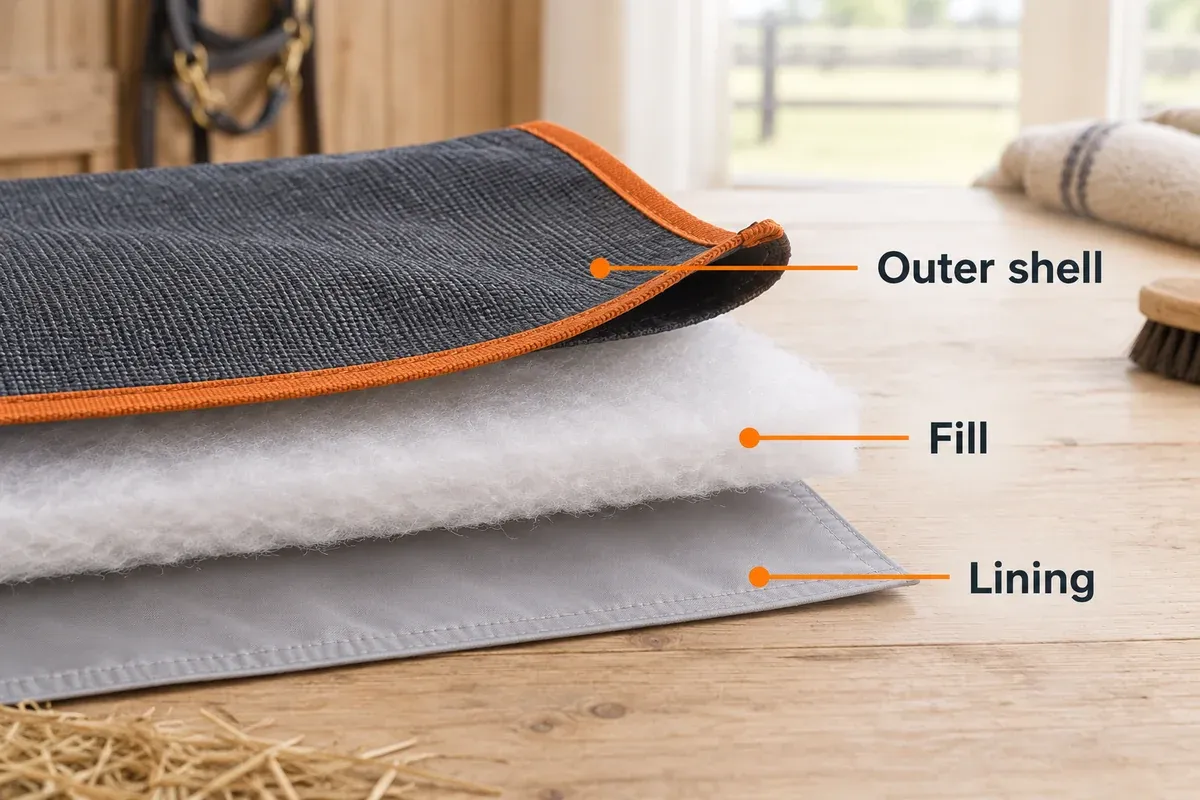
Check current price on Amazon →The layers below explain what you are comparing. The shell faces the weather, the fill adds insulation and the lining sits against the coat; none of these features guarantees that a blanket fits your horse.
Horse Blanket Buying Guide 2026
1. Understanding Denier Ratings: 600D vs 1200D
Denier measures the mass of a given length of yarn: one denier is one gram per 9,000 meters. Bally Ribbon Mills’ textile glossary explains the unit. It describes the yarn used in the outer shell, rather than the thickness of the fill or a blanket’s warmth.
600D Outer Shells:
- Use a lower-denier yarn than 1200D shells.
- Can suit everyday turnout when the fabric, seams, and fit meet the horse’s needs.
- Can be found on both no-fill sheets and filled winter blankets.
- Need the same inspection for snags, worn areas, and loose stitching as heavier-denier designs.
1200D Outer Shells:
- Use a higher-denier yarn, which is one part of the fabric’s construction.
- Are worth comparing when resistance to fabric damage is a priority.
- May include ripstop reinforcement, as the Gallopoff and WeatherBeeta do.
- Do not establish total blanket weight, twice the strength, or a fixed number of seasons of use.
Ripstop is a weave with reinforcing threads that help limit tear spread. WeatherBeeta’s fabric explanation distinguishes that reinforcement from denier. Fiber type, weave, coating, seams, and strap attachments also affect performance.
For a horse that is hard on blankets, examine those details together. A tear-resistant shell is useful, but strong fabric will not save a worn buckle or a weak strap attachment. For warmth, look at the fill next.
2. Fill Weight Guide: Which Weight for Your Climate?
The gram figure identifies the insulating fill, not the weight of the whole blanket. More fill generally adds insulation within a comparable design, but there is no universal conversion from grams to an outdoor temperature.
The University of Maine’s winter blanketing guide separates rain sheets, lightweight, midweight, and heavyweight blankets. Use those categories to narrow the choice, then account for the horse and conditions.
0g Turnout Sheet:
- Has no added insulating fill.
- Suits a weather-protection job when the horse does not need a filled blanket.
- Still changes conditions around the coat by covering it and blocking wind and rain.
- The Tough1 is the no-fill option in this comparison.
Lightweight Fill, Often Around 60–100g:
- Adds a light layer of insulation beyond a rain sheet.
- Can help when a no-fill sheet is insufficient but a midweight is too warm.
- Must be chosen for the horse’s coat, exposure, and response rather than the season alone.
- None of the four selected models here is a lightweight-filled version.
Midweight Fill, Including 200g:
- Offers more insulation for horses that need it during turnout.
- Can suit different conditions for a clipped horse and an unclipped horse.
- Includes the BARN & STABLE and Gallopoff models compared above.
- May be too warm during a mild, sunny spell even within a generally cold winter.
Heavyweight Fill, Around 300g and Above:
- Adds heavier insulation for horses with a greater need for warmth.
- Requires attention to daytime warming and the horse’s comfort under the blanket.
- Includes the WeatherBeeta 360g combo.
- Is not automatically necessary for every horse in a cold climate, especially one with a full winter coat.
Before choosing a weight, consider clipping, age, body condition, acclimation, wind, rain, forage, and shelter. Our horse blanket temperature chart brings those factors together as a starting point.
A second weight can be useful when your horse’s needs change with the weather. Choose it to fill an actual gap in protection; there is no minimum number of blankets every owner must buy. If you use liners, confirm compatibility and refit the outer blanket with the liner attached.
3. Waterproof Ratings Explained
Waterproofing and breathability answer separate questions: how the fabric resists water entering, and how moisture vapor can pass out. Neither number tells you how much insulation a horse needs.
Hydrostatic Pressure, Measured in Millimeters:
A hydrostatic-head test applies increasing water pressure to fabric until penetration occurs. A 2000mm figure corresponds to the pressure of a two-meter water column under the test conditions. The result describes the tested fabric; the complete blanket’s construction and condition affect its protection in use.
Higher figures indicate greater water-pressure resistance when measured by comparable methods. In use, the seams, coating condition, neck opening, fit, and any damage also matter. A clean, intact shell cannot protect an area that the blanket does not cover.
Moisture-Vapor Transmission:
Breathability figures describe water vapor passing through a fabric under test conditions. They may be expressed in grams per square meter over a stated period. Compare values only when the units, time period, and test method are comparable; a shortened label such as ‘mvp’ does not supply all that information.
Breathable fabric supports moisture transfer. It cannot prevent sweating when a horse wears too much insulation or works hard under a blanket. WeatherBeeta’s waterproofing guidance also explains the difference between waterproof fabric and moisture transfer.
Figures for These Four Options:
- BARN & STABLE: Specifies 3000mm/3000mvp. Keep the breathability label as given rather than assuming an unstated test period.
- WeatherBeeta Combo: Specifies 2000mm+ hydrostatic testing and 3000g/m²+ moisture-vapor testing.
- Tough1: A waterproof sheet without a numerical hydrostatic-head figure provided for this comparison.
- Gallopoff: A waterproof, breathable shell without numerical figures provided for this comparison.
Missing figures do not justify guessing a rating or declaring a blanket inferior. Use the available specifications alongside construction, coverage, and care requirements. After wet turnout, check the horse and lining to see whether the protection is working.
4. How to Measure Your Horse for Correct Blanket Sizing
Use the measuring method for the brand and model you intend to buy. Horse height, breed, or a size that fitted another brand can help orient you, but none replaces measuring the horse.
For WeatherBeeta Body-Length Sizing:
- Stand the horse square on level ground. Have a helper hold the horse if needed.
- Put a soft measuring tape at the center of the chest.
- Run it along one side, around the shoulder and body, to the end of the rump.
- Keep the tape following the body without pulling it tight or allowing it to sag.
- Use that measurement in the model’s size chart and check the units before ordering.
The WeatherBeeta size guide distinguishes body length from back-seam length. Back-seam measurements run from the withers to the top of the tail. These are different measurements and cannot be substituted for one another.
Selected WeatherBeeta Size-Chart Entries:
| US body-length size | Body length shown in chart | European back-seam size |
|---|---|---|
| 69 inches | 175cm | 125cm |
| 72 inches | 185cm | 135cm |
| 75 inches | 190cm | 140cm |
| 78 inches | 200cm | 150cm |
| 81 inches | 205cm | 155cm |
| 84 inches | 215cm | 160cm |
These are the brand’s chart entries, not a universal conversion table. WeatherBeeta advises moving up when between its sizes; use the relevant brand’s rule for other blankets. Do not add a blanket-wide allowance of two or three inches to every measurement.
Check the Fit on the Horse:
- The chest closure should sit comfortably and lie flat rather than pulling open.
- The neckline should remain comfortable with the head lowered to graze.
- Look for pressure at the withers and tension across the shoulders.
- Check rear coverage and whether the blanket sits centered.
- Watch the horse walk and graze after all fastenings have been adjusted and secured.
Try a new blanket on a clean horse while following the return conditions. If the length seems right but the chest or neckline does not, a different cut may help more than simply changing size.
5. Closure Systems: Which Is Best?
The best fastening system is one you can adjust correctly and use consistently. Front closures set the chest fit; belly and rear straps help stabilize the blanket. Each has a separate job.
Double-Buckle Front Closures:
- Allow individual adjustment of the front straps.
- Suit owners who prefer a familiar buckle fastening.
- Need enough adjustment range for the horse’s chest without pulling the blanket backward.
- Are used on the BARN & STABLE, Gallopoff, and Tough1 models here.
Quick-Clip Front Closures:
- Let you clip a previously adjusted front into place during changes.
- Still require an initial fit adjustment.
- Need inspection for damage, trapped dirt, and secure engagement.
- Are used on the WeatherBeeta combo in this comparison.
Hook-and-Loop or Touch-Tape Assist:
- Helps hold the front overlap together.
- Should be kept clear of hair, mud, and bedding so it grips properly.
- Works alongside the model’s other fastenings; follow the designed closure arrangement.
- Needs replacement or repair if it no longer holds as intended.
Surcingles, or Belly Straps:
- Cross beneath the belly when the design calls for crossed straps.
- Need adjustment that allows movement without long, dangling loops.
- Should follow the manufacturer’s specified clearance, rather than a universal finger rule.
- WeatherBeeta calls for about a hand’s breadth between the belly and cross surcingles in its blanket fitting guide.
Leg Straps and Other Rear Fastenings:
Use the arrangement designed for that blanket. Some designs use leg straps; others use a tail cord or another system. Do not add improvised straps or leave supplied fastenings dangling.
WeatherBeeta’s leg-strap method fastens each strap back to the same side, with the second strap passed through the first to link them. It specifies equal lengths and roughly 4–5 inches of clearance from the thigh. Apply that method to the appropriate WeatherBeeta construction; other manufacturers may use different instructions.
Keep the horse controlled while fitting. Secure the front and remaining fastenings according to the design before letting the horse move away. On removal, release the rear and belly fastenings before the chest so the blanket does not hang loose around the legs.
6. Maintenance: Washing, Storage, and Repairs
A blanket’s condition tells you when it needs care or replacement. Daily exposure, fit, damage, washing, and storage all affect service life, so a denier rating cannot promise a set number of seasons.
Pre-Wash Inspection:
- Check the outer shell, lining, seams, and strap attachments for damage.
- Brush off loose hair, dust, and dried mud.
- Remove detachable straps if the care instructions call for it, and secure the remaining fastenings.
- Arrange repairs before washing if a tear or loose attachment could worsen in the machine.
Washing and Drying:
Follow the blanket’s care label for cleaner, temperature, wash cycle, and drying. Nikwax’s Rug Wash instructions explain why dirt and detergent residue can affect the outer fabric’s water repellency. A suitable technical cleaner can help remove contamination without treating a damaged waterproof layer as a cleaning problem.
- Use a machine large enough for the blanket to move and rinse properly, or use a blanket-cleaning service.
- Avoid household additives that the blanket or cleaner instructions do not permit.
- Rinse as directed and dry the entire blanket, including fill and seams, before storage.
- Air-dry when required. Use a dryer only if the care label permits it, at the specified setting.
- Reproof only with a compatible treatment and the manufacturer’s instructions.
Our horse blanket washing and re-waterproofing guide explains the cleaning and reproofing process in more detail.
Storage:
Store the clean, fully dry blanket in a dry place away from rodents. Keep straps together so you can find the complete set when the weather changes. Inspect it again before the next season rather than discovering a broken buckle at turnout time.
Repair or Replace:
A compatible fabric patch may suit a small, non-load-bearing tear. Damaged seams, strap attachments, and buckles need a repair that can withstand use; a professional blanket repairer can assess them and select suitable materials.
Replace a blanket when its fit, fastenings, lining, or weather protection can no longer be restored for the job you need. Reproofing can restore surface water repellency in a suitable fabric, but it cannot close holes or repair a failed waterproof layer.
Common Mistakes to Avoid
Mistake #1: Judging Waterproofing by One Number
The problem: A high hydrostatic-head figure draws attention away from worn seams, damaged fabric, or gaps in coverage. The fabric rating cannot tell you whether the complete blanket is still protecting your horse.
The fix: Compare the available figures, inspect the shell and seams, and check the lining after wet turnout. If it is damp, look for the cause: water entry, a soaked outer surface, or sweat under excessive insulation require different responses.
Mistake #2: Choosing Size from Horse Height
The problem: Two horses of the same height can have different chest width and body length. Guessing from hands alone can produce a blanket that pulls, slides, or leaves poor coverage.
The fix: Measure using the chosen brand’s landmarks, apply its chart, then assess the chest, shoulders, withers, and rear on the horse. Treat the horse’s movement as part of the fitting check.
Mistake #3: Leaving the Same Fill on Through Changing Weather
The problem: A blanket that suits cold overnight turnout can become excessive when the sun comes out or the horse moves indoors. A heavyweight blanket has limited flexibility if its insulation is fixed.
The fix: Plan changes around the forecast and your horse’s needs. Use a lighter blanket, remove a compatible liner, or remove the blanket when appropriate. Adjust the setup again after a substantial weather change.
Mistake #4: Assuming Breathable Means Sweat-Free
The problem: A horse can sweat under a breathable turnout when the fill is too warm. Persistent dampness also makes it harder to judge whether rain is entering.
The fix: Feel beneath the blanket, especially behind the withers, and reassess insulation if the horse is hot or sweaty. Remove the blanket daily to inspect the skin and coat. Persistent soreness, hair loss, or other signs of illness need appropriate veterinary attention.
Mistake #5: Leaving Straps Loose or Unsecured
The problem: Loose, damaged, or incorrectly fastened straps can let the blanket shift or create loops that catch a leg. Simply attaching every strap does not establish a safe fit.
The fix: Use the blanket’s intended fastening arrangement and clearances. Inspect clips and attachments, adjust straps evenly where required, and secure them before turnout. Replace damaged parts before using the blanket again.
Frequently Asked Questions
What’s the difference between a turnout blanket and a stable blanket?
A turnout blanket has a weather-resistant outer intended for outdoor use. A stable blanket is intended for indoor warmth and is generally not waterproof, so it should not replace a turnout in rain.
Some turnout blankets can also be worn in a stall when the fit and insulation suit the conditions. Check that the outer and lining are dry and that the horse is comfortable after coming indoors. There is no need for a separate stable blanket if your existing turnout meets that indoor need.
A fly sheet serves another purpose: insect protection rather than winter insulation. Choose by the protection required; a cooler, stable blanket, rain sheet, and filled turnout are not interchangeable.
Can a 200g fill blanket work in extreme cold, below 20°F?
It may suit some horses and be insufficient for others. At 20°F, about −7°C, coat, clipping, wind, wetness, body condition, and shelter still affect the decision. University of Minnesota Extension’s winter-care guidance discusses those factors.
If more insulation is needed, use a suitable heavier blanket or a compatible liner and reassess fit. A fleece layer has no universal gram-fill equivalent. The WeatherBeeta’s base 360g fill remains in the blanket when a liner is removed; its liner system only adds insulation to that starting point.
How often should I blanket my horse?
Blanket when the individual horse needs protection, and reassess as conditions change. A healthy horse with a full winter coat, adequate forage, and shelter may need less blanketing than a clipped, underweight, or older horse. Starting to blanket does not by itself create a requirement to keep the horse blanketed for the rest of winter.
The British Horse Society’s rugging guide recommends assessing comfort beneath the blanket. The horse should feel comfortably warm and dry. Check again when the weather warms, the horse moves indoors, or you change the fill, and remove the blanket daily to inspect the whole horse.
Will a blanket rub my horse and cause hair loss?
It can. Fit, pressure, friction, dirt, and movement all affect rubbing; a smooth lining or fleece pad alone does not rule it out.
Check whether the neckline pulls backward, the shoulders are restricted, or the blanket slides off center. Look at the chest, withers, and hips during daily removal. Address a developing rub promptly by changing the fit or cut and keeping contact surfaces clean. Our guide to horse blanket rubbing at the shoulders explains that assessment. Broken skin or persistent soreness needs veterinary advice.
Is a 360g blanket excessive in a mild climate, with 40–50°F winters?
It can be, especially for an unclipped horse with a full coat. That range is about 4–10°C, but wind, rain, clipping, age, and body condition can change the need for protection.
Consider a no-fill sheet, a lighter-filled blanket, or no blanket when those options meet the horse’s needs. A 200g blanket can also be too warm in mild conditions. Choose the lightest option that keeps the individual horse comfortable, then check the horse under it.
What do I do if my horse refuses to wear a blanket?
First check for pain, a poor fit, or a fastening that touches or restricts the horse. If the blanket is unfamiliar, work with an experienced handler in a quiet, enclosed area.
- Let the horse investigate the folded blanket while you keep it controlled.
- Introduce contact gradually, rewarding calm behavior and pausing if the horse becomes worried.
- Keep the blanket under control while placing it; do not leave it resting loose and unattended.
- Adjust and secure the intended fastenings before asking the horse to walk.
- Keep the first sessions supervised and progress at the horse’s pace.
If the horse remains distressed, stop and get experienced help. There is no fixed training time that suits every horse. The British Horse Society’s safe rugging instructions describe controlled placement and fastening.
Final Verdict: Best Horse Blankets 2026
Choose the use case before the brand:
- BARN & STABLE 600D 200g: A midweight turnout with adjustable buckle closures, fleece wither protection, and shoulder gussets.
- Gallopoff 1200D 200g: A midweight option for owners who prioritize a ripstop outer and smooth nylon lining.
- Tough1 600D Turnout Sheet: The no-fill choice when rain protection is needed without added insulating fill.
- WeatherBeeta ComFiTec Essential Turnout Combo 360g: The heavyweight choice when the horse needs more insulation and integrated neck coverage.
The two 200g models deserve a fit comparison as well as a fabric comparison. The 0g and 360g options meet different warmth needs, so neither is a direct substitute simply because it is also a turnout.
Final Recommendation
Before ordering, measure your horse with the chosen brand’s method, decide whether neck coverage is useful, and choose fill for the conditions your horse will actually face. Make sure you can adjust the front and straps without reaching the limits of their range.
Once the blanket is on, check it during standing, walking, and grazing, with all fastenings secured. Then make checking the horse’s skin, coat, warmth, and dryness part of the daily routine. A blanket that fits and supplies the needed protection is the useful choice.
Sources and Further Reading
- University of Maine Cooperative Extension: Winter Blanketing Guide
- University of Minnesota Extension: Caring for Your Horse in Winter
- British Horse Society: Rug Types, Suitability, and Safe Handling
- WeatherBeeta: Blanket Size Guide and Blanket Fitting Guide
- WeatherBeeta: ComFiTec Essential Turnout Combo 360g Specifications
- Tough1: 600D Turnout Sheet Specifications
- Nikwax: Rug Wash Instructions