

 Published sources
 Product details checked
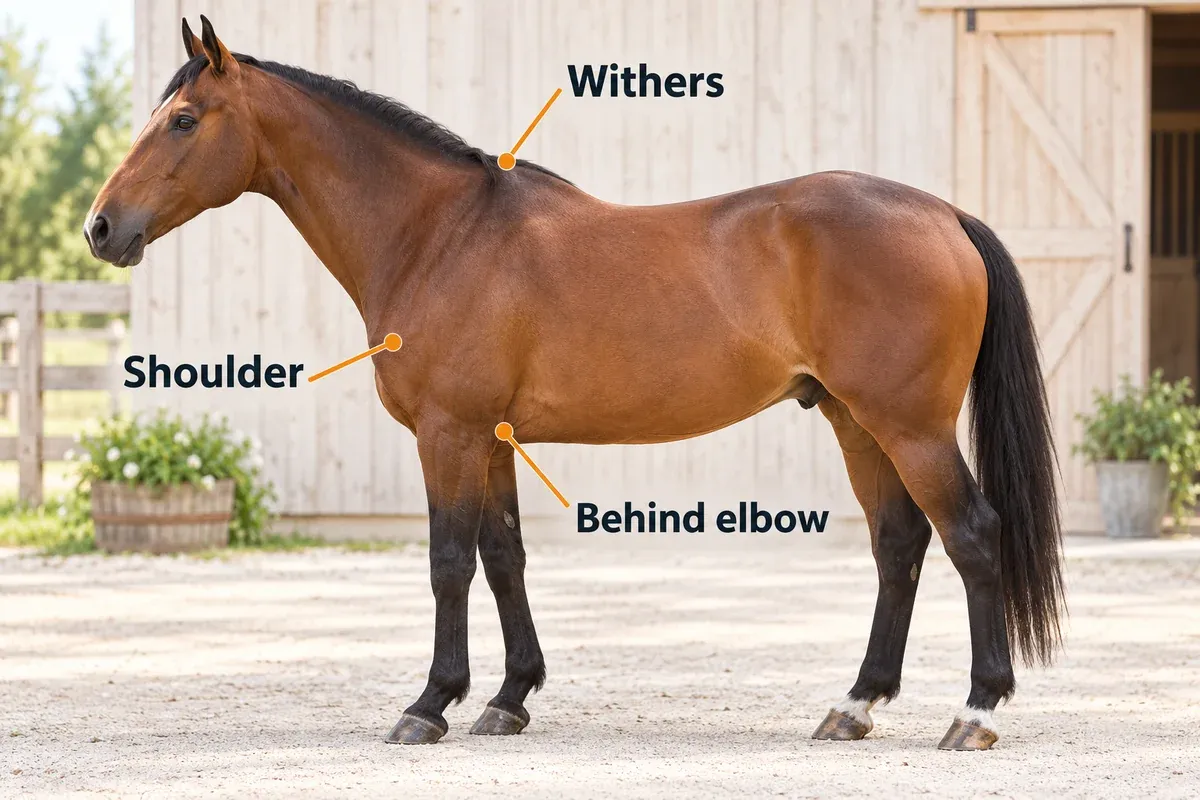
Hair loss at the front of the shoulder, a worn patch behind the elbow, or a rubbed spot over the withers is a sign that something is happening between the horse, the blanket, and the horse’s movement. It is not automatically proof that the blanket is too small. A blanket can also be too large, sit too far back, twist during turnout, or have the wrong neck and shoulder cut for that horse’s shape.
Quick answer: Remove the blanket, inspect the horse’s dry coat and skin, then check the neck, wither, shoulder, chest, and strap fit before adding another layer. If the blanket fits everywhere except the coat is chafing, a shoulder guard can help. If the chest closure pulls, use a chest expander or change the blanket cut. If the blanket repeatedly shifts or presses on a prominent wither, replace it with a better-fitting design instead of hiding the pressure with a thick liner.
This guide combines manufacturer fitting instructions and equine-care guidance. It is a fit and management guide, not a diagnosis of a skin condition. Open sores, heat, swelling, discharge, marked pain, or a rub that does not improve after the source of friction is removed deserve veterinary advice.
In this guide, you will learn:
- How to tell a tight shoulder, a slipping blanket, and a rough-surface rub apart
- How to measure and position a horse blanket before adjusting straps
- When a bib, liner, chest expander, or belly-strap extender makes sense
- Why layering can make a borderline fit worse
- Which linked options match each specific fit problem
- How to recheck the horse after movement, grazing, and rolling
Start with the symptom, not the product
The fastest way to waste money is to buy a larger blanket or a thicker liner before identifying where the pressure comes from. Use the pattern of the rub as a clue, then confirm it with the blanket off and on.
| What you see | Most likely fit clue | First check | First sensible fix |
|---|---|---|---|
| Even hair loss on both front shoulders | Chest or neck opening is tight, or the blanket is moving over a broad shoulder | Slide a hand down the neck and shoulder while the horse lowers its head | Refit the chest and try a shoulder guard only if there is no pinching |
| Rub is mostly on one shoulder | Blanket is twisting or slipping to one side | Look at the center line, surcingles, leg straps, and uneven dirt marks | Re-center and refit; replace the cut if it keeps rotating |
| Hair is worn at the top or front of the withers | Blanket is sitting too far back or pressing on a prominent wither | Check wither clearance with the horse standing and reaching down | Move the blanket forward; choose a wither-friendly cut if pressure remains |
| The chest closure pulls open or cuts into the front of the chest | Front width is too narrow for the horse’s shoulder | Keep the body length and back fit in mind while checking the chest | Use a chest expander or a broader-front blanket |
| Rub is behind the elbow with a damp, dirty coat | Friction is amplified by sweat, grit, or a liner that bunches | Feel for moisture, grit, and folds after turnout | Clean and dry the contact layers; remove the offending layer |
| No rub, but the horse is sweaty under the shoulders | The problem is heat or trapped moisture, not insufficient padding | Check under the blanket after work and during warmer weather | Reduce fill or remove the liner; do not add a bib over a damp coat |
A clean, symmetrical wear pattern can still be a fit problem. A one-sided patch is more suggestive of shifting, a twisted strap setup, or an uneven blanket surface. Either way, stop the repeated friction before it becomes a skin injury.
The marked areas below help you compare both sides of the horse. Note the position of a rub before checking where the blanket presses or shifts.
The five-minute horse blanket fit check
Do the check with the horse standing square, coat dry, and the blanket clean. A second person makes measuring and movement checks much easier.
1. Measure the horse, not the old blanket
Use a soft tape from the center of the chest, around the widest part of the shoulder, to the point of the buttock.
Do not use height at the withers as a substitute for this measurement. Two horses of the same height can have very different chest width, shoulder angle, back length, and wither shape.
2. Place the blanket where the coat lies naturally
Lay the blanket over the back and slide it into position so the coat lies flat. The front should sit in front of the withers rather than dragging backward as the horse moves. WeatherBeeta’s blanket-fitting instructions specifically emphasize a comfortable fit over the withers and shoulders so the blanket does not slip back.
If the blanket is too long, the tail seam can sit below the top of the tail and the whole blanket may shift. If it is too short, the chest and shoulder opening can pull tight even when the back looks covered.
3. Test the neck, withers, and shoulder in motion
With the front closure fastened, slide your hand down the neck of the blanket and up over the shoulder. You should not feel a hard edge pressing into the withers, and the fabric should not restrict the horse when the head reaches down to graze or feed. The blanket should follow the shoulder instead of stopping the shoulder from rotating.
Ask the horse to lower its head, walk a few steps, and turn. If the blanket creeps backward, pulls the chest straps tight, or leaves a deep fold behind the elbow, the cut is not working in motion even if it looked acceptable while standing still.
4. Adjust the straps for stability, not extra pressure
Fasten the chest first, then the belly and leg straps. The WeatherBeeta fit guide recommends equal leg-strap adjustment with roughly a hand’s width between the leg straps and the horse’s thigh. Its instructions also show the two leg straps looped together so they pull against one another rather than hanging toward the legs.
Belly or surcingle straps should be secure without digging in. A dangling strap is an entanglement risk; a strap tightened to compensate for a loose or badly cut blanket can add pressure elsewhere. If your blanket fits the chest but the belly straps are simply too short, that is the narrow use case for a strap extender—not a reason to loosen everything.
5. Recheck after real movement
Inspect the horse after 30 to 60 minutes of walking or turnout, and again after grazing or rolling. Look for new hair laid in the wrong direction, damp patches, grit under a bib or liner, a blanket that has rotated, and chest or wither pressure. A fit that works only while the horse stands still is not a reliable fit.
Why horse blankets rub the shoulders or withers
The blanket is too tight in front
A tight neck opening or narrow chest closure makes the blanket pull across the front of the shoulder.
The blanket is too large and slips back
Oversizing is not always generous. A blanket that moves backward can drag the front edge over the withers and repeatedly sweep across the shoulder. The result may look like a small blanket because the chest feels tight after the blanket has migrated, but the original cause is movement.
The cut does not suit the horse’s conformation
High withers, a narrow chest, broad shoulders, a short back, and a deep shoulder angle all change the fit. The correct length does not guarantee the correct front shape. This is when gussets, a shaped wither pad, a smoother lining, or a different chest closure can matter more than a higher denier number.
A liner changed the fit
Adding insulation increases the total thickness around the neck, chest, and shoulder. A liner can make a comfortable shell too tight, trap sweat, or create folds that rub behind the elbow. It is a useful layer only when the outer blanket has enough room and the liner is secured so it cannot bunch.
Dirt, moisture, or a damaged seam adds friction
Dried sweat, sand, mud, and rough stitching turn a tolerable fit into a rub. Check the blanket’s inside surface with your hand. A broken buckle, stretched elastic, curled binding, or rough repair is a reason to stop using the blanket until it is fixed or replaced.
Product options by problem, not by hype
The table below is intentionally diagnostic. The products solve different parts of the problem, and none of them can make a fundamentally pinching blanket safe.
-
WeatherBeeta Satin Shoulder Guard, Black, Full
WeatherBeeta
A simple satin shoulder guard that slips on over the horse and uses a front chest loop to help protect the coat from blanket friction.
- Lightweight satin outer layer helps reduce blanket rubbing
- Front chest loop helps keep the guard in place
- Slip-on design is quick to put on and remove
- Use when
- A low-cost, lightweight barrier when the blanket already fits well
- Fit job
- Surface barrier for an otherwise sound blanket fit
-
Harrison Howard Breathable Elastic Horse Shoulder Guard Anti-Rub Stretch Bib, Large
Harrison Howard
An all-elastic, moisture-wicking bib covering the chest, shoulders, and withers, with an elastic girth and hook-and-loop fastening to limit shifting.
- Soft all-elastic fabric is breathable and moisture-wicking
- Covers high-friction areas at the chest, shoulders, and withers
- Elastic girth with hook-and-loop closure helps stabilize the bib
- Use when
- A breathable, fuller-coverage anti-rub layer under a blanket
- Fit job
- Breathable barrier for chest, shoulder, and wither rubs
-
Tough 1 Soft Fleece Blanket Liner/Sheet, X-Large
Tough 1
A 100% soft-fleece liner/sheet with a front buckle, tail cord, and four size options. It can reduce direct coat-to-shell friction, but it also changes the total blanket fit.
- 100% soft fleece adds warmth and a softer contact layer
- Front buckle closure and tail cord help keep the liner positioned
- Use when
- Adding warmth and a soft fleece interface when the shell has enough room
- Fit job
- Soft interface and added warmth for a roomy shell
-
Rhinegold Horse Rug Chest Expander, Universal Extension
Rhinegold
A buckle-on chest expander designed to reduce pulling across the front of a standard rug without replacing the entire blanket.
- Designed for broad shoulders and reduced chest pulling
- Universal design fits standard rugs with compatible clips and buckles
- Attaches with simple buckle clips in a classic navy finish
- Use when
- A broad-shouldered horse whose blanket length and back fit are otherwise correct
- Fit job
- Front-chest width adjustment
-
Tough 1 Belly Surcingle Strap Extensions
Tough 1
Adjustable strap extensions that add 8-12 inches to belly/surcingle reach. They solve a strap-length problem, not a shoulder or wither fit problem.
- Adjustable 8-12-inch extension range described
- Designed for belly or surcingle straps
- Useful when the blanket body and chest already fit
- Use when
- A blanket whose belly or surcingle straps are too short after the chest fit is correct
- Fit job
- Belly/surcingle strap length only
-
BARN & STABLE 600D 200g Turnout Blanket
BARN & STABLE
A 600D polyester turnout blanket with 200g fill, a waterproof and breathable shell, fleece wither protection, and shoulder gussets.
- 600D polyester outer shell
- 200g midweight poly-fill
- Double-buckle front with hook-and-loop assist
- Use when
- Midweight turnout with adjustable front buckles
- Fit job
- See product page
-
WeatherBeeta ComFiTec Essential Turnout 0g, Navy/Burgundy, 87-inch
WeatherBeeta
A 1200D turnout sheet with a smooth 210T lining, fleece wither pad, traditional side gusset, adjustable quick-clip front closure, and WeatherBeeta liner compatibility.
- 1200D ripstop shell with waterproof and breathable Guard-Tec coating
- Smooth 210T lining and fleece wither pad reduce friction pressure
- Side gusset and adjustable quick-clip front closure support movement and fit changes
- Use when
- A fit-focused, waterproof 0g shell when repeated rubs justify changing blanket cut
- Fit job
- Full blanket replacement with shoulder/wither fit features
Review the linked product page before purchasing.
Shoulder guards: when the blanket fits but the coat needs a barrier
The WeatherBeeta Satin Shoulder Guard is the low-cost, simple option in this group. Its satin surface, slip-on design, and front chest loop are useful when the blanket has adequate room and the problem is surface friction. It is not a solution for a tight neck, a pressed-down wither, or a blanket that rotates.
Check current price on Amazon →The Harrison Howard Stretch Bib provides broader coverage at the chest, shoulders, and withers. Its all-elastic, moisture-wicking fabric and elastic girth can be a better match for a horse that needs a soft, breathable layer under a blanket for longer periods.
Check current price on Amazon →Use either guard only after the fit check. Put it on a clean, dry coat, smooth out folds, fasten it so it stays in place without constricting the chest, and inspect behind the elbow after movement. A shoulder guard should reduce friction; it should never be used to keep a painful or open rub covered.
Fleece liner: useful only when the shell has spare room
This is the right category when the shell already fits, the horse needs added warmth, and you want a softer interface between coat and outer blanket. It is the wrong first move when the shoulder is already pinched. Fleece adds bulk, and added warmth can create sweat that makes rubbing worse. Fit the liner and outer blanket together, then check the horse’s temperature and the contact points.
Check current price on Amazon →Chest expander: for a broad front, not a high-wither gap
This is a targeted adjustment. It can create front width without immediately replacing a blanket that otherwise works, but it cannot lift a blanket away from a prominent wither or fix a blanket that is too long and slipping backward. Confirm clip style, chest position, and the resulting neck clearance before turnout.
Check current price on Amazon →Belly-strap extender: the narrow fix many owners mistake for a chest fix
the product documentation states an adjustment range of 8-12 inches. They are useful when the blanket body and chest fit correctly but the belly straps do not reach comfortably after a horse changes condition or the blanket’s strap layout differs from the horse’s shape.
They do not make the shoulder opening wider. Do not loosen the belly straps to create apparent shoulder room; loose straps can hang where a leg can catch them. Measure the existing strap and buckle style, install the extension securely, and keep the finished strap snug rather than dangling.
Check current price on Amazon →Better-fitting blanket: when the same rub keeps returning
If a bib, cleaned seam, and careful adjustment only postpone the rub, the blanket cut is probably the real problem. Look for a front closure that can be adjusted without pulling the fabric into the chest, a shoulder gusset or shaped front, a smooth lining, useful wither clearance, and stable surcingles. A thicker shell or a higher denier alone does not guarantee any of those things.
It is still a 200g winter blanket, so choose it for the horse and weather rather than the rub alone. A horse that needs a 0g shell, a lighter layer, or a different size should not be put into a 200g blanket just because the front is better shaped.
Check current price on Amazon → Check current price on Amazon →The product is a strong fit-feature candidate when you need a waterproof shell and the current blanket keeps pressing or shifting. It is not a heavyweight winter blanket, and its premium price is unnecessary when a simple refit or low-profile shoulder guard solves the issue.
A sensible fix order
Use this sequence so each change teaches you something about the problem:
- Remove the source of friction. Take off the blanket and any liner or bib that leaves grit, sweat, a fold, or a pressure mark. Do not put a wet or dirty contact layer back on the horse.
- Inspect the horse and blanket. Check both shoulders, the top of the withers, behind the elbows, the chest closure, and the blanket’s inside seams. Photograph the pattern if the rub is recurring; it makes comparison easier.
- Refit the existing blanket. Measure the horse, lay the blanket forward so the coat lies flat, and check the neck, shoulder, chest, belly, and leg straps in motion.
- Choose one targeted adjustment. Use a shoulder guard for surface friction, a liner for a roomy shell that also needs warmth, a chest expander for front-width pressure, or a belly extender only for strap length.
- Change the blanket cut if the issue repeats. Repeated shoulder or wither rubs, a rotating blanket, or restricted shoulder movement call for a different size or design—not endless layers.
- Recheck after turnout. Inspect the horse after movement and wash the protective layer before grit accumulates.
The University of Kentucky’s blanketing guidance also stresses that blanketing is a daily management decision influenced by weather, coat, body condition, shelter, and forage. A more comfortable fit does not make an overly warm blanket appropriate for the conditions.
What not to do
- Do not size up blindly. A larger blanket can add length and movement while still leaving a tight front edge.
- Do not use a thick liner to pad over a hard pressure point. Padding can conceal the warning sign while increasing total pressure.
- Do not loosen the belly or leg straps until they dangle. Stability and safe strap placement matter during turnout and lying down.
- Do not keep a blanket on raw, hot, swollen, or weeping skin simply because the forecast is cold. Remove the friction source and ask your veterinarian what the skin needs.
- Do not assume a high denier rating means a better shoulder fit. Denier describes shell durability; cut, closure, lining, and gussets determine how the blanket behaves on the horse.
- Do not wash a bib or liner with heavy fragrance or leave detergent residue in the fabric. Any new irritant can be mistaken for a fit failure.
Frequently Asked Questions
Can a shoulder bib fix a horse blanket that is too tight?
No. A bib can reduce coat-to-blanket friction when the blanket has adequate room and stays centered. It cannot create clearance over the withers, widen a restrictive neck opening, or stop a blanket from pulling the shoulder backward. Check the fit first.
Should I buy the next larger blanket if the shoulders rub?
Only after measuring and checking the blanket’s position. Compare length, neck, shoulder, and chest—not just the number on the tag.
Is a fleece liner a good way to prevent shoulder rubs?
It can help when the outer blanket fits comfortably and the problem is a soft, clean contact layer or the horse needs more warmth. It can make a borderline-tight blanket tighter, alter how the chest closes, and trap sweat. Recheck the combined layers after movement.
How much space should there be over the withers?
There should be no hard pressure, and you should be able to slide your hand under the blanket and up the shoulder while the horse can lower its head freely. Exact clearance depends on the blanket’s cut and the horse’s shape, so a hand check plus a movement check is more useful than one universal number.
Why does only one shoulder rub?
One-sided rubbing often points to a blanket that twists, uneven strap adjustment, a damaged seam, or a horse that moves asymmetrically. Center the blanket, check both surcingles and leg straps, inspect the inside surface, and observe the horse walking before choosing a new product.
When should a blanket rub be checked by a veterinarian?
Ask for veterinary help when the area is open, hot, swollen, painful, draining, repeatedly scabbing, or not improving after the blanket is removed. Hair loss can also have causes unrelated to the blanket, so persistent or spreading changes should not be managed with equipment alone.
Bottom line
Treat a shoulder or wither rub as a fit diagnosis. If the blanket is otherwise roomy and stable, start with a clean, low-profile shoulder guard. If it fits but needs warmth, consider a liner and reassess the combined fit. If the front closure pulls, a chest expander can be a precise short-term adjustment; a belly-strap extender is only for strap reach.
When the same mark returns after a careful refit, move to a different blanket cut with usable wither clearance, a smoother lining, a stable front closure, and enough shoulder freedom. The goal is not the thickest or most expensive layer. It is a dry, comfortable horse whose blanket stays in position while the horse moves.
Sources and further reading
- WeatherBeeta: How To Fit Your Blanket — neck, shoulder, wither, surcingle, and leg-strap positioning.
- WeatherBeeta: Horse Blanket Size Guide — body-length and back-seam measurements, including the between-sizes rule.
- The Horse: Tips for Correctly and Safely Fitting a Horse Blanket — practical fit checks, rub prevention, and daily inspection guidance.
- University of Kentucky: Blanketing Horses: Do’s and Don’ts (PDF) — individual weather, coat, body-condition, shelter, and forage considerations.
- FarmVet: Blanket Rub Solutions — additional discussion of friction, conformation, protective layers, and daily checks.