

 Published sources
 Product details checked
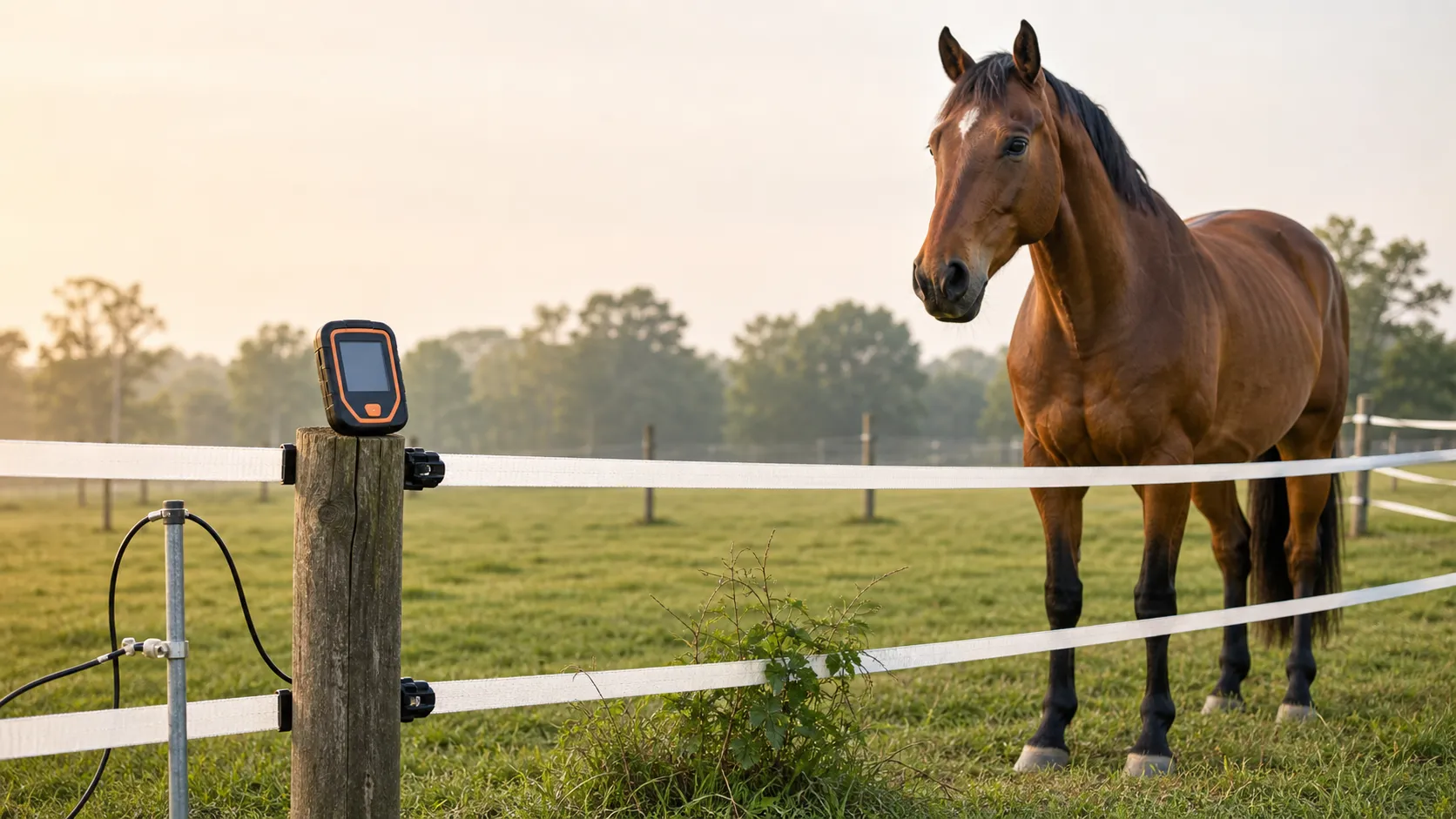
When a horse suddenly leans through an electric fence, the charger light can make the problem confusing. The energizer may be clicking and showing a normal indicator while the far end of the fence has lost most of its useful voltage. Grass touching the lower tape, a loose gate connection, a cracked insulator, dry soil, or a failing ground system can all create the same symptom: a fence that feels weak to the horse.
Quick answer: Move the horse to a safe backup area, then use a purpose-made pulse fence voltmeter. Test the energizer with the fence disconnected, test the grounding system, and then measure every hot wire near the charger and at the farthest point. If the charger is strong but the far end is weak, clear vegetation and inspect connections before buying a larger charger. If the charger itself is weak, check its power source, fuse, battery, and lightning damage before replacing it.
In this guide, you will learn:
- What a charger light can and cannot tell you
- How to distinguish a grounding problem from a vegetation short
- What voltage range is a sensible warning point for horses
- How to test the charger, near fence, far fence, ground rods, gates, and lead-out cable
- When a digital tester or a new low-impedance charger is useful—and when it is the wrong purchase
- Which linked products match the measured problem rather than adding more hardware blindly
The three-reading fault map
The fastest useful diagnosis comes from comparing readings, not from staring at the charger’s status light. Record the value at each point so you can see where the voltage falls.
| Reading point | What it answers | What a weak result suggests |
|---|---|---|
| Energizer fence terminal with the fence lead disconnected | Is the energizer producing a proper pulse? | Power, battery, fuse, internal damage, or an undersized/failing charger |
| Ground rods while the fence is deliberately loaded according to the meter or charger instructions | Can the grounding system carry the return path? | Too few rods, poor clamps, dry or frozen soil, corrosion, or a broken ground lead |
| Fence immediately after the lead-out connection | Is the pulse reaching the fence? | Bad lead-out cable, gate switch, jumper, connection, or insulator near the start |
| Farthest section and each hot wire | Does the fence hold voltage along its full length? | Vegetation, a cracked insulator, a broken conductor, a wet branch, a bad gate crossing, or high-resistance poly tape |
The voltage should normally remain high when nothing is touching the wire. Virginia Tech explains that a major voltage drop together with increased current usually means current is escaping somewhere, such as through vegetation, a worn insulator, a metal T-post, or a downed fence section. A basic voltage meter cannot show every part of that pattern, but it can show where the line stops behaving normally.
What voltage should a horse electric fence have?
There is no single number that fits every horse, wire type, climate, charger, and fence layout. Sources also use different definitions: some discuss the minimum voltage needed at the animal, some describe a typical fence reading, and some describe the charger’s no-load output.
Here is a practical way to read the guidance:
| Fence reading at the animal’s contact point | How I would interpret it |
|---|---|
| Below 2,000 V | Treat it as a clear containment problem until proven otherwise |
| 2,000–3,000 V | The lower horse-fence range cited by Zareba; it may be inadequate for a long run, thick winter coat, heavy vegetation, or a determined horse |
| Around 3,500 V | A useful warning threshold because Rutgers describes anything below 3,500 V as ineffective on its fences |
| 5,000–6,000 V | A common operating target in extension or equine-farm guidance when the fence is correctly installed and maintained |
Zareba recommends a minimum of 2,000–3,000 volts on the fence line for horse containment and notes that vegetation, fence length, and poly tape or rope affect the reading. Rutgers describes roughly 6,000 volts as typical on its fences and says a reading below 3,500 volts would be ineffective there. The University of Georgia’s older horse-fence guidance says that at least 700 volts can control short-haired animals, but that figure should not be treated as a modern horse-paddock target; it is a minimum physiological reference, not a comfortable maintenance goal.
Use the number as a diagnostic trend. A fence that reads 6,000 V beside the charger and 1,400 V at the far corner has a fault even if the horse still gets a small shock. A fence that reads 4,000 V at both ends may need a better design, more capacity for its vegetation load, or a different wire arrangement—but it does not automatically need a new charger.
First: protect the horse and yourself
Before you troubleshoot, put the horse behind a reliable physical barrier or in a temporary paddock with clean water and forage. A horse that has discovered a weak fence can keep testing it, and a short repair session is not a reason to leave the animal loose beside an unreliable boundary.
Switch off the energizer before disconnecting fence or ground leads, removing a broken insulator, clearing a branch, or opening a gate connection. Turn it on only when people, tools, and animals are clear. Never touch a live fence to “feel” whether it works, and never use a household multimeter, screwdriver, or improvised bulb as a pulse-fence tester.
Stop and use a qualified electrician or fence professional for any of the following:
- A mains-powered energizer with damaged wiring, a burnt smell, repeated fuse failure, or lightning damage
- A fence energizer installed near a barn, water pipe, milking equipment, or other farm grounding system
- A persistent shock on gates, waterers, metal buildings, or other equipment that should be dead
- Underground or buried cable damage that cannot be isolated safely
- Work involving the building’s electrical panel, permanent receptacle, lightning protection, or stray voltage
A safe troubleshooting sequence
1. Walk the line before changing anything
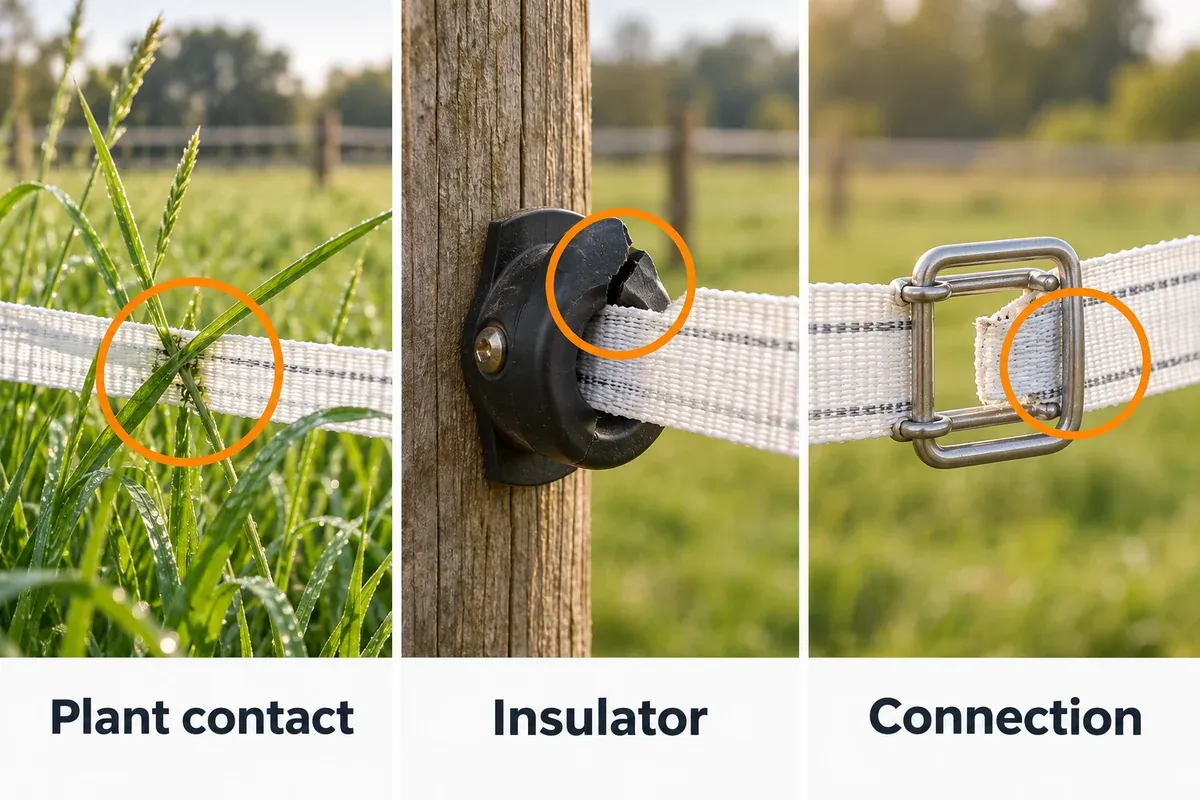
With the energizer off, walk the entire fence. Look for the failures that create a direct path to earth:
- Green grass, weeds, vines, brush, or a wet branch touching an energized tape or wire
- A tape sagging onto a metal post, ground wire, wet soil, or fallen tree
- Cracked, dirty, loose, or incorrectly sized insulators
- A broken strand, frayed poly tape, corroded wire, loose crimp, or burnt connection
- A gate handle, cut-out switch, underground crossing, or jumper that has come loose
- A metal T-post or brace touching a hot conductor
- An energizer indicator that is off, blinking unusually, or showing a battery or grounding warning
Pay special attention to the lowest hot wire after rain and during rapid grass growth. One blade may not be enough to collapse a low-impedance charger, but a continuous wet load along several hundred feet can drain a surprisingly large amount of the pulse.
The close-ups below show the kind of fault to look for on your walk. Keep the horse behind a reliable barrier while you inspect the line.
2. Test the energizer by itself
The charger must be separated from the fence before you can blame the charger. Turn it off and unplug or disconnect its power source. Remove the fence lead and the ground lead from the output terminals, following the energizer manual. Make sure the fence is clear, then power the unit back on and use the pulse-fence meter across the energizer’s fence and ground output terminals.
Virginia Tech describes about 7,000–9,000 V as a healthy test range for the energizers in its troubleshooting procedure. Your manufacturer may specify a different no-load range, so use the manual as the final reference. If the reading is low with the fence disconnected, the pasture wire is not the first problem to solve. Check the battery state, solar charge controller, mains supply, fuse, terminal corrosion, and any visible lightning damage. A charger can click and still fail to deliver a useful pulse.
If the energizer produces a strong no-load reading, turn it off again before reconnecting the fence. The next test is where the pulse is being lost.
3. Compare the near end with the far end
Reconnect the fence and ground leads, clear the area, and test the first accessible fence section. Then test the farthest section you can reach, plus every hot wire on a multi-wire fence. Test both sides of gates, lane crossings, cut-out switches, and any repair.
Do not confuse the charger’s no-load number with the voltage at the horse’s nose. The far-end reading is the important number for containment. A high reading at the charger and a low reading at the last post usually points to a short, poor connection, excessive resistance, or a vegetation load between those points.
4. Check the ground system, not just the hot wire
An electric fence is a circuit: the pulse leaves the energizer on the hot wire, passes through the horse and soil, and returns through the ground rods to the energizer. If the ground path is weak, the fence can show a voltage reading in the air but deliver a disappointing shock when the horse touches it.
Inspect the ground terminal, ground lead, clamps, and every rod connection for looseness, rust, corrosion, or a broken cable. The ground rods should be driven deep enough to reach moist soil and spaced apart rather than clustered beside the energizer. Extension guidance commonly describes at least three rods separated by about 10 feet for many livestock energizers, with more grounding capacity for larger output or dry conditions. The energizer manual and local electrical requirements take priority because rod count depends on joules, soil, climate, and the fence design.
Keep the fence grounding system separate from household, utility, water-pipe, and barn-equipment grounds. The University of Georgia’s horse-fence guidance places the controller ground away from other farm grounding systems, while Virginia Tech recommends keeping rods away from utility grounds and metal water pipes. This is a safety issue, not a place for a salt, oil, or water “hack.”
Advanced ground-rod test
Some digital fence testers and charger manuals describe a loaded-ground test: temporarily load the fence far from the ground rods, measure the voltage on the ground rod farthest from the energizer, and add grounding capacity only if the reading remains too high. Virginia Tech’s procedure uses a deliberate fence load and aims for 500 V or less on the remote ground rod. That is a controlled test, not permission to throw a metal bar onto a live wire without understanding the pulse, the meter, and the local setup.
If you are not comfortable interpreting that test, record the charger output, near-end voltage, far-end voltage, soil conditions, and rod layout, then call a fence installer. Adding rods at random can hide the actual problem and may create stray-voltage risks if the system is bonded incorrectly.
5. Remove vegetation as a measured repair
Turn the energizer off before trimming. Clear the lower hot wire, the space beside each insulator, fence corners, the area around gate hardware, and any place where tall grass bends into the tape after rain. Do not spray a pasture-edge herbicide simply because it is convenient; the label, grazing restrictions, drift risk, and horse access matter.
After clearing one section, turn the energizer on and retest the same point. If the voltage rises sharply, you found a real load. If it does not, keep walking the line rather than buying a bigger charger. Vegetation can be seasonal: a fence that works in spring may fail in a wet summer week, and a solar fence may show the problem sooner because its energy reserve is smaller.
6. Inspect gates and lead-out cable
Gates are common weak links because the hot wire often crosses from one side to the other through an underground lead-out cable, a cut-out switch, or a jumper. Use insulated lead-out cable made for electric fencing under gates and through buildings. Virginia Tech warns that residential electrical wire is not adequate for high-voltage fence pulses and recommends protecting buried lead-out cable from abrasion, including with conduit where vehicles or hooves can damage it.
Test on both sides of every gate. If the first section is strong and the far side is weak, isolate that crossing before you replace the charger. Also check whether a gate has accidentally become energized through a metal hinge or whether a cut-out switch is arcing, wet, or only partly closed.
7. Decide whether charger capacity is actually the problem
Only after the system passes the basic checks should you compare the energizer’s capacity with the fence. Use the horse electric fence energizer size calculator to record fence-route length and total hot-conductor length separately, then compare the manufacturer’s ratings for your layout and vegetation. Measure each connected run once and count its hot strands separately. Include internal divisions, temporary sections, conductor type, and normal seasonal conditions; the calculator explains when a length-only joule reference applies.
Low-impedance chargers tolerate some leakage better than older high-impedance designs. That does not make a low-impedance unit maintenance-free. The University of Maine’s electric-fence design guidance notes that heavy vegetation can require more joule capacity and identifies poor grounding as a leading cause of fence problems. Mississippi State similarly recommends matching the charger to fence length, soil moisture, wire type, vegetation, and animal hair, rather than relying on a marketing mileage number.
Do not connect two energizers to the same perimeter. If a perimeter is too large for one unit, divide it into independent systems using a qualified installer’s design.
Reading patterns that save a wasted purchase
| Charger alone | Near fence | Far fence | Most likely next step |
|---|---|---|---|
| Low | Low | Low | Check power source, battery, fuse, terminals, and energizer condition |
| High | Low | Low | Inspect the lead-out cable, first connection, nearby insulators, and ground return |
| High | High | Low | Walk from near to far: clear vegetation, inspect gates, joins, broken wire, and insulators |
| High | High | High, but ground test high under load | Improve the ground system using the manual and a controlled test; check dry or frozen soil |
| High at every test point | High | High | Look beyond voltage: fence visibility, wire height, training, winter coat or blanket, physical gaps, and horse behavior |
The last row matters. A strong meter reading does not prove that the fence is safe or well designed. A horse may avoid a wire when untrained, then learn to push through it later. A rug can reduce the contact quality. A low, nearly invisible line can be ignored even when the pulse is strong. Electric fencing is a psychological barrier, so horses need a calm introduction and a visible, well-maintained boundary.
Products that fit the diagnosis
The products below are tools for a defined branch of the fault map. The tester comes before a charger purchase. The two chargers are examples of different capacity levels, not automatic recommendations for every paddock.
Tools for checking a weak horse fence
-
allsun Digital Electric Fence Voltage Tester and Fault Finder
allsun
A compact digital fence meter intended for 300 V to 9.9 kV pulse measurements with voltage and grounding/fault indications. It helps separate a charger problem from a fence-line problem, but it is not a substitute for an electrician or a full directional fault finder.
- Numerical LCD reading for pulsed fence voltage
- 300 V to 9.9 kV range described
- Grounding and fault-finder functions described
- Best for
- A first numerical check of fence voltage and the grounding side of a weak horse fence
- Key feature
- Low-cost numerical fence diagnostic meter
-
ALLOSUN EM555 Digital Electric Fence Tester, Max 9.9 kV
ALLOSUN
The EM555 is a simple digital pulse-voltage tester with a maximum reading of 9.9 kV. It is useful for logging the charger, near end, and far end of a fence, but it gives less diagnostic context than a meter that also reports current direction or amperage.
- Digital fence-voltage display
- Maximum 9.9 kV reading described
- Best for
- A straightforward spare or second meter when you want a simple maximum-9.9-kV reading
- Key feature
- Simple numerical backup meter
-
Zareba EAC10M-Z 10-Mile AC Low-Impedance Fence Charger
Zareba
A low-impedance energizer with 0.5 output J and a 115 V, 60 Hz mains supply. Zareba's poly-fencing limits are 5 miles clear, 2.5 miles with light weeds and 1 mile with heavy weeds; confirm the conductor and multi-strand layout.
- 115 V, 60 Hz mains supply
- 0.5 output J
- Separate steel and poly-fencing distance limits
- Best for
- A maintained, modest permanent fence with a suitable US mains supply
- Key feature
- Permanent low-impedance energizer for smaller fence systems
-
Zareba EAC50M-Z 50-Mile AC Low-Impedance Fence Charger
Zareba
A low-impedance energizer with 2 output J and a 115 V, 60 Hz mains supply. Zareba's polywire limits are 25 miles clear, 12 miles with light weeds and 6 miles with heavy weeds; grounding and installed voltage still require testing.
- 115 V, 60 Hz mains supply
- 2 output J
- Separate steel and polywire distance limits
- Best for
- A longer permanent fence or greater seasonal load that exceeds the smaller AC models' ratings
- Key feature
- Higher-capacity permanent energizer for long or heavily loaded fences
Review the linked product page before purchasing.
Digital voltage and grounding check: allsun B07DCKG2SX
The Check current price on Amazon → is the most useful first purchase in this article because it turns “the fence feels weak” into comparable numbers.
Use it to record the energizer, near-end, far-end, and gate readings. That is enough to identify many vegetation, connection, and distance problems. The limitation is important: a compact meter does not replace a professional fault finder with directional current information, and voltage alone does not prove that the fence remains strong under load.
Pros:
-
Numerical readings make near-versus-far comparisons possible
-
Useful for routine seasonal checks after mowing, storms, and rapid growth
Cons:
- A reading does not repair the fault or prove the charger is correctly sized
- the product documentation’s “fault finder” wording should not be confused with a full directional amp meter
Simple backup meter: ALLOSUN EM555
It makes sense for a basic logbook routine: test the charger, test the near end, test the far end, and write down the numbers. It makes less sense as the only diagnostic tool when you need to locate a hidden short or compare current direction. Choose it for its simplicity, not because 9.9 kV is a target voltage.
Pros:
-
Clear numerical fence-voltage check
-
Practical spare for a second barn or trailer
Cons:
- Less diagnostic context than a true amperage or directional fault finder
- Does not test household GFCI circuits or replace an electrician’s equipment
- The maximum display range is not a recommendation for charger output
Small permanent system: Zareba EAC10M-Z
If the charger-alone test is low and the fence is genuinely short enough for the unit, the Check current price on Amazon → is a 10-mile AC low-impedance energizer with a described 0.5-joule output.
That makes it a candidate for a permanent, powered small or medium fence—not a default fix. A 10-mile marketing range does not mean 10 miles of several strands of wet poly tape and weeds. Confirm the total energized length, the actual far-end voltage, the ground system, and the electrical installation before choosing it.
Pros:
- Low-impedance design is more suitable for normal vegetation loads than an old high-impedance unit
- AC power avoids routine battery charging for a permanent installation
Cons:
- 0.5 joule may be too little for long, multi-strand, or heavily vegetated fences
- It cannot solve poor grounding, a direct short, or a damaged lead-out cable
- Mains installation needs dry protection and the correct local electrical setup
Longer or heavier-loaded system: Zareba EAC50M-Z
This is the kind of product to consider only after a measured diagnosis shows that the existing energizer is undersized for the real fence load. More joules do not compensate for a bad ground or a hot wire lying in wet grass. In fact, a larger charger can make an unresolved short harder on the system and can increase the consequences of incorrect installation.
Pros:
- Higher described output for long or heavily loaded permanent fences
- Low-impedance design suits the vegetation problem described in this guide
Cons:
- Overkill for a short, clean horse paddock
- A mileage claim cannot replace a measured far-end voltage check
- Lightning protection, grounding, and mains work deserve professional review
What not to buy or do first
Do not buy a larger charger because the far end is weak
If the charger tests strong and the first fence section is strong, a low far-end reading is evidence of a line fault until you find another explanation. Clear the vegetation, test both sides of the gates, inspect the buried lead-out cable, and check every insulator before increasing output.
Do not rely on a row of lights
A charger light confirms that the unit is doing something. It does not tell you whether the far corner has 6,000 V or 800 V. A numerical pulse meter is more useful for a maintenance record, especially when soil moisture and plant growth change.
Do not improvise the ground
Do not pour salt, fertilizer, oil, or random chemicals around a rod. Do not connect the fence ground to a household ground, water pipe, or barn metalwork without an approved design. Do not mix copper, galvanized steel, and clamps casually; dissimilar-metal corrosion can create a new weak connection. Use compatible described hardware and follow the energizer manual.
Do not leave a weak fence as the horse’s only barrier
Until the fence holds a reliable reading at the far end, use a sound physical boundary or move the horse. Electric tape is not a structural substitute for safe perimeter fencing, especially for a frightened horse, a new horse, a foal, or a horse that has already learned it can push through.
A maintenance routine that catches seasonal failures
Keep a small log beside the energizer. Record the date, weather, charger-alone reading, near-end reading, far-end reading, and anything you changed. Then check the fence:
- After every lightning storm, power interruption, mowing session, or fallen branch
- Weekly during fast grass and vine growth
- At the start of a dry season or after the ground freezes
- Whenever the horse begins leaning, rubbing, cribbing, crowding a gate, or testing a familiar section
- After moving a temporary fence or adding tape, rope, polywire, or another paddock
Trend data is more useful than one good reading. If the far end falls every time the rain arrives, vegetation or wet insulators may be the primary leak. If every reading collapses after several dry weeks, the ground system or earth-return design deserves attention. If the charger-alone output falls after a storm, stop treating it as a pasture-maintenance problem and inspect the energizer professionally.
Frequently Asked Questions
Why does my horse’s fence light say it is working when the fence feels weak?
The light is usually a charger-status signal, not a far-end voltage measurement. A direct short, vegetation load, broken connection, or poor ground can leave the charger clicking while the horse-contact point has too little voltage. Test the charger alone, then compare the near and far fence sections with a pulse fence meter.
How many volts does a horse electric fence need?
Treat anything below 2,000 V at the horse-contact point as a clear problem. Zareba cites 2,000–3,000 V as a minimum range for horses, Rutgers describes below 3,500 V as ineffective on its fences, and roughly 5,000–6,000 V is a common practical operating target in well-maintained systems. The correct number still depends on the horse, coat, wire, vegetation, soil, and charger.
Can grass really make an electric fence weak?
Yes. Wet grass and vines provide a path for pulse energy to leak into the soil. A small touch may be tolerated by a low-impedance charger, but continuous contact across many feet of wire can pull the far-end voltage down. Turn the energizer off, clear the contact, and retest before deciding the charger is bad.
How many grounding rods do I need?
Follow the energizer manual first. A common extension baseline for many livestock energizers is at least three deep rods spaced roughly 10 feet apart, with additional grounding capacity for higher joule output, dry soil, rocky soil, or a continuous-ground design. Rod count is not safely determined by the pasture acreage alone.
Does dry ground make a horse fence weaker?
It can. In a standard earth-return system, the horse bridges the hot wire to the soil and the current returns through the ground rods. Very dry, frozen, rocky, or sandy soil can increase resistance. A properly designed ground-wire or earth-return system may help, but it must be installed according to the energizer and fence design rather than added as a random second wire.
Should I test only at the charger?
No. The charger-alone test tells you whether the energizer can make a pulse without the fence attached. The far-end test tells you whether that pulse survives the actual wire, insulators, gates, vegetation, and connections. Both readings are needed.
Is a stronger charger safer for a horse?
Not automatically. The goal is a reliable, brief, correctly installed pulse—not the highest number on a product box. Oversizing can hide a maintenance problem, stress a faulty system, or be inappropriate for the fence design. Match output to the actual energized length, vegetation load, wire type, grounding, and manufacturer guidance.
My horse crosses the fence even though the voltage is good. What now?
Check visibility, wire height, physical gaps, training, and contact quality. A thick winter coat or blanket can reduce the felt shock, and a horse that was never calmly trained may not respect a psychological barrier. Use a safe physical fence while you correct the layout and seek experienced equine-fence advice.
Bottom line
A weak horse electric fence is usually a measurement problem before it is a shopping problem. Keep the horse contained, test the charger alone, verify the grounding path, compare the near and far ends, clear vegetation, and inspect gates, insulators, joins, and buried lead-out cable. Only then decide whether the energizer is actually too small or damaged.
For most owners, a numerical pulse-fence tester is the highest-value first tool because it shows where voltage is lost. A low-impedance charger can be the right replacement for a measured capacity problem, but it cannot repair a bad ground, a wet branch, or a broken connection. If the system involves mains wiring, lightning damage, stray voltage, or a ground test you cannot interpret safely, involve a qualified professional before the horse returns to that perimeter.
Sources and further reading
- Virginia Cooperative Extension: Electric Fencing—Troubleshooting
- Virginia Cooperative Extension: Electric Fencing—Installing and Testing a Proper Grounding System
- Virginia Cooperative Extension: How Does an Electric Fence Work?
- University of Georgia Cooperative Extension: Fences for Horses
- Rutgers Equine Science Center: What voltage should an electric fence be?
- Zareba: Electric Fencing Advice for Horses
- University of Maine Cooperative Extension: Electric Fence Design
- Mississippi State University Extension: Livestock Fencing Systems for Pasture Management