

 Published sources
 Product details checked
The right bird perch is not the thickest one that fits in the cage. It is the one your bird can grip securely while still getting several different diameters, shapes, and textures throughout the day. A budgie, cockatiel, conure, African Grey, Amazon, cockatoo, and macaw should not all receive the same smooth dowel.
Quick answer: Start with untreated, bird-safe natural wood and choose a diameter that lets the toes wrap around roughly three-quarters of the perch. Use the species table below as a starting range, then adjust to your individual bird. Add a flat platform for resting, use rope only while it stays intact, and treat concrete or ceramic as an occasional grooming surface—not as the main or highest perch.
The care guidance comes from veterinary and husbandry sources; the linked products are examples rather than items tested by our team. For a bird with sore feet, a changed grip, swelling, bleeding, or a reluctance to perch, skip product experimentation and contact an avian veterinarian.
In this guide, you’ll learn:
- The practical starting diameter for seven common parrot groups
- Why variety matters more than finding one “perfect” perch size
- When natural wood, rope, concrete, and platforms make sense
- How to spot a perch that is too large, too small, abrasive, or unsafe
- Which linked options match each use case
Bird Perch Options at a Glance
Five useful perch formats, not five interchangeable picks
-
BILLIOTEAM 4-Pack Natural Wood Bird Perch Stand with Platform
BILLIOTEAM
Natural-wood set with a flat platform, a thick main perch, and two forked branches for medium and large parrots.
- Approx. 6 x 3 inch resting platform
- Approx. 1-1.4 inch apple-wood main perch
- Two forked branches described at about 0.6-1 inch
- Size / format
- Platform plus 3 branch perches
- Best for
- Medium and large parrots needing one varied starter set
-
Niteangel Parrot Cage Wooden Platform Perch, 2-Pack
Niteangel
Two flat natural-wood platforms that add a stable rest and a bark-side texture for small birds without replacing varied branch perches.
- Approx. 7 x 3 inch platform
- Soft fir with a bark-side curve
- Built-in bolt and wing nut for cage mounting
- Size / format
- Two flat platforms
- Best for
- Budgies, parakeets, and cockatiels that need a flat resting surface
-
Kintor Cotton Rope Bungee Perch for Medium and Large Parrots
Kintor
Product selected for the stated use case; confirm fit with the manufacturer's specifications.
- Approx. 1 inch rope diameter
- About 83-87 inches described length
- 100% cotton rope with bendable steel wire core
- Size / format
- Flexible bungee perch
- Best for
- Climbing and flexible movement for medium and large parrots
-
Sweet Feet and Beak Comfort Grip Large Pedicure Perch
Sweet Feet and Beak
Large bird-safe concrete-blend perch with a smoother top and rougher sides, intended as an occasional foot, nail, and beak-grooming surface.
- 13-inch large-perch product information
- Approx. 1.5-inch size
- Smooth top with rougher sides
- Size / format
- Large grooming perch
- Best for
- A supplementary textured step for African Greys, Amazons, and similar large birds
-
Pana's Exotic Bird Manzanita Perches, 5-Pack, 24 Inch
Pana's Exotic Bird
Five 24-inch natural manzanita perches with described 1/2, 1, and 1.5-inch diameter choices; a specialist long-branch option rather than a blind default.
- Five 24-inch perches
- described 1/2, 1, and 1.5-inch diameter choices
- Natural curved branches with built-in bolts
- Size / format
- Five long branch perches
- Best for
- Owners who want the stated features and a clear fit for their setup
Review the linked product page before purchasing.
The table is intentionally mixed. A natural branch, a flat platform, a rope bungee, and a textured grooming perch solve different problems. Comparing them only by a popularity signal would encourage the wrong purchase.
The Rule That Matters More Than a Species Chart
VCA Animal Hospitals’ avian-veterinary guide says a bird’s toes should wrap about three-quarters of the way around the perch so the bird can grip without slipping. The same guide recommends several diameters because a single size repeatedly loads the same areas under the feet. Read VCA’s guide to perches for birds for the full explanation and safety notes.
Use this three-second fit check when your bird is standing calmly:
- The toes should wrap around the perch, not sit flat on top. If the toes barely bend, the perch is too wide for that location.
- The toes should not meet or overlap underneath. If they wrap all the way around a narrow dowel, add a wider option.
- The grip should look relaxed. Repeated slipping, a constantly stretched foot, or a bird avoiding the perch is a reason to change the setup and ask a veterinarian if the problem persists.
The goal is not one diameter everywhere. A good cage has a comfortable sleeping perch, a thinner and thicker branch for movement, and at least one differently shaped surface. Natural branches make this easier because they change diameter along their length instead of behaving like a perfectly round dowel.
Bird Perch Diameter Chart by Species
These are practical starting ranges, not rigid prescriptions. The species-specific anchors come from avian-veterinary information sheets from LafeberVet, including its sheets for parakeets, conures, African Greys, Amazons, cockatoos, and macaws. Where a source gives one approximate size, the wider “variety” band below is a practical setup recommendation based on that anchor and the general foot-health guidance from VCA.
| Bird | Useful starting range | What to put in the cage first |
|---|---|---|
| Budgie / parakeet | 3/8–3/4 in (10–19 mm) | A 1/2-inch main branch, plus one thinner and one slightly wider natural perch. |
| Cockatiel | 1/2–1 in (13–25 mm) | A 5/8–3/4-inch sleeping perch, a varied branch, and a flat platform. Lafeber’s cockatiel perch guidance specifically warns against making every perch identical. |
| Conure | 1/2–5/8 in (13–16 mm) for small conures; 3/4–1 in (19–25 mm) for larger conures | Start with the smaller band for a green-cheek conure and measure the individual bird’s grip. Sun, blue-crowned, and other larger conures may need more width. |
| African Grey | About 1 in (25 mm) as a main-perch anchor; offer roughly 3/4–1.5 in (19–38 mm) across the setup | A comfortable 1-inch natural branch, a thinner climbing branch, and a broader platform or rest surface. |
| Amazon | About 1 in (25 mm) as a main-perch anchor; offer roughly 3/4–1.5 in (19–38 mm) across the setup | A 1-inch starting branch with a larger option for a heavier individual. Use bark and branch models instead of only a smooth round dowel. |
| Cockatoo | About 3/4–2 in (19–51 mm), depending on species | Medium cockatoos usually begin around 1–1.5 inches; larger birds may need 1.5–2 inches. Provide chewable softer wood as well as a sturdy branch. |
| Macaw | From 5/8 in (16 mm) for a Hahn’s macaw up to 2 in (51 mm) for a hyacinth macaw | Match the exact macaw species. Many large macaws start around 1–1.5 inches, while a hyacinth may need a much broader perch. |
The wide cockatoo and macaw ranges are not a typo: those groups cover birds with very different body and foot sizes. The LafeberVet macaw sheet gives a range from 5/8 inch for a Hahn’s macaw to 2 inches for a hyacinth macaw. Its cockatoo sheet likewise gives a species-dependent range of 3/4–2 inches. That is why a product labelled simply “large parrot” still needs a physical fit check.
How to convert the chart into a real setup
For most birds, choose three starting surfaces rather than three identical perches:
- Sleep perch: a stable, comfortable natural branch in the middle of the bird’s range, positioned high but not directly over food or water.
- Movement perch: a branch or rope with a different diameter and route, encouraging climbing and balance.
- Resting surface: a platform or broad, gently shaped branch that lets the feet change position without forcing a tight grip.
Then watch what your bird actually uses. If the bird spends every night on a single smooth dowel, replace that dowel with a safe natural branch of a similar size first. New shapes can be introduced gradually so a cautious bird does not avoid the entire cage.
Which Perch Material Is Best?
Natural wood: the best default for daily use
Natural wood is the strongest all-round choice because it combines grip, chewing value, and changing diameter. VCA lists manzanita, apple, elm, ash, maple, willow, and other bird-safe woods among suitable branch options, while also stressing that branches must be clean and free from toxic treatments.
Look for unfinished wood with intact bark, rounded edges, and secure hardware. Replace a branch when it becomes deeply chewed, splintered, contaminated, or loose. A hard wood is not automatically better: birds that prefer to chew may need softer, replaceable wood, and the most comfortable sleeping perch should not be chosen solely for durability.
Do not bring an unknown outdoor branch straight into the cage. If you collect your own branch, identify the tree, avoid sprayed or treated wood, remove unsafe species, wash it, and follow a reliable disinfection procedure. VCA describes heating a washed branch at 200°F (93°C) for 30 minutes, but the wood must still be bird-safe and fully dry before use. When in doubt, buy a perch from a reputable bird-supply manufacturer.
Rope: comfortable and flexible, but only while intact
Untreated cotton or hemp rope can be comfortable for older birds and useful for climbing. A bendable rope also lets you create a route that is more interesting than a straight bar.
Check rope perches whenever you clean the cage and after periods of heavy chewing. Remove the entire perch when fibers loosen or the inner wire becomes accessible. Synthetic fibers are a poor choice when a bird is likely to shred them. Rope should complement natural wood, not replace it.
Concrete, cement, and ceramic: a supplementary texture
A single solid textured perch can be useful near a food bowl or along a route where the bird steps on it briefly. It may provide a different surface for the feet and may help with beak or nail wear. It should not be the only perch, the highest perch, or the place where the bird sleeps for hours.
VCA warns that concrete can be abrasive to the foot pads. The LafeberVet caging handout also recommends a variety of perch diameters and materials, specifically cautioning against abrasive perches as the only or highest option. Never use loose sand or a rough coating that can flake off; sandpaper perch covers are not a safe nail-trimming shortcut.
Platforms: a valuable change of posture
A platform is not a replacement for a branch. It gives the bird a flat place to rest, forage, or change how pressure is distributed across the feet. Platforms are especially useful for small birds, older birds, and cages where every perch is a smooth round dowel.
Choose an unfinished, stable platform with no sharp corners, exposed staples, or peeling coating. Mount it so droppings do not fall into food or water. For a large parrot, a small “large bird” platform may still be too narrow, so measure the usable surface rather than trusting the label.
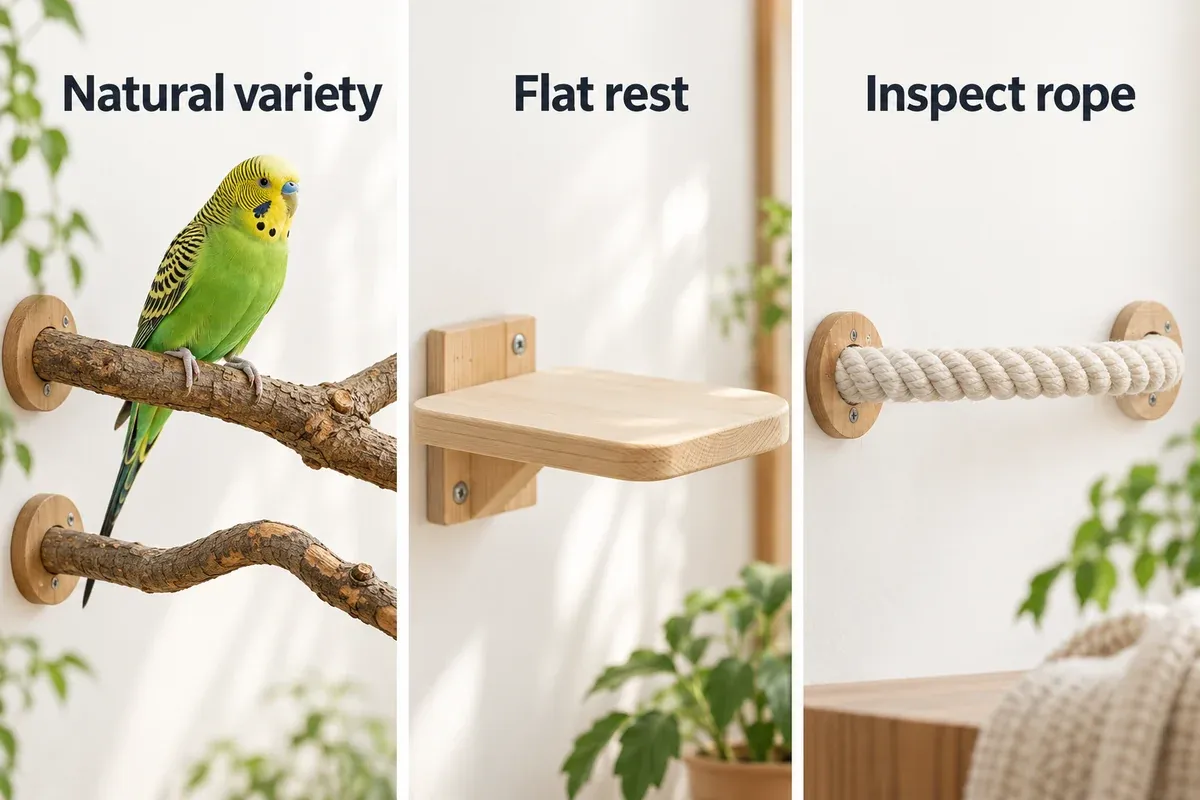
The examples below show how different perch surfaces can serve different jobs. Keep natural branches as the main option, and inspect every surface your bird can chew.
Linked products: Where Each One Fits
The following picks are organized by job, not ranked as interchangeable winners. Check the linked product page for the current purchase terms.
BILLIOTEAM 4-Pack Natural Wood Stand — best varied starter set for medium and large parrots
Check current price on Amazon →This is the most useful single set in the group if you are starting with a Conure, African Grey, Amazon, Eclectus, or Macaw and want several surfaces immediately. Its value comes from the mix: a platform, one thicker branch, and two smaller forked branches. That matches the foot-health principle better than buying four identical dowels.
Inspect the natural wood and all bolts when it arrives; a high rating does not remove the need to check for splinters or loose hardware.
Niteangel Wooden Platform Perch, 2-Pack — best flat rest for small birds
Check current price on Amazon →Use these as resting and posture-change surfaces in a small-bird cage, especially when the supplied cage perches are all identical and smooth. The platform is not a flight perch and is not suitable as a main surface for a Macaw or large Cockatoo. Pair it with natural branches so the bird still gets gripping and climbing variety.
Watch-outs: the product documentation says soft fir, so expect chewing and replace the platform when it becomes rough or unstable. Keep the usable top clear of droppings and mount it away from food contamination.
Kintor Cotton Rope Bungee — best for climbing and flexible movement
Check current price on Amazon →This makes sense when a bird needs a climbing route or a flexible perch that can be shaped around the cage.
Inspect it frequently. Remove it immediately if it frays, exposes the core, or produces loose fibers.
Sweet Feet and Beak Large Pedicure Perch — best supplementary textured step
Check current price on Amazon →This is the right kind of product for a limited, deliberate role: a textured step near a food bowl or along a route, not the bird’s only resting place. Its size is a plausible match for an African Grey, Amazon, Eclectus, or similar large bird, but the rough surface still needs monitoring.
Watch-outs: do not place it as the highest sleeping perch. If the foot pads look red, dry, shiny, cracked, or irritated, remove the textured perch and arrange an avian-veterinary check.
Pana’s Exotic Bird Manzanita, 5-Pack — specialist long-branch option
Check current price on Amazon →This is useful when a large cage or play area needs several long branches and you specifically want manzanita. Confirm the diameter selection before ordering and use the branches as part of a mixed setup.
A Safe Cage Layout by Job
Think of the cage as a small route, not a row of bars:
- Put the sleep perch high and stable. Use a comfortable natural branch in the bird’s normal range. It should not wobble, and it should not sit over a bowl.
- Add a second natural branch with a different diameter. A fork, bark, or gentle curve gives the feet and beak something different to do.
- Create a flat rest. Use a platform or a broad branch where the bird can relax without maintaining the same round grip.
- Add rope only for a bird that leaves it intact. Shape it to support climbing, not to create a single suspended sleeping surface.
- Place a grooming texture where the bird uses it briefly. A concrete or ceramic perch near a bowl can work; the highest perch should remain comfortable and non-abrasive.
- Keep routes clear. Perches should not force the bird to climb through food bowls, toys, or cage bars, and droppings should not land in food or water.
Change one item at a time when possible. A bird that is nervous about new equipment may ignore a perfectly good perch simply because too many cage changes happened at once.
For supervised time outside the cage, apply the same grip and surface checks to a separate play area. Our parrot play stand size and placement guide explains how to measure usable perch space, check the base, and keep reachable room hazards away from the bird.
Signs the Perch Setup Needs to Change
Inspect the feet and the hardware during normal handling or veterinary checks. A perch is not working well if you see:
- Repeated slipping or a bird refusing one particular perch
- Toes that cannot close around a round perch at all
- Toes that completely overlap under a very narrow dowel
- Redness, shiny pressure spots, cracks, swelling, or scabs on the foot pads
- Splinters, sharp edges, loose bolts, frayed rope, or exposed wire
- Droppings or wet food building up on a frequently used surface
Foot changes are not always caused by a perch. Bumblefoot, arthritis, injury, infection, obesity, and other health problems can change how a bird stands. If the bird shifts weight persistently or seems painful, contact an avian veterinarian rather than trying progressively rougher grooming products.
Frequently Asked Questions
What diameter perch should a budgie use?
Use about 3/8–3/4 inch as a starting range, with roughly 1/2 inch often useful as a main perch. Offer a thinner and a slightly wider natural branch as well. The budgie should be able to grip the perch without slipping, and no single size should be the only surface in the cage.
Is one perch diameter enough for a cockatiel?
No. A cockatiel can start around 1/2–1 inch, but variety is more important than choosing one exact number. Combine a comfortable branch, a different-shaped perch, and a platform or broader rest surface. If the bird is older or has foot problems, ask an avian veterinarian to help tailor the setup.
Are rope perches safe for parrots?
They can be, if the rope is intact and the bird does not shred or swallow it. Cotton or hemp is preferable to loose synthetic fibers, but any rope can become dangerous when it frays. Check it often and remove it at the first sign of loose strands or exposed wire.
Should a concrete perch be the highest perch?
No. Use a solid textured perch as a supplementary step, not as the only perch or the highest sleeping perch. Abrasive surfaces can irritate the foot pads when a bird spends too much time on them. A comfortable natural-wood perch should remain available.
Can I use a branch from my yard?
Only after identifying the tree, confirming that it is bird-safe and untreated, washing it, and disinfecting it properly. Outdoor branches can carry insects, fungus, bacteria, pesticides, or toxic plant oils. When the species or treatment history is uncertain, choose a commercially prepared bird perch instead.
How do I know if a perch is too wide?
Watch the toes. If they sit spread out on top and cannot wrap around the perch, it is too wide for that bird at that location. VCA’s practical target is roughly three-quarters toe wrap. A larger platform can still be useful because it is meant for flat-footed rest rather than a tight round grip.
Bottom Line
Start with natural wood, choose the diameter from the bird’s feet rather than the product label alone, and build variety into the cage.
Add a platform for rest, use rope only while it is intact, and keep concrete or ceramic in a limited supporting role.
Research sources
- VCA Animal Hospitals: Perches for Birds — diameter fit, natural wood, rope, concrete, sandpaper, cleaning, and safe-tree guidance.
- LafeberVet: Caging the Companion Parrot — variety of perch materials and cautions for abrasive and frayed surfaces.
- LafeberVet: Parakeet, Conure, African Grey, Amazon, Cockatoo, and Macaw care sheets — species-specific diameter anchors.
- Lafeber: Perch diameter sizes for a Cockatiel — practical cockatiel range and the importance of varied natural branches.