

 Published sources
 Product details checked
Choosing a bird cage is really two decisions. The cage must be large enough for comfortable movement, perches, toys, and wing stretching, while the gaps must be narrow enough that your bird cannot push its head through or trap a toe. A big cage with unsafe openings is still unsafe; a tight-bar cage that leaves no usable flight room is still a poor home.
Quick answer: Use the species selector below as a conservative starting point for one bird, then buy the largest suitable cage that fits your room and enrichment setup. Measure the usable interior and the widest real opening in millimeters as well as inches—product titles and photos are not precise enough for this safety check.
The selector combines the Merck Veterinary Manual’s minimum cage-size and bar-spacing table with species-specific guidance from LafeberVet’s caging handout, the Avian Welfare Coalition’s housing guide, and the individual-bird fit principle described by Merck’s pet-bird home guidance. Where sources give a range, the tighter end is the safer shopping starting point for a smaller individual.
Verify the exact product specifications and cage dimensions before purchase.
In this guide, you’ll learn:
-
The minimum starting cage dimensions for common bird groups in inches and millimeters
-
How to separate cage size from bar-spacing safety
-
Why parrotlet, cockatiel, and large-parrot product pages need extra care
-
Which linked products match a small-bird, medium-bird, or walk-in aviary use case
For a walk-in or outdoor aviary, bar spacing is only the bird-side check. Our predator-proof outdoor aviary guide covers mesh, ground barriers, doors, and night security.
Use the bird cage species selector
Interactive species selector
Find a safe bird-cage starting point
Choose the closest species group to see a practical minimum starting size and a bar-spacing range in both inches and millimeters. These are screening values for one bird, not a guarantee that every cage or individual bird will fit.
Starting point for Finch or canary
Shopping ceiling: Do not exceed 1/2 in (12.7 mm). Smaller individuals may need a tighter opening.
Use the size wisely: For these active small birds, prioritize usable length for short flights instead of choosing a narrow, tall cage.
Basis: Practical flight-cage starting point; small-bird guidance from the Avian Welfare Coalition.
Measure the usable interior and the widest real opening—not the cage title or stand. A bird's head must never pass through a bar gap, and a larger cage cannot compensate for unsafe spacing.
The result is intentionally a starting point, not a promise that one number fits every bird in a species.
Bird cage size and bar spacing chart
The dimensions below are minimum planning targets for one bird. They refer to the cage’s usable interior in length × width × height, not the rolling stand, roof finial, seed skirt, or outside frame. A wider or longer cage is often more useful than a narrow cage that gains height through a tall stand.
| Bird or group | Minimum starting cage size (in) | Minimum starting cage size (mm) | Practical bar-spacing range | Conservative shopping check |
|---|---|---|---|---|
| Finch or canary* | 24 × 18 × 18 in | 610 × 457 × 457 mm | 3/8–1/2 in (9.5–12.7 mm) | Do not exceed 1/2 in; smaller individuals may need less. |
| Budgie or parakeet | 20 × 20 × 30 in | 508 × 508 × 762 mm | 3/8–1/2 in (9.5–12.7 mm) | Use 1/2 in (12.7 mm) as a maximum, not a target for every bird. |
| Parrotlet | 20 × 20 × 30 in | 508 × 508 × 762 mm | 1/4–3/8 in (6.4–9.5 mm) | Prefer the tighter end; never assume 1/2 in is safe. |
| Lovebird | 20 × 20 × 30 in | 508 × 508 × 762 mm | 3/8–1/2 in (9.5–12.7 mm) | Keep the widest opening at or below 1/2 in. |
| Cockatiel | 20 × 20 × 30 in | 508 × 508 × 762 mm | 1/2–5/8 in (12.7–15.9 mm) | Use 1/2 in for a smaller cockatiel; check 5/8 in individually. |
| Green-cheek or small conure | 36 × 24 × 48 in | 914 × 610 × 1219 mm | 1/2–3/4 in (12.7–19.1 mm) | Do not exceed 3/4 in (19.1 mm). |
| Quaker, caique, or Poicephalus | 36 × 24 × 48 in | 914 × 610 × 1219 mm | 5/8–3/4 in (15.9–19.1 mm) | Keep the maximum at 3/4 in unless the individual fit is clear. |
| Large conure or ring-neck | 40 × 30 × 60 in | 1016 × 762 × 1524 mm | 3/4–1 in (19.1–25.4 mm) | Start at 3/4 in; use 1 in only after a fit check. |
| African Grey, Amazon, or small cockatoo | 40 × 30 × 60 in | 1016 × 762 × 1524 mm | 3/4–1 in (19.1–25.4 mm) | Treat 3/4 in as the conservative shopping ceiling. |
| Large macaw or large cockatoo | 48 × 36 × 66 in | 1219 × 914 × 1676 mm | 3/4–1.5 in (19.1–38.1 mm) | The 1.5-in upper end is for genuinely large birds with strong, thick bars. |
*The finch and canary dimensions are a practical flight-cage starting point built around the small-bird housing guidance of at least one square foot of floor area. They are not a claim that every finch or canary should be limited to that size.
Why the sources do not all show one identical number
Veterinary tables often group species to make shopping practical. Individual species guides may then give a narrower range, especially for small birds. For example, the Merck table groups parrotlets with other small parrots at a 1/2-inch maximum, while Lafeber’s parrotlet guidance points to a much tighter opening for a very small bird. The selector therefore shows the tighter fit as the first choice and treats the wider value as something to verify—not something to assume.
The same issue appears with cockatiels and large parrots. Lafeber’s cockatiel guidance notes that a smaller cockatiel may not be safe in a 3/4-inch opening, while large-parrot guidance may allow wider gaps when the bird’s head cannot pass through and the bars are strong enough. When sources differ, choose the smaller opening and the larger cage whenever your bird can use the extra room.
Cage size and bar spacing solve different problems
Think of the two checks as a simple sequence:
- Safety check: Can the bird’s head, beak, or toes reach through the widest opening?
- Welfare check: With safe openings, can the bird turn, climb, stretch both wings, move between perches, and use toys without constantly touching bars or tail-catching on accessories?
- Setup check: After food bowls, natural branches, a platform, and enrichment are installed, is there still a clear horizontal route through the cage?
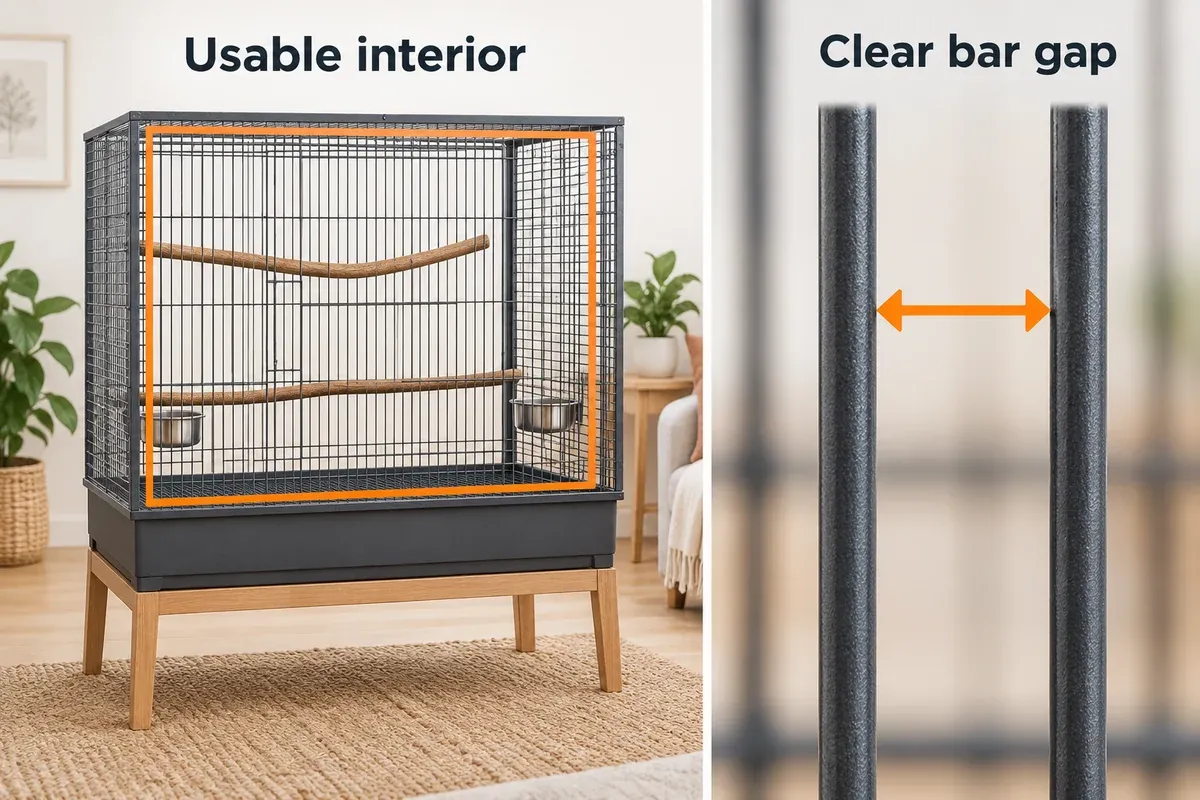
Bar spacing is the distance between adjacent bars—not the thickness of the wire. A cage advertised as “1/2 inch spacing” may still have larger openings at the door, decorative arches, feeder doors, welds, or corners. Use a ruler or caliper on the actual assembled cage.
For a second bird, do not simply multiply one-bird dimensions and call the result safe. Choose a meaningfully larger flight area, provide duplicate resources, and confirm that the birds are compatible. Birds that chase, bite, guard food, or cannot retreat from one another need separate housing even when the cage is physically large.
Use the two views below to keep the space and safety measurements separate. Compare the interior dimensions with the species guide, then check the widest real opening on the assembled cage.
How to calculate a size for an unlisted bird
The Scottish Government’s animal-welfare licensing guidance uses a generous wingspan-based planning formula for bird accommodation:
- Length: at least 2 × the bird’s wingspan
- Depth: at least 1.5 × the bird’s wingspan
- Height: at least 1.5 × the bird’s wingspan
That guidance is written for licensed animal-welfare establishments, not as a universal pet-cage law. It is nevertheless a useful conservative benchmark when a species is missing from a product chart. Measure the bird’s natural wingspan when you can do so safely, multiply the result in inches, then convert with 1 inch = 25.4 mm. The Merck home-care guidance also recommends buying the largest suitable cage and allowing at least 1.5 times the wingspan in all directions for a single bird.
Do not use a stand’s total height as the height of the bird’s home. Do not include an outside seed catcher in the usable width. If the product only provides outside dimensions, treat the interior as smaller until the manufacturer confirms the real inside measurement.
What to check on a cage product page before buying
Use this short checklist when comparing a product page:
- Exact gap: Look for a stated measurement such as 0.4 in, 1/2 in, or 12.7 mm.
- Widest opening: Check doors, feeder doors, play tops, decorative panels, and corners—not just the main side panel.
- Bar strength: Large parrots need bars that resist bending and chewing. A safe gap with flimsy wire is not a safe large-parrot cage.
- Finish: Prefer a bird-safe, intact finish with no peeling, exposed metal, lead, or zinc concerns. Avoid an old or damaged cage unless its coating can be professionally verified.
- Interior space: Subtract the space taken by trays, bowls, perches, and toys. A cage should not become an obstacle course.
- Locks and doors: Large parrots can learn weak latches. Check that doors close securely and that the bird cannot reach through to open the lock.
- Shape: Rectangular cages usually give more usable flight space than round or heavily ornamented designs.
- Returns: Keep the packaging until you have measured every opening and watched your bird use the cage under supervision.
Linked examples by use case
These are not interchangeable “best” picks.
Three examples, three different fit checks
-
VIVOHOME 54-Inch Wrought Iron Bird Cage with Rolling Stand
VIVOHOME
A rolling 54-inch flight cage with a 0.4-inch / 10 mm gap, slide-out tray, casters, and room for a practical small-bird setup.
- 24.2 × 16.9 × 54 in described dimensions
- 0.4-inch / 10 mm bar gap
- Rolling stand with casters
- Bar spacing
- 0.4 in / 10 mm
- Best for
- Finches, canaries, budgies, and small birds needing a tight gap
-
A&E Cage 8003223 Black Play Top Bird Cage, 32 × 23 in
A&E Cage Company
A 32 × 23-inch black play-top cage whose product information specifies 5/8-inch bar spacing, useful when a cockatiel needs more room than a compact starter cage.
- 32 × 23 in described cage size
- 5/8-inch bar spacing stated in the product documentation
- Play-top format for supervised interaction
- Bar spacing
- 5/8 in / 15.9 mm
- Best for
- Cockatiels and medium birds that fit a 5/8-inch opening
-
A&E Cage Co WI8662 Walk-In Bird Aviary, 86 × 62 × 79 in
A&E Cage Company
A walk-in indoor aviary with an 86 × 62-inch exterior footprint, a key-lock door, and external feeder access. Plan floor protection and room access before ordering.
- 1-inch bar spacing and a 69 × 25-inch entry door
- Key-lock front door and three feeder doors
- Three stainless steel bowls
- Bar spacing
- 1 in / 25.4 mm
- Best for
- An indoor bird room for larger parrots that fit a 1-inch gap
Review the linked product page before purchasing.
VIVOHOME 54-inch cage: a tight-gap small-bird example
It is not an automatic parrotlet recommendation. Lafeber’s parrotlet guidance is tighter than the product’s 0.4-inch gap, so measure the bird and choose a cage with a smaller opening if there is any doubt.
Check current price on Amazon →A&E 8003223: a 5/8-inch medium-bird example
The product specifications state 5/8-inch / 15.9 mm bar spacing and a 32 × 23-inch cage size with a play top.
The 5/8-inch opening is wider than the conservative 1/2-inch choice for a small cockatiel. If your bird is slight, young, or able to reach its head into the opening, choose a tighter-bar alternative.
Check current price on Amazon →A&E WI8662: a large aviary example with an unresolved safety question
Products, LLC.
That missing number is a reason to pause, not a minor detail. A room-sized cage is not safer than a smaller one if the widest opening can trap a bird’s head or foot.
Check current price on Amazon →Frequently Asked Questions
What bar spacing is safe for a budgie?
Use 3/8–1/2 inch (9.5–12.7 mm) as a practical starting range and treat 1/2 inch as a maximum to verify. Choose the tighter end for a small or young bird, and measure the openings around doors and feeder panels.
Is a 1/2-inch cage automatically safe for an African Grey?
No. The gap may be narrower than needed for a large bird’s head, but the cage may still be too small, the bars may be too weak, or the interior may not leave room for enrichment. African Greys need a much larger starting footprint than a small-parrot cage; use the selector and inspect bar strength separately.
Can a cockatiel use 5/8-inch bar spacing?
Some larger cockatiels may fit a verified 5/8-inch opening, but a smaller cockatiel may not. Start at 1/2 inch when you are unsure. Never choose a wider gap merely because it gives more product options.
Is a taller cage better than a wider cage?
Not automatically. Height is useful for climbing and tail clearance, but a narrow tower can leave very little horizontal flight room. Compare the usable length and width after accessories are installed, then choose the largest balanced footprint your space allows.
Do these minimum sizes count as legal requirements?
No. They are practical welfare and safety starting points compiled from veterinary and welfare guidance. Local laws, boarding rules, rescue requirements, and housing standards may set different minimums, so check the rules that apply where you live.
How do I convert bird-cage inches to millimeters?
Multiply each inch measurement by 25.4. For example, a 36 × 24 × 48-inch cage is about 914 × 610 × 1219 mm. Round to the nearest whole millimeter for shopping, but do not round a borderline bar gap upward.
Sources and method
The strongest general source for the grouped cage dimensions in this article is the Merck Veterinary Manual minimum-size and bar-spacing table. It gives practical groupings for small parrots, conures, African Greys and Amazons, and macaws. The LafeberVet Caging handout adds useful species ranges and the head-clearance principle. The Avian Welfare Coalition housing guide is especially useful for small-, medium-, and large-bird bar-spacing ceilings, although its minimum floor-area advice is written for shelter housing. The Scottish Government’s guidance provides a more generous wingspan-based planning formula for licensed establishments.
Use these sources as a well-supported starting point, then confirm the individual bird, the exact cage interior, the widest opening, and the condition of the finish. If a bird has previously trapped a head or toe, has unusual body proportions, or is being housed with another bird, ask an avian veterinarian before relying on a generic chart.
Use our parrot cage buying guide to compare specific models, enclosed interior dimensions, cleaning access, and room requirements. This selector provides the species-specific size and bar-spacing reference for that decision.