

 Published sources
 Product details checked
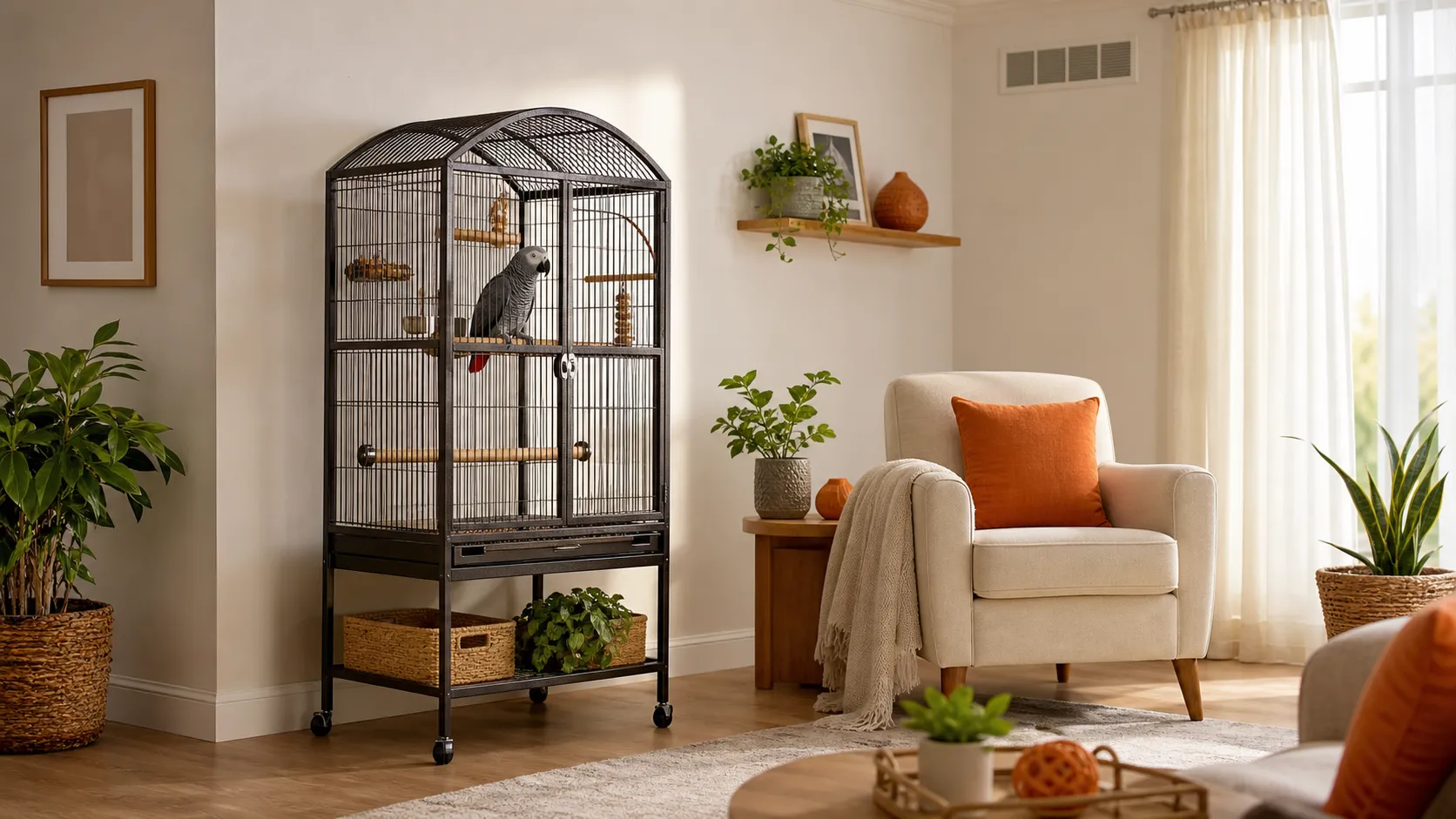
The safest bird cage location is usually a calm corner of a living room or home office: one side near a wall, enough household activity for daily social contact, and no direct sun, kitchen fumes, heater, air-conditioning outlet, or heavy foot traffic. The cage should also be able to become quiet and dim at the bird’s regular bedtime.
That sounds simple until one room is bright but drafty, another is quiet but isolating, and the living room opens directly into the kitchen. This guide treats cage placement as a room-design problem. It helps you test the exact spot you have, decide what to change, and know when a second sleep cage is more realistic than forcing one location to do everything.
Quick answer: Put the cage at a stable indoor temperature, close enough to normal family life but outside the main walking lane. Keep the cage away from windows, exterior doors, vents, radiators, fireplaces, kitchens, smoke, sprays, and direct sun. Give the bird a wall or quiet back side for security, preserve an unobstructed view of the room, and create a consistent dark sleep period every night.
The strongest general reference is Merck Veterinary Manual’s peer-reviewed guidance on providing a home for a bird, updated March 2026. It specifically warns against kitchens, windows, and air-conditioning, while noting that some birds need household activity and others feel safer in quieter spots. LafeberVet’s caging handout and its household-dangers PDF add the details about fumes, sunlight, exterior doors, vents, and temperature extremes.
A five-minute room test
Before moving the cage, stand in the proposed spot and answer these questions. If a room fails one of the first three tests, a cover or accessory should not be used to hide the problem.
| Test | A workable setup | A reason to reject the spot |
|---|---|---|
| Light | Bright indirect daylight with shade available; no sunbeam can heat the cage | Glass-level placement, glare, or direct afternoon sun |
| Air and temperature | No air stream hits the cage; temperature stays comfortable and changes slowly | HVAC outlet, radiator, fireplace, exterior door, or a measurable overnight swing |
| Household air | Clean room air with no smoke, aerosols, fragrances, or cooking vapors | Kitchen, laundry/utility room, workshop, candles, sprays, or overheated nonstick cookware |
| Social contact | The bird can see and hear normal activity from a calm edge of the room | Isolated cupboard, stair landing, or the middle of a busy walkway |
| Sleep | The room can become quiet and dim for the bird’s regular bedtime | Television, gaming, late-night kitchen use, bright hallway, or unpredictable noise |
For a cage-size or bar-spacing decision, use our bird cage size and bar-spacing chart. This article assumes the cage is already large enough. If the interior still feels crowded after a good location is chosen, the parrot cage setup checklist covers perches, bowls, toys, and open movement space.
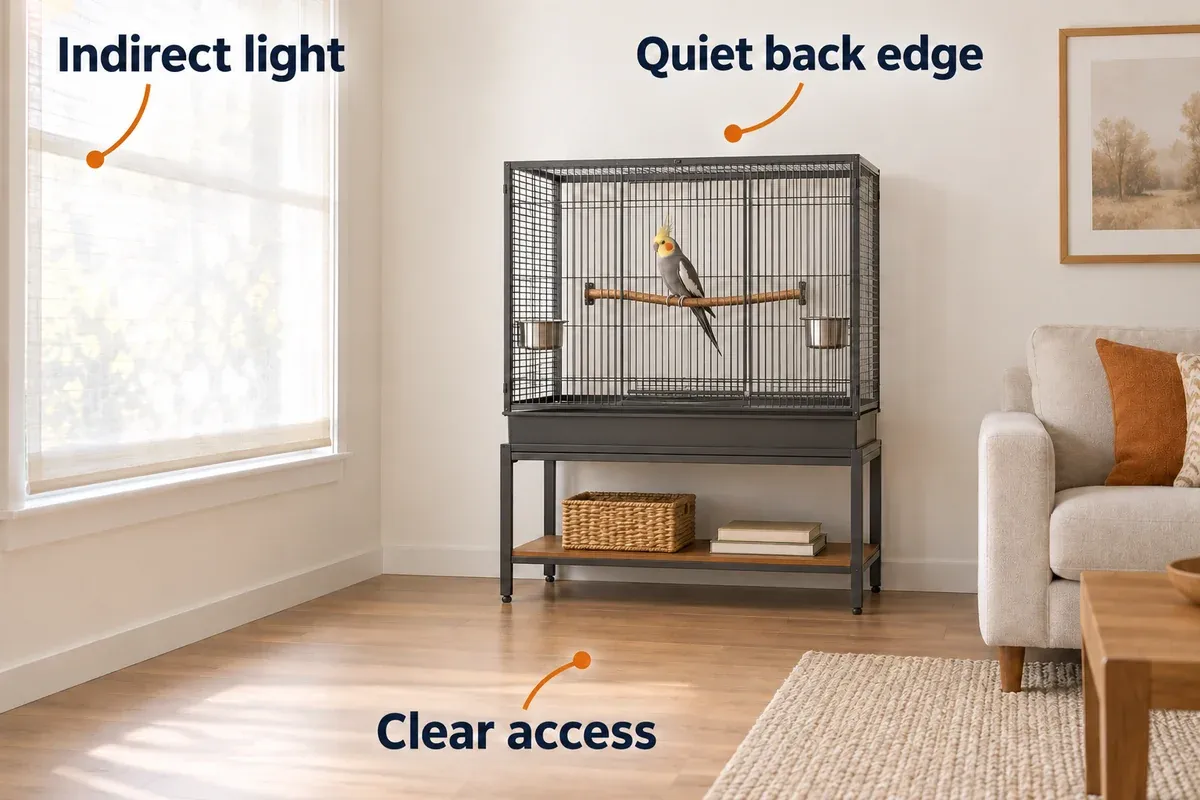
The example below shows a workable daytime arrangement. Check the same spot again during heating, afternoon light, and the evening routine before settling on it.
Small tools that address real placement problems
These products do not make a bad room safe. They are useful only after the cage is away from fumes, direct heat, direct sun, and strong airflow.
Placement helpers, not cage substitutes
-
Prevue Pet Products Good Night Bird Cage Cover 12502, Medium
Prevue Pet Products
A lightweight black nylon cover for reducing evening light and household distractions when the cage itself is otherwise in a good location.
- Official model 12502; overall cover size 18 x 18 x 25 inches
- Fits cages up to 20 x 20 x 30 inches according to Prevue
- Breathable, non-toxic, color-fast nylon described by the manufacturer
- Best use
- Small-to-medium cages that need calmer, darker evenings
-
Prevue Pet Products Good Night Bird Cage Cover 12503, Large
Prevue Pet Products
The larger Prevue cover is useful for controlling light around a properly placed flight cage without moving the bird into a kitchen, hallway, or drafty window area.
- Official model 12503; overall cover size 31 x 21 x 41 inches
- Fits cages up to about 37 x 25 x 48 inches according to Prevue
- Breathable black nylon intended to reduce distractions
- Best use
- Larger flight cages where the room stays bright after the bird's bedtime
-
Govee Indoor Hygrometer Thermometer H5075
Govee
A Bluetooth temperature-and-humidity logger that helps you compare the cage area with the rest of the room before you blame the bird's behavior on a vague draft.
- Bluetooth monitoring with alerts and two-year data export as documented
- 164-foot Bluetooth range as documented; the H5075 is not a Wi-Fi sensor
- described accuracy of ±0.54°F / ±0.3°C and ±3% relative humidity
- Best use
- Finding cold spots, heat swings, and overnight draft patterns
-
Amazon Basics Air Purifier with H13 HEPA and Activated Carbon
Amazon Basics
A compact three-stage purifier with a pre-filter, activated-carbon layer, and H13 HEPA filter that can support cleaner room air when it is positioned without blowing directly at the cage.
- Three-stage filtration with H13 HEPA and activated carbon as documented
- 140 CFM CADR and 213-square-foot room claim at five air changes per hour
- 32 dB sleep mode, three speeds, timer, and 31-watt motor as documented
- Best use
- Reducing routine dust and airborne particles in a bird room
Review the linked product page before purchasing.
Prevue 12502 Medium — light control for a smaller cage
The Medium version is a practical fit check for cages up to about 20 x 20 x 30 inches. Prevue’s official 12502 specification lists a breathable black nylon cover with an overall size of 18 x 18 x 25 inches.
This is useful when the bird’s room is in the right place but a lamp, hallway, or family schedule keeps the area bright after bedtime. It is not a reason to place the cage beside a window or to cover a cage that is already too warm. Measure the cage body, not the stand, play top, or seed guard.
Check current price on Amazon →Prevue 12503 Large — light control for a flight cage
The Large model is intended for a much bigger cage, with Prevue’s official 12503 specification giving an overall cover size of 31 x 21 x 41 inches and a fit up to about 37 x 25 x 48 inches.
The fit matters more than the price. A cover that hangs heavily, traps warm air around the roof, or leaves a gap that lets a bright lamp shine directly at the bird does not solve the sleep problem. Introduce it during a calm daytime trial, leave an exit or opening that does not create a loose snagging hazard, and stop if the bird becomes distressed.
Check current price on Amazon →Govee H5075 — find a real draft instead of guessing
The H5075 is the most diagnostic item in this list. Put it near the cage at the height of the main perch, then compare readings in the morning, late afternoon, and during heating or air-conditioning.
It is not a bird-health monitor and it does not tell you what temperature is medically right for a sick bird. Its value is simpler: it can show that the cage corner is consistently colder than the rest of the room, warms sharply in direct sun, or changes whenever the HVAC system starts. Move the cage or correct the room source first; do not point a fan at the cage to “even out” the reading.
Check current price on Amazon →Amazon Basics H13 HEPA Air Purifier — support cleaner room air
Treat that as room-air support, not a fume shield. LafeberVet’s household-dangers handout lists smoke, air fresheners, sprays, bleach, scented candles, oven cleaner, and overheated nonstick items among risks for birds. A purifier cannot make it safe to keep a bird in the kitchen while cooking. Place the unit across the room or at the side of the room so the airflow does not blow directly on the cage, and keep the cord inaccessible.
Check current price on Amazon →1. Choose a stable temperature, not a perfect number
A cage does not need a special microclimate if the room is comfortable and stable. Merck notes that pet birds generally do well at temperatures comfortable for people; the bigger concern is a rapid or localized extreme. A warm room can still be unsafe if one side of the cage receives a cold air stream at night or a hot sunbeam in the afternoon.
Walk the room at three times of day:
- Morning: Check the cage corner before the household warms up.
- Afternoon: Look for direct sun, glass heat, and rising room temperature.
- Evening: Check what happens when the furnace, heat pump, or air conditioner cycles.
If the cage area differs from the rest of the room, look for the source rather than adding a blanket. Common causes are a floor-level vent, a baseboard heater, a nearby door, a window leak, or a purifier/fan that creates a continuous air stream. A small sensor outside the cage can help confirm the pattern, but your bird’s behavior still matters.
Place the cage away from:
- air-conditioning and heating outlets;
- radiators, fireplaces, wood stoves, and portable heaters;
- exterior doors and frequently opened windows;
- the narrow gap between furniture and a cold outside wall;
- ceiling fans or floor fans used in the same flight area.
The AVMA’s companion-bird housing guidance also recommends placing cages away from drafts and at eye level or higher so the bird feels secure. For a large rolling cage, that does not mean putting the whole cage on a table. It means avoiding a low, exposed position where people, dogs, or cats pass directly over the bird.
2. Use daylight without putting the cage in a window
Daylight helps a home feel predictable, but a bird cage should not sit in the glass line. LafeberVet specifically warns against a spot where the sun beats down through a window, and Merck warns that windows can create both excessive heat and cold.
A better arrangement is:
- the cage several feet away from the window rather than touching the glass;
- indirect daylight from the side;
- a sheer curtain or adjustable shade for the brightest hours;
- a wall or furniture edge behind one side of the cage;
- a clear view of the room without forcing the bird to stare at outdoor movement all day.
Watch the bird and the cage, not just the room’s average brightness. A pale wall can reflect strong afternoon light into the cage. A window can also expose a bird to passing hawks, cats, dogs, or sudden shadows. If your bird startles repeatedly at the glass, move the cage farther back or change the sightline with a curtain.
Do not treat a grow light, bright desk lamp, or full-spectrum bulb as a reason to put the cage in an otherwise poor location. If you use artificial lighting for a species-specific care plan, place it on a timer, keep cords out of reach, and ask an avian veterinarian about the correct setup.
3. Build a social zone with a quiet back edge
Most companion birds benefit from seeing and hearing their people. That does not mean the cage belongs in the center of the room. The useful middle ground is the edge of a room where the bird can observe normal activity without being bumped, stared at, or startled every few minutes.
Think in layers:
- Back: one side of the cage near a wall or stable piece of furniture for security.
- Front: a clear approach for cleaning, feeding, and supervised out-of-cage time.
- Side: a view of the room, preferably including the people the bird interacts with most.
- Above: no shelf, plant, speaker, or object that can drop debris into the cage.
The LafeberVet new-bird home checklist describes the same balance: place the cage where it shows human activity but not in heavy traffic, while still allowing adequate sleep. The Association of Avian Veterinarians also notes that one side of a cage next to a wall can create a more secure area.
Good default rooms include a living room, a family room, or a home office that is used during the day. A quiet dining area can work if it is truly separate from cooking vapors. A bedroom can work if your sleep and wake times match the bird’s schedule. A dedicated bird room can work for several birds only when it still provides daily interaction rather than becoming a storage room with cages.
Avoid:
- the middle of a hallway or the top of a staircase;
- a doorway where bags, coats, or children pass close to the bars;
- a low spot beside a dog bed or cat route;
- a desk where typing, calls, or speakers occur inches from the cage;
- an isolated room used only for cleaning or storage.
If the bird is timid, elderly, newly rehomed, or recovering from illness, prioritize a calmer corner and introduce more activity gradually. If the bird is strongly bonded to people, a visually isolated room may create more stress than a slightly busier but predictable living area.
4. Make sleep a daily condition, not a fabric purchase
Sleep is the part of placement that makes open-plan homes difficult. A cage can be perfectly positioned during the day and still fail if the family watches television, cooks, or turns on bright lights beside it until midnight.
Start with the room:
- Choose a bedtime that the household can keep most nights.
- Dim the room in the same order each evening.
- Remove loud activity from the cage’s immediate area.
- Keep the cage away from a bright hallway or kitchen sightline.
- Let the bird wake with a predictable morning routine.
Merck says most birds should not have their cages covered at night because covering can create stress. A dark, quiet room is the better default. A breathable cover can be a useful tool for a bird that tolerates it and for a room that is otherwise safe, but it should not become a substitute for moving the cage away from heat, drafts, noise, or fumes.
Some households use a full-size day cage in the social room and a smaller sleep cage in a quiet room. That can be sensible when the day room cannot become dark, when a parrot sleeps earlier than the household, or when the main cage is too large to move safely. The sleep cage still needs safe food and water access, a stable perch, good ventilation, and a calm transition routine. It should not be a bare carrier used for hours without planning.
If a cover causes frantic climbing, panting, repeated calling, or a refusal to settle, remove it and solve the room problem instead. If the bird’s sleep, breathing, appetite, or behavior changes suddenly, contact an avian veterinarian.
5. Treat the kitchen as a no-go room
This deserves its own section because an open-plan floor plan can make “living room” and “kitchen” sound like the same placement. They are not the same risk zone.
Birds have highly efficient respiratory systems and can be harmed by fumes that people barely notice. LafeberVet lists cooking vapors, overheated nonstick cookware, smoke, sprays, fragrances, cleaning products, and self-cleaning ovens as household hazards. Merck’s bird-home guidance simply says not to keep a cage in the kitchen because smoke and cooking fumes can be bad for birds.
Move the cage to a separate room before:
- using nonstick cookware or an appliance that may contain PTFE-type coatings;
- running a self-cleaning oven;
- frying, searing, or boiling foods that create visible vapor;
- spraying cleaners, perfume, hair products, insecticide, or air freshener;
- burning candles, incense, or wood;
- painting, using adhesives, or applying strong disinfectants.
Ventilation hoods and an air purifier are not permission to leave the bird nearby. The safest location is physically separated from the source, with clean air and a plan for unexpected fumes.
6. Compare common room choices
There is no universal “best room.” The correct choice is the one that passes the five-minute test for your bird and your schedule.
Living room or family room
Usually the best starting point for a social companion bird. Choose a back edge rather than the sofa’s main traffic lane. Check that the room can become quiet at bedtime and that the kitchen is not the bird’s effective air source.
Home office
Useful for birds that enjoy close human presence, but watch the schedule. Video calls, desk lamps, headphones, and sudden chair movement can become constant stimulation. Put the cage beside—not behind—the desk, with a clear escape route for the caretaker and no reachable cables.
Bedroom
Good for a bird whose sleep schedule matches yours and whose room stays clean and stable. It is a poor choice if lights, alarms, late-night reading, or an air vent wake the bird. A quiet sleep cage elsewhere may be better.
Dedicated bird room
Helpful for multiple cages, quarantine, or a controlled sleep routine. It still needs daily interaction, natural room cues, and safe air. For a newly acquired bird, follow veterinary quarantine advice before placing it beside resident birds. The LafeberVet home checklist recommends housing a new bird as far as possible from other parrots during quarantine.
Sunroom, conservatory, or screened porch
Usually too variable for a permanent indoor cage. Glazing can create rapid heat, winter cold, glare, and direct sun. Use such spaces only when the enclosure and climate are specifically designed for the species and monitored with professional guidance.
A practical placement sequence
If you are moving the cage today, use this order:
- Mark out the cage footprint with painter’s tape.
- Remove kitchen, bathroom, laundry, workshop, direct-window, heater, vent, and doorway locations.
- Pick the remaining spot with the best predictable social contact.
- Put one side toward a wall and leave enough space to clean behind and beside the cage.
- Run the room through morning, afternoon, and evening light and temperature checks.
- Watch one full bedtime routine before adding a cover or moving furniture.
- Observe where the bird chooses to perch, whether it startles at shadows, and whether it settles without repeated calling.
For cage interior placement after the room is solved, use the parrot cage setup checklist. For perches that support varied posture in the new location, see the bird perch diameter and material guide.
Frequently Asked Questions
Where is the best place to put a bird cage?
For most companion birds, start with a calm edge of a living room or home office. Put one side near a wall, keep the cage away from windows, vents, heaters, kitchens, and heavy traffic, and make sure the household can provide a consistent quiet sleep period.
Can I put a bird cage next to a window?
Use daylight from a window, but do not place the cage directly against the glass or in a sunbeam. Windows can create heat, cold, drafts, glare, and visual stress from outdoor movement. A shaded position several feet away with indirect light is safer.
Is a living room too noisy for a parrot?
Not automatically. Normal, predictable household activity can provide social contact. The cage becomes a poor fit when it sits in the walkway, next to loud speakers, under a constantly moving doorway, or in a room that cannot become quiet at bedtime.
Should I cover my bird’s cage at night?
Not by default. Merck notes that covering can stress some birds, so a quiet, dark room is the preferred first solution. If a breathable cover is appropriate for the individual bird, measure it carefully, introduce it gradually, and never use it to compensate for drafts, heat, fumes, or poor ventilation.
How do I know whether a room is drafty?
Look for a temperature change at the cage’s perch height when the HVAC starts, a window opens, or an exterior door moves. A temperature logger can reveal patterns that are hard to feel with your hand. If the bird shows persistent cold-stress behavior, breathing changes, or sudden illness, move it away from the source and contact an avian veterinarian.
Can I use an air purifier in the same room as a bird?
An appropriate particle filter can support cleaner room air, but it does not neutralize cooking fumes or make sprays safe. Use our bird-room air purifier size calculator to check CADR and filter-cost assumptions for the room. Keep the unit away from the cage, avoid direct airflow, keep cords inaccessible, and do not use fragrance- or ozone-producing functions. Remove the bird from any known fume source.
Can the cage be in a bedroom?
Yes, if the bedroom is stable, clean, and quiet enough for the bird’s sleep schedule. If you wake late, read with bright lights, or use a vent that blows toward the cage, a social day cage plus a separate sleep cage may be more practical.
Should the cage be high off the floor?
The bird should not sit in the main path of people or predators. The AVMA recommends cages be away from drafts and at eye level or higher for security. For a large cage, a stable manufacturer stand is better than improvised furniture; always keep the cage level, locked, and accessible for cleaning.
Bottom line
Place the bird cage where four conditions overlap: clean air, stable temperature, indirect daylight, and reliable social contact. Then protect sleep with a consistent quiet routine. The most useful “accessory” is often a better room position; a cover, thermometer, or purifier only helps after the location itself is safe.
If your home cannot provide social time and sleep in the same room, use a carefully planned day cage and sleep cage rather than accepting a permanent compromise. When a bird shows sudden breathing, appetite, energy, or sleep changes, treat that as a veterinary question—not as a decorating problem.
Sources and method
- Merck Veterinary Manual: Providing a Home for a Bird — peer-reviewed guidance on room choice, windows, air-conditioning, kitchens, temperature, and cage covers; last updated March 2026.
- LafeberVet: Caging the Companion Parrot — veterinary caging reference and handout.
- LafeberVet: Household Dangers — fumes, smoke, sprays, direct sun, windows, vents, doors, and temperature extremes.
- LafeberVet: Preparing Your Home for Your New Baby Bird — human activity, traffic, sleep, fumes, and quarantine considerations.
- VCA Animal Hospitals: Housing Small Birds — general housing, enrichment, and species-sensitive setup principles.
- American Veterinary Medical Association: Selecting a Bird — draft avoidance, cage height, and household safety.
- Association of Avian Veterinarians: Basic Care for Companion Birds — air quality, sleep, and companion-bird care reminders.