

 Published sources
 Product details checked
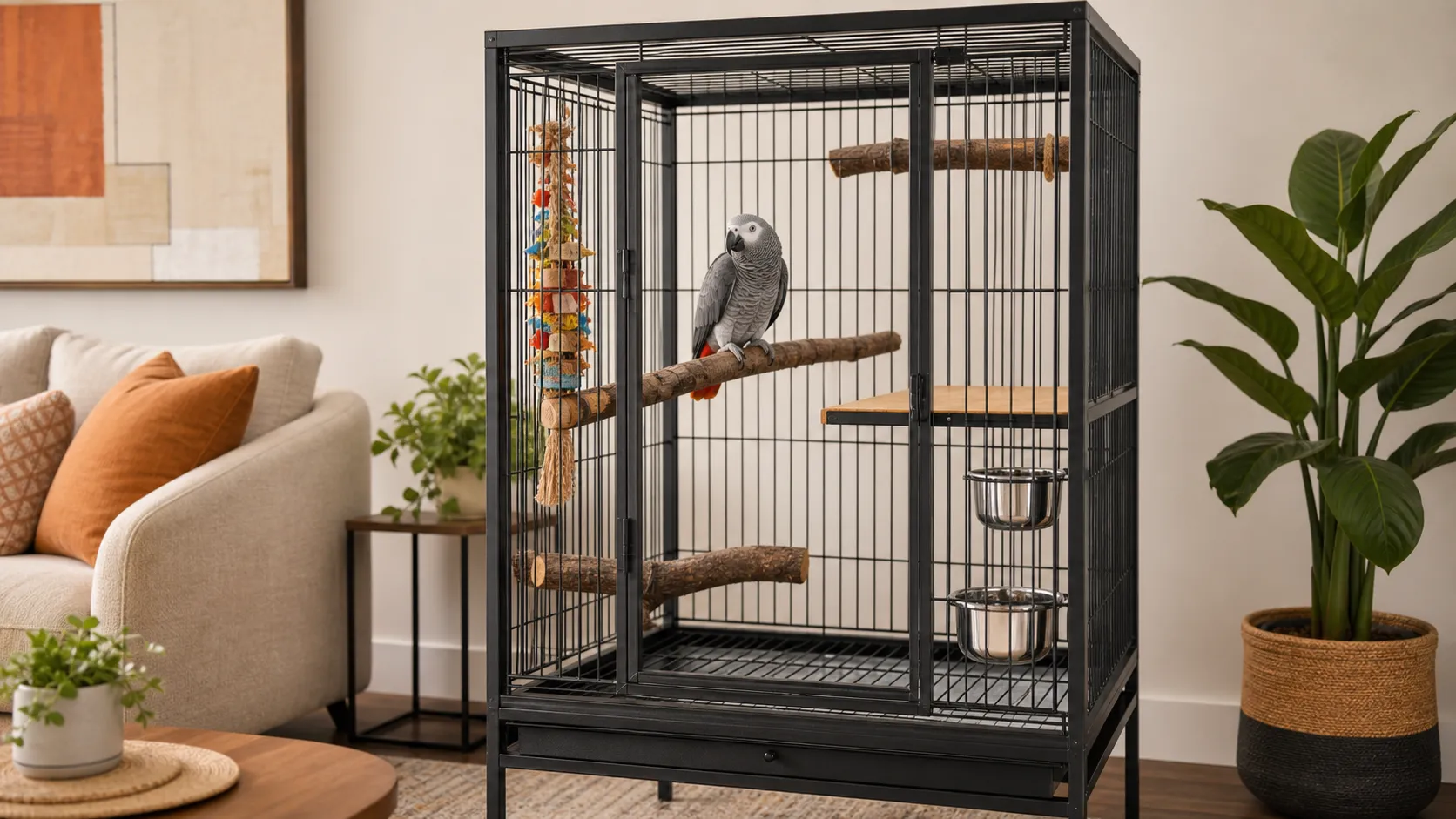
The best parrot cage setup is not the one with the most accessories. It is the one where your bird can sleep in a quiet high corner, move between stable perches, eat and drink without droppings falling into the bowls, and reach enrichment without having to squeeze through a cluttered route.
This parrot cage setup checklist turns those principles into a repeatable layout. It covers cage position, perch height and diameter, bowl placement, toy spacing, and a practical sleep zone. It also includes a visual right-versus-wrong plan so you can adjust the cage before your bird moves in.
Quick answer: Put the most stable natural perch high and toward the back of the cage, offset the other perches so they create a clear route, attach food and water cups to the side at mid-level or higher, keep every cup out from under a perch, and hang one chew toy where it is reachable but not above food, water, or the sleep perch. Leave enough open space for a full wing stretch and make the quietest corner the sleep zone.
Before You Hang Anything: Check the Cage Shell
Accessories cannot fix a cage that is too small, poorly ventilated, or in an unsafe room. Start with the empty cage and check these items first:
- Usable interior: Measure the inside, not the advertised outside dimensions or stand. Your bird should be able to turn, stretch both wings, and move around the accessories without its tail constantly touching bars or objects. Merck gives a useful minimum rule of at least 1.5 times the bird’s wingspan in every direction, but more space is better when the cage will be the main home.
- Bar spacing: Choose spacing that prevents the head from passing between bars. Use the species and size details in our bird cage size and bar-spacing chart rather than relying on a product title such as “parrot cage.”
- Shape and access: Rectangular cages usually give birds more usable horizontal flight space than tall, narrow cages. Doors, feeder openings, and the removable tray should remain usable after the perches and toys are installed.
- Room position: Place the cage where the bird can see and hear normal household activity without being in the middle of a walkway. Avoid kitchens, cooking fumes, direct drafts, heaters, air-conditioning outlets, exterior doors, and harsh all-day sun. The LafeberVet caging reference is especially clear about keeping cages away from heat, cold, and cooking hazards.
- Sleep conditions: Choose a corner that can become reliably quiet and dim at night. A cage placed beside a television, late-night kitchen, or bright hallway may have a technically good accessory layout but still provide poor rest.
If you are still choosing the cage, compare interior dimensions, bar spacing, and cleaning access in our parrot cage buying guide and then return here to plan the interior. The cage should be selected for the bird first; accessories come second.
Right-versus-Wrong Cage Placement Plan
The diagram below is a simple top-down-style map of the inside of a cage. It is not drawn to scale. “High” means closer to the cage roof, and “back” means the quieter wall away from the main door and household traffic.
Wrong: stacked hazards
- A perch sits directly above the food and water station.
- The hanging toy narrows the only practical route.
- The highest area is busy instead of being a calm sleep zone.
Right: separate functional zones
- The sleep perch is stable, high, and away from the door and bowls.
- Perches are offset rather than stacked, with room to turn and stretch.
- The bowls and toy have their own reachable spaces.
A small, useful equipment list
These products are included because they solve four different setup problems: varied foot surfaces, a flat rest option, cage-side feeding, and shredding enrichment. None of them replaces measuring the cage or observing the bird.
Four setup aids, four different jobs
-
BILLIOTEAM 4-Pack Natural Wood Bird Perch Stand with Platform
BILLIOTEAM
Natural-wood set with a flat platform, a thick main perch, and two forked branches for medium and large parrots.
- Approx. 6 x 3 inch resting platform
- Approx. 1-1.4 inch apple-wood main perch
- Two forked branches described at about 0.6-1 inch
- Format
- Platform plus 3 branch perches
- Best for
- Medium and large parrots needing one varied starter set
-
Niteangel Parrot Cage Wooden Platform Perch, 2-Pack
Niteangel
Two flat natural-wood platforms that add a stable rest and a bark-side texture for small birds without replacing varied branch perches.
- Approx. 7 x 3 inch platform
- Soft fir with a bark-side curve
- Built-in bolt and wing nut for cage mounting
- Format
- Two flat platforms
- Best for
- Budgies, parakeets, and cockatiels that need a flat resting surface
-
Tfwadmx Stainless Steel Bird Feeding Dish Cups, 2-Piece
Tfwadmx
Two stainless-steel cups with removable cage brackets for a dedicated food-and-water station.
- Two-piece stainless-steel cup set
- Removable bowls and cage-side brackets
- Format
- Two cage-mounted food or water cups
- Best for
- Small and medium birds that need secure food and water cups
-
Wesco Pet Original Bird Kabob Shreddable Bird Toy
Wesco Pet
A 12-inch hanging toy made from soft, fibrous, pithy wood for chewing and shredding. It is an enrichment item rather than a perch, so hang it where the bird can reach it without blocking the food station or sleep zone.
- Soft fibrous pithy wood for shredding
- Biodegradable wood material described
- Several size options, including Mini and Medium
- Format
- Hanging shreddable toy
- Best for
- Shredding and chew enrichment for small to large hookbills
Review the linked product page before purchasing.
Perch Placement: Build a Route, Not a Ladder
Perches are the cage’s walking paths, resting places, and launch points. A good layout gives the bird several ways to move without forcing every perch into one vertical stack.
1. Start with the sleep perch
Place the most stable, comfortable natural-wood perch high in the quietest back corner. It should be easy to reach from another perch, but it should not sit above a food or water cup. Leave enough headroom for the bird to stand upright and enough clearance for the tail to move away from the bars.
The sleep perch does not need to be the thickest or most decorative perch. It needs to be secure, comfortable under the feet, and positioned where the bird is least likely to be disturbed. Do not put a swinging toy, rope knot, mirror, or noisy bell beside it by default.
2. Add a lower movement perch
Add a second perch at a different height and on a different side of the cage. A diagonal branch or offset horizontal perch can create a simple route from the door or feeding station toward the sleep corner. Avoid placing two perches directly one above the other: the upper bird can soil the lower one, and the lower perch becomes a dead end.
The bird perch diameter and material guide explains why one perfectly uniform dowel is not enough. Offer varied diameters that let the toes wrap differently, while avoiding a diameter so large that the bird cannot grip securely. Natural branch shapes are useful when they are clean, stable, and known to be bird-safe.
3. Add a platform only when it has a job
A platform can give a small bird a flat rest, provide a comfortable transition point, or create a quiet place for a bird that dislikes a narrow branch. It should not replace varied branch perches, and it should not turn the cage into a series of shelves that block the flight path.
Concrete or abrasive perches should never be the only or highest perch. The LafeberVet caging handout recommends an assortment of diameters, shapes, and textures; use textured grooming products as limited supplements, not as the main sleeping surface.
4. Check the route from three angles
After installing the perches, stand in front of the cage, look through the side, and open the main door. Ask:
- Can the bird move from the door to the feeding station without climbing over a toy?
- Can it turn around without striking a perch, platform, or cage wall?
- Is there one open area for a full wing stretch?
- Does any perch point directly at a bar, bowl, or sharp hardware?
- Are all fasteners outside the beak’s reach, or are they made for bird use and in good condition?
If the answer to any of these is no, remove one item before adding another. A less crowded cage is usually easier to clean and easier for the bird to understand.
Bowl Placement: Clean Food and Water Stations
Food and water cups belong on the cage side, not on the cage floor. VCA’s small-bird housing guidance recommends sturdy, non-toxic, easy-to-clean dishes attached to the cage sides so droppings do not fall into them. The same principle applies to parrots: a cup is not clean just because it still looks full.
Use these placement rules:
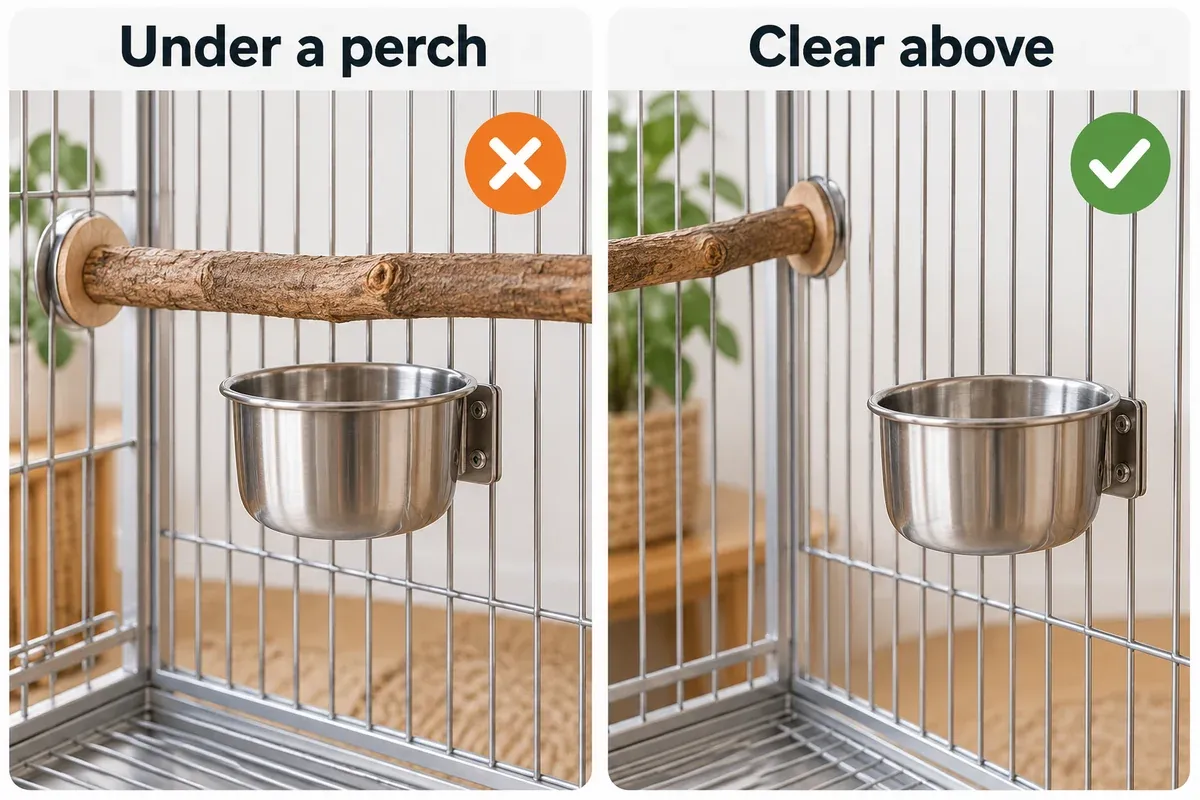
- Put bowls at mid-level or higher, but not directly under a perch. This single change prevents a large share of avoidable contamination.
- Keep food and water separated. Water splashed from a food cup can ferment or spoil more quickly, while wet pellets and fresh food become harder to monitor.
- Keep the station on a side wall. A side-mounted cup is easier to remove and clean than a dish buried behind a platform or toy.
- Leave a clear approach. The bird should be able to land, turn, and leave without brushing against a hanging toy or squeezing between bowl rims.
- Use the right depth and clamp. A small bird may struggle with a deep cup, while a large parrot may tip a lightweight cup or damage a weak bracket. Check the cup after the bird uses it, not just when it is empty.
- Clean daily and inspect the hardware. Replace cracked plastic, bent brackets, rust, sharp edges, or bowls that no longer seat firmly.
For more than one bird, provide enough access that one bird cannot guard the only water cup. Two stations on different sides can reduce conflict, but they still need to stay out from under perches.
Look straight above each cup as well as at its mounting point. The comparison below shows why a secure bowl can still be poorly placed.
Product fit: Tfwadmx stainless-steel cups
Toy Placement: Enrichment Without Clutter
Toys should make the cage more interesting without making it harder to move, sleep, eat, or drink. The LafeberVet foraging reference describes how much of a parrot’s natural day is spent searching and manipulating food; that does not mean every cage needs a crowded puzzle wall. Start with a simple, bird-specific chew or shredding toy and observe how your bird uses it.
Hang toys where the bird can reach them
Place the first hanging toy beside a stable movement perch, not directly above the bowls and not beside the sleep perch. The bird should be able to approach, investigate, and retreat without swinging into the cage wall. Leave a gap around the toy so the tail and wings do not catch on nearby accessories.
Rotate one item at a time. A toy that is ignored may be too far away, too large, too noisy, or introduced alongside too many changes. Move it closer to a familiar perch before buying more toys.
A separate play area can give your parrot room for supervised climbing and food-search activities outside the cage. Use the parrot play stand size and placement guide to check perch fit, stability, and room hazards while keeping the cage’s movement and sleep areas clear.
Inspect every toy like hardware
The Avian Welfare Coalition housing guide emphasizes bird-specific toys and careful housing choices. Check metal clips, bells, chains, leather, rope, paper, and wood. Remove anything that becomes sharp, frayed, loose, soiled, or small enough to swallow. Rope is not automatically safe because it is marketed for birds; it needs frequent inspection and immediate removal when fibers separate.
Avoid using a mirror as the default “companion” toy. If a bird becomes fixated on a reflection, regurgitates toward it, guards it, or becomes distressed, remove it and discuss the behavior with an avian veterinarian.
Product fit: Wesco Bird Kabob
Sleep-Zone Placement: Quiet, Stable, and Boring
The sleep zone is the one part of the cage that should not be competing for attention. Reserve the highest back corner for the stable sleep perch and keep that area free of food, water, swinging toys, and busy foot traffic outside the cage.
Merck’s pet-bird home guidance stresses adequate sleep and notes that most birds should not be covered at night because covering can cause stress. In practice, prioritize a predictable dark and quiet sleep window. A cover may be appropriate for an individual bird or household, but it should not compensate for a noisy cage location, and it must never create a chewing or entanglement hazard.
Do not make a soft hut, tent, or enclosed nest the default sleep solution. Enclosed items can become chewable, dirty, or strongly nest-like. If your bird seeks enclosed spaces, shows hormonal behavior, or has trouble sleeping, ask an avian veterinarian about the individual setup rather than adding fabric automatically.
Species Adjustments: The Same Map, Different Dimensions
Use this as a starting point and then verify the species-specific measurements in the cage chart.
| Bird type | Placement adjustment | What to watch |
|---|---|---|
| Budgie or parakeet | Use smaller, secure cups and shorter perches with appropriately narrow diameters. Keep the movement route open even in a smaller cage. | A large cup or oversized branch can take away more usable space than expected. |
| Cockatiel | Keep one horizontal route and add a stable platform or broad rest area if useful. | Long tails need clearance; do not fill the upper half with hanging toys. |
| Conure | Use robust cage-side clamps and varied natural branches. Put chew toys near a perch but away from bowls. | Inspect fasteners and toy hardware more often because strong beaks can change the setup quickly. |
| African Grey or Amazon | Prioritize a large cage, strong bars, thicker natural perches, and heavy-duty attachment points. | Avoid flimsy toys, weak clips, and a route that forces the bird through a narrow gap. |
| Macaw or large cockatoo | Choose heavy-duty cage construction, reinforced hardware, large open lanes, and correctly sized perches and toys. | Accessory failure becomes a major risk; check every attachment and use the largest practical cage. |
The Merck overview of pet birds is a useful reminder that cage design, perches, sanitation, and enrichment are connected. A strong toy still fails if it blocks the only route; a large cage still fails if the bowls sit under a perch.
A Five-Minute Setup Sequence
Use this order when setting up a new cage or resetting an overcrowded one:
- Photograph the empty cage. A quick reference makes it easier to undo a change and compare the bird’s behavior later.
- Mark the sleep corner. Install the stable high perch first, away from the door and bowls.
- Create one movement route. Add a lower or diagonal perch and keep the center open for turning and wing movement.
- Attach the feeding station. Place food and water cups on a side wall at mid-level or higher, with no perch above them.
- Add one enrichment item. Hang a chew toy beside a familiar perch, away from the sleep and feeding zones.
- Observe before decorating. Watch how the bird enters, lands, eats, drinks, sleeps, and avoids objects. Change one item at a time.
This sequence also makes cleaning easier. You can remove the bowls without moving the sleep perch, replace a toy without disturbing the feeding station, and wipe the cage without dismantling the entire interior.
Troubleshooting Common Layout Problems
“My bird avoids the new cage”
Reduce the number of changes. Move a familiar perch or bowl into the new cage first, leave one side visually open, and introduce the toy later. A bird that is frightened by a new object needs a calmer transition, not a more elaborate cage.
“The food keeps getting dirty”
Look directly above the bowl. Move the nearest perch sideways or upward so the droppings path does not cross the cup. If a toy sheds fibers or paper into the bowl, move the toy to the opposite side and clean the cup.
“The sleep perch is soiled”
Move the sleep perch to a back corner and offset the perch below it. Do not simply add another platform beneath the dirty perch; that usually creates the same problem one level lower.
“The toy is ignored”
Put it beside a perch the bird already uses, reduce the size, or offer a simpler shredding material. Many birds need time to investigate a new texture. Rotate rather than filling the cage with several unfamiliar toys at once.
“The cage feels crowded”
Remove the least-used item and inspect the route again. A cage needs empty air space as much as it needs accessories. If the bird cannot turn without touching two objects, the layout is too dense.
“My bird chews the bowl bracket or toy clip”
Remove the part if it becomes sharp, loose, corroded, or small enough to swallow. Replace it with bird-specific hardware and ask an avian veterinarian if the behavior is persistent or accompanied by ingestion.
Frequently Asked Questions
Where should food and water bowls go in a parrot cage?
Attach them to a side wall at mid-level or higher, with a clear approach and no perch directly above. Keep food and water separate, and choose a depth and clamp that match the bird and cage. Clean them daily and replace damaged hardware.
Should the highest perch be the sleep perch?
Usually, the highest stable perch becomes the preferred sleeping place, so make that area quiet and comfortable. It should not be an abrasive perch, a swinging toy, or a perch positioned above food and water. The bird’s behavior matters: if it chooses another stable perch, check comfort, drafts, and disturbance before forcing a change.
How many perches does a parrot cage need?
Enough to create a route between the door, feeding station, and sleep zone while leaving room to turn and stretch. The number depends on the cage and bird. Start with one sleep perch, one offset movement perch, and an optional platform or branch; add only when the layout still has open space.
Should toys hang near the food bowl?
They should be reachable from a perch but not above, inside, or directly beside the food and water station. Keep shreddable material out of the bowls and leave enough clearance for the bird to approach and leave safely.
Should I cover my parrot’s cage at night?
Not by default. Merck notes that most birds should not be covered because covering can cause stress. A consistent quiet, dark sleep environment is more important. If your bird needs a cover for a specific household or behavioral reason, use it only when safe and discuss the individual routine with an avian veterinarian.
How often should I rearrange the cage?
Change one item at a time and observe the bird for several days. Clean bowls daily, remove droppings from perches promptly, and inspect toys and fasteners every day at first. Rearrange when a zone is dirty, unsafe, or no longer useful—not simply to make the cage look new.
Bottom Line
Set the cage up around four functions: a quiet sleep zone, varied and stable perches, clean side-mounted bowls, and reachable enrichment. Keep food and water out from under perches, keep toys away from bowls and sleep, and protect a clear movement lane. When in doubt, remove one accessory and watch what your bird actually uses.
For a deeper purchase decision, start with the parrot cage size and bar-spacing chart, then use the perch diameter and material guide to select surfaces that fit your bird’s feet.
Sources and Review Notes
- Merck Veterinary Manual: Providing a Home for a Bird
- Merck Veterinary Manual: Overview of Pet Birds
- LafeberVet: Caging
- LafeberVet: Foraging Behavior
- VCA Animal Hospitals: Housing Small Birds
- Avian Welfare Coalition: Housing for Birds
The sources above support the care and placement principles.