
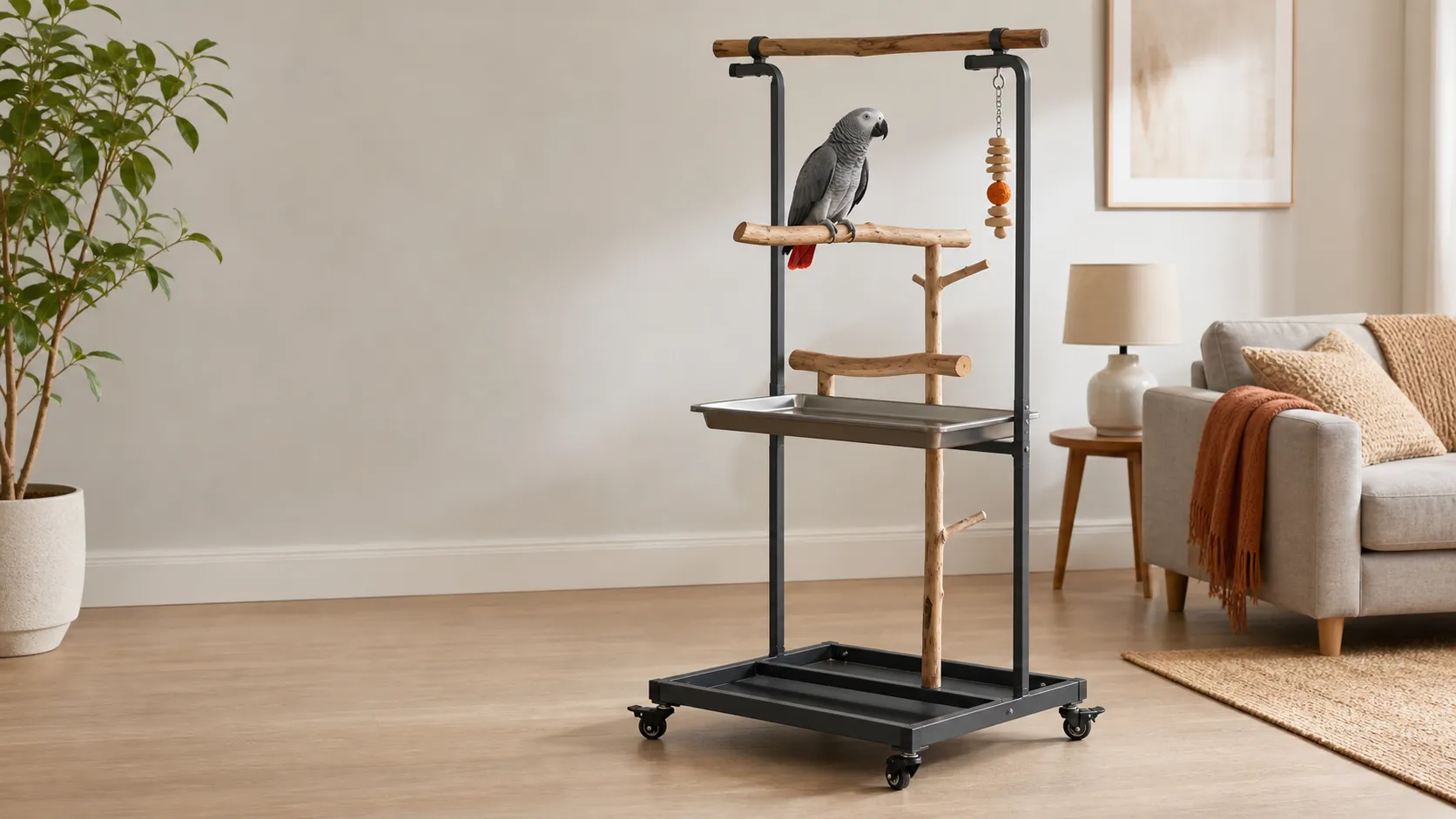

 Published sources
 Product details checked
Choose a parrot play stand that your bird can grip, turn on, and use without the structure rocking or moving. Measure the usable perch space and the assembled footprint, then check the room from the bird’s position. An attractive stand is a poor fit if a bowl blocks the perch, a climbing bird makes the base lift, or a nearby cord is within beak reach.
There is no single minimum stand width or height in the veterinary guidance linked here. Fit depends on the individual bird, the branch arrangement, the accessories, and the supporting surface. The product dimensions below are measurements of specific models, not minimum sizes for a species.
A play stand gives your parrot a place for supervised activity outside its cage. The Merck Veterinary Manual recommends supervised out-of-cage exercise. Keep a suitable cage for secure housing and rest; a stand does not contain a bird that flies, climbs, or walks away. Our parrot cage setup checklist covers the perches, feeding stations, and sleep area the bird returns to.
In this guide:
- Measurements and usable perch space
- Perch height and foot fit
- Footprint, tray coverage, and stability
- Three stand formats to compare
- Room placement and reachable hazards
- Introduction, daily care, and troubleshooting
- Frequently asked questions
The measurements that matter
Bring a tape measure, paper, and removable floor tape. Record the stand’s dimensions in one unit throughout; mixing inches and centimetres makes it easy to misread a perch or a tray. For a tabletop tree, measure the table as well.
| Measurement | How to take it | What it tells you |
|---|---|---|
| Active perch height | Measure from the floor to the surface where the bird’s feet will rest. Add table height for a tabletop stand. | Whether you can offer a hand or familiar transfer perch comfortably. |
| Perch diameter | Measure across the branch at several places the bird can stand. A tapered branch has several diameters. | Whether the bird can grip the available surfaces. |
| Usable perch length | Measure the clear section between bowls, uprights, fasteners, and other obstructions. | How much room remains for standing, turning, and moving after assembly. |
| Assembled footprint | Measure the widest points of the base, casters, tray, and any fixed projection. | How much floor or table space the stand occupies. |
| Tray coverage | Compare the tray outline with the positions directly below perches, cups, and chew toys. | Which debris falls inside the tray and which reaches the floor. |
| Movement and access clearance | Allow for branches, swinging toys, the bird’s movement, door openings, and your approach. | Whether the stand remains usable in the chosen room. |
Count the space the bird can actually use
A long dowel with a cup at each end can have a much shorter clear standing section. A branching tree may have several useful routes, but adding their lengths together gives little information about whether the bird can turn around at one spot.
Look at the main resting perch, each feeding position, and the route between them. The bird should be able to change direction without brushing its tail against a post or forcing its body through a gap between accessories. Leave room for normal wing stretching around the resting area. VCA’s small-bird housing guidance describes unobstructed turning and wing movement; apply that movement check to an open stand without treating cage dimensions as stand specifications.
Before buying, use a familiar perch your bird already handles comfortably as a reference. Note its diameter and the clear space around it during normal movement. Observe voluntary stretches; do not restrain the bird or pull its wings open to take a measurement. Once the stand is assembled, check the actual arrangement again with the bowls and toys installed.
For a long-tailed bird, inspect clearance below and behind its favourite position. For an active climber, follow the route out to the branch ends. Extra branches help only when their grip, connections, and surrounding space are usable.
How tall should a parrot play stand be?
Measure to the perch surface. Overall height may end at a toy hook or climbing rail well above the bird’s usual resting position. Ask for the main perch height when a dimension drawing shows only the highest point.
Choose a height that lets you approach calmly and offer a hand or transfer perch without stretching overhead, standing on a chair, or reaching through toys. Check this for everyone who normally handles the bird. Your shoulder can be a convenient personal measuring reference, but it is not a universal height limit or a rule about the bird’s behaviour.
For a tabletop tree, the calculation is straightforward: floor-to-perch height = table height + height of that perch above the stand’s base. The tree’s overall height may still include branches above the perch you intend to use. A compact tree on a tall cabinet can leave the bird harder to reach than a floor stand.
Height also needs to suit the bird’s mobility. If your parrot has balance problems, painful feet, or difficulty transferring, ask an avian veterinarian about suitable surfaces and access before choosing a tall climbing structure. Provide a clear route to the cage without requiring a jump the bird cannot manage.
| Stand format | Useful setting | Main limitation to check |
|---|---|---|
| Tabletop tree | A stable table where a smaller bird can join quiet household activity. | The table and tree must both stay steady; the table edge adds a fall hazard. |
| Rolling floor stand | A regular social area with room to approach, clean, and park the stand. | Casters, joints, and the base must remain secure during use. |
| Tall, compact tower | A room with enough vertical clearance and a bird that fits the perch arrangement. | Overall height says little about clear perch space or resistance to tipping. |
| Broad floor tree or stand | A bird that uses several climbing routes and needs more room around them. | Branch strength, fasteners, and the assembled footprint still need checking. |
Pick perch diameter by foot fit, not species label
VCA recommends a perch diameter that allows the toes to curl around roughly three-quarters of the surface. Treat that as a practical grip check, not a requirement to measure a precise angle. A branch is too wide at a particular spot if the bird can only stand on top with its toes spread and cannot hold securely.
Watch both feet during standing, turning, and climbing. Repeated slipping, constant repositioning, or refusal to use a branch deserves another look. A flat platform has a different purpose: it provides a resting surface without the round grip of a branch, so the toe-wrap check does not apply to it.
Offer suitable variation across the surfaces the bird uses. The University of Florida recommends different perch diameters, shapes, and textures and warns against sandpaper perches. Wrapping an unsuitable dowel in an abrasive cover does not solve a fit problem.
For species starting ranges and the differences between wood, rope, and resting platforms, use our bird perch size and material guide. Keep the individual grip check even when a stand is labelled for your species. A product described for “large parrots” can still have a main perch that does not suit your bird.
If grip changes suddenly, or you notice swelling, wounds, or apparent pain, stop the session and contact an avian veterinarian. Do not assume a new perch alone will resolve a foot problem.
Match the footprint to the bird’s movement
Mark the stand’s widest assembled outline with removable tape before buying. Include protruding casters and any guard or branch that extends beyond the base. Then mark the movement of a swing or hanging toy separately. The first outline shows where the stand sits; the second shows space that must remain clear during play.
Walk around the outline carrying the items you normally use there. Check whether you can bring a food bowl, reach the bird, and remove the tray without moving furniture. With the bird safely elsewhere, test door and cabinet openings. If a door can hit the stand or a passing person must squeeze beside a branch, change the location.
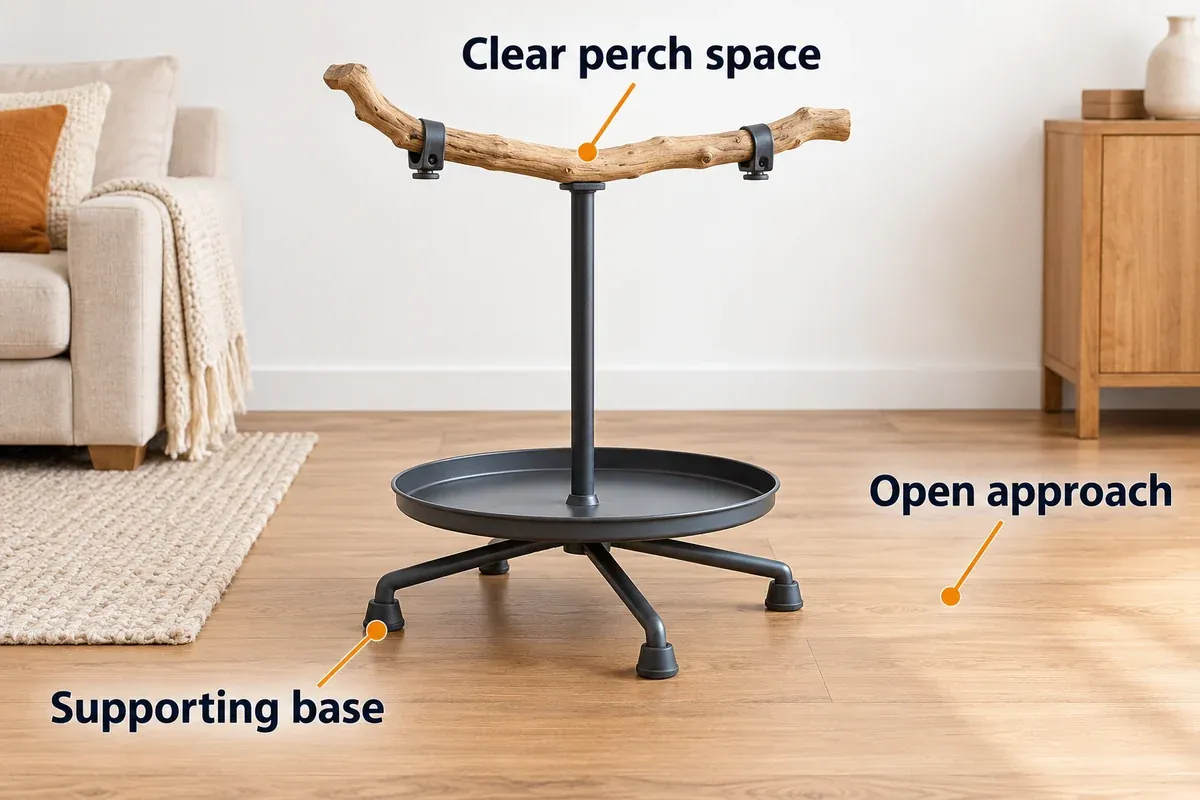
The tray and the base do different jobs. A wide tray catches debris, while the feet or wheels support the structure. Tray diameter alone does not tell you the distance between those support points or how the stand behaves when a bird climbs off-centre.
Keep all wheels or feet on the same firm, level surface. A caster partly on a rug edge or threshold can leave the frame rocking. A flat floor protector can help with cleanup if it does not slide, curl, or interfere with the wheels. Check the assembled stand on the actual surface you will use.
Measure catch-tray coverage separately
Look straight down from the feeding position and the main perch. Check whether both fall inside the tray outline. Repeat for branch ends and the place where the bird shreds toys. A bowl mounted outside the tray can make a large tray less useful than its diameter suggests.
Expect some thrown food and light debris beyond that outline. Choose a location where you can clean around the base and lift out the tray without spilling it through a narrow gap. After the first sessions, inspect where debris actually lands and adjust the accessory positions or floor protection.
Leave cups out of the droppings path. LafeberVet’s caging handout advises positioning dishes to reduce contamination. On a branching stand, check for an upper perch directly above each cup as well as the perch beside it.
A stability check before the bird uses it
Use the correct assembly instructions and install all required base sections, braces, washers, and fasteners. The PawHut D10-055V01 assembly sheet and COZIWOW assembly manual show the base and upper structure as a complete assembly. Missing parts or a perch that rotates at its attachment need resolving before use.
The following checks help identify obvious faults at home. They are not a load certification, and passing them does not establish suitability for every bird.
- Check the empty base. Place the stand on its intended surface. Make sure every support point contacts it. With no bird present, gently check for rocking; do not deliberately tip or stress the structure.
- Inspect the connections. Hold the main perch and check for unintended rotation or movement at the joints. Tighten or adjust only as the instructions permit. Stop if a thread strips or a connection cannot be secured.
- Check the wheels. Engage every fitted brake and confirm the parked stand stays still. If the stand has no brakes, verify it will not roll during normal use. A movable base that drifts needs a different solution before bird contact.
- Install the intended accessories. Use the cups, toys, and attachment points you plan to keep. Follow any specified accessory limits. Recheck the base and joints; an arrangement that was steady empty may move with weight on one side.
- Inspect what the beak and feet can reach. Look for sharp edges, protruding screws, peeling finishes, loose connectors, and trapping gaps. Check branch undersides and the tray rim as well as the top perch.
- Observe ordinary use closely. Only after the earlier checks pass, let the bird approach voluntarily. Watch the base during transfers and climbs. Remove the bird if the stand rocks, rolls, twists at a joint, or begins to lift at a support point.
For a tabletop tree, repeat the checks for the table: it must stay steady, and the tree must remain fully supported without sliding toward an edge. Rubber feet are useful, but they do not make a slippery surface or an unstable table suitable.
Do not wedge a faulty stand against furniture or add improvised hanging weights to make it appear steady. Reassemble it correctly, obtain the missing or defective part, or choose a structure suited to the bird’s movement. Repeat the checks after relocation, accessory changes, or substantial chewing.
The three areas highlighted below need separate checks on the assembled stand. Confirm its stability with the bird safely elsewhere, then watch closely during voluntary use.
Product examples by stand job
These three models illustrate a wider rolling base, a tall compact stand, and a tabletop tree. Compare them by the space you measured and the way your bird moves. The comparison uses published specifications; it does not claim hands-on testing or a verified load capacity.
Three play-stand geometries to compare
-
PawHut 63-Inch Large Bird Perch Stand with Toy Hook and 3 Ladders
PawHut
A steel-and-wood rolling play stand listed at 27.2 × 25.2 × 63 inches, with a round stainless tray, bowls, ladders, and a toy hook.
- 27.2 × 25.2 × 63 in overall dimensions listed by PawHut
- 23.6-in round stainless tray with a removable-tray design
- 0.87-in diameter × 16.7-in wooden perch
- Size geometry
- 27.2 × 25.2 × 63 in
- Tray / cleanup
- 23.6-in round stainless tray
- Best fit
- A rolling floor stand when a wider catch-tray footprint matters
-
COZIWOW 72-Inch Parrot Stand with Stainless Tray and Wheels
COZIWOW
A 72-inch iron-and-solid-wood play stand with a compact base, stainless catch tray, bowls, a toy hook, and four casters.
- 19.9 × 18.3 × 72 in overall dimensions listed by COZIWOW
- 17.7-in tray and 17.9-in wooden perch listed on the product page
- Four casters, including two with brakes, for supervised repositioning
- Size geometry
- 19.9 × 18.3 × 72 in
- Tray / cleanup
- 17.7-in stainless tray
- Best fit
- A tall compact stand for small-to-medium birds when vertical space is available
-
Prevue Pet Products Coffeawood Tree Mini Tabletop Play Stand 22634
Prevue Pet Products
A natural coffeawood tabletop tree with a compact base, one cup, toy eye screws, rubber feet, and varied branch diameters.
- 22.5 × 14.5-in base with a listed tree height of 19.5–24 in
- Natural coffeawood/Java tree with 9/16–1 3/8-in branch diameters
- One food or water cup and two eye screws for toys
- Size geometry
- 22.5 × 14.5 × 19.5–24 in
- Tray / cleanup
- No catch tray; tabletop cleanup
- Best fit
- A Java or coffeawood tabletop option for small and medium birds
PawHut 63-inch stand: the wider rolling option
The PawHut D10-055V01 measures 27.2 × 25.2 × 63 inches overall, approximately 69 × 64 × 160 cm. Its round tray is 23.6 inches across, and the wooden perch is 16.7 inches long with a 0.87-inch diameter, approximately 42 cm long and 22 mm across.
This is the wider rolling example here. It suits a room where the full base fits outside the walking lane and the bird can use the main perch comfortably. Measure the clear perch section between the cups; its full length is not all standing space.
The removable tray helps with cleanup, but the ladders and toy hook need separate clearance. The overall dimensions and the manufacturer’s species list do not establish suitability for an individual macaw or cockatoo. Check grip, branch access, and stability before making that choice.
Check current price on Amazon →COZIWOW 72-inch stand: tall and compact
The COZIWOW 72-inch stand measures 19.9 × 18.3 × 72 inches overall, approximately 51 × 46 × 183 cm. It has a 17.7-inch tray and a 17.9-inch-long wooden perch, with four casters, two of which have brakes. The perch length does not tell you its diameter; confirm the actual grip surface before buying.
This compact footprint may fit a smaller room, provided you still have clear approach space and an accessible main perch. Engage both brakes and check the assembled stand with its intended accessories. The additional overall height is not a stability rating.
COZIWOW identifies small-to-medium birds as its intended users. Choose it only when the individual bird fits the available surfaces and the base remains steady in use. A narrow tower is a poor solution when your bird’s climbing movements shift the structure.
Check current price on Amazon →Prevue 22634 Java/coffeawood tree: tabletop enrichment
The Prevue 22634 tabletop tree has a 22.5 × 14.5-inch base and a tree height of 19.5–24 inches, approximately 57 × 37 cm at the base and 50–61 cm tall. Its branches range from 9/16 to 1 3/8 inches across, approximately 14–35 mm.
It suits a small or medium bird when a stable table is already available. Include the table in your height and floor-space measurements, keep the base fully supported, and check that neither surface moves during transfers.
Each natural tree has a different branch arrangement, so inspect the actual routes and cup position. Prevue specifies one food or water cup and cautions against tightening it all the way down to the branch. Follow that instruction rather than applying the same tightening approach to every component. Arrange separate access to whichever food or water provision the single cup does not cover.
Check current price on Amazon →Where to place a parrot play stand
Start with the quieter edge of a room where you spend time and can watch the bird. The stand should be visible from your normal position, with a clear approach for transfers and cleaning. A home office works only when calls, headphones, or concentrated work do not prevent you from noticing the bird leaving the perch.
LafeberVet recommends housing where birds can observe household activity without being in its busiest part. Use that balance when choosing a play area too. Our bird cage placement guide helps you compare room conditions, while the checks below address the extra access an out-of-cage bird has.
Good default placement
- Keep the stand outside door swings and the route people take through the room.
- Choose a firm, level surface with space to approach from the side used for transfers.
- If one side faces a wall, leave the bird unable to chew the wall, trim, cables, or nearby furniture. Do not use the wall to prop up the stand.
- Keep the cage reachable by a safe transfer route. A nearby cage does not make an unsecured room safe.
- Provide accessible water and suitable food for the session, with neither cup directly below a perch or hanging toy that drops debris into it.
There is no fixed wall or furniture clearance that protects every parrot. Branch reach, neck reach, climbing ability, and flight change what the bird can access. Inspect from each usable perch, including the highest branch and the outside ends.
Places to avoid
Check hazards the bird can reach from the stand and those it can encounter after leaving it. Merck identifies windows, mirrors, fans, electrical cords, flames, poisons, and open water as household dangers for birds. A small tray or a clipped wing does not create a boundary around the perch.
| Room hazard | Check before the session |
|---|---|
| Windows, mirrors, and exterior doors | Close escape routes, make large panes visible with appropriate coverings, and keep household members from opening an exterior door while the bird is loose. |
| Fans and exposed moving parts | Switch fans off before the bird comes out. Keep the bird away from equipment it can reach or land on. |
| Cooking, flames, smoke, and sprays | Choose a room away from cooking activity. Keep candles, smoke, aerosols, and fragranced products out of the bird’s airspace. |
| Cords, blinds, and reachable shelves | Remove access to cables, hanging loops, plants, small objects, and decorative items the bird could chew or pull down. |
| Open water and hot liquids | Cover or remove open containers, close toilet lids, and keep hot drinks away from the play area. |
| Cats, dogs, and other animals | Keep them physically separated from the bird during the session. Height alone does not prevent an animal reaching the stand. |
| Sun, heaters, and air outlets | Watch for direct sun on the perch and airflow at the bird’s level. Choose a position without intense heat or direct drafts. |
The LafeberVet household-dangers handout covers cooking fumes, sprays, direct sun, temperature extremes, and other pets. Fume control concerns the room’s air, not just the distance to a saucepan or spray bottle. Moving a stand across an open-plan kitchen does not remove exposure to air from the cooking area.
VCA’s household-safety guidance recommends keeping electrical cords inaccessible and making windows and mirrors visible. Check behind the stand too: a cable hidden from your usual viewing angle may still be reachable by climbing down a post.
Secure the room even for a bird with clipped wings. VCA notes that clipped birds can still walk, climb, and sometimes fly. A stand cannot provide outdoor containment either. For outdoor time, use a suitable secure enclosure or another arrangement agreed with an avian professional rather than relying on the bird to remain on an open perch.
Keep the stand separate from the cage when that helps
A separate play area can give the bird another place to climb and search for food. LafeberVet’s foraging handout describes trees with food stations at different levels and recommends introducing foraging gradually. Keep an easy feeding position available while the bird learns a new task.
The useful distance from the cage depends on the room and the bird’s transfer skills. Start where you can move the bird between the two calmly. If a connecting branch or ladder is appropriate, it must have secure attachments and clear surroundings; do not bridge a walking lane or doorway.
Check the proposed location before buying
Keep the bird safely elsewhere while you test the room:
- Tape out the assembled footprint and the space needed for toys and branches.
- Mark the main perch height and check that you can approach and offer a transfer perch comfortably.
- Walk the normal household route and open nearby doors and cabinets. Check that neither people nor moving furniture will strike the stand.
- Trace access from every planned perch to cords, shelves, windows, and other hazards. Then inspect the wider room in case the bird leaves the stand.
- Check the spot at different times of day for direct sun, heater or air-conditioning use, and changes in traffic.
- Confirm that you can remove the tray, clean below the stand, and return the bird to its cage without squeezing through a gap.
If the outline obstructs the room, choose another position or stand format. If the room cannot be secured, resolve that before bringing the bird out.
Introduce the stand with a supervised first session
Begin after assembly, stability, and room checks pass. Install a suitable perch, accessible water, and a simple familiar activity. Avoid covering every attachment point with a new toy at once. VCA advises introducing unfamiliar enrichment gradually.
Let a cautious bird observe the stand from a familiar place first. Offer the transfer method it already knows, such as stepping onto a hand or a familiar perch. Do not force it onto the stand or leave it there to “get used to it.” Stay close enough to respond, with a clear way to return it to the cage.
Watch the transfer as well as the resting position. Does the perch move when the bird steps on? Can it turn without catching its tail? Does a climb toward a toy make the base shift? If a surface slips, a joint moves, or the bird repeatedly loses balance, end the session and inspect the setup.
For food-search activities, start with something easy to find and retrieve. LafeberVet recommends increasing foraging difficulty slowly and monitoring new items. Keep the familiar food and water route usable throughout.
Supervision means someone can see the bird and respond to movement or trouble. Being elsewhere in the house, watching through a camera, or concentrating on work without checking the bird does not provide the same response. Return the bird to its secure cage when you need to leave or cannot watch it.
Cleaning and checks that keep the stand usable
Remove food waste and droppings after sessions, and replace dirty water promptly. Clean cups daily and whenever contaminated. VCA’s housing guidance recommends daily cleaning of food and water dishes. Put them back in the same accessible positions while checking that their mounts remain secure.
Clean dirty perches with a method suited to the material, rinse away cleaning products, and let washed surfaces dry before use. VCA’s perch guidance stresses keeping standing surfaces clean and rinsing them thoroughly. Keep the bird elsewhere during cleaning, follow the cleaning product’s instructions, and avoid sprays in its airspace.
Inspect the parts that receive repeated chewing or movement:
- Branches and dowels for sharp splinters, weakened sections, or movement at their connections.
- Rope and toys for loose fibres, exposed wire, open connectors, or parts the bird can detach.
- Bowls and tray mounts for looseness, trapped debris, or sharp edges.
- Casters and feet for damage, debris, or a changed contact with the floor.
- Accessible metal surfaces for peeling coating, corrosion, or rough edges.
Remove an unsafe accessory immediately. If the main perch or supporting structure is affected, stop using the stand until it is repaired or replaced. Keep replacement parts consistent with the manufacturer’s design; a new branch or oversized toy can change both the bird’s access and the balance of the stand.
When the setup is not working
| What you notice | What to check | Next step |
|---|---|---|
| The stand rocks during transfers | Floor level, wheel contact, base assembly, and loose joints. | Stop use. Correct the cause and repeat the empty checks before another session. |
| The bird slips or avoids one perch | Diameter, surface texture, contamination, and whether the perch rotates. | Provide a suitable secure surface; seek veterinary advice for a changed grip or signs of pain. |
| The tail hits a post or bowl | Clear standing length and the space needed to turn. | Move permitted accessories or choose a different branch arrangement. |
| The bird climbs onto nearby furniture | Branch ends and reachable surfaces beyond the base. | Relocate the stand and remove the access route; recheck the whole room. |
| Food or droppings miss the tray | Cup placement and frequently used positions beyond the tray outline. | Adjust accessories where permitted and protect the surrounding floor without destabilising the base. |
| The bird avoids the whole stand | Wobble, awkward transfers, unfamiliar toys, noise, and room position. | Simplify the setup and allow gradual, voluntary exploration. Do not force a transfer. |
Frequently Asked Questions
Is a taller parrot play stand better?
Extra height is useful only when the bird can reach suitable perches and you can manage transfers comfortably. Compare the active perch height, usable space, base support, and stability with the accessories installed. A tall hook does not add standing room.
How large should a stand be for an African Grey or macaw?
Use the individual bird’s grip, turning space, climbing reach, and movement to assess the stand. There is no universal dimension in the sources here that makes a stand suitable for every African Grey or macaw. A broader base is a feature to assess alongside construction and branch strength, not a safety guarantee. Ask an avian veterinarian about surfaces and access for a bird with mobility or foot problems.
Does a play stand need a catch tray?
A tray is useful for cleanup, but it does not establish safety or contain the bird. Check coverage below the main perch and cups, and allow for debris thrown beyond the rim. A tabletop tree without a tray needs a suitable washable surface and a practical cleaning routine.
Is Java wood safe for a parrot play stand?
Choose a purpose-made stand with suitable branches and inspect the actual tree. The wood name alone cannot establish that the grip, branch strength, finish, and hardware suit your bird. Follow its assembly instructions and remove access to sharp splinters or weakened branches. Natural trees also vary in shape, so a photograph cannot confirm the usable perch arrangement of the tree you receive.
Can a parrot stay on a play stand while nobody is home?
Return the bird to a suitable secure cage before leaving. An open stand allows access to the room, and a bird that usually stays put can still move away. Keep stand sessions supervised as part of the safe exercise routine recommended by Merck.
Can I put the stand beside a window?
Choose a position away from direct sun on the perch and secure the window before the bird comes out. Make large panes visible and keep frames, blind cords, and curtain hardware inaccessible. Check the light at different times of day; a shaded spot in the morning can be in direct sun later. Moving the stand back does not remove a window collision risk elsewhere in the room.
How long can a parrot stay on a play stand?
The sources used here do not give one session length for every parrot. Continue only while the bird uses the stand comfortably, has access to water and appropriate food, and you can supervise. Allow a return to the cage for rest. End the session if the bird struggles with balance, the stand moves, or you cannot maintain supervision.
Does a play stand let me use a smaller cage?
Keep cage size and stand choice as separate decisions. The cage still needs appropriate room for the bird’s normal movement and suitable bar spacing during the time it spends inside. Use our bird cage size and bar spacing guide for that assessment. Supervised use of an open stand does not solve an unsuitable cage layout.
Sources and further reading
- LafeberVet: Caging the Companion Parrot — perch variety, dish placement, and household location.
- LafeberVet: Foraging Behavior in Companion Parrots — gradual introduction of food-search activities and foraging trees.
- LafeberVet: Household Dangers — fumes, temperature extremes, accessible household items, and other pets.
- Merck Veterinary Manual: Providing a Home for a Bird — exercise and supervision.
- Merck Veterinary Manual: Household Hazards for Pet Birds — collision, escape, electrical, flame, and water hazards.
- VCA Animal Hospitals: Perches for Birds — grip and cleaning standing surfaces.
- VCA Animal Hospitals: Housing Small Birds — movement clearance, dishes, and gradual introduction of enrichment.
- VCA Animal Hospitals: Household Hazards and Dangers to Birds — cords and visible glass barriers.
- VCA Animal Hospitals: Wing Clipping — continued climbing, walking, and potential flight after a wing trim.
- University of Florida Small Animal Hospital: How to Care for Your Pet Bird — varied perch surfaces and avoidance of abrasive covers.
- PawHut D10-055V01 specifications and assembly sheet.
- COZIWOW 72-inch stand specifications and assembly manual.
- Prevue 22634 tabletop-tree specifications.