

 Published sources
 Product details checked
Few cat-care problems are more frustrating than a cat who walks up to the litter box, hesitates, and then chooses the carpet instead. The right litter can remove one important source of friction, but it cannot compensate for urinary pain, a dirty box, a frightening location, or another cat blocking the exit.
Quick Answer: If your veterinarian has ruled out a medical problem, Dr. Elsey’s Cat Attract is the most targeted first test because it combines an unscented clumping texture with a natural attractant. For a neutral reset, start with Dr. Elsey’s Ultra Unscented. If your cat dislikes heavy clay, World’s Best Multiple Cat Unscented is the most useful texture change in this group. No litter is best for every cat, so the safest approach is to offer a small test in a second box instead of replacing the only box overnight.
In this guide, you’ll learn:
- Which litter to test first for a recent refusal, a fragrance aversion, or a clay-texture problem
- Why a clean, accessible box often matters more than a stronger odor-control claim
- How to switch gradually without removing your cat’s familiar option too soon
- What to do when the cat uses the box inconsistently or prefers a different surface
- Which warning signs mean a litter experiment should wait for a veterinary visit
Quick Comparison: Best Cat Litter for Litter Box Refusal
Five practical starting points
-
Dr. Elsey's Cat Attract Clumping Clay Cat Litter – 18 lb
Dr. Elsey's
Clumping clay litter formulated as a targeted trial for cats that avoid an otherwise suitable litter box.
- Cat Attract formula for a focused litter-preference trial
- 18-lb bag suited to testing one box without a large commitment
- Best for
- Cats with litter or substrate aversion after a veterinary check
- Key feature
- Natural herbal attractant
-
Dr. Elsey's Ultra Unscented Clumping Clay Cat Litter – 40 lb
Dr. Elsey's
It is a sensible control option when you want to remove fragrance without adding an attractant.
- 100% bentonite clay with firm clumping
- Unscented and marketed as low dust and low tracking
- Large 40-lb bag suits repeat testing or multi-cat homes
- Best for
- A neutral, fragrance-free reset for cats sensitive to scented litter
- Key feature
- Unscented neutral baseline
-
Fresh Step Advanced Simply Unscented Multi-Cat Litter – 37 lb
Fresh Step
An unscented multi-cat clay option that adds activated-charcoal odor control without relying on perfume. The large two-box pack is practical when several boxes need the same neutral formula.
- Unscented clumping clay with activated charcoal odor control
- Large 37-lb total pack for multi-cat households
- product information states low dust and compatibility with automatic litter boxes
- Best for
- Multi-cat homes that need unscented litter with stronger odor control
- Key feature
- Activated charcoal odor control
-
Purina Tidy Cats Free & Clean Unscented Clumping Litter – 38 lb
Purina Tidy Cats
A fragrance- and dye-free clumping clay with activated charcoal and a lower price per pound than small specialty bags. It is a practical follow-up when a cat accepts unscented clay but the household needs more odor margin.
- Made without added fragrance or dye
- Activated charcoal paired with tight clumping for odor control
- 38-lb box gives multi-cat homes a value-focused refill
- Best for
- Fragrance-sensitive multi-cat homes that want a value-oriented clay option
- Key feature
- Fragrance- and dye-free with activated charcoal
-
World's Best Cat Litter Multiple Cat Unscented – 15 lb
World's Best Cat Litter
A lightweight, unscented corn-based litter with quick clumping and odor control. It is the most useful texture change in this group when a cat dislikes the feel or handling weight of clay.
- Made from whole-kernel corn with no artificial perfume
- Lightweight and marketed as 99% dust free
- Quick clumping and odor control for multi-cat use
- Best for
- Cats who reject heavy clay and tolerate a lighter plant-based texture
- Key feature
- Lightweight unscented alternative
Review the linked product page before purchasing.
Before You Change the Litter: Rule Out Pain First
A sudden refusal is not automatically a preference problem. Urinary inflammation, stones, constipation, arthritis, and other conditions can make elimination painful or urgent. A cat may then associate that discomfort with the box and avoid it even after the original problem has improved.
Arrange a veterinary examination promptly if the change is sudden, persistent, or paired with repeated box visits, straining, crying, licking the urinary area, blood, vomiting, unusual tiredness, or very small amounts of urine. If a cat is repeatedly trying to urinate and producing little or nothing, treat that as urgent rather than waiting for a new litter to work. Male cats are especially vulnerable to life-threatening urinary blockage, but any cat with these signs needs professional advice.
The ASPCA recommends ruling out medical problems first. Cornell also notes that cats may not look obviously sick even when a medical condition is contributing to house soiling. A new litter is a behavior and environment experiment, not a treatment.
How I Chose These Litters
The picks below are not five versions of the same product. Each fills a different role in a sensible troubleshooting process:
- Texture and smell: Unscented formulas and fine-to-medium clumping textures are reasonable first tests because many cats dislike perfume or abrupt changes in how litter feels under their paws.
- A targeted attractant: A natural attractant can be useful when the box itself has become a negative cue, but only after health and access problems are addressed.
- Odor control without perfume: Activated charcoal can add odor margin in a multi-cat home without asking the cat to tolerate a strong fragrance.
- A non-clay alternative: A lighter corn litter gives you a meaningful texture change instead of another clay brand with a new label. Product claims below are identified as product information or manufacturer claims rather than independent laboratory results.
The Best Cat Litters for Cats That Refuse the Litter Box
1. Dr. Elsey’s Cat Attract – Best for a Targeted Reset
Check current price on Amazon →Best for: A cat who began avoiding the box after a change in litter, location, or routine Texture: Medium-grain clumping clay
Why We Recommend It
Cat Attract is the clearest first experiment when your cat has been medically cleared but still treats the litter box as suspicious. It combines a familiar clumping-clay format with a natural herbal attractant and an unscented presentation, so you are changing the cue that may be causing the refusal without adding perfume.
The goal is not to sprinkle attractant into every box indefinitely. Put it in one clean, uncovered test box beside the familiar box. That gives your cat a genuine choice and lets you see whether the texture and attractant make a difference.
Key Features
- Natural herbal attractant: Designed to make the box more inviting for cats who hesitate or walk away.
- Medium-grain bentonite clay: Creates firm clumps that are easy to remove before odors build up.
- Unscented, low-dust approach: Avoids the strong perfume that can turn a sensitive cat away, while the product documentation emphasizes reduced dust.
- 18-lb test size: Smaller and less wasteful than buying a multi-cat bag before you know whether your cat accepts it.
Pros & Cons
Pros:
- The most directly targeted option for litter box avoidance in this group
- Unscented and easy to test in a second box
- Firm clumping makes fast, thorough scooping practical
- More affordable than changing the box, furniture, and litter all at once
Cons:
- An attractant will not solve pain, stress, access problems, or a dirty box
- Clay is heavy and may not match a cat who prefers pellets or plant-based litter
- Some cats reject the attractant or its herbal smell even though it is not a perfume
Bottom Line
Choose Cat Attract when the medical check is clear and you want the most focused litter trial. Keep the old litter available during the test; if your cat does not use the new box, that result is useful information rather than a reason to keep adding more attractant.
Best for: Recent refusal with no obvious health cause, especially after a litter or routine change Skip if: Your cat is straining, cannot urinate normally, or refuses every box and seems unwell
2. Dr. Elsey’s Ultra Unscented – Best Neutral Baseline
Check current price on Amazon →Best for: Cats who are sensitive to fragrance or households that want a plain reset Texture: Fine-to-medium clumping clay
Why We Recommend It
Sometimes the best troubleshooting move is to remove variables. Ultra Unscented gives you a widely reviewed, fragrance-free clay baseline without an added attractant or a dramatic change to the normal clumping-litter routine. It is a good control when you suspect the problem is a scented formula, deodorizer, or a new texture.
The 40-lb bag is economical for repeat testing and multi-cat homes, but it is also a commitment. If your cat has never accepted clay, buy only if you can test a small amount in a second box or already know that clay is familiar.
Key Features
- Unscented formula: Removes perfume as a likely source of aversion instead of masking box odor.
- Bentonite clumping: Firm clumps help you remove waste completely and keep the remaining litter cleaner.
- Low-dust and low-tracking claims: Useful for homes where dust around the box is itself a concern.
Pros & Cons
Pros:
-
Simple, unscented baseline for a controlled litter trial
-
Good value per pound when several boxes need the same litter
-
Firm clumps support frequent scooping
Cons:
- The large bag is heavy and difficult to store
- No attractant for cats who need a stronger positive cue
- A clay baseline does not help if the cat dislikes clay underfoot
Bottom Line
Ultra Unscented is the pick I would use when fragrance is the prime suspect or when you want a neutral benchmark before trying specialty formulas. Test acceptance first, then buy the large bag; a low per-pound price does not help if your cat refuses the texture.
Best for: Fragrance-sensitive cats and owners who want the simplest unscented clay test Skip if: Your cat has clearly preferred pellets, paper, wood, or plant-based litter in the past
3. Fresh Step Advanced Simply Unscented – Best for Multi-Cat Odor Control
Check current price on Amazon →Best for: Multi-cat homes that need odor control without added fragrance Texture: Unscented clumping clay with activated charcoal
Why We Recommend It
If your cat accepts clumping clay but starts avoiding a box once it smells used, odor control becomes part of the behavior solution. Fresh Step’s Simply Unscented multi-cat formula adds activated charcoal without relying on perfume, and the two-box pack is practical when several boxes need the same baseline.
This is not permission to stretch the scooping schedule. Odor-control media can buy you margin, but a cat’s nose is still much more sensitive than yours. Scoop at least daily, and more often when multiple cats share the home.
Key Features
- Unscented clay: A better starting point for cats that react to perfumed litter or scented deodorizer.
- Activated charcoal: Product information describes charcoal-based odor control and an ammonia-control system; treat those as product claims, not a promise that the box will never smell.
- Multi-cat pack size: Two 18.5-lb boxes are easier to handle than one oversized bag while still giving a multi-cat home a useful supply.
- Automatic-box compatibility claim: the product documentation states compatibility with automatic litter boxes, but always follow the specific machine’s litter requirements.
Pros & Cons
Pros:
- Strongest fit for owners who prioritize odor-control features
- Odor-control features without added fragrance
- Two smaller bags are easier to handle than one 40-lb bag
- Sensible follow-up when the cat already accepts clay
Cons:
- A two-box pack is too much if you are still testing whether your cat likes the texture
- More expensive than the plain clay baseline
- Charcoal cannot replace clean boxes, adequate box count, or daily scooping
Bottom Line
Choose Fresh Step Simply Unscented when the texture is already familiar and the household needs more odor margin. It is less compelling as a first-ever litter trial than Cat Attract or a small neutral test because the pack size and price make a failed experiment more wasteful.
Best for: Multi-cat homes with a proven preference for clumping clay Skip if: Your cat is avoiding the box because of its location, cover, entry height, or an obvious medical symptom
4. Purina Tidy Cats Free & Clean – Best Value Unscented Multi-Cat Option
Check current price on Amazon →Best for: A fragrance- and dye-free refill when budget matters Texture: Clumping clay with activated charcoal
Why We Recommend It
Free & Clean makes sense after your cat has accepted an unscented clay texture and you want a larger, value-oriented supply. It avoids added fragrance and dye, then uses activated charcoal and clumping to support odor control in a multi-cat home.
The important sequence is easy to miss: first confirm that the cat likes the litter, then optimize cost per pound. Starting with the biggest value box can leave you with 38 lb of unusable litter if the real problem is texture.
Key Features
- No added fragrance or dye: Reduces two common sources of sensory overload around the box.
- Activated charcoal: Adds odor adsorption to a traditional clay formula.
- Tight-clumping design: Helps remove urine clumps before the remaining litter becomes unpleasant.
- 38-lb box: A practical refill size for a multi-cat home that has already confirmed acceptance.
Pros & Cons
Pros:
- Good price-to-quantity balance for multi-cat households
- Unscented and dye-free
- Activated charcoal supports odor control without a perfume cloud
Cons:
- Too large for a first trial if your cat is texture-selective
- Heavy to lift and store
- Still a conventional clay litter, not a solution for cats who dislike clay
Bottom Line
Free & Clean is the practical value pick once you know unscented clay works. It is not the most targeted option for a cat actively refusing the box, but it can keep a successful setup affordable and less perfumed over time.
Best for: Multi-cat households that already know their cats accept unscented clay Skip if: You are trying to identify a texture preference and need a small, low-risk test
5. World’s Best Multiple Cat Unscented – Best Lightweight Clay Alternative
Check current price on Amazon →Best for: Cats who dislike heavy clay or may accept a plant-based texture Texture: Whole-kernel corn clumping litter
Why We Recommend It
If your cat keeps perching on the edge of the box, shaking its paws, or walking away from clay, switching only to another clay brand may not answer the real objection. World’s Best Multiple Cat Unscented gives you a meaningful material change: a lightweight corn-based litter with quick clumping and no artificial perfume.
Plant-based does not automatically mean cat-approved. Corn granules feel different from clay, and some cats prefer the familiar sand-like sensation. Use this as a side-by-side texture experiment rather than mixing it into the only box on day one.
Key Features
- Whole-kernel corn: A lighter material that is easier to carry and can suit homes trying to move away from clay.
- Unscented presentation: Avoids adding a strong human fragrance to a cat’s elimination area.
- Quick clumping and odor control: Useful when the cat accepts the material and the box is scooped consistently.
- Smaller 15-lb bag: Less intimidating to test than a bulk clay box, although it does not equal a 40-lb bag in volume.
Pros & Cons
Pros:
- The clearest material change in this comparison
- Much lighter to carry than a large clay bag
- Unscented and plant-based
Cons:
- The corn texture can be rejected by cats accustomed to fine clay
- The smaller bag may cost more per pound than bulk clay
- Follow local waste and plumbing rules even if a product documentation mentions flushability
Bottom Line
World’s Best is the right experiment when weight, clay dust, or clay texture is the suspected problem. It is not automatically the best choice for a cat refusing every box; if the refusal is sudden or paired with discomfort, go back to the veterinary check before testing materials.
Best for: A confirmed clay aversion or owners who need a lighter unscented option Skip if: Your cat has never tolerated corn-based textures and you have not tested it in a second box
The Litter Box Setup Matters as Much as the Bag
When cats refuse a box, changing litter alone is often too narrow. Use the new litter as one part of a reset:
- Offer an uncovered, roomy box. Covered boxes hold odor in and can make a cat feel trapped. A large cat needs enough room to turn around and choose a comfortable posture.
- Keep the route safe. Choose a quiet, accessible spot with more than one way out. Do not put the box beside a loud washer, a dog’s feeding station, or a place where another cat can ambush the user.
- Use enough boxes. A useful starting rule is one box per cat plus one extra, distributed across separate areas rather than lined up together.
- Keep the litter shallow and clean. Many cats prefer roughly one to two inches of litter. Scoop at least daily; in a busy multi-cat home, twice-daily scooping may be necessary.
- Separate food from elimination. Keep food and water away from the litter area.
- Clean accidents with an enzymatic cleaner. Ordinary deodorizer can leave an odor that your cat still detects and may encourage a repeat visit to the same surface.
These recommendations align with the practical box-management guidance from the ASPCA and Cornell’s explanation of litter, box, location, and social aversions. If your cat has a preferred accident location, a temporary box there can be more effective than repeatedly carrying the cat to a different room.
A Low-Risk 7-Day Litter Switch Plan
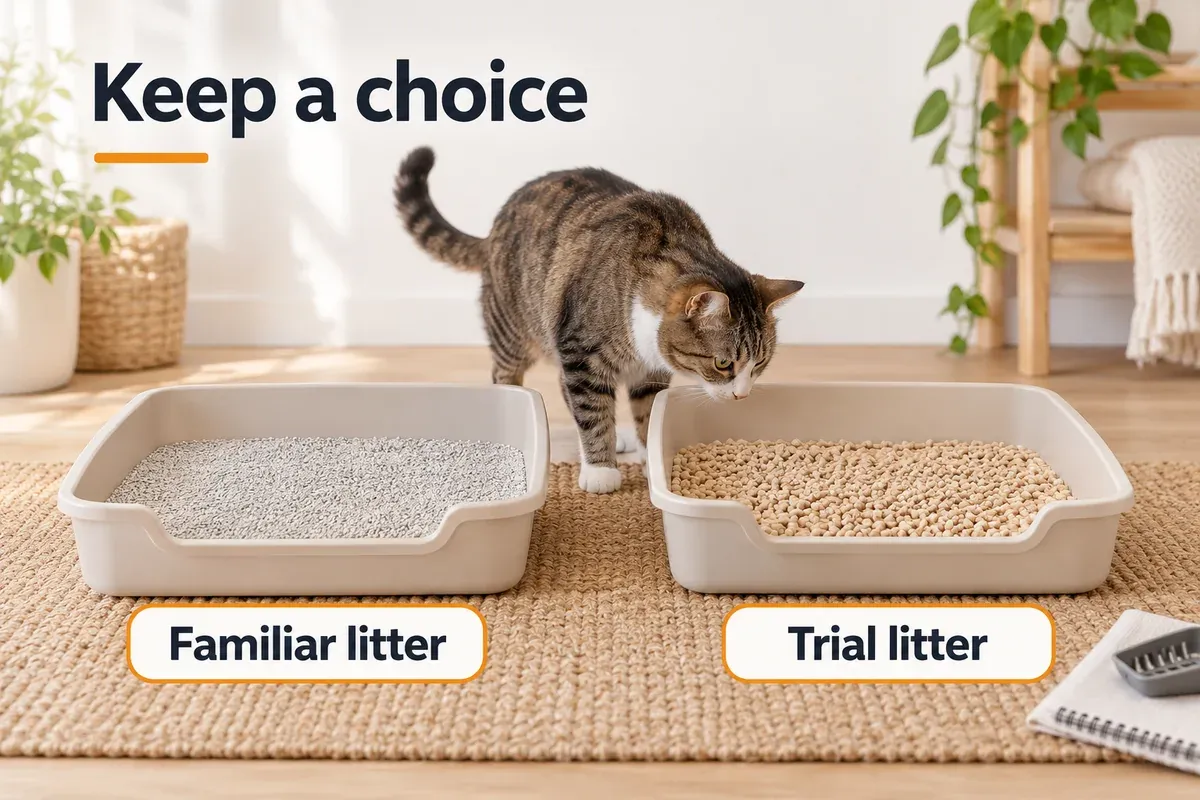
Do not remove the familiar litter on the first day. A cat who is already uncertain needs control over the choice.
| Day | What to do | What to watch for |
|---|---|---|
| 1–2 | Put a clean second box beside the familiar box with the new litter at the usual depth. Keep the old box unchanged. | Sniffing, stepping in, digging, or using the new box are all useful signals. |
| 3–4 | Scoop both boxes promptly. If the new box is used reliably, keep it available and avoid adding another change. | Does the cat use it for urine, stool, or both? Partial use can still reveal a preference. |
| 5–6 | If use is consistent, make the new box the easier option: keep it cleaner and place it in the calmer location. | Watch for edge-perching, rapid exits, paw shaking, or accidents immediately beside the box. |
| 7 | Continue with the preferred box. Retain a backup box during the adjustment instead of forcing a single choice. | If use drops, return to the last successful setup and change one variable at a time. |
If you must transition litter inside one box, make the change slower: start with a small amount of new litter and increase it only when the cat is using the box normally. Side-by-side boxes are better for troubleshooting because they show preference without making the cat choose between elimination and an unfamiliar substrate.
Common Mistakes That Make Refusal Worse
Switching every day
Changing brands, box styles, locations, and cleaners at the same time removes your ability to see what helped. Pick one variable, hold everything else steady, and give the cat a clean choice.
Choosing scented litter to cover the problem
Perfume may be pleasant to people but overwhelming to a cat. Start unscented, then address odor with scooping, box count, ventilation, and appropriate cleaning rather than a stronger fragrance.
Mixing the new litter into the only box immediately
A cat cannot opt out of a forced experiment. Use a second box first, especially when the cat has a history of refusing new litter.
Keeping a covered box because it looks tidier
The cover may keep litter and odor out of the room for you while trapping odor and limiting visibility for the cat. An open box with a litter mat is usually a better troubleshooting baseline.
Punishing accidents
Scolding, chasing, or putting a cat’s face near an accident increases stress and does not explain the desired behavior. Clean the area thoroughly, make the box more appealing, and investigate the cause.
Assuming the litter is the whole problem
A cat may refuse a box because another cat controls the hallway, the entry is too high, the box is too small, or the cat associates that location with pain. A better litter cannot fix an unsafe route or untreated illness.
Frequently Asked Questions
Is Cat Attract the best litter for a cat refusing the box?
It is the most targeted option in this comparison after a veterinary check because it combines an attractant with an unscented clumping texture. It is not a universal answer. If the cat is in pain, cannot access the box, or dislikes clay, Cat Attract may be ignored just like any other litter.
Should I use scented litter for stronger odor control?
Usually, start with unscented. Cats have a much stronger sense of smell than people, and perfume can create an aversion. Use frequent scooping, enough boxes, and a suitable unscented formula before adding fragrance.
How long does it take a cat to accept new litter?
Some cats use a new box immediately; cautious cats may need several days or longer. Keep the familiar option available, change one variable at a time, and treat an accident or sudden refusal as a signal to slow down rather than push through.
Can I mix two litters?
You can transition gradually inside a box, but side-by-side boxes are safer for a cat that already refuses the litter box. A separate box lets you learn whether the cat prefers the new texture without making the only bathroom option unfamiliar.
What if my cat uses the box for urine but not stool?
That pattern still deserves a veterinary conversation, especially if it is new or the cat strains. It can also indicate that the box is too dirty, too small, uncomfortable to enter, or associated with a particular elimination experience. Track which box, litter, surface, and time of day are involved.
When should I stop experimenting and call the vet?
Call promptly for sudden refusal, repeated straining, crying, blood, frequent tiny urinations, vomiting, lethargy, constipation, or no urine. Do not wait for an attractant or litter change to resolve possible urinary blockage or painful elimination.
Final Verdict: Best Cat Litter for Cats That Refuse Their Litter Box
Start with Dr. Elsey’s Cat Attract if your cat has been checked by a veterinarian and you need a focused reset. Choose Dr. Elsey’s Ultra Unscented when you want a plain, fragrance-free baseline. For a household that already knows its cats accept clay, Fresh Step Simply Unscented adds more odor-control margin, while Purina Tidy Cats Free & Clean is the value-oriented refill. If clay weight or texture is the suspected problem, test World’s Best Multiple Cat Unscented in a second box.
The winning litter is the one your cat chooses consistently. Make that choice easier with a clean, uncovered, accessible box; enough boxes for the household; a gradual transition; and prompt veterinary care when the behavior is sudden or uncomfortable.