
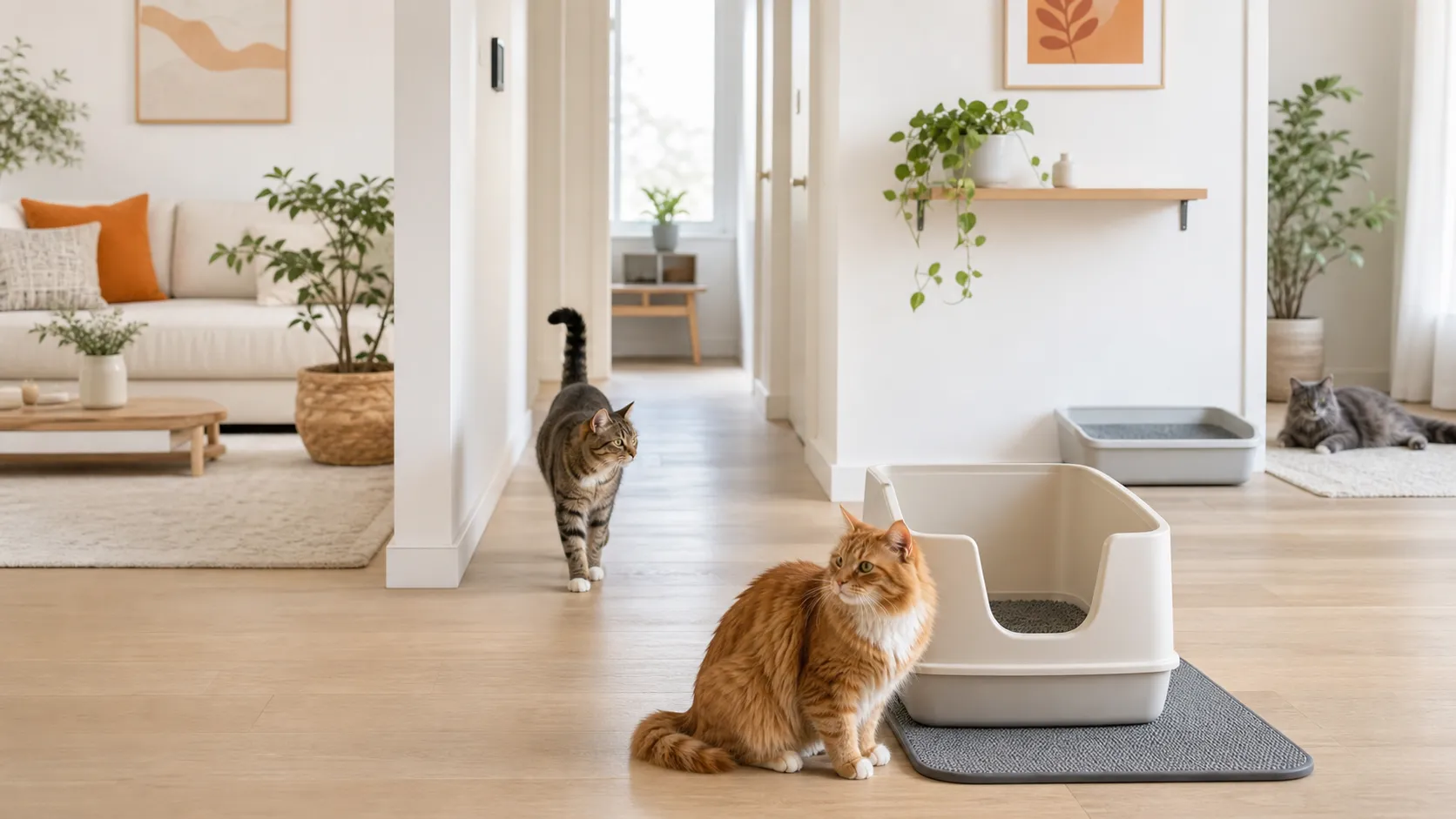

 Published sources
 Product details checked
Two cats can live peacefully together and still need separate bathrooms. The common mistake is to buy three boxes, line them up in one laundry room, and assume the problem is solved. For cats, the route to the box, the view from inside it, and the chance of being blocked on the way out matter almost as much as the total count.
Quick answer: Start with one litter box per cat, plus one extra: three boxes for two cats, four for three cats, and five for four cats. Then spread them through the home instead of clustering them. The AAHA/AAFP feline life-stage guidelines also recognize a useful alternative when social groups are clear: one box per social group plus one extra. In a home with two floors, make sure cats can reach a box on each commonly used level.
This guide turns that rule into a room-by-room plan. It covers small apartments, multi-story homes, territorial blocking, box size, senior-cat access, and a short list of linked products that fit different jobs. It is a planning guide, not a claim that every cat will accept the same layout.
The starting number: cats plus one
The familiar rule is a useful starting point, not a guarantee. Use this table before you decide where the boxes will go:
| Cats in the home | Starting number of boxes | Practical planning note |
|---|---|---|
| 2 cats | 3 boxes | Put them in three usable zones, not three inches apart. |
| 3 cats | 4 boxes | Give the busiest floor or social group an additional option. |
| 4 cats | 5 boxes | Map the routes first; five boxes in one room do not create five independent zones. |
AAHA says boxes should be placed in different, accessible locations, particularly in multi-cat households. Its guidance also mentions one box per social group plus one when the groups are known. That matters when four cats are really two bonded pairs and one pair regularly controls access to a hallway or room.
The Ohio State University Indoor Pet Initiative uses the same one-per-cat-plus-one rule and adds an important floor-plan point: multi-story homes need boxes on each level. Cornell’s house-soiling guidance likewise recommends multiple boxes in multiple locations to reduce competition and give each cat options.
Why three boxes side by side are not the same as three zones
There is no universal test that tells us exactly how a cat mentally counts adjacent boxes. The practical conclusion below is an inference from the guidance about different locations, escape routes, and blocked access: for planning purposes, treat a row of boxes in one room as one resource zone. A cat can still be cornered by another cat, a dog, a closing door, or a noisy appliance before it reaches the row.
If one room is your only realistic option, create separation within it. Leave a clear approach to each box, avoid placing them in a straight row, use different walls or visual barriers, and make sure a cat can leave without passing another box occupied by a territorial cat. Then add a box in another safe zone as soon as the layout allows.
What makes a litter-box location work?
Use these five tests for every candidate spot:
- The cat can reach it at any time. The door must stay open, the route must not depend on a person moving furniture, and a senior cat should not have to climb stairs to reach the only box.
- The cat can see and leave. A box in a dead-end corner or behind a toilet can allow another animal to block the entrance or exit. AAHA specifically recommends quiet locations with an escape route.
- The location is quiet but not isolated. Cats need privacy, but a distant garage, sealed closet, or room that is often closed can become inaccessible. Ohio State advises avoiding washers, dryers, air ducts, and places where people or other animals can sneak up on the cat.
- Food and water are separate. Cornell describes a quiet, private location away from feeding areas as the usual preference.
- The box fits the cat, not just the corner. The AAHA/AAFP guideline recommends a box at least one and a half times the cat’s nose-to-tail length. Many commercial boxes are smaller than that, so check usable interior floor rather than trusting “large” or “jumbo” on the label.
Room-by-room placement planner
Start with the rooms your cats already use. A box placed where a cat feels safe is usually more useful than a technically perfect box in a room the cat avoids.
| Room or zone | Good use | Placement test | Common failure |
|---|---|---|---|
| Quiet living-room corner | A central, easy-to-monitor station | The cat has two directions to leave and people do not walk directly past the entrance | A decorative screen or sofa creates a blind corner |
| Bedroom or quiet office | A night-time or shy-cat station | The door stays open and the box is not beside a bed, food, or a noisy fan | The box disappears behind a closed door |
| Hallway or landing | A useful connector in a larger home | The hallway stays wide enough for the cat to turn and no door can trap the route | A narrow passage becomes a territorial choke point |
| Bathroom | A practical small-home location | The door remains open, the fan is quiet, and the cat can see the approach | A cat is startled by the fan or blocked by a person |
| Laundry room | Only when the machines are quiet and the door is always accessible | Put the box away from the washer, dryer, furnace, and air ducts | A spin cycle scares the cat or the door closes |
| Basement or garage | Usually a secondary option, not the only bathroom | The cat can reach it without a difficult stair route and the temperature is stable | The cat avoids the distance, cold, noise, or another pet |
Living room: the default shared zone
For many homes, one box belongs in a calm edge of the living area because cats spend time there and the route is easy to observe. Keep it away from a dog bed, a busy doorway, and a corner with only one exit. An open-top box often makes it easier to notice changes in urine clumps, stool, or frequency, while also giving a cat a wider view.
Do not hide every box in matching furniture. A cabinet can look tidy to a person but function like a trap to a cat if the entrance is narrow, the door sticks, or another cat waits outside. If you use an enclosure for one station, keep at least one open and plainly accessible alternative.
Bedroom or office: the quiet option
A bedroom, office, or spare room can give a shy cat a low-traffic bathroom. It works only if the door stays open and the cat can leave without crossing a sleeping person, a closed baby gate, or another cat’s favorite resting spot.
In a two-cat home with one confident and one cautious cat, this is often a better third location than placing all three boxes in the utility room. The goal is not to assign one box permanently to one cat. The goal is to make sure a cautious cat always has an option that is not controlled by the confident cat.
Bathroom: useful in an apartment, but test the door and fan
Bathrooms are practical because they have washable floors and easy cleanup. They are risky when the door is regularly closed, the fan starts suddenly, or the box blocks the only path to the sink or toilet. A bathroom box is a poor choice if the cat can be trapped inside by a person or another pet.
If the bathroom is your only low-traffic room, place the box near the open part of the room rather than behind the toilet. Put a clear note on the door if guests or children may close it, and check that the cat can still reach another box if the bathroom becomes unavailable.
Laundry room: convenient for people, often unpleasant for cats
Laundry rooms are popular because litter stays out of sight. They are also full of sudden noise, heat, vibration, and doors. Never make a laundry room the only available box location for a cat that is startled by appliances.
If you use one there, observe a complete wash and dry cycle while your cats are nearby. Keep the box away from the machines and leave a clear escape route. If a cat pauses, startles, or exits without using the box, move the station before accidents begin.
Ready-to-use layouts for 2, 3, and 4 cats
The examples below assume an average home with one main floor. If your home has multiple floors, use the floor-by-floor section after them.
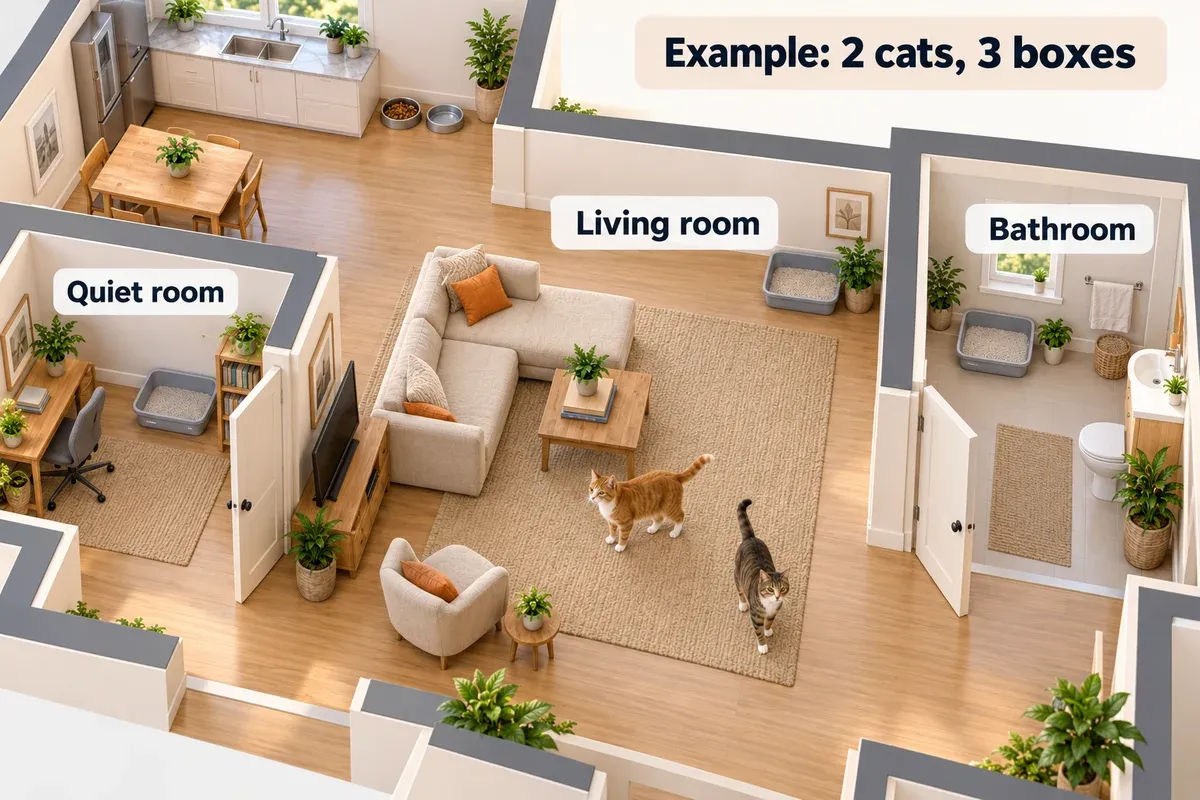
Two cats: three-box layout
Plan A for a single-floor home:
- Box 1: quiet living-room edge with a clear view of the room;
- Box 2: bedroom or office with the door kept open; and
- Box 3: a separate bathroom, hallway landing, or second quiet room.
Do not make Box 2 and Box 3 adjacent just because the bathroom and laundry room share a wall. If one cat guards that corridor, both boxes can become difficult to use. If the cats are a bonded pair and never block each other, the three-zone layout is still a useful hygiene buffer.
Three cats: four-box layout
Use two boxes in the areas where the cats spend the most time, but separate them by room or sightline. A practical layout is:
- one in the living room;
- one in a quiet bedroom or office;
- one near the main night-time route; and
- one in the most used secondary room or on the second floor.
If one cat is elderly, anxious, or repeatedly chased, give that cat a station with a low threshold and more than one way out. Do not put all four boxes near the food area to save cleaning time.
Four cats: five-box layout
For four cats, the fifth box is often the difference between a resilient layout and a single point of failure. A useful starting map is one station in each major zone plus a second station in the room where the cats spend the most time. Keep the two stations in that room visually separate.
If your cats form distinct social groups, map where each group rests, eats, and travels. A bonded pair may share space freely while another cat avoids the same hallway.
Multi-story home: put a box on each useful level first
For two cats in a two-story home, three boxes could be placed as two upstairs and one downstairs, or one upstairs, one downstairs, and one near the cats’ main shared area. Choose based on where the cats actually spend time. Do not put all three downstairs because the basement has the easiest washable floor.
For three or four cats, make the first box on each commonly used floor. Then distribute the remaining boxes according to sleeping areas, social groups, and conflict points. A senior cat with painful joints should not have to use stairs to reach the nearest toilet; the AAHA life-stage checklist specifically calls out easy access and avoiding stairs for painful cats.
How to spot territorial blocking
Cats do not need to fight openly for a box to be unsafe. Watch the approach and exit for a week, especially after adding a new box. Warning signs include:
- one cat staring at or waiting beside a box;
- a cat entering, then leaving without eliminating;
- a cat taking a long detour to reach the box;
- a cat using only one room even though several boxes are available;
- urine or stool just outside the box; or
- a cat hesitating at a doorway, corner, or narrow passage.
Move the station away from the choke point and give it a route with more visibility. If a cat prefers a different location, Cornell recommends placing a box in that preferred area first and moving it only a few inches at a time after reliable use returns. Do not punish accidents or carry a cat to the box as a correction.
Record which cat uses which box if you can do so without disrupting them.
Choose the box for the station
Placement cannot rescue a box that is too small or hard to enter. Use the cat’s body and mobility to choose the box type:
-
Large or long-bodied cat: prioritize usable floor length and a wide turn-around area. A high wall is helpful only if the cat can step over it comfortably.
-
Senior or mobility-limited cat: choose a low front entry, a level non-slip approach, and a route without stairs. A low-entry box may need a washable wall shield behind it because access and spray containment are different problems.
-
High-spraying or enthusiastic digger: use higher back and side walls with a lower front rather than a tall wall on every side.
-
High-traffic station: place a large litter mat outside the approach without shrinking the escape route or creating a raised edge.
Remember that a product’s outside dimensions include rims, sloped walls, and corners. The cat experiences the interior floor.
-
IRIS USA XX-Large High Sided Cat Litter Box
IRIS USA
An open-top plastic box with a 30 x 20 x 14-inch described footprint, tall walls, and a lower curved entry. It gives a multi-cat home a spacious primary station without a hood.
- 30 x 20 x 14 in described dimensions
- 14 in high walls with a 6.5 in curved entry
- Open top for visibility and easier monitoring
- described size
- 30 x 20 x 14 in
- Best fit
- A large main station for average-to-large cats and high-spray households
-
IRIS USA Large High Sided Cat Litter Box, Open Top - 2 Pack
IRIS USA
A two-pack of open-top, high-sided trays that makes it easy to start a distributed setup. Each tray is compact, so it is a poor substitute for an extra-large box for long-bodied cats.
- Two trays in one package
- 19 x 15 x 11.75 in described dimensions per tray
- Open top with tall scatter-shield walls
- described size
- 19 x 15 x 11.75 in each
- Best fit
- Two separate compact stations for average-size cats
-
Pureness Giant High Sides Cat Litter Pan
Pureness
A polypropylene open pan with a described 21.25 × 17.63 × 9.25-inch outside size. It adds wall height without a hood, but its length may be limiting for large cats.
- 21.25 × 17.63 × 9.25 in described
- Open top
- Polypropylene
- described size
- 21.25 × 17.63 × 9.25 in
- Best fit
- Budget-friendly high sides for cats that spray or kick litter
-
KittyGoHere Senior Cat Litter Box, Large, Low Entrance
KittyGoHere
An open tray with a described 3-inch entrance and 24 × 20 × 5-inch dimensions. It prioritizes access, so the low walls are not a strong high-urine solution.
- 24 × 20 × 5 in described
- 3 in low entrance
- Open top
- described size
- 24 × 20 × 5 in
- Best fit
- Senior cats and cats that need a low step-in
-
GORILLA GRIP Cat Litter Box Mat, 35 x 23 in
GORILLA GRIP
A wide cushioned coil-mesh mat with deep grooves that catches loose litter outside the box. It helps keep a planned station tidy but cannot compensate for a box that is too small or badly placed.
- 35 x 23 in described size
- Cushioned coil mesh with deep catch grooves
- Can be rinsed or vacuumed
- described size
- 35 x 23 in
- Best fit
- Litter tracking around a high-traffic station
Review the linked product page before purchasing.
Large main station: IRIS USA XX-Large
The IRIS USA XX-Large is the most practical match in this comparison for a spacious, open main station.
The important limitation is the entry and the interior. A 14-inch wall can be useful for a cat that sprays or kicks litter, but it is not access-first for every senior cat. Measure the usable floor and watch the step-in height before making this the only station.
Check current price on Amazon →Two compact stations: IRIS USA Open Top 2-Pack
Do not treat this as an extra-large solution. Nineteen inches is too short for many long-bodied cats, and the two trays only help if they are placed apart.
Check current price on Amazon →Budget high sides: Pureness Giant
Low-entry station: KittyGoHere Senior Large
The trade-off is containment. Five-inch walls do not protect well against high urine or vigorous digging, so pair this box with a washable wall shield or floor mat when needed. The clear approach matters more than the label: do not place it behind furniture or at the end of a narrow route.
Litter-tracking control: GORILLA GRIP 35 x 23 mat
The GORILLA GRIP mat is not a litter box, but it can make a carefully planned station easier to keep clean. The described 35 x 23-inch cushioned coil-mesh surface has deep catch grooves and can be rinsed or vacuumed.
Use it around the approach of one busy station, not under every box by default. Leave enough flat floor for a cat to enter, turn, and leave without stepping over a curled edge. A mat can catch tracking; it cannot fix territorial blocking, a too-small box, or urine landing outside the pan.
Check current price on Amazon →Cleaning and maintenance for a multi-cat layout
More boxes only help if each one stays usable. Scoop solid waste and clumps at least daily; in a busy four-cat home, a second quick pass often prevents one box from becoming the “dirty” option. Refill consistently so the litter depth and texture do not change unpredictably from room to room.
AAHA recommends regular scooping and cleaning with hot water while avoiding soap or strong chemicals that can leave a scent. Ohio State notes that many cats need enough litter to scratch and bury waste, usually around two inches. If you change litter, test the new type in a separate box rather than replacing every station at once.
Keep a spare clean box or pan if possible. It lets you replace a cracked or odor-holding box immediately and gives you a low-stress way to test a new location. The guide to cats refusing the litter box covers litter preference, box aversion, and gradual changes in more detail.
When a litter-box problem needs a veterinarian
A new accident, sudden box avoidance, or a change in frequency is not always a placement problem. Cats can hide pain. The AAHA guide to litter-box re-training recommends checking medical causes before assuming a behavior issue, and Cornell advises a veterinary examination for house-soiling.
Seek urgent veterinary care if a cat strains repeatedly, cries while trying to urinate, produces only drops or no urine, has blood in the urine, vomits, becomes weak, or seems painful. A urinary blockage can become life-threatening quickly. No new litter box, deodorizer, or automatic cleaner can safely rule that out. See Why Does My Cat Pee Outside the Litter Box? for the warning signs and next steps.
Frequently Asked Questions
How many litter boxes do I need for two cats?
Start with three: one box per cat plus one extra. Place them in three usable zones, or at least in separate rooms or sightlines where a cat can approach and leave without being blocked. If the cats form clear social groups or one cat controls a route, you may need to adjust the locations before adding more products.
How many litter boxes do I need for three cats?
Start with four. Put at least one on each commonly used floor, then distribute the remaining boxes around sleeping areas, quiet rooms, and known traffic routes. Four boxes in one laundry room are less resilient than four boxes spread through the home.
How many litter boxes do I need for four cats?
Start with five. Use the fifth as a separate option in the busiest area or at the biggest conflict point, not as a fifth box in the same row. If one cat is chased, elderly, or anxious, give that cat a low-entry, easy-to-see station with a clear exit.
Can all of my litter boxes be in the same room?
They can be, but it is usually a compromise. Adjacent boxes share the same noise, door, traffic, and territorial risk. If a single room is unavoidable, separate the boxes by walls or sightlines, keep routes open, and add another room or floor when possible.
Does an automatic litter box count as two boxes?
For planning, count it as one physical station. Automatic cleaning can reduce waste buildup, but it does not create another location or another escape route. Keep a traditional box available during the transition and whenever a cat is wary of the motor or movement. Our automatic litter box guide for multiple cats explains the trade-offs.
Should I put a litter box on every floor?
If cats regularly use more than one floor, place at least one accessible box on each commonly used level. Add the remaining boxes according to where the cats spend time. This is especially important for kittens, seniors, cats with painful joints, and cats that are reluctant to use stairs.
Should the litter box be next to food or water?
Usually no. Cats generally prefer a quiet bathroom separated from feeding areas. Use a different wall or room, and keep the route open so the cat does not have to pass the food bowl, a dog bed, or a narrow doorway controlled by another pet.
What should I do if one cat blocks another cat from the box?
Move the box away from the choke point and choose a location with more visibility and more than one way out. Add a second route or a separate station in a quiet room. Record which cat is blocking access and which cat is avoiding the box; repeated tension may need a veterinarian or qualified feline behavior professional.
Final room-by-room checklist
Before you call the layout finished, check:
- You have started with cats plus one: 3 for 2 cats, 4 for 3 cats, or 5 for 4 cats.
- The boxes are spread across rooms, sightlines, or floors rather than lined up in one cluster.
- Every commonly used floor has an accessible option.
- Each cat can approach, turn, and leave without passing a waiting animal.
- The box is at least roughly one and a half times the cat’s nose-to-tail length where possible.
- Senior or mobility-limited cats have a low, level entry and no required stairs.
- Boxes are away from food, water, sudden appliance noise, and doors that can close.
- You are monitoring use, cleanliness, and any blocking behavior for at least a week after a change.
The best multi-cat litter-box setup is not the one with the most equipment. It is the one that gives every cat a clean, reachable, low-conflict option in the part of the home where that cat actually lives.