

 Published sources
 Product details checked
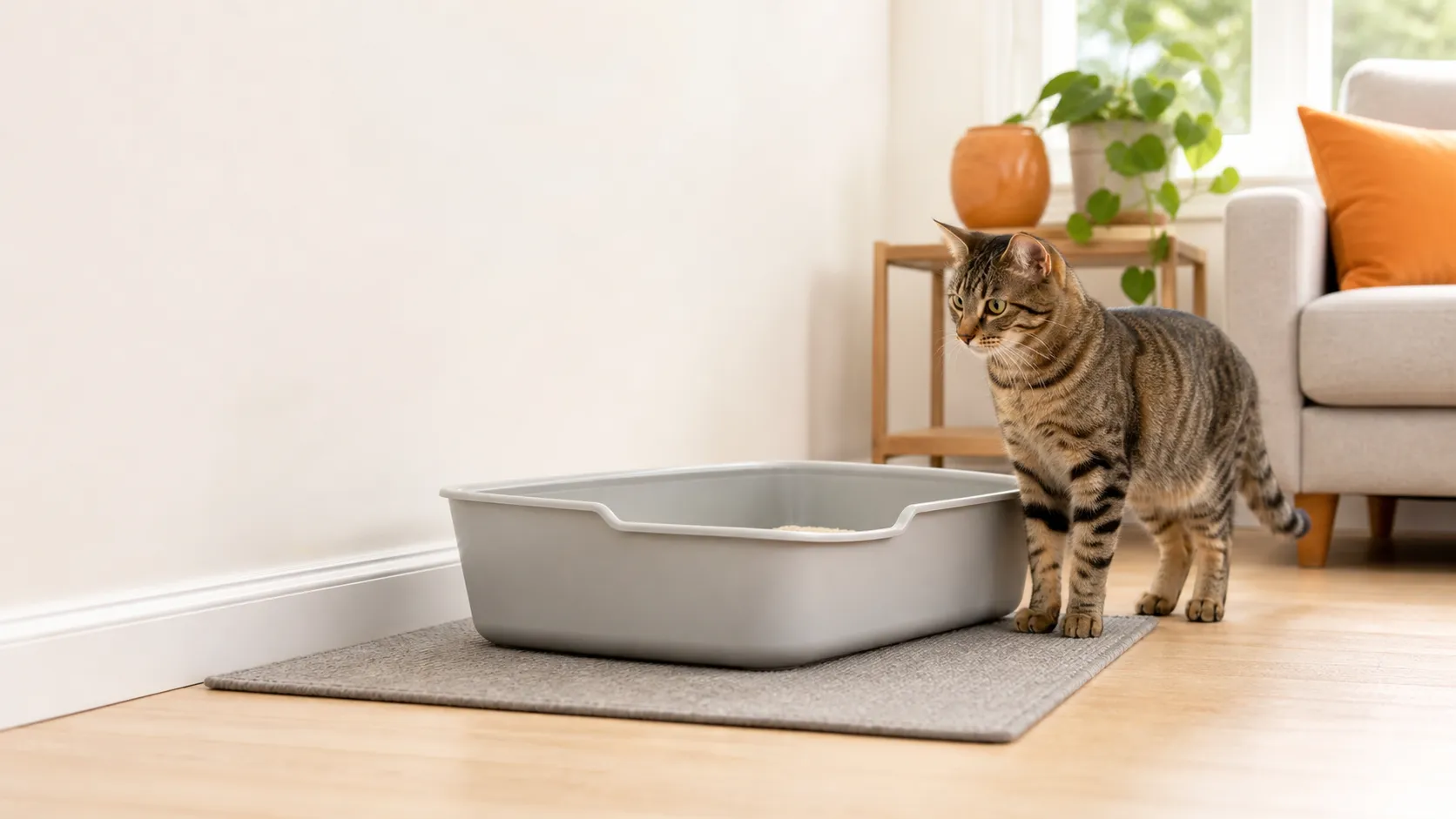
A cat that has used the litter box reliably can suddenly leave a puddle on the rug, bed, or floor. It is frustrating, but it is not revenge—and it is not a problem to solve by scolding. Urinating outside the box is a signal that something about your cat’s body, environment, or bathroom setup needs attention.
Short answer: A new or repeated change in litter-box behavior deserves a veterinary check before you change products. Painful or urgent urination from lower urinary tract disease can look like a behavior problem, and a blocked urethra is an emergency. If your cat is straining, crying, visiting the box repeatedly, producing only drops or no urine, or has blood in the urine, contact a veterinarian immediately.
Once medical causes are being treated or ruled out, the most common explanations are litter-box aversion, a box that is too small or difficult to access, an unpleasant location, conflict with another pet, stress, or a learned preference for a soft surface. The fix is usually a short investigation rather than one magic product.
In this guide, you’ll learn:
- How to tell ordinary house-soiling from urine marking
- Which medical signs should not wait for a routine appointment
- Why cats reject a box, litter type, or location
- How to reset the litter-box environment step by step
- Where litter attractant, a larger box, and an enzyme cleaner can help—and where they cannot
First: Is Your Cat Urinating or Spraying?
The pattern gives you a useful clue, but it does not replace an examination. Cats can use the box normally and still spray elsewhere, and a medical problem can trigger either pattern.
| What you see | More consistent with | What to do next |
|---|---|---|
| A larger puddle on a horizontal surface after squatting | Urinating outside the box, often called house-soiling | Arrange a veterinary check, then review the box, litter, and location |
| A small amount on a wall, furniture side, or another vertical surface; tail held high or quivering | Urine marking | Rule out medical causes, then investigate territory and social stress |
| Repeated box visits, straining, crying, licking, blood, or only a few drops | Pain, inflammation, stones, or obstruction | Call a veterinarian urgently; no product can safely rule this out |
The ASPCA’s guide to urine marking describes spraying as a small deposit, usually on a vertical surface, with the tail upright and often twitching. A normal bladder-emptying event is usually a larger amount on a horizontal surface. When in doubt, treat a sudden change as a health issue first.
Medical Reasons a Cat May Pee Outside the Box
Cats often hide pain. A cat may not look ill; the only obvious change may be a new accident or more frequent trips to the litter box. The Cornell Feline Health Center explains that any condition interfering with normal urination can lead to house-soiling.
Lower urinary tract pain or inflammation
Feline lower urinary tract disease is an umbrella term for several bladder and urethral problems. Cystitis, crystals, stones, and other causes can create urgency, frequent attempts, or pain. A cat may begin to associate the litter box with that pain and avoid it even after the original episode improves.
Common clues include:
- Frequent trips to the box
- Squatting for a long time or straining
- Crying or restlessness while trying to urinate
- Licking the genital area more than usual
- Blood in the urine
- Urinating in unusual places because the urge arrives suddenly
The Cornell overview of feline lower urinary tract disease notes that a urethral obstruction is a true emergency. A cat that repeatedly tries to urinate but produces little or nothing needs immediate veterinary attention—especially a male cat, whose urethra is more vulnerable to blockage.
Urinary infection, stones, or obstruction
A urinary tract infection is one possible cause, but it is not the only one and cannot be diagnosed from behavior alone. Stones, plugs, inflammation, and other urinary conditions can look similar. Your veterinarian may recommend a physical examination and urinalysis, with blood work or imaging if the first tests do not identify the cause.
Do not give leftover antibiotics, human pain medication, or an over-the-counter “urinary” remedy without veterinary guidance. The wrong medication can delay proper treatment or harm your cat.
Kidney disease, diabetes, and other conditions that increase urine volume
Kidney disease and diabetes can cause a cat to drink and urinate more. A box that used to stay clean may suddenly become full faster, or your cat may not reach it in time. Older cats can also develop arthritis, weakness, vision changes, or cognitive changes that make a distant, high-sided, or upstairs box difficult to use.
If the accidents began with increased thirst, weight loss, appetite changes, vomiting, lethargy, or reduced mobility, mention those details at the appointment. They help your veterinarian choose the right tests.
When Is Peeing Outside the Box an Emergency?
Seek urgent veterinary care if your cat:
- Strains repeatedly but produces no urine or only a few drops
- Cries, pants, or appears increasingly distressed while trying to urinate
- Has blood in the urine or repeatedly licks the genital area
- Vomits, becomes weak, hides, collapses, or seems painful
- Has a tense or painful abdomen, especially together with failed urination
Do not wait to see whether a new litter, attractant, or cleaner changes these signs. A complete urinary blockage prevents urine from leaving the body and can become life-threatening quickly. If you are unsure whether any urine is coming out, treat that uncertainty as urgent and call a veterinary clinic.
Why a Healthy Cat May Reject the Litter Box
After a veterinary check, look at the box from your cat’s point of view. A box can be clean by human standards and still feel unsafe, cramped, exposed, or painful to enter.
The box is too small, enclosed, or hard to enter
Large cats need room to turn around without touching the sides. Senior cats and cats with arthritis often need a low entry. A top-entry box, steep step, or high rim can turn a routine bathroom trip into a painful climb.
Covered boxes can work for some cats, but they hold odors in and reduce visibility. If another cat, dog, or child can approach from outside, an enclosed box may also make your cat feel trapped. Start with a large open box in a quiet location before assuming a lid will solve tracking or smell.
The litter changed—or smells too strong
Many cats prefer an unscented, fine-textured litter. Perfume, deodorizer, dusty texture, or a sudden brand change can be enough to create avoidance. Make changes gradually, or place a second box with the new litter beside the familiar one so your cat can choose.
Do not switch every box at once. A simple preference test is easier to read when everything else stays the same.
The location feels unsafe
A laundry machine, loud furnace, busy hallway, or a box surrounded by walls can make a cat hesitate. So can a dog that watches the exit or another cat that guards the route. Choose a quiet, well-lit, always-accessible location with more than one way out when possible.
The box should not be next to food and water. In a multi-level home, keep a box on each level your cat uses—particularly if stairs are painful or your cat is older.
There are not enough boxes
The common starting rule is one litter box per cat, plus one extra. The boxes should be distributed through the home rather than lined up in one room. This gives each cat a usable option and reduces the chance that one cat can block another’s access.
If one cat is being chased or ambushed near a box, adding another box beside the first one may not help. Put the new box in a separate, calmer area instead.
Stress or conflict changed the routine
Moving, visitors, construction, a new baby, a new pet, a changed work schedule, or an outdoor cat at the window can trigger marking or avoidance. Cats can also experience quiet social pressure that humans miss: staring, blocking a doorway, or waiting outside the litter-box room.
Give each cat separate access to litter, food, water, resting areas, hiding places, and elevated perches. Keep routines predictable, and avoid forcing cats to share narrow passages or one “resource room.”
A previous accident created a surface preference
Carpet, bedding, laundry, and upholstered furniture are soft and absorbent. Once urine odor remains in a material, your cat may continue to recognize that spot as an acceptable bathroom. The Cornell house-soiling guidance recommends neutralizing odor rather than merely covering it and specifically warns against ammonia- or vinegar-based cleaners, which can be irritating or smell urine-like to a cat.
A Practical Reset Plan for Today
Use this order so you do not change five variables at once:
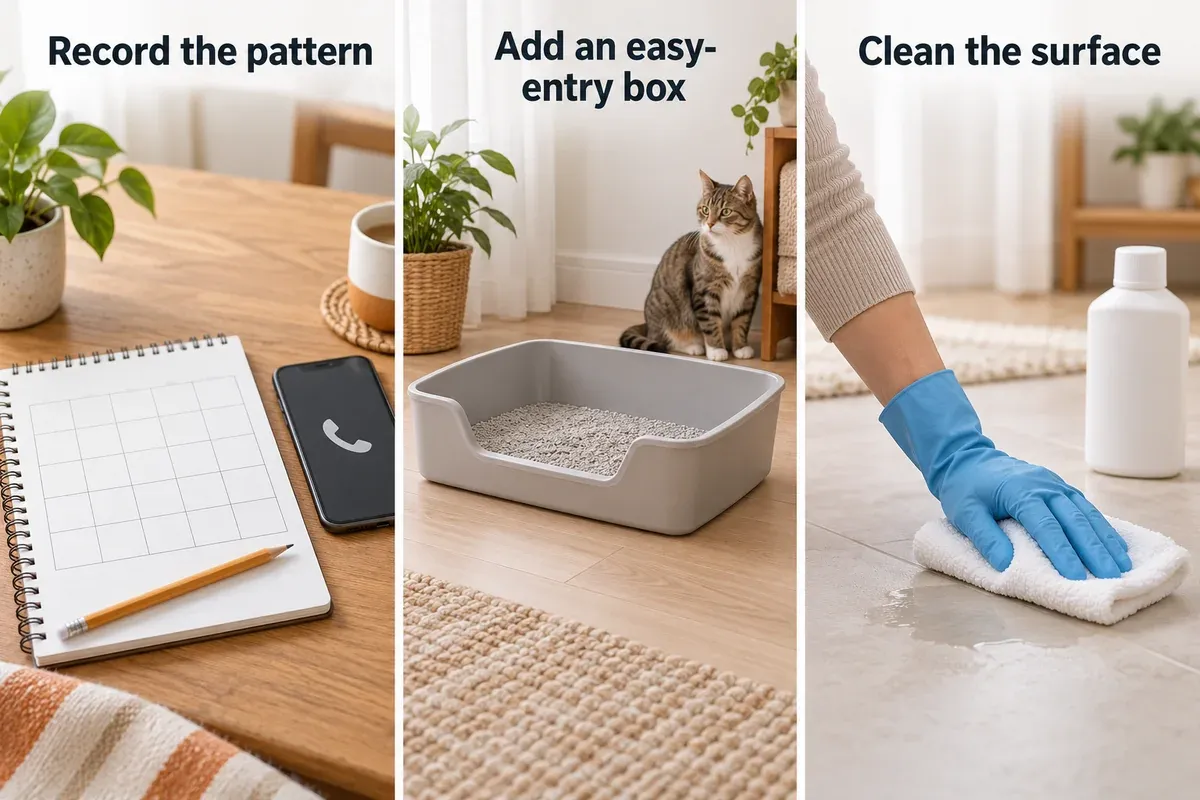
- Call your veterinarian for a new or repeated problem. Write down when it started, how often it happens, whether the surface is horizontal or vertical, and whether your cat still uses the box.
- Document the pattern. A quick photo of the location, notes about urine volume, and a short log of box visits can be more useful than guessing at the cause.
- Add a plain backup box. Use a large, uncovered container with unscented litter in a quiet, easy-to-reach location. If your cat is stiff or arthritic, prioritize a low entry.
- Keep every box genuinely clean. Scoop at least daily; scoop more often in a multi-cat home. Wash with mild, unscented soap and water, rinse, and dry thoroughly. Avoid strong fragrance and do not punish your cat.
- Clean accident sites with the right method. Use a product labeled for cat urine and the specific surface. Follow the label’s contact time, ventilate, patch-test fabrics, and keep your cat away until the area is dry.
- Remove access to repeat targets temporarily. Close the bedroom door, cover a favorite rug with a washable barrier, or move laundry into a closed hamper while the cause is being addressed.
- Reduce competition and stress. Spread boxes and other resources through the home. Give your cat a quiet retreat where another pet cannot corner them.
If your cat reliably uses the new box, move it only a few inches at a time toward the preferred location. If accidents continue after medical problems are addressed and the setup is improved, ask your veterinarian for a referral to a veterinary behaviorist rather than repeatedly buying new products.
Products That Can Help After Medical Causes Are Checked
These products support a plan; they are not treatment for a blockage, infection, bladder inflammation, kidney disease, or diabetes.
-
Dr. Elsey's Cat Attract Clumping Clay Cat Litter – 18 lb
Dr. Elsey's
Clumping clay litter formulated as a targeted trial for cats that avoid an otherwise suitable litter box.
- Cat Attract formula for a focused litter-preference trial
- 18-lb bag suited to testing one box without a large commitment
- Best for
- Cats with litter or substrate aversion after a veterinary check
-
iPrimio Stainless Steel Cat Litter Box XL
iPrimio
Large stainless-steel litter box with high sides and a detachable enclosure for testing open versus covered access.
- 23.5 × 15.5-inch format gives larger cats more room than compact pans
- Stainless steel does not absorb urine odor like scratched plastic can
- Detachable enclosure can help contain scatter and spray or be removed
- Best for
- Large cats and households needing a non-porous, high-sided box
-
Nature's Miracle Urine Destroyer Plus for Cats
Nature's Miracle
Enzymatic cat-urine stain and odor cleaner for breaking the scent loop on compatible carpets and household surfaces.
- Cat-specific enzymatic formula for severe urine stains
- 17.5-oz two-pack is practical for treating more than one accident site
- Best for
- Removing urine residue from suitable washable household surfaces
Review the linked product page before purchasing.
Dr. Elsey’s Cat Attract — a targeted litter-preference trial
Try it in one separate box, not throughout the home. That makes your cat’s preference easier to read and avoids forcing a sudden change. If your cat uses the new box, keep the setup stable for several days before changing anything else.
Limitations: Cat attractant cannot make painful urination safe, and it will not fix a box that is inaccessible, guarded by another pet, or too small. If the litter is dusty, strongly scented, or simply disliked by your cat, a plain unscented alternative may be a better test.
Check current price on Amazon →iPrimio Stainless Steel Cat Litter Box XL — large and easy to clean
The iPrimio product information is a 23.5 × 15.5-inch high-sided stainless-steel box with a detachable enclosure. Stainless steel is non-porous and can be easier to clean thoroughly than plastic that has become scratched or holds odor.
The detachable enclosure is useful for testing two setups: start open if your cat needs visibility, then add the enclosure only if your cat accepts it and you need more spray or scatter control. Measure the usable interior and your cat before ordering; a large outer measurement does not guarantee that every extra-large cat will have enough turning room.
Skip or adapt it for: cats with arthritis or limited mobility if the high entry is difficult, and cats that already avoid covered or enclosed boxes. A lower-entry open box is the safer first test for those cats.
Check current price on Amazon →Nature’s Miracle Urine Destroyer Plus — break the scent loop
It is a practical option for treating repeat accident sites on surfaces that the label allows.
Use enough product and enough contact time for the label’s instructions, then let the area dry fully. Patch-test fabrics and keep your cat away while the surface is wet. The cleaner can remove odor cues that invite repeat marking, but it cannot tell you why the first accident happened.
Check current price on Amazon →What Not to Do
- Do not punish your cat. Yelling, hitting, or rubbing a cat’s face in urine adds fear and can make avoidance worse. It does not teach the cat which medical or environmental problem caused the accident.
- Do not mask the smell with perfume. Strongly scented litter, sprays, and air fresheners can make the box less appealing and do not remove the odor cues your cat detects.
- Do not use ammonia or vinegar on accident sites. They can irritate and may smell too similar to urine. Use a cat-urine product that is labeled for the surface instead.
- Do not make an automatic litter box your first response. A new motorized box adds noise, movement, and a new routine. Stabilize ordinary box use first; if you later consider an automatic model, introduce it unplugged beside the familiar box.
- Do not assume a clean bill of health ends the investigation. Pain can create a lasting negative association, so the box and environment may still need a reset after treatment.
Frequently Asked Questions
Does peeing outside the litter box always mean a UTI?
No. Urinary infection is one possibility, but cystitis, stones, obstruction, kidney disease, diabetes, pain, stress, marking, litter aversion, and access problems can look similar. A veterinarian needs to assess the cat and decide whether urine testing or additional diagnostics are appropriate.
Why does my cat still use the box sometimes?
Partial use does not rule out a medical or behavioral problem. A cat may use the box when the urge is mild but avoid it when urination is painful, when another cat is nearby, or when the box is already dirty. Cats that spray may also continue to use the box for ordinary urination.
Why does my cat pee on my bed, clothes, or a rug?
Soft surfaces can become a preferred substrate, and residual odor can draw a cat back. A medical problem or stress may have started the pattern.
Will cat-attract litter solve the problem?
It can help a cat that dislikes the litter, but it is only a controlled trial—not a diagnosis. Use it in one additional box after medical causes have been checked. If there is pain, urgency, social conflict, or a difficult location, changing litter alone will not solve the underlying problem.
How long does it take to stop?
There is no reliable one-size-fits-all timeline. Urgent medical problems may improve after treatment, while a learned surface preference or household conflict can take longer. Track accidents and box use; if the pattern continues after the veterinary plan and environmental reset, request help from a veterinary behaviorist.
Bottom Line
Peeing outside the litter box is communication, not spite. Treat a sudden change as a medical clue first—especially when there is straining, frequent attempts, blood, pain, or little to no urine. Once your veterinarian has checked the common medical causes, give your cat a large, clean, accessible box in a quiet location, provide enough boxes for the household, clean old odor thoroughly, and reduce social pressure.
Products can support that plan: Cat Attract can test a litter preference, a large stainless-steel box can improve space and cleanability, and an enzymatic cleaner can remove odor cues. None of them replaces diagnosis, pain relief, or a calm, cat-friendly setup.
For the next step, see our guides to reducing litter-box smell and choosing a self-cleaning litter box for large cats once your cat is using the box comfortably again.