

 Published sources
 Product details checked
Your cat used the litter box yesterday, but today there is urine on the rug, stool beside the box, or a suspicious puddle behind the sofa. It is frustrating, but it is also useful information: a cat that stops using the box is usually communicating that something about health, access, the box, the litter, the location, or the household has changed.
Quick answer: If the change is sudden, treat it as a health question before treating it as a behavior problem. Straining, repeated trips with little or no urine, crying, vomiting, weakness, or a painful belly can indicate a urinary emergency. If your cat can urinate normally, arrange a veterinary check and then run a controlled litter-box reset: add a large open box, use unscented litter at a shallow depth, provide one box per cat plus one, scoop daily, clean accidents with an enzyme cleaner, and reduce conflict or noise around the box.
First, check for an emergency: If your cat is repeatedly straining, crying while trying to urinate, licking the genital area, producing only drops or no urine, vomiting, becoming weak, or developing a painful or swollen abdomen, contact an emergency veterinarian immediately. A blocked urethra can become life-threatening, especially in male cats. See the Cornell Feline Health Center’s guide to feline lower urinary tract disease and VCA’s emergency guidance for cats for the warning signs.
What “Not Using the Litter Box” Can Look Like
The pattern helps you choose the next question, but it does not diagnose the cause. Pain, stress, and box aversion can overlap, so use these clues to organize your response rather than to rule out medical care.
| What you see | What it may point to | First move |
|---|---|---|
| Frequent trips, straining, crying, or only drops of urine | Painful lower urinary tract disease or obstruction | Emergency veterinary advice, especially if little or no urine is produced |
| A full puddle on a horizontal surface | Urgency, pain, box aversion, access trouble, or a learned preference for another surface | Vet check plus a box-and-location audit |
| Small amounts on vertical surfaces, often with the tail quivering | Urine marking or territorial stress | Vet check, then reduce conflict and outside-cat triggers |
| Stool beside the box while urine is still in the box | Constipation, diarrhea, pain, mobility limits, or a box that is hard to enter | Vet check and a lower, larger, easier-to-reach box |
| Accidents begin after a new litter, liner, cover, room, appliance, or pet | A strong preference or fear association | Restore the previous setup and offer a second choice |
| One particular room, rug, or corner is used repeatedly | Residual odor or a surface preference | Enzyme-clean the area and block access temporarily |
Medical Causes Come Before Behavior Training
Cats often hide illness. A cat can seem bright, eat normally, and still avoid the litter box because urinating or defecating has become painful. The Cornell Feline Health Center explains that many medical conditions can contribute to house-soiling, including urinary disease, kidney disease, diabetes, thyroid disease, digestive problems, and age-related mobility changes.
Urinary pain and inflammation
Bladder inflammation, crystals, stones, infection, or an obstruction can make the box feel like the place where pain happens. Your cat may then seek a softer surface, a cooler floor, or any location that feels different. A new accident is not proof of a behavioral issue, even when the puddle is large.
The most dangerous pattern is repeated attempts with very little urine. Do not wait to see whether a new litter or calming product helps. A cat that cannot pass urine needs immediate veterinary attention.
Constipation, diarrhea, and gastrointestinal discomfort
A cat that associates the box with painful bowel movements may start defecating beside it, on a bath mat, or in a secluded room. Diarrhea can also create urgency that arrives before your cat reaches the box. Straining, hard or infrequent stool, blood, vomiting, reduced appetite, or a tense abdomen warrant veterinary advice rather than a litter experiment.
Arthritis, injury, and reduced mobility
Jumping into a tall box, walking down stairs, or squeezing through a small entry can hurt an older or arthritic cat. Some cats still want to use the box but cannot get there comfortably in time. Put a low-entry box on the same floor as your cat’s favorite resting area, and ask your veterinarian about pain or mobility if the change is new.
Kidney, endocrine, or other systemic disease
Increased thirst, larger urine clumps, weight loss, appetite changes, lethargy, or a change in stool can accompany conditions that also cause accidents. These signs are not specific enough to diagnose at home. They are useful details to tell your veterinarian.
Make the appointment more useful
Before the visit, write down when the change started and whether your cat is urinating, defecating, or both outside the box. A short video of straining, repeated box visits, or spraying can be helpful. If there are multiple cats, try to identify which cat is affected without forcing or frightening anyone.
If Your Cat Is Medically Stable, Audit the Box
Once urgent causes have been addressed—or while you are waiting for a scheduled appointment—look at the setup from your cat’s point of view. The box may be too small, too dirty, too scented, too exposed, too hard to enter, or placed where another animal can block the exit.
1. Check the size and shape
Your cat should be able to turn around, dig, squat, and cover waste without touching the sides. A useful starting point is a box about one-and-a-half times your cat’s body length. Large cats often need a storage tote or an extra-large open box because many commercial “large” pans are still compact.
Covered boxes are not automatically wrong, but they can trap odor and give a worried cat only one exit. If your cat has started avoiding a covered box, put a clean open box beside it rather than removing the old option immediately. A transparent or open-sided setup can also help in a multi-cat home where a cat needs to see whether another animal is approaching.
2. Make entry easy
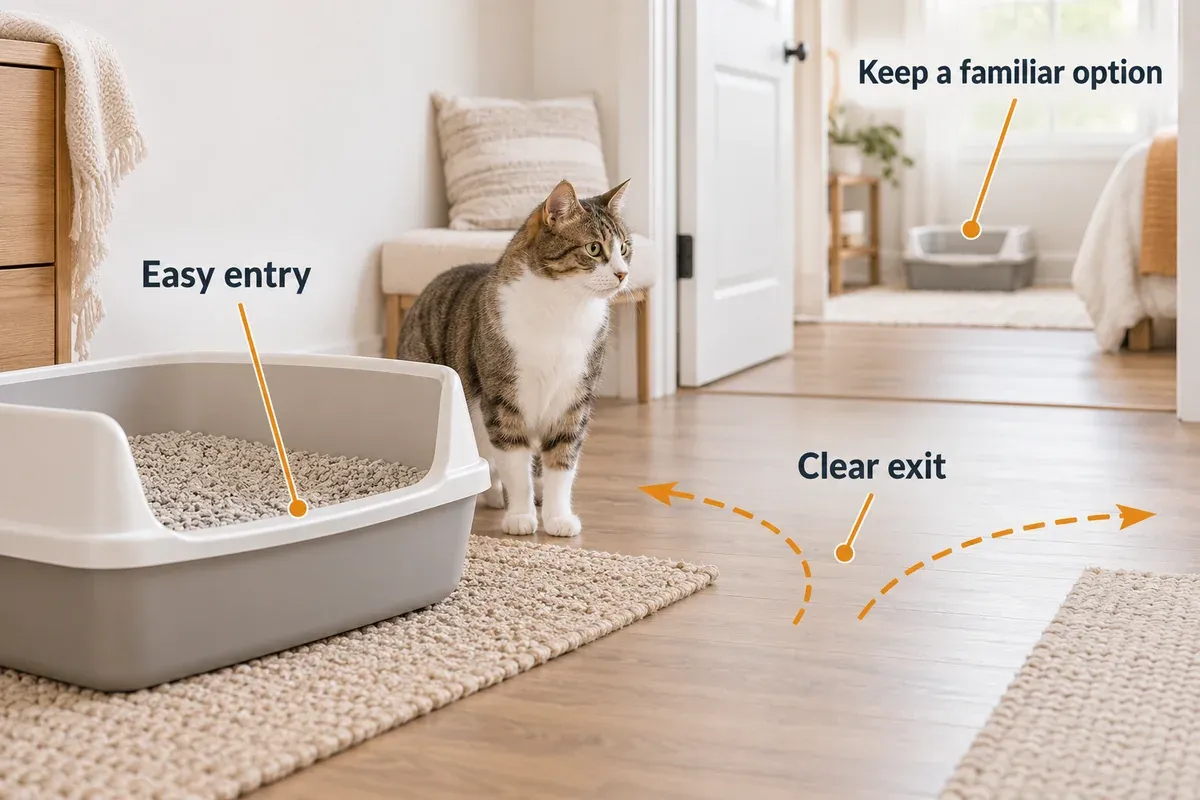
Kittens, senior cats, and cats with stiff joints may need a low front entry. High sides can help contain scatter and urine, but a high step can turn the box into an obstacle. You can combine a low-entry box with a larger high-sided box so the cat has an accessible choice and the room stays easier to clean.
3. Use a neutral litter depth and scent
Many cats prefer unscented, fine-textured litter. Start with about 1–2 inches of litter unless your cat clearly prefers more. Strong fragrance, deodorizing beads, liners, dusty litter, and a sudden change in texture can all create avoidance. If you are testing a new litter, keep the familiar box and offer the new litter in a separate box so you can see the preference instead of changing every variable at once.
4. Provide enough boxes
The practical starting rule is one box per cat, plus one extra. Place them in separate, quiet locations rather than lining them up together in one room. A group of boxes in one location may function like one resource from a cat’s perspective.
Choose locations with easy access, good visibility, and more than one possible exit. Avoid placing a box beside a washing machine, furnace, dog feeding area, cat flap, or narrow hallway where another animal can startle or ambush the user. Keep food and water away from the toilet area.
5. Treat cleanliness as a daily requirement
Scoop at least once a day; in a multi-cat home, twice daily may be more realistic. Wash the empty box about weekly with warm water and unscented soap, rinse thoroughly, and dry it fully before adding litter. Avoid strong perfumes and ammonia-based cleaners. The ASPCA’s litter-box guidance also recommends daily scooping, unscented litter, enough boxes, and avoiding punishment.
The 24-Hour Litter-Box Reset
You do not need to buy a complete new system to learn what your cat dislikes. Make one careful change at a time and keep the old setup available while you test.
Step 1: Remove the medical uncertainty
Use the emergency signs above as your threshold for immediate care. For a cat that is otherwise passing urine and acting normally, book a veterinary appointment if the change is sudden, repeated, or accompanied by blood, pain, unusual thirst, appetite changes, constipation, diarrhea, or weight loss. Do not use a product trial as a reason to delay care.
Step 2: Add a neutral “choice” box
Set up a large, open, easy-entry box in a quiet room your cat already uses. A plain temporary pan is fine for a troubleshooting test. Use unscented litter at 1–2 inches and do not add a liner or fragrance while you are trying to learn what your cat prefers.
Keep the original box in place and make sure the new box is not beside food. If your cat uses the new box, resist moving it immediately. Let the successful habit become predictable first.
Step 3: Run one litter preference test
If you suspect the litter, place two boxes side by side for a short test: one with the familiar litter and one with the candidate litter. Keep box size and location as similar as possible. Record which one your cat uses. Once you know the preference, transition gradually if you need to replace the old litter rather than making a sudden full change.
Step 4: Clean every accident properly
Blot fresh urine without rubbing, then use a cat-urine enzyme cleaner according to its label. Give the product the required contact time and let the area dry before your cat returns. Patch-test fabrics and finished surfaces first. Do not combine cleaners, especially products containing bleach or ammonia.
If the same corner keeps attracting your cat, change what the area means after cleaning: place a bed, scratcher, or supervised feeding station there if appropriate, or block access temporarily. Never punish, yell, or carry your cat to the box after an accident. Punishment can increase fear and make the pattern harder to solve.
Step 5: Reduce ambushes and stress
In multi-cat homes, make sure one cat cannot guard the only route to the box. Add separate food, water, resting, and hiding options. Close blinds if neighborhood cats trigger repeated window watching or marking, and keep routines predictable during moves, renovations, new-pet introductions, and schedule changes.
If a stressor is plausible, an optional pheromone diffuser may support the environmental changes, but it should not replace a medical check or a better box layout. Give the intervention time and track the result rather than adding several products at once.
Step 6: Keep a simple log
For seven days, record which boxes are used, whether urine and stool look normal, when boxes are scooped, and any changes in appetite, thirst, or behavior. The log helps you see whether the problem is improving and gives your veterinarian a clearer history. If your cat goes several days without reliable box use despite the reset, go back to the medical question.
Products That Help With Specific Parts of the Problem
These products are tools for a troubleshooting plan, not universal fixes.
Targeted tools for a litter-box reset
-
Dr. Elsey's Cat Attract Clumping Clay Cat Litter, 40 lb
Dr. Elsey's
Unscented clumping clay with a herbal attractant, useful as a controlled litter-preference test after medical causes are addressed.
- 40 lb bag
- Unscented
- Hard clumping
- Best use
- A targeted litter trial for cats avoiding the box
-
Nature's Miracle Urine Destroyer Plus for Cats, 32 oz
Nature's Miracle
A ready-to-use enzymatic cleaner for cat urine stains and odor residue; follow the label and test it on an inconspicuous area first.
- 32 oz ready-to-use bottle
- Enzyme-based formula
- Designed for cat urine
- Best use
- Removing residual urine odor from accident areas
-
Amazon Basics Large Cat Litter Box with High Sides
Amazon Basics
An inexpensive open-top, high-sided box with a scoop that makes it easy to test whether the current box shape or cover is the problem.
- Open top
- High sides
- 19 × 15 × 11.75 in
- Best use
- A quick open-box test for small-to-average cats
-
FELIWAY Classic Cat Calming Diffuser Kit, 30 Day Starter Kit
FELIWAY
A plug-in pheromone diffuser starter kit for households where a recent stressor plausibly contributes to litter-box avoidance.
- 48 mL vial
- 30-day starter kit
- Plug-in diffuser
- Best use
- Stress-related marking or avoidance as an optional adjunct
-
Vansky UV Flashlight Black Light, 51 LED Pet Urine Detector
Vansky
A compact 51-LED UV flashlight for scanning floors, baseboards, and fabrics in a dark room before cleaning.
- 51 LEDs
- Portable
- Useful for hidden spots
- Best use
- Finding old accident spots before enzymatic cleaning
Review the linked product page before purchasing.
Dr. Elsey’s Cat Attract: a controlled litter trial
Dr. Elsey’s Cat Attract is most useful when your cat is medically stable and you suspect a texture, scent, or substrate preference. It is unscented and includes a herbal attractant, but no attractant can override urinary pain or a frightening location.
Use it in one clean box while leaving a familiar-litter box available. Watch the result for several days, keep the depth consistent, and transition slowly if you decide to keep it. The bag is heavy, clay can track, and a cat that prefers pellets, paper, or another texture may still reject it.
Check current price on Amazon →Nature’s Miracle Urine Destroyer Plus: remove the scent loop
An accident can become a repeat location when odor residue remains below the surface, even if people can no longer smell it. Nature’s Miracle Urine Destroyer Plus for Cats is a ready-to-use 32 oz enzymatic cleaner.
Blot first, apply enough product to reach the contaminated area, follow the label’s contact and drying directions, and keep your cat away until the area is dry. Test an inconspicuous spot on carpet, upholstery, wood, or painted surfaces. This product can remove an odor cue; it cannot diagnose why the accident happened.
Check current price on Amazon →Amazon Basics Large Cat Litter Box: test open versus covered
Sometimes the most useful purchase is a simple box that lets you test one variable. This Amazon Basics model is open-top and high-sided, measures about 19 × 15 × 11.75 inches, and includes a scoop with storage.
Treat it as a budget test box for a small-to-average cat, not as an extra-large recommendation. The dimensions may be too short for a large breed, and the high sides may not suit a senior or arthritic cat. Measure your cat and compare the usable floor area before ordering; a bigger open pan is the better experiment when your current box is cramped.
Check current price on Amazon →FELIWAY Classic Diffuser: an optional stress adjunct
If the timing matches a move, renovation, new pet, conflict between cats, or repeated outside-cat activity, FELIWAY Classic may be worth trying alongside better access and more resources. The 48 mL starter kit is designed for about 30 days.
Place the diffuser in the room your cat uses most, not as a replacement for a clean, well-placed box. Results vary, and refills add a recurring cost. If your cat is straining, producing little urine, or showing other illness signs, a diffuser is not an appropriate first response.
Check current price on Amazon →Vansky UV Flashlight: find hidden spots before cleaning
A 51-LED UV flashlight can help you scan rugs, floor edges, baseboards, and the underside of furniture in a dark room. It is useful when you know there is an odor but cannot locate the source.
Use it as a locator, not a diagnostic test. Some stains will not fluoresce, and other substances can glow under UV light. Never shine the light into your cat’s or anyone else’s eyes; once you find a spot, clean it with a suitable enzyme product and keep the area unavailable until dry.
Check current price on Amazon →When Should You Call the Vet?
Use the following timing guide:
- Immediately: repeated straining, no urine, only drops, crying, vomiting, collapse, severe pain, or a tense/swollen abdomen.
- Today or within 24 hours: blood in urine or stool, frequent new accidents, obvious pain, repeated licking of the genital area, constipation with straining, or a cat that is not eating or drinking normally.
- Soon: a sudden change in a senior cat, increased thirst or urination, weight loss, recurrent accidents, diarrhea, or any problem that continues after you restore a comfortable box.
- Book a behavior-focused follow-up after medical care: marking or avoidance that continues despite normal tests and a carefully improved setup.
Do not wait for a cat to “get used to it” when urination has changed. Early care can also prevent a painful accident from becoming a strong location or surface habit.
How to Tell Whether the Reset Is Working
Look for reliable box use, normal urine and stool, fewer searches for secluded corners, and relaxed movement around the box. Improvement is not just one successful visit; it is a pattern over several days.
Keep the successful box in place until the routine is stable. If you need to move it, shift it a small distance at a time and keep a second box at the original location during the transition. Continue scooping daily and clean any new accidents promptly so the old scent does not re-establish the habit.
If the cat uses one litter but not another, one box but not another, or one room but not another, that information is valuable. Keep the preferred option available while you work with your veterinarian or a qualified feline behavior professional on the remaining trigger.
Frequently Asked Questions
Why did my cat suddenly stop using the litter box?
Sudden avoidance can be caused by urinary or digestive discomfort, constipation, arthritis, a dirty or inaccessible box, a frightening noise, another animal blocking access, a litter change, or household stress. Because pain can look like a behavior change, arrange veterinary advice first when the change is sudden or repeated.
Can stress alone cause litter-box problems?
Stress can contribute to marking, avoidance, and conflict around the box, but stress should not be assumed until medical causes have been considered. Reduce competition and unpredictable noise, add separate resources, and keep the box quiet, visible, and easy to leave. If the problem continues, ask your veterinarian about a behavior plan.
How many litter boxes should I have?
Start with one box per cat plus one extra, placed in separate accessible locations. Spread them across the home so a single cat cannot control every option. A larger household may need more than the starting rule if cats live on different floors or have a history of conflict.
Is an open or covered litter box better?
There is no universal winner. An open box gives more visibility and escape routes and usually makes cleaning easier. A covered box may contain scatter but can trap odor and feel unsafe to some cats. If you are unsure, offer both at the same time and record which one your cat chooses.
What litter is most likely to be accepted?
Many cats accept an unscented, fine-textured litter, but individual preference matters. Avoid making several changes at once. Offer the new litter in a separate box first, keep the depth around 1–2 inches, and transition gradually if your cat shows a clear preference.
Can I use a litter attractant?
You can use an attractant as a controlled preference trial after a veterinary check, ideally in a separate box beside the familiar setup. It is not a treatment for urinary pain, constipation, infection, stones, obstruction, or anxiety. Stop and reassess if the cat avoids the new litter or develops illness signs.
Should I buy an automatic litter box?
Not as the first response to sudden avoidance. Some cats dislike the motor, enclosed shape, movement, or new smell. Solve the health and preference question with a simple, quiet box first. If you later try an automatic model, keep a familiar manual box available during the transition and make sure the entry and interior are large enough.
How do I clean cat urine so my cat does not return to the same place?
Blot fresh urine, use a suitable enzyme cleaner according to its label, allow the required contact time, and let the area dry fully. Patch-test the material first, never mix cleaners, and block access while it dries. A UV flashlight can help locate hidden spots, but fluorescence is not proof of urine.
When is litter-box avoidance an emergency?
Repeated straining, crying, frequent attempts with little or no urine, vomiting, weakness, or a painful/distended abdomen require immediate veterinary attention. A cat that cannot urinate can deteriorate rapidly. If you are unsure whether urine is being produced, treat that uncertainty seriously and call an emergency clinic.
Related Cat-Care Guides
- How to Reduce Litter Box Smell: build a cleaning and odor-control routine after the medical question is addressed.
- Best Self-Cleaning Litter Boxes: compare automatic options only after your cat is comfortable with the basic box setup.
- Self-Cleaning Litter Boxes for Large Cats: check sizing and entry dimensions for Maine Coons, Ragdolls, and other large cats.
- Why Is My Cat Not Drinking Enough Water?: support hydration habits that matter for urinary health, with veterinary care still taking priority when symptoms appear.
The Fix Is a Diagnosis, Not a Gadget
The most reliable way to solve litter-box avoidance is to work in the right order: rule out pain and urinary trouble, offer a physically comfortable box, make litter and location predictable, remove odor cues, and reduce competition or fear. A targeted product can make one part of that plan easier, but no attractant, cleaner, diffuser, or flashlight can replace a veterinary exam when a cat’s elimination pattern changes.
If your cat is comfortable, urinating normally, and responding to a calmer, cleaner, more accessible setup, keep the successful routine stable. If the problem returns, use your log to show your veterinarian exactly what changed and how quickly.