

 Published sources
 Product details checked
Choose a cat exercise wheel by its clear inner diameter first. Then compare the usable running width with your cat’s chest width, the permitted pet weight with the cat’s actual weight, and the complete assembled wheel with the space available. An outside diameter or an “XL” label cannot answer those questions.
For a cat measuring 18 inches from nose to tail base and 10 inches at the shoulder, this calculator gives a 40-inch clear inner-diameter target. A cat measuring 22 inches long and 13 inches tall gets a 46-inch target. These are worked examples of this guide’s planning rule, not veterinary minimums. A wheel advertised as 48 inches might have a smaller running circle inside.
Use the result to narrow your search, then confirm the actual measurements and watch how your cat moves. No measurement can guarantee that a cat will enjoy a wheel, and the calculator cannot establish structural stability or diagnose a comfortable gait.
Cat Exercise Wheel Size Calculator
Replace the example values with your measurements. Enter half the clear inner diameter in the radius field: a 44-inch inside diameter means a 22-inch radius. Keep unknown product dimensions blank; a missing measurement should stop the comparison rather than become a guessed value.
For a shared wheel, use the longest body length and tallest shoulder height across both cats, even if those measurements belong to different cats. Enter each cat’s chest width and weight separately. Sharing one at a time uses the broader chest and heavier weight; simultaneous use needs explicit permission for the exact model before it can be checked.
Interactive sizing tool
Screen a cat exercise wheel before you buy
Compare your cat's measurements with a wheel's clear inner radius, usable track, pet-weight limit, base, and overall size. The starting values are an example; replace them with your measurements.
Your starting fit screen
Enter your measurements to compare a candidate wheel. The worked examples below show how to calculate the diameter by hand.
The calculator uses transparent planning screens for body geometry and space. It is not a veterinary standard, structural certification, or weight-loss prescription; inspect the assembled wheel and supervise the first sessions.
The units selector converts the values and their allowed ranges together. Decimal measurements are accepted, including a manufacturer’s 39.37-inch inside diameter. Results shown in centimeters come from the same calculation as results shown in inches, so changing units does not change the sizing rule.
Measure Your Cat Without Stretching or Restraining Them
Have a tape measure, a way to record the measurements, and your cat’s current weight ready. Choose a time when the cat is standing calmly on a level floor. A second person can reward the cat for staying nearby, but the measurement should not involve pulling the legs, stretching the body, or holding the cat in an unnatural position.
| Measurement | What to measure | Common mistake |
|---|---|---|
| Body length | Straight-line distance from nose to the base of the tail while the cat stands naturally | Including the tail or measuring a tightly curled sleeping cat |
| Shoulder height | Floor to the withers, the top of the shoulders | Measuring to the head or ear tips |
| Chest / shoulder width | Broadest point across the chest or shoulders | Entering chest circumference instead of width |
| Current weight | The cat’s actual weight now | Using a hoped-for weight after a diet |
Repeat the length and height measurements when the cat is standing comfortably again. If the results differ noticeably, check the endpoints and posture before choosing a value. A side-on photograph with a measuring reference can help you compare two attempts, but perspective can distort a photograph; a direct measurement is preferable when your cat tolerates it.
Long hair can obscure the shoulders. Avoid squeezing the coat into an artificially narrow outline. You are trying to judge the space your cat occupies while moving, including room to adjust their footing, rather than obtain a precise anatomical measurement.
Which cat determines the size in a shared household?
Do not average the cats. One may be longer while another is taller, broader, or heavier. Record each cat’s measurements and use the largest relevant value for each check. For two cats taking turns, their weights do not need to be added, but the permitted pet weight must cover the heavier cat.
The calculator accepts adult-sized body measurements from 10 to 30 inches long and 6 to 16 inches at the shoulder. Those limits describe the tool’s range, not a definition of a normal cat. A growing kitten, an unusually small cat, or a cat outside that range needs an individual assessment. Do not enter the nearest allowed value to make the tool produce a result.
Understand Inner Diameter, Radius and Outside Size
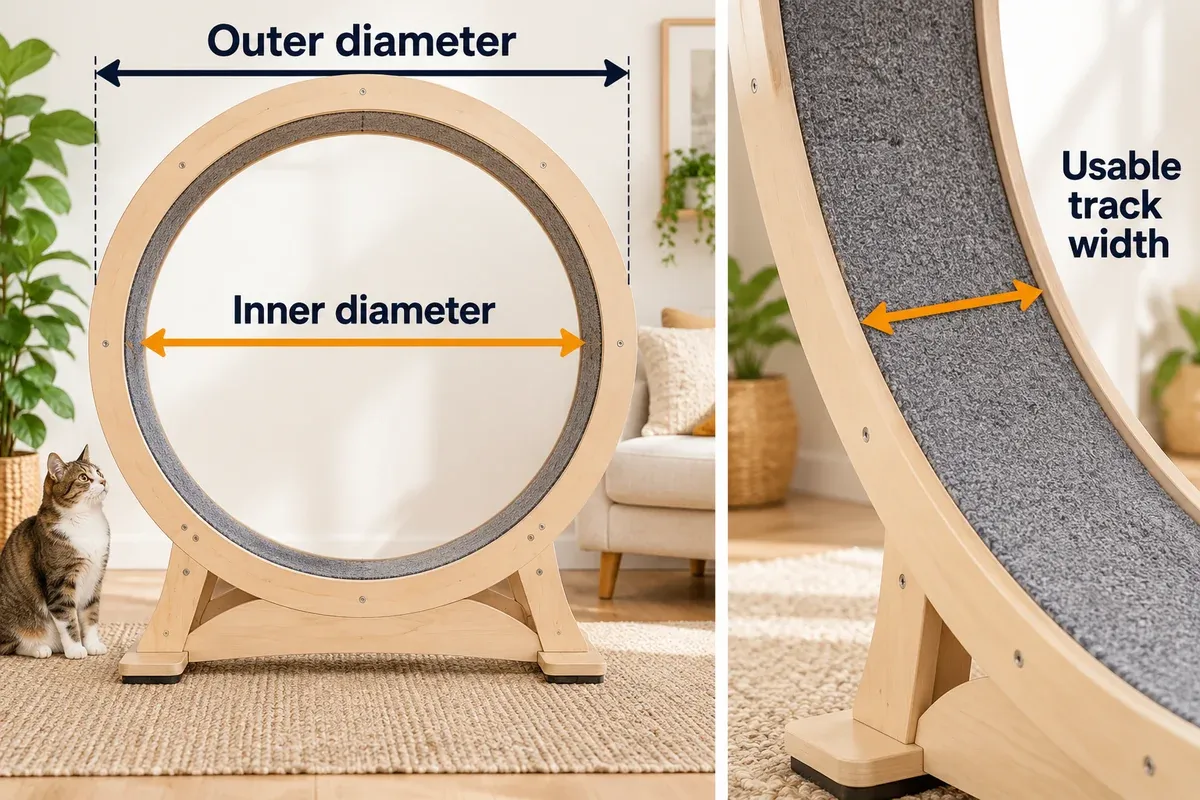
A wheel has several measurements that can look interchangeable in a product title. Keep these separate when reading a drawing or asking for dimensions.
| Product measurement | Meaning | Where to use it |
|---|---|---|
| Clear inner diameter | Distance across the inside running circle through its center | Compare with the body-fit diameter target |
| Clear inner radius | Half the clear inner diameter | Enter in the calculator’s radius field |
| Outer diameter | Distance across the outside rim | Part of the room-space check; it does not establish running space |
| Usable track width | Running lane between rails, guards or other obstructions | Compare with the chest-width allowance |
| Base footprint | Width and depth of the stand’s actual floor contact | Compare with the base planning references |
| Overall assembled width and depth | Largest occupied dimensions, including the rim, guards and stand | Use for the floor-space check |
| Overall height | Floor to the highest part of the assembled wheel | Check ceilings, shelves and nearby furniture separately |
Measure the running circle with its normal pads or carpet fitted. Ask whether a quoted inside dimension includes that surface. An outer rim measurement minus a guessed wall thickness is not a dependable substitute for an inside measurement, particularly when side guards or a raised track change the available space.
Convert radius and diameter before comparing products
The relationship is simply diameter = 2 × radius. A 22-inch radius equals a 44-inch diameter. In metric units, 55.88 cm of radius equals 111.76 cm of diameter. A product described as 44 inches across the outside still has an unknown inside radius until the running circle is measured.
If a technical drawing gives the running circumference instead, a circular track’s diameter is the circumference divided by π. Only use that conversion when the figure actually describes the inner running circle. Do not use the total length of carpet supplied, packaging dimensions, or an outside circumference.
The One Fast Cat Gen 7 specifications make the distinction clear: 48 inches outside and 43 inches inside, with an 11-inch running surface and a 25 lb maximum supported pet weight. The full assembled dimensions are 48 × 13 × 50 inches. The 48-inch name therefore does not describe a 48-inch clear running circle.
The Diameter Formula and Its Limits
This guide uses a practical comparison rule built around body length and a small height allowance. It has not been validated as a veterinary sizing formula. The starting diameter, buffers, and rounding are assumptions that make the calculator reproducible; they do not establish an injury threshold or prove that a particular wheel protects the spine.
Calculate in inches:
- Double the nose-to-tail-base body length.
- Add 0 inches for shoulder height up to and including 10 inches, 1 inch for height above 10 and up to and including 12 inches, or 2 inches for height above 12 inches.
- Use 40 inches if that calculation is smaller than 40.
- Round the result up to the next whole inch when it contains a fraction.
Written as a formula, the target is ceil(max(40, 2 × body length + height buffer)). The inner-radius target is half that result. The height steps are coarse planning choices; there is no biological change at precisely 10 or 12 inches.
A larger diameter creates a gentler circular arc. That geometry explains why inside size is worth comparing, but body length cannot describe every cat’s stride, flexibility, balance, or preferred pace. Persistent crouching or difficulty keeping the paws on the track calls for stopping and reassessing the fit, rather than encouraging the cat to run faster.
Worked examples: the table and calculator use the same targets
These are hypothetical measured cats. The last column compares actual clear inside diameters, not the size printed in a product name.
| Body length | Shoulder height | Calculation before rounding | Clear inner-diameter target | How to compare a candidate |
|---|---|---|---|---|
| 18 in / 45.72 cm | 10 in / 25.40 cm | Double length = 36 in; the 40 in starting floor applies | 40 in / 101.60 cm | A confirmed 43 in inside diameter exceeds the target |
| 20 in / 50.80 cm | 12 in / 30.48 cm | 40 + 1 = 41 in | 41 in / 104.14 cm | A 40 in inside diameter falls short |
| 21 in / 53.34 cm | 11 in / 27.94 cm | 42 + 1 = 43 in | 43 in / 109.22 cm | A 43 in inside diameter meets the target exactly |
| 22 in / 55.88 cm | 13 in / 33.02 cm | 44 + 2 = 46 in | 46 in / 116.84 cm | A confirmed 48 in inside diameter exceeds the target; an unspecified “48-inch wheel” remains unresolved |
| 26 in / 66.04 cm | 14 in / 35.56 cm | 52 + 2 = 54 in | 54 in / 137.16 cm | Neither a 43 in nor a 48 in inside diameter meets the target |
Compare the actual inside measurement with the calculated target. For a 46-inch result, you can choose a larger manufactured size, but its confirmed inside diameter must still be at least 46 inches. A 48-inch outside label does not satisfy that condition.
Using the rule with centimeters
Convert the cat’s measurements to inches using 1 inch = 2.54 cm, apply the rule, then convert the target back. For the 55.88 cm long, 33.02 cm tall example, that gives 22 inches of length, 13 inches of height, and a 46-inch target, equivalent to 116.84 cm.
Do not round the converted body length or shoulder height to a whole inch first. That can move a cat across a height step or change the rounded diameter. The calculator preserves the entered precision during conversion and rounds the displayed answer separately. A displayed value near a limit should not replace the exact specification used in the comparison.
Track Width and Pet-Weight Limits Are Separate Checks
For one cat, the track-width target is chest width plus 4 inches / 10.16 cm. For cats sharing one at a time, use the broader chest. This allowance belongs to the guide’s planning method; it is not an established manufacturer or veterinary requirement.
For example, a cat with a 7-inch chest gets an 11-inch usable-track target. A broad 9-inch chest gets 13 inches. Both cats can have the same body-length target while needing different track widths. A large diameter does not prevent a cat from brushing a side guard, placing a paw near the edge, or struggling to turn on a narrow lane.
Measure the lane where the paws can actually land. Count neither raised rails nor empty space outside the carpet. Inspect the surface for loose edges, exposed fasteners, slippery patches, or material that catches claws. A replacement pad that is thicker, narrower, or poorly fitted can change the usable space even when the frame is unchanged.
Use actual pet weight, with room for changes
The weight check compares the permitted pet weight for the exact model with the cat’s current weight. For cats taking turns, it uses the heavier cat. For expressly permitted simultaneous use, it adds both weights.
Meeting the published maximum exactly leaves no weight margin. Recheck the cat’s weight if they are still growing or their weight changes. Do not invent an extra safety factor and treat it as a manufacturer’s approval, and do not use shipping weight, wheel weight, or a generic material load as the permitted pet weight.
Weight also cannot replace body measurements. A light, long-bodied cat may need a larger running circle than a heavier, compact cat. Passing the load check does not fix an undersized diameter or a narrow track.
Can two cats run at the same time?
Start with one cat at a time. Simultaneous use adds another problem: the cats may choose different speeds or directions, step off at different moments, or compete for the same moving lane.
Only consider it when the manufacturer explicitly allows simultaneous running on the exact model and gives any applicable combined pet-weight limit. A photograph of two cats sitting inside a stationary wheel does not establish permission for running together. The calculator requires you to confirm that permission and enter both cats’ widths and weights; it does not replace the instructions.
Its simultaneous track allowance is the two chest widths added together, plus 4 inches. Two hypothetical 7-inch-wide cats therefore get an 18-inch / 45.72 cm target. Even if a brand permits two cats on a narrower product, that wheel does not meet this guide’s width allowance for those measurements. Do not reduce the entered widths to obtain a pass.
If one cat blocks the other from reaching the wheel, provide other play opportunities and separate access. The AAFP/ISFM Environmental Needs Guidelines recommend separated resources and individual safe places in multi-cat homes. Adding a shared moving object does not resolve competition over resting or feeding areas.
Plan the Base and the Space Around the Whole Wheel
Keep support footprint and occupied room space separate. The circle can extend well beyond the stand. Measuring a 36-inch base does not mean a 48-inch-wide wheel will fit in a 36-inch gap.
The calculator uses these openly stated base references:
- Base width: 75% of the candidate’s actual clear inner diameter, with a 32-inch minimum, rounded up to a whole inch.
- Base depth: the candidate’s actual usable track width plus 2 inches, with a 14-inch minimum, rounded up to a whole inch.
For a hypothetical 44-inch inside diameter and 12-inch track, those references are 33 inches wide and 14 inches deep. For a 48-inch inside diameter and 16-inch track, they become 36 × 18 inches. The references follow the wheel you are considering, including a wheel larger than the body-fit target.
These dimensions do not certify stability. They are prompts to investigate the support. A product below a reference is not automatically unsafe, and one above both references is not automatically stable. Roller position, support geometry, construction, assembly, movement, floor contact and the manufacturer’s instructions all matter. Ask for the model’s support details rather than treating 75% or an extra 2 inches as a structural test.
Floor clearance uses the assembled width and depth
For room planning, the calculator adds 6 inches / 15.24 cm on each side of the complete assembled wheel. That is 12 inches / 30.48 cm added to overall width and depth. It checks both orientations, so turning the wheel by 90 degrees can change whether it fits the measured floor rectangle.
A hypothetical wheel 48 inches wide and 16 inches deep therefore needs a starting space allowance of 60 × 28 inches / 152.40 × 71.12 cm. A 48 × 28-inch space fails that allowance, even if the stand itself is only 36 inches wide. The outside circle still occupies the missing width.
Six inches is a planning allowance, not a universal safety distance. Increase the space when the cat needs a longer approach, the exit faces a doorway, or people and other pets pass nearby. Follow any larger clearance required by the manufacturer. Check the height separately: the calculator does not know about a shelf above the rim or a sloping ceiling.
Before assembling, mark the full outside width and depth on the floor with removable tape. Open nearby doors, move chairs as you normally would, and check that you can reach the running surface for cleaning. Choose a location where the cat can approach and leave without another cat guarding a narrow passage.
How the Four Wheel Models Compare
The useful question is which dimensions are established and whether they meet your result. The model comparisons below use published specifications where available. They do not describe hands-on testing or award a wheel a general safety approval.
| Model | Clear inner diameter | Usable track | Permitted pet weight | What it means for the worked examples |
|---|---|---|---|---|
| One Fast Cat Gen 7 | 43 in / 109.22 cm | 11 in / 27.94 cm | Up to 25 lb / 11.34 kg | Diameter meets the 18/10 example’s 40 in target; fails the 22/13 example’s 46 in target |
| Nordic Beast 48 XL | Unconfirmed; 48 in is not explicitly labeled as the clear inner diameter | 15.7 in / 39.88 cm | 45 lb / 20.41 kg | Diameter fit remains unresolved for both examples |
| VEVOR 4.0 XL, product reference 010166177754 | 39.37 in / 100 cm | 11 in / 28 cm | Pet-use text gives up to 25 lb; another load field conflicts | Diameter falls below both examples and the guide’s 40 in starting target |
| Homegroove 46 in XL, reference B0BL3L38CX | Unconfirmed | Unconfirmed | Unconfirmed for this exact reference | Fit remains unresolved; the size label cannot establish suitability |
One Fast Cat Gen 7: a conditional option for the smaller target
For the hypothetical cat with an 18-inch body, 10-inch shoulder height, 7-inch chest, and 12 lb weight, the Gen 7’s inside diameter, track, and pet-weight limit meet the 40-inch, 11-inch, and 12 lb body checks. Its confirmed 43-inch running circle falls 3 inches short of the taller 22/13 example’s target. Choose it only when your own measurements meet those limits; a breed label cannot decide the fit.
The exact floor-contact footprint still needs confirmation. Its 13-inch overall depth also falls below this guide’s 14-inch base-depth reference, which is a reason to examine the actual support and instructions, not proof of instability. The Gen 7 roller guidance confirms that its pinned rollers are not adjustable. Do not apply instructions about tightening older-generation roller bolts to this model.
Nordic Beast 48 XL: wider lane, unresolved inside diameter
The Nordic Beast specifications give a 15.7-inch track, 45 lb capacity, 51.5-inch overall height, and a diameter labeled 48 inches. They also give a 38-inch width without enough detail to treat that as the full floor-contact footprint. The clear inner diameter and base depth remain necessary measurements.
A wider lane may help a broad cat, but it cannot settle the circle’s fit. For a 46-inch target, request an inside measurement with the carpet fitted before buying. Nordic Beast explicitly describes side-by-side use; its 15.7-inch track still falls below the calculator’s 18-inch allowance for two 7-inch-wide cats. Manufacturer permission and enough measured room are separate conditions.
VEVOR 4.0 XL: outside size overstates the running circle
The VEVOR 4.0 XL specifications give 43.3 inches outside, 39.37 inches / 1000 mm inside, an 11-inch / 280 mm track, and a base of 39.2 × 13.6 inches. The model number there is 4.0 XL. The 39.37-inch circle fails the 40-inch starting target; rounding it to “about 40” would conceal the shortfall.
The pet-use text says up to 25 lb, while a separate capacity field gives 150–190 lb. Use neither the larger figure nor the product’s weight as permission to run a heavier cat. The pet limit needs clarification if that affects a purchase. This model is excluded from the purchase options below because its diameter does not meet the guide’s starting target.
Homegroove 46 in XL: measurements needed before a recommendation
For product reference B0BL3L38CX, the clear inside diameter, usable track width, and permitted pet weight remain unconfirmed. The 46-inch size label is insufficient for either worked example. Obtain a dimensioned manual or a manufacturer response that identifies this exact reference and separates the inside running circle, outside size, and support footprint.
Until those values are available, leave the corresponding calculator fields blank and keep this model out of a buying shortlist. A lock, a broad-looking stand, or a general “large cats” description cannot fill the measurement gap.
Purchase options to investigate after measuring
One Fast Cat is a conditional candidate when its established dimensions meet your measurements. Nordic Beast remains an option to investigate after confirming the inside circle and stand. Neither receives an unconditional fit recommendation.
Compare these options with your measurements
-
One Fast Cat Gen 7 Cat Exercise Wheel
One Fast Cat
A Gen 7 ABS wheel with a 43-inch inside diameter and an 11-inch running surface. Confirm the stand footprint and room clearance before choosing it.
- 48 in outer diameter; 43 in inner diameter
- 11 in running surface; maximum pet weight 25 lb
- Replaceable felt or foam traction pads
- Consider when
- One cat with a diameter target no greater than 43 in, a track target no greater than 11 in, and weight within 25 lb
- Clear inside diameter
- 43 in / 109.22 cm
- Usable running width
- 11 in / 27.94 cm
- Permitted pet weight
- Maximum pet weight 25 lb / 11.34 kg
-
Nordic Beast 48 XL Cat Wheel
Nordic Beast
A wood wheel with a 15.7-inch running lane. Its advertised 48-inch diameter is not explicitly identified as the clear inside measurement, so body fit remains unresolved.
- 15.7 in running surface; 45 lb capacity
- Removable carpet on a plywood wheel
- 48 in diameter label needs an inside-dimension check
- Consider when
- A broader cat after the clear inner diameter and stand dimensions are confirmed against its measurements
- Clear inside diameter
- Unconfirmed; 48 in diameter label does not establish inside size
- Usable running width
- 15.7 in / 39.88 cm
- Permitted pet weight
- 45 lb / 20.41 kg capacity; confirm any combined-use limit
Inside dimensions and support details must match the exact model you buy. An unresolved measurement means fit is still unknown.
Inspect the Assembled Wheel Before Your Cat Uses It
Read the instructions for the exact generation and size before assembly. A generic video for a similar wheel may show a different roller attachment, support position, or locking mechanism. Install the intended running surface and guards before checking clear dimensions.
With the cat elsewhere, work through these checks:
- Confirm floor contact. Place the wheel on the floor surface recommended for the model. Check that all intended support points contact the floor and the stand does not rock. A mat must not let one side sink or obstruct rollers.
- Check the moving path by hand. Rotate the empty wheel slowly through a complete turn. Watch for rim contact, lifting, scraping, uneven resistance, or sideways movement. Resolve those problems before inviting the cat inside.
- Inspect accessible gaps. Look at the rim-to-base area, roller openings, guards, pad edges and exposed fasteners. Small-looking gaps and “no-gap” marketing are not a universal paw-safety certification. Keep your own fingers clear of moving pinch points.
- Test any supplied lock. Confirm it engages and releases as instructed. A lock holds the wheel still for a specific purpose; it does not prove stability while running. If the model has no lock, follow its introduction instructions rather than improvising a brake.
- Measure the finished wheel. Check the inside circle, usable lane, support footprint, and full outside dimensions against what you entered. Update the comparison if the assembled measurements differ.
- Check access. Clear the route in and out, and remove dangling cords or objects that can reach the rotating surface. Keep children and other pets away during the first sessions.
Follow the manufacturer’s fastening instructions and maintenance schedule. Tightening every roller as hard as possible can create a different problem; some designs require free movement, while others use pins. If rocking or scraping persists after the correct assembly checks, stop and ask the manufacturer to resolve it.
Introduce the Wheel in Stages
A wheel is an optional activity that the cat should choose. The One Fast Cat training guide recommends a gradual approach with treats or toys, short sessions, and a stationary surface while a nervous cat explores. Progress depends on the cat’s comfort; it is not a deadline or a fitness challenge.
First let the cat approach and sniff the assembled wheel. Reward calm interest without lifting the cat into it. If they walk away, let them. Keep ordinary resting and play areas available so the wheel does not become the only attractive place in the room.
Next, keep the running surface stationary in the way the model’s instructions describe. Reward a voluntary paw touch or step onto the track. Stay at this stage until the cat can stand comfortably and step off without hesitation.
Introduce a small amount of movement only after that. Allow the cat to choose the pace and leave freely. Keep any toy clear of the rollers and rim; do not tether a cat, attach a leash to the frame, or pull them forward to make the wheel turn. End a session while the cat is still comfortable rather than waiting for exhaustion or frustration.
When to stop and reassess
Stop the session if the cat repeatedly slips, catches a claw, bumps a guard, struggles to exit, becomes frightened, or develops an uneven gait. Recheck the surface and fit with the cat off the wheel. If the cat continues to avoid it after a calm introduction, use another activity instead of forcing more sessions.
New stiffness, reduced activity, reluctance to climb, or a changed gait deserves a veterinary assessment. Cornell’s guidance on cats slowing down explains that joint pain can cause subtle changes in activity and mobility. A cat that appears to need “more exercise” may first need help with pain.
Difficulty breathing or open-mouth breathing warrants urgent veterinary attention. Stop the activity and contact a veterinarian immediately; do not test another session to see whether the cat improves. Cornell’s explanation of feline breathing difficulty identifies respiratory distress as requiring prompt care.
Cleaning, Replacement Parts and Everyday Use
Before buying, find out how the running surface is cleaned and replaced, whether pads are supplied for the exact size, and how the manufacturer supports worn rollers, bearings, guards and locks. An available replacement carpet is useful only if you can fit it securely and restore the intended running space.
Keep the surface dry and inspect it before use. Remove fur and debris from accessible areas with the wheel stationary, following the model’s cleaning instructions. Do not add oil or lubricant unless the manufacturer specifies it; the wrong substance or location can affect traction or attract dirt.
Stop using a pad that lifts, bunches, leaves an exposed seam, or repeatedly catches claws. After replacing it, rotate the wheel by hand and recheck the usable track. A new material’s thickness can also affect the inside diameter. Check fasteners and support points at the intervals given in the manual and after moving or disassembling the wheel.
A used wheel needs the same assessment. Identify the model and generation, check for cracks and missing guards, and establish whether parts and instructions still exist. If a missing measurement or damaged part cannot be resolved, a low purchase price does not make the fit known.
A wheel is only one part of an active indoor home
Keep climbing, scratching, hiding and interactive play available. The AAFP/ISFM guidance includes opportunities for play and predatory behavior alongside safe places and accessible resources. A wheel supplies a different activity from a perch, scratching post or hunting game.
If your room cannot accommodate the diameter and approach space, consider a cat tree sized around usable perches and climbing routes, food puzzles, and short supervised play. Where safe outdoor access is possible, a renter-friendly catio setup is another option. Choose an activity that fits the cat and room rather than shrinking the wheel to fit a leftover corner.
For weight management, ask your veterinarian for an appropriate target weight and feeding plan. Cornell’s feeding guidance recommends veterinary help when adjusting a cat’s diet to reach and maintain an ideal weight. The calculator checks physical dimensions and permitted pet weight; it does not estimate calories burned or prescribe running time.
Frequently Asked Questions
Is a 29- or 32-inch wheel large enough for my cat?
It falls below this calculator’s 40-inch clear inside-diameter starting target, even if the smaller number describes the inside circle. That alone is not a diagnosis of harm, but this guide cannot recommend it as passing the sizing method. If the number is an outside diameter, the running circle is smaller still.
What size wheel does a Maine Coon need?
Measure the individual cat. A breed name cannot supply body length, shoulder height, chest width or current weight. The hypothetical 22-inch-long, 13-inch-tall cat in the table needs at least 46 inches of confirmed inside diameter under this method; a longer cat can exceed that. Keep the track and pet-weight checks separate.
Does a 48-inch wheel always pass a 46-inch target?
Only when the clear inner diameter is at least 46 inches. A 48-inch outside label can describe a smaller running circle. Obtain an inside measurement with the normal surface fitted before deciding.
Why does the result not round up to 48 inches?
The calculation gives the minimum comparison target from the stated rule. It rounds up to whole inches, not to product classes. For a 46-inch result, choose any model with a confirmed inside diameter of 46 inches or more that also meets the other checks.
The base is below the reference. Must I reject the wheel?
The base references cannot determine that on their own. Examine the model’s support design, assembly instructions and actual behavior on the intended floor. A below-reference base needs closer investigation; an above-reference base still needs inspection. Persistent rocking, scraping or lifting is a reason to stop use and resolve the problem.
Can I put the wheel on carpet?
Follow the model’s floor requirements. Check that the assembled support does not sink unevenly, move across the carpet, or place the running circle or rollers against the pile. If the wheel rocks or drags, resolve the placement before a cat uses it. The calculator knows the measured floor area, not the firmness of the surface.
What if a manufacturer will not give the inside dimensions?
Keep the fit unresolved and compare a model with usable measurements instead. For an existing wheel, measure the assembled running circle and lane directly when you can do so safely. Do not enter its advertised outside diameter as the inside diameter to complete the form.
Can a senior or overweight cat use a wheel?
Get veterinary advice first if the cat has pain, reduced mobility, a medical condition, or a change in exercise tolerance. A larger track or higher pet-weight limit cannot decide what activity is appropriate. Allow voluntary, supervised use only within that individual advice, and keep comfortable alternatives available.
Sources and Further Reading
- One Fast Cat: Gen 7 dimensions and permitted pet weight
- One Fast Cat: introducing a cat to the wheel
- One Fast Cat: roller adjustment differences between generations
- Nordic Beast: 48 XL specifications and described simultaneous use
- VEVOR: 4.0 XL dimensions and pet-use information, reference 010166177754
- AAFP/ISFM: Environmental Needs Guidelines
- Cornell Feline Health Center: Is Your Cat Slowing Down?
- Cornell Feline Health Center: Dyspnea (Difficulty Breathing)
- Cornell Feline Health Center: Feeding Your Cat