

 Published sources
 Product details checked
The right litter box is not the one with the biggest label. It is the one that gives your cat enough usable floor to stand, turn, dig, and position comfortably—while still being easy enough to enter and high enough to contain the mess.
Quick answer: Start with a usable interior length of at least 1.5 times your cat’s body length, measured from the nose to the base of the tail. For many average adult cats, that means roughly 24 × 15 inches of usable floor as a practical starting point. Large or long-bodied cats need more. Senior cats need a lower entrance, while cats that urinate high need taller back and side walls without a tall step-in.
The AAFP/ISFM house-soiling guidelines and AAHA feline life-stage guidance support the 1.5× sizing rule. This guide turns that rule into a usable decision tool, then shows how to compare real box dimensions, entry heights, and footprints.
Use the Cat Litter Box Size Calculator
Enter your cat’s body length, mobility needs, urine pattern, maximum comfortable step-in, and the space available at home. The calculator reports a planning target, not a promise that your cat will accept a particular litter, hood, or doorway.
Interactive sizing tool
Calculate your cat's litter box target
Enter the measurements you know. The breed choice is only a starting preset—the actual body length wins when it differs.
Your starting target
Enter your cat's details to see a fit target.
The calculator uses the 1.5× body-length rule for the usable floor and practical planning targets for walls, entry, and clearance. Measure the actual interior of any box before buying.
How to measure your cat
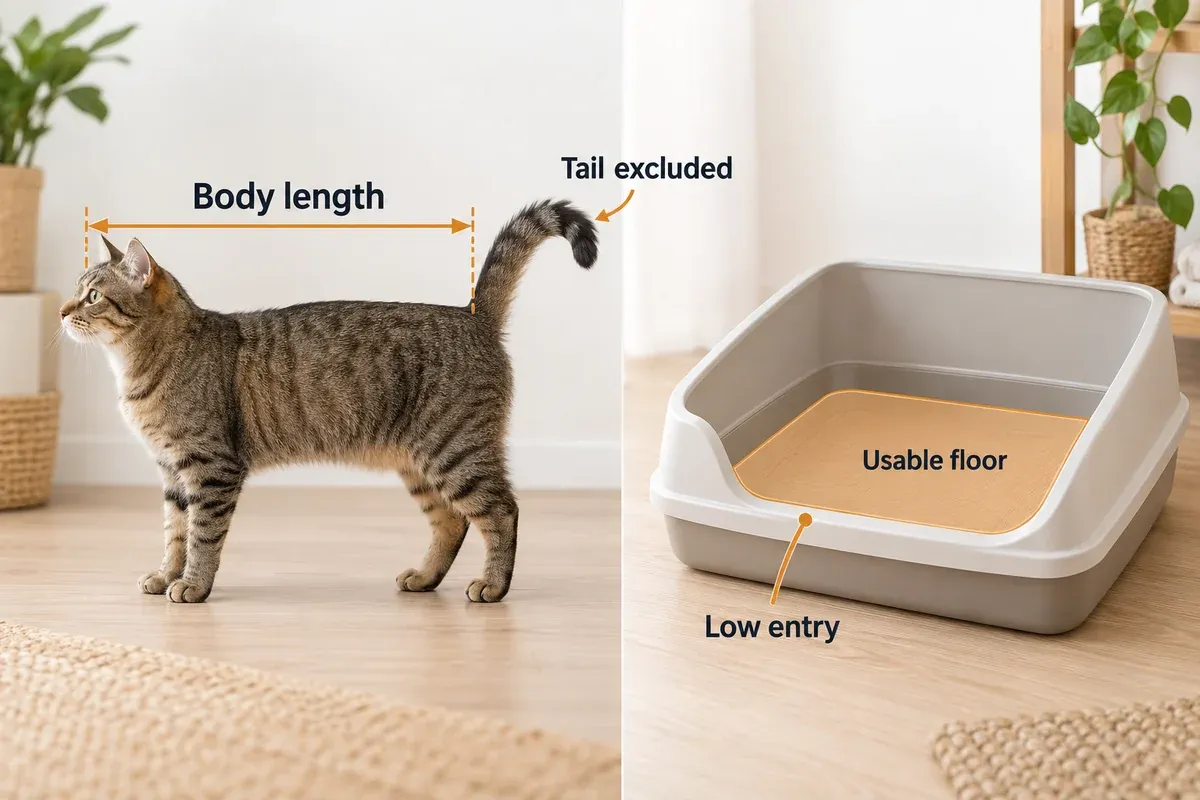
Measure along the back from the nose to the base of the tail. Do not include the tail. A flexible tape measure works well if your cat will stand still; otherwise, measure a relaxed stretch against a ruler or use the breed preset as a temporary starting point.
Breed is useful for spotting an undersized box before you buy, but it is not a substitute for the individual measurement. Two cats of the same breed can have different body lengths, body shapes, mobility, and bathroom habits.
The diagram below separates your cat’s body length from the tail and shows the usable floor behind the box’s entrance.
What the Calculator Is Measuring
1. Usable length: the non-negotiable dimension
The cat needs enough length to enter, turn around, squat, and leave without pressing against a wall. The 1.5× rule is calculated from body length—not weight, shoulder height, or the outside length printed on the box.
For example, a 16-inch cat gets a 24-inch minimum usable length. A 20-inch Maine Coon gets a 30-inch minimum. If the box is only 22 inches long inside, a product page calling it “large” does not change that result.
The AAFP/ISFM guidance also discusses research in which adult cats preferred boxes around 34 × 15 inches (86 × 39 cm) over smaller options. That does not mean every kitten needs a 34-inch box today. It does mean that standard commercial boxes can be surprisingly small, especially for large cats or cats that avoid a cramped enclosure.
2. Usable width: room to turn, not just room to fit
Length gets most of the attention, but a narrow box can still force awkward positioning. The Ohio State Indoor Pet Initiative recommends a box that lets a cat stand and turn, and notes that many cats prefer a large, uncovered box. Preventive Vet’s litter-box guide gives a useful practical range of roughly 13–15 inches or more depending on the cat.
The calculator therefore uses a 15-inch width floor for adult planning and increases it for longer cats. Treat that as a screen: a cat that turns tightly, kicks litter everywhere, or consistently perches on the edge may need more width even if the number technically passes.
3. Entry height: the highest step your cat can comfortably use
The entry-height field is a constraint, not a suggestion to make the doorway as tall as possible. A senior cat with stiff joints may refuse a box that a younger cat enters easily. The AAHA guidance specifically cautions against edges that are too high for kittens and senior cats, and Cornell also recommends lower sides for cats with mobility problems.
Use the lowest practical front entry and preserve the larger floor behind it. If the box has a removable doorway, a cut-down front, or a low step, measure the actual step-in—not the height of the tallest back wall.
4. High urine position: containment without creating a barrier
Some cats squat close to the floor. Others stand higher, back up against a wall, or send urine over a low rim. The high-urine checkbox changes the recommendation toward a tall back and side wall with a lowered front entry. It does not diagnose spraying, urinary disease, or a behavior problem.
If the high urine position is new, or your cat strains, visits repeatedly, cries, produces only drops, or has blood in the urine, contact a veterinarian promptly. Cornell’s house-soiling guidance explains why medical causes should be considered before treating accidents as a training issue.
The calculator’s wall-height number is a practical planning target. There is no single wall height that works for every cat, and a tall front wall can make a box unusable for a senior cat. Think in terms of a low-cut front, high back, sealed corners, and enough outside protection for the wall behind the box.
5. Available floor space: compare the box to the room
The calculator adds a small allowance for box walls and approach clearance, then checks the footprint in either orientation. A result that fits only when the cat has to squeeze between the box and a door is not a real fit.
Measure the actual floor at the intended location, including:
- the depth and width of the box itself;
- the space needed for your cat to approach and turn at the entrance;
- clearance for lifting a hood or pulling out a pan;
- enough room to scoop without standing on top of the cat; and
- the route to the box if the cat is older, anxious, or easily blocked by another pet.
Choose the Box Type From Your Result
Use the result to choose a shape, then use product dimensions to check the fit. “Jumbo,” “large,” and “senior” are marketing labels; the usable interior and entrance are what your cat experiences.
| Calculator signal | Start with | Watch out for |
|---|---|---|
| Good mobility, no high-urine pattern | Large open-top tray | Short interior length hidden by a thick rim |
| Senior or mobility-limited | Large low-entry tray | A tall hood or a high front step |
| High urine position | High-sided open box with a low front, or a hooded box your cat accepts | A tall front wall that blocks entry |
| High urine plus senior mobility | High back and sides with a lowered front entry | Choosing between access and containment as if you can only have one |
| Small available footprint | Re-measure, relocate, or use a custom storage-bin style box | Buying a tiny box simply because it fits the corner |
| Cat avoids enclosed spaces | Open top with a privacy screen or high back | Assuming a hood will solve odor or avoidance |
Open extra-large trays
An open tray is the easiest default because the cat can see the room, enter from a low front, and use the full floor. It is also easier to measure and clean. A high-sided open tray can contain kicked litter and high urine while preserving visibility.
For a large cat, inspect the interior floor—not only the outside length. A wide rim, sloped wall, or rounded corner can remove several inches of usable space.
High-sided, low-entry boxes
This is usually the most useful compromise for a senior cat that also has a high urine position. The front edge stays low; the back and side walls rise higher. Some products are molded this way. Others can be paired with an external wall shield, washable mat, or a carefully cut storage bin.
Do not add a loose barrier that can tip into the box or trap the cat. The entrance must remain obvious and stable, and the cat must have a clear exit.
Low-entry senior trays
A senior tray is access-first. Its walls may be too low for a cat that urinates high, so it is not automatically the right choice just because the cat is old. Use a low-entry model with a larger floor, then add protection behind the box if needed.
If your cat is hesitant, place the low-entry box next to the old one rather than removing the familiar box on day one. A box that is perfect on paper still has to feel safe.
Covered or hooded boxes
A hood can help with privacy, litter scatter, and wall containment, but it reduces visibility and often makes the interior smaller than the outside footprint suggests. The Ohio State Indoor Pet Initiative notes that many cats prefer uncovered boxes, and Cornell similarly describes uncovered boxes as a common preference.
Choose a hood only if your cat already uses enclosed spaces comfortably or you have tested it with the cover removed first. Never use a top-entry design for a cat that cannot climb or step down easily.
DIY large-bin alternatives
If the calculator target is larger than the commercial options in your budget, a clean, food-safe storage bin or large mixing tray can provide more usable floor for less money. The opening must be wide, the plastic must be stable, the cut edge must be smooth and protected, and the cat must be able to enter without a high leap.
The same measurement rules still apply. A DIY box is not automatically safer; inspect for sharp edges, slippery surfaces, unstable sides, and corners that are difficult to scoop.
Linked Options That Match Common Results
-
KittyGoHere Senior Cat Litter Box, Large, Low Entrance
KittyGoHere
An open tray with a described 3-inch entrance and 24 × 20 × 5-inch dimensions. It prioritizes access, so the low walls are not a strong high-urine solution.
- 24 × 20 × 5 in described
- 3 in low entrance
- Open top
- described size
- 24 × 20 × 5 in
- Fit to screen
- Senior or mobility-limited cats
-
PetFusion BetterBox Non-Stick Large Litter Box
PetFusion
An ABS-plastic open box with a non-stick coating, high sides, and a low-entry design. Its described outside size is useful for screening, but the 22.6-inch length can miss a long cat's 1.5× target.
- 22.6 × 18.1 × 8 in described
- ABS plastic
- Non-stick coating
- described size
- 22.6 × 18.1 × 8 in
- Fit to screen
- Average-sized cats needing an open box
-
Pureness Giant High Sides Cat Litter Pan
Pureness
A polypropylene open pan with a described 21.25 × 17.63 × 9.25-inch outside size. It adds wall height without a hood, but its length may be limiting for large cats.
- 21.25 × 17.63 × 9.25 in described
- Open top
- Polypropylene
- described size
- 21.25 × 17.63 × 9.25 in
- Fit to screen
- Containment on a tighter budget
-
Nature's Miracle Hooded Flip Top Cat Litter Box
Nature's Miracle
A front-entry hooded box with a flip-top, charcoal filter, and non-stick surface. The described 25.13 × 19.13 × 11.75-inch outside size is a screening measure, not the usable interior.
- 25.13 × 19.13 × 11.75 in described
- Hooded front entry
- Charcoal filter
- described size
- 25.13 × 19.13 × 11.75 in
- Fit to screen
- Privacy and wall containment
-
Amazon Basics Cat Litter Box with Lid, 26 × 23 × 20 in
Amazon Basics
A large enclosed plastic box with a swinging door and a described 26 × 23 × 20-inch outside footprint. The footprint is generous, but the hood and door still need to suit the individual cat.
- 26 × 23 × 20 in described
- Enclosed design
- Swinging front door
- described size
- 26 × 23 × 20 in
- Fit to screen
- Covered-box households with floor space
Review the linked product page before purchasing.
1. KittyGoHere Senior Cat Litter Box: access-first
The trade-off is clear: five-inch walls are not a strong solution for a cat that urinates high. Choose it for mobility and access, then protect the wall behind the tray if necessary. Check whether the 24-inch described length gives your cat enough usable interior after the rim is excluded.
Check current price on Amazon →2. PetFusion BetterBox: open, high-sided, easier to clean
The PetFusion BetterBox is an open ABS-plastic box with a non-stick coating, high sides, and a low-entry design. The manufacturer also publishes those dimensions on its official BetterBox product page.
That 22.6-inch outside length is the important caveat. It can work for an average-sized cat whose calculated target is shorter, but it is unlikely to satisfy a 24-inch-or-longer usable target once the walls are accounted for. Treat it as an open-box candidate to measure, not as a safe choice for every cat described as large.
Check current price on Amazon →3. Pureness Giant High Sides: budget containment
The Pureness Giant High Sides pan is a simple open polypropylene tray with a described 21.25 × 17.63 × 9.25-inch outside size.
This is the budget choice when the main problem is litter scatter or urine reaching a low wall—not when the cat needs a genuinely long interior. It has no special low-entry front, so check the step-in carefully for seniors and cats with arthritis. A cat with a 24-inch length target may outgrow this box even though the product name says Giant.
Check current price on Amazon →4. Nature’s Miracle Hooded Flip Top: privacy and containment
The Nature’s Miracle Hooded Flip Top box combines a front entry, flip-top cleaning access, charcoal filter, and non-stick surface.
The hood can help contain mess, but it can also reduce usable interior and make the doorway feel restrictive. Measure the entrance and floor inside the hood, and use the cover only if your cat is comfortable entering an enclosed space. It is not an access-first option for a stiff senior cat.
Check current price on Amazon →5. Amazon Basics 26-inch enclosed box: large footprint, enclosed preference
This is the most spacious-looking enclosed option in this group, but the outside dimensions do not prove that the cat gets a 26-inch usable floor. The hood, doorway, pan shape, and litter depth all reduce the space inside. It is best reserved for a cat that already accepts covered boxes and has good mobility.
Check current price on Amazon →Setup Guide: Make the Dimensions Work
Measure the interior before you commit
Ask the manufacturer for interior dimensions when possible. If only outside dimensions are published, subtract the wall thickness, rounded corners, rim, and any sloped section before comparing the box with the calculator. For covered boxes, measure the floor inside the hood—not the lid’s longest outside edge.
The cat also needs room to approach. Do not push the entrance against a wall, behind a door, or into a narrow gap where another pet can block the exit.
Use the right number of boxes
The AAHA guidance and Cornell Feline Health Center both support the familiar starting point of one box per cat, plus one extra. Place them in separate, quiet locations rather than lining every box up in one room. A cat that dislikes a location may avoid all of the boxes if they are clustered together.
In a multi-level home, one box on each commonly used floor is often more practical than making a cat travel downstairs every time. Keep food and water away from the litter area, and provide a clear escape route.
Keep the entrance and route predictable
Senior cats benefit from a level, non-slip approach and a low front edge. A small stable step can help with a tall-sided box, but never use a step to justify a doorway the cat still cannot safely cross. Watch the cat enter and leave rather than assuming that a product marketed for seniors is accessible.
For an anxious cat, an open box with visibility may be more usable than a private hood. Do not place the box next to a loud washer, a furnace, or a door that can swing into the cat’s back while it is inside.
Contain high urine without shrinking the floor
Start with a high back and side walls, a lowered front, and a washable wall shield behind the box. A large mat can catch scatter, but it should not create a slippery step or reduce the entrance. Our cat litter tracking guide covers mat placement and the test sequence in more detail. Clean the wall and floor around the box as well as the pan; residual odor can make a cat avoid the area.
If urine consistently lands outside the box, record the posture and location. Tail-up marking on a vertical surface is different from a cat that cannot comfortably squat, turn, or reach the box. New or worsening accidents deserve a veterinary conversation before you keep changing box styles.
Introduce a new box gradually
Place the new box beside the familiar one for several days. Use the same litter at first, keep the depth consistent, and scoop both boxes frequently. Once the cat reliably uses the new box, move it only a few inches at a time if the final location is different.
Many cats prefer an unscented, clean box. Scoop at least daily, remove waste promptly, and wash the pan with a mild product that does not leave a strong fragrance. Avoid punishing accidents; it increases stress without making the box easier to use.
When a Bigger Box Is Not the Whole Answer
It cannot treat bladder pain, constipation, arthritis, kidney disease, diabetes, or stress. A cat that suddenly stops using a previously accepted box should be evaluated instead of being repeatedly moved from one product to another.
Seek prompt veterinary advice for straining, repeated trips, vocalizing during urination, blood, genital licking, or a sudden change in urine volume. Little or no urine with repeated straining is an emergency, especially in a male cat. Keep the box easy to reach while you arrange care, and do not restrict water.
Frequently Asked Questions
Does the 1.5× rule include my cat’s tail?
No. This calculator measures from the nose to the base of the tail and then multiplies that body length by 1.5. The tail is not included. If your cat is unusually long, broad, or reluctant to turn, choose the larger result after watching the cat use the box.
What is a good litter box size for an average adult cat?
For a 16-inch body length, the calculator starts at 24 inches of usable length and 15 inches of usable width, before allowing for walls and approach space. Many commercial boxes list a similar outside size but provide less interior floor. Measure the inside and size up if your cat touches the walls or perches on the rim.
Does a Maine Coon need a special litter box?
It needs a box that meets its measured target. A Maine Coon often has a longer body than an average domestic shorthair, so the 1.5× calculation may lead to a 30-inch-or-longer usable length. Large open trays, custom bins, and high-sided low-entry designs are often easier to fit than compact covered boxes.
How do I combine high sides with a low entry for a senior cat?
Look for a box with a lowered front and taller back and side walls. If the product is a simple tall pan, a stable cut-down entrance or a safe external splash shield may be better than asking the cat to climb over the full rim. Keep the floor non-slip and observe the cat’s exit as well as the entry.
Are covered litter boxes better for odor?
Not automatically. A hood can contain some scatter and reduce visual exposure, but it can also trap odor inside and make the box feel cramped. Frequent scooping, adequate ventilation, and a box your cat willingly enters matter more than the presence of a lid. If your cat prefers open boxes, use high sides or a wall shield instead.
What wall height is best for a cat that urinates high?
There is no universal number. Use the calculator’s wall target as a screening point, then prioritize a tall back and sides with a low front entrance. If the cat’s posture has changed recently, treat that as a possible health or mobility signal—not only a containment problem.
What if I do not have enough space for the calculated box?
Re-measure the space, try the box rotated in the other direction, and look for a safer location before accepting a smaller interior. A large storage-bin style box can sometimes provide more floor in the same budget, but it still needs a smooth opening, stable walls, and a safe entry. Do not trade away turning room just to keep the box in a convenient corner.
How many litter boxes should I have?
Start with one box per cat plus one extra, then spread them across quiet, accessible areas. A large box in one hidden room is not equivalent to multiple usable boxes if a cat is afraid to cross the house or another pet guards the route.
Bottom Line
Measure your cat, not the marketing label. Use 1.5× nose-to-tail-base body length as the floor-length starting point, aim for enough width to turn, keep the front entry low enough for the individual cat, and add taller back and side walls only when they do not become a barrier.
Then compare the actual usable interior and doorway with your floor space. For a senior cat, access comes first. For high urine, use a high-sided low-entry design. For a long-bodied cat, prioritize length over a hood, a scoop compartment, or a small footprint. The box your cat can comfortably enter, turn in, and leave is the right size—even when its packaging calls it something else.