
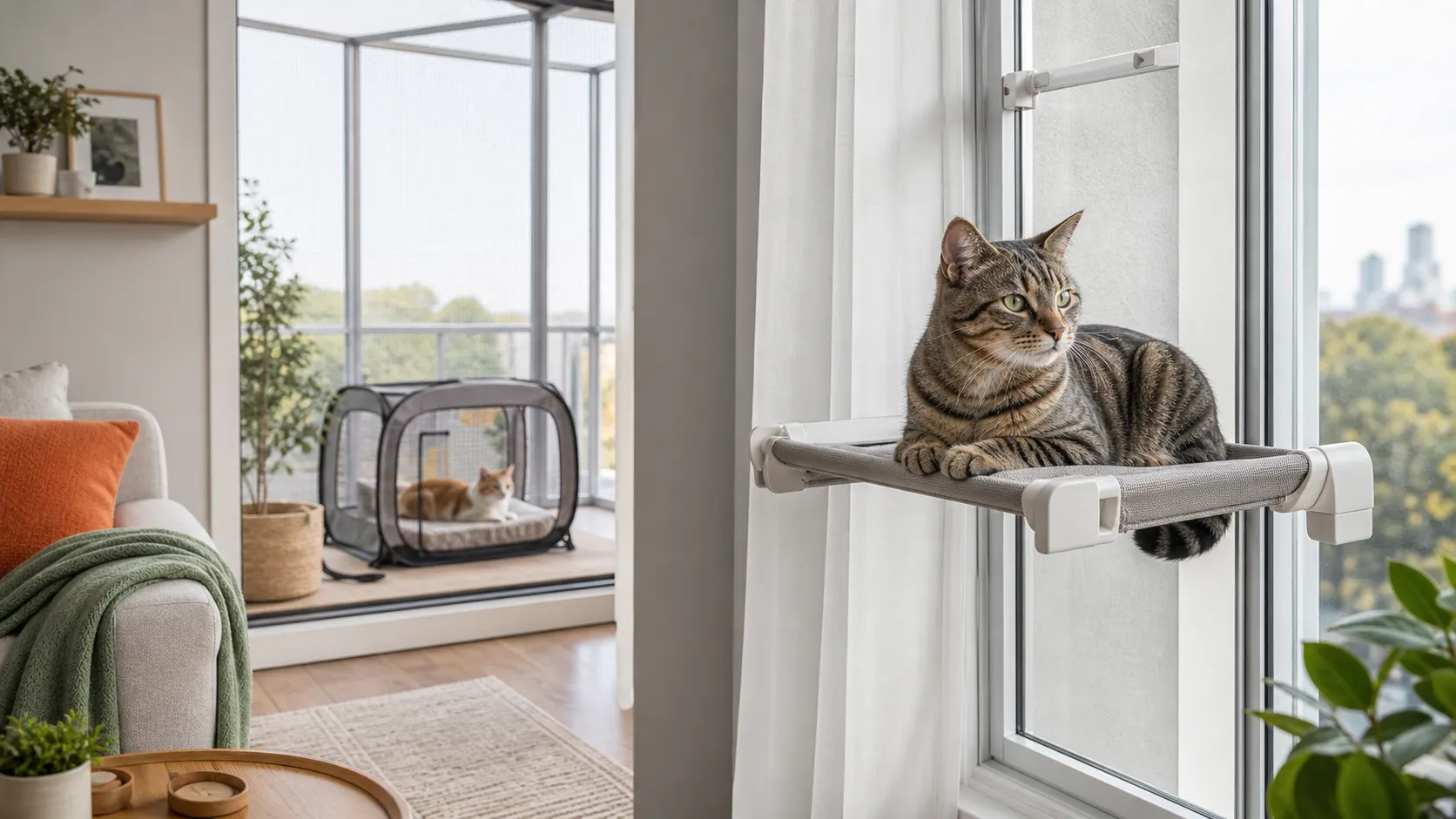

 Published sources
 Product details checked
If you rent, the best catio is not automatically the biggest one. It is the setup that gives your cat fresh air and safe enrichment without damaging the property, blocking an emergency exit, or turning a balcony railing into an untested fall barrier.
Quick answer: For a compatible 26–32-inch vertical window, the VistaGato Signature Window Catio is the clearest true no-drill option. If your window needs a cat door, a removable Cat Flap Fever insert can create the indoor connection, but it still needs a separate, fully enclosed outdoor space. For a balcony, use a complete freestanding enclosure only when the balcony itself is permitted and every open side—including the top—is protected. A lightweight tent or modular mesh kit is not a substitute for balcony fall protection.
This guide focuses on the living situation rather than repeating a general product roundup.
Start with the space you are actually allowed to change
Before measuring a product, identify the boundary between your private living space and the building’s safety system. A window insert that sits inside the frame is a different risk from a balcony net that spans several stories. “Removable” describes how a product comes out; it does not automatically make the installation safe, approved, or suitable for your cat.
Ask the landlord or property manager in writing about:
- drilling, screws, anchors, adhesive mounts, tension poles, and exterior hardware;
- balcony netting, panels, privacy screens, and anything visible from outside;
- window inserts that change how far a window opens or how it closes;
- fire-escape access, maintenance access, sprinklers, and egress requirements;
- weight on the balcony, railing, sill, or exterior wall;
- whether the building has rules for pets on balconies or in shared outdoor areas.
Keep the approval, measurements, and a few before-and-after photos. That makes move-out easier and forces you to solve the right problem before money is spent.
The renter setup matrix
| Your housing situation | Most sensible starting point | What it solves | What it does not solve |
|---|---|---|---|
| Vertical window, no balcony | No-tool window catio/perch | Fresh air, sun, smells, and a secure perch | It is not a full outdoor room or a second escape barrier |
| Window beside a safe patio or enclosed catio | Removable window insert plus separate enclosure | Controlled indoor-to-outdoor access | The insert alone does not enclose a balcony or yard |
| Open balcony in a rental | Permission first, then a full enclosure or professional non-invasive system | Prevents climbing, slipping, and gaps when properly designed | A small tent inside the balcony does not protect the surrounding balcony |
| Ground-floor patio or screened porch | Portable enclosed catio | Flexible, reversible outdoor sessions | Lightweight fabric can move, tear, or become unsafe in wind |
| No approved outdoor area | Indoor window enrichment, harness training, or a screened room | Outdoor sights and stimulation without property risk | It will not create unsupervised outdoor access |
Humane World describes catios ranging from a simple window box to a roofed room, and specifically tells renters to check with the landlord or management company. That is the useful distinction here: a window box can be a complete small catio, while a window insert is only the doorway into another enclosure.
Window catios: the cleanest no-drill route
Best fit: a vertical window-mounted perch
The VistaGato Signature Window Catio is designed for a narrower problem than a general catio kit: giving an indoor cat an enclosed place at the window without tools or wall damage.
That makes it the strongest match for a renter with the right window. It is compact, reversible, and does not ask you to build a structure against the building. It is also easy to misunderstand: it is a window perch/enclosure, not a full-height balcony guard, not a way to seal an entire window opening, and not permission to leave a cat in an exposed window during extreme heat or cold.
Measure before ordering: confirm the clear vertical opening, sill depth, frame shape, how the window locks, and whether the installed unit still allows the window to close as intended. Check the described weight against the combined weight of your cat, bedding, and any accessories. For two cats, do not assume that a described 50-pound capacity means the perch will be comfortable or stable for simultaneous use.
Check current price on Amazon →Best if you need a cat door: a removable window insert
A window insert is useful when the cat needs to move between the room and a separate catio. Use the linked product page to confirm the insert dimensions and mounting requirements.
The key advantage is not the flap alone. It is the combination of a measured insert, a sealed window edge, and a separate enclosure that keeps the cat from reaching an unprotected ledge or balcony. The key drawback is that custom measuring matters: a small gap can become an escape route, and a window that no longer closes tightly can create drafts, rain entry, or a security problem.
Treat the insert as an access component, not as the outdoor safety system. Decide how the flap will be locked when you are away, whether the microchip function is needed, and how you will remove and store the panel when you move.
Check current price on Amazon →Window products that are not automatically renter-friendly
Many attractive wood or metal window boxes are designed to be screwed into a wall, sill, or exterior trim. They can be excellent products for a homeowner and still be the wrong product for a lease. If product information says “wall mount,” “undersill brackets,” or “anchor to the siding,” treat that as an installation requirement—not a minor optional extra.
An ordinary insect screen is also not a catio. ASPCA warns that unscreened windows can cause serious falls and recommends snug, sturdy screens; it also cautions that childproof window guards are not reliable pet protection because cats can slip through them. A cat pressing against a screen, latch, or loose adjustable panel is a real load test, even when the product was never marketed as one.
Balcony setups: secure the balcony before placing a catio on it
An enclosure sitting inside an open balcony does not automatically make the balcony safe. A cat can leave the tent, climb the railing, squeeze behind furniture, or reach a gap above the enclosure. Catit’s guidance is appropriately strict: a safe balcony barrier needs to run from floor to ceiling, use suitable weather- and UV-resistant material, remain taut, and have no gaps. If there is no balcony above, the top also needs protection because cats climb.
That creates two different use cases:
- A truly enclosed balcony: a portable catio can be used as a comfortable inner room, especially for supervised sessions. The balcony’s own netting, glazing, or approved enclosure remains the fall-protection layer.
- An open or high-rise balcony: do not use a small fabric catio as the only barrier. You need landlord approval and a complete, properly secured enclosure designed for that building. If you cannot create that safely, keep the cat indoors.
Portable balcony or patio option: Rywell foldable catio
The Rywell Extra Large Foldable Catio is a practical renter product when “portable” means a cat can use it inside a safe, level, already-enclosed area. Product documentation describes a three-tier foldable tent with a steel frame, 300D Oxford fabric mesh, five openings, a weather-resistant roof cover, and a carry bag.
Its strengths are storage and flexibility: it can move between an indoor room, a ground-level patio, and a screened balcony without drilling. Its weaknesses are exactly what make it unsuitable as balcony fall protection: it is lightweight, can feel bouncy, needs careful inspection, and is not a permanent structure. In a rental, use a non-slip base rather than improvised exterior anchors, keep the unit fully inside the approved enclosure, and supervise the first sessions. Do not tie it to a railing and assume the railing has become a safe catio wall.
Check current price on Amazon →Roll-away ground-level option: Aivituvin on wheels
The Aivituvin Mobile Cat Catio is a better fit for a ground-level patio, sheltered porch, or a fully enclosed balcony with enough floor area. The current product details list a 24.5 x 23.4 x 62.8-inch fir-wood unit with an asphalt roof, three tiers, four swivel wheels, and two brake casters.
The wheels make seasonal storage easier, but this is still a wooden assembled structure. It needs assembly, a level base, brake engagement, and an honest check that the cat can use the doors without the unit rolling. It is not a no-drill window connection simply because the product documentation mentions a window attachment option. Do not place it where a cat could step from the roof or a shelf to an unprotected balcony edge.
Check current price on Amazon →Lowest-cost modular trial: Kitty City
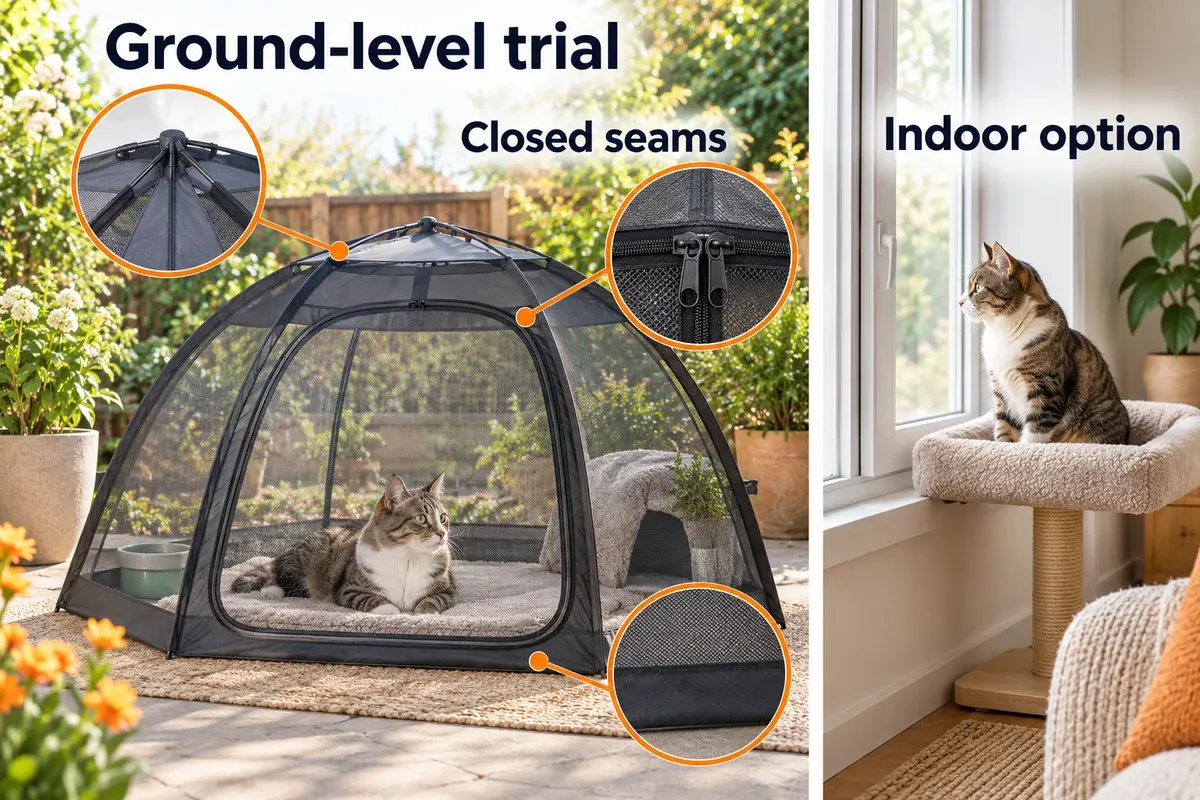
That is useful value for a supervised ground-level patio, a screened porch, or a temporary indoor trial. It is not a structural balcony barrier. Inspect seams, zippers, connectors, and the base each time, and bring it in for wind, heavy rain, predators, or any situation where you cannot supervise. If a cat can reach the outside of the balcony from inside the kit, the kit is in the wrong location.
Check current price on Amazon →The examples below pair a fully closed ground-level enclosure with an indoor perch, depending on which safe space is available.
What “no-drill” should—and should not—promise
No-drill is an installation method, not a safety rating. Use this hierarchy when comparing setups:
| Setup method | Good use | Main limit |
|---|---|---|
| Manufacturer-designed window clamp or insert | A measured window with a known fit and controlled opening | It protects only the window zone; verify locks, load, and gaps |
| Removable insert plus a separate catio | Indoor-to-outdoor access in a ground-level or already enclosed area | Two components mean two sets of seams, latches, and measurements |
| Freestanding frame inside an approved enclosure | Patio, screened porch, or fully enclosed balcony | It must remain stable and cannot be the balcony’s only fall barrier |
| Tension poles or removable panels | Closing a documented gap when the system is rated and regularly inspected | Tension can change; do not assume an improvised fit is load-rated |
| Adhesive hooks, suction cups, or ordinary screens | Light shade, visual blocking, or temporary enrichment | Not a dependable cat barrier, especially on an elevated balcony |
The most common mistake is to hear “no permanent changes” and skip the structural question. A removable system can still fail if a cat jumps onto it, pushes a seam, climbs above it, or opens a gap. Catit recommends regular checks even for renter-friendly systems; Humane World likewise emphasizes a sturdy frame, firmly attached components, ventilation, shade, and no openings—including overhead ones.
A safer setup checklist
Use this checklist before the first outdoor session:
- Permission: You have written approval for the exact window, balcony, panels, and installation method.
- Fit: You measured the clear opening rather than relying on a nominal window size.
- Egress: The setup does not block a fire escape, emergency window, maintenance route, door, sprinkler, or required ventilation.
- Load: The window sill, floor, brackets, and product are rated for the combined cat and accessory weight.
- Containment: The cat cannot reach an unprotected ledge, roof edge, railing, gap, or open window from inside the setup.
- Top edge: The enclosure is closed above. Cats climb, and a side barrier that stops below the ceiling is not complete containment.
- Mesh and seams: Openings are small enough for your cat, with no loose corners, frayed edges, damaged zippers, or collar-snag points.
- Weather: There is shade, ventilation, water, and an indoor retreat. Do not use a fabric enclosure in high wind, severe heat, heavy rain, or freezing conditions.
- Stability: Wheels are locked, the base is level, and a portable unit cannot slide or tip when the cat jumps.
- Introduction: You watched the first sessions, checked every latch afterward, and never left a new setup unattended until it has passed repeated inspections.
Humane World recommends supervising cats while they enjoy a catio and providing water, shade, ventilation, and a place to retreat. The goal is safe enrichment—not forcing a cat to stay outdoors because an enclosure exists.
Three renter plans that work in practice
Plan A: Window-only enrichment
Choose the VistaGato if your vertical window fits. Add a washable mat, a low-profile perch, and shade that cannot become a climb-out route. Keep the window opening and lock accessible, and use the catio for supervised fresh-air time rather than treating it as a permanent outdoor room.
Plan B: Window-to-enclosure access
Use a custom Cat Flap Fever insert only after you have a fully enclosed destination. The insert gives the cat a controlled doorway; the exterior catio supplies the actual containment. This is the most flexible route for a ground-level patio or a screened porch, but it requires the most measurement and inspection.
Plan C: No window modification
Use a Rywell or Kitty City unit for supervised sessions in a safe room first, then move it to a ground-level patio or an already enclosed balcony. This tests your cat’s comfort and your maintenance routine without committing to a window alteration. For a high-rise balcony that is not completely protected, stop at the indoor trial.
If your lease or building rules do not allow any safe outdoor setup, indoor enrichment is the correct answer—not a workaround made from an insect screen and adhesive hooks. A window perch, bird-viewing station, harness training, puzzle feeders, and short play sessions can provide the stimulation without creating an unapproved fall risk.
For an active cat that enjoys training, a correctly sized indoor exercise wheel can provide another voluntary activity. Use the cat exercise wheel size calculator to compare the inside running circle, usable track and full floor-space requirements before choosing one. Keep climbing, resting and interactive play available alongside it.
Frequently Asked Questions
Can I install a catio in a rental apartment?
Sometimes. A no-tool window unit or removable insert may be permitted, but you still need to check the lease, window rules, building policy, and emergency egress. A balcony setup needs separate permission because it changes an exterior-facing area and may affect building safety.
Is a no-drill catio safe on a high-rise balcony?
Not by itself. “No-drill” does not prove that a product can resist a jump, wind load, or a fall. A high-rise balcony needs a complete, approved barrier with no gaps and overhead protection where required. A portable tent inside an open balcony is not enough.
Are tension rods safe for cats?
They can close a gap in a properly designed, rated system, but a tension rod is not automatically a fall barrier. Check the manufacturer’s load and installation requirements, inspect it regularly, and never rely on an improvised rod-and-net combination as the only protection on an elevated balcony.
Can I connect a window insert directly to a portable catio?
Only if both products are designed to work together or you can create a sealed, stable connection without reducing window security. Do not improvise a tunnel through a gap, leave the window partly open without a secure barrier, or assume a flap locks the exterior space.
Is the Rywell catio suitable for a balcony?
It can be suitable inside a fully enclosed, level, sheltered balcony for supervised use. It should not be tied to a railing or used as the only protection on an open or high-rise balcony. Its fabric frame and portability are benefits for storage, not evidence of structural fall protection.
Do I need a cat door?
No. A catio can be used with a person opening the door for supervised sessions. A cat door becomes useful when the window connection is measured, lockable, and leads into a genuinely enclosed space. A microchip lock can control which cats use the opening, but it cannot correct a gap or an unsafe balcony.
What should I do if the landlord says no?
Do not install it secretly. Ask whether a removable interior window perch, a ground-level portable enclosure used during supervised sessions, or a screened-room setup is allowed. If no safe option is approved, build the outdoor experience indoors with views, climbing, play, and harness training.
Final verdict
- Best true no-drill window option: VistaGato Signature, if your vertical window measures within the described 26–32-inch range and the installation does not interfere with the lock or egress.
- Best window-to-catio bridge: Cat Flap Fever’s custom insert, paired with a separate fully enclosed and permitted outdoor space.
- Best portable renter setup: Rywell for a safe ground-level patio or already enclosed balcony—not for an open railing.
- Best roll-away structure: Aivituvin on wheels for a level, ground-level or fully enclosed area where its brakes and footprint work.
- Best low-cost trial: Kitty City for supervised, contained outdoor enrichment when you need a soft-sided modular starter.
The right renter catio is the smallest setup that fully solves your cat’s containment problem within the rules of the property. For a broader comparison of enclosure formats, see our best outdoor cat enclosures and catios guide. For materials and budget planning, use the catio cost breakdown; for the access hardware itself, see the microchip cat flap guide.
Sources and further reading
- Humane World for Animals: Catios—Safe Outdoor Enclosures for Cats — enclosure types, permission, materials, roof, ventilation, shade, escape-proofing, and supervision.
- ASPCA: High-Rise Syndrome—Lifesaving Tips for Cat Parents — window and fall-safety warnings, including why loose screens and childproof guards are not enough.
- Catit: How to Cat-Proof Your Balcony — full-height coverage, overhead protection, small gaps, weather resistance, and renter considerations.
- VistaGato: VistaCatio — window fit, dimensions, capacity, materials, and manufacturer installation claims.
- Cat Flap Fever: 1/4-inch Plexiglass Cat Door Window Insert — custom sizing, removable installation, weatherstripping, and product reviews.
- BC SPCA: DIY Stand-Alone Catio Plan — a useful reference for renters who later move to a permitted ground-level home with space for a sturdier build.