

 Published sources
 Product details checked
Finding vomit on the floor is unsettling, especially when you do not know whether it was a one-off stomach upset or a sign of something more serious. Cats can vomit after eating too quickly, swallowing hair, or getting into something they should not. They can also vomit because of parasites, an intestinal blockage, pancreatitis, kidney disease, hyperthyroidism, or other medical problems.
Quick answer: A single episode in an otherwise bright, comfortable adult cat may pass without treatment, but repeated vomiting should not be written off as “just a hairball.” Call your veterinarian the same day if your cat vomits more than twice in 24 hours, cannot keep water down, seems painful or unusually quiet, has blood in the vomit, or may have swallowed a foreign object or toxin. Vomiting more than once a week also deserves a veterinary conversation, even if your cat seems normal between episodes.
This guide explains what you can observe at home, what is safe to do while you arrange advice, and which feeding tools may help only when fast eating is part of the pattern. It is educational information, not a diagnosis or a substitute for an examination.
Urgent reminder: If your cat is weak, collapsed, having trouble breathing, showing a painful or swollen abdomen, repeatedly retching without producing anything, or may have eaten medication, lilies, antifreeze, string, or another toxin, contact an emergency veterinarian now. Do not induce vomiting or give human medication unless a veterinary professional specifically tells you to.
First, identify what you are seeing
Owners often call every episode “vomiting,” but the distinction between vomiting, regurgitation, and coughing gives your veterinarian useful information. If possible, take a short video rather than relying on memory.
| What you see | Typical pattern | Why it matters |
|---|---|---|
| Vomiting | Nausea signs such as lip licking, drooling, repeated swallowing, retching, and active abdominal contractions before food or fluid comes up | The stomach or upper intestine may be involved, but the cause can be dietary, infectious, toxic, obstructive, or systemic |
| Regurgitation | Food comes up passively, often soon after eating; it is usually undigested and may be tube-shaped | Fast eating, esophageal disease, or swallowing problems can look like “vomiting” but need a different work-up |
| Coughing | Hacking or wheezing with the neck extended; little or nothing may be produced | Respiratory disease can be mistaken for a hairball or vomiting episode |
| Hairball | A damp, compact bundle of hair may be expelled, sometimes with bile or foam | An occasional hairball can happen, but frequent hairballs or unproductive retching still need veterinary advice |
The episode’s timing also matters. Note whether it happened immediately after eating, several hours later, after drinking, during grooming, or after access to a plant, medication, human food, or a toy.
When vomiting is an emergency
Do not wait for a home remedy to work if any of these apply:
- Repeated episodes: more than two bouts in 24 hours, vomiting several days in a row, or vomiting that is becoming more frequent.
- Blood or abnormal material: bright-red blood, dark material that resembles coffee grounds, or pieces of a foreign object.
- Dehydration or inability to keep water down: dry or sticky gums, marked weakness, sunken-looking eyes, or repeated vomiting after drinking.
- Pain or a possible blockage: a tense or swollen abdomen, crying when handled, repeated unproductive retching, severe constipation, or a cat that may have swallowed string, yarn, ribbon, a rubber band, or a small toy. Never pull a visible string from the mouth or anus.
- Systemic illness: collapse, difficulty standing, breathing trouble, fever, severe lethargy, rapid weight loss, or refusal to eat.
- Higher-risk patient: a kitten, senior cat, pregnant cat, or cat with kidney disease, diabetes, heart disease, or another diagnosed condition.
- Possible poisoning: medications, lilies, antifreeze, rodenticide, cleaning products, essential oils, chocolate, onions, or another substance that may be toxic to cats.
If poisoning is possible in the United States, call your veterinarian or the ASPCA Animal Poison Control Center at (888) 426-4435. Keep the packaging or a photo of the substance and, if safe, note what was vomited. Do not wait for symptoms to worsen: some toxins have delayed effects.
Common reasons cats vomit
Vomiting is a symptom, not a diagnosis. The same-looking mess can come from a mild dietary problem or a serious disease, so the pattern and your cat’s overall behavior matter more than the color alone.
Eating too fast or too much
Some cats inhale dry food, eat a large meal after missing one, or compete with another cat. They may bring up mostly undigested food shortly after eating. In these cases, splitting the daily ration into smaller meals and making the food take longer to reach can help—but only after your veterinarian is comfortable that there are no red flags.
Sudden food changes or dietary indiscretion
New food, rich treats, table scraps, spoiled food, plants, insects, or access to another pet’s bowl can upset the gastrointestinal tract. Change diets gradually unless your veterinarian has given you a different plan. Keep a note of every food, treat, supplement, and flavored medication your cat receives.
Hair and grooming
Cats swallow hair while grooming, and an occasional hairball can be uneventful. Frequent hairballs, repeated dry heaving, constipation, appetite loss, or vomiting without producing a hairball are not problems to solve with a laxative on your own. Ask your veterinarian whether skin disease, over-grooming, constipation, or another condition is contributing.
Parasites, infection, or inflammation
Intestinal parasites and gastrointestinal infections can cause vomiting, diarrhea, poor appetite, weight loss, or a dull coat. Inflammatory bowel disease and food reactions can also cause recurring signs. A fecal exam and other testing may be needed; guessing at a dewormer or switching foods repeatedly can make the pattern harder to interpret.
Constipation or an intestinal obstruction
A cat that is vomiting and not passing normal stool, straining in the litter box, hiding, or showing abdominal pain needs prompt veterinary assessment. Foreign material such as thread, ribbon, plastic, or a toy can obstruct the digestive tract. A slow-feeder bowl cannot make an obstruction safe.
Medical disease
Recurring vomiting can accompany pancreatitis, kidney or liver disease, diabetes, hyperthyroidism, inflammatory bowel disease, cancer, and other conditions. Cats often hide illness, so a cat that appears “mostly fine” can still need bloodwork, a fecal test, urine testing, X-rays, ultrasound, or other diagnostics.
Medication, toxin, or household exposure
Human pain relievers, some plants, chemicals, essential oils, and antifreeze are dangerous to cats. Store medications and chemicals behind closed doors, keep lilies out of the home, and check that toys do not shed strings or small pieces. If exposure is possible, call a veterinary professional before offering food, milk, oil, or any home treatment.
What to do after one mild episode
If your adult cat vomited once, is alert and comfortable, is breathing normally, and has no known toxin or foreign-object exposure, focus on observation rather than a cupboard full of remedies.
- Remove access to the suspected trigger. Put away new treats, plants, string toys, human food, and anything spilled on the floor.
- Keep fresh water available. Do not force water into the mouth. If every drink triggers more vomiting, call your veterinarian promptly.
- Avoid a large replacement meal. Once your cat has settled, ask your veterinarian how to restart food. A small amount of the usual diet or a veterinary-recommended easily digestible diet may be appropriate; do not improvise a long-term diet from internet recipes.
- Keep the environment quiet. Stress and activity can make nausea harder to assess, and a quiet room makes it easier to notice new symptoms.
- Record the details. Write down the time, food, amount, appearance, retching, stool, urination, behavior, and anything unusual your cat could have reached.
Do not give Pepto-Bismol, ibuprofen, acetaminophen, aspirin, antacids, essential oils, or another human product without veterinary instructions. “Natural” does not mean safe for cats, and some products can worsen the problem or hide important symptoms.
If your cat vomits after meals
Feeding changes are useful for a narrow situation: a cat that is otherwise well and repeatedly eats too quickly or receives portions that are too large. They are not a substitute for a veterinary work-up when vomiting is frequent, new, or accompanied by other signs.
Try one change at a time so you can tell what helped:
- Measure the daily ration. Divide the total amount recommended for your cat into smaller meals instead of simply adding extra feedings.
- Slow access to dry food. A simple puzzle or slow-feeder bowl can reduce gulping. Start with an easy pattern; a frustrated cat may eat even faster or stop eating.
- Separate cats during meals. Competition can make a cat swallow quickly. Feed in separate rooms or use a calm, predictable routine.
- Keep the diet stable. Avoid switching foods, treats, and supplements at the same time. A food change should be gradual unless your veterinarian says otherwise.
- Watch the clock. Note whether the episode happens immediately after eating or hours later. Immediate, undigested food may be regurgitation rather than vomiting.
- Stop if the tool creates stress. A feeder that is difficult to clean, traps food, or makes your cat skip meals is not a good fit.
Two practical feeding tools
These products are optional tools for meal pacing and portion routines—not anti-vomiting treatments.
Tools that may help with fast eating
-
Outward Hound Fun Feeder Slo Bowl – Small
Outward Hound
Small 3/4-cup slow-feeder bowl with a wave pattern and non-slip base. It makes dry-food pieces harder to eat in one fast mouthful without adding electronics or a complicated setup.
- 3/4-cup capacity for small meals
- Wave pattern slows access to kibble
- Non-slip base
- Best for
- Cats that gulp dry food and need an inexpensive slow-feeding trial
- Why it may help
- Small 3/4-cup slow-feeder bowl with a wave pattern and non-slip base. It makes dry-food pieces harder to eat in one fast mouthful without adding electronics or a complicated setup.
-
PETLIBRO Granary 5L WiFi Automatic Cat Feeder
PETLIBRO
A 5L dry-food dispenser with WiFi, freshness preservation, a low-food sensor, and scheduling for up to 10 meals per day. Smaller scheduled portions can help test whether fast or irregular eating is contributing to episodes.
- 5L food capacity
- Up to 10 scheduled meals per day
- 5G WiFi and app control as described in product documentation
- Best for
- Owners who need scheduled, measured dry-food meals and want app-connected monitoring
- Why it may help
- A 5L dry-food dispenser with WiFi, freshness preservation, a low-food sensor, and scheduling for up to 10 meals per day. Smaller scheduled portions can help test whether fast or irregular eating is contributing to episodes.
Review the linked product page before purchasing.
Outward Hound Fun Feeder Slo Bowl — simple and inexpensive
Check current price on Amazon →The small 3/4-cup version is a sensible first experiment when your cat gulps dry food. Its wave pattern adds a little work to each bite, and the non-slip design avoids the distraction of a motor or app.
Use it with a measured portion, not a constantly topped-up bowl. Give your cat a few supervised meals to see whether they eat calmly, finish enough food, and show less immediate post-meal regurgitation. If the pattern makes your cat paw frantically, skip meals, or become distressed, return to a plain bowl and ask your veterinarian about another approach.
PETLIBRO Granary 5L WiFi — scheduled dry-food portions
Check current price on Amazon →The PETLIBRO Granary is the more involved option for owners who need predictable timing. Product documentation describes a 5L dry-food dispenser with WiFi/app control, freshness preservation, a low-food sensor, and up to 10 meals per day.
It can make a daily ration easier to divide into several smaller meals, but do not assume the programmed volume equals the calories your cat needs. Weigh or measure a test portion, confirm the schedule with your veterinarian if your cat has a medical diet, and keep a backup feeding plan for power or WiFi problems. This model is for dry food; it is not a safe way to leave wet food out all day.
What your veterinarian may check
Bring a video and a written log if you can. Your veterinarian will usually want to know:
- how often the episodes occur and whether they follow food or water;
- what the material looked like and whether it contained hair, blood, or a foreign object;
- appetite, thirst, weight, stool, urination, energy, and abdominal comfort;
- every food, treat, supplement, medication, plant, and possible household exposure;
- whether other pets are sick or share the same food and environment.
Depending on the history and examination, testing may include bloodwork, fecal testing, urine testing, abdominal X-rays, or ultrasound. Chronic or severe cases may need more advanced evaluation. Treatment depends on the cause: fluids for dehydration, prescription medication for nausea or inflammation, parasite treatment, dietary therapy, or surgery when an obstruction is found.
What not to do
Some well-meant responses can make a vomiting cat less safe:
- Do not induce vomiting at home. Hydrogen peroxide and other internet remedies can injure cats or make some poisons more dangerous.
- Do not pull string or ribbon. A linear foreign body can be anchored inside the digestive tract.
- Do not give human medication. Cats process common human drugs differently, and some are toxic at small doses.
- Do not keep changing food every few hours. It can add dietary upset and erase useful clues.
- Do not assume a hairball explains everything. Repeated retching, weight loss, or vomiting without a hairball deserves an examination.
- Do not use a feeder to postpone care. A product can slow a meal; it cannot rule out obstruction, pancreatitis, kidney disease, poisoning, or other illness.
A simple vomiting log for the next appointment
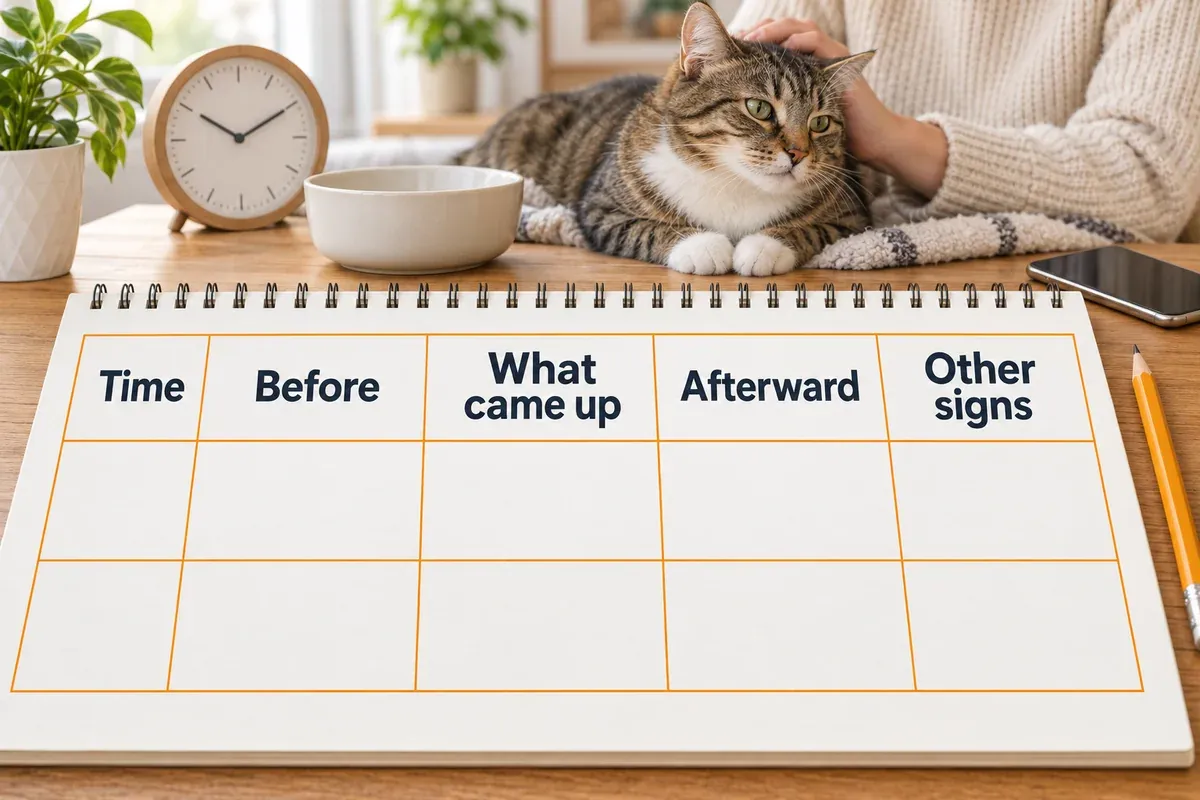
Use one line per episode:
| Time | Before the episode | What came up | Afterward | Other signs |
|---|---|---|---|---|
| 7:30 a.m. | Ate dry food quickly | Undigested kibble | Alert, wanted food | No diarrhea |
Also record the day’s food amount, water intake if you can estimate it, medications, litter-box output, and body weight if you have a reliable scale. A clear pattern is often more useful than a guess about the color of the vomit.
Frequently Asked Questions
How often is vomiting normal for a cat?
There is no universal “normal” frequency. An occasional episode in a healthy cat may be minor, but Cornell Feline Health Center advises prompt veterinary evaluation when vomiting happens more than once a week or when it comes with lethargy, weakness, reduced appetite, blood, diarrhea, or changes in thirst or urination. A cat vomiting every day should be assessed rather than managed only with a feeder.
Why does my cat throw up undigested food right after eating?
Eating too quickly, overeating, competition, or regurgitation from the esophagus can all look this way. Slow feeding and smaller measured meals may help a cat that is otherwise well, but repeated episodes still warrant veterinary advice—especially if appetite, weight, stool, or energy changes.
Is clear or foamy vomit harmless?
Not necessarily. Foam or clear liquid can occur when the stomach is empty or irritated, but appearance alone cannot identify the cause. Judge it with frequency and behavior: repeated episodes, pain, weakness, poor appetite, or inability to keep water down should prompt a call to your veterinarian.
Should I give my cat a hairball remedy?
Ask your veterinarian first. Repeated hairballs can reflect excessive grooming, skin disease, constipation, or a gastrointestinal problem, and a hairball product should not delay care for obstruction or persistent vomiting.
Can a slow-feeder bowl stop vomiting?
It may reduce gulping-related regurgitation for some cats, but it cannot diagnose why a cat is vomiting and will not treat toxins, foreign bodies, parasites, pancreatitis, kidney disease, or other medical causes. Stop using it if your cat becomes frustrated or eats less.
The practical takeaway
Treat the pattern, not just the mess. After one mild episode, remove possible triggers, keep water available, observe closely, and record what happened. If vomiting repeats, becomes more frequent than once a week, or comes with pain, blood, weakness, appetite loss, dehydration, diarrhea, weight loss, or a possible toxin or foreign body, contact a veterinarian promptly.
If a veterinarian agrees that fast eating is part of the problem, start with the simplest change: measured portions, a calm feeding space, and an easy slow-feeder pattern. Use a scheduled feeder only when its dry-food portions fit your cat’s nutrition plan. A calmer bowl routine can be useful, but it should support medical care—not replace it.
If your veterinarian recommends an examination and you need a US planning range, our vet cost calculator can help you prepare questions about the estimate. It does not replace the clinic’s quote or emergency advice.