
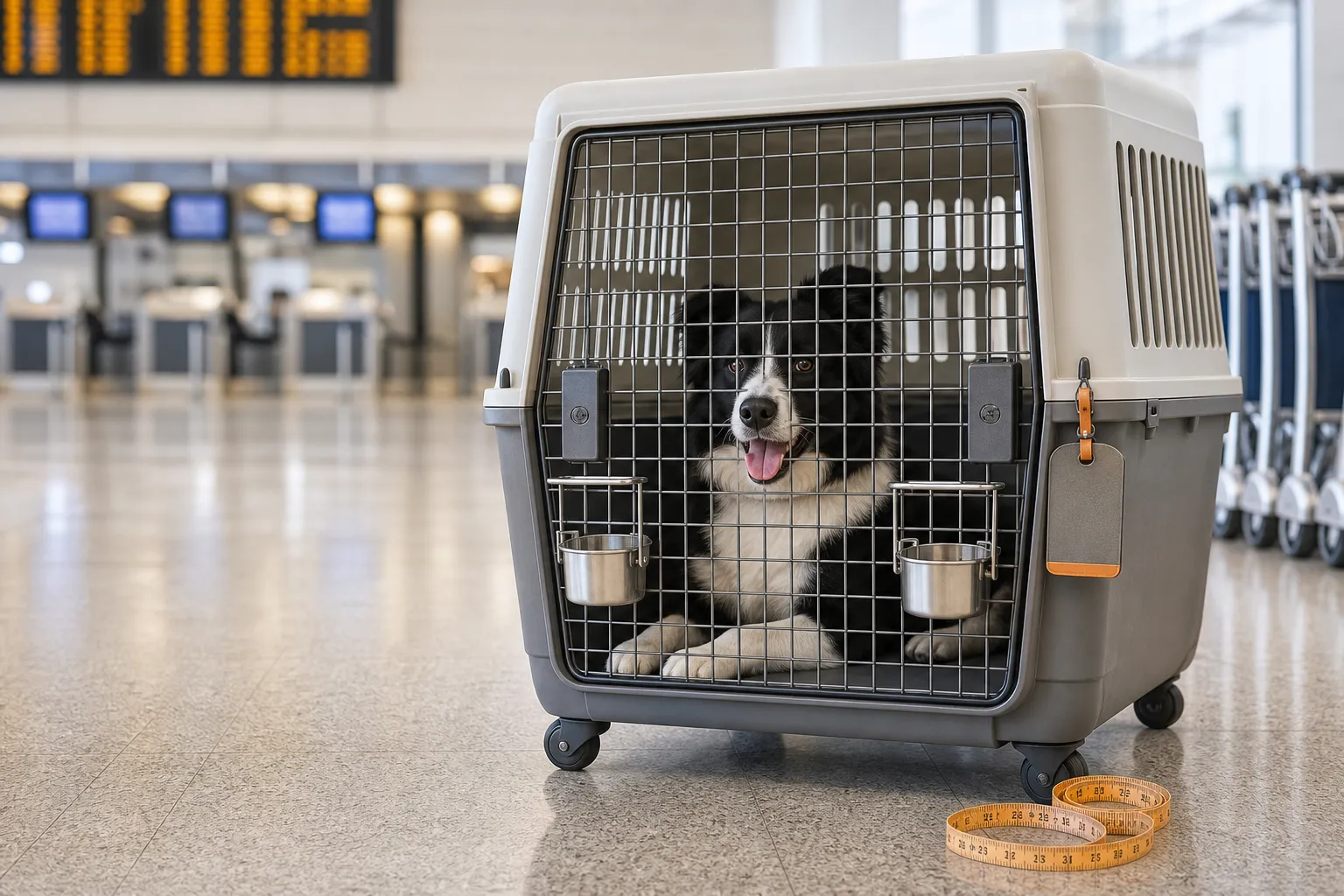

 Published sources
 Product details checked
Choosing an airline dog crate by breed, body weight, or the number printed on the box is a reliable way to end up with the wrong interior. A crate can look enormous from the outside and still be too short for your dog’s ears, too narrow for a turn, or too small once bedding is inside.
Quick answer: for one dog, IATA’s starting formula is minimum internal length = A + ½B, width = C × 2, and height = D + bedding. Here, A is nose to tail root, B is floor to elbow, C is shoulder width or the widest point, and D is standing height to the top of the head or ear tip. Snub-nosed breeds need a larger container under the IATA guidance. The result is a sizing target—not an airline booking approval.
In this guide, you’ll learn:
- How to take the five measurements the calculator needs
- How IATA’s internal-dimension formula works, including the snub-nosed adjustment
- Why a crate’s exterior size or weight range is not enough
- Which compatible products have interiors that can be compared with your result
- What to confirm with the airline, aircraft, route, and cargo desk before paying
Airline Dog Crate Size Calculator
Use the tool with your dog’s actual measurements. The calculator asks for A-D plus E, the bedding allowance. IATA labels the resulting internal height as container height E; separating the bedding input here keeps that output clear and prevents a pad or absorbent liner from being forgotten.
Calculate your dog's minimum crate interior
Measure your dog standing on a level surface, enter the five values below, and use the result as a minimum internal target. The calculator does not approve a crate or a route.
Minimum internal dimensions
Smallest checked catalog option that clears all three dimensions
—
Compare the current crate options below →The calculated numbers are minimum internal dimensions. Compare them with a product’s usable interior, not its outside dimensions, and round up when a dog is between options. A dog must still be able to stand naturally without touching the roof, turn around, sit erect, and lie down in a natural position.
How to Measure Your Dog for Air Travel
Measure on a firm, level floor while your dog is calm and standing naturally. Do not pull the neck upward, flatten the ears, or measure a curled-up dog. Take each measurement twice and use the larger reliable number.
| Measurement | What to measure | Practical method |
|---|---|---|
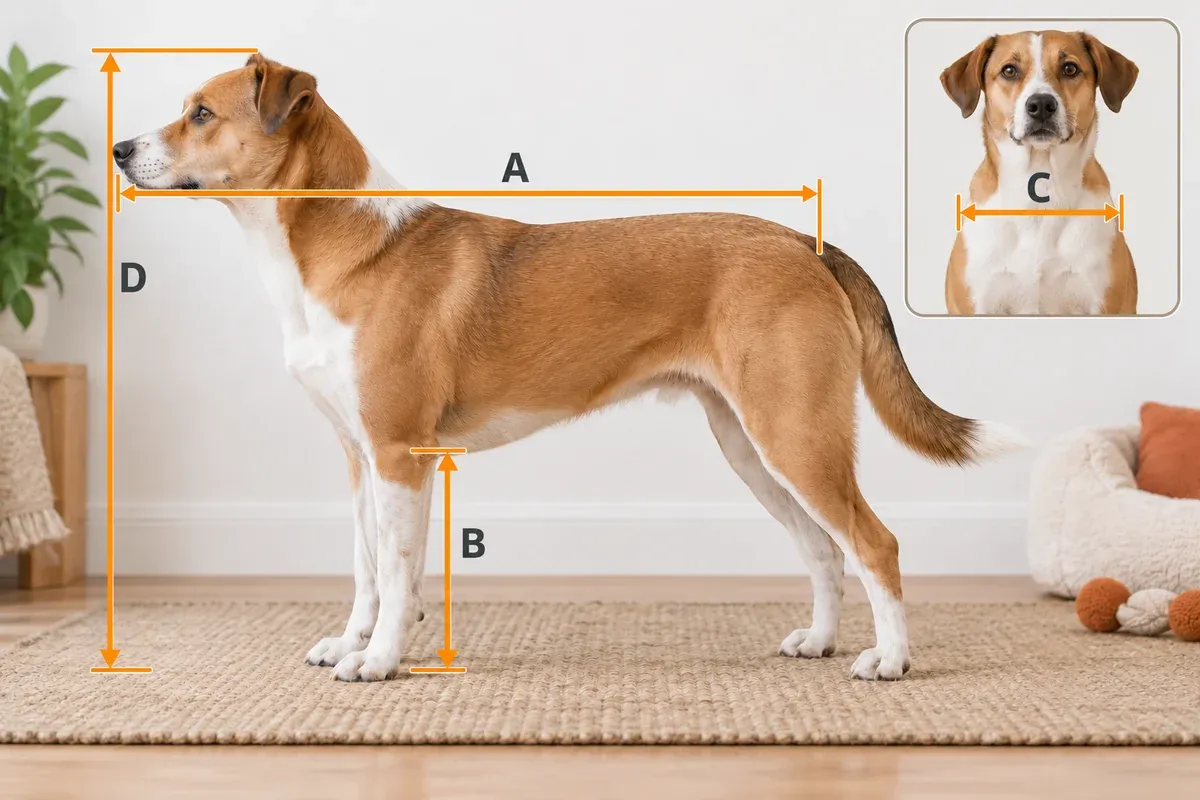
| A | Nose to the base of the tail | Hold a straight tape from the tip of the nose to the tail root. Do not measure to the end of the tail. |
| B | Floor to the elbow joint | Measure from the floor to the elbow of the front leg. This adds the standing and movement allowance to the crate length. |
| C | Shoulder width or widest point | Measure across the shoulders; if the ribs or another body area is wider, use that wider measurement. |
| D | Natural standing height | Measure from the floor to the top of the head or the highest ear tip—whichever is higher. |
| E | Bedding allowance | Measure the thickness of the pad or bedding under the dog’s feet. Use the actual travel setup, not a paper-thin liner used only for the measurement. |
The side and front views below show the measurement points; use the table above to record each value.
A simple measuring routine
- Have a second person offer a treat so the dog stands squarely.
- Place the tape beside the dog rather than bending it around the body.
- Measure the tallest natural ear position. Folded or relaxed ears still need room to stand naturally if that is how the dog normally carries them.
- Add the thickness of the absorbent pad or bedding to the height calculation.
- Repeat after a coat change, growth spurt, or major weight change. Weight is useful for handling and airline limits, but it does not replace these measurements.
For a dog that will travel in a crate for the first time, practice standing, turning, and settling in a similar enclosure before the flight. A calculator can identify a dimension problem; it cannot prepare a dog for a noisy airport or a long separation.
The IATA Formula Explained
IATA’s Traveler’s Pet Corner publishes the measurement definitions and the approximate formula. The detailed Container Requirements PDF is the stronger technical reference; it identifies the calculated values as internal container dimensions and is marked Edition 52, January 2026.
For one dog, calculate:
Minimum internal length = A + (0.5 × B)
Minimum internal width = 2 × C
Minimum internal height = D + bedding allowance
Worked example
Suppose your dog measures:
- A = 30 inches from nose to tail root
- B = 12 inches from floor to elbow
- C = 10 inches at the widest point
- D = 24 inches from floor to the top of the ears
- E = 1 inch of travel bedding
The minimum target is:
- Length: 30 + (12 ÷ 2) = 36 inches
- Width: 10 × 2 = 20 inches
- Height: 24 + 1 = 25 inches
If the dog is snub-nosed, IATA’s guidance says the container should be 10% larger. That example becomes approximately 39.6 × 22 × 27.5 inches internally. Round up to a product that truly clears every dimension, then ask the airline whether that larger crate and the dog’s breed are accepted on the exact aircraft and route.
The formula is not a way to squeeze a dog into a smaller product. If the result is 36 inches long but a product offers only 32.5 inches of usable interior, that product fails the length test even if the exterior label says “36 inch.”
Crates to compare with your result
These are not universal approvals. They are current product options whose published specifications provide dimensions that can be compared with the calculator. The table uses the usable interior where it was published.
Airline-crate options by usable interior
-
Petmate Sky Kennel 21 Inch
Petmate
Hard-sided Petmate kennel with a 21-inch exterior, 360-degree ventilation, a metal door, and travel labels for small dogs.
- 18.75 x 13.5 x 14.5 in interior
- IATA requirements stated in product information
- Four-way ventilation
- Usable interior
- 18.75 x 13.5 x 14.5 in
- Best for
- Small dogs up to about 15 lbs
-
Petmate Vari Kennel 28 Inch
Petmate
Popular hard-sided kennel with four-sided ventilation, a wire door, a stay-dry moat, and an interior sized for many medium dogs.
- 24.25 x 18.25 x 19.5 in interior
- Airline-friendly design
- Easy-clean plastic shell
- Usable interior
- 24.25 x 18.25 x 19.5 in
- Best for
- Medium dogs around 20-30 lbs
-
SportPet Airline Compliant Large Kennel
SportPet Designs
Rolling hard-sided travel kennel with removable wheels, two bowls, live-animal labels, and a 28.75-inch internal length.
- 28.75 x 19.75 x 21.5 in interior
- Removable wheels and top handle
- Two bowls and four labels included
- Usable interior
- 28.75 x 19.75 x 21.5 in
- Best for
- Large dogs that benefit from wheels and included bowls
-
Petmate Vari Kennel 36 Inch
Petmate
Large Petmate kennel with a 36-inch exterior, four-sided ventilation, a stay-dry moat, and a 32.5-inch internal length.
- 32.5 x 22.25 x 26 in interior
- Rigid plastic shell with wire door
- Usable interior
- 32.5 x 22.25 x 26 in
- Best for
- Large dogs around 50-70 lbs
-
Petmate Vari Kennel 40 Inch
Petmate
The largest Petmate Vari option checked, with a 36.25-inch internal length for dogs whose calculated minimums exceed smaller kennels.
- 36.25 x 24.75 x 28.8 in interior
- Four-sided ventilation and secure wire door
- Usable interior
- 36.25 x 24.75 x 28.8 in
- Best for
- Large dogs around 70-90 lbs
Review the linked product page before purchasing.
1. Petmate Sky Kennel 21 Inch — small-dog starting point
Check current price on Amazon →Petmate’s official Sky Kennel page lists the same 21-inch interior, four-way ventilation, secure latches, and air-travel labeling. This is a sensible option only when your calculated target fits with room to spare. A Chihuahua-sized crate is not a universal “small dog” answer: a long-backed or tall small breed can outgrow it.
Best for: a genuinely small dog whose A-D result clears 18.75 × 13.5 × 14.5 inches. Skip if: the ears touch the roof, the dog cannot turn without folding the body, or the airline requires a different construction or size.
2. Petmate Vari Kennel 28 Inch — widely reviewed medium option
Check current price on Amazon →Petmate’s Vari product page is useful because it publishes interior dimensions for every size and says the kennel meets most air-travel requirements. Petmate also says that wing nuts and bolts are required for airline travel and recommends verifying the specific airline. That is the important distinction: “airline-friendly” describes a starting design, not a promise for every carrier.
Best for: medium dogs whose calculated interior target is no larger than 24.25 × 18.25 × 19.5 inches. Skip if: your dog needs more than 19.5 inches of clear height after bedding or is close to any dimension limit.
3. SportPet Airline Compliant Large 31.5 Inch — wheels and travel accessories
Check current price on Amazon →Its useful differentiators are removable wheels, a top carry handle, two food/water dishes, metal hardware, and four “Live Animal” labels. The manufacturer describes the kennel as designed to IATA standards and includes airline-required tie-down holes. Treat those as manufacturer claims to verify against your airline’s acceptance checklist; the interior measurements remain the deciding fit test.
Best for: a dog that clears 28.75 × 19.75 × 21.5 inches and a traveler who values wheels for moving a heavy kennel through a terminal. Skip if: your calculation is close to the interior limit or the airline has a narrower maximum width/height for your aircraft.
4. Petmate Vari Kennel 36 Inch — large-dog option with a substantial interior
Check current price on Amazon →This is the first option in the table that can clear a 36-inch-length result only if the calculated length is actually 32.5 inches or less. Product names and exterior dimensions make that easy to miss. Use the internal number, and remember that a bed or thick absorbent pad reduces the usable height.
Best for: larger dogs that clear 32.5 × 22.25 × 26 inches internally and need a rigid plastic travel kennel. Skip if: your dog needs more length or your aircraft has a lower maximum kennel height.
5. Petmate Vari Kennel 40 Inch — extra-large interior, extra airline checks
Check current price on Amazon →It can be the right answer when the formula demands more than the SportPet Large or Vari 36, but the extra size creates a second screening step. A crate can be large enough for the dog and too tall or heavy for a particular aircraft, handling service, or route. Petmate notes that its largest kennels can require ground or freight transport on its own store, so check the transport requirements and the airline’s maximum exterior dimensions.
Best for: dogs whose calculated minimums clear 36.25 × 24.75 × 28.8 inches and whose airline confirms that this size is accepted. Skip if: you have not received route-specific confirmation or the aircraft limit is below the crate’s exterior height.
How to Match the Calculator Result to a Product
Use this three-axis check for every candidate:
- Length: product interior must be at least
A + ½B(and 10% larger for the snub-nosed adjustment when applicable). - Width: product interior must be at least
2C. - Height: product interior must be at least
D + beddingso the dog can stand naturally.
If any one axis fails, move to the next size. Do not average a shortfall in length against extra width. Do not use the product’s “fits up to X pounds” line as a substitute for the height and shoulder measurements.
Interior versus exterior dimensions
Retailer titles usually advertise the outside length: a “36-inch crate” can have an interior length of only 32.5 inches after the shell, door, and molding are accounted for. The calculator deliberately reports internal targets so the comparison is honest. When a product does not publish internal dimensions, ask the manufacturer before relying on it for air travel.
Bedding, bowls, and usable space
Use a thin, absorbent, airline-accepted pad that cannot slide into the dog’s feet. A thick cushion can turn a passing height calculation into a failed one. Food and water dishes should be attached where the airline requires them—USDA APHIS guidance describes dishes attached to the inside of the kennel door—without blocking the dog’s standing or turning space.
Airline and Route Confirmation Is Mandatory
IATA’s formula is a strong starting standard, but IATA does not issue a universal “approved crate” list for every passenger itinerary. The operating airline, aircraft type, route, temperature policy, cargo or checked-pet service, and destination rules still control whether the dog can travel.
For example, American Airlines’ current pet policy publishes aircraft-specific maximum kennel heights, a combined pet-and-kennel weight limit for checked pets, ventilation and fastener requirements, and breed restrictions. Its cabin carrier limits are also completely different from a hard-sided cargo crate. That is an example of why a crate can pass the IATA sizing formula and still be rejected on a particular flight.
Before ordering, contact the operating carrier, not only the airline whose code appears on the ticket, and ask:
- Is the dog traveling in the cabin, as a checked pet, or through cargo?
- What are the maximum exterior length, width, and height for every aircraft segment?
- What is the maximum combined weight of dog plus crate?
- Are the exact crate model, metal door, bolts, tie-down points, wheels, and bowl setup accepted?
- Does the airline restrict this breed, age, season, temperature, connection, or destination?
- Does a partner airline or codeshare apply a stricter rule?
Save the answer with your booking details. Recheck it close to departure because airlines change pet acceptance, aircraft, and seasonal restrictions.
Cabin carrier versus cargo crate
This calculator is for a hard-sided crate sized around the dog, not an under-seat cabin carrier. Cabin carriers have to fit the aircraft’s under-seat envelope, so the dog and carrier are governed by a different maximum. A large dog cannot be made cabin-eligible by buying a soft carrier that is too small; ask the airline about cargo or alternate travel plans instead.
Air-Travel Crate Checklist
USDA APHIS’s Pets on Planes preparation guidance is a strong practical checklist for kennel construction and handling. Before the airport, verify that your setup has:
- A hard-sided, secure crate with a door that closes and can be opened in an emergency
- Strong fasteners and a door that prevents escape or protruding paws
- Adequate ventilation on the sides required by the airline
- A leak-proof floor with clean, absorbent material
- Food and water containers attached where handlers can reach them without opening the door
- “Live Animal” and upright-arrow labels where required
- A sturdy handle or handholds that allow the crate to be lifted without tilting
- Routing details, owner contact information, and feeding/watering instructions in the required document pouch
Do not sedate a dog for air travel unless a veterinarian and the airline have given specific, current instructions. American Airlines notes the respiratory and cardiovascular risk of sedatives at altitude; the safer preparation is gradual crate training and an honest health discussion with your veterinarian.
Common Sizing Mistakes
Choosing by breed or weight alone
Breed charts are useful for finding a starting range, but two dogs of the same breed can differ in back length, shoulder width, ear height, and posture. Measure the individual dog.
Comparing against the outside label
The number in a product name is often the exterior length. A 36-inch label does not guarantee 36 inches of interior floor space.
Forgetting the ears and bedding
The tallest ear tip counts under IATA’s definition. The pad belongs in the height calculation too. Measuring from the shoulders to the top of a relaxed head usually understates the needed height.
Treating “airline approved” as a universal promise
Manufacturers and retailers use terms such as airline-friendly, airline compliant, or meets most airline requirements. Read that wording precisely and confirm the exact crate dimensions, hardware, airline, aircraft, and route.
Waiting until the day before the flight
Large crates may require freight shipping and extra lead time. Buy early enough to test the crate, assemble the required hardware, add labels, and practice calm confinement.
Frequently Asked Questions
What is the correct IATA dog crate formula?
For one dog, use length = A + ½B, width = C × 2, and height = D + bedding. A is nose to tail root, B is floor to elbow, C is shoulder width or the widest point, and D is standing height to the top of the head or ear tip. These are internal dimensions.
Does my brachycephalic dog need a larger crate?
IATA’s published guidance says snub-nosed breeds require a container 10% larger. That does not override an airline’s breed restrictions; some carriers may restrict or refuse brachycephalic dogs for checked or cargo travel. Ask the airline and your veterinarian before buying the crate.
Is a Petmate Sky or Vari Kennel automatically approved for every airline?
No. Petmate publishes airline-travel guidance and says its Vari kennel meets most air-travel requirements, while the Sky product page describes airline cargo compliance. You still need the correct hardware, exact size, operating airline, aircraft, route, and service confirmation. The calculator checks fit, not acceptance.
What if my dog is between two crate sizes?
Choose the smallest option whose internal length, width, and height all clear the calculated minimums, then confirm the external dimensions with the airline. If one dimension is close, size up only when the airline confirms the larger crate; bigger is not automatically transportable on every aircraft.
Can I use this calculator for an under-seat carrier?
Not reliably. Under-seat cabin carriers have a tight aircraft-specific envelope and different airline rules. Use the airline’s cabin dimensions and ask whether your dog can travel in the cabin; do not use the cargo-crate formula to justify an under-seat carrier that cannot close comfortably.
Sources and Further Reading
- IATA Traveler’s Pet Corner — measurement definitions, formulas, and the 10% snub-nosed note.
- IATA Container Requirements PDF, Edition 52, January 2026 — detailed CR1 container and internal-dimension guidance.
- USDA APHIS: Pets on Planes — Preparing and Receiving Pets for Air Travel — kennel construction, ventilation, leak-proof flooring, labels, and handling checks.
- American Airlines: Pets — an example of airline- and aircraft-specific limits and restrictions.
- Petmate: Sky Kennel — published Sky Kennel dimensions and features.
- Petmate: Vari Kennel — published interior dimensions, hardware notes, and airline-verification warning.
Product specifications and airline requirements can change. Verify the exact model and current travel rules before purchase.