

 Published sources
 Product details checked
For home treadmill shopping, start by comparing a usable moving belt at least twice your dog’s nose-to-tail-base length. Then check width, the lowest controllable speed, and the permitted dog weight separately. A high weight limit cannot compensate for a belt that is too short or narrow.
Cornell University College of Veterinary Medicine gives a 1.5–2× body-length reference. Preventive Vet’s home-use guidance recommends at least 2×, ideally 2.5–3×, using nose-to-tail-base length. These are published sizing recommendations with different allowances for movement. Neither range approves a particular machine for every dog.
The calculator keeps the reference and your shopping target visible together. Its default home-walking target is 2×, the walk-to-trot target is 2.5×, and the longer-stride target is 3×. Those selected targets and the width allowances are planning choices for comparing equipment. They do not establish a safe workout.
Dog treadmill size calculator
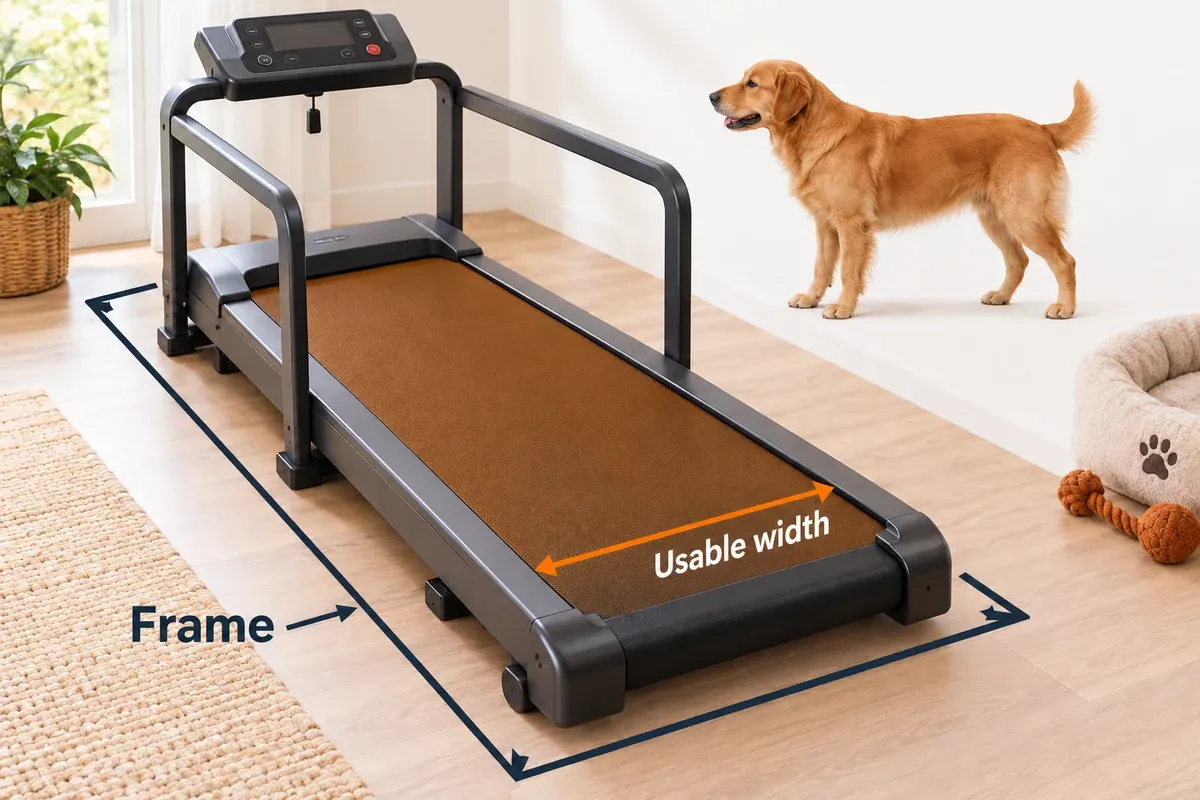
Measure your own dog standing comfortably, enter each measurement, and compare the result with the usable belt or flat slat track. Outer frame dimensions describe how much room the machine occupies, not how much room your dog has to move.
Interactive sizing tool
Calculate a dog treadmill fit screen
Compare your dog's measurements with the usable moving belt. See the published length reference, your selected planning target, and extra room to consider before choosing a machine.
Your starting fit screen
Enter your dog's measurements to see a deck-length, width, and control target.
Length references: Cornell's 1.5–2× guidance and Preventive Vet's longer 2–3× recommendation. Selected length and width targets are shopping estimates. Measurements convert to at most three decimal places; unchanged measurements retain their original precision when you switch back. Length targets round up once to the next 0.5 in or 1 cm. No speed, incline, or session duration is calculated from body size.
If a field is empty or outside the supported range, the calculator shows a correction message and withholds the sizing result. Correct the measurement before changing units. It accepts decimal measurements; converted values display up to three decimal places, and switching back without editing restores the original measurement. Length and width targets round upward once to the next 0.5 inch or 1 centimeter.
Rehabilitation mode compares equipment only. It uses the same space allowances as the equivalent home-use gait and does not calculate speed, incline, session length, calorie burn, or progression. The University of Illinois rehabilitation service bases an individual plan on physical, neurologic, and orthopedic assessment. Body dimensions cannot replace that assessment.
Measure your dog before looking at machines
Use a tape measure, a firm level floor, and a current weight. Have a second person help your dog stand naturally if needed. Keep the head in an ordinary position; a dog stretching toward a treat or turning to look behind is difficult to measure consistently.
| Measurement | What to measure | What the result helps you check |
|---|---|---|
| Body length | Straight-line distance from the tip of the nose to the base of the tail, excluding the tail itself | Usable deck length |
| Shoulder height | Floor to the withers, the highest point of the shoulder blades | A rough height description and clearance around the frame |
| Chest or shoulder width | Straight across the widest part of the shoulders or rib cage; use the wider measurement | Lateral room between the rails |
| Current weight | Your dog’s present body weight on a suitable scale | The manufacturer’s permitted dog weight |
For width, you need the side-to-side distance, not chest circumference. A harness size measured around the rib cage cannot go into this field. For length, use the same nose-to-tail-base endpoints each time. Shoulder-to-tail measurements are shorter and will produce a smaller deck target.
Take each distance twice. If the results differ, reposition the dog and measure again instead of averaging obviously different postures. Record the units beside the numbers so that a measurement in centimeters is not entered as inches.
The calculator supports body lengths of 10–80 in, shoulder heights of 6–40 in, chest widths of 4–24 in, and weights of 2–250 lb, with converted metric limits. These are tool input ranges, not statements about which dogs should exercise on a treadmill. If a measurement falls outside them, verify the measurement and ask the equipment manufacturer for individual sizing rather than entering a smaller number to obtain a result.
For a growing dog, a shared machine, or a dog whose weight is changing, keep separate measurement records. A treadmill that fits one dog may fail another dog’s length or width check. Recheck the actual dog before using an old sizing result.
Read the three length results correctly
The calculator answers three separate questions: what the shorter published reference looks like, what your selected comparison target is, and how much room a longer deck would provide. The first result is a reference range rather than a pass mark.
Cornell’s reference is not a buying guarantee
Cornell explains that a dog’s full stride can exceed a human’s and that the deck must suit the dog and pace. Its treadmill guidance supports the 1.5–2× reference and controlled walking or trotting. The calculator displays both ends so that a product barely reaching the lower end is not presented as an approved fit.
For shopping, compare the selected target as well. A model that exceeds the shorter reference but falls below your chosen target has not met that target. If a professional recommends a different deck for an individual dog, use the actual assessment and intended gait to make the decision.
Choose a target that matches the space you want to compare
| Selection | Selected usable-length target | How to use it |
|---|---|---|
| Daily exercise + controlled walk | Body length × 2 | Starting comparison for home walking |
| Daily exercise + walk to trot | Body length × 2.5 | Compare more fore-and-aft room for the intended gait |
| Any use + longer stride at a walk or trot | Body length × 3 | Compare the longest allowance offered by this tool |
| Working or sporting-dog use + controlled walk or walk to trot | Body length × 2.5 | A larger shopping allowance; it does not authorize faster exercise |
| Rehabilitation or weight-management plan | Same multiplier as the selected gait: 2, 2.5, or 3 | Ask the veterinary team to approve fit and the exercise plan independently |
| Dog-powered slatmill | Same multiplier as the selected gait: 2, 2.5, or 3 | Preliminary comparison of a flat usable track; confirm the machine’s own sizing requirements |
These mode choices apply the longer planning approach; they are not formulas for stride mechanics. Selecting a different use does not diagnose why a dog drifts, and choosing rehabilitation does not justify a shorter belt. The 3× longer-deck comparison remains visible in every mode. When your selected target is already 3×, those two results match.
Example: why a 52-inch belt can still be too short
For an illustrative dog measuring 30 inches from nose to tail base, the unrounded lengths are:
| Comparison | Calculation | Usable belt length |
|---|---|---|
| Shorter published reference | 30 × 1.5 to 30 × 2 | 45–60 in / 114.3–152.4 cm |
| Home-walking target | 30 × 2 | 60 in / 152.4 cm |
| Walk-to-trot target | 30 × 2.5 | 75 in / 190.5 cm |
| Longer-deck comparison | 30 × 3 | 90 in / 228.6 cm |
A 52-inch usable belt is above 45 inches but below the 60-inch walking target. A 132-pound load rating does not change that length comparison. For this example, the machine misses the selected home-walking target even if the dog is much lighter than 132 pounds.
Use this arithmetic for any candidate: usable belt length ÷ measured body length = that product’s length multiplier. A 60-inch belt for a 30-inch dog is 2×. The same belt for a 40-inch dog is 1.5×. Breed labels such as “large dog” hide that difference.
Example in centimeters and inches
For an illustrative 70 cm dog, the walking target is 140 cm, the walk-to-trot target is 175 cm, and the longer comparison is 210 cm. In US display, they round upward to 55.5, 69, and 83 inches respectively. The underlying measurements are unchanged; the small difference comes from rounding to the selected output unit.
Always compare against the unrounded physical requirement if a candidate sits close to a boundary. A product labeled “about 55 inches” has not established that it provides a verified 140 cm of usable length.
Check usable width separately
The calculator adds 4, 6, or 8 inches of total width allowance to the measured chest width:
| Selected gait | Total added width | Allowance on each side if centered |
|---|---|---|
| Controlled walk | 4 in / 10.16 cm | 2 in / 5.08 cm |
| Walk to trot | 6 in / 15.24 cm | 3 in / 7.62 cm |
| Longer stride at a walk or trot | 8 in / 20.32 cm | 4 in / 10.16 cm |
These are editorial shopping allowances, not veterinary width standards. They make side-to-side room visible during comparison and should not be treated as proven minimums or guarantees. Neither cited length guide supplies this width equation. Check the actual dog’s paw placement and movement as well as chest width.
For an illustrative dog with a 9-inch chest width, the controlled-walk estimate is 13 inches before display rounding. A 14.2-inch belt clears that particular estimate; it could still fail the length check. Change the same dog to walk-to-trot and the width estimate becomes 15 inches, so the narrower belt no longer clears the selected width target.
Confirm the moving surface between the side rails, including any intrusion by brackets or supports. Outside frame width, the width of a mat beneath the machine, and the distance between tall outer posts are different measurements.
A paper width comparison also cannot show where the dog’s paws land or whether the dog leans against a panel. If the intended gait appears cramped, involves rail contact, or cannot be maintained comfortably, stop the trial and have fit and gait assessed. Extra length cannot correct inadequate width.
The result’s small, medium, or large height label is only a shorthand: up to 16 in / 40.64 cm at the shoulder, over that through 23 in / 58.42 cm, and above 23 inches. Those are descriptive cutoffs used by this tool, not veterinary size classes. They do not change the length calculation, prescribe speed, or approve a product.
Weight capacity and starting speed are separate checks
Use the permitted dog weight, not a structural load headline
Compare current body weight with the manufacturer’s dog-weight guidance for the exact model. If a document lists both a frame capacity and a recommended pet maximum, record both and use the pet recommendation in your decision.
The PawRunner is a useful example: its manufacturer manual, specification page 44, distinguishes a 200-pound maximum pet-weight figure from a 130-pound recommended maximum. Neither figure proves that a dog has enough stride room on its much shorter running surface.
Do not round your dog’s weight down to pass a product limit. A machine that clears the length and width targets but does not meet its permitted dog-weight requirements should leave your shortlist. If your dog is close to a limit, ask the manufacturer whether that exact model suits the dog and intended use.
Compare the lowest controllable speed first
A motorized belt keeps moving when a dog hesitates. Look for the lowest available speed, the size of each adjustment, how smoothly movement begins, and a stop control you can reach while supervising. A remote is useful only if you can operate it reliably from the handling position.
The calculator uses around 0.5 mph / 0.8 km/h as a low-speed shopping reference for nonmedical electric-machine comparisons. That number is an equipment preference, not an instruction to start every dog at that speed. Some dogs need a different pace or a machine offering slower control; an injured dog needs the speed limits specified by the veterinary team.
The PR720F’s manufacturer range begins at 1 mph, whereas the PawRunner begins at 0.5 mph. This difference matters more for a slow-speed requirement than whether one tops out at 8 or 7.5 mph. Neither maximum is a target for your dog’s session.
For rehabilitation, make a written equipment checklist with the clinician: required starting speed, adjustment increments, permitted gait, incline settings, support arrangement, and stopping procedure. The University of Illinois description of rehabilitation treatment includes land-treadmill acclimation and individualized home exercises. A generic length calculator cannot supply those patient-specific instructions.
Motorized treadmill, slatmill, or treadwheel?
An electric dog treadmill lets the handler select belt speed. A flat slatmill moves through the dog’s effort and needs comparison of track dimensions, resistance, braking, and the intended handling arrangement. Preventive Vet explains the two drive types. Dog-powered movement does not by itself establish appropriate fit or safe use.
This calculator’s slatmill mode remains a flat-track estimate. Use the actual manufacturer requirements for the individual slatmill, including permitted dog size and any harness arrangement. Do not shorten a track simply to make an available product match the result.
A treadwheel has a curved running surface. Its diameter, internal width, and usable space need a wheel-specific assessment. An overall wheel diameter cannot be entered as if it were a straight moving-belt length, so the calculator does not select a treadwheel size.
For medical rehabilitation, ask the clinician which equipment type is appropriate before comparing products. A self-powered slatmill cannot be assumed to substitute for controlled land-treadmill work or an underwater treadmill used in a treatment plan.
Two motorized models to compare with your result
Use these as measured alternatives, not as automatic recommendations for the dog in the default calculator. Both have a defined moving surface, but either can fail your individual length, width, weight, or slow-speed requirement.
Compare moving surfaces and minimum speeds
-
Lifepro PawRunner Pet Treadmill
Lifepro
A compact motorized treadmill with a 38.2 in × 14.2 in running surface, remote control, and magnetic safety key. Compare the usable belt with your dog's length and width targets before choosing it.
- 38.2 in L × 14.2 in W usable running surface
- 0.5–7.5 mph speed range with remote control and magnetic safety key
- 130 lb recommended maximum pet weight; 200 lb maximum is a separate figure
- Usable surface
- 38.2 in L × 14.2 in W running surface
- Motor speed range
- 0.5–7.5 mph (0.8–12.1 km/h)
- Dog-weight guidance
- 130 lb recommended maximum pet weight
-
GoPet PR720F PetRun Dog Treadmill
GoPet
A motorized treadmill with a 52 in × 16 in running area and a GoPet USA speed specification of 1–8 mph. The higher minimum speed and 16 in belt width are separate fit checks; the 132 lb weight limit does not establish stride room.
- 52 in L × 16 in W usable running area
- 1–8 mph GoPet USA PR720F specification; minimum is above 0.5 mph
- 132 lb maximum dog weight and push-button speed adjustment
- Usable surface
- 52 in L × 16 in W running area
- Motor speed range
- 1–8 mph (1.6–12.9 km/h), GoPet USA PR720F specification
- Dog-weight guidance
- 132 lb maximum
A product belongs on your shortlist only when its usable dimensions and controls meet your dog's requirements.
Lifepro PawRunner: a compact belt for a dog that clears every measurement
The PawRunner manual gives a 38.2 × 14.2-inch running surface, about 97.0 × 36.1 cm, and a 0.5–7.5 mph speed range. Its 48-inch overall length includes space your dog cannot use as moving belt. It has a remote and magnetic safety key.
That compact surface is the main constraint. Dividing 38.2 inches by the 2× walking multiplier gives 19.1 inches of dog body length. A dog measuring more than that misses the selected 2× length target, even if it meets the manufacturer’s own pet-length guidance. At the 2.5× target, the corresponding body-length comparison is about 15.3 inches. These divisions are shopping calculations, not manufacturer-approved dog-size limits.
The belt’s 14.2-inch width must also clear the selected width allowance. For a small dog that clears those comparisons, the compact footprint and lower minimum speed may be useful. For a longer dog, a heavier frame or a high structural-load figure does not solve the short belt.
Check current price on Amazon →GoPet PR720F: a longer belt with a higher published minimum speed
The GoPet USA PR720F specification gives a 52 × 16-inch running area, approximately 132.1 × 40.6 cm, a 132-pound maximum dog weight, and 1–8 mph speed control. This comparison uses that named PR720F specification. The 16-inch moving width still needs a separate check.
The 52-inch belt corresponds to a 26-inch dog body length at the 2× target, or 20.8 inches at 2.5×. That makes the PR720F longer than the PawRunner without making it a fit for every medium or large dog. The illustrative 30-inch dog above still misses the walking target.
Keep the version’s speed data together. A GoPet PetRun family manual covering the PR720F, hosted by ManualsLib gives a different 0.6–7.5 mph range. That document and the GoPet USA 1–8 mph specification should not be combined into an invented 0.6–8 mph range. The family manual also separates folding PR720F instructions from incline-equipped models; it does not justify assigning a 15% incline to this PR720F.
If the unit you are offered has the family manual’s controls rather than the GoPet USA specification, obtain confirmation of that unit’s minimum speed, increments, usable deck, and model revision before ordering. A 1 mph specification does not meet a requirement for control at or below 0.5 mph, and the alternative 0.6 mph figure does not meet it either. Choose equipment that meets the required lower speed instead of relying on the model name alone.
Check current price on Amazon →Make a purchase decision in the right order
Record the following for each candidate. An unanswered item is a reason to seek the missing information before paying.
| Check | What to record | When to reject or pause |
|---|---|---|
| Identity | Model name, revision, supply voltage, and matching manual | The advertised variant and supplied instructions disagree |
| Usable length | Actual moving belt or track length | It misses the selected target or the professional’s individual requirement |
| Usable width | Moving width between rails and intruding supports | It misses the width comparison or visibly restricts the intended gait |
| Dog weight | Permitted or recommended pet weight, separately from structural load | The dog exceeds the applicable rating |
| Speed and stop | Lowest smooth speed, adjustment steps, emergency-stop operation | Required slow control is unavailable or the stop cannot be reached reliably |
| Home setup | Overall footprint, manual-required clearance, floor and outlet suitability | The room can hold the frame but cannot provide operating clearance |
| Ownership | Assembly, belt care, parts support, warranty terms, and return conditions | You cannot maintain it or resolve an unsuitable fit within the terms offered |
The body-height label is not another pass criterion. It helps describe the dog, but the actual deck and any overhead clearance need checking on the chosen machine.
Plan the operating space, not just the footprint
A tape outline on the floor can show where the frame would sit. Mark the additional clearance required by the machine’s manual and the handler’s standing position as well. Include a clear route for getting on and off; the back of a moving belt should not lead straight into furniture or stairs.
Compact machines can still require a large working area. For example, the PawRunner manual’s placement instructions, page 10, require 7 feet behind the machine and 4 feet at the front and sides. Those are instructions for that model, not universal clearances for every treadmill. Use the correct manual for your candidate.
Check the route into the room too: doorway width, stairs, assembly needs, and where the machine will be stored. A folding function reduces storage demands only when the unfolded operating setup also works.
Include routine care in the decision
Find the manual’s cleaning, belt inspection, alignment, and lubrication instructions before purchase. Motorized belt care and slatmill-bearing care are different; a universal maintenance routine is not appropriate.
Ask whether replacement belts, safety keys, remotes, and other wear parts are available for the exact model. Consider the time needed to keep the surface clean, inspect it, and store it safely between sessions. A machine that is difficult to maintain is a poor fit for the household even when its deck dimensions work.
If no candidate passes the checks, retain the measured requirement. Reducing the body-length input or selecting a different gait solely to approve a short machine does not improve fit. A supervised equipment trial, a different model, or an alternative exercise plan may be the more useful next step.
Introduce the machine before adding exercise
Familiarity with a machine and readiness for a workout are separate. Cornell recommends an initial professional assessment and positive conditioning, with appropriate support and a fitted harness where indicated. Our basic dog-training guide explains reward timing and manageable steps for unfamiliar tasks.
After confirming suitability and reading the machine’s instructions, use Preventive Vet’s gradual introduction as a progression rather than a timed challenge:
- Keep the belt stationary. Reward voluntary stepping onto and off the deck.
- Introduce motor noise separately. Let the dog hear it from beside the machine and pair it with rewards.
- Introduce brief belt movement under supervision. Use the appropriate low setting and a level deck.
- Change one exercise variable at a time. Progress only while movement and participation remain comfortable.
If your dog avoids the deck or struggles to step down calmly, return to the stationary stage. Completing basic cues does not mean the dog accepts a moving surface, and treats should not be used to pull a reluctant dog through a workout.
Keep a simple session record if treadmill work becomes part of the routine: machine setting, duration approved for that dog, willingness to participate, and any changes you notice afterward. Bring that record to the clinician when a plan needs reassessment; it is more informative than increasing speed because a calculator produced a large deck target.
Know when to stop
Stay with the dog throughout use. Stop for inability to keep pace, repeated paw scuffing, uneven movement, distress, or pain. Cornell notes that treadmill mechanics differ from ordinary land walking and may aggravate scuffing in some patients. Do not try to correct a persistent gait change by experimenting with speed or incline.
Preventive Vet’s safety advice warns against leash-tethering a dog to the frame and calls for immediate stopping and veterinary contact for a bluish tongue, pale gums, or excessive drooling. Follow the model’s emergency-stop instructions; a safety-key cord and a leash restraining the dog to a frame serve different purposes.
Arrange veterinary advice before exercise when pain, injury, surgery, abnormal gait, heart or breathing problems, or a medical weight-management plan are involved. Puppies and dogs with changing physical capacity also need individual suitability advice. A suitable belt size gives no information about tolerance for a workout.
Keep appropriate outdoor walks and enrichment in the routine. A treadmill cannot provide the same opportunities to sniff, explore, and choose a route; Preventive Vet explicitly cautions against replacing all walks.
Frequently asked questions
Can I choose a dog treadmill by breed or weight alone?
Measure the individual dog. Weight checks load capacity; body length and width check space. Two dogs with the same weight can have different proportions, and a breed-size description cannot establish their usable-deck requirements.
Does reaching 1.5× body length mean a treadmill fits?
It reaches the lower end of the published reference shown by this tool. Compare the selected planning target, width, controls, and intended gait as well. A measurement at the lower end is not a fit approval.
Why does rehabilitation mode still show a long deck?
The mode flags a need for individual clinical guidance. It does not assume that a dog in rehabilitation needs less stride room. Only the treating professional can decide whether different equipment, assistance, or a particular exercise protocol is appropriate.
What if the metric and inch results differ slightly?
The display rounds targets upward to whole centimeters or half inches. A 140 cm target therefore appears as 55.5 inches in US display. Switching units without editing retains the original measurement, so repeated switching should not move the dog across a height category or change the underlying target.
Does a wider belt allow me to buy a shorter one?
No. Treat length and width as independent comparisons. Additional lateral room does not supply the missing fore-and-aft space, and a longer surface cannot correct a narrow track.
Should I buy the machine with the fastest top speed?
Choose the range and adjustments needed for the dog and intended use. Compare slow-speed control and stopping first. The calculator does not derive exercise pace from weight, shoulder height, or deck length.
Can my existing human treadmill do the job?
Verify its moving surface and controls rather than using the outside dimensions. Many human belts miss a dog’s length requirement. Have suitability assessed before introducing the dog; a human machine’s load rating and your ability to run on it do not establish canine fit.
What if my dog refuses even a correctly sized machine?
Stop the exercise attempt and work on the stationary introduction only if the dog participates willingly. Discuss continued avoidance with a reward-based trainer and any movement difficulty with the veterinarian. Buying a larger deck does not necessarily resolve fear, pain, or unwillingness to use a treadmill.
Sources and further reading
- Cornell University College of Veterinary Medicine: Treadmill training for dogs
- Preventive Vet: Dog treadmills—what you need to know
- University of Illinois Veterinary Teaching Hospital: Rehabilitation service
- University of Illinois: Rehabilitation treatment approaches
- Lifepro: PawRunner user manual, including usable running surface and placement clearances
- GoPet USA: PR720F specifications
- GoPet: PetRun family manual covering PR720F, archived copy on ManualsLib