

 Published sources
 Product details checked
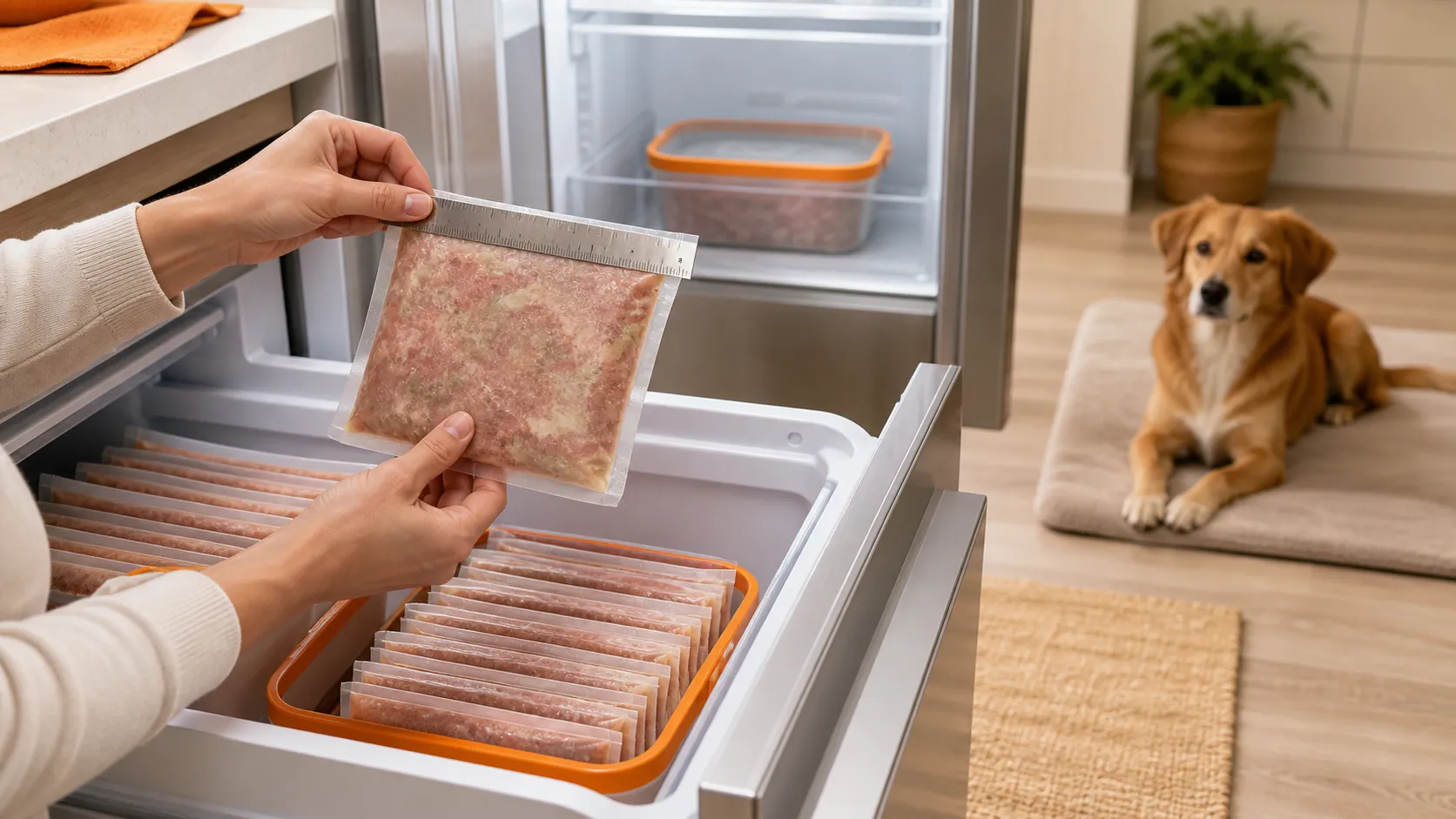
There is no honest universal answer such as “one cubic foot holds X pounds of raw dog food.” Twelve pounds can arrive as flat one-pound pouches, thick bricks, patties in cartons, or irregular tubs. Each format leaves different gaps around shelves, baskets, lights, vents, and the freezer door.
The reliable answer comes from four numbers:
- the dog’s actual daily ration;
- the number of days stored at once;
- the weight and outside dimensions of one hard-frozen package; and
- a clearly stated reserve for curved packages, dividers, and room to rotate stock.
Measure one frozen package, run the calculator below, then compare the result with the compartment you can actually clear. For a 30-day order, also plan a refrigerator thaw zone, first-in-first-out rotation, delivery overlap, and a safe response to delay or partial thawing.
Important safety context before planning a raw-food order
This storage guide is not an endorsement of raw feeding. The CDC does not recommend raw pet food because uncooked animal proteins may carry pathogens that can make pets and people sick. The CDC also states that freezing, freeze-drying, or dehydrating reduces some germs but does not kill all of them. The FDA likewise says raw pet food poses significant risks to pets and owners.
The risk extends beyond the person filling the bowl. Raw food, utensils, refrigerator surfaces, the dog’s mouth, and feces can spread contamination. The WSAVA raw-meat diet resource notes that people who are pregnant, very young, elderly, immunocompromised, or taking certain medications can face greater risk. AAHA advises that dogs in households with immunocompromised people, pregnant people, elderly people, or children under five should not be fed raw food or raw treats.
If anyone in the household falls into a higher-risk group, discuss a cooked complete diet with the veterinarian and the person’s healthcare professional instead of treating a separate freezer drawer as sufficient protection. A dedicated compartment can organize food; it cannot sterilize raw meat.
Raw dog food freezer space calculator
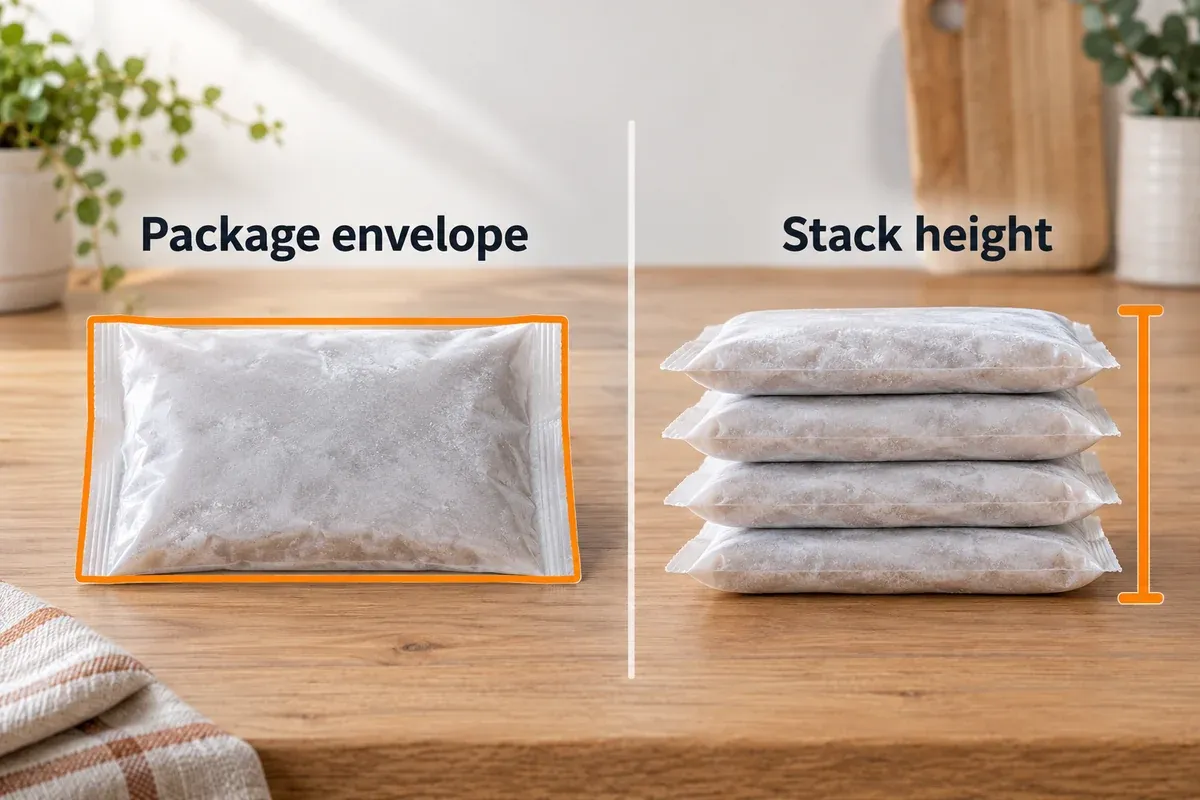
The calculator does not convert pounds directly into cubic feet. It uses a rectangular package envelope: length × width × maximum frozen thickness. That slightly conservative envelope captures the shelf space a bulging pouch actually blocks, including small voids within its outline.
Measured-package freezer calculator
Size 30 days of raw dog food without guessing its density
Start with the dog's actual daily ration and the frozen package's outside dimensions. The calculator separates the space needed for one delivery from the space needed to hold the entire planning period.
Your freezer-space plan
Enter the ration and measured package dimensions to calculate cubic feet.
Rectangular-envelope method: package length × width × thickness × package count ÷ 1,728, then add the selected reserve. Compare the result with a cleared, measured compartment—not only the appliance's advertised total capacity.
The formula behind the result
Food for the period (lb) = daily ration (lb) × days

Package count = round up(food for the period ÷ weight per package)

One-package envelope (in³) = length × width × frozen thickness

Packed volume (ft³) = package count × package envelope ÷ 1,728

Planned compartment space = packed volume × (1 + chosen reserve)
There are 1,728 cubic inches in one cubic foot. For metric planning, one cubic foot is about 28.3 liters. The reserve is an assumption you choose, not a food-safety rule. The calculator starts at 20% as a practical handling example, but a rigid stackable carton may need less and floppy or curved packages may need more. Measure a test stack whenever possible.
Why the appliance’s advertised capacity is not your answer
A freezer labeled 5 ft³ does not give you a clean 5-ft³ rectangular block. Compressor housings, baskets, shelf spacing, an ice maker, curved walls, and door clearance reduce usable geometry. Food already in the freezer reduces it further.
Measure the cleared space where the raw food would sit:
Usable compartment volume = clear length × clear width × clear heightThen subtract space blocked by rails, bins, vents, lights, and the door sweep. Do not cover an air outlet or ignore the appliance manual to reach a calculated number. The calculator is an order-planning tool, not permission to obstruct the freezer’s required clearances.
A defined 12-lb trial before a monthly order
Raw Wild’s current product and FAQ pages describe its 12-lb trial as twelve individual one-pound frozen packages made with elk and deer. That defined weight makes it useful for a real-world freezer test: receive the shipment, measure a hard-frozen pouch, stack all 12 in the intended drawer, and replace the calculator’s blank dimension fields with actual measurements.
The current manufacturer information describes the food as formulated to meet AAFCO Dog Food Nutrient Profiles for all life stages, including growth of large-size dogs. Verify that wording, the calorie statement, full ingredient list, lot information, package count, and feeding directions on the delivered product. “Complete and balanced” does not remove raw-food pathogen risk, and it does not determine the correct ration for an individual dog.
A measured trial quantity for the freezer test
-
Raw Wild Premium Raw Dog Food, 12 lb Trial
Raw Wild
A 12-pound frozen raw dog-food trial made with elk and deer; the current product page describes the food as AAFCO complete and balanced.
- 12 lb frozen trial format
- Elk and deer are the named animal proteins
- Product page describes the meal as AAFCO complete and balanced
- Planning role
- A frozen raw-food cost and freezer-space trial for an adult dog
Confirm the current package count, frozen condition, label, nutritional adequacy statement, ingredients, calories, handling instructions, and feeding amount before ordering.
Example calculations for 20-, 50-, and 80-lb dogs
The examples below are not general feeding recommendations. To make the arithmetic reproducible, they use Raw Wild’s current manufacturer FAQ rule of thumb for adult dogs—2% to 3% of body weight per day. That percentage may be inappropriate for a particular dog and is not a substitute for calories, body-condition monitoring, or veterinary guidance. Puppies, seniors, pregnant or nursing dogs, very active dogs, overweight dogs, and dogs with disease can need a different plan.
For the space column only, assume a hypothetical measured one-pound pouch envelope of 90 in³ and add the calculator’s example 20% handling reserve. No Raw Wild page reviewed for this guide publishes that pouch dimension. Replace 90 in³ with your own frozen-package measurement.
| Dog weight | Manufacturer-example ration at 2%–3% | Food for 30 days | One-pound packages | Hypothetical space at 90 in³/package + 20% |
|---|---|---|---|---|
| 20 lb | 0.4–0.6 lb/day | 12–18 lb | 12–18 | 0.75–1.13 ft³ |
| 50 lb | 1.0–1.5 lb/day | 30–45 lb | 30–45 | 1.88–2.81 ft³ |
| 80 lb | 1.6–2.4 lb/day | 48–72 lb | 48–72 | 3.00–4.50 ft³ |
These ranges show why body weight alone cannot settle either question. The ration range changes monthly food weight by 50%, and the package envelope controls how that weight occupies a drawer.
What a 12-lb trial covers in the same manufacturer example
| Dog weight | Example daily ration | Approximate days covered by 12 lb |
|---|---|---|
| 20 lb | 0.4–0.6 lb/day | 20–30 days |
| 50 lb | 1.0–1.5 lb/day | 8–12 days |
| 80 lb | 1.6–2.4 lb/day | 5–7.5 days |
Do not round a large dog’s ration down merely to make a trial last longer. Set the food amount from the label and veterinary plan, then treat the trial as the number of days it genuinely covers.
Measure the frozen package correctly
Package measurements should describe the shape that enters the freezer, not the flexible empty wrapper.
- Freeze it flat as directed. Measure after the pouch is fully hard. A partly thawed package can flatten temporarily and underestimate stacking space.
- Measure the maximum outside length and width. Include sealed seams that stop another pouch from lying flush.
- Measure the thickest point. Do not compress a bulge with the ruler.
- Test a stack of four. Divide the stack height by four. This often gives a more repeatable average thickness than measuring one soft-edged pouch.
- Count secondary packaging. If cartons, dividers, or trays stay in the freezer, measure the carton or the complete stack—not a naked pouch.
- Repeat when packaging changes. A manufacturer can change pouch dimensions without changing net food weight.
If pouches freeze in irregular shapes, arrange a real delivery in the intended basket and measure the entire occupied block. Use whichever estimate is larger: the package-envelope calculation or the measured stack.
Plan for delivery overlap, not only 30-day consumption
Freezer occupancy often peaks on delivery day, when the new shipment arrives before the previous one is empty.
Peak pounds on hand = new delivery + old stock remaining + emergency reserveFor example, a dog eating 1 lb/day has 3 lb left when a 12-lb shipment arrives. Peak inventory is 15 lb before any emergency reserve. A calculator set to “12-lb delivery” would understate that moment if you forget the leftovers.
Choose the reorder point from the actual fulfillment window, shipment days, weather risk, and the number of days you can safely cover with another complete diet agreed with your veterinarian. Manufacturer shipping schedules can change; check the current order page instead of building the plan around a historic weekday or delivery promise.
Keep one clearly marked inventory line:
Reorder when remaining food = daily ration × (expected lead days + chosen delay buffer)The delay buffer is another planning assumption, not a reason to hold months of stock that no longer fits or rotates cleanly.
Build a safe freezer-to-bowl workflow
The best layout makes the oldest package easy to take without moving every newer one.
1. Freezer zone: 0°F (-18°C) or below
The USDA freezing guidance recommends 0°F or below for long-term frozen storage and an appliance thermometer to verify temperature. Freezing stops microbial growth but does not reliably destroy pathogens. Keep raw pet food sealed and separate from human food so a leak cannot drip onto other items.
Use a washable bin with a clear “raw pet food” label. Store new packages behind or below the older stock, depending on the freezer design. Record the received-on date, lot number, and use-first order before discarding the shipping carton.
2. Thaw zone: refrigerator at 40°F (4°C) or below
CDC advises thawing frozen raw pet food in the refrigerator, in a sealed container, separate from other foods. FDA also advises a refrigerator temperature of 40°F or below. Put the unopened pouch in a lidded, leak-resistant tray on the lowest practical shelf so it cannot drip onto ready-to-eat food.
Do not thaw raw food on the counter or in the sink. Do not rinse raw meat; splashes can spread contamination around the kitchen. Thaw only the number of meals allowed by the product’s current instructions and discard food that exceeds its refrigerated use window.
3. Bowl zone: clean, portion, feed, remove
Wash hands with soap and water for at least 20 seconds before and after handling raw pet food. Use a dedicated scoop or utensil instead of the pet’s bowl as a measuring device. FDA recommends washing bowls and utensils with soap and hot water after each use; surfaces that touched raw food should be cleaned and then disinfected with a suitable product used according to its label.
Remove leftovers promptly and follow the product’s discard instructions. CDC advises throwing away raw pet food left at room temperature rather than saving it. Prevent face licking immediately after a raw meal, and pick up feces promptly because dogs can shed pathogens without looking sick.
Receiving a frozen delivery
Make room before the carrier arrives. A frozen shipment sitting in the entryway while you rearrange the freezer defeats the plan.
On arrival:
- Photograph the unopened carton and any damage.
- Open it promptly and check every pouch for tears, leaking seals, swelling, or contamination.
- Confirm the food is frozen or still contains ice crystals, as applicable to the product instructions.
- Record the temperature if you have a clean food thermometer and the package permits a safe surface or between-pack reading.
- Move acceptable packages directly into the freezer.
- Isolate questionable packages and contact the manufacturer; do not feed first and ask later.
USDA’s general frozen-food guidance says food that still contains ice crystals or remains as cold as a refrigerator—40°F or below—may be refrozen or used, although quality can decline. Perishable food held above 40°F for more than two hours should be discarded. Apply the product’s instructions and the more conservative limit when they differ. Odor and appearance cannot prove microbiological safety.
FIFO rotation that survives real life
“First in, first out” works only when the old food is visible.
- Label bins USE FIRST and NEW DELIVERY.
- Put a removable card on the freezer door with pounds received, pounds remaining, lot code, and next planned order date.
- Move only the next one to three days of food into the refrigerator, within the manufacturer’s thawed-storage limit.
- Count packages weekly; do not estimate by looking at the top layer.
- Keep torn or leaking pouches isolated and discard them according to manufacturer and local waste guidance.
- Clean the raw-food bin whenever a leak occurs and on a regular schedule.
A chest freezer benefits from two lift-out bins so older stock does not disappear beneath a new order. An upright freezer benefits from a shelf lip or bin that prevents dense pouches from sliding out when the door opens.
Power-outage and freezer-failure plan
Keep an appliance thermometer inside and avoid opening the door during an outage. USDA estimates that an unopened full freezer generally holds temperature for about 48 hours and a half-full freezer for about 24 hours. Those are planning estimates, not guarantees; room temperature, freezer condition, load, and door openings matter.
When power returns, evaluate packages individually. Ice crystals and a measured temperature of 40°F or below are useful evidence; smell is not. Separate any leaking food from human food, photograph damage for the seller or insurer, and follow public-health and product instructions. When safety is uncertain—especially in a high-risk household—discard rather than gamble.
Confirm nutrition before committing a month of space
A freezer calculation answers logistics, not whether a food is nutritionally appropriate.
Use the dog cost calculator to place recurring food spending in the wider care budget. If the food is intended for a puppy expected to mature above 70 lb, check the life-stage and mineral context in our large-breed puppy food guide before committing freezer space to a monthly supply.
Check the delivered label for:
- a complete-and-balanced nutritional adequacy statement for the dog’s life stage;
- calorie content per kilogram and per familiar feeding unit;
- feeding directions and package handling instructions;
- full ingredients, including vitamin/mineral premixes and known allergens;
- manufacturer contact details, lot code, and best-by information; and
- quality-control information, including final-product pathogen testing and any pathogen-reduction process.
CDC suggests asking raw-food companies whether they test final products for Salmonella, E. coli, and Listeria; what they do to reduce or kill germs; how they sanitize facilities; and whether veterinary nutritionists are involved. A “wild,” “natural,” “human grade,” “organic,” or “premium” marketing phrase does not answer those questions.
The WSAVA resource states that evidence does not show raw meat diets provide health benefits over commercial or balanced home-cooked diets, while contamination and nutritional imbalance are established concerns. If a less-processed texture is the goal, ask a veterinarian or board-certified veterinary nutritionist about complete cooked alternatives as well.
Plan the first order in five steps
- Get the dog’s daily ration in calories and pounds from the label and veterinary feeding plan.
- Order the smallest defined quantity that lets you test acceptance, tolerance, package geometry, thaw time, and household workflow without assuming it is suitable.
- Measure one hard-frozen package and an actual stack; enter the larger footprint in the calculator.
- Confirm that one delivery plus leftover stock fits in a sealed, washable zone without blocking freezer components.
- Do not schedule a larger recurring delivery until the dog, label, sanitation routine, and real package measurements all check out.
Frequently Asked Questions
How many cubic feet does 30 lb of raw dog food need?
Measure the frozen package. If each one-pound pouch occupies a 90-in³ rectangular envelope, 30 pouches occupy about 1.56 ft³ before reserve and about 1.88 ft³ with a 20% handling reserve. That is an illustration, not a universal density. A different pouch, carton, patty, or tub can change the answer substantially.
Can I calculate freezer space from pounds alone?
No. Pounds tell you how much food to order, but package shape determines cubic feet. Use weight ÷ package weight to find the package count, then multiply count by the measured frozen-package envelope.
Does a 12-lb raw dog food order last 30 days?
Only when the actual daily ration is 0.4 lb/day. At 1 lb/day it lasts 12 days; at 1.5 lb/day it lasts eight days. Do not change the ration to fit a calendar or box size.
Do I need a separate freezer for raw dog food?
Not necessarily, but the food needs a sealed, leak-resistant, clearly separated zone that protects human food from drips and cross-contamination. In a high-risk household, CDC and AAHA raw-food guidance matters more than whether the appliance is dedicated.
What temperature should a raw dog food freezer be?
Keep the freezer at 0°F (-18°C) or below and verify it with an appliance thermometer. Keep the refrigerator thaw zone at 40°F (4°C) or below. Follow any stricter product instructions.
Can freezing kill Salmonella or Listeria in raw pet food?
Do not rely on it. CDC says freezing raw animal protein reduces some germs but does not kill all of them. Treat frozen and thawed raw pet food as potentially contaminated.
How much extra freezer space should I leave?
There is no universal percentage. The calculator’s 20% default is a transparent handling example for curved pouches, baskets, gaps, and stock rotation—not a safety standard. Measure a real stacked delivery and adjust the reserve to your packaging and freezer.
What if the delivery arrives partly thawed?
Isolate it and check the product instructions, ice crystals, and temperature. Contact the manufacturer with photographs and the lot code. USDA says food with ice crystals or at 40°F or below may generally be refrozen or used, but food above 40°F for more than two hours should be discarded. Use the stricter product or public-health instruction when in doubt.
Final freezer and hygiene checklist
- Base the order on the dog’s actual feeding plan, not a universal percentage.
- Measure one hard-frozen package in all three dimensions.
- Calculate the 30-day package count and one-delivery package count separately.
- Label the packing reserve as an assumption and verify it with a test stack.
- Add leftover stock to the delivery-day peak.
- Maintain 0°F or below in the freezer and 40°F or below in the refrigerator.
- Thaw sealed packages in a leak-resistant refrigerator container, separate from human food.
- Wash hands for 20 seconds and clean bowls, tools, and surfaces after each use.
- Keep lot codes, received-on dates, and oldest stock visible.
- Do not feed raw products in a high-risk household without discussing the CDC and AAHA guidance with the relevant professionals.
The best raw dog food freezer-space calculation is not a memorized pounds-per-cubic-foot shortcut. It is a measured package, a known ration, a visible assumption for handling room, and a cold-chain routine the household can follow every day.
Sources and further reading
- CDC: About Pet Food Safety
- FDA: Tips for Safe Handling of Pet Food and Treats
- FDA: Raw Pet Food Diets Can Be Dangerous to You and Your Pet
- USDA FSIS: Freezing and Food Safety
- WSAVA: Raw Meat Based Diets for Pets
- AAHA: Raw Protein Diet Position Statement
- AAFCO: Reading Pet Food Labels
- Raw Wild: 12-lb Trial, FAQ, and current label details — manufacturer information