

 Published sources
 Product details checked
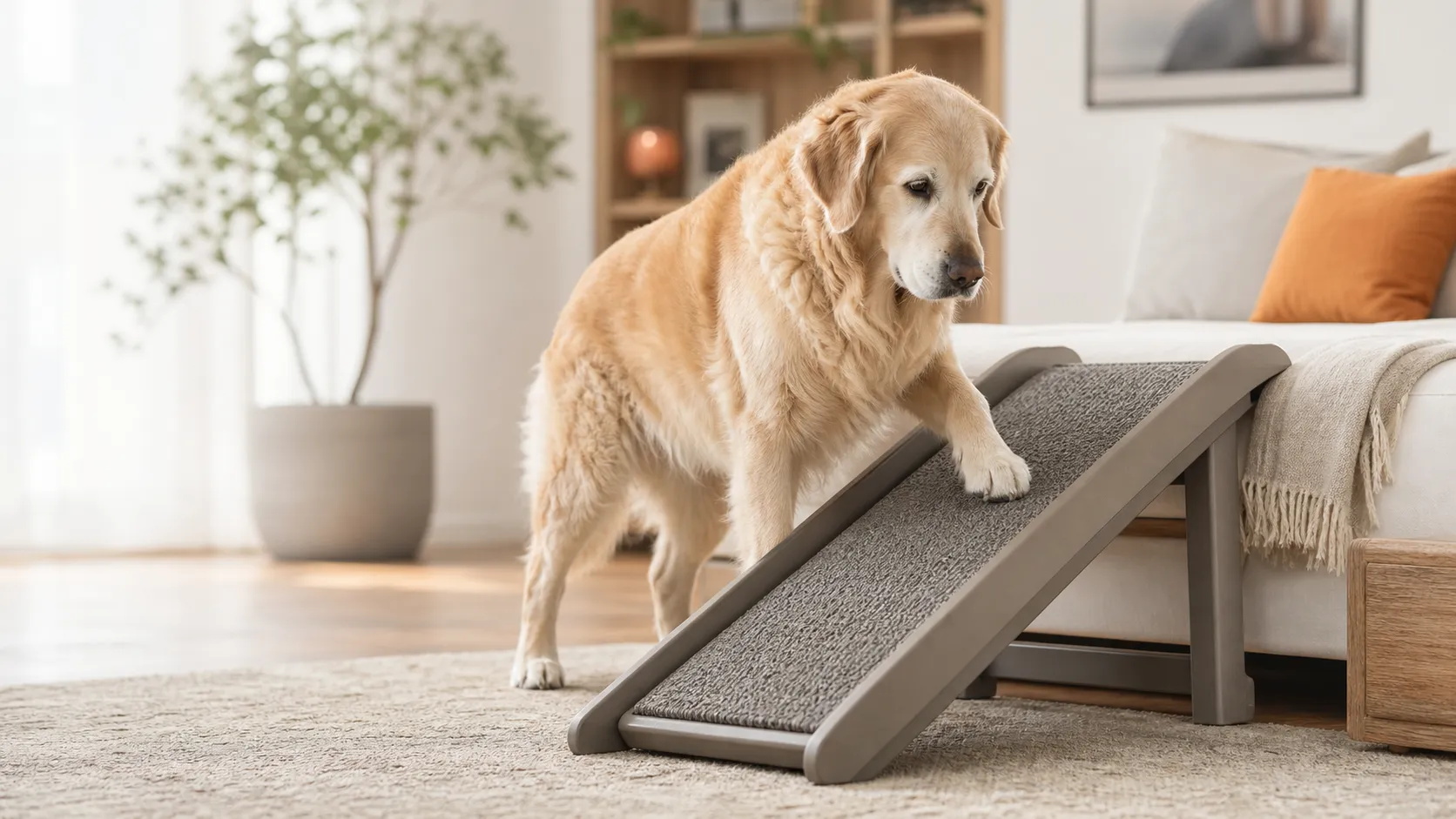
A dog that refuses a ramp is usually giving you useful information. The surface may be slippery, the ramp may move under load, the angle may be too steep, or the dog may be worried about the drop at the top. A sudden refusal can also be a pain signal rather than a training problem.
Quick answer: Put the ramp flat on a stable, non-slip floor and see whether your dog will cross it. If the flat test works, add height in small steps while checking the ramp’s grip, flex, side edges, and landing. Fix the physical bottleneck first, then use short reward-based sessions. Do not drag, push, or corner a frightened dog onto the ramp.
This guide is a diagnosis flow for the ramp you already own. It also explains when a strip of traction tape, a compatible carpet cover, a cut-to-fit rubber surface, a self-supporting ramp, or an adjustable bed ramp is the sensible next move. For a broader comparison of car, bed, and couch ramps, see our large-dog ramp comparison.
You will learn how to:
- separate grip, angle, wobble, edge confidence, and fear;
- test each failure point without putting your dog at risk;
- choose a product only when it solves the diagnosed problem; and
- recognize when reluctance should be checked by a veterinarian.
Products matched to the diagnosed bottleneck
-
3M Safety-Walk Slip-Resistant Tape 610, Black, 4 in x 15 ft
3M
Industrial-grade adhesive-backed mineral traction tape that can be cut into strips for a ramp. It is a grip experiment, not a soft paw pad, so use it selectively and inspect the dog's paws.
- 4-inch-wide, 15-foot roll
- Mineral-coated high-friction surface
- Adhesive backing for clean, dry surfaces
- Best for
- Adding targeted traction to a hard ramp surface
-
PawStep 50706 Non-Slip Carpet with Adhesive Backing
PawStep
Adhesive-backed replacement carpet selected for the PawStep 50524 pet ramp. It makes sense when the original cover is smooth, torn, or detached, but the fit should be confirmed before ordering.
- One-set replacement carpet
- Adhesive backing for the compatible ramp surface
- Softer feel than industrial abrasive tape
- Best for
- Replacing a worn cover on the compatible PawStep 50524 ramp
-
Rubber-Cal Ramp Cleat Non-Slip Outdoor Rubber Mat
Rubber-Cal
A thick outdoor rubber mat with a cleated surface that can be cut to a ramp's dimensions. It is a material option for a careful DIY surface refresh, not a loose mat to place on top and hope stays put.
- Approx. 1/8-inch rubber thickness
- Cleated non-slip surface for outdoor use
- Large sheet can be trimmed to fit
- Best for
- A cut-to-fit rubber traction layer for a custom or hard-surface ramp
-
Pet Gear Free Standing Pet Ramp with supertraX Surface
Pet Gear
A self-supporting 56-inch ramp with a removable supertraX traction mat, raised side rails, and rubberized bottom grippers. Its own base addresses the common failure mode where a ramp shifts or flexes at the middle.
- Free-standing design with no assembly described
- 56 in x 16 in x 23 in dimensions
- Supports up to 200 lb (manufacturer/manufacturer claims)
- Best for
- A wobble or support problem at a bed, sofa, or low vehicle entry
-
Tresbro Adjustable Wooden Dog Ramp for High Beds, 55.11 in
Tresbro
A 55.11-inch adjustable wooden bed ramp with an anti-slip mat, side rails, and a described height range of 19.3 to 27.17 inches. It is a furniture solution, not a universal car ramp.
- 55.11-inch ramp length
- Adjustable height range of 19.3 to 27.17 inches
- Anti-slip mat and side rails
- Best for
- Matching a ramp to a high bed when angle and side confidence are the blockers
Review the linked product page before purchasing.
The 60-Second Diagnosis
Start with the least demanding version of the task. Put the ramp flat on a carpet or another surface that will not slide, remove the top height, and let your dog investigate without being called onto it. Keep treats beside the ramp rather than luring the dog into a place where it feels trapped.
Use this sequence to find the first failed variable:
| What you see | Most likely bottleneck | First test | Fix direction |
|---|---|---|---|
| Paws splay, slide, or scratch for purchase | Traction | Walk the ramp flat and dry; watch each step | Clean the surface, add a suitable cover or targeted grip, or replace a worn surface |
| Dog crosses flat but refuses as soon as one end is raised | Angle, height, or landing | Raise the end only a few inches and compare | Lower the rise, use a longer ramp, or choose an adjustable model |
| Ramp shifts, dips, creaks, or twists | Wobble or poor support | Press down at the center and load both ends by hand | Secure both ends, add manufacturer-approved support, or move to a self-supporting ramp |
| Dog walks up but backs away at the top | Edge or landing confidence | Make the top landing wide, level, and brightly lit | Add side rails, improve the landing, or change the approach angle |
| Dog freezes, trembles, lip-licks, avoids treats, or bolts | Fear or too much pressure | Return to flat and reward looking, then one paw | Use smaller steps and shorter sessions; never force the crossing |
| Refusal is sudden or paired with stiffness, limping, or trouble rising | Pain or another health change | Stop the experiment and observe normal movement | Contact your veterinarian before more training |
Change one variable at a time. If you add grip, do not also raise the ramp, move it to the car, and start a new cue in the same session. Otherwise, you will not know what helped—and your dog may learn that the ramp predicts several difficult changes at once.
Fix Grip Before You Train
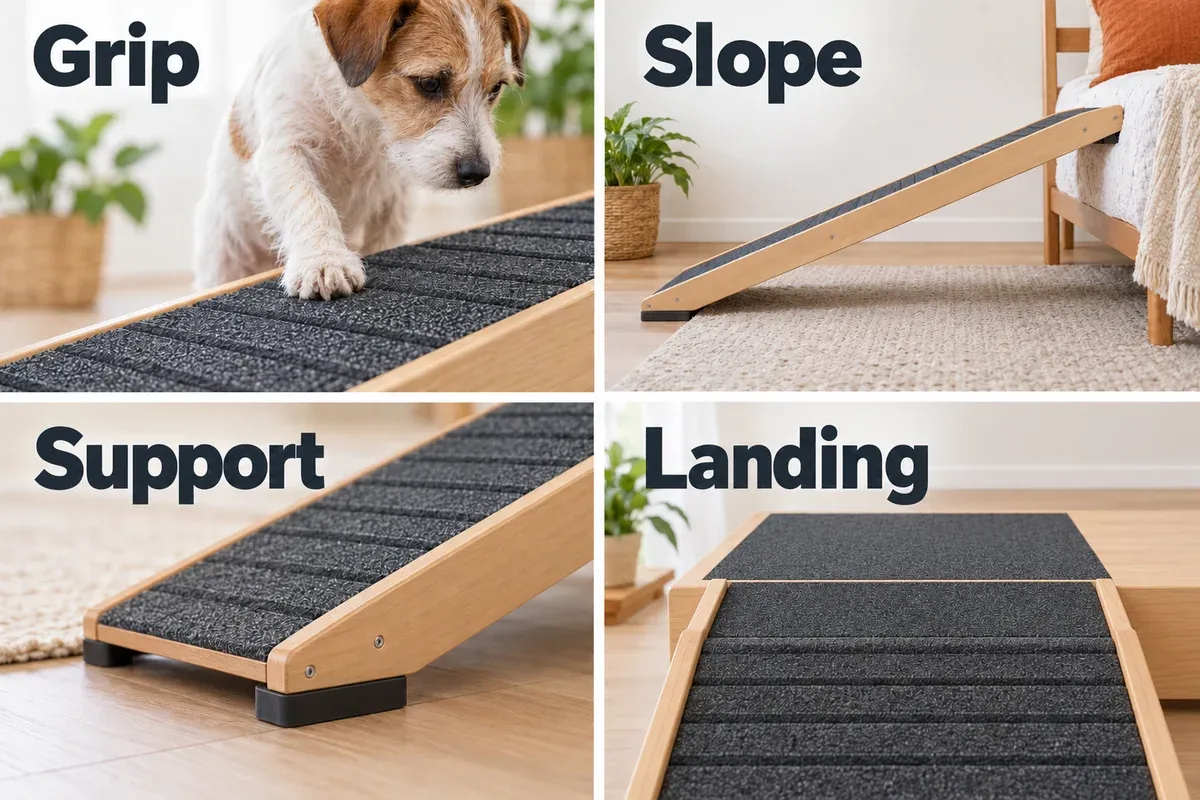
Dogs need to feel that each paw will stay where it lands. A surface that looks textured to a human can still be slippery under a dog’s pads, especially when it is dusty, damp, worn smooth, or covered with loose fibers. VCA recommends a sturdy ramp with a non-slip surface and notes that stick-down grip tape or carpet runners can be useful in a mobility-friendly home. Their guidance also emphasizes non-skid flooring around the ramp, because a secure ramp cannot compensate for a slippery takeoff or landing.
Try these low-risk checks first:
- Wipe the ramp clean and dry. Remove hair, mud, and loose fibers.
- Check the cover with your hand. If it slides, bubbles, or lifts at an edge, your dog can feel that movement.
- Put a non-slip mat under the approach and landing. The dog should not lose traction before or after the ramp.
- Test the flat ramp with one calm step at a time. Stop if paws slide or the dog changes gait.
When grip tape makes sense
3M Safety-Walk Slip-Resistant Tape 610 is an industrial mineral-coated tape intended for high-friction areas including ramps, steps, and vehicles. A 4-inch-wide, 15-foot roll can be cut into spaced strips rather than laid as one uninterrupted abrasive floor.
That distinction matters. A narrow test strip can tell you whether traction is the problem, but the coarse mineral surface may be uncomfortable for sensitive, injured, or post-operative paws. Test a small section, round or seal the edges, and inspect your dog’s pads after use. If your dog has sore paws or a very tentative gait, a softer rubber or compatible carpet surface is a better starting point.
When a carpet cover makes sense
The PawStep 50706 replacement carpet is for the compatible PawStep 50524 ramp. It is useful when the ramp’s original cover is the failed part—smooth, torn, loose, or missing—but it cannot correct a steep angle or a frame that flexes.
Measure and confirm the model before ordering.
When a rubber mat makes sense
The Rubber-Cal Ramp Cleat mat is a large, cleated outdoor rubber sheet that can be trimmed to fit a custom or hard-surface ramp. It is a material option for a careful surface repair, not a loose blanket to place on top. The finished layer must be bonded or otherwise secured so it cannot bunch under a paw.
If the ramp is a folding model, check that added material does not stop the hinges from closing or prevent the ramp from sitting flat on the vehicle. Recheck the load path after the modification.
Fix the Angle, Not Just the Dog’s Confidence
If your dog uses the ramp flat but refuses it at height, the slope is the leading suspect. A ramp’s length, the rise to the bed or vehicle, and the available landing all interact. For example, a 24-inch rise on a 63-inch ramp is roughly a 22-degree slope when the ramp length is treated as the sloping side. That is a useful comparison, not a universal veterinary limit; a painful or fearful dog may need a gentler setup.
Use this order:
- Lower the destination if you can. A lower platform or a different parking position may solve the problem without a new product.
- Increase the ramp length when the dog needs a gentler climb. A longer ramp also needs enough ground space to sit fully flat.
- Keep the top landing level and generous. A dog should not have to step from the ramp onto a narrow lip or immediately turn.
- Match the ramp to the job. A short couch ramp, a high-bed ramp, and a vehicle ramp are not interchangeable just because all three are called dog ramps.
The existing large-dog ramp comparison covers longer vehicle ramps and their load limits. If the problem is a tall bed rather than a car, an adjustable indoor ramp is usually easier to fit than a fixed car ramp.
When an adjustable bed ramp makes sense
The Tresbro adjustable wooden ramp is designed for high-bed access, with a described 55.11-inch length, an adjustable height range of 19.3 to 27.17 inches, an anti-slip mat, and side rails. Those rails can help a dog that is worried about stepping off the side, while the height settings let you test a less demanding rise.
Measure the actual mattress or platform height, not only the bed frame. Set the ramp so the top ends on a level landing rather than on a soft, shifting blanket. It is a furniture solution, not a reason to use a bed ramp for a vehicle.
Fix Wobble and Support Before Adding More Treats
One unexpected shift can teach a dog that the ramp is unsafe. Check the ramp while it is empty, then apply hand pressure where your dog’s weight will travel. Look for:
- a bottom edge that walks forward on the floor;
- a top edge that can slide off the bed, bumper, or trunk lip;
- a center that dips or twists under load;
- feet that do not touch evenly; and
- side rails or hinges that rattle when the ramp moves.
The support has to be part of the ramp’s intended load path. Do not put a loose box, cushion, stack of books, or generic motorcycle loading-ramp support under the middle and assume it is safe. A support that shifts, catches a paw, or changes the angle as the dog climbs can make the ramp more dangerous than the original setup.
When a self-supporting ramp makes sense
The Pet Gear Free Standing Pet Ramp with supertraX surface is a practical choice when the support problem is the main blocker. Pet Gear lists a free-standing design, rubberized bottom grippers, raised edges, a removable traction mat, 56 x 16 x 23-inch dimensions, and a 200-pound capacity. Its base supports itself instead of relying on a narrow furniture edge or an improvised center prop.
It still needs a proper fit. Measure the height, check the landing, and make sure the ramp sits on a surface where all grippers can contact the floor. “Free-standing” does not mean “works at every height” or “cannot slide on a slick floor.”
The Pet Gear manufacturer page explains the free-standing concept and the lower-foot design in more detail. That is a stronger source for the design intent than an anonymous marketplace summary.
Treat Fear as Information, Not Disobedience
Once the physical setup is safe, train the smallest version of the behavior. The AKC’s positive-reinforcement guidance describes marking and rewarding the behavior you want. For a ramp, the first useful behavior may be looking at it, not walking the full length.
Use this progression:
- Place the ramp flat on a non-slip floor. Reward looking at it, sniffing it, and choosing to approach.
- Reward one paw on the ramp, then two paws. Feed low and close to the surface so the dog does not have to stretch or scramble.
- Build a short crossing. Let the dog step off immediately; do not block the exit.
- Repeat at the same setup until the dog moves easily, then raise one end only a little.
- Add the real destination—bed, sofa, or car—last. Keep the ramp in the same orientation if possible.
Use high-value, pea-sized rewards and end after a few successful repetitions. If the dog stops eating, turns away, freezes, pants, trembles, or rushes backward, the step is too large. Lower the difficulty instead of holding the treat farther away.
Do not pull the leash up the ramp, carry the dog to the middle, push from behind, or use food to lure the dog into a position where it cannot retreat. A ramp should become predictable and voluntary. Dogster’s ramp-training walkthrough also recommends starting with the ramp flat and increasing the incline gradually.
Products Matched to the Failure Point
The table above is the quick shopping view. Use these notes to avoid buying a product that solves the wrong problem.
3M Safety-Walk Tape — use for a hard, slippery surface
Skip it if: your dog has tender paws, the ramp already has a comfortable carpet surface, or you are hoping tape will stop a ramp from sliding or flexing.
Check current price on Amazon →PawStep 50706 Carpet — use when the compatible cover is worn
Skip it if: your ramp is not the PawStep 50524, the frame wobbles, or the angle is too steep. Confirm the model and dimensions first.
Check current price on Amazon →Rubber-Cal Ramp Cleat Mat — use for a cut-to-fit rubber surface
Skip it if: you cannot secure the edges, the ramp must still fold tightly, or you have not confirmed that the frame itself is safe.
Check current price on Amazon →Pet Gear Free Standing Ramp — use when support is the bottleneck
Skip it if: you need a very gentle vehicle slope, have less than 16 inches of width available, or cannot create a level top landing.
Check current price on Amazon →Tresbro Adjustable Bed Ramp — use when height and side confidence are the blockers
Skip it if: you want a car ramp, your dog exceeds the described 200-pound capacity, or the bed has no stable landing area.
Check current price on Amazon →What Not to Do
- Do not force a frightened dog onto the ramp. It can turn hesitation into a stronger avoidance response and may cause a fall.
- Do not use a loose support or loose mat. Anything that shifts under load is part of the hazard.
- Do not trust the printed weight limit by itself. A ramp can be rated for your dog’s weight and still be wrong for the height, width, surface, or landing.
- Do not cover every ramp with coarse abrasive tape automatically. Test paw comfort and inspect the surface after a short session.
- Do not hide pain behind training. A dog that suddenly stops climbing stairs, jumping, rising, or using a familiar ramp deserves a health check.
When Ramp Refusal Means a Vet Visit
The VCA notes that reluctance to walk, run, climb stairs, jump, or play can be a sign of pain, and Cornell’s canine pain guide lists difficulty moving, climbing stairs, and getting up among behaviors worth taking seriously. Watch for a new limp, stiffness after rest, a tucked or hunched posture, trembling, yelping, reluctance to be touched, changes in appetite, or a dog that avoids jumping and stairs as well as the ramp.
Stop ramp practice and contact your veterinarian if the change is sudden, follows an injury or procedure, or appears in normal movement. For a dog with arthritis or another mobility condition, a veterinary rehabilitation professional can help you choose a safe rise, surface, and progression. Our guide to dog beds for arthritis covers the surrounding rest setup, but it does not replace an examination.
If your dog can comfortably manage a short walk but needs help with the return journey, our stroller vs wagon guide for large senior dogs compares resting space, entry height, ramps, and handling. Choose transport around the movement your dog can manage; a ramp-equipped wagon still requires a comfortable ramp entry and does not solve the cause of refusal.
If your dog has assessed hind-limb weakness on level ground and the veterinary team recommends a cart, use our dog wheelchair size and support selector to prepare the measurements and compare rear with full support. The support choice depends on front-limb strength, balance, and the clinical plan; a refusal to use a ramp by itself does not establish a need for a wheelchair.
For US financial planning after you have contacted a clinic, our vet cost calculator can show a range for common dog visits and procedures. It must not delay urgent care.
A Seven-Day Ramp Reset
This schedule is a starting framework, not a deadline. Repeat a day when your dog is hesitant, and move back one step after a fearful response.
| Days | Setup | Goal |
|---|---|---|
| 1-2 | Ramp flat, dry, stable, and away from the destination | Voluntary approach, sniffing, and one- to two-paw contact |
| 3-4 | Same ramp with a very small rise | Calm crossing without sliding, rushing, or stopping |
| 5 | Correct height with a wide, level landing | Walk up, pause, and step onto the landing |
| 6 | Add the real bed, sofa, or parked car while keeping the setup stable | Generalize the behavior without adding pressure |
| 7 | One or two calm repetitions, then stop | Maintain confidence; do not chase extra repetitions |
Keep a short note of the exact setup, the dog’s body language, and the point where it hesitates. That record is more useful than simply writing “refused ramp,” especially if you need to show the pattern to your veterinarian or trainer.
Frequently Asked Questions
Why will my dog use the ramp flat but not when it is raised?
The raised version adds slope, height, and often a visual drop. Lower the rise, improve the top landing, and test a longer or adjustable ramp. Keep the surface and training steps the same while you change only the height.
Should I use carpet or rubber on a dog ramp?
Choose the surface your dog can grip without sliding and tolerate without paw irritation. Carpet can feel familiar but may hold moisture or wear smooth. Rubber can offer consistent traction but must be secured. Industrial abrasive tape is a targeted option, not a default paw-friendly covering.
How do I stop a dog ramp from wobbling?
Make sure both ends sit on stable surfaces, the feet contact evenly, and the frame does not flex under hand pressure. Use only a support designed for that ramp or choose a self-supporting model. Never rely on a loose box, cushion, or generic loading-ramp stand.
Can I train my dog to use a ramp after surgery?
Follow the veterinary team’s instructions first. The correct ramp angle, surface, leash use, and amount of assistance depend on the procedure and recovery stage. If the dog is painful or unsteady, training should not be used to override those limits.
How long does ramp training take?
Some dogs cross a flat ramp in one session; others need days or weeks, especially after a slip or when pain has been involved. Progress is measured by relaxed body language and reliable movement, not by forcing a deadline.
Sources and Further Reading
- VCA: Creating a Comfortable Home for a Mobility-Compromised Dog — non-slip surfaces, sturdy ramps, flooring, and gradual support.
- VCA: Pain Management for Dogs — mobility changes that can indicate pain.
- Cornell Riney Canine Health Center: Recognizing Pain in Dogs — behavioral and movement-related pain signs.
- AKC: Training Your Dog with Rewards and Positive Reinforcement — reward-based training mechanics.
- 3M: Safety-Walk Slip-Resistant Tape 610 — official surface and application information.
- Pet Gear: Free Standing Pet Ramp — official dimensions, traction mat, grippers, and support details.