

 Published sources
 Product details checked
A dog wheelchair is not sized by breed name or body weight alone. The useful starting measurements are rear-leg height, armpit-to-rump length, and current weight. The support decision matters just as much: a rear cart supports the hind end while the front limbs propel and steer, whereas a full-support or four-wheel configuration also changes how the front limbs and trunk are loaded.
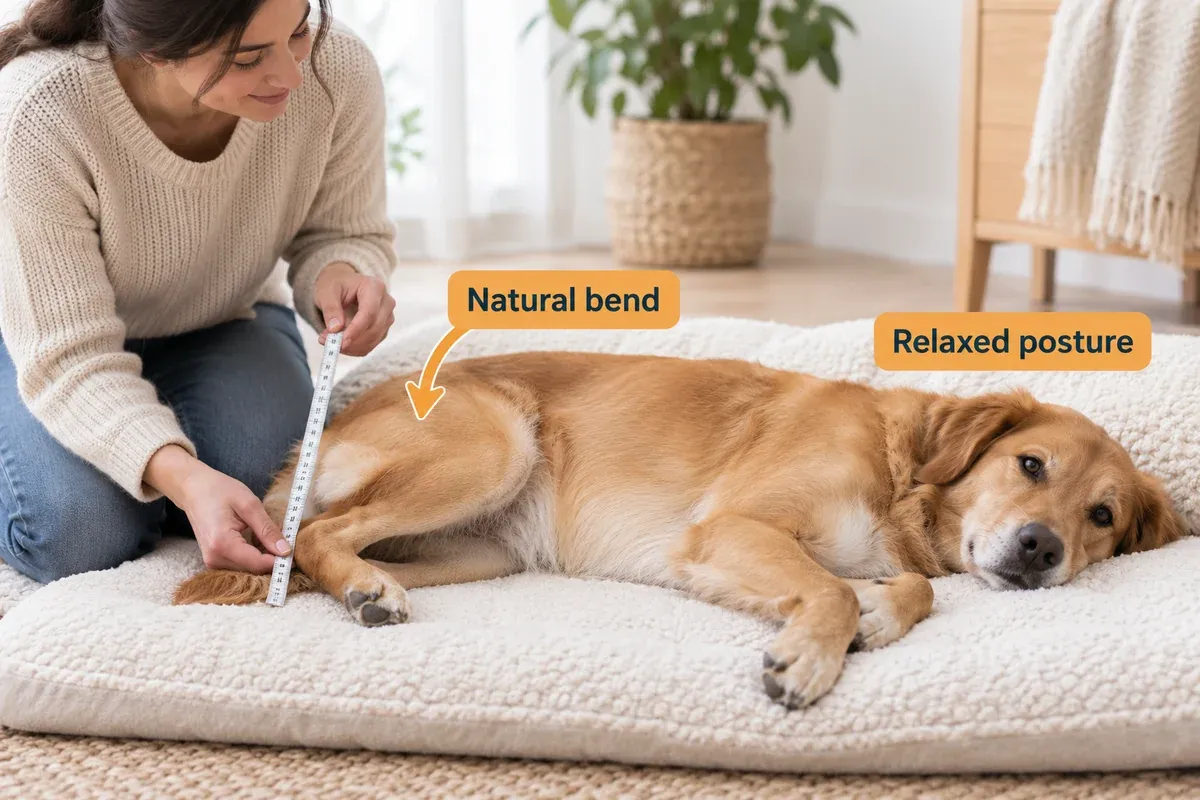
Quick answer: choose a rear-support starting point only when the front legs can bear weight, steer, and maintain a coordinated gait. Discuss full support when the front limbs are weak, all four limbs are affected, or balance is poor. For the Walkin’ Wheels frames covered here, measure the rear leg with the dog lying on its side, from where the leg meets the abdomen to the toe pad, keeping its natural bend. Measure body length from behind the front leg to the rump, then match the measurements to the exact frame, wheel, and strut configuration. A veterinarian or canine rehabilitation professional should assess the underlying problem and the fit, especially after a sudden change, with pain, or with a progressive neurologic condition.
Medical note before you buy
Mobility equipment can help a dog move, exercise, and participate in daily life, but it does not diagnose the cause of weakness or pain. Cornell’s Sports Medicine and Rehabilitation service describes gait assessment, rehabilitation, and assistive devices as parts of a broader clinical process. VCA’s overview of veterinary rehabilitation likewise frames mobility work as a coordinated plan rather than a one-size-fits-all product.
If your dog suddenly cannot stand or walk, seems painful, or is deteriorating quickly, contact a veterinarian promptly instead of using a wheelchair to postpone an examination. For a known condition, ask whether the cart should be used for short supported walks, exercise, bathroom trips, or only selected activities. The right schedule depends on strength, sensation, skin condition, joint motion, bladder and bowel function, and the dog’s ability to rest safely between sessions.
Before choosing equipment, tell the clinician what your dog can do on an ordinary level floor: stand without collapsing, move forward, turn, and stop. Describe whether the difficulty is constant or appears after activity, and whether it affects one limb, both hind limbs, or the front limbs as well. A short video of normal movement may help the conversation if you can record it without asking the dog to repeat a painful task.
Ask which paws should bear weight, whether any paws need protection from dragging, who will check the first fit, and what should make you stop a session. VCA’s rehabilitation guidance calls for a veterinary examination and an individual treatment plan, with follow-up assessment of the response. A size chart cannot answer those clinical questions.
Dog Wheelchair Size and Support Selector
Measure the individual dog on a firm surface, with a second person helping to keep the dog relaxed. The selector records your measurements and points to a broad rear-frame weight reference. It does not choose a wheel-and-strut combination, confirm the fit of a Corgi frame, or select a full-support size.
Interactive sizing screen
Screen a rear or full-support cart
Enter the dog's current measurements and the kind of support you are considering. The result gives you a manufacturer-chart starting point and highlights the fit checks that still need a veterinary or rehabilitation assessment.
Your starting support screen
Enter the dog's measurements to see a frame band and the next fit checks.
The weight references come from the Walkin' Wheels rear-wheelchair sizer. Special frames such as the Corgi have their own charts. A weight reference does not confirm leg height, frame length, width, or medical suitability. Decimal measurements are accepted; the input limits are calculator limits, not product fit ranges.
The official Walkin’ Pets wheelchair sizer gives these general rear-frame weight references: Mini 2–10 lb, Small 11–25 lb, Medium 26–49 lb, Medium/Large 50–69 lb, and Large 70–180 lb. The Corgi has a separate chart. Keep the rear-leg measurement and armpit-to-rump length beside the weight; the word “Medium” alone does not tell you which hardware fits.
Read the result before choosing a frame
The size name in a rear-support result means that the recorded weight falls in that general frame band. Fit remains unconfirmed. The manufacturer still needs the leg measurement to match wheel diameter and strut length. A strut is the upright piece that connects the wheel to the frame. Body proportions and harness position also need checking, even if the weight sits comfortably in the middle of the range.
If the result says “Between weight bands,” keep the actual weight and ask the manufacturer about the adjacent frames. The published bands use whole pounds and leave gaps for readings such as 25.5 lb or 69.5 lb. Rounding the dog’s weight up or down to obtain a size name would hide that uncertainty. Above 180 lb, arrange a load-rating and fit discussion instead of assuming the standard Large configuration applies.
Full support returns “Quad chart needed.” A rear-frame weight band does not approve the front attachment, front harness, or overall balance of a four-wheel cart. If you select “Uncertain,” the next step is an assessment of the support need before choosing equipment.
Using inches, centimeters, pounds, and kilograms
Select the units you used for measuring. You can enter decimals in either system. When you switch units, the measurements and their input limits convert together. Empty, negative, and out-of-range fields show an error and remove the size result until corrected; they do not become a default measurement or a capped value.
The selector’s starting measurements give this conversion example:
| Measurement | US value | Metric equivalent |
|---|---|---|
| Rear-leg height | 12 in | 30.48 cm |
| Armpit-to-rump length | 24 in | 60.96 cm |
| Current weight | 55 lb | Approximately 24.94758 kg |
These are example inputs, not a fit recommendation. In particular, the 24-inch body length remains 60.96 cm when you switch to metric. Converted inputs display up to eight decimal places; switching back without editing restores the original entry. Copy your original measurements into the manufacturer’s sizer rather than adding an allowance or rounding them to reach a size band.
Rear support vs. full support
The words “rear” and “full” describe load distribution, not the diagnosis. Use this decision screen:
| Situation | Starting direction | Why the distinction matters |
|---|---|---|
| Hind-limb weakness, while the front limbs are strong and coordinated | Rear support | The dog can use the front limbs to move and steer while the cart supports the back end. |
| Front-limb weakness plus hind-limb weakness, or poor balance through the trunk | Full support / quad | Four-wheel or front-attachment systems can support both ends, but they alter the dog’s gait and loading. |
| One painful limb, a changing limp, or an unclear neurologic problem | Assessment first | A cart can hide a symptom, load an injured area, or be the wrong tool for the problem. |
| A dog that cannot tolerate the harness, cannot steer, or repeatedly collapses | Stop and reassess | A technically correct size is not a safe fit if the dog cannot remain comfortable and controlled. |
What rear support can and cannot do
A rear-support cart is designed for a dog that still has enough front-end strength to push, steer, and stop. The hind limbs may be weak, paralyzed, knuckle, or tire quickly, but the dog still needs to control the front half of the body. Depending on the condition, the rear paws may touch the ground for assisted walking or rest in stirrups for non-weight-bearing support. The choice should come from the dog’s gait and veterinary plan, not from the product title.
When full support deserves a closer look
Full support can mean a four-wheel frame or a rear cart with a compatible front attachment. It may be considered when the front legs cannot reliably support the chest, when all four limbs are affected, or when the dog cannot stay balanced in a rear cart. The Walkin’ Pets front-attachment instructions illustrate why the front piece is a real fit system: the extenders, front legs, chest width, and ground contact all have to line up.
Do not assume that adding two front wheels automatically creates a safe full-support setup. A clinician may prefer a different harness, a temporary sling, a brace, physical rehabilitation, or another mobility plan. A four-wheel cart can also remove useful weight-bearing from limbs that still need carefully controlled loading.
How to measure a dog for a wheelchair
Use the instructions for the exact brand you are considering. The method below is for the Walkin’ Wheels frames linked in this guide. Another manufacturer may ask for standing height or additional measurements; those numbers are not interchangeable with Walkin’ Wheels rear-leg height.
Have a tape measure, a current weight, and someone who can help keep the dog comfortable. Take each measurement twice and record the posture. If the readings differ, recheck the starting point and leg position before recording a final number. Do not average two measurements taken in different postures. If lying on the side causes pain or distress, stop and ask the veterinary or rehabilitation team to help measure.
| Measurement | How to take it | What it controls |
|---|---|---|
| Rear-leg height | With the dog lying on its side, measure from the top of the rear leg where it meets the abdomen down to the toe pad. Keep the natural bend; do not stretch or extend the leg. | The wheel-and-strut combination, available height adjustment, and intended paw contact. |
| Armpit-to-rump length | Measure along the side of the body from behind the front leg to the rump. Exclude the neck and tail. | Frame length, harness placement, and the amount of body that sits between the front and rear support points. |
| Current body weight | Weigh the dog in its current condition, including any meaningful change from the last visit. | A load-rating screen and a starting frame band; never a substitute for the two length measurements. |
| Widest-body width | Check the width across the widest part of the body, usually the chest, following the frame’s fitting instructions. A harness may separately require chest circumference. | Side clearance and whether the dog stays centered between the frame rails. Chest circumference is not the same measurement as frame width. |
Rear-leg height is not standing height
For Walkin’ Wheels, standing floor-to-hip or floor-to-shoulder height is the wrong measurement. Its Medium sizing instructions identify the upper endpoint as the top of the leg where it meets the abdomen. The manufacturer’s measuring guide shows the side-lying posture and natural bend.
Work through the measurement in this order:
- Let the dog settle comfortably on its side. Keep the hind leg in its relaxed, naturally bent position.
- Locate the upper point where the rear leg meets the abdomen and the toe pad shown in the manufacturer’s diagram.
- Measure between those points without pulling the paw away from the body or straightening the joints.
- Record the number and unit, then repeat with the same posture and endpoints.
- If you cannot reproduce the reading, show the measurement position to the manufacturer or clinician before ordering hardware.
If the dog can still use the hind legs, ask whether the toe pads should touch the ground. The manufacturer’s height-adjustment guidance distinguishes between supported paw contact and stirrups for a weak or paralyzed limb. That is a fitting and clinical decision, not a setting to guess from a product photograph.
Back length matters most in smaller and long-backed dogs
Weight bands become less useful when two dogs have the same weight but very different proportions. A short-legged, long-backed dog may need a different frame length or harness position than a compact dog at the same weight. This is why the selector keeps armpit-to-rump length beside the weight result instead of hiding it in a note.
The official measuring guide specifically asks for body length in dogs under 25 lb. The Corgi chart also uses length for its smaller configuration. Measure from the back of the front leg to the end of the body, stopping at the rump. A tape that includes the neck or tail produces a number the chart cannot use. Keep the body-length record for a larger dog as well; it can help the fitting conversation without implying that the selector has validated the frame’s length range.
When measurements sit near a boundary
A leg reading between two published hardware ranges needs clarification. For example, a chart that lists 13–14 inches and 15–18 inches does not tell you to round a 14.5-inch measurement into either option. Recheck the posture, keep the measured value, and ask which wheel-and-strut combination provides the necessary adjustment.
Do the same if the weight and leg measurements point in different directions. Choosing a larger wheel to match the weight can leave the frame too tall for a short-legged dog. The manufacturer’s wheel-size guidance explicitly cautions that larger wheels can reduce usable height adjustment. The appropriate response is a configuration check, not an automatic move to the next size.
What the fit should look like
Once the frame is assembled, compare the actual position with the manufacturer’s adjustment instructions:
- The hip or knuckle reference should sit where the manufacturer indicates, rather than several inches behind the pelvis.
- The frame should track straight and stay parallel to the dog’s body instead of pulling the spine sideways.
- The side rails should clear the body without squeezing the hips or leaving the chest unstable.
- The harness should distribute pressure over broad, padded areas and leave the armpits, groin, and skin folds free from rubbing.
- The paws should either make the intended ground contact or be protected in the intended stirrups. A toe dragging unexpectedly is a stop signal, not a reason to keep walking.
The Walkin’ Wheels adjustment guide describes centering the black knuckle at the hips, keeping the frame straight, and using the widest part of the body to set width. Those are useful checks even when you compare another brand, but each frame has its own harness geometry and instructions.
Products to compare after measuring
The rear-support options below use specific leg-height configurations. All require enough front-limb function for the planned activity. Use the matching manufacturer’s sizing section alongside the purchase link; a whole frame family can cover more leg heights than the individual configuration you are ordering.
Match the wheel-and-strut configuration
These configurations are documented in the Medium, Medium/Large, and Large manufacturer sizing sections:
| Rear-support configuration | Weight reference | Rear-leg measurement | Wheel and strut combination |
|---|---|---|---|
| Medium, 13–14-inch leg | 26–49 lb | 13–14 in / 33.02–35.56 cm | 8-inch wheels with 9-inch struts |
| Medium/Large, 17–20-inch leg | 50–69 lb | 17–20 in / 43.18–50.8 cm | 12-inch wheels with 12-inch struts |
| Large, 20–22-inch leg | 70–180 lb | 20–22 in / 50.8–55.88 cm | 16-inch wheels with 12-inch struts |
Each row is a configuration to compare, not a pass for every dog in the weight range. The Medium family also has 10–12-inch and 15–18-inch leg configurations. Medium/Large also has 14–16-inch and 21–22-inch configurations; Large also has 14–16-inch, 17–19-inch, and 23–25-inch configurations. A different leg measurement may need different hardware within the same frame family. If yours falls between those intervals, ask for a fitting check.
For the broader recurring cost of caring for a dog—not the wheelchair itself—use our dog cost calculator as a separate planning screen.
Rear-support configurations to compare
-
Walkin' Wheels Medium Dog Wheelchair
Walkin' Wheels
A Medium rear-support configuration for a 13–14-inch rear-leg measurement. It pairs 8-inch wheels with 9-inch struts; weight, body clearance, and harness fit also need to match.
- Rear cart format supports the hind end while the front limbs provide forward motion
- 13–14-inch rear-leg configuration with 8-inch wheels and 9-inch struts
- A size-specific frame can be adjusted only within its intended range
- Best for
- Dogs in the medium rear-support frame range whose front limbs remain functional
- Fit reference
- 26–49 lb; rear leg 13–14 in / 33.02–35.56 cm; body and harness fit still required
- Frame / adjustment
- Height, length, and width adjustment; 8-inch wheels with 9-inch struts
-
Walkin' Wheels Medium/Large Dog Wheelchair
Walkin' Wheels
A Medium/Large rear-support configuration for a 17–20-inch rear-leg measurement. It combines a medium frame with 12-inch wheels and 12-inch struts.
- Rear support can reduce hind-end load while preserving front-limb movement
- The frame is intended to be fitted around the individual dog rather than chosen from weight alone
- 17–20-inch rear-leg configuration with 12-inch wheels and 12-inch struts
- Best for
- Medium-to-large dogs with hind-limb weakness and enough front-limb strength to steer
- Fit reference
- 50–69 lb; rear leg 17–20 in / 43.18–50.8 cm; body and harness fit still required
- Frame / adjustment
- Height, length, and width adjustment; 12-inch wheels with 12-inch struts
-
Walkin' Wheels Large Dog Wheelchair
Walkin' Wheels
A Large rear-support configuration for a 20–22-inch rear-leg measurement. It pairs 16-inch wheels with 12-inch struts; the broad weight range still requires individual body and harness checks.
- Rear cart format is designed to support the hind limbs while the dog uses the front limbs
- 20–22-inch rear-leg configuration with 16-inch wheels and 12-inch struts
- The large frame is a broad range, so leg height and body proportions remain decisive
- Best for
- Large dogs in the rear-support range whose front limbs can support and propel the body
- Fit reference
- 70–180 lb; rear leg 20–22 in / 50.8–55.88 cm; body and harness fit still required
- Frame / adjustment
- Height, length, and width adjustment; 16-inch wheels with 12-inch struts
Match both weight and rear-leg measurement to the wheel-and-strut configuration. Confirm body clearance, harness fit, and return terms before ordering.
How to use the rear-support entries
Start with the support decision and measurements, then compare the relevant configuration. The Medium 13–14-inch option is a candidate only when the dog’s weight and rear-leg measurement both fall within that row. A 12-inch rear-leg measurement needs a different Medium configuration, even if the weight is within 26–49 lb.
The Medium/Large 17–20-inch option combines larger wheels with a medium frame. It does not fit a 14-inch rear-leg measurement simply because the dog weighs 55 lb. For a short-legged dog whose measurements conflict with the general frame band, ask about a suitable special frame.
The Large 20–22-inch option is one configuration within a broad 70–180 lb family. Body width, harness placement, and front-end strength still matter. A large dog with strong front limbs may be a rear-cart candidate; the same weight with front-limb weakness needs a full-support assessment.
Check current price on Amazon →Short-legged dogs: use the separate Corgi chart
The Walkin’ Wheels Corgi sizing chart separates two configurations:
- 11–43 lb: rear-leg measurement 8–11 in / 20.32–27.94 cm, armpit-to-rump length 10–22 in / 25.4–55.88 cm, with 8-inch wheels and 9-inch struts.
- 44–70 lb: rear-leg measurement 10–13 in / 25.4–33.02 cm, with 8-inch wheels and 6-inch struts. The chart does not publish a body-length interval for this configuration; confirm length and harness placement with the manufacturer.
At 44 lb, the general rear-frame screen says Medium, while the Corgi chart places the dog in its larger special configuration. That is why the selector cannot approve a Corgi size. Use the Corgi measurements and frame instructions together; the breed name and a seller’s broad weight description cannot resolve the choice.
What a full-support comparison needs
Compare where the front harness sits, how the frame turns, and whether the configuration has a clear measurement range for both ends of the dog. A front attachment must match the rear frame’s hardware. The Medium front-attachment sizing instructions use rear strut length and wheel diameter to identify a compatible attachment. “Medium” on two product names is insufficient.
The Walkin’ Wheels Medium/Large full-support chart separates 14–16-inch, 17–20-inch, and 21–22-inch rear-leg configurations. Its fit must also account for chest support and the position of the front legs. Follow the front-attachment fitting instructions for the shoulder position, level extenders, and intended paw contact, with the rehabilitation team’s guidance on loading.
A four-wheel frame from another brand needs its own instructions. Use a documented quad system as a reference for the questions to ask, rather than transferring its measurements to an unrelated cart. If the supplier cannot provide the applicable size chart and fitting instructions, leave that option out of the shortlist.
Before placing an order
Send the manufacturer or fitter a single record containing the current weight, rear-leg measurement, body length, chosen units, and support needs. Include any requested photos of the measurement position. Keep their confirmed frame and hardware recommendation with the order so you can compare it with what arrives.
Check the following before paying:
- The exact configuration covers both the weight and rear-leg measurement, with the intended wheels and struts.
- The body-length and width adjustments suit the dog, and the harness has its own correct size.
- The supplied components include the support pieces needed for the agreed paw-contact plan.
- Any future front attachment is compatible with that rear frame and hardware.
- You can manage the fitting, removal, and storage of the assembled cart.
- You understand the return conditions after assembly or a fitting trial, including any wear or shipping charges.
Allow for fitting help, replacement harnesses or leg rings, and wheel maintenance as well as the frame itself. The Medium wheelchair manual covers replacement wear parts and cleaning after exposure to sand, mud, or salt water. Actual service and replacement costs depend on the equipment and care plan; the dog’s routine cost calculator does not estimate them.
A safe fitting and introduction sequence
Even a good measurement can fail if the dog is introduced too quickly. The Walkin’ Wheels Medium manual recommends familiarizing the dog with the harness and cart, starting with short sessions, and providing rest breaks. Ask your veterinary or rehabilitation team how much loading and walking is appropriate, then use a controlled progression:
- Assemble and adjust the cart away from the dog. Check that buckles, wheels, stirrups, and support straps work before the first session.
- Let the dog investigate the frame while it is stationary. Reward calm behavior and stop before the harness becomes a source of fear.
- Fit the harness for a brief standing check. Look for free breathing, unrestricted shoulders, no pressure in the armpits, and the intended paw contact.
- Start on a level, non-slip surface with support from a second person. Walk only a short distance and watch the front and rear paws.
- Increase either time or distance gradually, not both at once. Recheck the skin and gait after every early session.
- Stop if the dog drags a paw, repeatedly tips, becomes distressed, develops rubbing, cannot urinate or defecate normally in the setup, or shows pain or unusual fatigue.
Keep sessions supervised. Take the dog out for rest; the standing carts described in the Medium and Large manuals do not let the dog lie down normally. Keep the cart clean and dry, inspect straps and wheel hardware, and follow its maintenance instructions.
After the first fitting, record the settings and look again when the dog’s weight, strength, gait, or skin condition changes. A previously comfortable fit may need adjustment. If the frame tilts, the harness rubs, or a paw starts dragging, stop the session and check the fit with the manufacturer and clinical team before increasing exercise.
Frequently Asked Questions
Can I choose a dog wheelchair by weight?
No. Weight is a load and frame-band check. It does not tell you whether the rear-leg height, armpit-to-rump length, chest width, harness position, or support type is correct.
Is a rear cart better than a four-wheel cart?
Neither is universally better. A rear cart may preserve useful front-limb movement when the hind limbs are the main limitation. Full support may be more appropriate when the front end or trunk cannot stay stable. The veterinary assessment decides which load pattern is safe and useful.
Does a four-wheel cart help a dog with hind-limb paralysis?
Sometimes, but not automatically. If the front limbs are strong and the dog can steer, a rear-support configuration may be simpler. A four-wheel setup can be considered when balance or front-limb function is also limited, but it changes the fitting and gait requirements.
How much back length should I add to the measurement?
Do not add an arbitrary allowance. Measure armpit to rump as instructed, then compare that result with the exact frame and harness chart. Extra length that moves the support behind the hips can be just as problematic as a frame that is too short.
Can I use a wheelchair without a veterinarian?
The equipment is available to purchase, but medical assessment is still the safer starting point. A professional can distinguish weakness from pain, identify problems that need urgent treatment, select the support type, and help set a tolerable duration.
How long can a dog stay in a wheelchair?
There is no single safe time limit for every dog. The answer depends on the condition, paw sensation, skin, strength, toileting, temperature, and the exact frame. Start with the veterinary or rehabilitation plan and use short sessions with frequent checks rather than a fixed clock-based rule.
What if my dog’s weight fits but the leg measurement does not?
Keep both measurements. A frame family may offer another wheel-and-strut combination, or the dog’s proportions may require a special frame. Ask the manufacturer to reconcile the numbers before purchase. Raising the cart or choosing larger wheels cannot safely be assumed to solve a mismatch.
Can a dog sleep in one of these wheelchairs?
Take the dog out to rest. The Medium and Large standing carts covered here do not allow normal lying down. Follow the clinical plan for transferring the dog, resting, and checking the skin between supported walks.
Sources and further reading
- Cornell University College of Veterinary Medicine: Sports Medicine and Rehabilitation
- VCA Animal Hospitals: Veterinary Rehabilitation Medicine
- Walkin’ Pets: Wheelchair Sizer
- Walkin’ Pets: How to choose the right Walkin’ Wheels size
- Walkin’ Pets Help Center: How to measure for a Walkin’ Wheels wheelchair
- Walkin’ Pets: Wheelchair adjustments
- Walkin’ Pets: Corgi sizing chart
- Walkin’ Pets: Medium sizing chart
- Walkin’ Pets: Medium/Large sizing chart
- Walkin’ Pets: Large sizing chart
- Walkin’ Pets: Medium front-attachment size guide
- Walkin’ Pets: Medium/Large full-support sizing chart
- Walkin’ Pets Help Center: Front attachment instructions
- Walkin’ Wheels Medium instruction manual
- Walkin’ Wheels Large instruction manual