


 Published sources
 Product details checked
A dog that barks at every delivery, hallway sound, passing dog, or empty corner is not necessarily being stubborn. Barking is communication. The useful question is not only how do I make it stop? but also what is my dog trying to change, avoid, or obtain?
Quick answer: Reduce barking by identifying the trigger, preventing your dog from rehearsing the behavior, and rewarding a specific alternative such as looking at you, coming to a mat, or staying quiet for a few seconds. Do not shout over the barking or start with an aversive bark collar. If the barking is sudden, happens only when your dog is alone, or comes with fear, pain, destruction, or escape attempts, involve your veterinarian or a qualified behavior professional.
The ASPCA’s barking guide makes the same central point: different barking patterns have different causes, and the realistic goal is usually to reduce barking rather than eliminate every normal alert. This guide turns that idea into a practical plan for the most common situations.
You will learn how to:
- tell alarm barking from attention, frustration, boredom, and separation-related distress;
- lower the number of barking rehearsals before training begins;
- teach a calm “quiet” response without punishing fear;
- choose simple tools that support the plan without pretending to replace it; and
- recognize when home training is not enough.
Tools that support a calmer barking plan
-
Furbo 360° Dog Camera
Furbo
A dog-focused rotating 1080p camera with treat tossing, two-way audio, color night vision, and barking alerts without a required subscription for core camera features.
- Rotating 360° view with automatic tracking
- 1080p video, color night vision, and two-way audio
- Treat toss and barking alerts for more active check-ins
- Best for
- Spotting barking triggers and checking on dogs when you are away
- Primary use
- 360° view + treat toss + two-way audio
-
KONG Classic Stuffable Dog Toy
KONG
A hollow natural-rubber toy that turns part of a dog’s daily food into a longer, calmer activity. It is useful before predictable barking periods, but it cannot fix fear or separation anxiety on its own.
- Hollow center for kibble or soft fillings
- Erratic bounce for interactive play
- Natural rubber for average chewers
- Best for
- Boredom, decompression, and reward-based training for average chewers
- Primary use
- Stuffable enrichment
-
PetSafe Busy Buddy Twist 'n Treat – Medium
PetSafe
An adjustable treat dispenser that can start easy and become more challenging as a dog learns to work calmly for kibble. The gradual difficulty makes it useful for short enrichment sessions.
- Adjustable opening for quick or slower dispensing
- Works with kibble and soft or smearable treats
- Random treat release keeps dogs engaged
- Best for
- Small-to-medium dogs who need an adjustable food puzzle
- Primary use
- Adjustable food puzzle
-
PetSafe Easy Walk Harness – Large
PetSafe
A front-chest-clip harness designed to reduce pulling and keep pressure away from the throat. It can make trigger-management walks safer and more workable while the dog learns calmer responses.
- Front chest attachment helps reduce pulling
- Martingale loop applies gradual pressure
- Adjustable breathable straps
- Best for
- Walk-triggered barking when you need more control to create distance
- Primary use
- No-pull front clip
Review the linked product page before purchasing.
Start With the Barking Pattern
Use this table for a first hypothesis, not a diagnosis. A dog can have more than one reason for barking, and the same dog may need a different response at the window than on a walk.
| What you see | What it may mean | First useful move |
|---|---|---|
| Barking at windows, doors, the fence, or people passing | Alarm or territorial behavior | Block the view, add distance, then reward a check-in or mat behavior |
| Barking directly at you for food, play, or access | Attention-seeking or demand barking | Stop delivering the reward during barking; reinforce quiet and a polite request |
| Barking at dogs or people on walks | Fear, excitement, or frustration | Increase distance before the bark starts and feed high-value treats while moving calmly |
| Barking after little activity, especially in the yard | Under-stimulation or a learned routine | Replace unsupervised yard time with sniffing, training, and food enrichment |
| Barking, pacing, scratching, or destroying things when alone | Separation-related distress | Use a camera to observe the pattern and get professional guidance rather than correcting remotely |
| Sudden barking, nighttime vocalizing, hoarseness, or unusual restlessness | Pain, illness, sensory change, or cognitive decline | Arrange a veterinary check before treating it as a training problem |
Keep a short trigger log for three to five days. Write down the time, trigger, distance, body language, what happened immediately before the bark, and what made the dog pause. This turns “my dog barks all the time” into a pattern you can actually train.
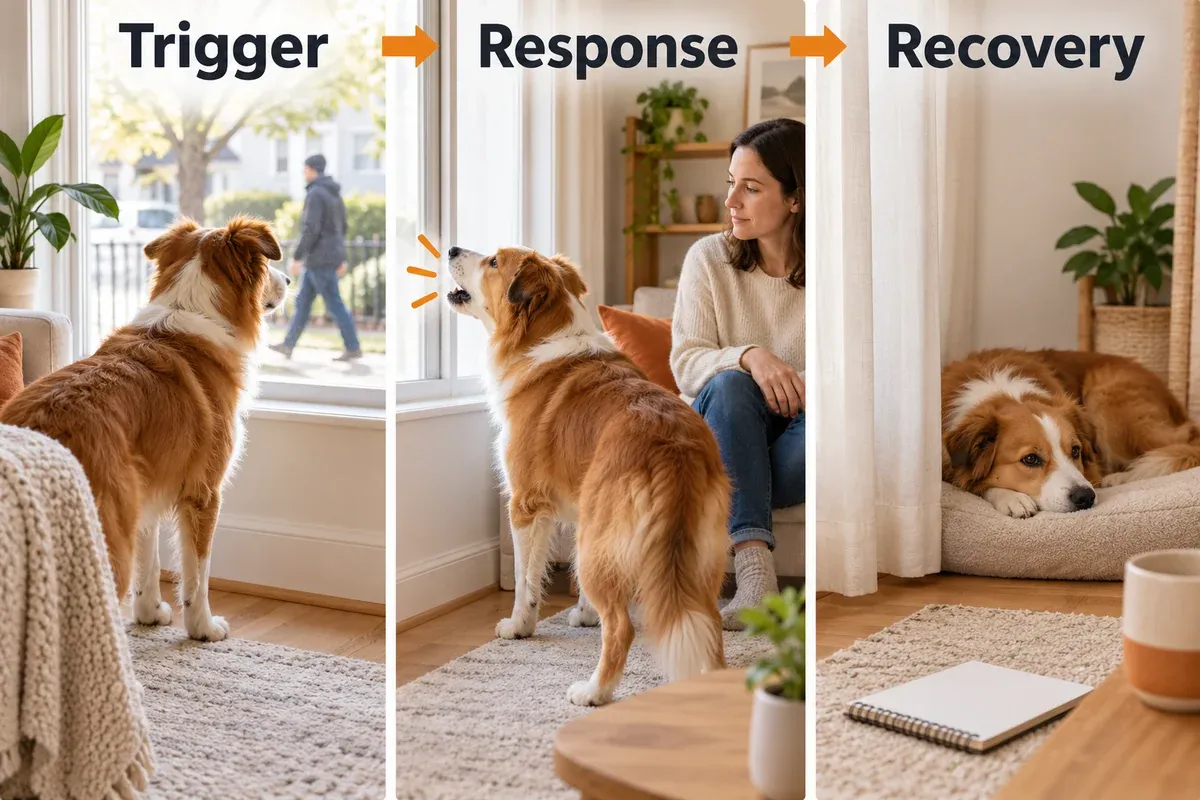
The Goal Is Less Barking, Not a Silent Dog
Some barking is useful. It can alert you to a visitor, signal discomfort, or express excitement. A dog who is never allowed to vocalize may become more frustrated, while a dog who is allowed to bark at every window movement gets many opportunities to practice the behavior.
Aim for three measurable changes:
- Lower intensity: your dog notices the trigger but can still eat and respond to you.
- Shorter duration: the dog recovers after a few seconds instead of continuing for minutes.
- A reliable alternative: the dog can look at you, move to a mat, sniff for treats, or leave the window when asked.
Those changes are more useful than a vague promise of “no barking.” They also tell you when the plan is working even if an occasional alert bark remains.
Step 1: Stop the Barking Rehearsal
Training works faster when the dog is not practicing the unwanted behavior dozens of times a day. Management is not giving up. It is how you create enough calm repetitions for learning to happen.
At windows and doors
- Close blinds or apply removable frosted film to the lower part of a window.
- Move furniture away from the best lookout spot.
- Use a baby gate to create a calm zone away from the entryway.
- Add steady background sound when hallway, traffic, or neighborhood noise is the trigger.
- Ask visitors to text instead of knocking during the first training sessions.
When the trigger appears, avoid racing to the window with your dog. Calmly call them away, scatter a few treats on the floor, and reward the moment they turn back toward you.
In the yard
Do not leave a dog who rehearses fence running or alarm barking outside unsupervised. Bring them in before the barking escalates, or use the yard only with an activity and a person present. A dog who is repeatedly able to chase the fence line may become quicker and more intense each time.
On walks
Choose quieter times and wider paths for now. Cross the street, step behind a parked car, or make a cheerful U-turn before your dog reaches the point where they can no longer eat. Distance is not failure; it is the training variable that keeps the dog under threshold.
Step 2: Teach a Quiet Response
The cue “quiet” works best when it predicts something the dog wants. Practice when the bark is mild, not in the middle of a full panic response.
A simple five-minute exercise
- Wait for a natural pause in barking, even if it lasts only one second.
- Say “quiet” once in a calm voice.
- Mark the silence with “yes” or a click, then deliver a pea-sized treat.
- Repeat five to ten times, stopping while the dog is still successful.
- Gradually wait for two, five, and then ten seconds of quiet before the reward.
If your dog barks again, do not repeat the cue louder. Lower the difficulty: move farther from the window, close the door, reduce the sound, or return to a shorter silence. Your dog cannot learn a new response while overwhelmed.
Once the cue is familiar, add an alternative behavior. Say “quiet,” wait for the pause, then guide your dog to a mat and reward again. Over time, the pattern becomes: notice trigger → check in → move away → earn reinforcement.
For attention barking, the timing is especially important. Do not give food, play, eye contact, or access to the yard while the dog is barking at you. Wait for a quiet second, ask for a sit or touch, and then provide the reward. Also give your dog regular attention when they are already calm so barking is not the only reliable way to start an interaction.
For a broader foundation, see our guide to basic dog training commands. Short, reward-based sessions make “come,” “sit,” “stay,” and “go to mat” useful outside the kitchen as well as inside it.
Step 3: Match the Plan to the Situation
Barking at the window or front door
Start with visual and sound management. Then practice a door routine with a helper:
- The helper stands far enough away that your dog can notice without exploding.
- You feed several treats for looking at you or standing on the mat.
- The helper takes one step closer, then stops while your dog can still eat.
- If barking starts, the helper moves away and you make the next repetition easier.
Do not ask a fearful dog to greet the visitor. Calm observation from a safe distance is a valid success. The AKC’s guide to excessive barking also emphasizes predicting the pause and reinforcing the quiet behavior rather than competing with the bark.
Barking at people or dogs on walks
Carry high-value, soft treats and look for the trigger before your dog does. Feed as soon as your dog sees the person or dog, then keep moving or create more distance. If your dog can no longer take food, the setup is too difficult.
A front-clip harness can help you create distance without putting pressure on the throat, but equipment should make training safer, not force a dog through a frightening encounter. Never use the leash to drag a barking dog toward a trigger.
If a dog who triggers barking will be joining your household, our guide to introducing two dogs explains the meeting and home setup. A dog who barks and lunges on leash needs individual help before a close introduction.
Barking at night
If nighttime barking is new, unusually intense, or accompanied by panting, pain, confusion, coughing, or repeated trips outside, call your veterinarian. Older dogs may also vocalize because of sensory loss or cognitive changes.
For a known environmental trigger, check the basics first: toilet break, comfortable temperature, secure sleeping area, and fewer visual or sound cues. Keep the response boring and predictable. Turning nighttime barking into a long conversation can accidentally reinforce it.
Barking when left alone
Do not assume this is boredom. Separation-related distress often begins soon after departure and may include pacing, drooling, destruction, escape attempts, or toileting. A camera can help you see whether the dog settles after five minutes or escalates immediately, but do not use the speaker to scold or repeatedly call the dog. That can add confusion or attention without addressing the anxiety.
Start with absences short enough that the dog remains calm, then increase duration in small steps. If the dog panics, seek help from your veterinarian or a qualified behavior professional. The ASPCA’s separation anxiety guidance explains why these signs should be treated as distress rather than disobedience.
Products That Support the Training Plan
These are tools for observation, enrichment, food delivery, and safer walks. None is a stand-alone cure for fear, frustration, or separation anxiety.
Furbo 360° Dog Camera – Best for Finding the Trigger
Best For: Barking that happens when you are away or in another room
Check current price on Amazon →Basic features: 360° view, barking alerts, two-way audio, night vision, treat toss
Why it helps
Guessing is the biggest problem with remote barking. The Furbo 360° can show whether the dog is reacting to a delivery, pacing at the window, barking at another pet, or becoming distressed as soon as you leave. The basic camera features do not require a subscription, which keeps the purchase more practical if you only need observation and bark notifications.
Use the camera to collect information, not to punish. A treat toss can reinforce a calm check-in, but tossing a treat immediately after every bark may teach the dog that barking makes food appear. Test the timing when the dog is quiet, and treat the camera as one part of a larger plan.
Pros:
- 360° rotation reduces blind spots in the room
- Bark alerts can reveal patterns you would otherwise miss
- Treat toss and two-way audio can support a planned calm routine
Cons:
- Advanced AI alerts and video history require Furbo Nanny
- Requires a power outlet and 2.4 GHz Wi-Fi
- The USB power adapter is not included
- A camera cannot treat separation anxiety by itself
Bottom line: Choose it when the first missing piece is information. If the camera shows panic rather than a simple alert bark, stop experimenting with remote corrections and get professional guidance.
KONG Classic Stuffable Dog Toy – Best for Boredom and Decompression
Best For: Average chewers who bark after too little mental activity
Check current price on Amazon →Material: Stuffable natural rubber; top-rack dishwasher safe
Why it helps
Sniffing, licking, chewing, and working for food can help many dogs settle after exercise or before a predictable trigger. Fill the toy with part of the dog’s normal meal, seal it with a small amount of wet food, and freeze it for a longer session. Start with an easy filling so the dog learns that the toy pays off.
The Classic is designed for average chewers, not determined power chewers. Choose the size recommended by the manufacturer, supervise the first sessions, and replace the toy if it becomes cracked or loses pieces. Food enrichment is useful for boredom barking, but it will not make a panicked dog comfortable with being alone.
Pros:
- Turns ordinary kibble into a longer activity
- Can be used on a mat or in a crate that the dog already likes
- Easy to clean and available in multiple sizes
Cons:
- The Classic formula is not the right choice for every power chewer
- Some dogs need a gradual introduction to food toys
- Extra treats can add calories if you do not subtract them from meals
Bottom line: This is a good low-cost first experiment for boredom and pre-trigger enrichment. It is not a bark stopper, and it should never be used to force a dog to stay alone longer than they can handle.
PetSafe Busy Buddy Twist ’n Treat – Best Adjustable Food Puzzle
Best For: Dogs who need a puzzle that can start easy and become harder
Check current price on Amazon →Format: Adjustable treat dispenser; top-shelf dishwasher safe
Why it helps
The Twist ’n Treat lets you change how quickly kibble or treats come out. Open it farther for a beginner, then close it as your dog learns to work without frustration. That makes it useful for short calm-down sessions, especially when barking is part of a predictable “I have nothing to do” routine.
Use a portion of the daily food allowance rather than adding a full bowl of extra treats. If your dog paws, bites, or gives up immediately, make the puzzle easier. The goal is relaxed problem-solving, not a second source of frustration.
Pros:
- Adjustable difficulty is helpful for teaching a new food puzzle
- Works with kibble as well as soft or smearable treats
- Compact and easy to clean
- Lower purchase cost than an electronic distraction device
Cons:
- Better suited to soft-to-medium chewers than aggressive chewers
- A dog can become frustrated if the opening is too tight
- It supports enrichment but does not address fear-based barking
Bottom line: Pick this instead of the KONG when adjustable difficulty matters more than bouncing or chewing. For many households, one well-used food puzzle is enough; you do not need a drawer full of toys.
PetSafe Easy Walk Harness – Best for Walk-Triggered Barking
Best For: Creating distance and control when a dog barks on walks
Check current price on Amazon →Design: Front-chest leash attachment with adjustable straps
Why it helps
Walk training is difficult when every lunge moves the dog toward the trigger. A correctly fitted front-chest harness can make it easier to turn away, cross the street, or guide the dog behind a visual barrier while you feed. The Easy Walk uses a front attachment and a martingale loop intended to reduce pulling without putting the leash load directly on the throat.
Fit matters more than the brand name. Check the manufacturer’s size guidance, look for rubbing after the first walk, and make sure the dog cannot back out. Start indoors with treats before using it near other dogs or people. The harness should give you safer handling while the dog learns that seeing a trigger predicts distance and food—not a forced greeting.
Pros:
- Front attachment can help with controlled U-turns and distance
- Adjustable, breathable design with quick-snap buckles
- Useful for management while reactivity training is underway
Cons:
- It does not change the emotion behind barking
- Incorrect fit can rub, restrict movement, or allow escape
- Some dogs need a different harness style or professional fitting
Bottom line: Consider it when the main problem happens outside and pulling makes it hard to get away from triggers. Pair it with high-value rewards and gradual exposure; do not use it to drag a dog toward something frightening.
What I Would Not Use as the First Fix
Anti-bark collars, shock devices, spray collars, and ultrasonic gadgets try to suppress the sound. They do not necessarily change why the dog is barking. The ASPCA describes anti-bark collars as punishment devices and does not recommend them as a first choice, particularly when barking is driven by fear, anxiety, or compulsion.
The American Veterinary Society of Animal Behavior’s humane training position statement advises against aversive methods such as electronic collars, prong collars, choke chains, and physical or psychological punishment. That matters here because a dog who is barking from fear may stop vocalizing while becoming more frightened, more frustrated, or less predictable.
Do not shout “quiet” repeatedly, shake objects at a fearful dog, or punish a dog for warning you. A calm interruption, more distance, and reinforcement for an alternative behavior give you better information and a safer training relationship.
When to Call a Veterinarian or Behavior Professional
Book a veterinary appointment before treating the issue as ordinary training if the barking:
- started suddenly or is dramatically worse;
- appears with pain, coughing, hoarseness, panting, confusion, or repeated nighttime waking;
- occurs with a new change in hearing or vision;
- is paired with pacing, drooling, destruction, toileting, or escape attempts when alone; or
- comes with growling, snapping, lunging, or a bite-risk situation.
For complicated cases, look for a board-certified veterinary behaviorist, a Certified Applied Animal Behaviorist, or a qualified positive-reinforcement trainer with experience in reactivity or separation-related problems. The ASPCA’s behavioral-help resource explains the different professional roles and when specialized help is appropriate.
A Practical 14-Day Reset
Use this as a starting schedule, then slow it down if your dog struggles.
Days 1–3: Observe and reduce rehearsal
Keep the trigger log. Block the most common window view, supervise the yard, and choose easier walking routes. Do not test the dog’s limits just to see whether the barking is “better.”
Days 4–7: Build the quiet response
Practice five minutes at a time in a low-distraction room. Capture natural pauses, add the cue, and then reinforce a mat, touch, or check-in. Use the KONG or Busy Buddy during a calm period so the dog learns how to use it before you need it.
Days 8–10: Add one mild trigger
Work below threshold with a helper, a distant dog, a quiet hallway, or a low-volume recording. Feed for noticing and recovering. End the session before the dog starts barking repeatedly.
Days 11–14: Generalize carefully
Practice the same response in a second room, at a different time, and on an easy walk. Keep the original management in place. New skills often disappear when the environment becomes harder, so change only one variable at a time.
If you cannot keep the dog under threshold, the barking is escalating, or the dog shows distress when alone, stop increasing difficulty and get professional help. A slower plan is safer than repeated failure.
Frequently Asked Questions
Can I teach my dog to stop barking at everything?
You can usually reduce the frequency, intensity, and duration, but a realistic goal is not zero barking. Start by identifying the function of the bark and teach an alternative response. If the dog is too distressed to eat or respond, increase distance or involve a professional.
Does yelling make a barking dog stop?
It may interrupt a bark for a moment, but many dogs experience yelling as attention, added excitement, or a threat. It can also increase fear in dogs who bark at people, dogs, or unfamiliar sounds. Use a calm cue once, create distance, and reinforce the pause.
Why does my dog bark only when I leave?
That pattern can be separation-related distress, especially when it begins soon after departure and comes with pacing, drooling, destruction, toileting, or escape attempts. Use a camera to observe the first few minutes and contact your veterinarian or a behavior professional rather than punishing the dog remotely.
Should I use a bark collar?
Not as a first step. Bark collars can suppress vocalization without resolving fear, frustration, boredom, or anxiety, and aversive devices can worsen the underlying problem. Start with trigger management, positive reinforcement, and professional help when needed.
Is a food toy enough to stop barking?
Food toys can help with boredom, predictable quiet periods, and decompression. They are not enough for fear, aggression, pain, compulsive barking, or separation anxiety. Use them as enrichment within a broader plan and supervise the first sessions.
How long does it take to reduce barking?
You may see small improvements within days when you stop rehearsals and reward quiet, but reliable behavior around real triggers often takes weeks. Progress depends on the cause, how often the dog practices barking, and whether the dog can stay under threshold. If there is no meaningful improvement after consistent, gentle work, get an assessment.
The Bottom Line
Your dog is unlikely to stop barking because of one gadget. The fastest path to a quieter home is usually a combination of better trigger information, fewer rehearsals, more distance, a rewarded alternative, and a plan that respects the dog’s emotional state.
Use a camera when you need to see what happens while you are away. Use a KONG or adjustable food puzzle for appropriate enrichment. Use a well-fitted harness when walk management is the bottleneck. Then keep the focus on the behavior plan: notice, recover, choose a calmer response, and earn something good.