

 Published sources
 Product details checked
Start with two handlers and a quiet outdoor space. Walk the dogs separately at a distance where both can stay relaxed, then move closer only if they remain comfortable. A brief greeting can happen during that first meeting if both dogs choose to approach calmly; it does not need to happen on a deadline. At home, supervise every shared interaction and give each dog a separate place to eat and rest. Dogs Trust’s introduction guidance and Best Friends Animal Society’s dog-introduction guide both put the dogs’ responses ahead of a fixed timetable.
This approach is for dogs that can remain reasonably comfortable around other dogs. If either dog has bitten another dog, guards resources, or barks and lunges on leash or behind a barrier, arrange individual help before attempting a close meeting. Best Friends specifically cautions against using a standard on-leash introduction for dogs with leash or barrier reactivity.
Before you arrange the meeting
Check whether this pairing is manageable
Think about how your resident dog behaves around dogs in ordinary settings, not just during an excited greeting. Can they notice another dog and look away? Do they recover when you give them more space? Can you call them away without pulling? Ask the shelter, rescue, or current caregiver how the new dog behaves around unfamiliar dogs, during meals, and when resting. A pleasant meeting is useful information, but it cannot tell you how the pair will handle every situation at home.
Consider each dog’s age, health, activity level, and need for quiet. A young dog that repeatedly pesters an older dog may need frequent breaks. A dog in pain or with a new change in behavior needs veterinary assessment; pain and other medical problems can contribute to irritability or aggression, as the ASPCA explains in its guide to aggression. If you cannot provide separate areas when needed, solve that practical problem before bringing another dog home.
Get help before the first close encounter if there is a bite history, repeated lunging or snapping at dogs, intense guarding of food or resting places, or a large size or health difference that would make an accident especially serious. A qualified reward-based trainer experienced with dog-to-dog introductions can help with the setup; for aggression or substantial fear, ask your veterinarian about a veterinary behaviorist. The ASPCA’s guide to behavioral help explains why guarding and aggression call for individual assessment rather than a group class.
Prepare a home with two separate areas
Set up a quiet area for the new dog and keep the resident dog’s familiar resting place available. Each needs water, a place to sleep, and a way to rest without being approached. Use doors that close securely for meals, overnight rest, and any time you cannot supervise. A sturdy gate can help with short, watched periods of visual contact only if neither dog becomes distressed at the barrier. If a dog barks, lunges, or fixates through it, use a closed door and seek guidance rather than repeatedly exposing them at the gate.
Put away loose food, chews, favorite toys, and bowls before any shared time. These items can create competition even when the outdoor meeting went well. Keep rewarding items in each dog’s own space, and plan for separate feeding from the start. Dogs Trust recommends separate areas for bowls and beds, while Best Friends recommends removing potential conflict items before the dogs enter the home.
If you can exchange a blanket or another familiar-scent item before the meeting, let each dog investigate it in their own space without pushing it toward them. Dogs Trust suggests scent swapping as an optional early introduction. A calm response to a scent does not replace watching the dogs together.
Arrange two adults who can handle the dogs comfortably, one per dog. Bring well-fitted walking equipment, ordinary non-retractable leads, and small rewards each dog can eat comfortably. The handlers should be able to turn away or increase distance without crossing leads. If a handler cannot safely control a dog, postpone the meeting and get help.
A practiced recall helps a handler call their own dog away for a break. If that cue needs work, practice it separately in a secure setting using our basic dog-training guide. A reliable cue helps you manage a meeting; it does not show that the dogs are ready to share a home.
The first meeting outdoors
Choose a quiet, roomy place
Meet outside the home in a place with room to move away from each other. A quiet walking route works better than a crowded dog park, narrow path, or doorway where the dogs may feel trapped. Avoid beginning with one dog waiting inside the resident dog’s home. Both Humane World for Animals and Dogs Trust recommend a first meeting outdoors with one handler per dog.
Keep the dogs apart during the trip to the meeting place. If you drive them home afterward, use separate secure travel spaces or separate vehicles; a shared car gives them little room to retreat, even after a promising walk. Best Friends makes this recommendation for the journey home.
Walk in the same direction before greeting
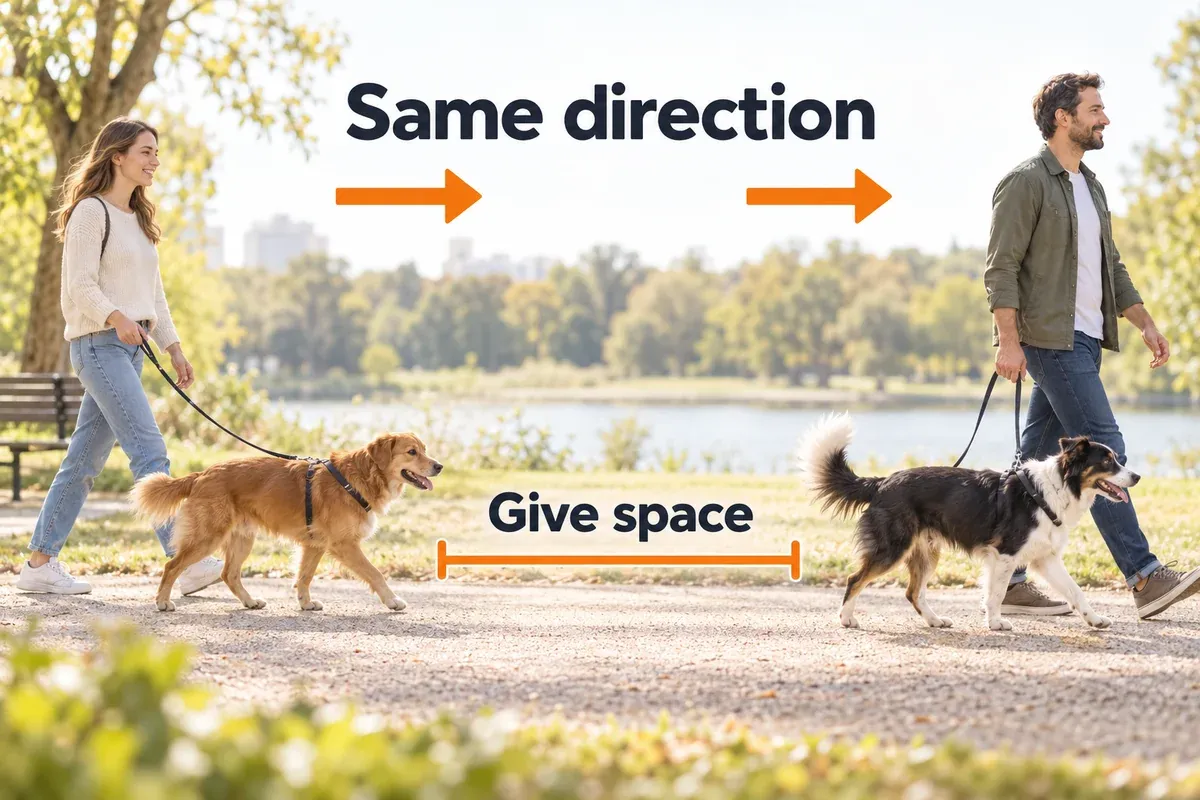
Begin far enough apart that each dog can walk, sniff the surroundings, take food if offered, and occasionally look toward the other dog without pulling or staring. Walk in the same direction with a handler beside each dog. Keep the leads loose enough for natural movement while maintaining control. Reward calm attention to the handler or a relaxed glance at the other dog. This is a chance for the dogs to be near one another without demanding contact.
When both stay loose and able to disengage, gradually narrow the gap. Do not reduce the distance at set intervals. If either dog stiffens, stares, strains toward the other, tries to leave, or can no longer respond to the handler, increase the space again. A dog that cannot settle at a workable distance is telling you the meeting is too difficult today. Best Friends describes this distance-based parallel walk, and Humane World advises moving closer only while both dogs remain comfortable.
Allow a greeting only if both dogs are willing
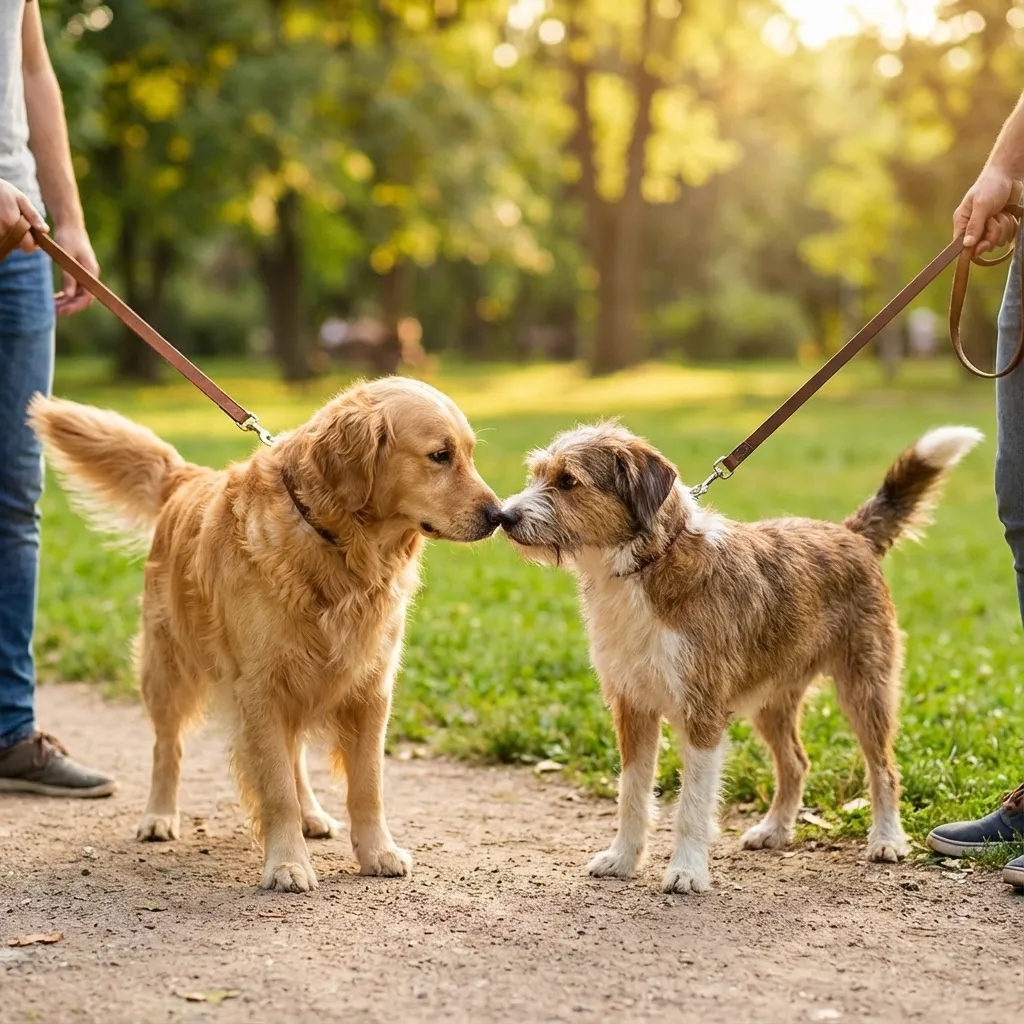
If the walk has remained relaxed and both dogs show gentle interest, let them come close enough to sniff while the handlers keep the leads from tightening or tangling. Let the greeting stay brief and then move on together. You can repeat this if both dogs still appear comfortable. If one turns away, moves off, freezes, or tries to hide, let that dog leave. There is no requirement to make them touch noses, play, or greet on the first outing. Dogs Trust advises short greetings followed by movement; Best Friends advises ending contact when either dog is uneasy.
If they are relaxed at a distance but not ready to greet, finish with a calm walk and keep them separate afterward. Arrange another controlled meeting when both have recovered. If there is barking with lunging, snapping, or an attempt to fight, end the introduction and seek qualified help before trying again. Waiting a particular number of days does not make the same setup safe.
Read both dogs, not just the wagging tails
Look at the whole body and what each dog does when the other approaches. A wagging tail alone does not prove friendliness, and a single yawn or lip lick needs context. Dogs Trust’s body-language guide explains how posture, facial tension, movement, and the ability to disengage work together.
| What you see | What to do |
|---|---|
| Loose movement, soft expression, brief looks followed by looking away, interest in sniffing the surroundings, and both dogs able to respond to their handlers | Continue at the current distance. Offer a brief greeting only if both dogs remain willing. |
| Turning away, lip licking away from food, a lowered body or tail, repeated avoidance, persistent staring, or a body that becomes stiff | Pause contact and create more space. Let both settle; resume only at an easier distance if they relax. |
| Freezing with a hard stare, growling that accompanies escalating tension, barking and lunging, snapping, or one dog pursuing the other as it tries to escape | End the interaction. Separate the dogs safely and get professional advice before another close meeting. |
Do not punish a growl. It communicates that a dog needs space. Move the dogs apart and change the setup. The American Veterinary Society of Animal Behavior (AVSAB) recommends reward-based training and rejects confrontational methods for behavior problems. Calling a tense encounter a “dominance challenge” does not identify the dog’s needs or make the next interaction safer.
Play also needs watching. Bouncy movement and play bows can be friendly invitations, but the other dog must be able to opt out. Interrupt while the dogs are still responsive, give them a chance to settle, and see whether both choose to re-engage. If one repeatedly flees, hides, or is pinned while the other keeps pursuing, separate them. Best Friends recommends breaks before play becomes overexcited.
Bringing the dogs home
First arrival and shared space
If the outdoor meeting went well, bring the dogs into a roomy, low-pressure area, such as a garden or a large room without food or toys. Avoid narrow entrances, the resident dog’s bed, and feeding spots. Keep one handler with each dog and watch their responses. Dogs Trust recommends this kind of open, supervised arrival.
The new dog still needs time to explore and rest alone. You can settle them in their separate area while the resident dog follows their normal routine. An outdoor greeting does not mean they must spend the evening together. If either dog appears uneasy indoors, end shared time and close the door between their spaces. If both remain relaxed, allow short supervised periods together and give them breaks before they become tired or overexcited. A gate is an option for supervised separation when both dogs are comfortable seeing each other through it; it is not a required feeding station or a step every pair must complete.
Meals, chews, toys, and attention
Feed in separate rooms with closed doors. Pick up bowls before opening the doors. Offer chews and food puzzles only in each dog’s own space. There is no need to move bowls closer together to prove progress, and there is no hierarchy to establish by feeding one dog first. The relevant question is whether each dog can eat and rest without the other approaching. Best Friends recommends separation for meals and valuable items; the ASPCA advises individual help for resource guarding.
Give each dog individual walks, attention, and quiet time. If one blocks the other from a person, bed, doorway, or resting area, separate them and assess the situation rather than setting up another encounter to see what happens. Keep shared toys out of the picture while you learn how the dogs respond to each other. Do not deliberately place a toy between them as a test for guarding.
Sleep and time without supervision
Use separate rooms, or another secure arrangement that prevents contact, when you sleep or leave home. Continue to separate them whenever you cannot watch and intervene early. Dogs Trust recommends separate rooms when interactions cannot be supervised, and Best Friends gives the same advice for time alone. A calm afternoon together is encouraging, but it cannot establish that they will share food, tight spaces, or an empty house safely.
Some households choose to keep separate spaces for meals and unsupervised time long term. That can be a practical way to maintain a peaceful home. If you are unsure whether the pair can be alone together, keep the separation in place and discuss the specific dogs with a qualified professional. Do not use an unsupervised trial as the test.
Decide when to continue, pause, or seek help
There is no universal day on which dogs are ready for a closer meeting, indoor play, or time alone. Use this check each time you change the setting:
- Continue at the current level when both dogs stay loose, can look away from each other, respond to their handlers, and choose to rest or move away without being followed. Repeat a comfortable setup before making it harder.
- Make the next attempt easier when one dog avoids, stiffens, fixates, or becomes too excited to settle. Add distance, shorten shared time, or return to separate rooms. Look at whether a doorway, food, fatigue, or crowding changed the interaction.
- Stop close introductions and get individual help after lunging, snapping, a fight, repeated guarding, or distress that continues even with more space. If a dog is injured, contact a veterinarian promptly. Dogs Trust’s guidance calls for separation after significant discomfort, veterinary care for injury, and accredited behavior help before another attempt.
The first outdoor walk and an indoor meeting are different tasks. A dog may relax in an open park and become tense near a sofa or food bowl. Treat that change as information about the setting, not a setback to push through. A professional can help identify triggers and build an individual plan when simple management is not enough.
Pairs that need extra planning
A puppy and an adult dog
Puppies may miss an adult dog’s signals or keep approaching when the adult wants rest. Give the adult a puppy-free area, interrupt persistent pestering, and arrange separate sleep and enrichment. Do not leave them together just because the adult has tolerated earlier play. Dogs Trust advises close supervision and breaks for puppies and adult dogs. Ask your veterinarian where your puppy can safely meet another dog while their vaccination course is underway; the answer depends on the puppy’s health and local infection risk.
A big size difference, limited mobility, or pain
Even playful contact can injure a much smaller dog or one with limited mobility. Choose space and activities that let both move away easily. Stop rough or one-sided play before one dog is cornered or knocked over. If an older or previously comfortable dog has become newly irritable, arrange a veterinary check instead of assuming they need more exposure to the new dog. The ASPCA notes that pain and sensory or age-related changes can affect aggressive behavior.
Leash reactivity, guarding, or prior fights
The ordinary parallel-walk-to-greeting sequence is not a do-it-yourself protocol for a dog that repeatedly lunges on leash or reacts at barriers. Nor is bringing the new dog indoors after a week a safe fallback. Keep dogs in separate secure areas while you arrange help from a qualified reward-based professional, and involve your veterinarian if fear, aggression, pain, or injury is part of the picture. Best Friends sets a clear limit for its standard introduction procedure; the ASPCA recommends individual treatment plans for guarding and aggression.
Breed, sex, and age can inform questions you ask about an individual dog, but they do not replace that dog’s behavior and history. A breed label cannot tell you whether two particular dogs will share a home comfortably; Best Friends emphasizes that dogs differ in their comfort around other dogs. Avoid rank-based rules such as feeding the “dominant” dog first. AVSAB cautions against treating dominance as a general explanation for behavior problems.
Frequently Asked Questions
Can two dogs meet face to face on the first day?
Yes, if both have remained relaxed on the outdoor walk and willingly approach on loose leads. Keep the greeting brief, move on, and continue observing them. If either dog is uncomfortable, leave the greeting for another time. There is no blanket first-day ban or requirement to make contact.
How long should an introduction take?
Plan for more than one session if needed, but use behavior rather than a calendar. Some dogs greet comfortably during the first walk; others need repeated distant walks and separate spaces at home. Progress is shown by relaxed movement, voluntary disengagement, and the ability to rest around each other. A set number of days does not guarantee friendship or safety.
Is it bad if the resident dog ignores the new dog?
No. Calmly looking away, sniffing elsewhere, or choosing to rest can be welcome signs that the dog does not feel obliged to interact. Make sure the other dog respects that choice. You are looking for comfortable coexistence, not constant play.
Should I feed the dogs on opposite sides of a gate?
No. Feed them in separate areas behind closed doors so neither has to eat while watching the other. Use a gate only for watched visual contact if both dogs remain relaxed there. Feeding closer and closer together is not a milestone in this guide.
What if one dog growls or snaps?
A growl asks for space. Calmly separate the dogs and consider what led to it, such as a close approach, food, or a blocked exit. Do not scold the warning or push them back together. Snapping, lunging, or repeated growling around ordinary household activities means the close introductions should stop until you have individual advice. Dogs Trust distinguishes early discomfort from more serious signs requiring separation and help.
What should I do if they fight?
Protect people first. Do not put your hands or face between fighting dogs or grab near their mouths. If you can use a solid object or barrier to separate them without entering the fight, do so, then secure them in different spaces. The American Kennel Club’s fight-safety guidance explains why grabbing at dogs can lead to serious bites. Have a veterinarian check either dog that was bitten; even a small wound can hide deeper damage, as the PDSA explains in its bite-wound guidance. Arrange qualified behavior help before another introduction. Do not simply restart at an earlier step without assessing what happened.
When can I leave the dogs alone together?
There is no reliable countdown or home test. Keep them separated whenever you cannot supervise while they are getting used to each other. If there has been guarding, fear, a fight, or a marked size or health difference, discuss the decision with a qualified professional. Separate rooms may remain the best arrangement for your household.
The aim is a home where both dogs can eat, rest, move away, and receive attention without tension. Friendship may develop, but peaceful coexistence is a worthwhile outcome in its own right.