
 Published sources
 Product details checked
To teach your dog basic commands, reward the behavior you want in a quiet place, add a consistent word or hand signal, and practice in small steps. Teach the movement first, then make it work without food held in front of your dog’s nose. Add waiting time, distance, and distractions separately. Keep a leash or secure barrier in place wherever a missed cue could put your dog at risk.
Start with attention and a few easy successes. Sit and down give you familiar positions; stay, come, leave it, and drop it address different everyday situations. Loose-leash walking and settling take practice throughout normal life. A dog who can sit in the kitchen still needs help learning what to do on a busy sidewalk.
On this page
- Set up a successful training session
- Teach nine everyday skills
- Move beyond the visible treat
- Follow a flexible practice plan
- Build skills around distractions
- Fix common training problems
- Choose useful training equipment
- Know when to ask for help
- Frequently asked questions
Before You Start
Choose a room with enough space to move, good footing, and no competing pets. Put rewards within reach before you begin. If your dog needs a bathroom break or is ready for sleep, meet that need first. Practice one small task while your dog is comfortable and interested.
Use rewards your dog enjoys. The American Veterinary Society of Animal Behavior’s humane training statement recommends reward-based methods for both everyday skills and behavior problems, and advises against methods that use pain, fear, or physical force. Shock collars, prong collars, leash jerks, and pushing a dog into position have no place in these exercises.
Choose rewards and account for the food
Small, easy-to-eat pieces let you reward several successful attempts without making the dog stop to chew a large biscuit. Some dogs will work for part of their normal food allowance; others need something more appealing when the task becomes difficult. Toys and access to a favorite activity can also be rewards. Watch whether your dog actually wants what you are offering.
Set aside the food you intend to use before the session. Keep track of treats, chews, and other extras across the whole day. WSAVA’s feeding guidance recommends keeping treats below 10% of daily calories and maintaining a complete, balanced diet. The percentage refers to calories, not the number of pieces or their weight. Ask your veterinarian about suitable rewards if your dog has dietary restrictions or needs a weight-management plan.
Teach a marker before asking for a command
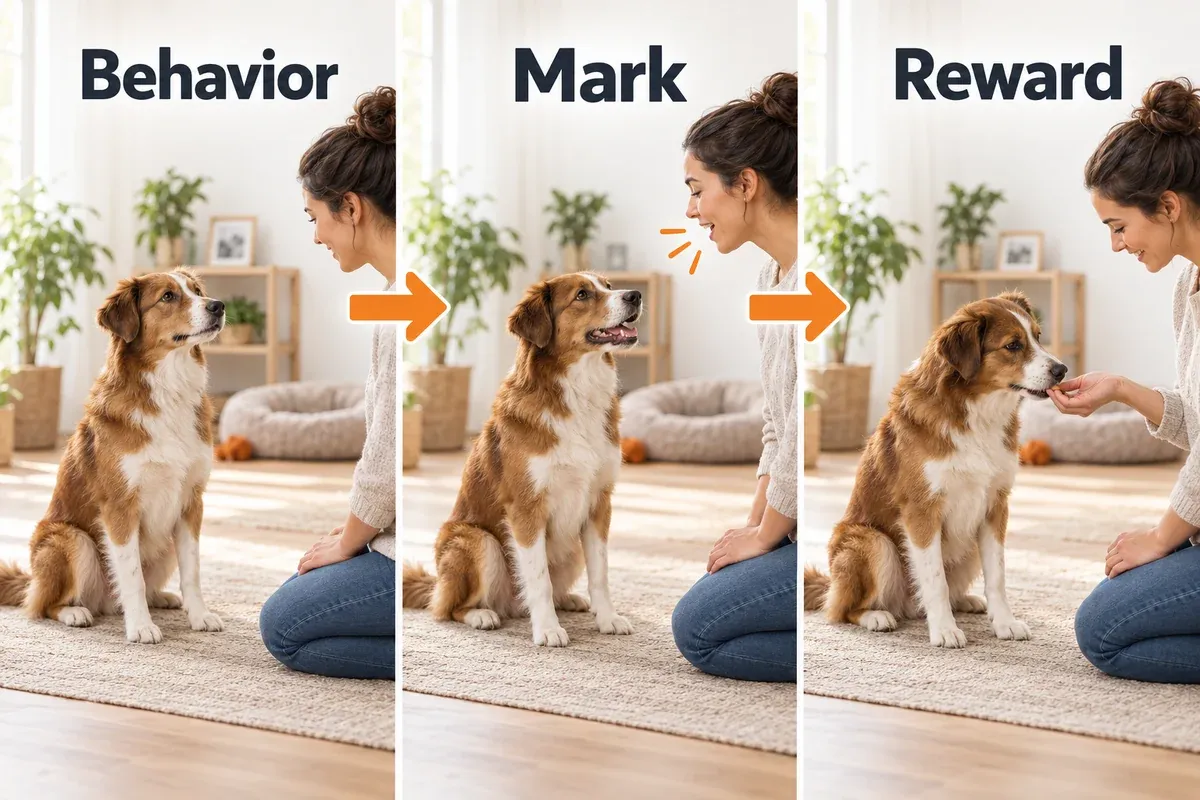
A marker is a brief signal, such as “yes” or a click, that identifies the moment your dog did something you want. The reward follows. This helps distinguish sitting from the standing up that may happen while you reach for food. The AKC’s guide to mark-and-reward training explains both spoken markers and clickers.
Begin by saying “yes” once, or clicking once, then immediately giving a small reward. Repeat in a calm setting until your dog begins to expect the reward after the signal. You do not need to ask for a sit at this stage.
During an exercise, mark the actual success, then deliver the reward. If you click accidentally, still follow it with a reward. Avoid repeatedly clicking to get attention: the marker tells the dog what earned the reward. A spoken marker is a useful choice if the click sound worries your dog or handling another object feels awkward.
Keep sessions brief and give each cue one meaning
For a beginner, try a few repetitions, pause, and decide whether your dog still wants to participate. VCA’s puppy training guidance recommends sessions of only a few minutes at first, repeated during the day. There is no need to fill a fixed time slot.
A cue is the word or gesture that asks for a behavior. Agree on words with everyone in the household. Use “down” for lying down, for example, and a different word for stepping off furniture. Pick a release word such as “free” to end a stay. Changing words or asking for different actions with the same word makes the task harder to understand.
Teach the Essential Skills
The table below helps you choose a starting point. You can work on more than one skill across the week, but keep each short exercise clear. Attention is a useful foundation; stay needs a comfortable position your dog already understands.
| Skill | What you want your dog to do | Begin with |
|---|---|---|
| Name and attention | Turn toward you when asked | A voluntary glance in a quiet room |
| Sit | Put their bottom on the floor | Following a small hand movement |
| Down | Lie down comfortably | Following a lure toward the floor |
| Stay and release | Hold a position until released | A very short pause beside you |
| Come | Return all the way to you | A few steps indoors |
| Leave it | Move away from something before taking it | A protected, low-value food item |
| Drop it | Release something already in their mouth | Trading an ordinary toy |
| Loose-leash walking | Walk without tightening the leash | A few steps in a quiet space |
| Settle | Rest comfortably near you | Quiet time on a familiar mat |
1. Name and attention
Your dog’s name can mean “look toward me.” Begin by rewarding voluntary check-ins, as in Dogs Trust’s name-training exercise.
- Stay quiet while your dog explores the room. When they glance at you, mark and reward.
- Repeat until checking in becomes familiar. Keep the food out of sight between rewards.
- Say their name once while they are nearby and only mildly occupied. Mark the turn toward you and reward.
- Let them look away, then try again. Later, practice in another quiet room or an enclosed yard.
At first, a brief glance is enough. Avoid demanding prolonged eye contact or holding your dog’s face toward you. If they do not turn, reduce the distraction and try at an easier moment. Repeating their name across the room while they are absorbed in play adds difficulty without teaching the response.
This is an attention exercise, not a full recall. “Come” will ask them to close the distance too.
2. Sit
Practice on a surface where your dog’s feet stay steady. The RSPCA’s sit exercise begins with a treat close to the nose and a small upward, backward movement.
- Start with your dog standing. Hold a small treat near their nose.
- Move your hand slowly upward and slightly back over the head. Keep it close enough to follow without jumping.
- Mark as their bottom reaches the floor, then give the treat.
- Once the movement is predictable, add “sit” as they move into position. After that association develops, say the word just before the familiar hand signal.
- Practice with an empty hand signal, then reward from your other hand. Gradually make the gesture smaller.
If your dog jumps, lower your hand. If they keep backing away, simplify the movement and check the footing. You can also reward a sit they offer naturally. Never press down on their hips.
A sit can help while you clip on a leash, but a dog who finds sitting uncomfortable can stand quietly instead. Sudden difficulty sitting belongs in the health checks below.
3. Down
Choose a comfortable surface and begin with a sit if that position suits your dog. The RSPCA’s down exercise uses a slow lure from the nose toward the chest and floor.
- Hold the treat near your dog’s nose.
- Lower it toward their chest, then the floor. Let them follow at their own pace.
- Mark when they lie down and reward while they are still there.
- Add “down” when the movement becomes predictable. Progress to the word followed by your hand signal.
- Use an empty hand for the gesture and reward separately. Add a little comfortable time in the position before releasing.
If your dog stands up to follow the treat, use a smaller movement. If the floor seems to be the problem, try a non-slip mat. Another option is to mark and reward a natural down when your dog chooses it.
Lying down on cue does not necessarily mean your dog feels relaxed. Keep settling as a separate goal, especially around visitors or unfamiliar places.
4. Stay and release
A stay has a beginning and an end. Choose a sit, down, or comfortable standing position, then teach your dog to wait for the release. The RSPCA’s stay guide builds waiting time before distance.
- Ask for the familiar position while you remain close.
- Give your stay cue and hand signal. Pause briefly, then reward in position before your dog moves.
- Say “free” and invite them to leave the position.
- Repeat, slowly extending the pause. Mix easy, brief waits into practice.
- Once that is comfortable, take a small step away, return, and reward in position. Release after returning.
If your dog gets up, calmly reset and shorten the next wait or reduce the step away. Avoid calling them to you for every reward: that changes the exercise from waiting to following.
Do not add a longer wait, more distance, and a moving distraction together. A stay should never be the only thing keeping a dog away from traffic, an open exit, or another hazard.
5. Come when called
Recall means returning within reach, not stopping several feet away. Start inside or in a securely enclosed space. The RSPCA’s recall guidance uses appealing rewards, short distances, and gradual outdoor practice.
- When your dog is near and ready to engage, say their name followed by “come” in a friendly voice.
- Move a couple of steps away. Reward when they reach you.
- Build distance gradually, then try calling between familiar rooms.
- Practice gentle collar or harness touches separately with rewards so securing your dog need not be a surprise at the end of a recall.
- Move outdoors with a leash connection or secure enclosure. Often release your dog back to a safe activity after rewarding.
Never punish a dog for returning, even after a delay. Avoid using recall only to end walks or start something they dislike. If your dog does not respond, move closer when safe and make the next attempt easier.
A long line gives you room to practice while maintaining a connection. Attach it to a fitted harness’s back attachment, manage the slack, and avoid letting your dog hit the end at speed. Battersea’s long-line instructions explain harness attachment and handling. Practice in open space away from roads and people who could become tangled in the line.
6. Leave it
“Leave it” asks your dog to disengage before taking something. Start with a harmless training item you can protect. Do not test the exercise with medication, toxic food, or anything your dog could swallow dangerously.
- Put a low-value treat in a closed hand and keep a separate reward ready.
- Wait quietly for your dog to move their nose away. Mark that choice and give the reward from your other hand.
- Repeat until backing off becomes familiar. Add “leave it” as the dog disengages, then begin saying it before the expected response.
- Progress to a treat on an open palm. Close your hand if they reach for it; reward looking away with the separate treat.
- Later, practice with a safe item on the floor that you can cover before your dog gets it.
The RSPCA’s leave exercise builds the skill from protected food to an open hand. If your dog persistently scratches or mouths your hand, pause and choose an easier setup rather than holding out through escalating frustration.
On a walk, create enough distance for the dog to turn away. The cue supplements supervision and leash management; it cannot make hazardous objects safe to approach.
7. Drop it
Use “drop it” when the item is already in your dog’s mouth. Begin with an ordinary toy they can release comfortably. Battersea’s drop-it exercise first builds a positive association between the word and food, then introduces trading.
- With no toy involved, say “drop” once and put a little food on the floor. Repeat in short sessions until the word predicts food.
- Let your dog briefly play with a low-value toy. Say “drop” and place food nearby so they can release the toy to eat.
- Leave the toy alone initially. Let the dog learn the exchange without competing with your hand.
- When the exchange is familiar, say “drop” and wait for the release before putting down the reward. If that fails, help with the easier exchange again.
- Build toward picking up the released toy and returning it for another round of play. Dogs who prefer play may enjoy trading between two similar toys instead.
Avoid chasing your dog or prying their mouth open during practice. If they freeze, growl, snap, or guard the object, stop and get individual help.
If your dog swallows a dangerous object or a possible poison, contact a veterinarian promptly. Repeating a training cue cannot address something already swallowed.
8. Loose-leash walking
The goal is a leash with slack while your dog walks with you. Begin in a quiet space where your dog can notice you. The RSPCA’s walking exercise rewards attention and movement on a loose leash.
- Stand still with the leash loose. Reward your dog for checking in or coming close.
- Take one or two steps. Mark and reward near your side while the leash remains loose.
- Add a few steps at a time. Turn gently or pause before your dog reaches the end of the leash.
- If the leash becomes tight, stop moving forward. Resume when your dog moves closer and the slack returns.
- Include access to sniffing as a reward when it is safe. Keep some parts of the walk for exploring rather than asking for constant attention.
If nearly every step ends in pulling, move to a quieter area and reward more frequently. Do not keep rehearsing the same difficult route while increasing leash pressure.
Lunging or barking at other dogs may need a separate plan. Our guide to persistent dog barking explains how to identify triggers, create distance, and choose a useful next step.
9. Settle on a mat
A dog holding a down while watching your treat hand may still be working hard. Settling means rewarding the quieter behavior you want during normal downtime. Dogs Trust’s settle exercise starts somewhere calm and rewards increasingly relaxed behavior.
- Put a familiar mat or blanket beside your chair. Sit quietly when your dog is ready for a rest.
- Reward calm choices, such as standing quietly or lying on the mat. Place small treats low so the dog can remain comfortable.
- Gradually reward signs of relaxation, such as shifting their weight or resting their head.
- Slowly increase the time between rewards. Avoid repeatedly talking to or prompting your dog if it keeps them alert.
- Later, add mild activity at a distance. If your dog repeatedly gets up or cannot relax, reduce the activity and return to easier practice.
Let your dog move away if needed. Do not use a mat to keep them close to something frightening.
For a visit from another dog, settling and recall can support management, but they do not establish compatibility. Follow our step-by-step guide to introducing two dogs for the first meeting and separate resting spaces.
Move Beyond the Visible Treat
There are two different jobs for food: guiding a movement and rewarding it afterward. A dog who responds only when you hold a treat may have learned the hand-and-food picture more clearly than the word. The next task is to transfer that response to a cue.
Use this sequence once the movement is familiar:
- Say the cue once, then give the familiar hand signal.
- Use the same gesture with an empty hand. Mark the success and reward from your other hand or pouch.
- Make the hand movement smaller over several successful sessions.
- Test the spoken cue in the same quiet setting, with your hands neutral. Pause briefly before helping with the hand signal.
- Repeat the process in another easy setting before expecting it in a busy one.
If removing the visible food stops the response, alternate easier attempts with empty-hand attempts. The AKC’s guide to fading a lure describes gradually reducing the prompt while continuing to reward.
Keep rewarding new skills consistently. Once a familiar skill is dependable, vary the rewards while continuing to make responding worthwhile. Reward difficult recalls generously. Removing the lure and removing every reward are separate decisions.
A Flexible Practice Plan
Use this as a suggested sequence for your first weeks, not a deadline. The readiness signs matter more than the day on the calendar. Repeat a stage whenever your dog needs more practice, and split it into smaller tasks if either of you becomes frustrated.
| Stage | Main practice | Signs you can try the next step |
|---|---|---|
| Build communication | Marker and voluntary check-ins | Your dog expects a reward after the marker and readily turns toward you |
| Teach easy movements | Sit and down in a quiet room | Your dog follows a comfortable hand signal without jumping or backing away |
| Transfer to cues | Spoken word, empty-hand signal, separate reward | The visible treat is no longer needed to start the movement |
| Add everyday control | Brief stays, short recalls, protected leave-it exercises, toy exchanges | Your dog succeeds at the easy version without repeated cues |
| Practice outside | Short loose-leash stretches and recalls with a leash connection | Your dog can engage in a quiet outdoor setting |
| Expand the setting | Mild distractions, new locations, quiet mat time | The task remains manageable when you change one condition |
For an ordinary day, you might practice a few check-ins before breakfast, a short sit or down exercise later, and some loose-leash steps during a walk. Capture quiet mat time when your dog is ready to rest. This is an example routine; choose fewer tasks when your dog needs a lighter day.
Keep a simple note: skill, location, help needed, and next step. “Sit in the living room, empty hand worked, try a smaller gesture” gives you more useful information than “good training day.” Record repeated difficulty too. It helps you spot whether the problem is a particular place, movement, or level of distraction.
Practice With Distractions
Three conditions change how hard a task feels: duration is how long your dog performs it, distance is how far you are away, and distraction is what else is happening. The AKC’s explanation of these training variables recommends working on them separately before combining them.
| Change | An easier first attempt | If the response breaks down |
|---|---|---|
| Duration | A brief stay with you beside the dog | Shorten the wait and reward in position sooner |
| Distance | One small step away, then return | Stay closer and reduce the movement |
| Distraction | Familiar cue with quiet activity well away | Increase space or reduce the activity |
| Location | Familiar cue in another quiet room | Restore the larger hand signal and reward readily |
A useful progression is a quiet room, another room, an enclosed yard, and then a quiet outdoor location with a leash. Reduce the other demands whenever you change location. Success at home gives you a starting point for teaching in the new place.
Avoid testing a recall by releasing an unprepared dog into a dog park. Keep physical management in place while practicing around distractions, and choose places where you can create enough space.
Apply the same approach to unfamiliar equipment
Basic commands do not establish comfort with a ramp, dryer, or moving machine. Let your dog investigate, reward voluntary participation, and keep an easy way to move away. For a ramp, begin with our guide to ramp refusal, which checks grip, wobble, slope, fear, and pain.
For treadmill work, Cornell recommends veterinary or rehabilitation assessment and a gradual, positive introduction. Use our dog treadmill size calculator and introduction guide to check the machine and plan practice with the belt stationary before considering movement. Knowing “stay” cannot compensate for unsuitable equipment.
When Training Isn’t Working
Check what happened before treating a missed cue as disobedience. An unfamiliar surface, a competing activity, an unclear gesture, or discomfort may have changed the task. Work through the first matching row, then try an easier repetition.
| What you notice | What to check | Your next step |
|---|---|---|
| Responds only when food is visible | Whether the treat is still part of the starting signal | Practice the same gesture with an empty hand and reward separately |
| Sits after you say the word several times | Whether the first cue is familiar and the setting is manageable | Say it once, pause, then help with the known hand signal; simplify the next attempt |
| Works at home but ignores you outside | Distractions, distance, and unfamiliar surroundings | Move somewhere quieter and return to the easiest version |
| Pops up during stay | Waiting time, distance, or reward placement | Remain closer, reward sooner while in position, and release clearly |
| Looks away, walks off, or refuses a normally welcome treat | Fatigue, worry, discomfort, or an unappealing reward | Pause; change the setting or meet the dog’s needs before resuming |
| Pulls toward every interesting smell | How many unrewarded steps you are asking for | Reward earlier and provide safe sniffing breaks |
| Runs away with toys | Whether approaching you predicts losing the toy | Rebuild easy trades; return safe toys during practice |
| Suddenly avoids sit, down, or touch | Stiffness, limping, appetite, and other changes | Stop that exercise and arrange a veterinary check |
If one change helps, keep it for a while. Resist adding all the difficulty back in the next session. If repeated attempts make either of you frustrated, finish with an easy familiar task if your dog is comfortable, or simply take a break.
Rewards also happen outside formal training. A dog may learn that pulling reaches the smell or that carrying a sock starts a chase. Prevent access to tempting objects and make the wanted behavior easy to reward. Consistent household responses matter as much as a neatly practiced command.
Useful Dog Training Equipment
Begin with suitable rewards, your existing walking equipment, and a comfortable mat. A clicker is optional. A pouch helps when retrieving food slows your timing; a long line helps when recall practice needs more room. Choose equipment for the task you are practicing.
These options cover different jobs. The selection uses their design and intended use; it is not a hands-on product test. The purchase links below go to Amazon.com.
-
PetSafe Clik-R Training Clicker
PetSafe
A handheld mechanical clicker with a finger band for reward-based training.
- Mechanical click provides a distinct training marker
- Finger band helps keep the clicker in your hand
- Includes clicker training instructions
- Best for
- Marking the moment your dog performs the behavior you want
- Design
- Handheld with finger band
-
PetSafe Treat Pouch Sport
PetSafe
A wearable treat pouch with a stay-open hinged pocket, an internal divider, and a detachable adjustable belt.
- Hinged pocket stays open during practice
- Divided pocket keeps two types of treats separate
- Belt clip, adjustable belt, and front storage pocket
- Best for
- Keeping regular and special rewards within easy reach
- Design
- Belt clip or detachable belt; hinged closure
-
PetSafe Cotton Training Lead, 20 ft
PetSafe
A fixed-length cotton webbing training leash measuring 20 feet long and 5/8 inch wide.
- 20 ft / 6.10 m fixed length
- 5/8 in / 15.9 mm webbing width
- For supervised distance and recall practice
- Best for
- Short outdoor recall exercises with a supervised leash connection
- Design
- 20 ft fixed length; cotton webbing
PetSafe Clik-R: for a distinct reward marker
The PetSafe Clik-R is a handheld mechanical clicker with a finger band. It is useful when you want to mark a brief action precisely, such as the moment your dog sits or looks toward you. Pair the click with a reward using the exercise above.
Choose it if the sound is comfortable for your dog and you can handle it easily alongside the other equipment. A clear spoken “yes” serves the same purpose without another tool.
Check current price on Amazon →PetSafe Treat Pouch Sport: for rewards within reach
The Treat Pouch Sport has a hinged pocket that stays open, a divider for separating rewards, and a belt clip with a detachable adjustable belt. You can keep everyday rewards and a more appealing option apart during a walk.
It is useful if searching in a pocket delays the reward. Empty food after practice, clean according to the care label, and let the pouch dry. It does not refrigerate perishable food. An existing washable pouch may already meet your needs.
Check current price on Amazon →PetSafe Cotton Training Lead: for supervised recall practice
The PetSafe Training Lead range includes a 20-foot cotton webbing leash, 5/8 inch wide. That is approximately 6.10 m long and 15.9 mm wide. The linked 20-foot model gives you room for short outdoor recalls while keeping a physical connection.
Choose it for open, uncluttered practice space. A shorter walking leash is more manageable near traffic or crowds. Attach a recall long line to a properly fitted harness’s back attachment, keep loose loops clear of legs, and manage the length before your dog accelerates. Inspect the webbing and clip before use. It is a supervised training leash, not a tether for leaving a dog unattended.
Check current price on Amazon →When to Get Professional Help
Pause an exercise that makes your dog freeze, cower, repeatedly move away, growl, or snap. Give them space and avoid reaching toward a guarded object. Fear, guarding, aggression, and panic when left alone need an individual assessment; adding more sit practice may leave the underlying problem untouched. The RSPCA’s behavior guidance recommends professional assessment for aggression and veterinary advice when behavior changes.
Contact your veterinarian if your dog suddenly struggles to sit or lie down, limps, becomes stiff, reacts differently to touch, or loses interest in food. Cornell’s guide to recognizing pain includes mobility, activity, and behavior changes. A video of ordinary movement at home may help your veterinarian assess what you are noticing.
For everyday training help, ask a trainer how they teach a new behavior, respond when a dog struggles, and manage frightened or overexcited dogs. Choose someone whose methods follow reward-based guidance and who will explain the plan clearly. Ask about relevant qualifications and experience with your particular issue.
Complex behavior problems may need veterinary behavior care. Cornell’s Behavior Medicine service describes assessment and treatment for fears, anxiety, aggression, and other emotional disorders. Your own veterinarian can help you find suitable local care.
Frequently Asked Questions
What should I teach my dog first?
Begin with attention and a reward marker, then choose a comfortable movement such as sit. Practice short recalls in a secure setting from the outset too. The most useful starting task is one your dog can succeed at and you can reward consistently. Teach a stable position before adding stay.
When can I start training a puppy?
Begin gentle, reward-based learning when your puppy comes home. Keep expectations small and sessions brief. VCA’s puppy guidance covers early learning and recommends discussing suitable classes and vaccination arrangements with your veterinarian. For planning the broader first-year expenses, use our puppy cost calculator.
Can an adult or rescue dog learn basic commands?
Yes. Begin with easy tasks and consistent rewards, allowing for the dog’s comfort, health, and previous experiences. The RSPCA’s behavior guide includes training for older and rehomed dogs. Do not assume that a recently adopted dog understands your words or can concentrate in every unfamiliar setting.
How long does basic dog training take?
There is no fixed completion date. Learning a movement in one room is different from responding around other dogs, unfamiliar people, or exciting smells. Judge progress by whether your dog can respond with less help under the conditions you have practiced. Expand those conditions gradually and keep maintaining the skills.
Do I need a clicker?
No. A distinct spoken marker such as “yes” can identify the successful moment. A clicker may help your timing, but the important sequence is the same: behavior, marker, reward. Choose the option that is clear for your dog and easy for you to use consistently.
Will my dog always need treats?
Keep making a correct response worthwhile. Remove food from the guiding hand as the skill develops, while continuing to reward afterward. For established skills, rewards can vary and may include play or a safe opportunity to sniff. New or difficult situations usually need more support. A dog responding without seeing food is a different goal from a dog never receiving a reward.
Why does my dog ignore commands outside?
The surroundings may be harder than the ones where you taught the skill. Move away from distractions, shorten the distance, and use a familiar hand signal if needed. If your dog cannot engage comfortably, the next step is an easier setting. Repeating the cue more loudly does not teach the missing practice.
Does a good recall mean my dog is ready to be off leash?
Indoor recall alone does not establish outdoor reliability. Use secure enclosures or an appropriate leash connection while practicing, follow local leash rules, and consider the risks at that location. Traffic, wildlife, and unfamiliar dogs can change the consequences of a missed response. Keep physical management wherever you cannot safely accommodate a mistake.
Sources and Further Reading
- AVSAB: Humane Dog Training Position Statement
- VCA: Puppy Behavior and Training Basics
- RSPCA: Dog Training and Understanding Dog Behavior
- AKC: Mark-and-Reward Training and Fading a Lure
- Dogs Trust: Name Training and Settle Training
- Battersea: Drop It and Long-Line Handling
- WSAVA: Feeding Treats to Your Dog
- Cornell: Recognizing Pain in Dogs