

 Published sources
 Product details checked
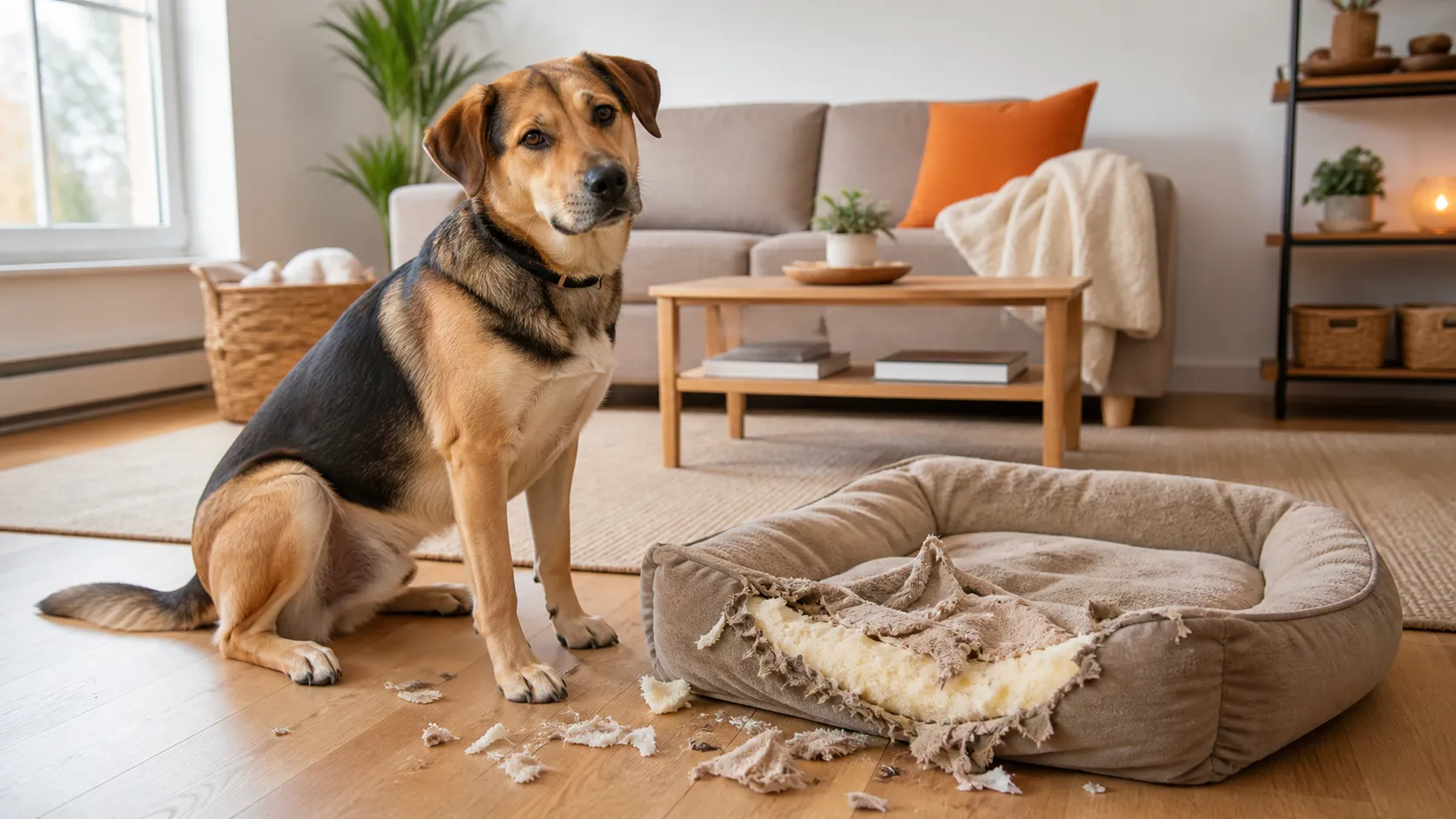
You come home to another pile of foam, fabric, and stuffing. If your dog destroys his bed but leaves the sofa alone—or only attacks the bed when you leave—the damage can feel personal. It is not revenge. The bed is simply an easy, rewarding target: it smells familiar, feels satisfying to tear, and is often available when your dog is bored, over-aroused, anxious, or trying to settle.
Quick answer: Dogs destroy beds because of normal chewing, teething, boredom, frustration, nesting, attention-seeking, or anxiety. The most useful clue is when it happens. Destruction that starts soon after you leave points toward separation-related distress; destruction during play or quiet time is more often a chewing or enrichment problem. Remove the damaged bed, prevent access while you investigate, and teach a calm replacement behavior instead of punishing the mess afterward.
This guide combines veterinary behavior guidance with published product information for durable bed and enrichment options. Product notes separate manufacturer information from practical fit considerations; they are not hands-on test results.
In this guide, you will learn:
- How to read the pattern behind your dog’s bed destruction
- The difference between ordinary chewing, boredom, and separation anxiety
- A humane seven-day plan to stop rehearsing the behavior
- When a raised or crate-specific bed makes sense
- How to use a durable food toy as part of a broader behavior plan
- Which signs mean you should call your veterinarian or a qualified behavior professional
The Pattern Matters More Than the Damage
The same shredded bed can have very different causes. Watch the context instead of guessing from the mess:
| What you observe | More likely explanation | First move |
|---|---|---|
| Your dog chews the bed while you are home, especially during quiet periods | Normal chewing, boredom, or an easy self-rewarding habit | Add supervised chew outlets and reward calm behavior away from the bed |
| Destruction starts shortly after you leave or close a door | Separation-related or confinement distress | Record a short video and contact your veterinarian if distress is clear |
| Your puppy targets fabric, cushions, and anything soft | Teething and exploration | Remove tempting fabric, offer size-appropriate chews, and supervise closely |
| Your dog digs, circles, and pulls at bedding before lying down | Nesting, temperature, texture, or a learned settling ritual | Try a simpler surface and reinforce lying calmly |
| Your dog tears fabric, swallows pieces, or cannot disengage | Ingestion risk or a repetitive/compulsive behavior | Remove the item and arrange veterinary guidance |
| An adult dog starts suddenly, alongside other behavior changes | A medical, pain, stress, or environmental change may be involved | Schedule a veterinary check rather than treating it as disobedience |
Chewing is a normal canine behavior. The ASPCA explains that dogs chew for exploration, teething, stimulation, and relief from boredom or mild anxiety. The problem is not that your dog needs to chew; it is that the bed has become the best available outlet.
Why Does My Dog Destroy His Bed?
1. The bed is a satisfying chew target
Soft beds offer resistance without hurting a dog’s mouth. Seams, corners, zippers, bolsters, and loose stuffing also give a dog something to grab and pull. Once a dog discovers that one bite opens a seam, the next few minutes become a very effective reward.
This is why a bed that feels comfortable to you may be a poor first bed for a determined chewer. Plush fabric and raised edges are not automatically bad, but they should be introduced when you can watch your dog use them calmly.
2. Puppies and young dogs are exploring with their mouths
Puppies investigate the world by biting, carrying, shaking, and chewing. Teething can make soft or textured objects especially attractive. The intense teething phase often eases as adult teeth come in, but the habit can continue if shredding has become the easiest way to get play, attention, or relief.
Do not wait for your puppy to “grow out of it” while giving him unrestricted access to expensive beds. Management and gentle redirection teach the skill you want: chew this item, not that one.
3. Boredom and insufficient enrichment
A bed is often available for hours, especially during a long nap period or while the household is away. If your dog has no satisfying way to sniff, chew, forage, or solve a small problem, shredding can become a hobby.
More exercise is not always the whole answer. A dog can be physically tired and still need calm mental work. Rotate food puzzles, short training sessions, sniff walks, and supervised chew time so the replacement activity is genuinely more rewarding than pulling apart foam.
4. Frustration or confinement
Some dogs destroy bedding when they are frustrated by a closed crate, a gate, a car, or being separated from an exciting activity. Chewing the bed may be an attempt to escape, release arousal, or occupy themselves while they wait.
If the bed is inside a crate and your dog is also biting bars, panting, vocalizing, drooling, or trying to get out, do not simply buy a tougher pad and leave the dog longer. First find out whether the crate or confinement area is creating distress. The Merck Veterinary Manual describes destructive chewing as normal exploratory behavior that can become serious when it is driven by fear, anxiety, or lack of desirable outlets.
5. Separation-related anxiety
Bed destruction that happens only when your dog is alone deserves a closer look. Separation anxiety often appears with other signs: whining or howling, pacing, drooling, repeated attempts to escape, toileting, or destruction focused around doors and windows. A dog may begin within minutes of departure, even if he looks relaxed while you are getting ready.
Use a camera or phone to record what happens after you leave. The goal is not to catch your dog in the act; it is to see whether he settles, searches for food, sleeps, or escalates into panic. The ASPCA’s separation-anxiety guidance is a useful starting point, but a dog who is injuring himself or attempting dangerous escapes needs professional help.
6. Fabric sucking or a repetitive behavior
Some dogs suck, lick, or chew blankets and beds for long periods. If the behavior is difficult to interrupt, spreads to many fabrics, or includes swallowing threads and stuffing, it is more than a simple preference for a soft bed. The ASPCA flags persistent fabric sucking as a reason to seek specialized behavior help.
Do not diagnose a compulsive disorder from one destroyed bed. Do take repeated, hard-to-interrupt fabric eating seriously.
Safety First: Remove a Bed Once It Is Damaged
A bed with exposed foam, torn fabric, loose strings, or broken zipper parts should not remain available as a “test.” It can become a choking or intestinal foreign-body hazard, and a dog that has already learned to pull pieces out may finish the job quickly.
If you know your dog swallowed foam, fabric, thread, or a toy fragment, call your veterinarian for advice rather than waiting for symptoms. Vomiting, repeated gagging or regurgitation, loss of appetite, abdominal pain, diarrhea, straining to pass stool, or lethargy are warning signs described in Merck’s veterinary guidance on gastrointestinal obstruction and VCA’s guide to foreign-body ingestion.
Until you understand the pattern, use a clean, safe resting surface that your dog cannot shred, and supervise any new bed or chew. A bare crate tray is not automatically comfortable, and a crate is not an appropriate solution for a dog who panics when confined. Choose the least restrictive safe setup that prevents access to dangerous materials.
A Seven-Day Plan to Stop Rehearsing the Behavior
The aim is not to win a battle over a bed. It is to make the desired behavior easier and more rewarding than shredding.
Day 1: Remove the damaged target and start a diary
Take the damaged bed away. Note the time, location, what happened immediately beforehand, whether anyone was home, and what your dog did with his body and voice. Include sleep, meals, walks, training, visitors, storms, and changes in routine.
If the behavior occurs when you leave, record the first 20–30 minutes with a camera if possible. If it happens while you are present, record a short session from a distance so your response does not become part of the pattern.
Days 2–3: Improve the alternatives
Offer two or three legal chewing options with different textures. Add a food-stuffed toy, a short sniffing activity, and a five-minute reward-based training session. Rotate options rather than leaving every toy on the floor all day.
The KONG Extreme Dog Toy can be useful for dogs who enjoy working food out of a rubber toy. It is a tool for redirection and enrichment, not proof that the dog can safely be left with any object. Start with supervision, choose the correct size, and inspect it every time.
Check current price on Amazon →Days 3–4: Teach “trade” and calm settling
When your dog picks up an approved toy, quietly praise him and occasionally exchange it for a treat. Do not chase him or grab the item unless safety requires it. Chasing can turn the object into a game and make him more likely to run away with it.
Place a mat or safe resting surface near you. Reward looking at it, stepping onto it, lying down, and staying relaxed. Keep the first sessions short. You are building a predictable alternative to digging at fabric, not testing endurance.
Reward-based training is recommended by the American Veterinary Society of Animal Behavior. Avoid shouting, physical corrections, or “alpha” techniques; these may add fear or arousal without teaching what your dog should do instead.
Days 5–6: Reintroduce a bed only when you can supervise
If the diary suggests ordinary chewing or nesting rather than panic, introduce a bed for two to five quiet minutes after exercise and enrichment. Sit nearby. Reward calm contact, then remove the bed before your dog becomes restless or starts digging.
Repeat several short successful sessions before increasing access. If your dog grabs a seam, calmly interrupt with a trade and end the session. Do not leave the bed in the room while you are away until your dog has shown a long, consistent history of resting without chewing it.
Day 7 and beyond: Increase freedom gradually
Add time in small steps: five minutes, ten minutes, then a short period while you move around the room. If the behavior returns, reduce the difficulty. A new bed is not a behavior treatment; it is a management aid while your dog learns a different routine.
If the video shows panic, do not use repeated absences as a “test.” Separation-related treatment usually requires gradual alone-time training below the dog’s fear threshold, and some dogs need a veterinarian or veterinary behaviorist to help with the plan.

When a More Durable Bed Is Worth Considering
A chew-resistant bed can prevent the bed itself from becoming a source of foam and fabric, but it cannot fix boredom, anxiety, or a dog who is determined to swallow pieces. Look for designs with fewer exposed seams, no loose stuffing, replaceable parts, and a size that lets your dog lie fully on the surface.
The three product options below serve different jobs.
Product options for bed destroyers
-
Kuranda Chewproof Elevated Dog Bed (44" x 27")
Kuranda
Raised aluminum bed with a taut heavy-duty vinyl surface, replaceable parts, and a one-year chew-proof warranty. The frame keeps the fabric edge out of reach and the open design is easy to wipe or hose clean.
- Aircraft-grade aluminum frame
- Heavy-duty vinyl sleeping surface
- Supports dogs up to 250 lbs
- Best for
- Persistent chewers who need a full-size everyday bed
-
K9 Ballistics Chew Proof Armored Crate Bed (35" x 22")
K9 Ballistics
Preassembled crate bed with an aluminum frame and 1200D ripstop ballistic fabric. The padded center gives more comfort than a bare crate tray while the framed edges limit access to chewable seams.
- 100% aluminum frame
- 1200D ripstop ballistic fabric
- Padded center for crate comfort
- Best for
- Dogs that destroy crate pads or need a contained sleeping surface
-
KONG Extreme Dog Toy (XX-Large)
KONG
Stuffable black natural-rubber toy that gives a dog a legal chewing and problem-solving outlet. It supports the behavior plan; it does not make an unsupervised dog safe around a damaged bed by itself.
- KONG's most durable natural-rubber formula
- Hollow center can be filled and frozen
- Erratic bounce adds play value
- Best for
- Redirecting food-motivated chewing and adding calm enrichment
Review the linked product page before purchasing.
Kuranda Chewproof Elevated Dog Bed — best fit for persistent full-bed chewers
The Kuranda is the most defensible option when your dog destroys ordinary floor beds and needs a full-size everyday surface. The 44 x 27 x 8 inch aluminum model has a taut heavy-duty vinyl surface, replaceable parts, and a one-year chew-proof warranty. Its frame hides the fabric edge instead of leaving a soft lip for a dog to grab.
The trade-off is comfort style. This is an elevated cot, not a thick memory-foam mattress. It improves airflow and is easy to wipe clean, but a senior or thin-coated dog may need a carefully supervised pad or blanket once he has shown he can leave it alone. Measure your dog lying down and compare that measurement with the usable surface before ordering.
Check current price on Amazon →K9 Ballistics Chew Proof Armored Crate Bed — best for destroyed crate pads
The K9 Ballistics option is a better match when the problem happens inside a 36-inch wire crate. Product documentation describes a preassembled 35 x 22 inch pad with an aluminum frame and 1200D ripstop ballistic fabric. The padded center is more comfortable than a bare plastic or metal tray, while the framed edges reduce access to loose seams.
This is not a giant-breed floor bed. Confirm the crate’s interior dimensions and the dog’s sleeping position before ordering. If your dog is panicking in the crate, a stronger pad only protects the pad; it does not make the confinement experience safe or comfortable.
Check current price on Amazon →KONG Extreme — best as a chew-and-enrichment outlet
The KONG Extreme is not a bed replacement. It belongs in the plan because a dog who needs to chew needs an appropriate place to do it. The XX-Large product information is a stuffable black natural-rubber toy designed for power chewers, with a hollow center that can be filled and frozen to extend the activity.
Durable does not mean indestructible. Inspect the toy before every use and remove it if it develops cracks, missing chunks, or a size your dog could swallow. The ASPCA recommends choosing chews for the individual dog’s size and chewing style, observing the dog, and contacting a veterinarian if a chunk is consumed; read its dog-chew safety position statement before making it part of your routine.
Check current price on Amazon →How to Choose a Bed That Is Less Appealing to Destroy
Start with the dog’s sleeping position
Measure from nose to the base of the tail while your dog is lying in his usual stretched-out position. Add room for turning and changing position. Weight limits matter, but a bed can be strong enough for a 100-pound dog and still be too short for the way he sleeps.
Reduce access to tempting edges
For persistent chewers, prioritize taut surfaces, enclosed fabric edges, metal or aluminum frames, and replaceable covers. Be skeptical of “indestructible” labels on plush beds. A cover can be durable and still expose a zipper, seam, corner, or stuffing pocket that your dog finds in minutes.
Match comfort to age and mobility
Raised beds can stay cool and dry, but they do not offer the same pressure distribution as a thick orthopedic bed. If your dog is older, stiff, recovering from an injury, or reluctant to lie down, ask your veterinarian about comfort and mobility before changing the bed style. Our guide to orthopedic dog beds for large and senior dogs covers memory foam, cooling gel, and supportive designs; the same supervised reintroduction rules still apply to any soft bed.
Consider cleaning and replacement parts
The practical winner is often the bed you can clean quickly and repair instead of throwing away. Water-resistant surfaces, machine-washable covers, and replacement fabric can matter more than a decorative bolster. Keep a simple backup resting surface available while covers are drying, but do not leave a loose blanket with a dog who eats fabric.
What Not to Do
- Do not punish the mess after the fact. Your dog cannot connect an earlier chewing episode with your anger when you return. Punishment can also make departures and your return more stressful.
- Do not give old shoes, pillows, or cushions as “approved” chew items. Dogs learn object categories poorly; the rule should be clear and consistent.
- Do not rely on a bitter spray as the treatment. A deterrent may change the taste of one object, but it does not supply exercise, enrichment, relaxation skills, or anxiety treatment.
- Do not leave a damaged bed in place to see whether your dog improves. Every successful shredding session strengthens the habit and increases the ingestion risk.
- Do not force a panicked dog into a crate. Use a safer room or pen while you seek guidance, and work on gradual comfort with confinement rather than escalating the equipment.
For a broader foundation, pair this plan with positive-reinforcement basics for dog training and avoid confusing your dog with mixed signals.
When Should I Call a Veterinarian or Behavior Professional?
Make the appointment sooner rather than later if:
- Your dog swallowed foam, fabric, thread, zipper parts, or toy pieces
- The behavior began suddenly in an adult dog or comes with pain, appetite, sleep, or mobility changes
- Destruction happens only when alone and includes panic, escape attempts, vocalizing, or self-injury
- Your dog repeatedly sucks or eats fabric and cannot be redirected
- You cannot safely confine or supervise your dog without repeated destruction
A veterinarian can check for medical contributors and help decide whether a veterinary behaviorist or qualified reward-based trainer should be involved. A heavy-duty dog crate may be useful for safe management in the right case, but equipment should support a behavior plan—not replace one.
Frequently Asked Questions
Why does my dog destroy his bed but not his toys?
The bed may have a more rewarding texture, stronger household scent, or easier-to-grab seams. It may also be available for longer than toys. Start by observing when the bed is targeted, then make approved chew options more interesting and keep the bed supervised until the habit changes.
Is destroying a bed always separation anxiety?
No. Puppies, bored dogs, normal chewers, nesters, and frustrated dogs can all destroy bedding. Separation anxiety becomes more likely when destruction occurs only during absences and is paired with panic signs such as persistent vocalizing, pacing, drooling, toileting, or escape attempts.
Will a chew-proof dog bed solve the problem?
It can reduce access to loose fabric and foam, but it will not treat anxiety or boredom. Choose a durable bed for management while you change the underlying routine. If your dog is swallowing material, no bed should be treated as safe without supervision and veterinary advice.
Should I take the bed away permanently?
Take away a damaged bed immediately. A permanent replacement is not always necessary. Many dogs can learn to use a soft bed safely after a period of management and supervised reintroduction; dogs with persistent fabric-eating or severe anxiety may need a different long-term setup.
How can I stop my puppy from shredding his bed?
Prevent unsupervised access, offer several safe chew options, use short reward-based training sessions, and reintroduce the bed only when you can watch. Teething-related chewing is common, but swallowing fabric or showing pain, vomiting, or loss of appetite is not a training problem—contact your veterinarian.
Can I use a crate to stop bed destruction?
A crate can help with management when your dog is already comfortable in it and has enough room to stand, turn, and rest. It should not be used to contain a dog who panics when confined. Record what happens when you leave and get behavior guidance if the dog tries to escape or injures himself.
Bottom Line
Your dog is not destroying his bed to punish you. He is using a behavior that currently pays: chewing feels good, relieves tension, provides stimulation, or gets a reaction. Find the trigger, remove unsafe bedding, build a better chew and enrichment routine, and reintroduce a bed in short, supervised sessions.
For persistent full-bed chewers, the Kuranda Chewproof Elevated Dog Bed is the strongest fit of the products reviewed here. For a crate pad, the K9 Ballistics Armored Crate Bed is more targeted. The KONG Extreme can make the replacement behavior worthwhile, but it still needs correct sizing, inspection, and supervision.